Disclosure: Some links in this post are affiliate links. As an Amazon Associate I earn from qualifying purchases, at no extra cost to you. Learn more
Specs are compiled from manufacturer listings and verified buyer reviews and can change over time — please confirm the key details on the product page before buying.
A probiotic’s CFU count on the label says nothing about how many live cultures survive stomach acid to reach your intestines. For Lactobacillus rhamnosus GG, the capsule’s acid protection matters more than the CFU number printed on the front. Every pick below uses a studied strain and a protective capsule, so the real decision depends on CFU strength (colony-forming units, the count of live cultures per dose) and how many pills you are willing to swallow each day.
This guide is built by comparing the manufacturers’ published specifications and the patterns across verified customer reviews, so you get each pick’s real strengths and trade-offs instead of marketing spin.
Some picks here are built for sheer culture count, others for gentle daily maintenance, and one for families who want a single shelf-stable bottle to share. Below you will find the strongest options, ranked by what actually matters in a daily lactobacillus rhamnosus gg probiotic.
Top Picks
How To Choose The Best Lactobacillus Rhamnosus Gg Probiotic
A probiotic label gives you a CFU number and a strain name. It rarely tells you whether those cultures survive stomach acid to reach your small intestine. That gap is where most probiotic buying mistakes happen.
Start with the strain, not the marketing
Lactobacillus rhamnosus GG — often shortened to LGG — is among the most studied probiotic strains in the world, and it appears by name on several bottles here. Others use a different strain, R-11, which is closely related. Either way, check that the exact strain is printed on the label, because a generic “probiotic blend” tells you nothing about what you are swallowing.
Match CFU to your goal
CFU stands for colony-forming units, the count of live bacteria per serving. A gentle daily maintenance bottle often sits in the single-digit billions, while a high-strength option can run to 100 billion CFU. A higher CFU count is not automatically better for every user. If you are new to probiotics, a moderate count is easier to start with; if you want maximum potency in one serving, go high.
Look hard at the capsule
Decide how many pills a day you will actually take
Some bottles ask for two capsules daily; others need just one. A one-capsule routine is easier to keep up with over months, especially if you travel or already take other supplements. Count the serving size before you commit.
Side-by-Side Comparison
| Model | Best For | CFU Per Serving | Capsule Count | Prebiotic | Amazon |
|---|---|---|---|---|---|
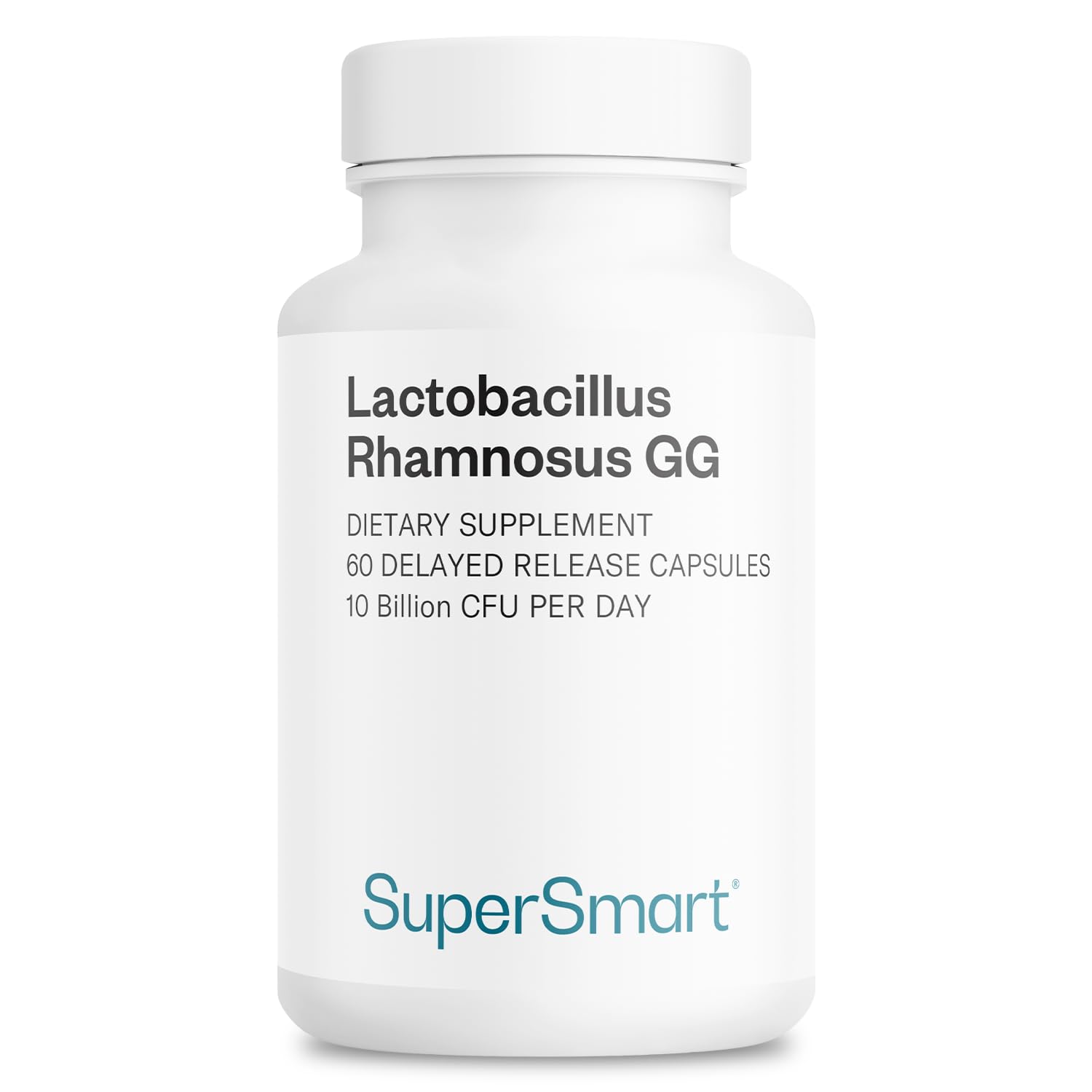
| Supersmart LGG 10 Billion CFU★ Best Overall | Daily gut maintenance | 10 Billion CFU | 60 DR Capsules | Inulin 250 mg | Amazon |
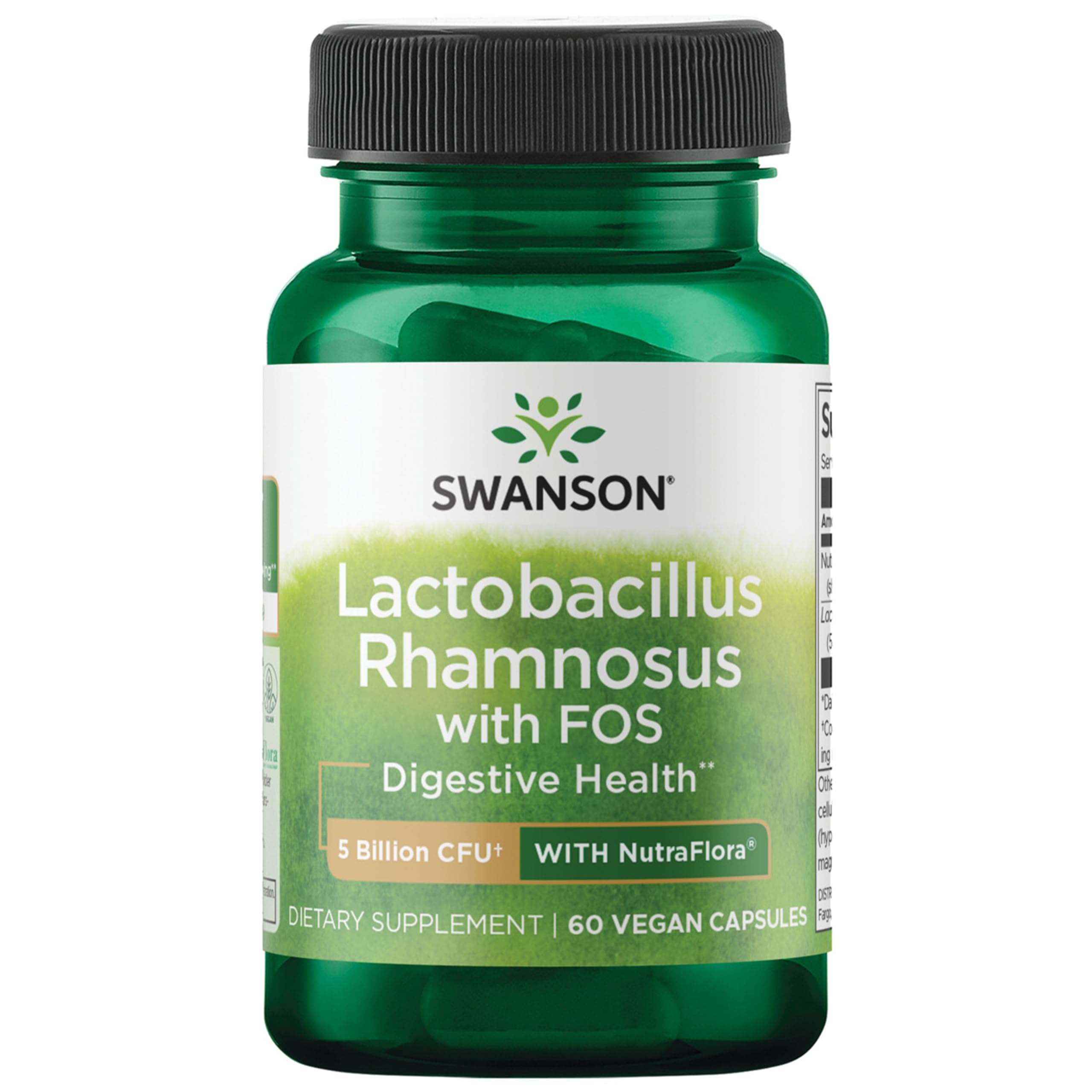
| Swanson Lactobacillus Rhamnosus with FOSBest Value | Budget starter bottle | 5 Billion CFU | 60 Veggie Capsules | FOS 100 mg | Amazon |
| GeriCare Extra Strength 20 Billion CFU | One-pill daily routine | 20 Billion CFU | 30 Capsules | — | Amazon |
| Toniiq 100B CFU with Prebiotic FOS | Maximum strength | 100 Billion CFU | — | FOS 100 mg | Amazon |
| LABO Nutrition FloraGG 25 Billion CFU | Family and travel use | 25 Billion CFU | 60 Capsules | Sunfiber 210 mg | Amazon |
Detailed Reviews
1. Supersmart Lactobacillus Rhamnosus GG
Our pick — 4.5+★ from 1,000+ verified ratings; the strongest balance of quality and price.
The LGG bottle that pairs a studied strain with a protective capsule and prebiotic fiber in one tidy daily dose.
What earns this bottle the top spot is the combination: 10 billion CFU of Lactobacillus rhamnosus GG in a delayed-release capsule, plus 250 mg of inulin (a prebiotic chicory root fiber that feeds the cultures once they land). The capsule is gastro-resistant, meaning it is built to hold together through stomach acid rather than dump its contents early.
The serving size is two capsules a day, so a 60-count bottle covers you for a month. Each serving carries 100 mg of the LifeinU LGG strain alongside that inulin. It is non-GMO, gluten free, and vegetarian, which keeps the label clean if those matter to you.
The honest trade-off is the two-capsule serving — if you already take a stack of daily pills, one more pair can feel like a chore. It also costs more than entry-level bottles. Neither is a dealbreaker, but if a single daily capsule is what keeps you consistent, a one-pill option further down may fit your routine better.
What works in its favor
- Gastro-resistant delayed-release capsule shields the cultures from stomach acid
- Inulin prebiotic at 250 mg feeds the LGG strain after it arrives
- Two-capsule serving gives a full month per bottle
What to weigh first
- Requires two capsules daily, not one
- Higher up-front cost than entry-level probiotic bottles
Made for: anyone who wants a well-rounded LGG plus inulin formula and does not mind a two-capsule morning.
Think twice if: a single daily pill is the only routine you will keep up with.
2. Swanson Lactobacillus Rhamnosus 60 Veggie Capsules
A low-dose, travel-friendly starter capsule that leans on a smaller culture count rather than brute strength.
Swanson keeps the serving modest at 5 billion CFU of Lactobacillus rhamnosus, packed into acid-resistant vegan capsules that are designed to carry the cultures toward the GI tract. There is 100 mg of NutraFlora short-chain fructooligosaccharides — a prebiotic fiber blended in to help the probiotics thrive. For comparison, the Toniiq bottle holds 100 billion CFU against this 5 billion, so pick your strength deliberately.
Where this bottle earns its place is the label focus: gut flora balance and replenishing microbial allies while traveling. The capsule is vegan-friendly and the strain count is gentle, which suits someone easing into probiotics rather than going straight to a megadose.
The caveat is that customer experiences with effectiveness genuinely split — plenty report it works great, others notice no change at all. That is normal for any single probiotic strain, but it means this is a fair bottle to trial rather than a guaranteed match. At this low CFU level, it is also a maintenance option, not a high-potency one.
Why buyers reach for it: acid-resistant vegan capsules, a prebiotic FOS blend, and a strain count low enough to start with.
Fit check: if you want the biggest culture count on the shelf, this is not the bottle for you — Toniiq sits far higher on that metric.
Reach for this if: you want an inexpensive vegan capsule to trial or to keep in a travel bag.
Look elsewhere if: you need a high-CFU formula or a strain directed at a specific digestive goal.
3. GeriCare Probiotic R-11

A single-capsule, 20 billion CFU option for anyone who wants gut support without swallowing a handful.
GeriCare packs 20 billion live active cultures of Lactobacillus rhamnosus R-11 into one capsule a day. That strain choice is worth knowing: it is closely related to the LGG strain used in this category’s best-known bottles, and the label notes L. rhamnosus is among the most studied probiotic strains. The bottle holds 30 capsules.
The one-capsule format is the real draw. Buyers report the capsules are medium-sized and easy to swallow, and the 30-count supply lines up neatly with a month of daily use. The R-11 strain also multiplies quickly — the review pages include someone coaxing it into homemade yogurt in 16 hours at 107°F using 2 capsules plus 3 tbsp inulin and 6 cups organic whole milk, with no leftover whey.
The trade-off is the strain label itself. If you specifically want the GG strain by name — the one the top pick uses — this bottle gives you R-11 rather than GG. It is also a smaller bottle at 30 capsules, so if you want a longer supply in one purchase, look to a 60-count option instead.
Simple-routine winner: one capsule daily at 20 billion CFU with no prebiotic to measure out separately.
Strain note: R-11, not GG — a closely related strain, but not the exact one named on the best-overall bottle.
Best suited to: daily users who want maximum CFU in a single capsule and a shorter, easy-to-finish bottle.
Not the one if: you are set on the Lactobacillus rhamnosus GG strain by name.
4. Toniiq Lactobacillus Rhamnosus 100B CFU

The megadose of the group — 100 billion CFU in one single-strain capsule, built for maximum potency.
If you want the biggest culture count here, this is it. Toniiq formulates 100 billion CFU of Lactobacillus rhamnosus per serving — twenty times the 5 billion CFU in the Swanson bottle. It pairs that with 100 mg of FOS prebiotic fiber and uses vegetable delayed-release capsules that shield the cultures from stomach acid.
The strain is kept pure and single, with no blends or fillers, and the brand states it is manufactured in a cGMP facility and third-party tested for potency, purity, and contaminants. The capsules are on the larger side but swallowable. Note that it does not run on a two-pill routine like the Supersmart bottle — this is one focused strain, at high strength, in a single capsule.
The honest catch is refrigeration. After opening, this bottle needs to go into the fridge, which is easy to forget if your routine happens in the kitchen. There is also a size consideration: the larger capsules are fine for most, but if you struggle with big pills, the GeriCare format is friendlier. Most owners mention no digestive upset from the higher count.
Where it pulls ahead
- 100 billion CFU per serving — twenty times the 5 billion in the Swanson bottle
- Delayed-release veggie capsule plus 100 mg FOS prebiotic
- Pure single-strain, no blends or fillers
Where it asks more of you
- Needs refrigeration after opening
- Capsules are noticeably larger than average
Pick this one when: high CFU in a single pure strain is exactly what you are after and you have fridge space ready.
Pass if: you want a shelf-stable bottle or a smaller pill to swallow.
5. LABO Nutrition FloraGG 60 Capsules

The family bottle: GG strain, Sunfiber prebiotic, and no refrigeration — built to live in a cabinet.
FloraGG serves up 25 billion CFU of Lactobacillus rhamnosus GG per serving, and the maker describes the strain as heat- and acid-resistant so it survives harsh stomach conditions. The capsule uses a five-layer microencapsulation system designed to keep the live cultures intact as they reach the intestines. It also carries 210 mg of Sunfiber — partially hydrolyzed guar gum, a soluble fiber — which is described as low FODMAP.
The bottle includes 60 capsules, so it runs about twice the count of the GeriCare bottle at 30. It is shelf-stable with no refrigeration required, which is why it works as a travel probiotic and a family bottle. The label lists it as suitable for men, women, seniors, and kids, and it is vegan with no gluten, wheat, soy, sugar, or artificial additives.
Two things to plan for. It is the most expensive bottle here, so the family-friendly format is a real cost to weigh against the smaller options. And the broad all-ages framing does not replace checking the label with your own household — the formulation is built for a wide range, not tailored to any single age group. If one person is your only user, the Supersmart or GeriCare bottle is more straightforward.
Built for sharing: 60 capsules, 25 billion CFU per serving, shelf-stable and vegan.
The sticker shock: the highest price here, aimed at households rather than solo users.
Grab this for: families or frequent travelers who want one shelf-stable GG bottle with a built-in prebiotic.
skip it if: you are buying for a single daily user and want the simplest, least costly bottle.
Know the Specs
CFU (Colony-Forming Units)
This is the count of live bacteria in a serving, written in billions. It tells you how many cultures are in the capsule at the time of testing, not how many survive to your gut. A modest bottle might list 5 billion CFU and a high-strength one 100 billion. Pick a count that matches your goal rather than chasing the biggest number.
Delayed-Release and Acid-Resistant Capsules
These capsules are designed to resist stomach acid and open further down the digestive tract. The idea is simple: bacteria that dissolve in the stomach may not reach the intestines alive. Some bottles here use vegetable delayed-release capsules; others describe heat- and acid-resistant construction. Either way, the capsule design can matter as much as the CFU figure on the front.
Prebiotic Fiber (Inulin, FOS, Sunfiber)
A prebiotic is food for the probiotic — fiber that helps the cultures thrive once they arrive. You will see inulin, FOS (fructooligosaccharides), and Sunfiber (partially hydrolyzed guar gum) named across these bottles. Some formulas skip it entirely. Adding it is a bonus, not a requirement, but it means fewer separate products to buy.
Strain Name: GG versus R-11
Lactobacillus rhamnosus GG (LGG) is the strain most often named in research and appears on several bottles here. R-11 is a closely related strain. The exact strain matters if a specific formula is what you have decided on — always check the printed strain on the label rather than assuming all L. rhamnosus products are the same.
Common Questions
Should I take Lactobacillus rhamnosus GG every day or only when my stomach acts up?
Does a higher CFU count always mean a better probiotic?
Can I take these alongside antibiotics?
Do any of these probiotic bottles need refrigeration?
How long will one bottle last?
Is the GG strain the same as the R-11 strain?
Will these capsules survive stomach acid?
Can children and older adults take a Lactobacillus rhamnosus probiotic?
The Bottom Line
For most people, the lactobacillus rhamnosus gg probiotic worth starting with is the Supersmart LGG bottle — a studied GG strain, a gastro-resistant capsule, and 250 mg of inulin in one daily dose. If you want the strongest single-strain formula and have fridge space, the Toniiq 100B delivers the biggest culture count here. And for a family bottle with no refrigeration and a built-in prebiotic, reach for the LABO Nutrition FloraGG. Whichever you choose, the capsule design and the strain name on the label matter more than the biggest number in the ad.
How we choose
We do not accept paid placement. Every pick is matched to a real buyer and a real use-case; we do not hands-on test units.
Sources
Specifications: manufacturer listings and product documentation. Review insights: verified customer reviews, as of October 2026. Pricing: not shown on this page (it changes often); check the current price via the retailer link.
As an Amazon Associate, Aappliancez earns from qualifying purchases. This does not affect which products we feature.