Disclosure: Some links in this post are affiliate links. As an Amazon Associate I earn from qualifying purchases, at no extra cost to you. Learn more
Specs are compiled from manufacturer listings and verified buyer reviews and can change over time — please confirm the key details on the product page before buying.
A honing steel does not grind a new edge — it straightens the one you already have, and that single fact decides which rod belongs in your kitchen. Every pick below is a real honing or sharpening rod, sorted by how it feels in the hand, how long the abrasive lasts, and whether it can handle the knives you actually own. Read the material and grit notes first, because a diamond rod and a smooth steel do very different jobs to the same blade.
This guide is built by comparing the manufacturers’ published specifications and the patterns across verified customer reviews, so you get each pick’s real strengths and trade-offs instead of marketing spin.
You will see how rod length matches blade size, how diamond and carbon steel differ in bite, and which handles stay grippy with wet hands. The shortlist below weighs length, steel hardness, and handle design so you can match a rod to the knives already in your block, which is the whole point of choosing a knife sharpening steel with care.
Top Picks


How To Choose The Best Knife Sharpening Steel
The wrong rod wastes your money in two ways: too short and you cannot complete a full stroke on a chef’s knife, too coarse and you shave metal off a blade that only needed straightening. Start with the blade, then work backward to the rod. That order solves most of the confusion before you read a single spec.
Length has to beat your longest blade
A rod needs to be longer than the blade you hone, so the edge stays on the steel for the whole sweep. An 8-inch rod is awkward against an 8-inch chef’s knife, while a 10-inch or 12-inch rod gives you room to run from heel to tip. If you cook with a mix of paring and chef knives, a 10-inch to 12-inch rod covers the spread without feeling clumsy.
Match the surface to what your edge needs
A smooth or fine steel realigns a rolled edge and removes almost nothing. A micro-ribbed or diamond surface bites harder and refreshes a tired edge faster, but it takes more metal with it. Ceramic sits in a similar place, cutting quickly and leaving a toothy finish. For routine upkeep, a finer surface treated gently keeps a knife alive longer.
Hardness and steel type decide what you can touch
Hard Japanese blades at high Rockwell hardness respond better to a rod that is hard enough not to skate. A carbon steel rod in the mid-to-high hardness range handles Western kitchen knives comfortably. Diamond, being the hardest abrasive, will work on nearly anything hard, which is why it shows up on rods meant for ceramics and hard alloys as well as kitchen blades.
Handle and guard matter more than they look
You hone with wet or oily hands, so a textured or Pakkawood handle with a non-slip grip keeps control. A guard or protective ring between rod and hand stops a slip from turning into a cut. A magnetized rod pulls metal dust to the surface instead of letting it fall onto food, and a hanging loop keeps the rod out of a crowded drawer.
Side-by-Side Comparison
| Model | Best For | Length | Material / Grit | Weight | Amazon |
|---|---|---|---|---|---|
| Victorinox Swiss Classic Fibrox Honing Steel★ Best Overall | Everyday kitchen upkeep | 10 in | Chrome-plated steel / Fine-Medium | 8 oz | Amazon |
| Shun Classic 9″ Combination Honing SteelBest for Japanese Blades | Japanese knives and angle control | 9 in | Steel / Fine, dual-sided | 8.16 oz | Amazon |
| 12-Inch Fine Carbon Honing RodBudget Champion | Big blades on a budget | 12 in | Carbon steel / Super Fine | — | Amazon |
| Utopia Kitchen 12 Inch Honing Rod | All-round home sharpening | 12 in | Nickel-chrome plated carbon steel / Fine | 0.33 kg | Amazon |
| Kota Japan Diamond Carbon Steel Rod | Quick edge refresh | 12 in | Diamond-plated carbon steel / Ultra Fine | 191 g | Amazon |
| Henckels Sharpening Steel | Between professional sharpenings | — | Stainless steel / Fine | 6.4 oz | Amazon |
| Mercer Genesis 10″ Sharpening Steel | Wet-hand grip and comfort | 10 in | High-carbon German steel / Medium | 0.27 kg | Amazon |
| SHARPAL 119N Diamond Sharpening Steel | Hard steels and built-in guides | 9.75 in rod | 1200-grit diamond / Fine | 10.56 oz | Amazon |
| Cutluxe Artisan Series Honing Rod | Heft and long-term use | 10 in | High-carbon stainless steel / Extra Fine | 16 oz | Amazon |
| TUO Honing Rod Fiery Phoenix | Thicker rod, drawer storage | 8 in rod | High-carbon steel, 62 HRC / Extra Fine | 12.16 oz | Amazon |
| Green Elephant Ceramic Honing Rod | Hard Japanese blades | 11 in | Ceramic, 1500 grit, 9 Mohs | 204 g | Amazon |
| Dexter Russell 1227-14 Butcher Steel | Heavy meat-prep work | 14 in | Magnetized high-carbon steel / Medium | 16 oz | Amazon |
| HexClad 9″ Knife Honing Rod | Magnetic dust control | 9 in rod (14 in total) | Japanese Damascus stainless / Fine | 9.92 oz | Amazon |
| F. DICK Dickoron Classic | Professional-grade finish | 11.8 in | Alloy steel, 65 HRC / Sapphire cut, ultra-fine | 0.51 kg | Amazon |
Detailed Reviews
1. Victorinox Swiss Classic Fibrox Honing Steel, 10-Inch
Our pick — 4.5+★ from 1,500+ verified ratings; the strongest balance of quality and price.
The buy-it-once rod most home cooks should own first.
The spec that carries this rod is its 10-inch chrome-plated steel surface — long enough that a chef’s knife runs heel to tip without falling off the end. That length is what makes daily honing feel quick instead of fiddly. The rod weighs 8 ounces, balanced enough that you are steering the blade, not fighting the tool. Two light strokes before dinner, then back in the block — no setup, no fuss. The material is a fine-to-medium grit, so it realigns a rolled edge without grinding metal away, which is exactly what you want from a tool meant to be used often.
Quality is what wins people over here, and the count backs it up — it is the most-praised thing about the rod by a country mile, and value for money trails a distant second. Buyers describe a workhorse that just keeps working, and the stainless build means it is not fussy about a damp cloth now and then. Where the Swiss Classic handle divides opinion is grip feel: some hands love the textured pattern, others find it a touch small. Note too — a handful of pocket-knife users found the full 10 inches more length than they needed for a small blade, though they still used the rod happily on the working section.
Where it earns its keep
- 10-inch chrome-plated steel covers full chef’s knife strokes
- Fine-to-medium surface realigns edges without eating metal
- 8-ounce balanced weight keeps the stroke steady
- Textured Swiss Classic handle stays controllable in hand
What to weigh first
- Handle gets mixed reactions on fit for larger or smaller hands
- 10 inches is more rod than small paring or pocket blades need
Best for: Anyone who wants one dependable rod for Western kitchen knives and does not want to think about it again.
Look elsewhere if: You hone short pocket blades only and want a compact rod instead.
2. Shun Cutlery Classic 9″ Combination Honing Steel
Two grits and a guide that holds your angle for you.
The reason to own this one is the shape of the rod rather than its length. The Shun has a smooth side for weekly upkeep and a micro-ribbed side that bites a little harder for monthly maintenance — two rods in the space of one. A built-in angle guide at the top of the handle sets your stroke to a 16-degree angle (a shallow Japanese-style bevel rather than a wider Western one). Set against the 10-inch Victorinox, this is the shorter steel at 9 inches, and it weighs 8.16 ounces versus 8 — a fraction heavier, and you feel that as a slightly more planted hand.
What makes the concept click for owners is the guide plus the fact that the ribbed side does genuine work. Shun’s own blades carry a narrower bevel than most, and the angle set here matches that. The D-shaped Pakkawood handle suits either hand, so left-handers are not fumbling. Honing performance is the most-praised trait by a clear margin, and with months of weekly use it stays looking new. The honest caveat involves sourcing — the listing artwork suggests a Japanese-made tool, and at least one buyer was surprised to find it produced in China and returned it on that basis. It is not a performance complaint; it is a set-your-expectations point.
The build that lasts: After five months of weekly honing, the surface still bites and shows no visible wear. A smooth Pakkawood handle, a guard that doubles as your angle guide, and a real dual-grit surface add up to a rod you will still be reaching for long after cheaper ones wear flat.
Set your expectations: The box does not shout its country of origin, so if that detail matters to you, check before you commit.
Worth it if: You run Shun or other narrow-bevel Japanese knives and want a guided stroke that protects the angle.
Instead consider: A longer Carbon rod if you mostly hone big Western chef knives and want maximum room per stroke.
3. 12-Inch Knife Sharpening Rod, Fine Carbon Honing Steel
Twelve inches of carbon steel that punches above its price tag.
On a long blade that translates to a complete, unhurried sweep instead of stopping short. The anti-slip metal tip lets you brace the rod against a cutting board so it stays planted while you work — a small detail that makes solo honing safer. A hanging loop keeps it off the counter, and the textured handle holds firm even with damp hands.
Functionality is the trait buyers talk about most, and value comes in second by a wide margin. The consistent theme is that it does the job of rods that ask a good deal more. There is a realistic ceiling, though: on genuinely dull edges it takes far more strokes than a maintenance hone, so it refreshes working knives rather than resurrecting neglected ones. A few owners also noticed the handle sitting slightly off-center from the start — cosmetic, not a performance issue, but worth a look on arrival.
The plain-language read: This is a maintenance rod, not a rescue tool. Keep your knives honed after each wash and it keeps them cutting smoothly; let them go fully dull and you will want a dedicated sharpener.
Watch on arrival: Give the handle a quick inspection — an occasional unit ships with a slightly misaligned grip.
Reach for this if: You want a long rod for big blades without spending much at all.
skip it if: Your knives are already totally dull and need real metal removed first.
4. Utopia Kitchen Knife Sharpener Rod 12 Inch
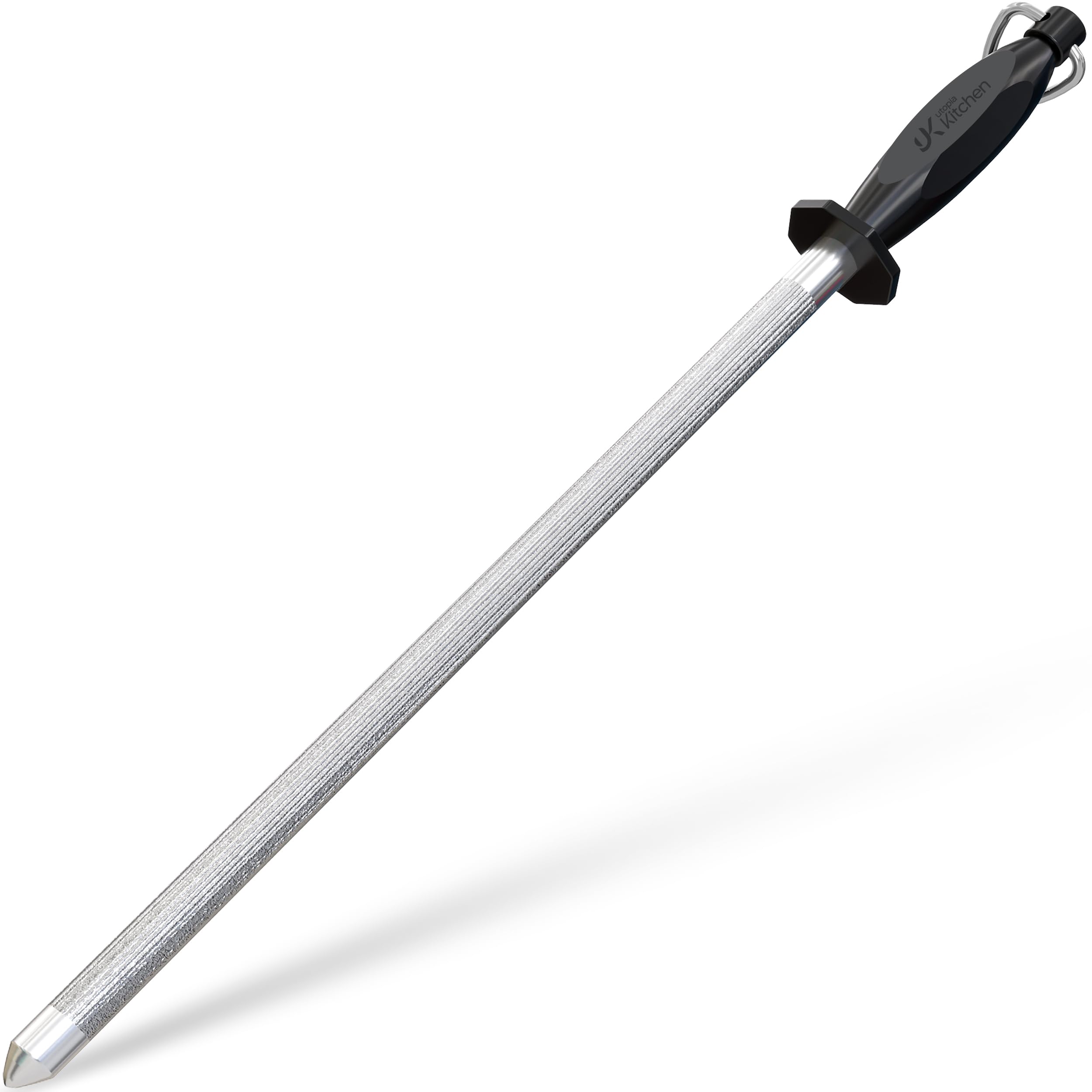
A 12-inch rod that treats serrated and standard edges the same.
Most honing rods expect a plain edge. This one is built to handle serrated blades alongside standard and pocket knives, which widens the jobs it can take on in one kitchen. The carbon steel rod carries a nickel-chrome plating, and the fine surface is there to protect the edge rather than tear into it. A slip-resistant rubber base gives you a planted footing during use, and the ergonomic handle works for either hand.
Quality is what owners praise most, and functionality is close behind — a pattern that fits a rod doing steady, unglamorous work. Kitchen blades come out noticeably sharper after a few passes, and the build is described as heavier and thicker than expected, which lands as confidence in the hand. The one recurring note is honest but worth hearing: it hones, it does not sharpen. Bring it a knife that has lost its actual edge and you will be disappointed; bring it a working knife and it realigns in seconds. Rust is also a live concern if you wet it — dry it fully and hang it, and it will not be an issue.
The reasons it stays on the counter
- Handles serrated, standard, and pocket knives
- Slip-resistant rubber base keeps the rod planted
- Thicker, heavier rod than many rivals at this tier
- Works for left- or right-handed grips
Before you commit
- Hones edges; it will not sharpen a fully dull knife
- Needs a full dry after washing to avoid rust
Fits best: A mixed knife drawer where serrated bread knives and chef knives both need upkeep.
The trade-off: Do not expect it to rescue a completely dull blade — that is a sharpener’s job, not a steel’s.
5. Kota Japan 12 in. Diamond Carbon Steel Sharpener Rod
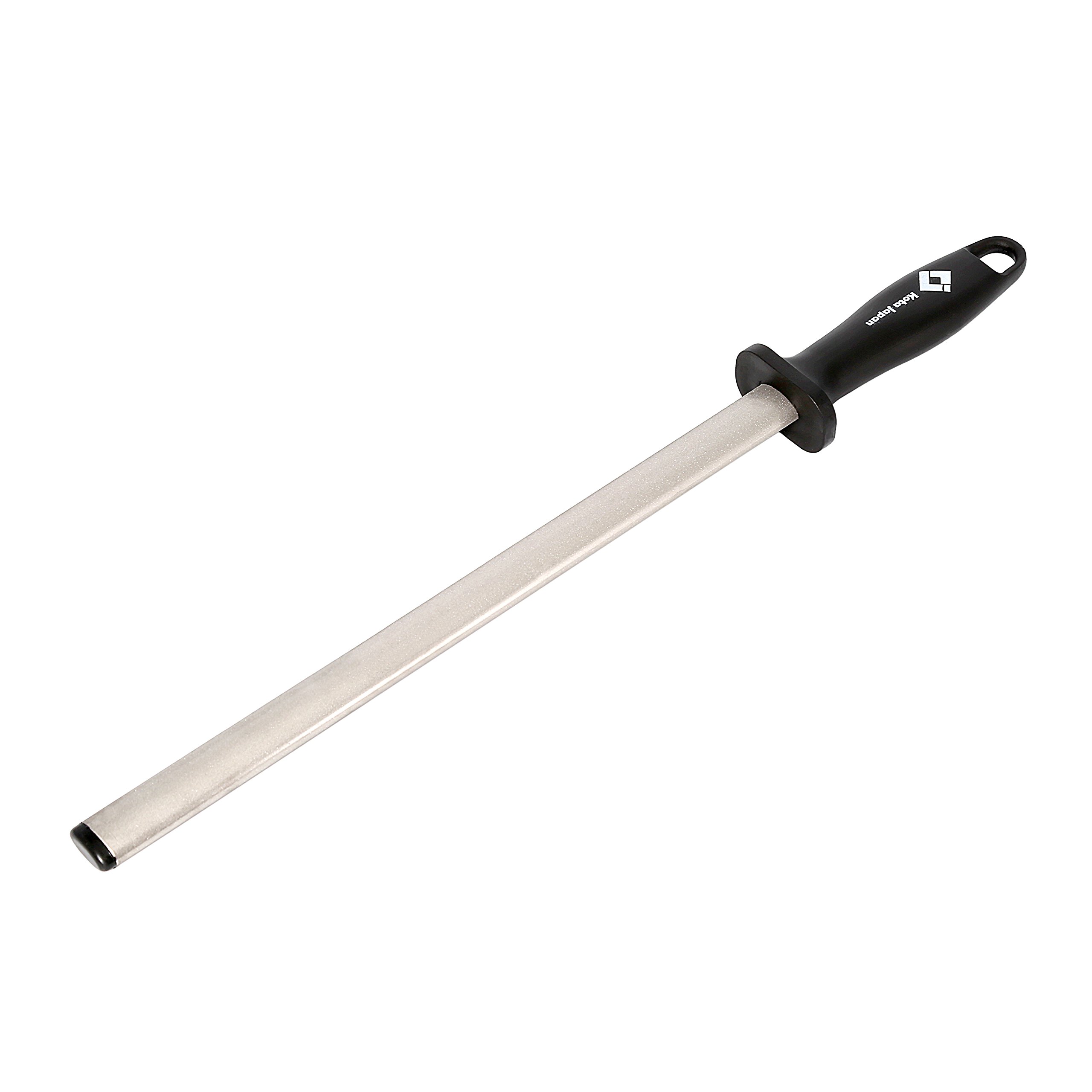
Diamond bite that brings a dull edge back in a handful of strokes.
Diamond electroplating is the headline: hard abrasive particles set onto the rod, shaped oval so there is a wider bearing surface for the blade to ride. The oval shape does more than look distinct — it gives you a flatter face to work against, which helps you control the contact point. The pitch is a lighter touch than a traditional steel; with diamond, “easy does it” is the instruction, and that lighter pressure is what keeps the edge from being over-cut.
Sharpness is the trait buyers reach for, and value is right behind it. Speed is the third recurring theme — this rod refreshes edges fast, which is the promise of diamond done right. The flip side is real and repeated: the diamond coating is the part that wears, and it will not outlast the steel underneath. Heavier use wears the surface faster, so treat it as a fast-refresher that earns its place on a busy board but is not the rod you will one day hand down. For a full knife rack in a working kitchen, though, that speed is genuinely worth having.
How it behaves in use: The abrasive is aggressive enough to take a tired edge to a usable point in a few passes. That same bite means it removes metal quickly, so use it for refresh, not daily polishing, and keep your finer steel for upkeep.
The durability arithmetic: Coating wear is the trade you make for the diamond’s speed, and it is the honest reason to budget for replacing this sooner than a solid steel.
Suits the busy kitchen: Cooks who need a usable edge fast and are fine with a rod that wears with heavy use.
Not the pick for: Anyone who wants one rod to last for decades without a coating to worry about.
6. Henckels Sharpening Steel, Fine Edge Honing Rod

A slim stainless steel built to hold the edge between professional sharpenings.
Where this one wins is its purpose, spelled out plainly: it keeps blades razor-sharp in the gap between trips to a professional sharpener. The stainless rod is a fine grit, matched to a smooth polypropylene handle — the kind of grip that stays predictable when your hands are wet. At 6.4 ounces it is the lightest pick here, which makes it easy to work for a full set of knives without your wrist tiring. The size handles 7-8 inch kitchen knives comfortably, covering most household chef and utility blades.
The appeal of a household name is that you know what you are buying, and this rod delivers on the core job. What most buyers value is that it simply does the maintenance work — a couple of passes on a working knife and it is ready again. The catch worth naming: it is a light-duty home tool, and if you are maintaining a rack of very large or very hard blades, a longer, harder rod serves you better. For the typical home kitchen, though, it is dependable and unobtrusive.
Why it lives in the block: A fine-grit stainless rod with a secure handle and a weight light enough to hold all evening — it does routine maintenance and does it without drama.
Think twice if: Your knives run long or very hard, where the extra leverage of a longer, harder rod will serve you better.
Best matched to: Home cooks on the Henckels or similar Western-knife path who want maintenance between professional sharpenings.
Consider a longer rod instead: If you regularly work with oversized blades.
7. Mercer Culinary Genesis Knife Sharpening Steel, 10 Inch

The wet-hand handle that does not make you worry about the blade.
Comfort is the whole case for this rod. The Genesis handle is designed to stay grippy even with wet hands, which is exactly the condition you hone in after washing a knife. The rod itself is precision-forged high-carbon German steel, and the 10-inch length suits a full-set of kitchen blades. It carries a medium grit, so it has enough bite to bring an edge back without being aggressive. At 0.27 kg it has enough substance that it sits steady, yet it is not a heavy tool to work with.
A feeling of control is what people praise, and the sharpening performance follows right behind. The nonslip grip gets specific love; between that, the balanced feel, and the fact that it restores an edge in a few minutes, this is a rod that makes honing feel less like a chore. The one repeated caveat is small but worth knowing: the medium grit can leave a slightly coarser finish than a fine steel, so if you want a polish, you follow with a finer rod or a strop. A little care with hand-washing, as the maker asks, keeps it working.
Where the Mercer pulls ahead
- Non-slip Genesis handle stays controllable with wet hands
- Precision-forged high-carbon German steel rod
- 10-inch length suits a full kitchen set
- Balanced 0.27 kg feel that does not fatigue the wrist
Keep in mind
- Medium grit leaves a slightly less polished finish
- Hand-wash only — not dishwasher safe
If your hands are often wet at the board: This is the grip to own, with a forged rod that handles a full knife set.
Trade-off to know: Pair it with a finer rod if you like a polished edge.
8. SHARPAL 119N Diamond Sharpening Steel

For blades so hard that ordinary steels just skate across them.
The spec that matters is the surface: 1200-grit diamond particles, a fine grade chosen for routine upkeep rather than heavy removal. Diamond is the hardest abrasive, so it also works on ceramics and hard alloys that defeat softer steels. Built-in angle guides sit on the handle, and that one addition takes the guesswork out of keeping a consistent bevel. The protective ring guarding your hand is a detail that keeps a slip off your fingers. The rod itself is a heavy 9.75-inch piece with a 5-inch handle, so there is real mass to work with.
Sharpening performance leads the praise, and functionality sits just behind. The 1200-grit surface is the specific thing buyers respond to — it refreshes a working edge in a couple of passes without gouging. The honest limits show up with harder use: it is not the rod for a chipped or neglected blade, that needs a stone, and the aggressive diamond does not suit a blade you want to coddle. The handle feels bulky to small hands, and the instructions clearly say not to run it through a dishwasher. For a hard-steel knife that defies softer rods, though, this earns its keep.
What it handles: A 1200-grit diamond face with built-in angle guides, on a substantial 9.75-inch rod. That combination bites into hard steels and ceramics that softer tools slide over, and the guides keep your angle honest.
The care it asks: Wipe it dry, keep it out of the dishwasher, and do not hand it a chipped blade expecting a rescue.
Buy for: Owners of hard high-end steels and ceramics who want a diamond face and guided angles in one rod.
Skip if: Your preference is gentle daily honing on softer Western blades.
9. Cutluxe Honing Rod, 10″ Knife Sharpener Steel
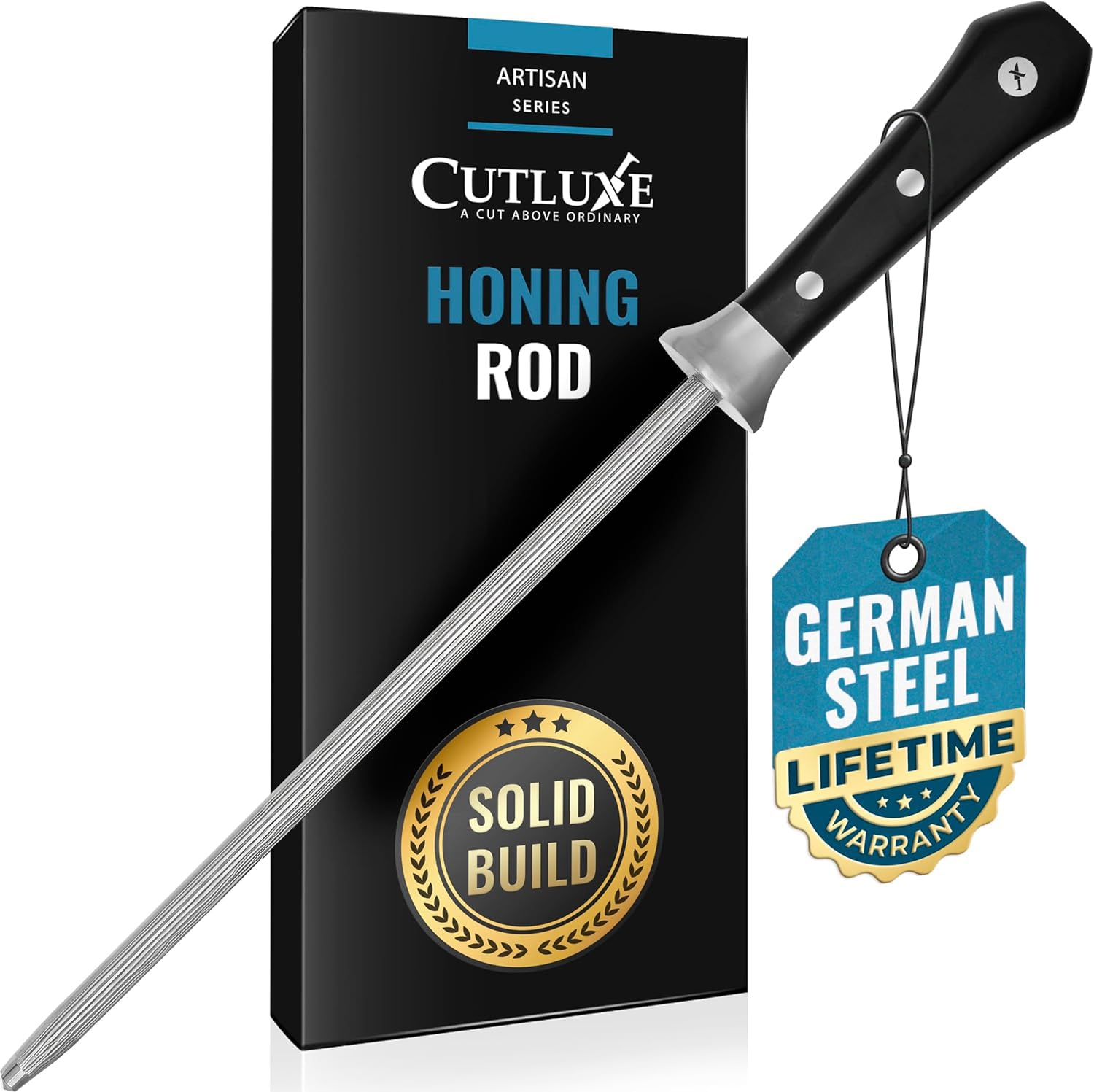
The rod with real mass — 16 ounces that sits planted in the hand.
At 16 ounces this is one of the heavier rods on the list, and that mass is the point. A heavier rod stays planted against the blade, so your stroke stays level and the pressure stays even. The maker says the 10-inch high-carbon stainless rod resists rust, corrosion, bending, and breaking. A non-slip PakkaWood handle works for either hand, and a 10-inch length means a chef’s knife gets a full pass from heel to tip.
Sharpening performance leads the praise here, with value for money a close second. The rod gets called heavy-duty in the best sense, and the handle earns separate credit for staying stable in the hand. Long-term owners note that the surface keeps its bite rather than fading — the sort of tool you grow attached to. The one clear trade-off is heft: 16 ounces is a lot to manage if your grip tires, so if you prefer a lighter rod, the Henckels at 6.4 ounces is the opposite end of the spectrum. Use it and it stays sharp; lean on it and the weight reminds you.
The feel of it: A 16-ounce, 10-inch rod in high-carbon stainless with a non-slip PakkaWood handle. It plants the stroke instead of letting it wander, which is why it suits long sessions across a full knife collection.
The counterweight: That same heft is the thing to consider if your grip tires quickly.
Choose it if: You want a weighty, planted rod for regular honing across many knives.
Go lighter if: Your wrists dislike a 16-ounce tool through a whole block.
10. TUO Honing Rod, High Carbon Steel 8″ with Larger Diameter

A short, thick rod built to disappear into a bread drawer.
Two specs define this one. The rod measures 0.48 inches thick — the maker says that is wider than most conventional models and offers 35% more surface area for the blade to ride on. And it is hardened to 62 HRC, which is the measure of how hard the steel is, and enough to work on hardened composite-steel knives. The 8-inch length is deliberately short so it tucks into most kitchen drawers or a woodblock without crowding, and it fits in a knife roll without poking out. A PakkaWood handle supplies the non-slip grip.
What tends to please owners is that the extra diameter gives a bigger landing zone for each stroke, so the rod feels less finicky than thinner models. It comes with a gift box, wiping cloth, and a hard case — the kind of package that makes it a ready-made present. The catch is the length itself: 8 inches is enough for utility and smaller chef knives, but a long 10-inch blade benefits from a longer rod like the Cutluxe. If space is tight and your blades are modest, that is a fair trade to make.
Where it shines: A thick 0.48-inch rod at 62 HRC in an 8-inch package. The extra diameter means more contact surface per stroke, which makes the rod forgiving on a knife roll or a crowded drawer.
The length question: Shorter blades suit it best; a long chef’s knife wants a longer rod.
Best for: Cooks short on drawer space and outdoor cooks who want a rod that fits in a knife roll.
Not ideal for: Very long blades that need more rod to hone fully.
11. Green Elephant Ceramic Honing Rod, 11-Inch, 1500 Grit

The ceramic rod that brings hard Japanese blades back to life.
Hardness is why this rod exists: 9 Mohs ceramic with a Rockwell of over 100, at 1500 grit. Those numbers matter because a hard blade needs an abrasive at least as hard to reshape its edge, and steel rods slide over very hard steels. The 11-inch ceramic also carries a shock-absorbing build — a silicon seal at the handle and a plastic end cap absorb vibration, designed to keep the ceramic from shattering if it lands on the floor. It is hand-wash only and weighs in at 204 g, light enough to work one-handed.
What owners highlight first is how effectively it works, and sharpness follows close behind. It gives a slightly toothy finish that bites into food, and it is comfortable in the hand despite the ceramic. The one thing to know before you commit is fragility of a different kind: ceramic is brittle, and while the shock-absorbing design helps, you should still treat it with care. If your priority is a rod that shrugs off a drop, a carbon steel rod is the safer bet; if you own hard Japanese steel, this one punches above its category.
The ceramic advantage: 1500 grit at 9 Mohs hardness cuts into hard Japanese blades that softer rods cannot reach. Owners describe a toothy, aggressive finish that slices cleanly and holds up over heavy use.
Handle with care: Ceramic is brittle; the shock-absorbing build helps, but this is not a rod to drop.
Reach for it: You own high-hardness Japanese knives that normal steels cannot refine.
Look elsewhere if: You want a rod you can drop on tile and not worry about.
12. Dexter Russell 1227-14 Butcher Steel, 14″ Magnetized

Fourteen inches of high-carbon butchery steel with a magnetized face.
This is the longest rod on the list at 14 inches of high-carbon steel, and that length is no accident — butcher and meat-prep blades run long, and a 14-inch rod lets you run the whole edge in one pass. The medium coarseness gives it real restorative bite. A magnetized surface attracts metal particles as you work, so the dust clings to the rod instead of falling onto your board and your food. The hardwood handle with a triangular guard provides control, protection, and a comfortable grip over long sessions. Constructed forged in the USA, it is a professional kitchen tool through and through.
What earns it a place in a pro or serious home kitchen is that it will simply last — it is described as heavy duty, and the build suggests a lifetime of regular use. This is a rod built for volume, not for a drawer that only opens on weekends. The honest trade-off is length and weight: 14 inches and 16 ounces is a lot of rod for a small kitchen or short paring knives, where it becomes unwieldy. If your work is large knives and long sessions, though, it is the kind of tool that stops being noticed because it just keeps doing the job.
Built for the long haul
- 14-inch high-carbon steel runs a full butcher blade in one pass
- Magnetized surface catches metal particles mid-stroke
- Hardwood handle with triangular guard for control and safety
- Forged, USA-made construction built for daily commercial use
Who should skip
- 14 inches and 16 ounces is awkward in a small kitchen
- Overkill for short paring or utility blades
For the meat board: Butchers, hunters, and heavy prep cooks who run long blades and want a rod that outlasts the work.
The size caveat: Too much rod for a compact home block of short knives.
Forged from a single block of high-carbon stainless steel and tempered to 58 HRC (the Rockwell measure of how hard the steel is), this 10-inch rod is the natural partner for forged German blades. That 58 HRC figure matters because it sits at the hardness that keeps a rod biting on a Western knife without being so hard it cuts a groove into the bevel. The grit is described as light, which means gentle upkeep rather than aggressive reshaping. At 9.12 ounces it is a middleweight — lighter than the Cutluxe’s 16 ounces, heavier than the Henckels’ 6.4 — and it covers a 10-inch chef’s knife in a single unhurried stroke.
Owners describe it as solid and reassuring in the hand, the kind of tool that makes honing feel like routine maintenance rather than a chore. The German-made build and the limited lifetime warranty reinforce the idea that this is a long-term purchase. What buyers keep coming back to is how reliably it brings a Wüsthof blade back toward factory condition after a few passes. The honest limit is that it is a fine-grit specialist — if you need aggressive bite on a neglected edge, the diamond rods do that job better. For owners already inside the Wüsthof ecosystem, though, it is the obvious match.
Why it earns premium status: Forged from one block of high-carbon stainless, tempered to 58 HRC, made in Germany, backed by a limited lifetime warranty. It is a rod meant to sit beside forged Western knives for years.
The honest scope: A light, fine-grit surface is built for upkeep and light realignment; it is not the rod you reach for to revive a badly dull edge.
Made for: Wüsthof and other forged German knife owners who want a matching, long-warranty rod.
Choose a diamond rod instead: If you need heavier removal on badly worn blades.
13. HexClad 9″ Knife Honing Rod
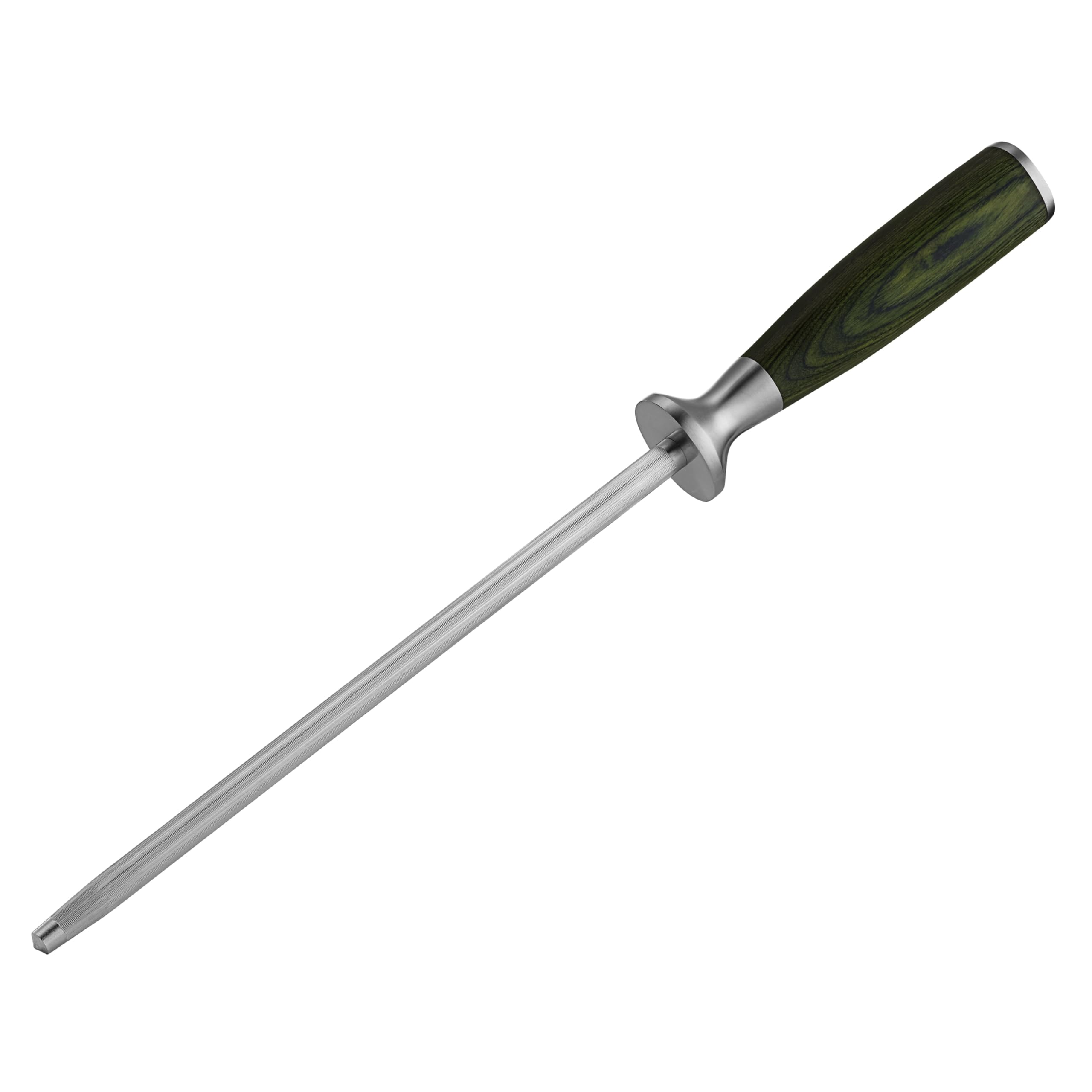
A magnetic rod that keeps metal dust off your board and your food.
The feature that sets this one apart is the magnetic body — it pulls metal dust toward the rod so it does not drift into the air or land on nearby food. That is a small detail that matters in a working kitchen, especially when you hone over a counter where ingredients sit. The honing surface is 9 inches of Japanese Damascus stainless steel, and the full tool is 14 inches end to end. The 5-inch Pakkawood handle gives the ergonomic grip, and the fine surface protects the cutting edge as it works. Given HexClad already has hexagon-pattern cookware owners scanning the brand, it dovetails into that same kitchen shelf.
Owners describe it as effective at refreshing a working knife, with the length and the build getting steady credit, and the quality is the part that gets called out. The brand comes with a lifetime warranty against manufacturing defects, though foodservice use voids it — so this is a home-kitchen tool, not a restaurant workhorse. The one thing to note: it does not cover damage from the dishwasher, hard cutting surfaces, or a dropped blade, so care is on you. If you hone frequently and want the dust-control angle plus a strong brand behind it, this is a clean fit.
The magnetic edge: A 9-inch Japanese Damascus stainless surface in a 14-inch tool, with a magnetic body that catches metal dust before it reaches your counter. A 5-inch Pakkawood handle supplies the grip.
Home only: The lifetime warranty is void for foodservice use and careless storage, so treat it like the home tool it is.
The right fit for: HexClad owners and home cooks who want magnetic dust control in a compact rod.
Not for: Commercial kitchens, where the warranty terms rule it out.
14. F. DICK Dickoron Classic Sharpening Steel, 11.8-Inch

The professional-grade finish — sapphire-cut and hardened to 65 HRC.
The sapphire corrugation is the signature here: a specially cut surface designed to sharpen very smoothly and leave an evenly fine, ultra-fine edge. The rod is tempered to 65 HRC — on the hard end of the range, which is what lets it hold up against hard knife steel without losing its own bite. The oval shape gives a wide bearing surface so the blade sits flat and steady during each stroke. At 11.8 inches it covers a long chef’s knife comfortably, and it weighs 0.51 kg, so it reads as substantial and balanced in the hand. The non-slip synthetic handle adds a finger guard for safety, and the tool is NSF certified for foodservice.
The result that owners describe is professional-grade: it works beautifully on hardened blades, realigns edges cleanly between sharpenings, and feels built to outlast its owner. This is a rod for cooks who hone deliberately and want an ultra-fine, even edge rather than a quick touch-up. The clear caveat is that this is the top tier — the performance is real and specific, and the price at this level reflects the sapphire cut and the 65 HRC build. If you want sapphire-cut precision and 65 HRC hardness and will pay for them, this is the rod to buy.
The professional’s case
- Sapphire-cut surface leaves an ultra-fine, even edge
- Hardened to 65 HRC for real bite on hard blades
- Oval shape gives a wide, steady bearing surface
- NSF certified with a finger-guard handle for commercial safety
- 11.8-inch length covers full chef’s knife strokes
What you are paying for
- Top-tier price reflects the sapphire cut and 65 HRC build
- More tool than a casual home cook needs for basic upkeep
For the serious cook: Professionals and dedicated enthusiasts who want sapphire-cut precision and 65 HRC hardness.
Spare the spend if: You just need simple weekly upkeep on forgiving kitchen knives.
15. HexClad 9″ Knife Honing Rod
A magnetic rod that keeps metal dust off your board and your food.
The feature that sets this one apart is the magnetic body — it pulls metal dust toward the rod so it does not drift into the air or land on nearby food. That is a small detail that matters in a working kitchen, especially when you hone over a counter where ingredients sit. The honing surface is 9 inches of Japanese Damascus stainless steel, and the full tool is 14 inches end to end. The 5-inch Pakkawood handle gives the ergonomic grip, and the fine surface protects the cutting edge as it works. Given HexClad already has hexagon-pattern cookware owners scanning the brand, it dovetails into that same kitchen shelf.
Owners describe it as effective at refreshing a working knife, with the length and the build getting steady credit, and the quality is the part that gets called out. The brand comes with a lifetime warranty against manufacturing defects, though foodservice use voids it — so this is a home-kitchen tool, not a restaurant workhorse. The one thing to note: it does not cover damage from the dishwasher, hard cutting surfaces, or a dropped blade, so care is on you. If you hone frequently and want the dust-control angle plus a strong brand behind it, this is a clean fit.
The magnetic edge: A 9-inch Japanese Damascus stainless surface in a 14-inch tool, with a magnetic body that catches metal dust before it reaches your counter. A 5-inch Pakkawood handle supplies the grip.
Home only: The lifetime warranty is void for foodservice use and careless storage, so treat it like the home tool it is.
The right fit for: HexClad owners and home cooks who want magnetic dust control in a compact rod.
Not for: Commercial kitchens, where the warranty terms rule it out.
16. F. DICK Dickoron Classic Sharpening Steel, 11.8-Inch
The professional-grade finish — sapphire-cut and hardened to 65 HRC.
The sapphire corrugation is the signature here: a specially cut surface designed to sharpen very smoothly and leave an evenly fine, ultra-fine edge. The rod is tempered to 65 HRC — on the hard end of the range, which is what lets it hold up against hard knife steel without losing its own bite. The oval shape gives a wide bearing surface so the blade sits flat and steady during each stroke. At 11.8 inches it covers a long chef’s knife comfortably, and it weighs 0.51 kg, so it reads as substantial and balanced in the hand. The non-slip synthetic handle adds a finger guard for safety, and the tool is NSF certified for foodservice.
The result that owners describe is professional-grade: it works beautifully on hardened blades, realigns edges cleanly between sharpenings, and feels built to outlast its owner. This is a rod for cooks who hone deliberately and want an ultra-fine, even edge rather than a quick touch-up. The clear caveat is that this is the top tier — the performance is real and specific, and the price at this level reflects the sapphire cut and the 65 HRC build. If you want sapphire-cut precision and 65 HRC hardness and will pay for them, this is the rod to buy.
The professional’s case
- Sapphire-cut surface leaves an ultra-fine, even edge
- Hardened to 65 HRC for real bite on hard blades
- Oval shape gives a wide, steady bearing surface
- NSF certified with a finger-guard handle for commercial safety
- 11.8-inch length covers full chef’s knife strokes
What you are paying for
- Top-tier price reflects the sapphire cut and 65 HRC build
- More tool than a casual home cook needs for basic upkeep
For the serious cook: Professionals and dedicated enthusiasts who want sapphire-cut precision and 65 HRC hardness.
Spare the spend if: You just need simple weekly upkeep on forgiving kitchen knives.
Know the Specs
Rod Length vs. Blade Length
Length is the spec that most often trips people up. A rod should be long enough to run your longest blade from heel to tip in a single stroke. An 8-inch rod works on small utility and paring knives, but a 10-inch or 12-inch chef’s knife needs a 10-inch to 12-inch rod to hone fully. If you see a rod listed as 9.75 inches, 10 inches, 11.8 inches, or 14 inches, that is the working surface length — and a 14-inch butcher steel like the Dexter Russell suits long meat-prep blades, while a 9-inch rod like the Shun is right for standard kitchen knives.
Grit, Surface, and Bite
Grit describes how fine the abrasive is — the higher the number, the smoother the surface. A 1200-grit diamond and a 1500-grit ceramic both leave a fine, precise finish with a slight toothy bite. A “fine” carbon steel rod is smooth enough to realign an edge with little metal removal, while a “medium” steel has more bite and refreshes a working edge faster. A “super fine” or “ultra fine” label tells you the rod is meant for upkeep rather than heavy reshaping. The rule of thumb: the finer the grit, the less metal it removes, and the longer your blade lasts.
Hardness and HRC
HRC stands for Rockwell hardness, a measure of how resistant the steel is to being scratched or dented. A rod at 58 HRC (like the Wüsthof) is tempered to a hardness that suits standard forged Western knives. A rod at 62 HRC (like the TUO) and at 65 HRC (like the F. DICK) are harder, which matters when you work on hardened or hard Japanese knife steel. Ceramic goes harder still, at 9 Mohs hardness on the mineral scale, which is why a ceramic rod can refine hard blades that a soft steel simply cannot reach.
Hone vs. Sharpen
A honing steel realigns the edge — it does not grind a new one. That distinction is the most important one in this category. When a knife feels dull but the edge is intact, a few passes on a honing steel bring it back. When the edge is actually worn down or chipped, you need a sharpener or a whetstone, and a steel will not rescue it. Diamond-coated rods bridge the two a little: they realign and remove some metal, so they refresh an edge faster, but they still are not a stone for repairing damage. Keep the steel for upkeep, and keep a sharpener for restoration.
Common Questions
What is the difference between a honing steel and a knife sharpener?
How long should my honing steel be compared to my knife?
Can a honing steel sharpen a fully dull knife?
Does a diamond sharpening steel wear out faster than carbon steel?
Can I use a honing steel on ceramic or serrated knives?
How often should I hone my knives?
Can a honing steel handle hard Japanese knives?
Why does a honing rod need a guard or a non-slip handle?
Should I store my honing steel in a drawer or hang it?
Can I wash my honing steel in the dishwasher?
The Bottom Line
For most kitchens, the knife sharpening steel that earns its place first is the Victorinox Swiss Classic Fibrox, because its 10-inch chrome-plated surface handles a full chef’s knife stroke while the fine-to-medium grit keeps the edge alive without eating it away. If you hone narrow-bevel Japanese blades, the Shun Classic Combination Steel puts a built-in angle guide and a dual-grit surface in your hand. For hard high-end steel and ceramics, the SHARPAL 119N brings 1200-grit diamond and guided angles together in a rod built for upkeep. And if you want professional-grade finish and do not mind paying for it, the F. DICK Dickoron Classic is the sapphire-cut, 65 HRC rod that serious cooks reach for. Match rod length to your longest blade and surface grit to your knife’s steel, and the choice becomes obvious.
How we choose
We do not accept paid placement. Every pick is matched to a real buyer and a real use-case; we do not hands-on test units.
Sources
Specifications: manufacturer listings and product documentation. Review insights: verified customer reviews, as of October 2026. Pricing: not shown on this page (it changes often); check the current price via the retailer link.
As an Amazon Associate, Aappliancez earns from qualifying purchases. This does not affect which products we feature.