Disclosure: Some links in this post are affiliate links. As an Amazon Associate I earn from qualifying purchases, at no extra cost to you. Learn more
Specs are compiled from manufacturer listings and verified buyer reviews and can change over time — please confirm the key details on the product page before buying.
Most dull knives do not need replacing — they need the right abrasive at the right angle. A pull-through gadget that scrapes off metal will make an edge feel sharp for a week and then wreck the bevel for good. A proper sharpening kit holds the blade at a consistent angle and removes only what it needs to, so your chef’s knife slices tomato skin without pressure. Below are fifteen kits that span every style: guided rods, diamond plates, whetstones, rolling sharpeners, and electric units. The best overall pick is the Dalstrong Whetstone Set. It earns 4.5+ stars across 1,200+ ratings, pairs a 1000 grit for repairs with a 6000 grit for polishing, and its extra-long stones let you stroke a 10-inch slicer in one pass.
This guide is built by comparing the manufacturers’ published specifications and the patterns across verified customer reviews, so you get each pick’s real strengths and trade-offs instead of marketing spin.
A whetstone that stays flat beats a bargain stone that dishes out, and a guided system beats freehand if you cannot hold an angle. Every kit here is picked for the job it does best. The right knife sharpening kit for you depends on your steel, your patience, and your counter space.
Top Picks

Check Price on Amazon
The #1000 grit stone does the heavy work here.
Check price on Amazon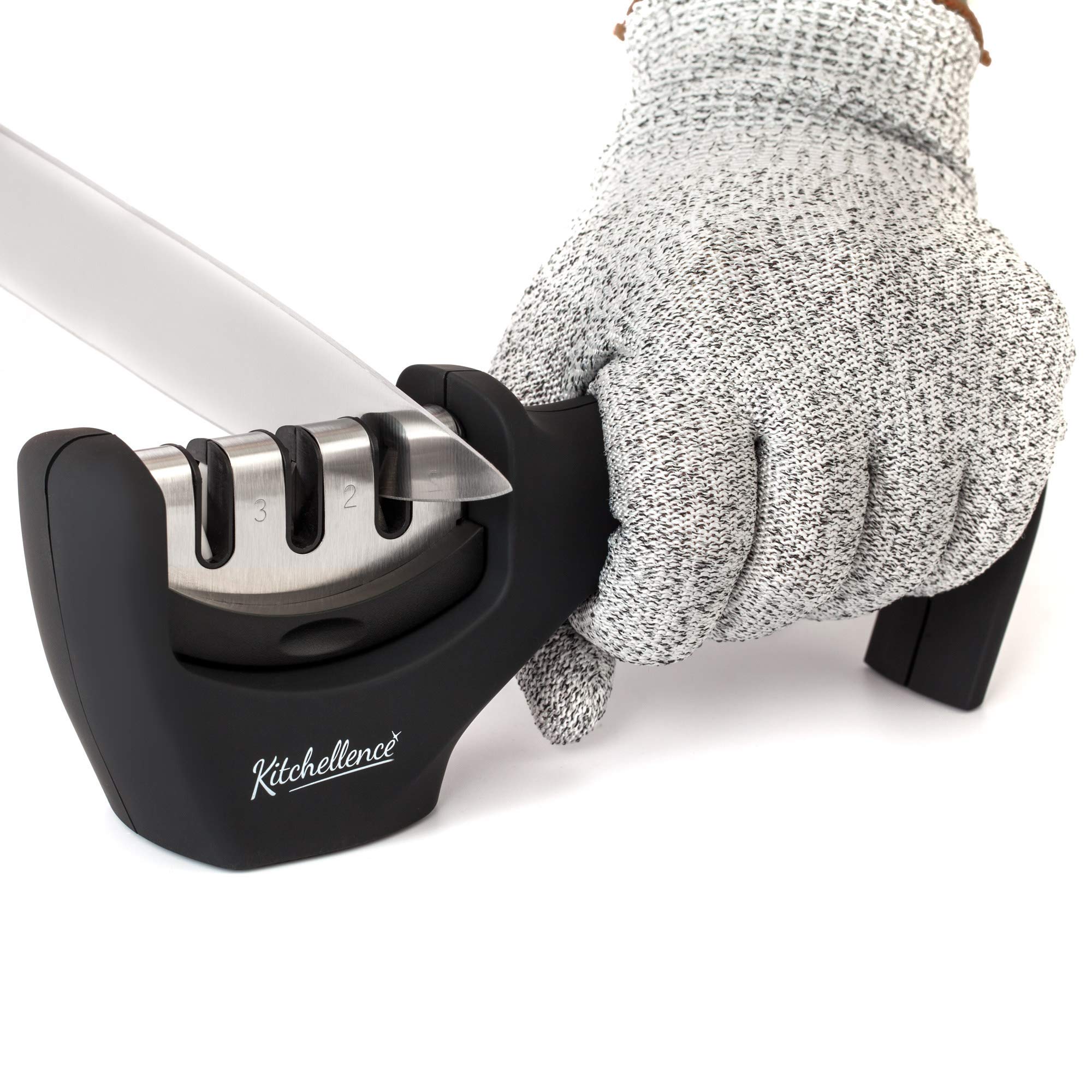
Check Price on Amazon
The 3-slot system is the point here. Slot one is a diamond rod that straightens damaged blades. Slot two sharpens and restores the V-shape.
Check price on Amazon
Check Price on Amazon
Six functions stack into a 2.4-ounce body. A tungsten-carbide V-notch slot sets a new edge fast. A ceramic slot hones it smooth.
Check price on AmazonHow To Choose The Best Knife Sharpening Kit
Buying a sharpening kit is really a decision about how much control you want. A pull-through sharpener is fast and cheap, and it can chew up a blade over years. A whetstone or diamond plate asks for a little practice and rewards you with an edge you cannot buy off a rack. Decide which buyer you are before you look at grit numbers.
Angle control is the whole ballgame
An edge is two planes meeting at a fixed degree — often 15° for Japanese steel or 20° for European kitchen knives. A sharpening kit is only useful if it keeps that angle steady across every stroke. Some kits use a physical guide you rest the blade against. Others clamp the knife into a rod system that sets the angle for you. Freehand stones give you the most freedom and the least hand-holding.
Match the grit to the job
Low grit numbers cut fast and remove metal — a 325 or 400 grit stone fixes nicks and resets a bevel. High grits polish and refine. A 1000 grit is the workhorse for maintenance and a 6000 grit gives you a mirror finish that glides. A kit missing the coarse end leaves badly damaged knives unfixable, so check the progression before you commit.
Diamond versus water stone
Diamond plates cut hard steel, including high-speed steel and carbide, and they run dry with no soaking. Water stones like corundum give a smoother, more polished edge but need a soak and a flattening stone to stay true. Neither is wrong. One suits a garage or outdoor user, the other suits a kitchen with five minutes of patience.
Side-by-Side Comparison
| Model | Best For | Grit Range | Style | Weight | Amazon |
|---|---|---|---|---|---|
| Dalstrong Whetstone Set★ Best Overall | Restoring and polishing | 1000 / 6000 | Whetstone | 17.01 g | Amazon |
| Kitchellence 4-in-1Fastest Touch-Up | Fast household touch-ups | 3-stage slots | Pull-through | 180 g | Amazon |
| SHARPAL 101NTrail EDC Pick | Pocket and trail carry | Fine / Medium / Coarse | Field tool | 2.4 ounces | Amazon |
| Intelitopia Complete Set | Beginners building a station | 400/1000 & 3000/8000 | Whetstone | 5 pounds | Amazon |
| RUIXIN PRO RX-008 | Reprofiling and angle play | 10 stones, 120–3000 | Fixed-angle clamp | 16 ounces | Amazon |
| Sharp Pebble Whetstone | No-skill home sharpening | 1000 / 6000 | Whetstone | 2.1 pounds | Amazon |
| Lansky Deluxe LKCLX | Angled guided work | 5 ceramic hones | Clamp and rods | 1.1 pounds | Amazon |
| Presto 08800 EverSharp | Two-minute kitchen service | 2-stage | Electric | 3 pounds | Amazon |
| SHARPAL 162N Diamond | Dry, fast hard-steel work | 325 / 1200 | Diamond plate | 1.4 kg | Amazon |
| DMT Deluxe Diamond Kit | Workshop and hand planes | 325 / 600 / 1200 mesh | Diamond blocks | 1.8 pounds | Amazon |
| The Original Tumbler | Large kitchen blades | Diamond disc + helix | Rolling | 1.4 pounds | Amazon |
| HORL 2 Walnut | Japanese and Damascus steel | Diamond + ceramic | Rolling | 1.74 pounds | Amazon |
| Chef’sChoice 15XV | Whole-drawer speed | 3-stage Trizor | Electric | 4.2 pounds | Amazon |
| KME Precision System | Precision and repeatability | 140 / 300 / 600 / 1500 | Guided rods | 12 ounces | Amazon |
| Work Sharp Precision Adjust Elite | Angle chasers and collectors | 10-piece abrasive set | Guided rods | 12.2 pounds | Amazon |
Detailed Reviews
1. Dalstrong Whetstone Set #1000/#6000
Our pick — 4.5+★ from 1,000+ verified ratings; the strongest balance of quality and price.
Two grits that take a rolled edge from dead to mirror-polished.
The #1000 grit stone does the heavy work here. It resets a rolled edge, lifts micro-chips out of the bevel, and rebuilds the shape a honing rod cannot reach. Five minutes on that side gives you a blade that grabs paper again. Then three minutes on the #6000 polishes the edge to a mirror finish that slides through tomato skin with no pressure.
Two things make this the pick to beat. First, the corundum abrasive (a very hard aluminum-oxide stone) stays flat longer than softer stones, so you lap it less often. Second, the XL format gives you enough surface to draw a 10-inch slicer in full strokes — no abbreviated angles and no drag at the tip. It handles German steel, Japanese steel, ceramic blades, and pocket knives alike.
What wins people over is the stone quality, which is the single most-praised thing about this set. The sharpening performance follows right behind. The included angle guide takes the guesswork out for a first-timer, and the non-slip silicone base keeps the stone planted whether you are pushing hard on the #1000 or finishing light on the #6000. As buyers report, the wide stones are “ideal for long kitchen knives.”
The honest catch is the jump from 1000 straight to 6000 with no 3000 in between. You jump straight from 1000 to 6000 with no 3000 in between, and the included flattening stone is on the small side. Durability of the base is the one thing feedback splits on — some expect many years, others want a sturdier mount. At 17.01 g it is a fraction of the 180 g Kitchellence, so it moves from drawer to counter without fuss.
Where it earns its keep
- #1000 then #6000 takes a dull blade to razor sharp in one session
- XL stone surface fits a 10″ slicer in full strokes
- Corundum abrasive stays flat longer than softer stones
- Non-slip silicone base holds the stone still
- Works on German, Japanese, ceramic, and pocket knives
What to plan around
- No 3000 grit, so the 1000-to-6000 jump is a wide one
- Included flattening stone is small
- Base durability is the one split vote in feedback
Reach for this if: you want one kit that both repairs and polishes, and you will soak a stone for five minutes.
Think twice if: you want a coarse grit for badly chipped knives — the #1000 is too fine for that job on its own.
2. 4-in-1 Kitchen Knife Accessories
Three slots, a few pulls, and a glove in the box.
The 3-slot system is the point here. Slot one is a diamond rod that straightens damaged blades. Slot two sharpens and restores the V-shape. Slot three fine-tunes for a clean polish. You place the blade in each slot and pull through a few times. That is it — no angle to hold, no soak, no learning curve.
Effectiveness is the quality that carries this kit, by far the most-cited strength. Sharpness comes second. The body is solid ABS plastic (a tough molded plastic), the base is non-slip, and the handle works for right- or left-handers. A cut-resistant glove ships in the box, which is a sensible add for a tool you pull a blade through.
Here is the real trade-off. This is the fastest and cheapest route to a working edge, and it brings tired knives back to feeling new. But pull-through sharpening removes metal on every pass, and the sharpening performance and durability lines both come back mixed — a fair share of home cooks love the speed, and a smaller group say heavy repeated use shortens blade life. Compare it to the Dalstrong above: at 180 g this is the heavier, chunkier tool in the hand, and 8.3″L x 2.2″W x 3.4″H is a 2.3x longer footprint than the palm-sized SHARPAL 101N at 3.54″L x 1.46″W x 0.51″H.
The speed argument: no other kit on this list gets a dull knife cutting again in fewer strokes, and the glove plus diamond-first slot shows the design thought about safety.
Where it costs you: if you sharpen the same chef’s knife weekly, the metal it removes adds up. Use this for quick revivals and a stone for the heavy lifting on your good blades.
Best fit: a busy kitchen that wants a sharp knife in seconds with zero technique.
Look elsewhere if: your best knives are high-end and you plan to sharpen them every week.
3. SHARPAL 101N 6-in-1 Pocket Knife Sharpener & Survival Tool
Six tools in a body that disappears into a pocket.
Six functions stack into a 2.4-ounce body. A tungsten-carbide V-notch slot sets a new edge fast. A ceramic slot hones it smooth. A tapered diamond rod at 400 grit handles serrations and gut hooks, a grooved diamond rod does fishhooks, then you get a ferro fire rod and a high-pitched emergency whistle. For a camping kit, that is a lot of survival utility in one pocketable tool.
Sharpening performance is what earns the praise here, and value runs right behind it. It pulls straight and serrated blades sharp in a few passes, and diamond rods reach the fine and hard-to-reach edges a slot misses. The real-world detail worth knowing: it puts most knives at roughly 24-25 degrees, so keep the blade centered and level in the slot as you pull.
What it is not is a kitchen station. This is a field tool that also works on a chef’s knife in a pinch. The fire starter and whistle both come back mixed — some love the sparks, some get none, and the whistle is loud and functional for some, a bit of a novelty for others. Those are bonuses, not why you buy it.
Who it is for: hunters, campers, motorcyclists, and anyone who keeps a pocket knife on them and wants a sharp edge without a bag of stones.
The carry angle: the built-in lanyard hole means you can tie it to a pack. Still, if you want a polished kitchen edge you will outgrow the 24-25 degree preset quickly.
Grab this if: your knife lives in a pack or a glovebox, not on a magnetic strip.
Not the one if: you want to set a 15° sushi edge — the fixed field angle is built for utility, not refinement.
4. Complete Knife Sharpening Stone Set
Everything a first whetstone kit should contain, in one box.

The grit ladder spans 400 through 8000 across two double-sided stones. That is the full range: 400 repairs a nick, 1000 sets the working edge, and 3000 to 8000 takes it to a mirror polish. Add a coarse flattening stone, a bamboo non-slip base, an angle guide, and a cowhide leather strop, and you have a station rather than just a stone.
Quality is the leading strength, and value sits second, with ease of use close behind. Beginners get the most out of it. The angle guide keeps the blade steady, the strop removes the burr a stone leaves behind, and the grit progression is gentle enough to learn on. That is a kitchen knife, a pocket knife, scissors, and a straight razor covered by one set.
The fuss is minor. It weighs five pounds, so this is a stay-put kit. The stones want a soak before work — a 10-15 minute drink is typical. And one fair note on the angle guide: “Great kit to sharpen, but I was not able to use the guide, it’s kind of tricky, probably a skill issue.”
What stands out: the four-grit spread plus a strop is the broadest starting kit on the list, and the flattening stone means the stones stay true instead of dishing.
The catch: every piece here wants a learning window. Budget an evening or two with a cheap knife before you touch a good blade.
Choose this if: you are buying your first real stone kit and want the coarse repair grit plus the polishing end.
Choose simpler if: you will not soak stones or practice the angle — a guided or rolling system will serve you better.
5. RUIXIN PRO RX-008 Knife Sharpener
Ten stones, a flip fixture, and a clamp that locks to your bench.

Ten stones ship with this kit — 120#, 180#, 320#, 400#, 600#, 800#, 1500#, 1500#, 2000#, and 3000#. That is a full arc from coarse repair up to fine polish. The G-clamp grabs a table, stool, or stove edge, and most of the frame is stainless steel. The 360° rotation flip design lets you turn the blade over to sharpen the other side with a stated deviation of +/- 2°.
It works, and it works well when you set it up right. Neglected knives come back sharp enough to pass a paper-slice test, and a worn Shun Classic with chips gets restored. The angle is adjustable via a screw on the vertical rod, so you can match a 17° filet knife or a kitchen workhorse. Hard steels take longer but hold their edge.
Setup is the honest friction. You need hex wrenches to mount the blade, and you will want a phone angle app to lock the exact degree. The stock stones are on the soft side and break if dropped, so change them over a table. The plastic blade-protection clips are not worth using — masking tape does the job. This is the most-involved kit on the list: ten stones and an adjustable clamp reward setup time with exact angles.
Why some sharpeners swear by it: the clamping surface holds knives far better than a small-clamp kit, and the adjustable angle fits any blade you own.
The catch: it asks for patience and upgrades. Budget for diamond plates and a metal swivel down the line, and keep the stones off the floor.
Suits you if: you enjoy dialing in an exact angle and want to reprofile a whole drawer of knives.
Skip the setup if: you want to sharpen in two minutes with no clamps — a rolling or electric unit is your lane.
6. Sharp Pebble Whetstone Knife Sharpener — 1000/6000 Grit
The angle guide that makes a whetstone beginner-proof.

A 1000/6000 dual-grit stone covers most home kitchens in one tool. The 1000 repairs dull or damaged edges, the 6000 polishes to a razor finish, and a bamboo non-slip base holds the stone steady. The included angle guide locks your blade position automatically so you do not have to hold the degree freehand.
What makes it distinctive is how the beginner gets there. Sharpening is water-based, so no oil, no mess. The kit ships with an instruction manual, a tips-and-tricks e-book, and an expert support channel. The roughly 2.1-pound stone sits neatly on the counter without sliding, and even heavy, oversized knives get handled. For most home cooks, that 1000/6000 pair covers the everyday job without over-buying coarser grits.
The one honest note is that this style of stone wants periodic flattening with a flattening stone or diamond plate to stay true. And like any stone, it rewards a few practice runs. The payoff is a working edge that holds longer than an electric and a station that lives on the counter instead of in a box.
Good fit for: a home cook who wants stone-quality edges but has never held an angle freehand.
Not ideal if: you need to fix deep chips — the 1000 grit is a maintenance stone, not a repair stone.
7. Lansky Deluxe Knife Sharpening System
Five color-coded hones, a knife clamp, and a case that travels.

The system clamps the knife, then you run color-coded hones across it on a fixed rod. Five stones progress from extra-coarse through extra-fine ceramic, with a bottle of specially formulated honing oil included. The stones sit in finger-grooved safety holders, and the whole thing packs into a custom-molded carrying case. It works on kitchen, outdoor, hobby, and garden knives.
The big advantage over a flat stone is the clamp. It holds the blade at a consistent angle so your strokes stay repeatable from edge to tip. The result shows up on large knives especially, where a freehand angle wobbles most. The 1.1-pound kit is light enough to store in a drawer and take to a cabin.
The mixed feedback is on the learning step. Some find the clamp-and-rod setup easy from the first knife. Others describe it as fiddly to figure out and say it takes a few sessions to feel natural. That is a familiarity issue, not a defect. Once the motions click, it produces a sharp, repeatable edge.
The trade it makes: you give up the speed of a slot sharpener and the freehand freedom of a stone, and you get a repeatable angle on every blade.
Worth knowing: give yourself one practice knife before you commit a good chef’s knife to the clamp.
Pick this if: you want a repeatable edge on a mix of kitchen and outdoor knives.
Look past it if: you want sharpening in under a minute — this is a sit-down, rod-by-rod process.
8. Presto 08800 EverSharp Electric Knife Sharpener
Two labeled slots and a razor edge in about a minute.

The 2-stage system is simple. Stage 1 grinds a precisely angled edge with Sapphirite wheels, the same ultra-hard material used in professional sharpening shops. Stage 2 fine-hones and polishes. Precision blade guides hold the knife at the right angle for you. Draw the blade through each slot a few times and you are done. No guesswork, no soak, 120 volts.
It is fast and forgiving. Dull kitchen knives come back cutting tomato, meat, and bread in a minute or two. The unit is 3 pounds, it is quiet, and it takes about two minutes to set up. Quality is the leading strength in feedback by a wide margin, sharpness is second, and ease of use is right up there. Owners mention old, tired knives looking and cutting like new.
The fair limit is the type of blade. This sharpener is built for non-serrated edges. One careful detail from the field: some thicker pocket knife steel dulls rather than sharpens, so keep it to kitchen blades. And a one-sided serrated knife needs care in which slot you use.
Why it earns its spot: a whole cutlery drawer gets back to sharp in the time it takes to boil pasta, with no technique to learn.
The catch: it is quick on kitchen knives but not the tool for collecting-grade or carbon steel. Keep your good chef’s knife to a stone.
Best for: the cook who wants sharp knives and has no interest in learning an angle.
Wrong tool if: your drawer is all high-carbon or single-bevel Japanese steel.
9. SHARPAL 162N Diamond Sharpening Stone
Dry diamond that eats hard steel in a minute.

Monocrystalline diamonds are electroplated onto a stainless-steel base 0.35 inch thick. The coarse 325 side (45 micron) sets a new edge fast. The extra-fine 1200 side (12 micron) hones it. You sharpen dry, so there is no oil or water and no mess. Hard materials — high-speed steel, carbide, ceramic, cubic boron nitride — all fall before it.
The speed is the headline. This cuts several times faster than an oil or water stone, and the MirrorFlat surface keeps long-lasting even contact so the plate does not wear into a dish. The kit ships with a storage case that doubles as a base, plus a non-slip rubber pad. An angle guide with four settings — 14°, 17°, 20°, 25° — arrives in the box. Barbershop owners use it to bring clipper blades near-mirror in minutes.
A few realities. A new plate needs a short break-in to knock off proud diamond. The smooth side can trap metal, which is fine for kitchen and pocket knives but matters on wood-carving tools that need 3000+ grit. And the case top makes a poor sharpening base for some — a separate holder is the safer move.
The draw: one flat, fast stone that runs dry and handles any blade you throw at it, from chef’s knife to clipper blade.
The caution: the angle guide helps at the start, but feel and muscle memory do the real work. A little restraint on pressure lets the diamond cut.
A good match if: you sharpen a mix of hard steels and want zero soak or mess.
Not the one if: you want a wood-carving or high-polish finish above 1200 grit.
10. DMT Deluxe Diamond Knife Sharpening Kit
Three micronized diamond blocks in a wood box that lasts.
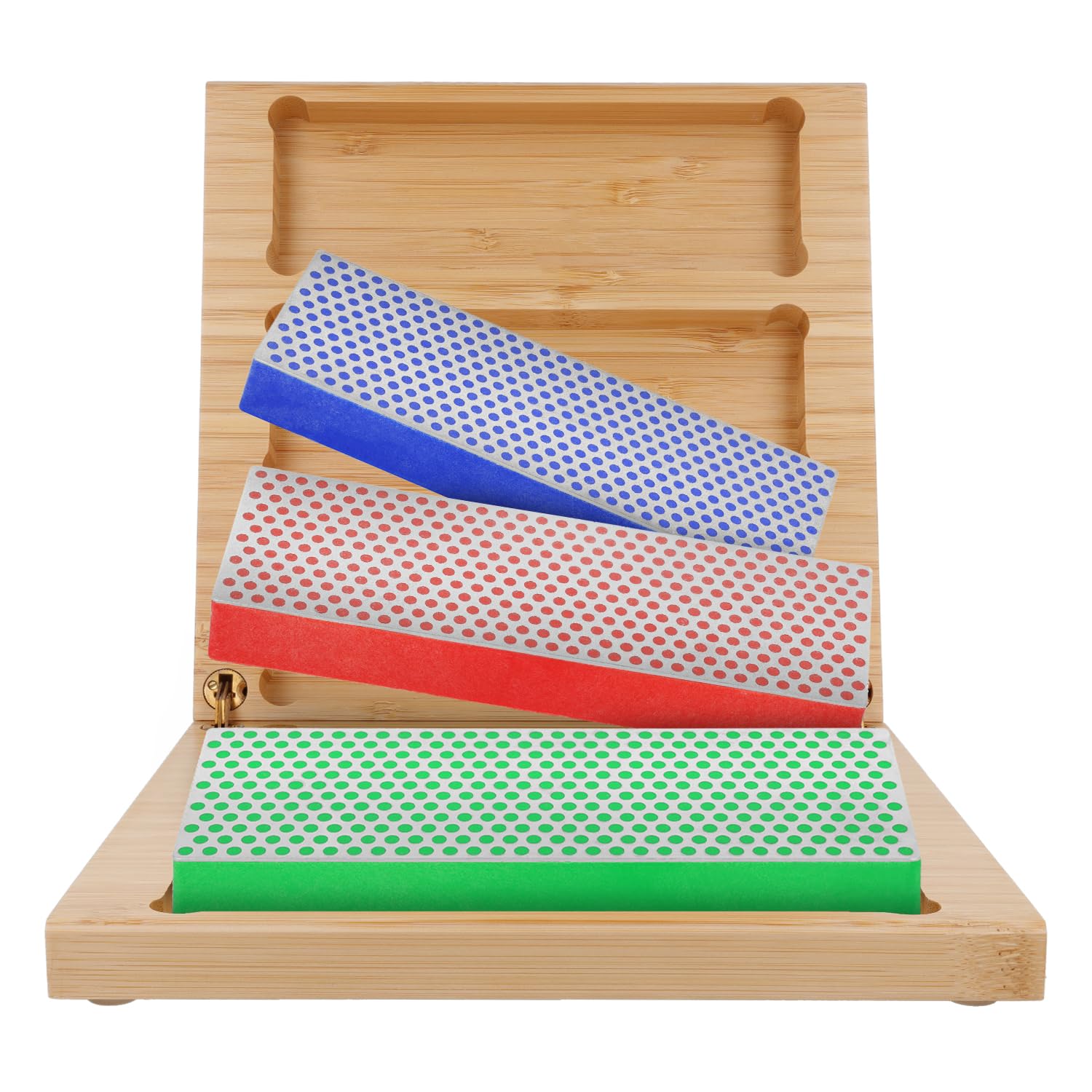
Three diamond stones, color-coded for a clear progression. Blue is coarse at 45 micron / 325 mesh for restoring neglected edges. Red is fine at 25 micron / 600 mesh for honing. Green is extra-fine at 9 micron / 1200 mesh for polishing and refining. The micronized monocrystalline diamonds are precisely sized for a uniform surface, and the set arrives in a natural wood box.
Performance is the top strength here, with sharpness second and value third. It removes metal fast and clean — one-third the strokes of a water stone on some tests — with no soaking and little mess. It handles hand-plane blades and household knives equally well, and the extra-fine stone leaves an edge smooth enough to skip the honing steel.
The friction is in the details. The grit is not printed on the stones, so the color chart becomes your reference (it is printed on the reverse of the box cover). The coarse 325 side is too fine for badly damaged edges and needs more passes. And the thin hollow plastic backing on some blocks feels light. One piece of advice from the field: use the wood box as a base, since the stones slide on their own.
What it delivers: a clean, fast, low-mess diamond edge from a set that will sit on a workbench for decades.
Where it stops: the kit tops out at 1200 grit, so mirror-polish chasers will want a high-grit stone or a leather belt finish.
Reach for this if: your sharpening happens in the garage and you want a set that skips oil and water.
Think twice if: you want a single self-contained stone — these live in their box.
11. The Original Tumbler Rolling Knife Sharpener™ (Wood)
A magnetic block, a rolling disc, and a 15°/20° preset.
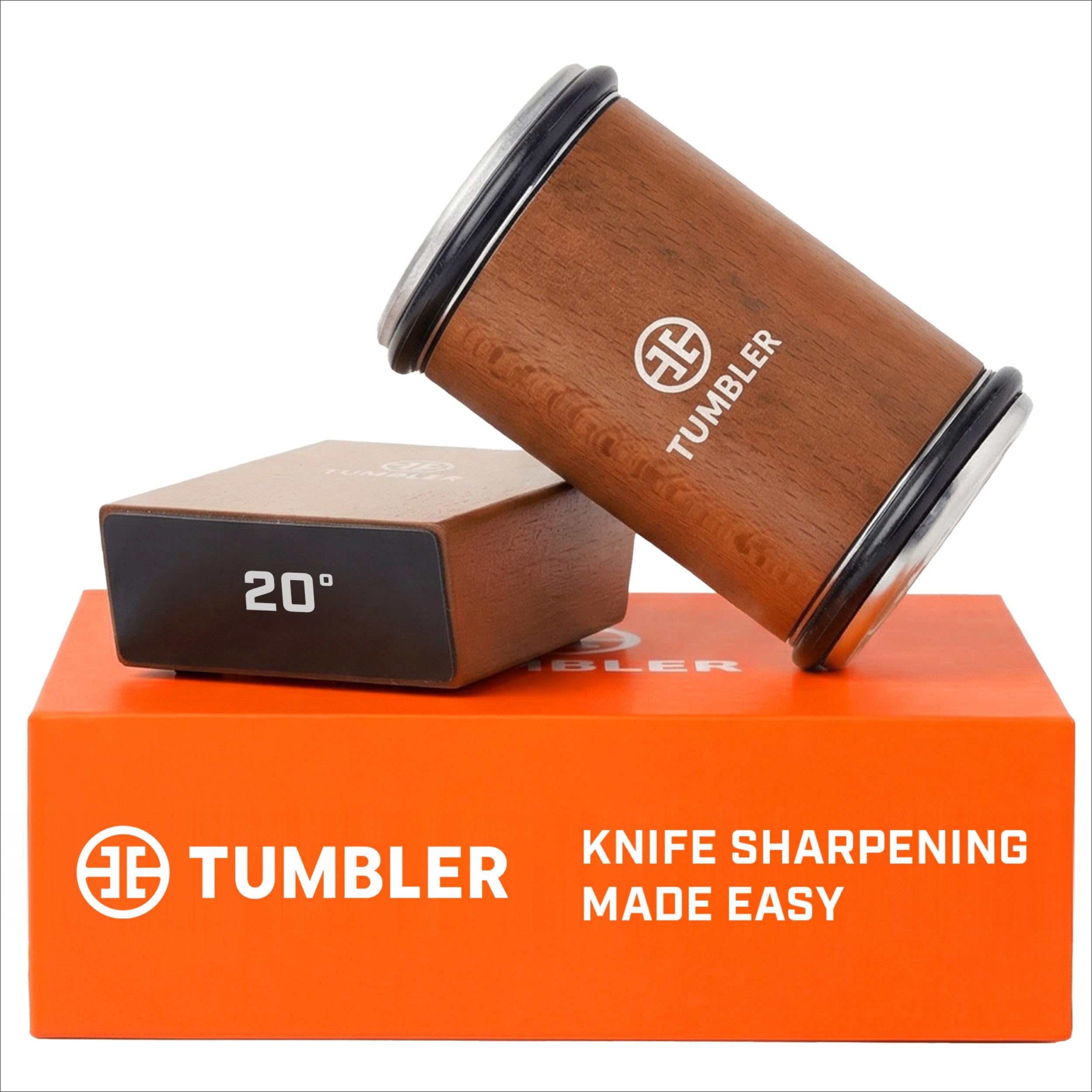
You clamp the blade into a magnetic holder and roll the sharpener across it instead of sweeping a stone back and forth. A diamond-plated disc restores the edge. A stainless steel helix disc hones and refines it. Fixed 15° and 20° angles hold the degree for you, so no wrist work. It packs at 1.4 pounds.
Performance is the strength that carries this, with effectiveness right behind. A dull tomato knife comes back slicing paper-thin in two minutes of the diamond side and about twenty passes per side of the hone. The strong magnet holds the blade firm. The smooth roller runs clean. The whole motion is quiet and controlled.
What to know before you buy. It is patient work — roughly six minutes per blade side if you let the disc do its job instead of rushing. And the diamond abrasive face wears faster than a stone does, so it is not a lifetime tool. Smaller knives can sit too low in the holder and hit the magnet before the edge gets worked. This rolling form shows up on the HORL 2 as well, and both ask for a steady, unhurried rhythm.
What people keep
- Magnetic holder holds the blade firm and steady
- 15° and 20° presets remove angle guessing
- Restores a razor edge on a tomato knife in minutes
- Roller runs smooth and quiet
What to weigh
- About six minutes per blade side if you do not rush
- Diamond face wears faster than a stone
- Smaller knives can sit low against the magnet
Worth it for: a cook who wants chef’s-knife edges without learning freehand angles.
Not the pick for: a full drawer of tiny paring knives — the holder favors larger blades.
12. HORL 2 Walnut Rolling Knife Sharpener — 15 & 20 Degree
Walnut, ball bearings, and a German-made disc that never quits.

This is a rolling system with interchangeable discs. A diamond disc does the cutting, a ceramic disc hones, and a magnetic angle support holds the blade at 15° or 20°. The 15° setting suits Japanese and Damascus steel, the 20° setting gives a durable everyday edge. The body is natural walnut from kiln-dried wood, on precision ball bearings for a smooth, play-free roll.
Sharpness is the runaway strength here, with the sharpener itself and sharpening time next. European knives run through 12-18 rolls a side on the rough disc, about twenty on the hone. The result slices grapes and tomatoes without crushing them. The magnet is strong and the build is handcrafted in the Black Forest near Freiburg, Germany, with each unit inspected.
The trade is value and time. Value-for-money feedback comes back mixed, which is expected at this tier. And a dull knife can take 15-20 minutes, slower than the marketing implies. The 15°/20° preset pair also leaves no room for the 10°-15° angles some fine knives want. It tops out near the Tumbler in output quality, but it is the more beautiful object to leave on the counter.
What is lovely: a home-cook edge with zero whetstone skill, in a body you will want to display rather than hide.
What it costs: the price, the patience on a dull blade, and a fixed angle set that cannot refit every knife.
A fit for: the cook with Japanese or Damascus knives who wants a showpiece that works.
Look past it if: you sharpen often and want speed over ceremony.
13. Chef’sChoice 15XV Electric Knife Sharpener
Three diamonds stages that convert a whole drawer to 15°.
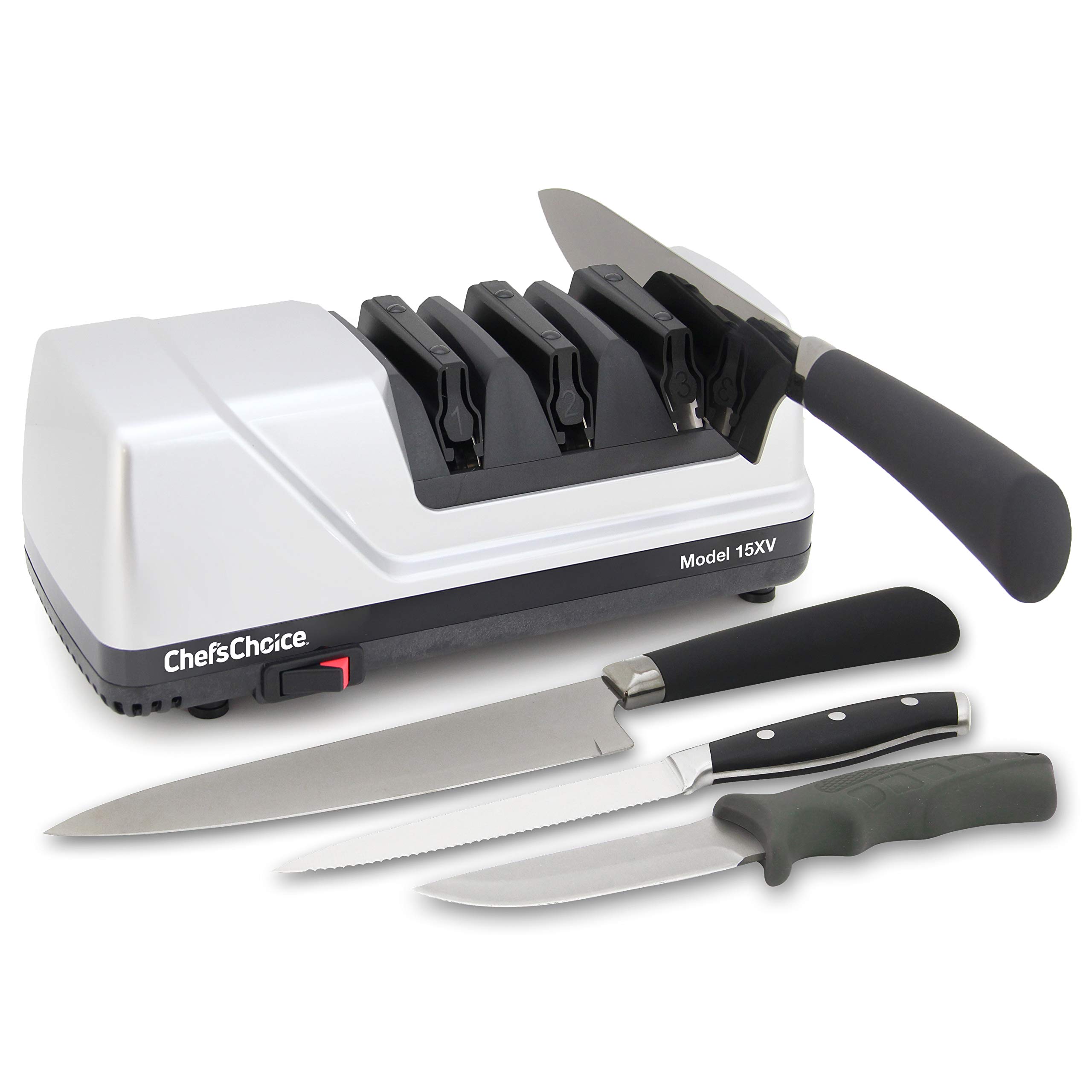
Three stages, all sitting on diamond abrasives. Stages 1 and 2 sharpen and hone with 100-percent diamond plating, and stage 3 runs a patented flexible abrasive system to polish and help serrated knives last. The unit converts a traditional 20-degree factory edge into a 15-degree Trizor XV edge. Flexible spring guides adjust the angle for you.
Speed is the calling card. First-time sharpening takes about a minute, resharpening about ten seconds. A nicked paring knife can come back cutting a hanging receipt in around ten passes. The maker spec is 4.2 pounds and 10″L x 4.25″W x 4.25″H, which is a compact counter footprint rather than a drawer gadget. Owners who sharpen a whole set at once report a uniform paper-test edge in twenty minutes.
Two things to know. Do not sharpen your best knife on your first try — one attempt can come out duller before you learn the passes. Practice on a cheap knife first. And this is a kitchen-knife tool, not a multitool — it will not touch scissors or garden shears. The manual and knife-type instructions matter, so read them.
The value: drawer-wide speed plus 15-degree precision, in a machine that sits on the counter and runs in seconds.
Where it stops: it is electrical and it is for knives only, so it earns its place in a busy kitchen rather than a minimalist one.
Best for: a family that wants every knife in the block sharp in the time it takes to make coffee.
Choose differently if: youhave one great knife you would never risk on a machine.
14. KME Precision Knife Sharpener System
Four gold diamond hones on a spherical-bearing rod guide.

Four diamond hones form the spine of this kit: 140 extra-coarse, 300 coarse, 600 fine, and 1500 extra-fine. The angle adjusts continuously from 17 to 30 degrees, marked in 1-degree increments. A spherical bearing rod guide holds zero angle deviation across the stroke, and the whole kit stores in a hard carry case at 12 ounces.
Sharpening performance leads here, with sharpness a close second and value third. It produces razor-sharp edges on chef, boning, and pocket knives, and the diamond stones hold up across many blades. Hard steels get re-profiled where freehand fails. The guided fixture and secure detent remove the angle guesswork, so you re-mount the same knife and the same degree holds.
The honest list is short but real. Fit and finish is workmanlike rather than polished — lots of tiny screws and bolts to tighten, and some loosen during use. The base does not fit inside the carry case, so the kit is not quite grab-and-go. The 1500 grit tops out fairly fine but leaves a slightly toothy edge, so a strop is worth adding for kitchen work.
The reason it earns its spot: repeatable, exact angles on any blade, from a setup you can learn in about twenty minutes.
Where it asks for patience: screws that need tightening and a base that travels separately. Budget for a strop to finish kitchen edges.
A strong fit for: someone who has fought freehand inconsistency and wants repeatable precision.
Not the one if: you want to sharpen a knife in two minutes flat.
15. Work Sharp Precision Adjust Elite Knife Sharpener Kit
A digital angle readout on a 12-pound bench system.

A digital angle indicator sets any sharpening angle from 15° to 30°, and the system holds it through the guided rod. Ten abrasives come in the box: 220, 320, 400, 600, and 800 grit diamond plates, a fine ceramic, 1200/2000/3000 grit resin-bonded diamond plates, and a leather strop. The frame is metal, and the weighted 12-pound base plus a V-block clamp and clamp stabilizer hold the whole setup still.
Quality is the strength that carries it, with functionality second. It handles blades up to ¼ inch thick and 15 inches long — long ones in sections. It accepts a dedicated serration sharpener and a small knife table attachment. The result is a precise, polished edge across kitchen, pocket, and hunting knives. A chef who tested it came away impressed with the edge.
Two constraints define the buyer. It is slow and deliberate — the sharpest edge on the list, but not a five-minute job, especially on super steels. And the single clamp point can flex a wide or flexible blade, which costs a little angle precision on long chef knives. Everything else here is premium-grade, and the rugged case keeps it all organized.
Why a collector would want it
- Digital angle readout from 15° to 30°
- 10-piece abrasive set from 220 grit to a strop
- 12-pound weighted base plus clamp stabilizer stay steady
- Handles blades up to ¼ inch thick and 15 inches long
Where patience is required
- Slow, deliberate process, not a quick touch-up
- Single clamp point can flex wide flexible blades
- Takes real counter space at 19.26″L x 14.92″W x 8.82″H
Made for: the knife collector who wants the most exact angle on every blade and enjoys the process.
Not for you if: you want a quick edge before dinner — hand it to the Chef’sChoice instead.
Know the Specs
Grit Numbers, Decoded
A grit number tells you how coarse the abrasive is — lower means rougher, higher means finer. A 325 or 400 grit cuts fast and fixes nicks. A 1000 grit is your everyday maintenance stone. A 3000 to 8000 grit polishes to a mirror finish. A kit that starts at 1000 and jumps to 6000, like the Dalstrong, covers repair and polish in one session but skips the mid of 3000. A kit with a full ladder, like the Intelitopia, gives a gentler path from repair to polish but means more stones in the box.
Diamond Versus Water Stone
Diamond plates cut fast, run dry, and handle hard modern steels, which suits a garage or a hunting pack. Water stones like corundum give a smoother, more polished edge but need soaking and a flattening stone to stay true. A rolling sharpener uses a diamond disc on a magnetic holder and asks for patience — six minutes a side on some models — instead of skill. An electric uses spinning abrasive wheels and asks for nothing but a few draws through a slot. Pick the style that matches your patience and your mess tolerance.
Common Questions
Will a sharpening kit work on serrated and ceramic blades?
How long does it take to learn whetstone sharpening?
What is the difference between a 1000 and 6000 grit stone?
Do diamond sharpeners wear out?
Can I sharpen a knife with a pull-through sharpener every day?
What angle should I sharpen a Japanese knife at?
Do I need to soak a whetstone before using it?
Can an electric sharpener ruin a good kitchen knife?
What is a leather strop for?
How often do I need to flatten a whetstone?
The Bottom Line
Start with your steel and how much time you will give it. If you want one kit that repairs and polishes with the best owner reputation on this list, the Dalstrong Whetstone Set is the pick — long stones, a flat-holding corundum surface (a hard, flat sharpening surface that stays true), and a two-grit progression that takes a dull edge to razor sharp. If you want the whole kitchen back to sharp with no technique at all, reach for the Chef’sChoice 15XV and its three diamond stages (three abrasive steps that grind and polish the edge). And if you simply cannot be bothered with an angle, the Kitchellence 4-in-1 will have a knife cutting again in a few pulls.
How we choose
We do not accept paid placement. Every pick is matched to a real buyer and a real use-case; we do not hands-on test units.
Sources
Specifications: manufacturer listings and product documentation. Review insights: verified customer reviews, as of October 2026. Pricing: not shown on this page (it changes often); check the current price via the retailer link.
As an Amazon Associate, Aappliancez earns from qualifying purchases. This does not affect which products we feature.