Disclosure: Some links in this post are affiliate links. As an Amazon Associate I earn from qualifying purchases, at no extra cost to you. Learn more
Specs are compiled from manufacturer listings and verified buyer reviews and can change over time — please confirm the key details on the product page before buying.
A torn ACL or meniscus makes every step feel uncertain, and the wrong brace makes it worse. Three specs decide whether a brace works: a hinge that locks at your surgeon’s set angle, straps that keep the frame from sliding down your leg, and a size matched to your thigh circumference. Get all three right and the brace holds the knee steady through walking, sitting, and sleep. Get any one wrong and you’ll spend the day tugging the brace back into place. This guide covers seven hinged and post-op braces, from recovery-grade frames with telescoping arms to lower-profile sleeves for active days.
This guide is built by comparing the manufacturers’ published specifications and the patterns across verified customer reviews, so you get each pick’s real strengths and trade-offs instead of marketing spin.
Post-surgical braces and hinged sports braces do different jobs, so your right pick depends on your stage of recovery and your thigh measurement. Here is how the knee brace for acl and meniscus tear options compare on fit, hinge control, and staying in place.
Top Picks

How To Choose The Best Knee Brace for Acl and Meniscus Tear
A knee brace for an ACL or meniscus tear is not a compression sleeve. It is a frame that takes load off a healing ligament and stops your knee from moving in ways it can’t handle yet. So the frame, the hinge, and the straps matter more than padding or looks. Here is what to weigh before you buy.
Match the brace to your stage of recovery
Right after surgery, a post-op brace with a lockable hinge is the usual choice. It holds your leg at the angle your surgeon wants and stops the knee straightening past a set limit. Once you are walking, climbing stairs, and starting light activity, a hinged sports brace with side uprights supports you without the bulk. A brace whose arms telescope from 17″ to 27″ can grow with your leg as swelling drops, so the fit holds through recovery.
Measure your thigh, not your height
Ordering by height instead of thigh circumference is the most common fit mistake. A brace built for thighs up to 30.5″, for example, will not sit right on a much bigger leg. Measure your thigh above the kneecap with a soft tape while standing, then check the size chart before you order. Sitting right on the edge between sizes? A brace with several numbered straps is far more forgiving than one with a fixed sleeve.
Look for a hinge with real stops
An adjustable ROM hinge lets you dial in how far the knee can bend and straighten. Some braces give you a handful of preset stops; others give you many more precise angle settings. Either way, the hinge should lock firmly and feel solid when you move. Ask whether it limits extension (straightening) and flexion (bending) separately — a torn ACL especially needs a cap on how far the knee extends.
Check how the brace stays put
A heavy hinged frame that slides down your leg is worse than no brace, because the hinge drifts off the joint it’s meant to control. Non-slip silicone liners, a strap that sits above the calf, and a fully numbered strap system all help it hold. A brace that slides is usually mis-sized rather than defective, so check your thigh measurement against the size chart before blaming the liners.
Side-by-Side Comparison
| Model | Best For | Hinge / Angle Control | Fit / Size | Key Material | Amazon |
|---|---|---|---|---|---|
| Breg T Scope Premier Post Op (L1833)★ Best Overall | Post-op ligament recovery and locked-angle walking | Adjustable ROM hinge, telescoping arms 17″ to 27″ | Thighs up to 30.5″ | Plastic frame, foam pads | Amazon |
| Komzer ACL Functional Knee SupportMost Precise Fit | Return-to-activity support with fine angle control | Dial hinge with 9 precise angle stops | Size Medium (Left) | Aircraft-grade aluminum and perforated neoprene | Amazon |
| Orthomen Functional ACL Knee Brace | Low-profile daily rehab with numbered straps | Dual-sided locking hinge, 9 stops, 0°-90° | Size XXL / Right | High-strength aluminum alloy and neoprene | Amazon |
| DonJoy Performance Bionic Fullstop | High-impact sport and hyperextension protection | FullStop dampening hinges and Four-Point Leverage System | Four adjustable straps | Neoprene with breathable mesh | Amazon |
| Orthomen OA Knee Brace Booster | Arthritis pain and meniscal instability | 13 adjustable angle stops, dual hinges | Size M / Right (unisex) | Aircraft-grade aluminum frame, PU foam with silicone gel | Amazon |
| Breg T Scope Premier Post-Op XL | Larger thighs after knee surgery | Hinged locking support | Fits up to a 35.5″ thigh | Neoprene blend | Amazon |
| Apex ACL Knee Brace | Budget-friendly double-upright stabilization | Extension 0–25°, flexion 0–90° | Size L / Right (21–23.5″ thigh) | Neoprene blend | Amazon |
Detailed Reviews
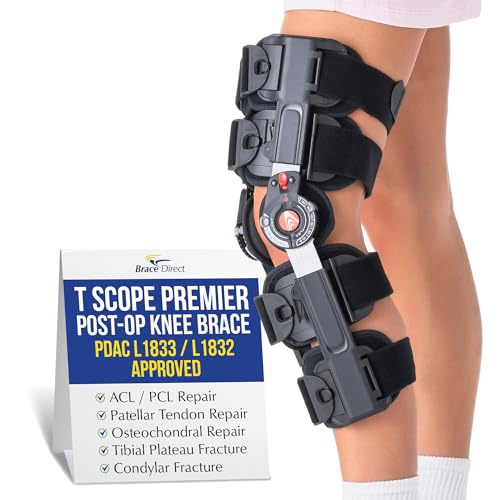
1. Breg T Scope Premier Knee Brace L1833
Our pick — 4.0+★ from 150+ verified ratings; the strongest balance of quality and price.
The recovery brace that locks your knee at the angle your surgeon set, and keeps it there.
The Breg T Scope Premier wins the top slot because its frame extends from 17″ to 27″ — a telescoping length that lets the brace change as your swelling drops and your leg shape shifts. That span fits more leg lengths than a fixed-length brace. It also takes thighs up to 30.5″, which covers most adult legs, so you can keep the knee locked at first and loosen the limits as your physio allows.
The adjustable ROM hinge (range of motion — the lockable joint that limits how far your knee bends or straightens) lets you set stops in both directions. Lock it straight for sleeping, then open it up for walking. The quick clip buckles are the practical part: they fasten in seconds even when the knee is still tender, which matters when you put the brace on several times a day. The frame is plastic rather than aluminum, so it sits lighter on the leg than a metal upright design.
The honest trade-off is bulk — this brace is hard to hide under trousers. A handful of buyers report it can slide if you don’t set the straps correctly. That points to fit, not a design flaw: set the straps properly and wear a thin sleeve underneath, and it holds. One recurring complaint is swelling from straps sitting above and below the kneecap, so tighten gradually instead of all at once.
What earns it the top slot
- Telescoping arms extend 17″ to 27″, so the frame adapts as swelling changes
- Fits thighs up to 30.5″, covering most adult legs
- Adjustable ROM hinge locks both straightening and bending limits
- Quick clip buckles fasten in seconds during tender post-op days
- Foam padding is comfortable and avoids the sweat of a full neoprene cover
What to plan around
- Bulky frame under trousers
- Can slide if straps aren’t adjusted properly
- Straps near the kneecap can cause swelling if over-tightened
Right for: anyone in the first stretch of ACL or meniscus recovery who needs a lockable hinge and a frame that adjusts with the leg.
Look elsewhere if: you want a low-profile brace to wear under jeans for sport — a slimmer hinged sleeve suits active days better.
2. Komzer ACL Knee Brace M-Left
Nine dial-set angle stops and a silicone-lined fit, for the days you want to move again.
The Komzer’s dial hinge gives you nine precise angle stops, so you control exactly how far your knee bends and straightens with finer tuning than a brace with only a few presets. Dual uprights made of aircraft-grade aluminum sit along the sides of the knee to resist the sideways shifting that a torn meniscus hates during a deep squat or a quick turn. Perforated neoprene and an open patella (a cutout over the kneecap) keep the joint from turning into a sweat trap over hours of wear.
This is where it beats the bulkier Breg: six numbered straps run thigh to calf and a silicone lining grips the skin, so it stays put on hills and stairs instead of creeping down. The numbered straps also cut the guesswork out of putting it on, which helps on days your knee is stiff and your patience is thin. You’ll want this one once you are past the locked-straight phase and starting to walk, hike, or do light gym work.
Sizing caveat: the brace runs on the trim side. At least one buyer found it tight in the thigh when sitting right on the size line — so if your measurement is borderline, take the next size up.
Daily feel: the open-patella, ventilated build is comfortable enough for long wear, and the velcro is designed not to snag on clothing.
Worth it for: active recovery, when you want fine angle control without a hospital-style frame.
Think twice if: your thigh sits right on the size boundary — sizing up avoids a tight fit.
3. Orthomen Functional ACL Knee Brace XXL-Right
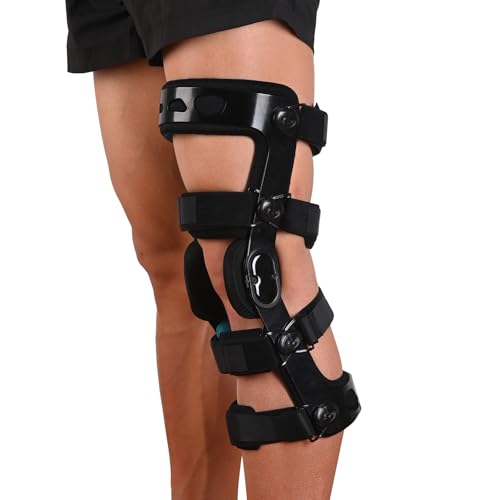
A slimmer aluminum-hinge brace built to disappear under trousers during rehab.
Say the hospital brace you were sent home with is too clunky to wear to work — the Orthomen Functional ACL brace answers that with an open patella and back design, airflow-vented fabric, and soft cushion pads. The low-profile frame suits long shifts and daily errands. Its dual-sided locking hinge has nine built-in stops to set extension and flexion between 0° and 90°, so it does the core job of stopping your knee from overstretching during recovery. The numbered Velcro system with silicone-coated liners is there to fight the sliding that plagues so many frames.
It ships with a complete accessories kit, including extra cushion pads, a 55cm extension strap, and a carry bag — handy for carrying the brace to physio sessions. The aluminum alloy hinges follow natural knee motion rather than locking the leg rigid, which helps on stairs and low-impact activity like cycling.
The honest catch: this one has very little review history so far, and the one piece of feedback available reports a strap breaking at five weeks. Treat the strap fastenings gently, and buy only if you’re comfortable being an early owner.
Smart use case: the low-profile design is the reason to choose it, especially if you need a brace that slips under clothing for work or travel.
Best for: people who value a discreet, low-bulk frame they can wear under normal clothes during rehab.
Skip if: you want a long track record of durability — with almost no reviews yet, the strap strength is unproven.
4. DonJoy Performance Bionic Fullstop Knee Brace

Built to catch the knee before it snaps straight — the sport brace for hard stops and landings.
The DonJoy Bionic Fullstop targets one risk: your knee hyperextending, or bending backward past straight, during a cut or a landing. Its FullStop hinges engage as the knee approaches full extension, a dampening mechanism designed to slow that backward bend. The Four-Point Leverage System supports the ligaments through rapid direction changes, and an open hex-shaped foam buttress around the kneecap helps guide proper patellar tracking. Coming back to tennis, pickleball, or field sport? This is the brace designed for that sudden backward bend.
The neoprene body gives supportive compression while a breathable mesh back panel manages heat. Four straps with easy-grip tabs let you fine-tune the fit as you warm up. It’s less bulky than a hospital-style post-op frame, and it goes on far faster than a rigid four-strap cage.
What buyers praise most: the level of support and the way it stops the knee from giving way during activity — that’s the strength of this brace.
What’s more mixed: durability shows up as a genuine issue for a small share of owners, with the occasional report of the brace stretching out or metal wearing through after months of hard use. Fit is mixed too — it works best when you match the size carefully, since it is designed to run snugly.
One EDS owner’s caution: it helps with the knee giving out and side-shifting but does not fully stop hyperextension for a knee that bends backward a long way — worth knowing if that’s your situation.
Reach for it if: you’re back to sport and want dampening hinges that guard against hyperextension during cuts and landings.
Look elsewhere if: you need a brace to hold a locked angle through post-op recovery — a ROM frame like the Breg is built for that.
5. Orthomen OA Knee Brace Booster M/Right
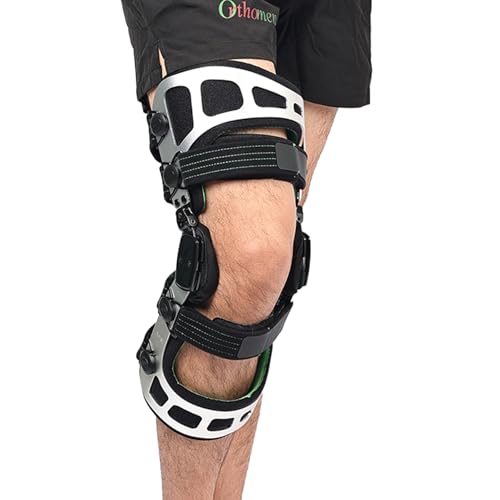
The unloading frame for a knee that hurts on stairs — with 13 angle stops to fine-tune.
Stairs hurt, and osteoarthritis or a complex meniscal tear is often why. This brace is built around that different problem: the bone-on-bone pressure of osteoarthritis and the instability of a complex meniscal tear. Its active unloading mechanism is designed to redirect joint pressure away from worn cartilage. Dual medical-grade hinges with 13 adjustable angle stops give you precise control over extension and flexion — more stops than the nine-stop Komzer. The frame is aircraft-grade aluminum, light and low-profile enough to sit under relaxed-fit pants, and the padding is ventilated PU foam with silicone gel to resist slipping on long walks.
For a knee that needs stability through twisting motions, the rigid frame is the point — it resists the plant-and-pivot motion that aggravates a meniscal tear. It’s tailored to left and right leg contours, and comes with a hex key and replacement pads for adjusting the fit.
The real friction: the six-strap system is fiddly to put on, and the upper section can dig into the thigh with every step if it isn’t dialed in precisely. With almost no review history yet, there isn’t a large record of long-term wear to lean on. It suits a buyer willing to spend time fitting it rather than someone who wants to clip it on and go.
Who it clicks with: one skater with a degenerative complex meniscal tear found the rigid frame kept the knee stable on the ice where a soft sleeve no longer would.
Pick it for: arthritis pain and meniscal instability where you want rotational stability and fine angle adjustment.
Pass if: you want quick, simple on-and-off — the multi-strap fitting takes time and patience.
6. Breg T Scope Premier Post-Op Knee Brace (XL)

Same trusted Breg post-op frame, sized up for a 35.5-inch thigh.
A thigh measurement past the standard fit is exactly what this XL version solves. It holds thighs up to 35.5″ — noticeably more room than the L1833 variant’s 30.5″ — while keeping the same hinged locking support and the 17″ to 27″ adjustable length. It’s a post-op brace in the classic mould: rock-solid, easy to set, and built to keep your leg straight on your surgeon’s orders.
Owners of the standard version consistently point to the quality and durability of this frame, and the XL keeps that build. The buckle closure and neoprene blend padding are comfortable for extended wear, and the adjustable hinge lets you move the range of motion as your recovery progresses. If your recovery means a lot of time in bed or on the couch with the leg propped, the sturdy frame holds its shape rather than sagging.
Real-world note: the one recurring gripe is that it can slide down if the straps aren’t set just right — a proper fit and a sleeve underneath solve most of that.
Setup tip: it takes a little practice to put on without help the first few times, so have someone spot you until you have the routine down.
Choose this if: your thigh measures above the standard fit and you still want a trusted post-op ROM frame.
Not for: a slim leg — the extra room will leave it loose, so the standard-size Breg fits better.
7. Apex ACL Knee Brace, Hinged Ligament Injury Support L1852
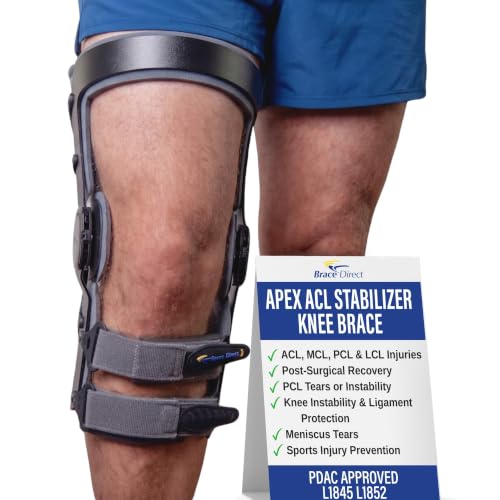
Double aluminum uprights and a set-and-lock hinge, at the entry-level tier.
The Apex gets you into a hinged ACL brace without the premium-tier spend, and the core structure is still there: aerospace-grade aluminum uprights on both sides of the knee reinforce the ACL, MCL, PCL, and LCL (the four main knee ligaments), and the ROM hinge lets you set extension from 0–25° and flexion from 0–90°. Non-slip padding under the frame reduces the migration that sends so many braces sliding down the shin. The one-step closure creates a contoured fit you can fasten quickly during daily use or light activity.
Measuring matters even more at this tier: it’s a size Large for the right leg, sized to a 21–23.5″ thigh measured 6 inches above the kneecap while standing. Get that number right and the fit falls into place.
Where it shines: the padding and support hold up well for walking, standing, and daily wear, and many owners find it more supportive than a plain sleeve for the money.
Where to be careful: the plastic strap loops are the weak point, with reports of one breaking early. And getting it on takes practice, since it has to slide under the foot, which can be awkward if your mobility is limited.
Good match for: budget-conscious buyers who want a genuine double-upright hinged brace for recovery and light activity.
Consider the Komzer instead if: you want a sturdier strap and fitting hardware and don’t mind stepping up a tier.
Know the Specs
ROM Hinge (Range of Motion)
A ROM hinge is the lockable joint on the side of the brace that sets how far your knee can bend and straighten. It matters most in the weeks after surgery, when your surgeon wants the knee limited to a set angle so the repaired ligament isn’t overstretched. Look for one that lets you set both extension (straightening) and flexion (bending) stops. Then check whether it offers a few presets or many fine angle settings — the Komzer’s nine stops and the Orthomen OA’s 13 stops give you finer tuning than a hinge with two or three.
Thigh Circumference & Telescoping Length
The most important measurement is your thigh circumference, not your height. A brace rated for thighs up to 30.5″ or 35.5″ will not sit right on a leg well outside that range. Telescoping frames — like the Breg T Scope’s 17″ to 27″ adjustable arms — let the brace grow with your leg as swelling changes, so you aren’t replacing it mid-recovery. Always measure the thigh above the kneecap while standing, and if you’re on a size boundary, take the next size up or choose a brace with several numbered straps.
Common Questions
What is the difference between a post-op knee brace and a hinged sports brace?
How do I measure my thigh for a knee brace?
Will an ACL brace stop my knee from hyperextending?
Why does my knee brace keep sliding down?
Can I wear a hinged knee brace under clothing?
How long should I wear an ACL knee brace after surgery?
What is the difference between a meniscus tear brace and an ACL brace?
Does an unloading knee brace help with arthritis pain?
Can I wear a knee brace all day and night?
How do I clean a hinged knee brace?
The Bottom Line
For most people buying a knee brace for acl and meniscus tear, the Breg T Scope Premier is the safest place to start. Its telescoping frame spans 17″ to 27″, it fits thighs up to 30.5″, and the adjustable ROM hinge lets you lock the knee at the angle your recovery calls for — the combination that matters most in the weeks after surgery. If your thigh is bigger, the XL Breg carries the same build up to 35.5″.
If you’re past the locked-straight stage and starting to move again, the Komzer’s nine dial-set angle stops and silicone-lined, anti-slip fit make it the more active pick. For a sporty return to tennis or pickleball, the DonJoy FullStop’s dampening hinges guard against hyperextension; for arthritis and meniscal instability, the Orthomen OA Booster’s rigid unloading frame and 13 stops lead the way. And if budget is the deciding factor, the Apex gives you genuine double-aluminum-upright support at the entry tier.
One last nudge: measure your thigh circumference above the kneecap while standing before you order, and size up if you land on a boundary. Get the measurement right and the hinge, straps, and frame line up with your joint through every stage of recovery.
How we choose
We do not accept paid placement. Every pick is matched to a real buyer and a real use-case; we do not hands-on test units.
Sources
Specifications: manufacturer listings and product documentation. Review insights: verified customer reviews, as of October 2026. Pricing: not shown on this page (it changes often); check the current price via the retailer link.
As an Amazon Associate, Aappliancez earns from qualifying purchases. This does not affect which products we feature.