Disclosure: Some links in this post are affiliate links. As an Amazon Associate I earn from qualifying purchases, at no extra cost to you. Learn more
Specs are compiled from manufacturer listings and verified buyer reviews and can change over time — please confirm the key details on the product page before buying.
You want a caramelized crust that shatters under a spoon, not a torch that sputters out halfway through dessert. The short answer: buy on flame control and build material first, and ignore the pretty shell. A stainless or alloy body with a real adjustment dial beats a plastic gun every time, and the picks below are sorted by what actually holds up in a kitchen.
This guide is built by comparing the manufacturers’ published specifications and the patterns across verified customer reviews, so you get each pick’s real strengths and trade-offs instead of marketing spin.
Most first-timers assume a bigger flame means a better torch, then scorch the sugar before the crust sets. What matters is whether you can dial the flame down to a whisper and whether the body survives a year of weekly use. The list below sorts that out for you, and it covers the full spread of kitchen torches with the flame range, fuel setup and build each one actually brings.
Top Picks


How To Choose The Best Kitchen Torches
Start with what you are torching. A crème brûlée needs a low, even flame you can sweep across sugar for ten seconds. A steak or a bed of charcoal needs volume. Those are two different tools, and buying for the wrong job is the most common mistake.
Butane head or propane gun
A butane torch screws onto a small handheld canister and fits in a drawer. A propane torch connects to a one-pound tank and throws a much wider, hotter blast. Butane is the kitchen default because the flame is smaller and easier to aim at a ramekin. Propane is the grill-and-charcoal tool.
Can you turn the flame down
An adjustment dial that goes genuinely low is worth more than a high maximum temperature. Sugar burns in seconds, and a torch whose lowest setting is still a roaring jet forces you to keep the flame far from the food. That distance makes an uneven crust. Look for a dial with a wide range and a lock so the flame holds steady while your hand moves.
Body material and the tip-over problem
Aluminum alloy, stainless steel and zinc alloy bodies survive drops and heat far better than ABS plastic shells. A wide base or an included stand matters too, because a hot torch laid on its side on a counter is a real hazard. If the torch ships with a stabilizing plate, use it every single time.
Refilling without the mess
Most butane torches refill from a standard canister, and most include a red adapter to fit long or short nozzles. A visible fuel window or gauge removes the guesswork about whether you have enough gas for one more dessert. Purge trapped air before the first fill or you get a weak, sputtering flame.
Side-by-Side Comparison
| Model | Best For | Max Temp | Fuel Type | Body Material | Amazon |
|---|---|---|---|---|---|
| Iwatani PRO2★ Best Overall | All-round kitchen work | 2700 °F | Butane | Stainless Steel | Amazon |
| Striludo Culinary TorchBudget Champion | Tightest budget entry | 2500 °F | Butane | ABS, Metal | Amazon |
| Tintec Chef TorchBest Value | Everyday value | 2500 °F | Butane | Aluminum, Silicone | Amazon |
| Kollea Culinary Torch | One-handed dessert work | 2500 °F | Butane | Aluminum | Amazon |
| TBTeek Kitchen Torch | Crafts and cooking | 2500 °F | Butane | Aluminum | Amazon |
| RONXS Butane Torch | Dual-flame flexibility | 1300 °C | Butane | Metal | Amazon |
| Sondiko Butane Torch | Fuel-window tracking | 1350 °C | Butane | Alloy Steel | Amazon |
| RAVS Butane Torch | Metal build on a budget | 2372 °F | Butane | Metal | Amazon |
| Chef Master Torch | Long burn sessions | 2192 °F | Butane | Metal, Plastic | Amazon |
| inZaynity Dual Flame | Gift-ready looks | — | Butane | Alloy Steel | Amazon |
| Sondiko Propane L8010 | Charcoal and grill | 1800 °C | Propane | Plastic, Stainless Steel | Amazon |
| ThermoMaven Propane Gun | Fire-starting power | 1800 °C | Propane | ABS, Brass | Amazon |
| Jo Chef Superior RX | Complete starter kit | 2370 °F | Butane | Alloy Steel, Aluminum, Plastic | Amazon |
| SearPro Charcoal Torch | Searing and charcoal | 1800 °F | Propane | Plastic | Amazon |
| Rösle 12844 | Table-side elegance | 1300 °C | Standard lighter gas | Stainless Steel | Amazon |
Detailed Reviews
1. Iwatani PRO2 Culinary Professional Kitchen Butane Torch
Our pick — 4.5+★ from 2,500+ verified ratings; the strongest balance of quality and price.
The stainless-steel workhorse that lets you reshape the flame, not just resize it.
If you already own a mediocre torch, you know the failure mode: it lights, it roars, and it cannot be tamed. The Iwatani PRO2 answers that with a stainless steel body and an adjustable flame you can concentrate or spread, which changes how close you have to hold it over a ramekin. It reaches 2700 °F, the highest maximum temperature in this group.
A one-touch piezo ignition (a push-button spark that lights the gas without a flame source) means no reaching for a match with a pastry in the other hand. The included stabilizing stand lets you set the hot torch down upright between passes, and the head locks onto a standard butane canister with a twist. The whole unit weighs 2.88 ounces, so it does not tire your wrist during a long dessert run.
What wins people over is quality of construction at a level the cheaper torches cannot match. As buyers put it: “Went through 3-4 torches before this; others prettier but this is simply best.” The recurring gripe is that even the lowest setting runs hot for delicate sugar work, so keep the flame moving and hold it further back on meringue. Butane fuel is also sold separately.
What sells it
- 2700 °F maximum temperature and a flame you can narrow for precision
- Stainless steel body with a stand, so it stands upright safely
- One-touch piezo ignition lights on the first press
Where it asks more of you
- The low setting is still strong for delicate brûlée work
- Butane canister sold separately, so it is not usable on arrival
Reach for this if: you want a single do-everything torch for sous vide searing, crème brûlée and roasted peppers.
Look elsewhere if: you need a feather-soft low flame for sugar lace — this one starts warm and stays warm.
2. Striludo Culinary Professional Kitchen Butane Torch Head
A burner head that snaps onto an ordinary gas canister and rotates fully upside down.
This is not a sealed handheld torch — it is a burner head that screws onto a card-type butane canister you buy separately. That design is why it is the cheapest way into a real culinary flame. You get an ergonomic master trigger for quick ignition, an adjustment knob for flame size, and a stated temperature of 1300 °C / 2500 °F. The head rotates 360 degrees, which means you can angle it sideways or inverted to reach under a broiler element or along a cake rim.
At 164 g it is the lightest torch head here, and at 4.9″L x 1.7″W x 10″H it stores in a drawer with the canister detached. The maker states each unit is tested through more than 10,000 ignition cycles before shipping. For straight cooking function at the entry tier, buyers consistently report it does the job — this is a torch that earns its place through what it does, not how it looks.
The honest catch is the housing. The body is ABS plus metal, and the recurring pattern in the negative end of the reviews is that the plastic can overheat, with reports of leaking and flame escaping where it should not. Treat it as a light-duty cooking head, use it in short bursts, and never leave it running unattended. This is the torch to buy for a few desserts a month, not a weekly restaurant prep session.
Short bursts only: keep torch sessions brief and turn the knob off between uses — the ABS housing is the weak point in this design.
Buy it if: you want a working culinary flame for the lowest entry tier and already own a card-type canister.
Pass if: you want a torch that lives on the counter and can run for minutes at a time.
3. Tintec Chef Cooking Torch Lighter
The dependable everyday torch, provided you accept that it is a refill-as-you-go tool.
Reliability is the whole pitch here. The Tintec is an aluminum alloy shell with an ABS handle and a heat-resistant muzzle, rated to 2500 °F, and it comes with a silicone basting brush that handles up to 446 °F / 230 °C. At 220 g it has enough heft to feel substantial in the hand, and at 4.7″L x 2.3″W x 6″H it is compact enough to live in a utensil drawer.
Against the Striludo above, the Tintec measures 220 g versus 164 g — it carries noticeably more mass, and that extra weight is what makes it feel steadier when you sweep across a baking dish. Side by side with the Iwatani PRO2, the shell is 4.7 inches long versus 7.62 inches on the Iwatani, so this one sits closer to your hand and takes less drawer space.
The safety lock stops accidental ignition, and the wide-set base keeps it from tipping. The real trade-off is fuel economy on long jobs. Owners describe the flame running out before a big project gets hot enough, and the refill valve is the part that draws the most mixed feedback. For dessert-sized tasks this is a non-issue; for soldering a large piece of jewelry in one sitting, plan on a spare canister.
Where it shines: crème brûlée, cheese melts, and quick sears where you want a familiar torch that lights every time.
The trade-off: small jobs finish fine, but long continuous jobs will outlast a single fill.
Fits you if: you want one affordable torch for dessert and light DIY duty with a real metal shell.
Not for: big soldering sessions or anything that needs twenty minutes of unbroken flame.
4. Kollea Culinary Torch

A red aluminum torch with a lock that frees your thumb to keep the ramekin steady.
Sugar work needs both hands: one for the flame, one for the dish. The Kollea answers that directly. Press the piezo ignition, twist to lock, and the flame holds without your thumb on the button — then open up to release. The flame tops out at 2500 °F and the aluminum body has a built-in finger guard between your knuckles and the heat path, plus a wide base so it stands without rolling off the counter.
Its dimensions land at 3.94″L x 2.17″W x 6.1″H, which is why owners describe it as compact enough to stay out of the way on a crowded counter. The long-reach nozzle lets you keep your hand back from the flame, and it refills from any brand of small butane tank — long or short nozzle — with the included red adapter handling the short ones.
Where it asks patience is on light-up. The starter is the most-discussed quirk here: some units fire on the first click with a strong flame, others take a few tries or come up with a flame closer to a cigarette lighter. If yours will not catch, check that the canister is not overfilled — the maker flags excess pressure as an ignition issue. Everything else about this torch is designed for the home baker who torches a few desserts a week.
Why bakers gravitate to it
- Continuous flame lock frees one hand for plating
- Finger guard and wide base both help on a busy counter
- Fits any small butane tank via the included adapter
What to expect
- Ignition can take several clicks on some units
- Flame size is modest compared with a propane gun
Right choice for: home bakers doing brûlée, meringue and pudding several times a week.
Think twice if: you want one-click confidence every single time without fiddling.
5. TBTeek Kitchen Butane Torch with Safety Lock

Cooking torch by day, jewelry soldering tool by night, with a lock for hands-free work.
The TBTeek is built for the person who wants one flame source for the kitchen and the craft table. It reaches 2500 °F and ships with three butane adapters, so it fits any tank whether the nozzle is long or short. The aluminum body is 4.72″L x 2.35″W x 6.29″H and weighs 225 g, which puts it in the same steady-in-hand class as the Tintec.
Continuous flame mode is the feature to focus on. Piezo ignition lights it, then a clockwise twist on the button holds the flame without your thumb pressed down — useful when you are rotating a crème brûlée dish or holding a small piece of jewelry with pliers. The safety lock stops accidental ignition when it sits in a drawer, which matters more than people expect in a house with kids.
One thing buyers should know before the first fill: the maker is specific that you need high-purity butane at 85% or above, and that you must purge trapped air before the first fill. Skip that step and you get a weak, wavering flame that looks like a defect. Do it, and the flame control behaves as intended.
Read the manual once: purge the air and use 85%-plus butane and this torch performs as designed; skip it and the flame will feel weak.
Choose it for: a two-room torch that covers dessert work and small craft jobs.
skip it if: you want to fill and go without reading setup notes.
6. RONXS Butane Torch, Refillable Cooking Lighter

Flip between a tight single jet and a wide double flame without changing the setting.
Two flames in one tool is the reason this earns a slot. The RONXS runs either a single flame or a double flame, and you switch between them without touching the flame level. That means one torch can throw a wide heating area across a steak and then drop to a single tight jet for a ramekin. The double-flame mode enlarges the heating area and speeds up the job, and the temperature reaches 1300 °C.
The body combines ceramic, zinc alloy and ABS, so it is more heat-resistant in the hand than a plain plastic shell. It measures 3.34″L x 3.34″W x 5.1″H and weighs 6.56 ounces, making it the smallest-footprint torch in this group that still has a lock-on flame. Press to ignite and set the lock simultaneously, and the flame keeps running while you work.
The flame stability is the point worth knowing before you buy. The double flame can be fussy — the top flame does not always catch on the first press — so light on single first, then switch. Its overall build quality is the least questioned part of this torch, and the metal-and-ceramic construction is why. Always turn the continuous lock to OFF and drop the flame level to minimum before storing it.
What makes it different
- Single and double flame modes in one body
- Ceramic plus zinc alloy resists heat better than plastic
- Lock-on flame for hands-free work
What to plan around
- The second flame can need a second press to catch
- Small size means it is not a long-session searing tool
Best if: you want one compact torch that can go wide for searing and narrow for dessert.
Not ideal if: you want to torch a whole ham in one pass — this is a mini torch.
7. Sondiko Butane Torch with Visible Fuel Window
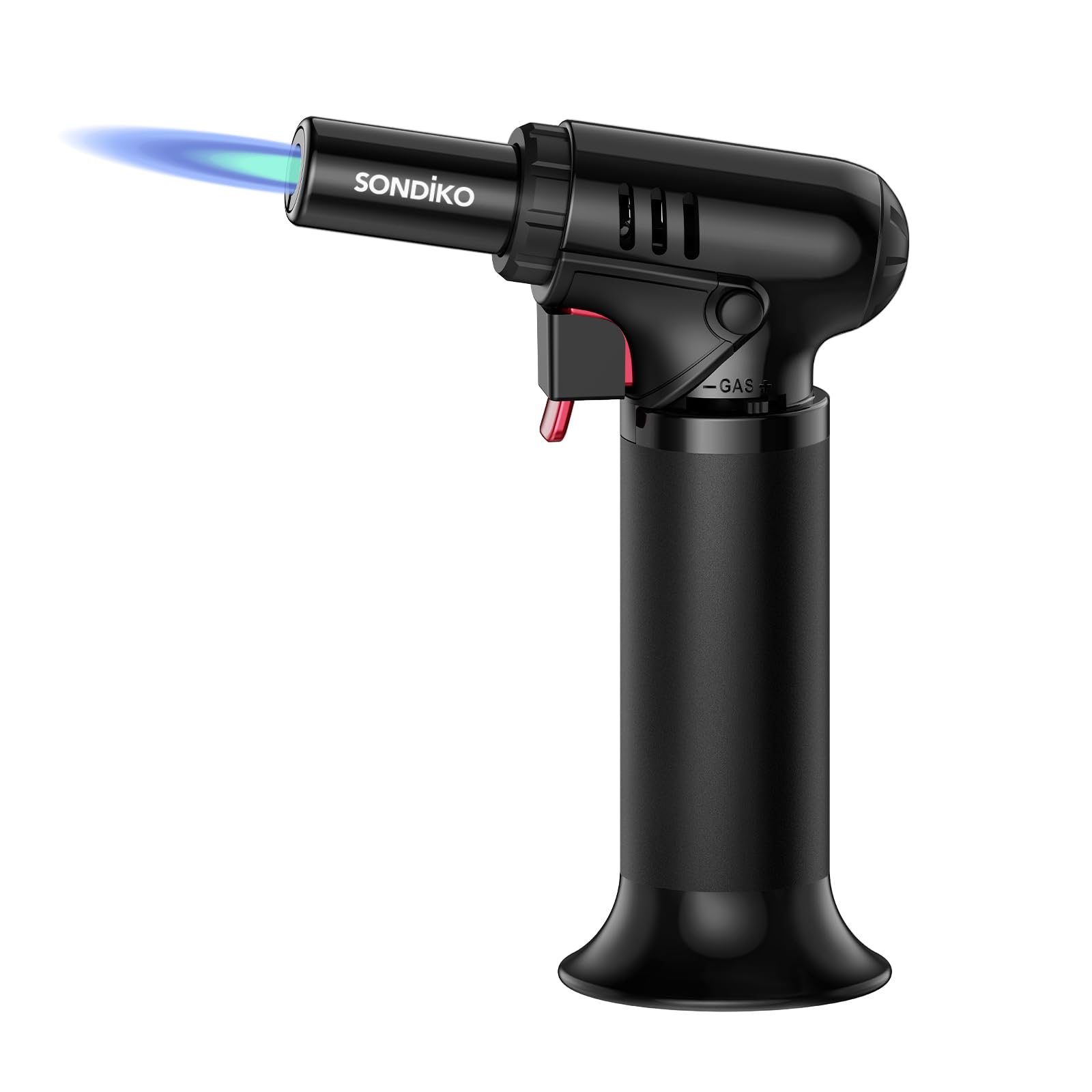
A transparent gauge on the base tells you if you have gas before the flame dies.
Running dry mid-caramelize is the small disaster every torch owner knows. Sondiko’s answer is a see-through fuel window on the bottom of the torch with a MAX line to warn you before you overfill. A full refill holds 10 g of gas, which the maker rates at 20 to 50 minutes of burn time.
The other ergonomic win is placement. The flame regulator and lock button both sit under your thumb, so you can adjust and lock the flame with one hand without putting the dish down. Flame temperature reaches 1350 °C, and the piezo ignition (a spark that lights the gas) lets you use it at any angle, including inverted.
This is where an honest warning belongs. Reports of the ignition system failing and units giving out after a month or two of regular use show up often enough to matter. That does not make it a bad buy for the occasional dessert, but if you plan to torch every day, spend more for the Iwatani or the Chef Master. It also fits any small butane tank through the included red adapter.
Great for occasional use: the fuel window and one-hand controls are genuinely useful for a few desserts a week.
Where it falls short: long-term ignition reliability is the weak link on this one.
Pick it when: you want to see your fuel level and work one-handed for weekend desserts.
Look elsewhere when: you need a torch to survive daily commercial use.
8. RAVS Butane Torch Lighter, Dual Flame Mode

Metal where it counts, so it feels sturdier than the plastic torches at this tier.
Survivability is the selling point. The RAVS is made of quality metal rather than a plastic shell, and it weighs 9.92 ounces — noticeably heavier in the hand than the 6.56-ounce RONXS or the 220 g Tintec. That extra mass and the wide copper base combine to keep it planted on the counter, and a torch that does not tip is a torch that does not roll flame-first across your stove.
Two flame modes carry the cooking side. A knob switches between the dual and soft flame, and the adjuster controls size, reaching 2372 °F. Piezo press ignition works one-handed, and the nozzle refills in about 15 seconds with 8 to 11 g of gas. Turn the flow knob off before filling, or the gas will not go in cleanly.
The trade-off is honest: at the budget end of the metal tier, the flame output is not going to match a 2700 °F Iwatani or a propane gun. Some corners of the review pages find it adequate, others find it modest. If you are searing a steak in a cast iron pan, this is enough. If you want a blast, look up the list.
Worth it for: the metal build and anti-tip base at an entry-tier position.
Worth knowing: the flame is steady but not huge — this is a torch for detail work.
Grab it if: you want the durability of a metal torch without stepping into the premium tier.
Leave it if: raw flame output is your priority.
9. Chef Master Refillable Butane Torch Lighter
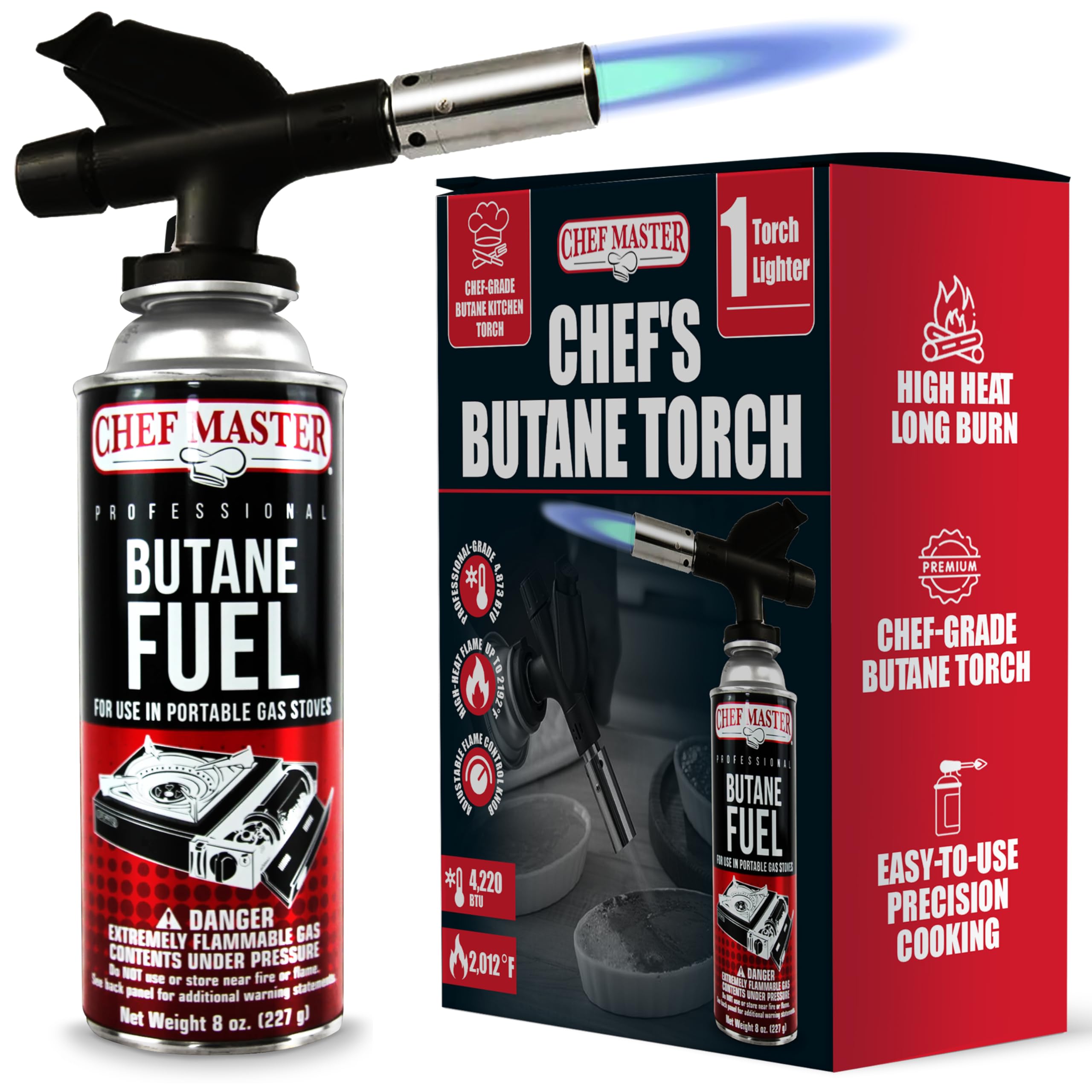
The one built for long sessions, with up to three hours of burn on an 8 oz canister.
If you need a torch that stays lit while you work through a tray of crème brûlées, this is the spec that matters. Chef Master rates it at up to 3 hours of continuous burn from a standard 8 oz canister, far longer than the small butane torches above. It outputs 4,220 BTUs at a maximum of 2,012 °F, and the anti-flare device keeps the flame from popping out unexpectedly.
It is compact at 5.5″L x 3″W x 1.5″H and weighs 6.8 ounces, so the long burn time does not come with a heavy body. The flame control goes from a small focused flame to a wide one, and the dial is praised for holding a setting accurately through a whole session. This one earns its keep in a catering line or on a grill station, not just a home dessert once a month.
Compared with the Iwatani PRO2 and its 2700 °F peak, this Chef Master tops out lower at 2,012 °F — the trade for that peak is the wide flame and the duration. The unit is heavier for its size than the plastic torches, and that weight is deliberate: good heat management keeps the body cooler in the hand. Buyers who need an all-purpose flame source for fireplaces, grills and candles also reach for this one.
The long-session torch: rated to run for up to three hours from one 8 oz tank, which is what separates it from pocket-size butane torches.
Best for: bakers and caterers torching trays of desserts or searing in volume.
Overkill for: one ramekin a month — the long burn time is wasted on small jobs.
10. inZaynity Dual Flame Butane Torch Lighter

The torch that looks like a gift and switches between a roaring jet and a soft flame.
Two flame styles is the feature everyone notices first: a powerful torch flame for concentrated heat and a switch to a softer flame for gentler work. This comes from a body made of kirksite and zinc alloy, weighing 11.04 ounces, which is the heaviest torch head in this group. That is deliberate — the metal body gives it a solid, substantial feel in the hand and looks the part on a shelf.
An adjustable gas flow pairs with a continuous flame lock, so you set the intensity and let it burn hands-free through a row of crème brûlées. The one-handed operation is what makes this a real choice for anyone with limited grip strength — the ignition is genuinely easy to fire. Butane refills are simple and it comes in gift-ready packaging for the chef, bartender or maker in your life.
The honest limit is fuel capacity and durability. The flame is small enough that heavy daily use will mean refilling often, and the refill valve is where the complaints cluster — some units spray butane on the first fill because they ship near full, so purge the air and fill gently. Durability also depends on the load; light use is fine, but a working kitchen will wear it faster than a stainless Iwatani.
What it does well
- Dual flame styles switch with a knob
- Heavy kirksite and zinc alloy body feels solid
- Continuous flame lock for hands-free torching
Where it limits you
- Fuel capacity needs frequent refills under daily use
- The refill valve can spray on the first fill if overfilled
Buy it for: a gift or for a cook who wants one handsome torch on a shelf for weekend desserts.
Don’t buy it for: a commercial kitchen that runs it hard every day.
11. Sondiko Powerful Grill & Cooking Propane Torch L8010

A full propane trigger torch that sears steaks and lights charcoal in the same breath.
This is a different animal from the butane torches above — it connects to a propane tank and produces a much larger flame. The adjustable fuel control stretches the flame up to 1800 °C / 3272 °F, the highest temperature on this list, and the extended angled nozzle plus a burn-free guard keep your knuckles clear of the heat. That reach and that heat are what make it a grill and charcoal tool as much as a kitchen one.
The trigger open up full power and the dial fine-tunes between a focused jet and a wide roar. That range covers steak in a cast iron skillet, crème brûlée under a broiler, melting cheese on a pizza, and firing up a chimney of lump charcoal faster than a starter chimney. The body is at 12.2″L x 2.3″W x 5.1″H, 430 g, in stainless steel and plastic.
Two things to accept before you buy. It needs a propane tank, and neither the tank nor the adapter is included, so factor that into the setup. And the trigger does the ignition, not the flame level — once lit, you adjust with the knob. Owners who like big flames and grilling find it reliable; owners who want a delicate dessert flame should stay with a butane head.
Power first: the highest flame temperature here at 1800 °C / 3272 °F, with a burn-free guard for close work.
Setup cost: tank and adapter are sold separately, so the first session needs a trip to the hardware store.
Choose it if: you grill, sear and light charcoal more than you torch dessert.
Steer clear if: you only need a small flame for sugar and cheese.
12. ThermoMaven Propane Torch Gun

The gun-shaped fire starter that turns a bed of charcoal into usable heat fast.
Shape says it all here — this is a torch gun designed to be pointed from a distance at a grill or a fire pit. The flame reaches 1800 °C / 3272 °F, matching the Sondiko L8010 above, from an ABS gun body with a brass valve measuring 13.81″L x 5.81″W x 2.3″H and weighing 1.1 pounds. The long reach and the trigger-style one-touch ignition keep your hand out of the heat path.
Where it earns its place is fire starting and grilling. It lights a full chimney of charcoal in a fraction of the time a paper starter takes, and it sears a steak or chars peppers in the same session. The adjustable knob lets you dial from a focused blue jet down for a gentler flame, and the safety lock stops accidental ignition between uses.
The catch to pay attention to: the gas canister is sold separately and the built-in igniter is the part most likely to cause frustration — reports of it quitting after a while exist. Use the knob between 50 and 150 degrees to ignite, avoid holding the max-power button to start, and detach the canister between uses. Store it separately and it will not leak down between sessions.
What it does well
- 1800 °C / 3272 °F flame from a long gun body
- Trigger ignition keeps your hand away from the fire
- Safety lock and adjustable knob for controlled work
Where it can disappoint
- Built-in igniter is the part that gets reported as failing
- Canister sold separately — not ready to use on arrival
Pick it for: charcoal, fire pits and backyard searing from a safe distance.
Not your tool if: you want a small, precise dessert flame.
13. Jo Chef Superior RX Kitchen Torch Kit with Butane
The only pick that arrives ready to light, with two butane cans and a purge tool in the box.
Most torches here make you buy fuel separately. The Jo Chef Superior RX kit skips that: two 3.38 oz butane cans, a purge tool, five nozzle adapters and a 23-recipe eBook ship alongside the torch, so the first crème brûlée happens the day it lands. The flame reaches 2,370 °F and the body is alloy steel with aluminum and a wide non-slip base that keeps it steady on a counter.
The detail that separates it from the Sondiko fuel-window torch is the gauge placement — a built-in fuel window shows how much gas is left before you start, and the purge tool clears trapped air so a refill actually goes to full. The base is a separate piece, which is why it stays planted. This is a kit aimed at someone who wants the whole setup in one box rather than a bare torch.
The recurring gripe is on the fill side: butane can spray out and run down the side of the torch if the valve is overfilled or if air is not purged first. Loosening the valve slightly during refill solves most of it. A 36-month warranty backs the unit, and the safety lock and anti-flare design add a second guard against accidental ignition.
The all-in-one: torch, two butane cans, five adapters and a purge tool together — no separate fuel run needed.
The one thing to master: refilling with the valve slightly loose avoids the sputtering that plagues a rushed fill.
Right for: a first torch buyer who wants everything in one order and a fuel gauge to watch.
Not for: anyone who already owns a canister of butane and only wants the torch.
14. SearPro Charcoal Torch Lighter

The steak-and-charcoal torch built for volume, with a wide flame that sears in seconds.
If you sous vide a steak and want a restaurant crust without a broiler, this is the torch for that job. The SearPro pushes over 1800 °F from a 13.3″L x 6.5″W x 3″H body weighing 1.2 pounds, and it connects to any one-pound butane, MAPP gas, Bernzomatic or Coleman propane tank. That tank compatibility is part of the appeal — you can source fuel almost anywhere.
It is a searing tool and a fire starter in one. It licks a flame over a filet mignon, glazes a ham, caramelizes ribs, and gets lump charcoal roaring quickly. The adjustable fuel control lets you dial it down for a skillet or up for a job that needs the big flame. It is aimed squarely at outdoor and grill duty, not at careful dessert work.
The honest trade-offs are noise and size. This flame is large and loud, so it is not a torch to use under a low kitchen hood over a delicate dessert. Some units have run flawlessly for years and then quit, which is the reality of any propane gun at this tier. The tank is not included, and disconnecting the propane between uses is the safe habit to build.
Built to sear: over 1800 °F and a wide blue flame that will crust a steak fast.
Not for delicate work: this flame is loud, large and hot — it is a grill station tool, not a dessert torch.
Buy it for: sous vide searing, charcoal lighting and outdoor cooking where power beats finesse.
Skip it for: indoor desserts or small kitchens with low clearance.
15. Rösle 12844 Crème Brulee Kitchen Cooking Torch

A stainless torch designed to sit on the counter and feel like a kitchen tool, not a gadget.
This one is for the cook who wants a torch that looks like it belongs next to the stand mixer. The Rösle 12844 is stainless steel, presented in white and silver, at 3.5″L x 5″W x 6.7″H and weighing 260 g. It runs standard lighter gas, has an adjustable gas dial to regulate flame size, and reaches 1300 °C — the same ceiling as the RONXS and the Rösle runs on a child-resistant safety switch.
The build quality is the part that holds up over years. The flame adjusts from a tiny focused point to a larger surface flame, which is why it lands neatly on desserts and roasted peppers. It sits balanced and upright without a separate stand, and it does not wobble while you work. On the dessert side, buyers get good results once they learn the ignition rhythm.
The honest caveat is the safety switch and the starter. The switch is a two-part motion that some find awkward, and the button takes a firm press to fire the piezo spark — some units are fussier than others about ignition. Refilling also takes a bit of practice, as with most butane torches. Once you have the sequence down, this is a calm, well-made torch for serious home cooking.
What makes it stand out
- Stainless steel body that sits upright without a stand
- Adjustable gas dial for flame size
- Reaches 1300 °C for cooking and roasting
What takes practice
- The safety switch and starter need a firm, deliberate press
- Refilling technique matters more than on some rivals
Ideal if: you want a good-looking stainless torch that lives out on the counter.
Not for you if: you want one-click ignition with no learning curve.
Know the Specs
Maximum temperature (°F and °C)
This is the hottest flame a torch can produce, and it tells you what kind of cooking it can handle. A lower ceiling like 1300 °C still caramelizes sugar just fine. A much hotter flame like 1800 °C sears and chars and lights charcoal fast. Do not read a higher number as automatically better for dessert — a hot flame with a coarse low setting will scorch sugar before the crust sets.
Fuel type and canister fit
Butane is sold in small handheld canisters and gives a fine, controllable flame for small pans of dessert. Propane comes in one-pound tanks and gives a much larger flame for grills and charcoal. Most butane torches include an adapter to fit long or short canister nozzles; check this before buying, because a torch that will not fit your canisters is a paperweight until you find the right tank.
Continuous flame lock
This is a small switch that holds the flame on after you press the ignition, so you can move your hand and work without a thumb jammed on the button. For hand-held dessert work it lets you rotate a dish, plate a dessert or hold jewelry pliers. The safety habit that goes with it: always return the lock to OFF and set the flame adjusting knob to the lowest level before storage.
Body material and base stability
Metal bodies — aluminum, stainless steel, alloy steel or zinc alloy — resist heat and survive drops better than an ABS shell. A wide base or a separate stand makes the torch stand upright on its own, which matters because a hot torch that tips over is a genuine hazard. A base that does not sit flush and a torch that will not stand up is worth treating as a red flag.
Common Questions
Will a butane kitchen torch sear a steak as well as a propane torch?
Is a butane torch safe to use over a gas stove?
How do I refill a butane kitchen torch without it spitting fuel?
How long does a butane kitchen torch flame burn on one fill?
Can I use a kitchen torch to light charcoal or a fire pit?
Will high-purity butane make a difference to my torch?
Can I use a kitchen torch for soldering and jewelry work?
Does the torch come with butane included?
How long should a kitchen torch last before it needs replacing?
The Bottom Line
For almost every home cook, the kitchen torches winner is the Iwatani PRO2 because its stainless steel body, 2700 °F flame and adjustable shape handle sous vide searing and crème brûlée in one tool. With 4.5+ stars across 2,500+ owners, it is the one buyers report keeps its flame control after years of use. If you want a starter kit that arrives with butane and a fuel gauge, the Jo Chef Superior RX is the pick. And for grilling and charcoal, the Sondiko L8010 propane torch delivers the widest, hottest blast on this list.
How we choose
We do not accept paid placement. Every pick is matched to a real buyer and a real use-case; we do not hands-on test units.
Sources
Specifications: manufacturer listings and product documentation. Review insights: verified customer reviews, as of October 2026. Pricing: not shown on this page (it changes often); check the current price via the retailer link.
As an Amazon Associate, Aappliancez earns from qualifying purchases. This does not affect which products we feature.