Disclosure: Some links in this post are affiliate links. As an Amazon Associate I earn from qualifying purchases, at no extra cost to you. Learn more
Specs are compiled from manufacturer listings and verified buyer reviews and can change over time — please confirm the key details on the product page before buying.
Thock is the low, rounded, wooden knock you hear when a key bottoms out on a well-damped board. If your keyboard currently answers back with a thin, plasticky tick, the keycaps are usually the cheapest place to fix it — not the switches. The short answer: thick PBT walls, a sculpted profile, and a full-cover kit do the heavy lifting, and the sets below are the ones worth your money. Below you’ll find seven picks sorted by what they actually change about the sound and feel of your board.
This guide is built by comparing the manufacturers’ published specifications and the patterns across verified customer reviews, so you get each pick’s real strengths and trade-offs instead of marketing spin.
Wall thickness, plastic type, and profile height decide whether a set sounds hollow or deep, and every pick here is judged on those three things. Here is what to know before you shop for the keycaps for thock.
Top Picks


How To Choose The Best Keycaps for Thock
Start with plastic type, because it decides more of your final sound than the colour ever will. ABS is the soft, cheaper plastic most stock keyboards ship with — it goes greasy and shiny with finger oil, and it rings higher. PBT is denser and harder, and it holds a deeper note as your finger lands.
Wall thickness is the real thock lever
Thicker plastic moves less air and eats more of the hollow echo inside the cap. Sets on this list publish walls around 1.5mm, 1.6mm, and 1.7mm, and you can feel the difference in your fingertips before you hear it. A thin cap sounds like a tap on an empty cup; a thick one sounds like a knuckle on a wooden table.
Profile height changes both sound and reach
OEM profile is the tall, trapezoidal shape with stepped rows — it fills a case with more air and tends to sound bigger. Cherry profile sits lower and flatter, so your fingers stretch less between rows and the tone tightens up. If your current caps feel like your hands are climbing, a lower profile is the fix.
Count your keys before you buy
Buy the key count your board actually needs, or you’ll be stuck with gaps. A 108-key set fits a standard full-size board and nothing else. Move up to 140, 143, or 168 keys and you get the extra sizes that 65%, 75%, 96-key, and Mac layouts need. Check your spacebar width first — the common standard is 6.25u (u is one standard key width, so 6.25u is about six and a quarter keys long). Also check if you need a big Enter key for an ISO board (the European layout with a tall, L-shaped Enter).
Backlight versus legend clarity
Shine-through legends glow through the cap, which is lovely in a dark room and useless in daylight if the print is faint. Opaque dye-sublimated legends stay crisp and readable but block the light. Decide which one you actually sit in front of before you commit.
Side-by-Side Comparison
| Model | Best For | Material & Wall | Profile | Key Count | Amazon |
|---|---|---|---|---|---|
| JSJT Ink Lotus★ Best Overall | Deep tone on a budget | PBT, oil-resistant | OEM | 140 keys | Amazon |
| Glorious GPBT Arctic WhiteSolid Heft Pick | Clean look, solid heft | Thick PBT | Cherry | 114 keys | Amazon |
| YMDK Double Shot 108 Carbon | Backlit boards | PBT, double shot and dyed | OEM | 108 keys | Amazon |
| YMDK 143 Shenpo | Mac and retro boards | Full PBT, around 1.5mm | Cherry | 143 keys | Amazon |
| YMDK 145 Apricot Yellow | Deep marble-like sound | PBT, around 1.7mm | Cherry | 143 keys | Amazon |
| PBT Moonlit Gradient | Dark rooms and RGB | PBT, frosted feel | Cherry, side print | 128 keys | Amazon |
| dokodoko Bento | Full kit, calm desk look | Thick 1.6mm PBT | Cherry | 168 keys | Amazon |
Detailed Reviews
1. JSJT Ink Lotus Keycaps
Our pick — 4.5+★ from 300+ verified ratings; the strongest balance of quality and price.
A 140-key kit in oil-resistant PBT that turns a thin-sounding board into something with weight behind each press.
The 140-key count is the reason this one takes the top spot. That is 32 more caps than the 108-key YMDK Double Shot set, so you get the extra sizes that 64-, 68-, 84-, 96-, and 98-key boards need. It also includes a large Enter key for ISO layout boards, which most kits this size skip. The plastic is oil-resistant PBT, which holds its hardness far longer than the ABS most boards ship with — your caps won’t turn greasy and shiny after a few months of typing.
The OEM profile is the tall, trapezoidal shape with a stepped R1–R4 row layout. That taller shape leaves more air inside the cap, which is exactly what gives you the bigger, rounder knock at the bottom of each press. The set is designed for both backlit and non-backlit boards, and it works with Cherry MX switches and clones including Gateron and Kailh. You also get a keycap puller in the box, so you can swap the whole board in one sitting.
Buyers single out the density of the PBT, and the matte finish keeps fingerprints off while keeping the tone dry. Buyers report: “These things have lasted me multiple keyboards, speaks enough for their build quality. They still look the same since i bought them and it’s been either one or two years.” The finish is matte rather than glossy, which keeps fingerprints off and keeps the tone dry. Installation is genuinely simple: pull the old caps and push these on.
Where this set delivers
- 140 caps cover far more layouts than a standard 108-key kit
- Oil-resistant PBT resists shine and greasy buildup
- Includes a large Enter key for ISO boards and a puller in the box
- The tall OEM row shape gives a bigger, rounder bottom-out tone
Where it asks for patience
- The spacebar can rub on the bottom wall and stick — check clearance before you commit
- Backlight support is single-colour, so a rainbow RGB board won’t glow as evenly
Worth grabbing if: you run a 65%, 75%, or 96-key board and want the deepest tone available at the entry tier.
One real catch: the spacebar fit is the weak point — a replacement can carry the same rub, so test clearance early.
2. GLORIOUS GPBT Keycaps
A heavy white set that sits low on the fingers and lands with a dense, satisfying clack.
Weight tells you a lot here. This set tips the scale at 0.36 kg, while the YMDK Double Shot 108 weighs 0.1 kg — the GPBT set is doing far more with its plastic per key. That mass is the reason each press sounds fuller rather than hollow. The Cherry profile sits lower and flatter than the OEM shape on the JSJT Ink Lotus, which pulls your fingers closer between rows and gives a tighter, less airy tone.
The 114 keys cover full-size, TKL, compact, and 75% boards, and the set is built to fit all GMMK and GMMK Pro models. The dye-sublimated legends are clean and non-transparent, so there is no shine-through at all — the lettering is baked in rather than glowing. That is a deliberate trade: gorgeous and readable in daylight, invisible in a dark room. If you type mostly with lights on, this is exactly right.
Owners praise the smooth, dense feel of the thick PBT, and the dye-sublimated legends sit under the surface so they resist wearing off. Dye-sublimated legends sit under the surface rather than on top, so they resist wearing off at the fingertips. One honest note from real experience: at full retail it’s a hard value read because the kitting skips a stepped caps lock and option/command keys — the set is a much smarter buy when it dips. Pick this if your board is a GMMK or a plain ANSI layout and you want the clean look.
What the extra mass buys you: 0.36 kg of thick PBT means the caps don’t ring — you get a fuller, more grounded knock on every bottom-out.
The honest follow-up: no shine-through legends, so on an unlit desk in the evening you’ll be reaching by feel. If backlighting is non-negotiable, the YMDK Double Shot 108 above is the better fit.
Reach for this if: you want heavy, low-profile caps in a clean white that will outlast several boards.
Look elsewhere if: your heart is set on glowing legends — these are deliberately opaque.
3. YMDK Rainbow Carbon Sunset Keycap

The one to get when your board has LEDs and you still want a deep, thocky OEM knock.
Shine-through is the headline. The legends are double shot and dyed so the light comes through cleanly, which means you can actually see your keys after dark and keep the thock intact. At 0.1 kg it’s a lighter set than the 0.36 kg GPBT above, so the tone runs a touch less dense — but the double-shot construction keeps the caps thick and the feel solid. The OEM profile adds the taller air chamber that deepens the bottom-out.
The 108 keys fit standard 61-, 87-, 104-, and 108-key ANSI MX boards, and the set is built around a 6.25u spacebar (11.7cm across) with 7 keys at 1.25u. Note the limits up front: this set does not work on 64-, 68-, 75-, 84-, or 96-key layouts that need special Shift, Alt, and Fn keys. Old Cherry boards like the 1800 with a different spacebar back hole won’t fit either. Check your bottom row before you order.
The shine-through legends are the draw, and owners mention the caps stay readable with the backlight both on and off. Owners note the caps are readable both with the backlight on and off, which is more than most shine-through sets manage. The tricky part is unevenness: darker caps in the set use a tan or brown shine-through material while the lighter caps use white, so a yellow reading shifts toward orange and blue drifts to purple. If you run a single solid colour, that’s invisible. If backlight uniformity is your priority, know it going in.
Who it beats: any opaque set on a backlit board — this is the pick when you want the LEDs to actually do something.
Who should pass: 75% and 65% owners, since the 108-key kit won’t cover layouts needing special Shift and Fn keys.
4. YMDK 143 Shenpo Keycaps

Two-tone beige in full PBT with Mac legends, built for the desk that wants a vintage look and a tight tone.
This is the Mac-friendly option. Full PBT with walls around 1.5mm and a Cherry profile, so you get the low, tight knock rather than the taller OEM echo. The 143 caps cover ANSI 104, TKL, GK61, 96, 75, GMMK, and NCR80 boards, and the set works on both north- and south-facing PCBs — which means your backlight setup won’t break the sound. Dye-sublimated legends are pressed into the plastic, so they don’t wear off at the surface.
The retro two-tone beige with grey-on-beige contrast and dark legends is the hook. Retro two-tone beige with strong grey-on-beige contrast and dark, readable legends reads like hardware from another decade, and the caps arrive in a compact kit with a puller. Thickness is where it earns the tone — the caps have a pleasant weight in the hand and a smooth, non-slippery texture under the finger. Installation is straightforward and the caps sit even and secure once they’re on.
The one thing to watch is consistency between batches. Over time the profile has shifted, with one run coming out flatter and wider with tighter key gap and better board fit than a later run. That’s a quality-control variable, not a sound problem — the tone stays consistently deep. Legends sit around 95% clean, with some characters a touch thicker than others. If you want an exact match to a set you already own, order together.
Why the retro crowd loves it: real Mac legends and a beige two-tone that no other set on this list offers, plus full PBT walls around 1.5mm for a dry, tight knock.
The catch worth knowing: profile consistency can drift between production runs, so a set bought months apart may not match perfectly.
Buy it for: a Mac or NCR80 build that needs a beige throwback look with genuinely deep, low-profile sound.
Think twice if: you need an exact match to an older set from the same line — profile runs can vary.
5. YMDK 145 Apricot Yellow Keycaps

Walls around 1.7mm thick, and you hear every bit of it — this is the deepest-sounding set here.
If thock is a number, 1.7mm is the one to chase. That’s the thickest published wall on this list, and the extra plastic is what produces the deep, marble-like knock that owners describe. The Cherry profile keeps the fingers low between rows, and the caps use full PBT with a soft, slightly grippy top texture rather than a slick finish. Dye-sublimated legends are pressed in, so the lettering stays bold and consistent.
Compatibility is broad. The set fits most MX-switch boards in 61, 64, 68, 75, 84, 96, 104, and 108 sizes with a 6.25u spacebar, and it covers YMD96, Melody96, Kira96, GK64, Tada68, KBD75, KBD67, and GMMK builds. It also fits Cherry 3800, 3000, and 3850 boards plus the SF Mini, GK61, and Anne Pro. North- and south-facing PCBs both work, and the kit includes multiple Mac Opt and Cmd keys in two different sizes.
The capsule review from real desks: “Thick as described, very thocky sound.” That matches what most buyers describe — deep tone, uniform walls, clean lettering, and colour that matches the photos. The honest limit is long-term durability, which is genuinely unknown for this dye-sub process — but the set is cheap enough that replacing it down the line isn’t painful. Not GMK quality, and it doesn’t pretend to be.
The thock ledger: 1.7mm PBT walls, a Cherry profile, and a soft textured top add up to the deepest tone on this list.
The open question: how many years those legends hold up is unknown — plan for replacement rather than forever.
Choose it for: a Mac-friendly board with the deepest, heaviest knock this side of premium sets.
Don’t pick it if: you want a proven decade-long legend lifespan — this one is a replace-when-worn value play.
6. PBT Moonlit Keycaps

A gradient blue set with side-printed legends that turns your board into a mood-lit desk piece.
Side print is the differentiator. The legends sit on the front face of the cap rather than the top, which keeps the top surface clean and lets the shine-through land where your eye actually catches it. Combined with the Cherry profile, the fingers sit lower and stretch less between rows — the shape tightens the tone and keeps the press comfortable over a long day.
The 128 caps cover 60%, 65%, 75%, 80%, and 96-key boards with a TKL footprint, and they’re designed for MX switches. The material is frost-feel PBT with high hardness, which resists the greasy shine ABS develops. Dye-sublimation keeps the vibrant gradient colours locked in, so the look holds up rather than fading across months of use. You get a puller in the box.
The royal blue gradient is the draw here, and it reads as elegant rather than loud on a desk. Owners describe the weight as substantial and the sound as creamy rather than clicky, which is exactly the thock target. The practical upside is after-dark use: the shine-through makes the keys and the RGB readable while you work in a dim room. One watch point — the space bar print can show pre-existing wear on arrival, so eyeball that cap first.
This is your set if: you work after dark and want side-printed legends that glow without a loud top graphic.
Skip past it if: your board’s backlight is uniform single-colour and you want even light across every cap — side print changes where the glow lands.
7. dokodoko Bento Keycaps
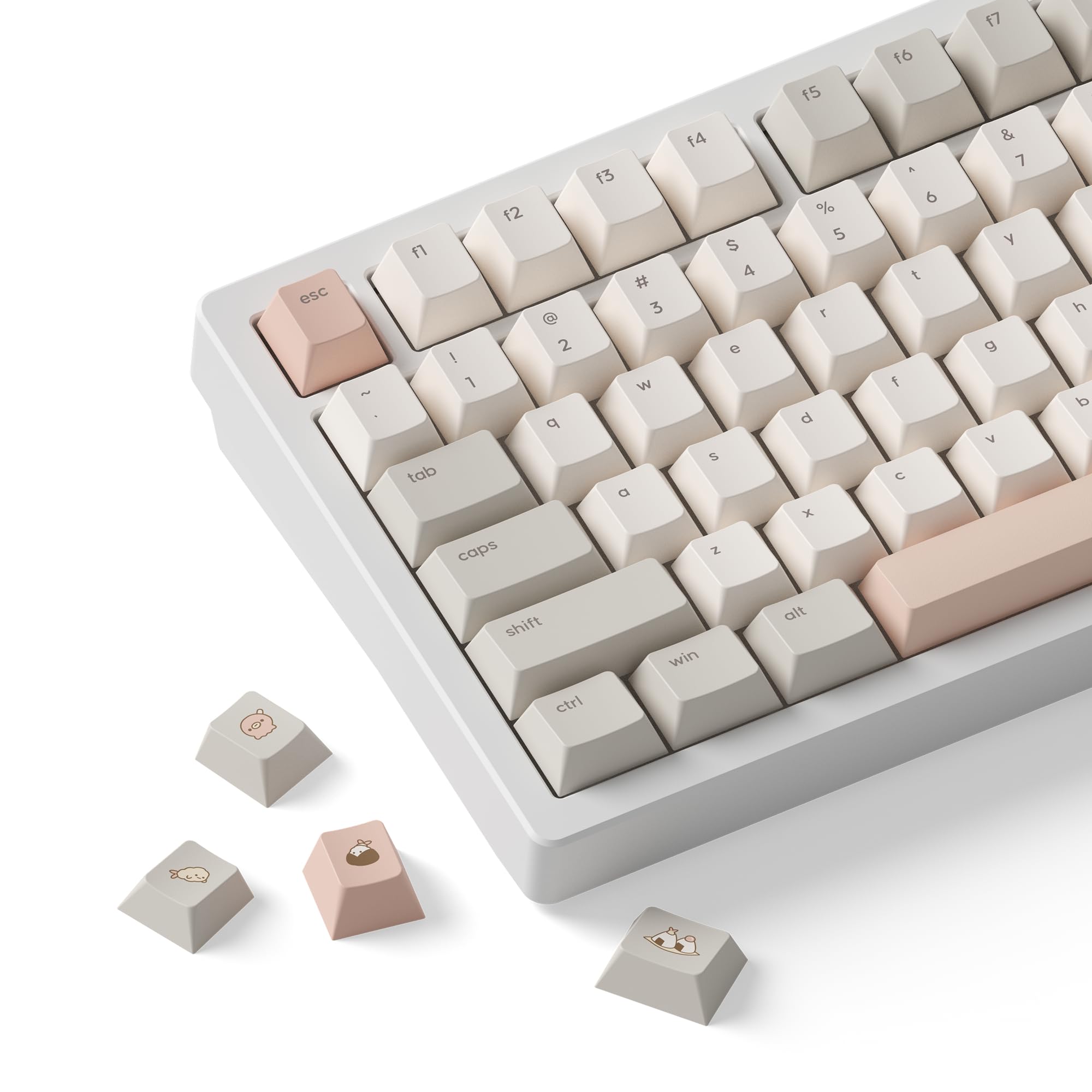
168 keys of thick 1.6mm PBT, built so you never order a second set to fill a gap.
The count is the argument. At 168 keys this is the largest kit here, and it covers 60%, 65%, 75%, TKL, and full-size 100% layouts plus novelty keys and Mac support. That means no hunting for add-on caps later. The plastic is thick 1.6mm PBT, which resists shine, wear, and oil buildup, and the Cherry profile keeps the fingers in a natural spot with lower travel between rows.
The look is deliberately quiet — subtle lettering in soft pastel tones that stays readable without shouting. The lowercase font and glossy novelty keys give it character without turning your desk into a toy. Legends are dye-sublimated so they resist fading, and the sculpted rows help typing accuracy across long sessions. Installation is straightforward: pull the old caps and push these on. It’s built for Cherry MX and MX-style switches including Gateron, Kailh, and Akko, but it won’t work on low-profile or membrane boards.
The thick 1.6mm walls give a clean, deep knock that matches the calm pastel look. “They sound great on aluminum keyboards” is the gist of it, and the thick walls give a clean, deep knock that matches the calm look. Buyers praise the thick 1.6mm PBT most, comparing it to sets that cost far more. The one honest callout: the actual shade runs slightly more peachy than the product photos on some colourways, so if you need an exact match to a photo, expect a warmer tint in person.
Why it earns the full-kit crown: 168 keys covering every mainstream layout plus Mac and novelty caps — one order, no gaps.
The colour caveat: some shades read more peachy in person than on screen, so plan around a warm pastel rather than a cool one.
Best call for: anyone who wants one complete kit that covers any board they own now or later.
Reconsider if: you’re matching an exact colourway from a photo — real tones run slightly warmer.
Know the Specs
PBT versus ABS plastic
PBT is the denser, harder plastic that gives a deeper knock and resists the greasy shine that finger oil causes on ABS. ABS is softer and cheaper, and it goes shiny faster — which is why most stock keyboards sound thin and look worn within months. Every set on this list is PBT, though one YMDK listing carries a spec table that names ABS; the buyer-facing description and reviews point to PBT in practice.
Wall thickness in millimetres
The wall thickness is the plastic shell’s depth, and it directly controls how much hollow ring you hear. The sets here publish walls around 1.5mm, 1.6mm, and 1.7mm — thicker walls deaden the empty-cup tone and produce a woodier knock. A thicker cap also feels weightier under the finger, which changes the perceived press even on the same switch.
Profile height explained
Profile is the shape of the cap across rows. OEM is the taller trapezoidal shape that leaves more air inside and sounds bigger; Cherry sits lower and flatter, tightening the tone and shortening the finger travel between rows. Neither is better — OEM tends to sound deeper, Cherry tends to feel more precise over long typing sessions.
Shine-through and dye sublimation
Shine-through caps let the backlight pass through the legend so it glows, which is a real benefit in a dark room. Dye-sublimated legends are pressed into the plastic rather than printed on top, so they resist wearing off — but they’re usually opaque, which blocks the glow. Decide which matters more by the light you actually type in.
Common Questions
Will these keycaps make my keyboard sound deeper?
What does “thock” actually mean for a keyboard?
Will a 108-key set fit my 75% or 65% keyboard?
What is 6.25u on a keycap set and why does it matter?
Will shine-through keycaps work with my RGB keyboard?
Do thick PBT keycaps last longer than my stock caps?
Can I use Cherry profile caps on an OEM profile board?
What if a keycap won’t fit my spacebar?
How do I install a new keycap set safely?
The Bottom Line
For most desks, the keycaps for thock winner is the JSJT Ink Lotus — 140 keys of oil-resistant PBT in a tall OEM shape, and it covers the compact and full-size boards a 108-key set can’t touch. If you want backlight glow, grab the YMDK Double Shot 108 for its shine-through legends and low per-set heft. For the single deepest tone on the list, the YMDK 145 Apricot Yellow at 1.7mm walls is the one to reach for.
Want the whole kit in one order and a calmer desk look? The dokodoko Bento at 168 keys leaves no layout gaps, so every board size on your desk gets covered in one go. Its 168 keys cover every mainstream layout, so it’s the one set to buy if you want to cover every board on your desk in one order.
How we choose
We do not accept paid placement. Every pick is matched to a real buyer and a real use-case; we do not hands-on test units.
Sources
Specifications: manufacturer listings and product documentation. Review insights: verified customer reviews, as of October 2026. Pricing: not shown on this page (it changes often); check the current price via the retailer link.
As an Amazon Associate, Aappliancez earns from qualifying purchases. This does not affect which products we feature.