Disclosure: Some links in this post are affiliate links. As an Amazon Associate I earn from qualifying purchases, at no extra cost to you. Learn more
Specs are compiled from manufacturer listings and verified buyer reviews and can change over time — please confirm the key details on the product page before buying.
If you have ever held a urine strip up to a color chart and squinted, you already know why blood ketone meters exist. A blood meter gives you an actual number instead of a shade of pink, and that number tells you whether your low-carb or fasting plan is genuinely working. The tricky part is choosing one, because the meter itself is the cheap half and the test strips are the half that drains your wallet month after month. This guide walks you through seven meters worth your attention, explains what the numbers on the box actually mean, and points you to the one that best fits how often you plan to test.
This guide is built by comparing the manufacturers’ published specifications and the patterns across verified customer reviews, so you get each pick’s real strengths and trade-offs instead of marketing spin.
Some meters measure ketones alone, while others handle blood glucose on the same strip port so one device covers both jobs. The seven picks below cover both camps, from a heavy-use kit with 140 strips to a compact single-meter setup. Each pick below matches a real testing habit, so the right ketone meter is the one whose strip supply and read time fit how often you test.
Top Picks


How To Choose The Best Ketone Meter
A ketone meter is a small handheld device that reads your ketone level from a single drop of blood on a test strip. It measures beta-hydroxybutyrate (the ketone your blood carries). You prick your finger with a lancet, touch the strip to the blood, and the screen shows a number in mmol/L (millimoles per liter — the standard unit for measuring how much of a substance is dissolved in your blood). That number tells you whether you are in ketosis, unlike a urine strip that only shows a color.
Decide if you need ketones only or ketones plus glucose
This is the first fork in the road. Some meters read ketone strips only, which is fine if your single question is “am I in ketosis?” Others, like the Keto-Mojo GK+ and the KetoBM system, read both ketone and glucose strips through the same port. If you are tracking how your meals move your blood sugar alongside your ketone level, the dual-testing kits save you from carrying two devices. If you only ever test ketones, a single-purpose meter keeps things simpler.
Do the strip math before you fall in love with the meter
The meter is a one-time buy. The strips are not. Ketone strips typically run far more per strip than glucose strips, and how many tests you run per day decides your real ongoing cost. A kit that lands with 50 or 60 ketone strips built in, like the KetoSens 60-strip set, delays that restocking bill. A kit with 10 strips gets you started but has you back at the checkout quickly if you test daily. Be honest about your testing rhythm before you choose.
Weigh read time and blood sample size
Two numbers describe how gentle and how fast a meter is. The sample size is how little blood the strip needs — the KetoSens meter needs just 0.5 microliter, which is a barely visible dot. The read time is how long the screen takes to show your number, and the KetoSens and the FORA Test N’GO both quote results in 8 and 10 seconds respectively. Smaller samples and shorter waits matter most if you test several times a day or if finger pricks bother you.
Check the app side before you commit
Bluetooth syncing turns a pile of one-off readings into a trend you can study. Most meters here pair with a free phone app. The Keto-Mojo uses MyMojoHealth and can push data into Apple Health, Cronometer, and Carb Manager. The KetoBM kit uses its own free iPhone and Android app with no subscription. A meter that logs every reading automatically saves you from scribbling in a notebook, especially if you share numbers with a doctor.
Side-by-Side Comparison
| Model | Best For | Tests | Read Time | Connectivity | Amazon |
|---|---|---|---|---|---|
| KETO-MOJO GK+ 140-Strip Kit★ Best Overall | Heavy daily testing | Ketones + Glucose | — | Bluetooth | Amazon |
| FORA Test N’GO Advance Ketone StripsCompact Pick | Ketone-only tracking | Ketones | 10 seconds | Bluetooth | Amazon |
| KetoBM Glucose & Ketone System | Budget dual testing | Ketones + Glucose | 10 seconds | Bluetooth | Amazon |
| KetoSens Bluetooth Starter Kit | Gentle small-sample testing | Ketones | 8 seconds | Bluetooth | Amazon |
| KETO-MOJO GK+ Fasting Kit | Long-term daily users | Ketones + Glucose | — | Bluetooth | Amazon |
| KetoSens 60-Strip Set | Less frequent restocking | Ketones | 8 seconds | No Bluetooth | Amazon |
| Precision Xtra Meter Bundle | Glucose and ketones in one unit | Ketones + Glucose | — | No Bluetooth | Amazon |
Detailed Reviews
1. KETO-MOJO GK+ Glucose & Ketone Meter Kit, 140 Strips
Our pick — over 4.5★ from 500+ verified ratings; the strongest balance of quality and price.
The kit that lands with enough strips to actually build a testing habit
If you plan to test every day, the strip count decides everything, and this is where the Keto-Mojo GK+ pulls ahead. The bundle arrives with 70 glucose test strips and 70 ketone test strips — 140 strips total — plus the Bluetooth meter, a lancing device, 20 sterile lancets, control solutions, and two pre-installed AAA batteries. That is enough supply to test both ketones and glucose for weeks without an immediate reorder. For anyone who has priced ketone strips one box at a time, that head start is the whole argument.
The meter itself reads both ketone and glucose strips through the same port. You do not swap devices when you want to check blood sugar alongside ketones. Each strip is individually foil-wrapped to keep it clean and dry until you tear it open, and the included control solutions let you spot-check that the system is behaving. Readings sync over Bluetooth to the free MyMojoHealth app, which works out your Glucose Ketone Index (GKI — a single number combining your glucose and ketone readings so you can track how deep into ketosis you are). The app also pulls into Apple Health, Cronometer, and Carb Manager, so your food log and your readings live in the same place.
This device wins people over by behaving reliably and getting out of the way. Buyers describe it as compact but useful and durable. One buyer says the household uses it to stay on track because it is easy to use and shows both glucose and ketone numbers clearly. Owners say it helps you see what makes you spike and what makes you drop out of ketosis. The recurring gripe is the strip price once the included supply runs down, so weigh how often you test before you commit.
Where it earns its place
- 140 strips in the box — 70 ketone plus 70 glucose — so you are not restocking in week one
- One meter reads both ketone and glucose strips, no second device needed
- MyMojoHealth app calculates your GKI and syncs to Apple Health, Cronometer, and Carb Manager
- Built-in control solutions let you verify the system is reading correctly
The honest trade-off
- Replacement ketone strips are the priciest part of ownership — the meter is the cheap half
- Some owners find strip accuracy varies from batch to batch, so a control test is worth learning
- The kit takes up more shelf space than a bare meter thanks to the lancing device, lancets, and solutions
Built for: the daily tester who wants ketones and glucose from one meter and a strip stash that lasts.
Less ideal if: you test once a week — you would be paying up front for strips you will not burn through quickly.
2. FORA Test N’GO Advance Blood Ketone Test Strips, 50 Count
Fifty ketone strips in a single vial and a ten-second answer
This one is for the keto dieter whose only question is whether ketones are where they should be. It ships as 50 blood ketone test strips in one vial, built for the FORA Test N’GO Advance meter, and skips glucose entirely. If you already own the meter and just want a steady supply, this is the straightforward restock. If you are new to testing, know going in that you are buying the strips side of the equation, not a full kit.
The two numbers that matter here are speed and sample size. Results land in 10 seconds, and the strip needs just 0.8 microliters of blood — a tiny dot most people barely feel after the lancet. Readings cover a range of 0.1 to 8.0 mmol/L, which comfortably spans the ketone levels a low-carb eater will typically see. The strip uses a Hydroxybutyrate Dehydrogenase enzyme to read the beta-hydroxybutyrate in your blood, and results sync over Bluetooth to your phone so you are not hand-logging each test. No trips to a clinic just to see a trend line.
Accuracy is what carries this pick. People who rely on these strips describe them as dependable reading after reading. One called it the best glucometer they had used — high praise for a strip designed purely around ketones. Pairing it with the app means you can watch a week of readings line up without transcribing anything. The catch is narrow: because this is ketone-only, your blood glucose tracking needs a second device, so think about if you want that split before you commit.
what separates it: a 0.8 microliter sample and a 10-second read make it as gentle as the KetoSens, while its 50-strip vial outlasts the 10-strip starter kits most people begin with.
Pick this if: ketosis is your one question and you want a generous strip count without glucose clutter.
Look further if: you also want to watch blood sugar — this strip cannot do that job, and you would need a dual-testing meter instead.
3. KetoBM Blood Glucose & Ketone Monitoring System
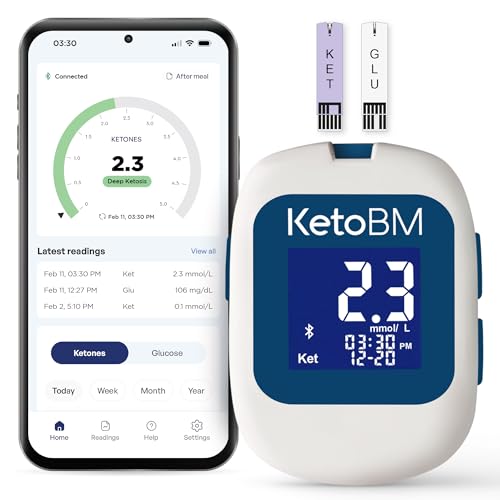
One entry-level meter that reads both ketones and glucose from a single kit
For the budget-conscious beginner who wants ketones and glucose from one box, this kit makes the least expensive start possible. It is a 2-in-1 smart meter that reads both blood ketone and blood glucose strips, so you commit to one device instead of two. The starter kit packs 10 ketone strips, 10 glucose strips, 20 lancets, a lancing device, and a carrying case. It runs on its own KetoBM-branded test strips sold separately — check the listing images so you buy the right refills.
The daily experience is where it stands out. Results come back in seconds from a single finger prick, which makes it easy to test without rearranging your morning. It pairs wirelessly with a free iPhone and Android app that logs readings, shows trends, and exports your data, with no subscription and no hidden fees. The meter itself measures 3.5 inches long by 1 inch wide by 4 inches tall and weighs 3.2 ounces, so it slips into a bag without being fiddly to hold. Compared with the full-size Keto-Mojo kit, it is the more pocketable of the two. The maker states it is FDA-cleared for home use and quotes a 3-year battery life.
What wins people over is how little thought it takes to operate, and the instruction videos help beginners get testing right the first time. Several owners say it beats the urine dip sticks they used before for getting an actual number rather than a shade to guess at. The strip cost is the honest snag — replacement ketone strips add up, and since ketone strips cost more than glucose strips, budget for that. Keep the meter clean with only a soft damp cloth and never immerse it in water, as the maker specifies.
The beginner’s case: a dual-reading meter, a free app, and a case, all in one starter kit that lets you try ketone testing without a large commitment.
The recurring cost: refill strips carry the real weight here — the entry price is small, but daily testing means regular strip purchases.
Best for: the first-time tester who wants to see both numbers cheaply and can accept buying strips more often.
Think twice if: you want a large strip supply in the box — this kit starts you with a small starting count on each type.
4. KetoSens Blood Ketone Monitoring Starter Kit with Bluetooth
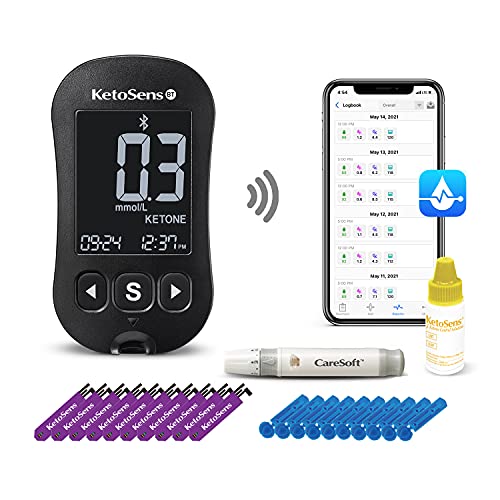
A half-microliter sample and an eight-second read for low-fuss testing
If finger pricks are the part you dread, the two numbers on this starter kit are the ones to read first. It needs a 0.5 microliter blood droplet — about as small as it gets — and turns that into a reading in 8 seconds. The maker states the leading competitor needs nearly twice the blood sample and takes about a fifth longer to read. For a ketone-only meter, this is a fast, unfussy experience built around the meter included in the kit.
The bundle covers the basics: the Bluetooth meter, 10 ketone test strips, a control solution vial, a lancing device, 10 lancets, and a travel case, all running on two included batteries. The screen is a large 2.5 inch negative LCD with an inverted background, so the digits stay readable in dim morning light. There is a strip ejector, which means you push out the used strip instead of pulling it free with your fingers — a small touch that matters when you test daily. There are no code chips, so you never stop to calibrate before a test.
Two things stand out from owner experience. First, the app side has a known quirk — Bluetooth pairing on iPhone can be confusing. One verified workaround says to open the app only after you pull the strip and let the data land, an approach that consistently worked for that buyer. Second, ketone strips here are the expensive part of ongoing use, something owners call out repeatedly. That pairing quirk is worth knowing before you buy, because it is fixable, not fatal.
Why owners keep it: the tiny 0.5 microliter sample and the 8-second read make it one of the gentlest, quickest ketone-only meters here.
Worth knowing: the Bluetooth pairing steps can puzzle first-timers, and replacement ketone strips are the priciest cost of ownership.
Choose this if: you test ketones only and value a small sample, a fast read, and a screen you can see in low light.
Consider the alternative if: you want glucose readouts too — that means a dual-testing kit instead of this single-purpose meter.
5. KETO-MOJO GK+ Glucose & Ketone Meter, Keto Fasting

The dual-testing meter for the long haul, with trends your doctor can read
This is the same GK+ platform as the top pick, sold as a leaner kit for the person who intends to keep testing for the long haul. It reads both ketone and blood glucose strips. The kit comes with the GK+ Bluetooth meter, 10 ketone strips, 10 glucose strips, 20 sterile lancets, a lancing device, glucose and ketone control solutions, two pre-installed AAA batteries, and a user manual. Where the larger kit front-loads strips, this one assumes you will buy your own refills — check the listing for current bundle details. The meter auto-detects which strip type you insert, so there is no second port to remember.
The part that separates it from the ketone-only meters is the MyMojoHealth app. It pulls in your readings automatically, tracks your Glucose Ketone Index, and syncs with Apple Health, Cronometer, and Carb Manager, so your trends and your food log live side by side. That makes it the one to hand to a doctor or coach when you want to show progress over time rather than a single number. The maker states it is FDA-cleared for home use and backs it with a lifetime warranty and US-based support. Some buyers report they would like a built-in Dr. Boz ratio, so if that exact calculation matters to you, do your homework first.
The people who test most days are the ones this meter rewards. Owners describe the setup as plug-and-play with fast, quickly readable results, and one notes the lancet’s three depth settings make level 1 plenty for a comfortable prick. Recurring gripes are the same ones that dog the whole category — strips and lancets add up, and occasional app sync issues mean a reading or two might not appear right away. Neither is a deal-breaker, but both are worth knowing going in.
What keeps it in rotation
- Reads ketone and glucose strips through one port with automatic strip-type detection
- MyMojoHealth app tracks your GKI and syncs with Apple Health, Cronometer, and Carb Manager
- Includes glucose and ketone control solutions to verify readings
- Lifetime warranty and US-based support, per the maker
Where it asks for patience
- Starter supply is small — 10 of each strip — so heavy testers restock soon
- Strips and lancets are the ongoing cost owners flag most
- App sync can occasionally lag, and there is no built-in Dr. Boz ratio
The right call for: steady daily tests you want to see as a graph, share with a doctor, and pair with your food log.
Wrong fit if: you test rarely — the standing app and refill setup is more than a light user needs.
6. KetoSens Blood Ketone Monitoring System Set
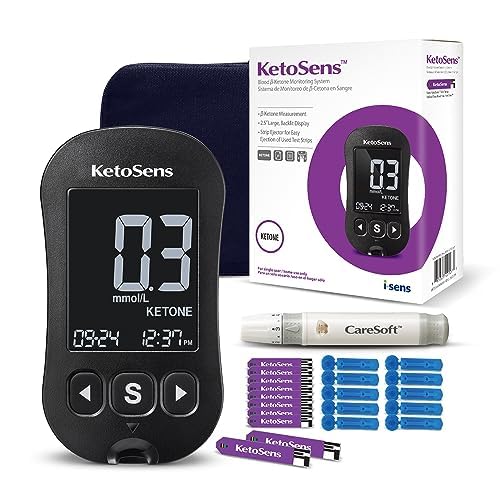
Sixty ketone strips and a meter built for a long stretch of testing
If restocking ketone strips is the chore you want to postpone, this set is built around that problem. It pairs a single KetoSens meter with 60 ketone test strips, 10 lancets, a lancing device, and a carrying case, so you start with a strip supply far larger than the 10-strip starter kits. For the keto dieter who tests most days, that head start is the entire point of choosing this bundle over the smaller KetoSens starter kit.
The testing experience matches the rest of the KetoSens line. It needs just a 0.5 microliter blood droplet and returns a reading in only 8 seconds. The maker states the leading competitor needs about twice the blood sample and takes nearly a fifth longer to read. That makes it gentle on the fingertip and quick to finish. The 2.5 inch negative LCD keeps the number visible in dim light, and the built-in strip ejector lets you push the used strip out rather than touching it. There are no code chips to calibrate, so every test starts the same way. This set is the without-Bluetooth version of the meter, so it will not sync readings to a phone on its own.
Owners who buy this meter usually have a specific reason. Several parents run ketone checks for a child with type 1 diabetes during illness, nausea, or a pump issue. They prefer a blood meter to urine strips because they can test any time rather than waiting. A parent testing for a newly diagnosed child called it steady reassurance during illness and a clear way to share numbers with the care team. The regular gripe is the lancing device — some families reach for their own preferred lancets instead — and the ongoing cost of ketone strips. Both are small next to the supply you get in the box.
The supply argument: 60 ketone strips in the box means you test for a long stretch before you think about reordering.
The one limitation: no Bluetooth, so if you want your readings logged in a phone app, you will write them down or choose the Bluetooth version.
Tailored for: anyone testing ketones often, especially for a family member who needs checks on demand when they feel unwell.
Not the fit if: you want a phone app to do the logging — this set runs without a wireless connection.
7. Precision Xtra Blood Glucose and Ketone Monitoring Meter Kit
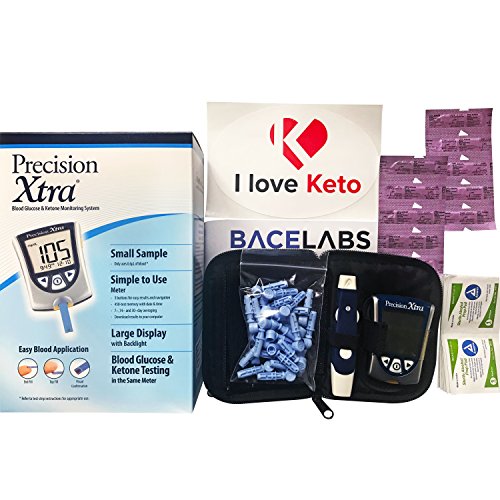
One bundle with glucose and ketone testing plus the accessories to start
This bundle solves two jobs at once, and it does so with everything needed to begin. It includes the Precision Xtra ketone monitoring system, dynarex alcohol wipes, a month of Abbott FreeStyle 28 gauge lancets, and even an “I Love Keto” sticker. The kit tests both glucose and ketones through one meter, so you do not need two devices to track both numbers. Buyers especially appreciate this dual function for staying on track with keto. It is the pick if you want the accessories sorted in the same box as the meter.
Simplicity is the daily experience here. Owners describe it as straightforward to use, find the included lancets surprisingly painless, and say it confirms whether they are in ketosis without waiting on a color to develop. One owner tests two to three times a week to track metabolic flexibility, watching ketones, insulin sensitivity, and glucose to see where the plan needs adjusting. That kind of feedback is exactly what a meter is for, and this one delivers it plainly.
The honest caveats are worth naming. The value-for-money feedback on this bundle tips toward concern, mostly because refill strips and lancets have to be bought again, which is the ongoing cost of this whole category. A few owners also find the finger-pricking device less consistent than they would like, and if that gripes you, a separate lancing tool solves it cheaply. On balance, this is a capable two-in-one meter that handles both glucose and ketones in one unit, with the accessories already in the box.
Why it earns a look: one unit reads both glucose and ketones, and the bundle throws in wipes and a month of lancets so nothing is missing at the start.
The friction point: refills are the real ongoing cost, and the bundled lancing device splits opinion on consistency.
Reach for it if: you want glucose and ketone testing in a single meter and a bundle that includes the supporting accessories.
Keep looking if: a smooth lancing experience is your priority — you may want to add your own lancing tool alongside.
Know the Specs
Blood sample size and read time
Sample size is how much blood the strip needs to give a reading — the KetoSens meters ask for just 0.5 microliter, a barely visible dot. Read time is how long the screen takes to show your number, quoted at 8 seconds for the KetoSens meters and 10 seconds for the FORA Test N’GO and KetoBM. Smaller samples mean a lighter finger prick, and shorter waits mean you spend less time holding still. Both matter most if you test several times a day, or if the sight of blood is what has kept you on urine strips.
Ketone measurement range in mmol/L
Your meter reports ketones in mmol/L (millimoles per liter — the unit that says how much beta-hydroxybutyrate is dissolved in your blood). The FORA Test N’GO strips cover 0.1 to 8.0 mmol/L, a span that reaches from the low end of a light fast to deeper ketosis. When you compare meters, note that this range belongs to the strip, not the meter — ketone strips are built to read a set band, so confirm the strip you buy matches the numbers you expect to see. Ketone strips and glucose strips are not interchangeable, even on a meter that reads both.
Bluetooth syncing and the app
Bluetooth is the short-range wireless link that sends each reading from the meter to your phone, so your numbers land in an app instead of a notebook. On the Keto-Mojo GK+ the app is MyMojoHealth, which also tracks your GKI and syncs with Apple Health, Cronometer, and Carb Manager. The KetoBM kit uses its own free iPhone and Android app with no subscription. The KetoSens 60-strip set and the Precision Xtra bundle run without Bluetooth, so those numbers stay on the meter’s own memory. Pick based on if you want a trend graph or just a current number.
Test strip supply and cost per test
The strip is the ongoing cost, because a meter is a one-time buy and a test strip is not. Ketone strips generally cost more than glucose strips, so a kit that lands with more of them saves you a restock. The Keto-Mojo 140-strip kit and the KetoSens 60-strip set front-load supply, while the small starter kits assume you refill soon. The maker notes strip best-by dates are printed on every unit — check that date when you buy in bulk so you do not run them past their window before you test through them.
Common Questions
How often should I test my ketone levels on a keto diet?
What ketone level should I aim for on keto?
Is a blood ketone meter better than urine strips?
Do test strips fit every ketone meter?
Can a ketone meter measure blood glucose too?
How long does a box of ketone strips last?
Why do my ketone readings change so much between tests?
How much blood does a ketone strip need?
Do I need Bluetooth on a ketone meter?
Is a ketone meter a replacement for medical advice?
The Bottom Line
For most people, the ketone meter worth starting with is the Keto-Mojo GK+ 140-Strip Kit because it lands ready to use with 70 ketone and 70 glucose strips, reads both through one meter, and turns your readings into a GKI trend in the MyMojoHealth app. If you only track ketones and want a gentle half-microliter sample with an eight-second read, the KetoSens Bluetooth Starter Kit fits that job. And if you want a big strip supply without a phone in the loop, the KetoSens 60-Strip Set keeps you testing for a long stretch. Whichever you choose, budget for refills from the start — the strips, not the meter, decide your real cost.
How we choose
We do not accept paid placement. Every pick is matched to a real buyer and a real use-case; we do not hands-on test units.
Sources
Specifications: manufacturer listings and product documentation. Review insights: verified customer reviews, as of October 2026. Pricing: not shown on this page (it changes often); check the current price via the retailer link.
As an Amazon Associate, Aappliancez earns from qualifying purchases. This does not affect which products we feature.