Disclosure: Some links in this post are affiliate links. As an Amazon Associate I earn from qualifying purchases, at no extra cost to you. Learn more
Specs are compiled from manufacturer listings and verified buyer reviews and can change over time — please confirm the key details on the product page before buying.
Buying a Japanese maple for a pot is mostly a gamble on how the thing arrives — bare-rooted and bent, or healthy and ready to leaf out. The variety matters, but shipping and graft quality decide whether you get a tree or a stick. Below are the maples worth potting, sorted by what they actually deliver on a patio.
This guide is built by comparing the manufacturers’ published specifications and the patterns across verified customer reviews, so you get each pick’s real strengths and trade-offs instead of marketing spin.
Container growing changes the rules: a maple needs a pot that drains, a spot out of harsh afternoon sun, and a variety that stays compact rather than racing to twenty feet. These seven picks cover dwarf laceleafs, coral-bark showpieces, and one upright that reaches tree size. Read on for the best japanese maples for containers.
Top Picks


How To Choose The Best Japanese Maples for Containers
A pot puts limits on a maple. Roots stay in a small volume of soil, so drainage and watering become daily facts of life. The variety you pick has to stay small enough to live there without constant repotting.
Match the mature height to the pot
A dwarf that tops out at 5 feet stays manageable in a large container for years. An upright bred to reach 20 to 25 feet wants ground space, and a pot only delays that. Look at the expected plant height on the listing and treat it as the ceiling.
Check the graft, not just the leaves
Most named maples are grafted — a named top joined onto a rootstock. A clean, well-healed graft callus keeps a potted maple alive through its first winter; a join that is still open invites rot and dieback. Ask how the join looks before you buy, and expect a visible scar that seals over time.
Read the light and soil needs
Most of these maples want partial sun or partial shade and moderate watering. A pot in full afternoon sun dries fast and scorches leaf edges. Loam or sandy soil that drains well keeps roots from sitting wet.
Side-by-Side Comparison
| Model | Best For | Mature Height | Hardy Zone | Light | Amazon |
|---|---|---|---|---|---|
| Scarlett Princess★ Best Overall | Compact red laceleaf in a pot | 4 feet | 5-8 | — | Amazon |
| Little Sango Dwarf Coral BarkBest Bark Color | Year-round coral-red stems | 5 feet | 5-8 | Partial sun | Amazon |
| Sango Kaku Coral Bark | Upright tree in a large container | 20-25 feet | 5 | Partial sun | Amazon |
| Tamukeyama Weeping Maple | Weeping red laceleaf for hot climates | 8 feet | 5, 6, 7, 8 | Partial shade | Amazon |
| Butterfly Dwarf Upright | Variegated leaves, slow growth | 6-8 feet | 6-8 | Full sun to partial shade | Amazon |
| Butterfly Dwarf Upright (Trade Gallon) | Same variegated maple, gallon-pot option | 6-8 feet | 6-8 | Full sun to partial shade | Amazon |
| Bloodgood Japanese Maple | Classic red upright, full-size tree | 15 feet | — | — | Amazon |
Detailed Reviews
1. Scarlett Princess Japanese Maple Live Tree
A rare red laceleaf bred from a witches broom, kept to 4 feet for patio pots.
What sets this one apart is the variety itself: a red dissectum dwarf that holds its color as well as Crimson Queen, with tight compact nodes that keep it dense and small. It tops out at 4 feet, which is a size a large pot can actually hold. Scarlett Princess reaches 4 feet, and the Little Sango below reaches 5 feet, so this one stays a foot shorter at maturity.
The 2-year plant is the stage where graft quality starts to show, and a clean join is what carries it through the first winter in a pot.
The honest catch is size. This is a 2-year plant, and some arrive at about 5 inches while others land at 10 or 11 inches. That is the spread on a young dissectum. Planted in ground too soon, these fail; kept in a container and sheltered from wind and excess sun, they take. If you want a specimen that looks like the photo on day one, this is not that — it is a long game.
Why the pot crowd likes it
- Compact red dissectum dwarf bred for small spaces and patios
- Holds color well — compared on the listing to Crimson Queen
- Ships in container with original soil
- Reaches 4 feet, manageable in a large pot
What to plan around
- Young 2-year plant can arrive tiny — around 5 inches for some
- Graft quality is the swing factor; inspect the join
- Needs container life and wind shelter to settle
Take this one if: you want a compact red laceleaf for a patio pot and can give it shelter and patience.
Look elsewhere if: you need a tree that looks established straight from the start.
2. Little Sango Dwarf Coral Bark Japanese Maple
Coral-red stems that carry the color show through winter, in a dwarf five-foot frame.
Sango means coral bark, and that is the whole point of this maple. The stems stay intense coral red year round, while spring pushes bright lime-green leaves that turn yellow, orange, and pink in fall. In a pot on a patio or by a door, the bare winter stems are the feature — not the foliage. It reaches 5 feet at maturity.
Where this beats the Scarlett Princess is the shoulder seasons. A red laceleaf gives you spring and fall color and then bare brown wood. Little Sango gives you the bark show in January. Both are dwarf options, but the Little Sango carries 5 feet against the Scarlett Princess’s 4 feet, and at 2 pounds against 1.7 pounds it is the slightly heavier plant on the listing.
The trade-off is size and graft clarity. Many plants arrive under 12 inches, and graft quality draws mixed notes — some arrive with the join still sealing, which is normal, while a few look like the wrong plant. One thing to know: it is listed as bonsai-suitable, but a plant can arrive too large for a small bonsai pot. Buy it as a small patio tree, not as a guaranteed bonsai starter.
The bark is the sale: coral-red stems hold color through winter, and the fall push runs yellow, orange, and pink — a four-season maple in a 5-foot package.
Size honesty: young plants often land under a foot tall, so plan for a slow first season in a pot.
Reach for this if: you want a compact maple that earns its place in winter, not just in leaf.
Pass if: you need a guaranteed bonsai-scale plant — this can arrive larger than a bonsai pot wants.
3. Coral Bark Japanese Maple Sango Kaku 3-Year Live Plant

The coral-bark classic in an upright form — big enough that the pot is a commitment.
Sango Kaku is the coral-bark maple most gardeners picture, and this one reaches 20-25 feet at maturity. That is a real tree, and in a container it means a very large pot and an eventual ground planting. The upside is the display: intense coral-red stems, lime-green spring leaves, and fall color in bright yellow, orange, and pink, with an upright habit that reads as a specimen.
The listing marks it deer-resistant, cold-hardy, and container-friendly, hardy to zone 5 in maple soil under partial sun. Those traits matter for a pot you plan to keep on a deck for a few years before transplanting. It is a 3-year live tree, so you start with more structure than a 2-year.
Expect to be underwhelmed by the trunk. A “3-year graft” can show up as a twig with a trunk barely wider than a matchstick, and one arrives small enough that the vertical growth looks trimmed back. Packing is generally good — staked, supported, soil moist — but a stem that is not tied to its stake can snap in transit. Treat the first season as establishment, not display.
The classic coral bark: 20-25 feet at maturity, upright habit, deer-resistant and cold-hardy to zone 5 — the one to pick if you want a real tree, not a patio dwarf.
Trim your expectations on trunk size: the 3-year label promises age, not width, and young stems can be thin enough to break in shipping.
Best for: gardeners with a large pot or a ground spot lined up and the patience for a slow-built specimen.
Skip if: you expect a thick trunk on arrival — the stem may be pencil-thin.
4. Red Laceleaf Weeping Japanese Maple Tamukeyama
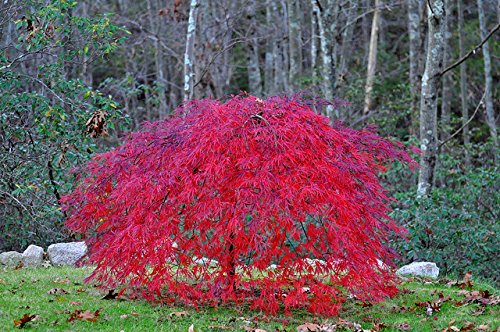
A cascading red weeper built to hold color through humid summers, reaching 8 feet.
Tamukeyama is a vigorous weeping maple with cascading red lace leaves, and this listing pitches it as superior in hot, humid climates where it holds its color well. Fall turns bright scarlet. It reaches 8 feet and is hardy to zones 5 through 8, making it the most heat-forgiving pick here. Partial shade suits it, and it ships in a container with soil.
For a patio pot, a weeper is a shape choice. Whether in a tall container or beside one, the cascade reads best when it has room to spill. The catch is sizing: plants often arrive much smaller than pictured, sometimes a tiny root-bound pot plant that will take years to match the photo.
There is a split in how these arrive. Some ship sturdy and leafed out; others show a graft that is coming apart, which is a genuine failure, not a shipping joke. Roots arrive damp and well wrapped when packing is done right. Give it a draining pot and afternoon shade, and the cascading branches do the rest.
The heat pick: holds color in hot, humid summers, cascades in red lace, reaches 8 feet, and braves zones 5 to 8 in partial shade.
Plan for slow growth: young plants can be very small and root-bound, and a graft that is not clean is a real risk to watch.
Go with it if: your summers run hot and humid and you want a red weeper that keeps its color.
Not your tree if: you need instant scale — these arrive small and grow slowly.
5. Butterfly Dwarf Upright Japanese Maple Tree
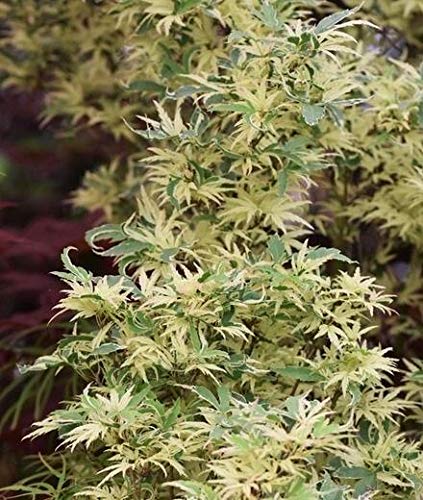
Mixed leaf sizes and silver-white margins — the maple that looks unlike the others in the row.
Butterfly earns its name from the leaf display: sizes and shapes mixed on the same branch, with silvery white margins around green leaves that shift toward scarlet magenta in fall. New spring growth comes in pink-tinged. It is a slow-growing, shrub-like dwarf made for containers, bonsai, and small gardens, reaching 6-8 feet and 4-6 feet wide.
Give it full sun to partial shade and zones 6 to 8, and it ships in a trade gallon pot — a standard nursery container with soil, so the roots arrive in real growing medium rather than bare. That gallon size is one reason this listing sits at the upper tier, and it is the pick if the variegated look is what you want. It can ship dormant from November through April.
Dormancy is the fork in the road. A dormant, single-stem plant can arrive looking like a stick with no side branches, and patience is required — one buyer found growth only after two years in mostly shade from Texas afternoon heat. Another wanted a bushy tree and got a spliced twig. Keep the soil evenly moist, mulch the surface, and make sure the pot drains freely, and a dormant gallon plant usually breaks bud by early summer.
The reason to choose Butterfly
- Variegated silver-white margins that turn magenta in fall
- Slow-growing dwarf suited to pots and small gardens
- Ships in a trade gallon pot with soil
- Full sun to partial shade, zones 6-8
The dormancy gamble
- May ship dormant and leafless from November to April
- Young plants can be single-stem and sparse
- Grafts are sometimes visible and uneven
The right call if: you want the unusual silver-edged foliage and can wait out dormancy in a gallon pot.
Think twice if: you want a full bushy tree on arrival — these can start sparse.
6. Butterfly Dwarf Upright Japanese Maple Tree (Trade Gallon)
The same Butterfly dwarf in a gallon pot — pick between the two listings on availability.
This is the same Butterfly dwarf upright as the pick above: silvery white-margined green leaves that go scarlet magenta in fall, pink-tinged spring growth, and a slow shrub-like habit built for containers and small gardens. It reaches 6-8 feet tall and 4-6 feet wide, in zones 6 to 8 under full sun to partial shade. Ships in a trade gallon pot with soil.
The gallon pot makes it a fair choice for a container plan — you get a plant already in growing medium, not bare-root. Where it differs from the listing above is only the SKU and timing. The thing to plan around is that the plant can ship dormant from November through April, and a dormant gallon maple looks like a bare stem until it wakes.
That dormancy is the honest risk. A plant that never buds after dormancy means a dead graft, and because dormant plants need weeks before failure shows, the return window can close first. The plants that do wake up arrive well packaged — heavy on the packing, sometimes larger than expected. Pot it up, water when the top inch dries, and watch the stems for swelling buds through May.
Same maple, different listing: gallon-pot Butterfly with silver-edged leaves, 6-8 feet at maturity, zones 6-8.
Watch the wake-up: dormant shipping means you may not know if it is alive until weeks after the box opens.
Worth it when: this gallon listing is the one in stock and you want variegated foliage in a pot.
Skip when: you cannot afford a dormancy gamble — a plant that never buds is a dead graft.
7. Brighter Blooms Bloodgood Japanese Maple Tree, 3-4 ft.

A 3-4 foot Bloodgood arrives ready to plant — the classic red upright, sized to start.
Bloodgood is the best-known red Japanese maple, and this one ships at 3-4 feet — a size you can start in a large container or set into the ground without waiting a season for it to look like a tree. It reaches 15 feet at maturity, so in a pot it is a long-term commitment with an eventual garden planting in mind. Red foliage all season, moderate watering, and spring planting suits it.
The draw here is the head start. A Bloodgood at 3-4 feet is the largest entry on this list by a wide margin. For container growers who want a tree that already reads as one, that is the whole pitch.
The catch is state restrictions: orders to AK, AZ, and HI are cancelled due to federal rules, so check you can receive it first. And a big plant can arrive showing brown tips that spread before new growth pushes; the warranty covers a healthy replacement but not damaged leaves. If a tree needs to look perfect on day one, this is a gamble.
The head start: 3-4 feet on arrival, red foliage all season, 15 feet at maturity, easy care — pick it if you want a tree that already looks like one.
Check the fine print: orders to AK, AZ, and HI are cancelled by federal restriction, and shipping can leave browned leaf tips.
Your tree if: you want the largest plant on arrival and a classic red maple for a big pot or the ground.
Check eligibility first: AK, AZ, and HI orders are cancelled — and shipping can leave brown leaf tips.
Know the Specs
Mature Height
This is the ceiling a maple reaches over years. A dwarf at 4 or 5 feet stays manageable in a large pot. An upright at 15 or 20-25 feet wants ground space, and a pot only delays the day you transplant. Read the height first when shopping for a container tree.
Hardy Zone
Zone numbers tell you the cold a maple tolerates. The dwarf picks here cover zones 5-8, which suits most temperate gardens. Butterflies run zones 6-8, slightly warmer. Match the zone to your winter low before you buy.
Light Exposure
Most maples want partial sun or partial shade — a few hours of gentle sun with shelter from harsh afternoon light. Full sun in a pot dries the soil fast and scorches leaf edges. Partial shade holds color better in hot climates.
Graft Quality
A grafted maple is a named top joined to a rootstock. The graft union is the weakest point on a potted maple, so inspect the scar before you plant. A graft with a sealed, callused scar holds for years; one splitting at the union fails within a season. Look for a visible scar that is sealing over, and remember the join can sit higher on the stem than you expect.
Common Questions
How big a pot does a dwarf Japanese maple need?
Will a Japanese maple survive winter in a container?
Why did my mail-order maple arrive as a bare twig?
What does a witches broom have to do with Scarlett Princess?
Is coral bark the same as red laceleaf?
Which of these maples holds its color best in a hot summer?
Do these maples need full sun?
What does “trade gallon pot” mean on a live maple?
Can I grow a Sango Kaku coral bark in a pot long-term?
Can I order a Bloodgood maple if I live in Alaska, Arizona, or Hawaii?
The Bottom Line
For most container growers, the japanese maples for containers winner is the Scarlett Princess because it is a compact red dissectum dwarf bred for small spaces, maturing at 4 feet with color that holds. If you want winter bark instead of summer leaves, grab the Little Sango Dwarf Coral Bark — coral-red stems that stay bright year round. And for a tree that already looks established on day one, the Bloodgood ships at 3-4 feet, provided you are not in a restricted state.
How we choose
We do not accept paid placement. Every pick is matched to a real buyer and a real use-case; we do not hands-on test units.
Sources
Specifications: manufacturer listings and product documentation. Review insights: verified customer reviews, as of October 2026. Pricing: not shown on this page (it changes often); check the current price via the retailer link.
As an Amazon Associate, Aappliancez earns from qualifying purchases. This does not affect which products we feature.