Disclosure: Some links in this post are affiliate links. As an Amazon Associate I earn from qualifying purchases, at no extra cost to you. Learn more
Specs are compiled from manufacturer listings and verified buyer reviews and can change over time — please confirm the key details on the product page before buying.
If you have ever watched a tonkatsu chef turn half a cabbage into a cloud of paper-thin shreds in under a minute, you already know why the Japanese mandoline earns its counter space. The version you want is the one that holds an edge, sits steady while you push, and lets you set an exact slice thickness instead of guessing. This article walks you through the fifteen models that matter, from tiny handheld slicers for garlic to wide cabinet-style boards built for whole cabbages.
This guide is built by comparing the manufacturers’ published specifications and the patterns across verified customer reviews, so you get each pick’s real strengths and trade-offs instead of marketing spin.
A mandoline can slice your vegetables in seconds, or slice your fingers just as fast. The difference often depends on one thing: how well the blade is guarded. So here is a clear, spec-by-spec look at the best Japanese Mandoline options, ranked by what they actually do well in a home kitchen.
Top Picks


How To Choose The Best Japanese Mandoline
The single most common mistake buyers make is grabbing the sharpest-looking board without checking how wide it actually cuts. A narrow blade forces you to quarter every cabbage and halve every onion, which defeats the entire point of owning a slicer. Width, thickness control, and blade material are the three levers that decide whether a mandoline saves you time or sits in a drawer.
Cutting width comes first
A wide slicing surface lets a half cabbage or a whole potato glide across the blade in one pass. Cabinets built for tonkatsu work often run five inches or wider across the cutting area, which is what makes fluffy shredded cabbage possible. A slim handheld model measures closer to two inches and is best reserved for garlic, radishes, and small cucumbers.
Fixed versus adjustable thickness
Some boards slice at one locked depth, typically around one millimeter, because that exact thickness is what a Japanese restaurant uses for cabbage. Others let you dial anywhere from paper-thin to thick. If you want one tool for chips, fries, and slaw, an adjustable dial covers all three cuts. If cabbage is your main event, a fixed one-millimeter board does that single job perfectly.
Blade material and upkeep
Stainless steel blades are the norm and can be honed or replaced. Ceramic blades keep their edge for a long stretch and resist rust, but they are brittle and cannot be sharpened the same way. Whichever you pick, plan to wash and dry the blade right after use — moisture and acidic vegetables are what dull an edge fastest.
Side-by-Side Comparison
| Model | Best For | Blade Length | Material | Weight | Amazon |
|---|---|---|---|---|---|
| Suncraft BS-271 Cabbage Slicer★ Best Overall | High-volume slaw and kraut | 12 cm | ABS resin, stainless steel | 0.35 kg | Amazon |
| Benriner Japanese Mandolin Vegetable SlicerAlso Great | Everyday all-round slicing | 10 cm | Plastic body, stainless steel blades | 13.28 oz | Amazon |
| Arnest Handheld Mandoline SlicerBest Value | Wavy cuts over a bowl | — | Stainless steel | 0.21 kg | Amazon |
| Nagao AMS-610 Double-edged Mini Slicer | Garlic and small veg | — | ABS resin, stainless steel | 0.05 kg | Amazon |
| Shimomura Katsu Shop 35098 Cabbage Slicer | Ultrathin cabbage on a budget | 8 cm | ABS resin, stainless steel | 0.11 kg | Amazon |
| Cabbage Slicer Ultra-Thin 0.04 in Julienne Cutter | Sauerkraut and coleslaw | — | ABS, stainless steel | 0.33 kg | Amazon |
| KAI Japanese Julienne Slicer | Korean-style carrot strips | — | ABS resin, stainless steel | 0.11 kg | Amazon |
| Shimomura Tonkatsu Shop 35950 Cabbage Slicer | Whole-cabbage volume | 27 cm | ABS resin, stainless steel | 0.4 kg | Amazon |
| KAI Japanese Mandoline Slicer, Adjustable | Dial-in thickness control | — | ABS resin, stainless steel | 117 g | Amazon |
| Arnest 3-Blade Wave Shredder | Triple-blade speed | — | ABS, stainless steel | — | Amazon |
| KYOCERA Adjustable Ceramic Mandoline | Ceramic blade longevity | 3.5 in | Ceramic blade | 0.11 kg | Amazon |
| Benriner Mandoline Jumbo Slicer | Oversized produce | 2.5 cm | BPA-free plastic, stainless steel | 600 g | Amazon |
| Japanese Double-Edged Slicer | Push-and-pull slicing | — | Stainless steel | 0.38 lb | Amazon |
| Benriner Mandoline with Collection Tray | Blade variety and tray | 7.4 cm | ABS/AS/POM resin, stainless steel | 11.2 oz | Amazon |
| Benriner Japanese Mandoline Ivory | Collector-grade finishing | 2.4 cm | Stainless steel | 12.64 oz | Amazon |
Detailed Reviews
1. Suncraft BS-271 Cabbage Slicer
Our pick — 4.5+★ from 2,500+ verified ratings; the strongest balance of quality and price.
The crowd favorite for high-volume cabbage — wide enough for real slaw sessions.
Here is the board that wins people over with sheer width. Its broad five-and-a-half-inch surface is sized to accept half a cabbage without quartering, and it cuts at approximately 0.04 inches (about one millimeter) — the tonkatsu-shop thickness that gives that airy, cloud-like pile of shreds. The 12 cm blade is long enough that you cover real ground with every push. Built in Japan from ABS resin with a stainless blade, it weighs 350 g — heavy enough to stay stable, light enough to hang from a hook.
Owners use it across cabbage, lettuce, onions, and carrots, and it handles sauerkraut prep with the same fine shave. The included safety holder grips and slides along the rails for safer slicing on smaller ingredients. Cleanup is a swish in soapy water and a rinse, and it stores compactly between sessions. That combination of width, sharpness, and easy cleaning is why it earns the runner-up spot behind the Benriner.
The one limitation is the fixed depth. It is locked at roughly one millimeter, so it makes superb ultrathin slices and is not designed for thicker cuts. The white body also stains — a carrot will leave a shadow unless you wash it right away. If you only want fine shreds, though, neither is a real issue.
Why it gets recommended most
- Wide five-and-a-half-inch surface handles a halved cabbage in one pass.
- Approx. one-millimeter slice is ideal for kraut and tonkatsu-style slaw.
- Safety holder grips and slides along the rails.
- Quick soapy rinse cleans up in seconds, and it stores compactly.
Limits to plan around
- One fixed slice depth, so no thick, chunky cuts.
- Carrots and other colored vegetables can stain the white resin body if not washed immediately.
- The blade is on the thin side — avoid stacking it with other tools.
An obvious choice for: dedicated slaw and sauerkraut makers who want a wide board that shreds fast.
The trade-off: no thickness adjustment means this board is committed to a single, very fine slice.
2. Benriner Japanese Mandolin Vegetable Slicer
The compact workhorse that made Japanese slicing famous in home kitchens.
This is the board the food industry reaches for first, and the reason it wins is simple: it does nearly everything. Three interchangeable blades (a straight slicer plus fine, medium, and coarse julienne teeth) let you knock out paper-thin cucumber rounds one minute and matchstick carrots the next. A 10 cm blade length gives you a cutting surface long enough for a whole potato, while the screws on either side of the blade let you dial thickness from a whisper up to the maximum marked cut. Buyers praise the sharpness above all else, and the cutting action is the thing that keeps people coming back to it instead of a knife.
What makes it so popular is how little it asks of your counter. At 13.28 ounces it sits lightly on a board or hooks over a bowl, and every blade pops out for cleaning or sharpening — one of the reasons professional kitchens buy them three at a time. The trade-off is simple to understand: it is small. Whole medium onions and full cabbage heads need halving or quartering first, so if volume shredding is your goal, go wider.
One long-running complaint is worth knowing before you buy: heavy biweekly use can wear the blade down to where a replacement costs about what a fresh unit does. That is the honest lifespan math of a stainless blade doing real work. Treat it as a tool with a service life, not a forever purchase. If you slice daily, budget for a spare down the road.
What earns its place first
- Three blades cover straight slices and three julienne widths without extra shopping.
- Adjustable screws let you set thickness from paper-thin upward.
- Every blade pops out for cleaning and sharpening.
- Compact enough to live on a small kitchen counter.
What to know before you click buy
- Narrow cutting surface means whole onions and cabbage need halving first.
- Heavy use eventually dulls the blade enough that replacement rivals a new unit.
- No adjustable side guard included in the box.
Best matched to: the home cook who slices a little of everything and wants one board to do it all.
Look elsewhere if: you routinely shred whole cabbages — a wider tonkatsu-shop board will save you real time.
3. Arnest Handheld Mandoline Slicer
A wavy handheld blade that turns a cucumber into crinkle-cut coins in seconds.
Here is a slicer built for the cook who wants one hand free. The wavy blade gives you decorative crinkle cuts for pickles and salads, and the whole unit weighs 0.21 kg — a mere fraction of the larger cabinet boards on this list. Slice directly onto a plate, a bowl, or a cutting board; the non-slip handle, knob, and foot keep it from skittering while you push. A safety holder is included for the last few inches.
The blade is stainless steel and cuts well enough that a few users compare it to a razor. That sharpness does not mean it handles everything, though — one reviewer noted firm vegetables are hard going compared to a three-blade slicer, and another found the resulting slices came out uneven. If you are slicing a single cucumber for a snack or a potato for a quick side, it delivers exactly what you need with almost nothing to clean.
The real caveat is thickness: this slicer sets a fixed depth rather than letting you dial a range. If you want one-millimeter cabbage or thick shoestring fries, an adjustable model is the better fit. For a low-effort prep tool that lives in a drawer, this is a cinch to reach for.
Where the value shows: an inexpensive handheld that handles the last-minute side dish and washes up in a literal rinse.
The honest limitation: the fixed depth and light build mean firm squash and dense root vegetables push back harder than they would on a heavier board.
Reach for this if: you want a fast, small prep tool for salads, cucumber snacks, and single-portion slicing.
Think twice if: you need a fixed one-millimeter shred for slaw — the slice depth here will not get you there.
4. Nagao AMS-610 Tsubamesanjo Double-edged Mini Slicer

The garlic-slicing specialist that fits in a cutlery drawer and weighs almost nothing.
At 0.05 kg this is the lightest slicer here — a genuine feather of a tool that slips into a drawer organizer or a travel bag without a second thought. The blade slices at roughly 1.7 mm (its stated slice thickness), which is exactly the depth for garlic slivers, radish paper, and thin cucumber coins. Its double-edged blade lets you cut on the push or the pull stroke, and the ABS resin body with stainless blade cleans up under a quick rinse.
What owners love about it is speed. The blade is sharp enough that a garlic clove goes through with almost no pressure, and the small footprint means it stores anywhere. What they also learn, often the hard way, is that sharpness cuts both ways — buyers report more than one slice through a fingertip while using it. That is the trade-off for a blade this effective on tiny ingredients.
The narrow width is the other thing to plan for. It seats carrots and small cucumbers happily, but wide eggplant and larger cabbage heads simply do not fit. Buyers who returned it almost always did so because they wanted to slice bigger vegetables, not because the blade underperformed.
Why the tiny size sells itself
- 0.05 kg means it disappears into any drawer.
- Double-edged blade cuts on push and pull strokes.
- Approx. 1.7 mm slices are ideal for garlic and radishes.
- ABS resin body with stainless blade rinses clean fast.
Where it runs out of room
- The narrow face simply cannot fit wide vegetables like eggplant.
- Owners mention it cuts fingertips just as easily as vegetables.
- No adjustable thickness — you get one slice depth.
Perfect for: garlic, radishes, and small-batch garnishes where a full-size board is overkill.
The catch: if your vegetable drawer is full of cabbage and eggplant, this one will leave you wishing for a wider face.
5. Shimomura Katsu Shop 35098 Cabbage Slicer

A narrow one-millimeter board that produces restaurant-style shredded cabbage fast.
This is the leanest way to get genuine tonkatsu-style shreds at home. The blade sits at 0.04 inches (about one millimeter) — the exact depth Japanese restaurants use — and the 8 cm blade length slices cabbage into delicate, airy ribbons. Its ABS resin body is heat resistant up to 176°F, so a rinse under warm tap water is safe, and the included safety holder grips smaller pieces while you push.
Performance is what earns it a place: the slice quality is consistent enough that shoppers brought it home to recreate the cabbage they ate in Japan. It also handles cucumbers for salad and thin layers for sauerkraut. Cleanup is straightforward — a rinse and a quick dry is all it asks.
The sizing is the honest catch. The blade is narrow, so larger cabbage heads and big vegetables must be reduced first, and one buyer found slicing whole cabbage tedious enough to recommend a wider alternative. If you make cabbage for two or a small side dish, that is not a problem; if you shred for a crowd, look for a wider cabinet board.
Where it shines: the one-millimeter slice is the exact cut that makes tonkatsu cabbage taste like the restaurant version, and the price leaves room for a spare.
The sizing reality: a narrow 8 cm blade means cabbage heads need reducing before you can slide them across.
Best for: home cooks making restaurant-style cabbage for two or small batches of slaw.
Skip if: you regularly slice whole cabbages for a family — the narrow blade will slow you down.
6. Cabbage Slicer Ultra-Thin 0.04 in Julienne Cutter
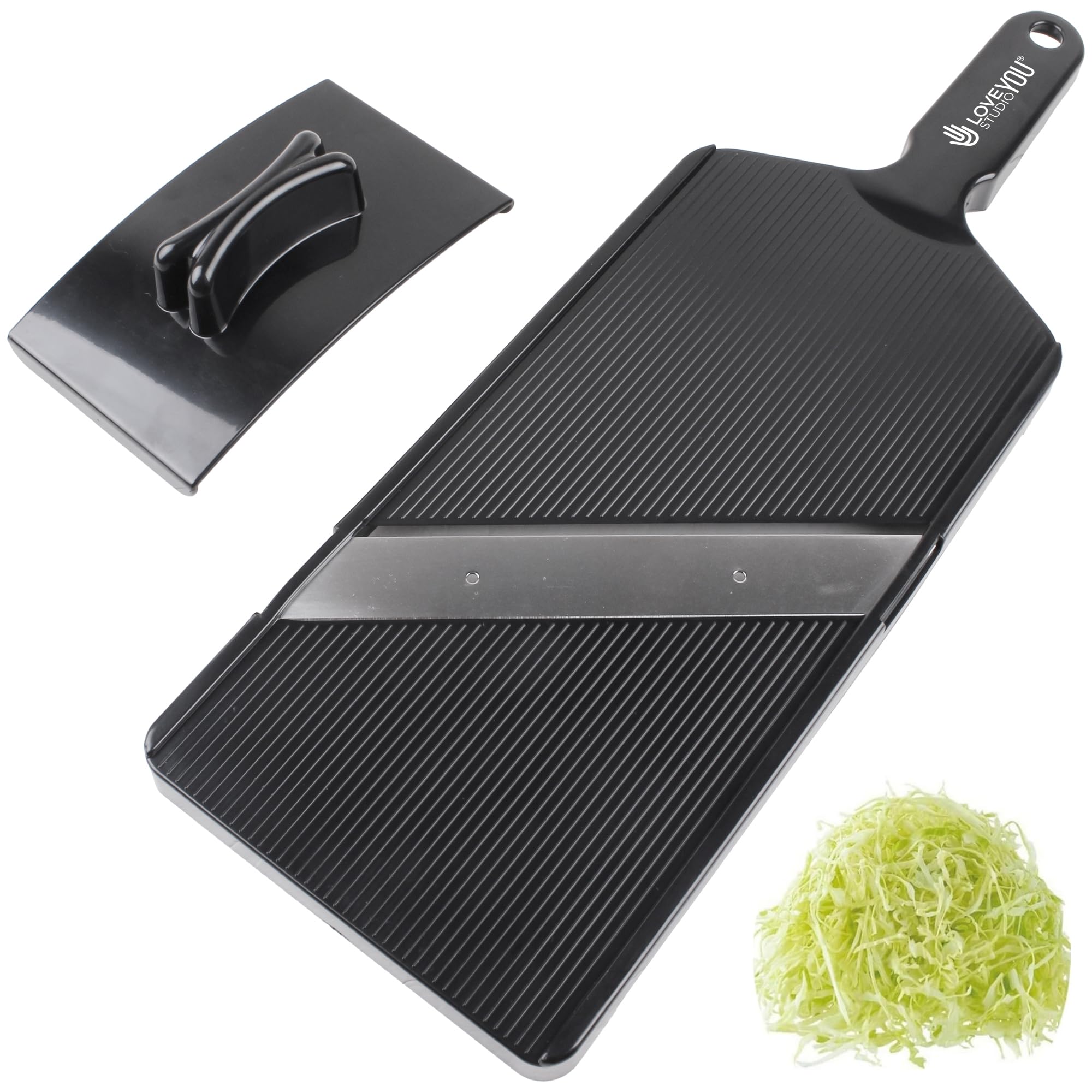
A folding, push-pull slicer built for coleslaw and sauerkraut volumes.
The lift-handle mechanism is what sets this one apart — you cut with a push-pull motion that gives you control on softer vegetables that usually squish under a straight push. The 0.04-inch (one-millimeter) blade is designed for the thin, threadlike shreds sauerkraut and coleslaw need, and the non-slip base keeps it planted while you work through a head of cabbage. When you are done, it folds flat for storage, which matters in a kitchen already full of gear.
Functionality and build quality are what shoppers highlight most, and the shave is genuinely fine — one buyer described it shredding cabbage almost as fine as sewing thread. It also handles onions, potato, carrot, and fruit, and the blade detaches for a quick rinse when the job is done. For a hand tool, that level of fineness is hard to match with a knife.
Sharpness is where opinions diverge. It arrives razor-sharp, and then some users find it dulls with heavy use — plan to keep it away from other tools in the drawer and to use the included hand guard on every pass. A few owners also felt the size or value did not fully meet expectations. As a dedicated fine-shred tool, this slicer earns its space.
Where the design pays off
- Push-pull lift handle controls soft vegetables without squashing them.
- 0.04-inch blade produces thread-fine shreds for kraut and slaw.
- Non-slip base keeps the board steady during a full head.
- Folds flat for storage and detaches for rinsing.
The honest notes
- The blade dulls with sustained heavy use, so keep it separated from other tools.
- Opinions on overall value vary; a few owners expected more for what it cost.
- The blade guard is not optional — the edge is genuinely dangerous.
Made for: the home fermenter making sauerkraut in batches and the cook who likes a folding tool that disappears into a drawer.
Not for: the cook who wants adjustable thickness — this one locks in at one very fine depth.
7. KAI Japanese Julienne Slicer

The ergonomic KAI that turns carrots into Korean-style matchsticks without fighting back.
For carrot ribbons, matchstick julienne, and Korean pickled carrots specifically, this is the pick that earns the job. The dual-action blade slices on both directions of travel, so you are not wasting half your effort on empty return strokes. Its 0.08-inch fine cut is sized for the narrow strips Korean cooking calls for, and the ABS resin body is rated heat resistant up to 212°F for warm-water cleanups.
What your hands will notice is the grip. KAI shaped the handle around ergonomic research to make it comfortable over long prep sessions, and the body has a cutout shape designed to keep food from clogging behind the blade. Buyers describe the ABS resin body and dual-action blade as sturdy enough for years of regular prep. For a hand slicer, that construction matters more than any single feature.
The limit is straightforward: it does julienne brilliantly, but this is not the board for thin straight slices of cabbage. Keep it as a dedicated julienne tool for Korean pickled carrots and banchan prep. On that narrow job, there are few better.
What makes it different: the dual-action blade does useful work in both stroke directions, and KAI’s ergonomic grip keeps a long prep session from cramping your hand.
The fit-check: it is built for julienne cuts, so look elsewhere if you need wide, uniform cabbage slices.
Pick this for: carrotheavy prep — pickled carrot, banchan, matchstick garnishes — where a fine julienne is the whole point.
Look past it if: your main job is flat slices and cabbage shreds.
8. Shimomura Tonkatsu Shop 35950 Cabbage Slicer

A wide-slicing cabinet board built to take a whole medium cabbage head in stride.
The 27 cm blade and 4.7-inch-wide slicing surface are what separate this board from the mini slicers: a halved cabbage glides back and forth across a wide surface, so shredding happens in big, quick strokes. It uses a 0.04-inch (one-millimeter) cut for fluffy tonkatsu-style shreds, and the included safety holder protects fingers and small pieces while you push. At 0.4 kg it is substantial enough to stay put on the counter.
Performance is what the crowd consistently notices: it works effectively across beets, radishes, carrots, and cabbage, and the wide face accommodates medium cabbages without reducing them first. For anyone making slaw or sauerkraut in real volume, that width is the difference between a chore and a quick job. It also stores upright against a wall, so it does not monopolize counter space.
The thickness divides opinion. The slice is very thin — some find it too fine for sauerkraut, which needs a bit more body to ferment correctly. It also dulls faster if stored loose in a cutlery drawer, so give it its own sleeve or plastic bag. The instruction leaflet is Japanese-only; a translation app handles that in a minute.
The case for going wide
- 27 cm blade and wide surface let a halved cabbage slide back and forth.
- Safety holder keeps smaller pieces moving safely.
- Handles beets, radishes, and carrots alongside cabbage.
- Substantial 0.4 kg body stays put on the counter.
Sizing the trade-offs
- One-millimeter slices may be thinner than some kraut-makers want.
- The blade dulls faster without a storage sleeve.
- Instructions are Japanese-only.
Go wide with: family cabbage needs — slaw for a crowd, jet-lagged tonkatsu, Sunday batch cooking.
Second-guess if: you want a slab-thicker cut for kraut, since this model locks in at about one millimeter.
9. KAI Japanese Mandoline Slicer, Adjustable

The dial-and-slide slicer that goes from paper-thin to a quarter-inch with one nudge.
Thickness control is where this KAI makes its case. A slide on the back moves the cutting plate from 1.0 mm all the way to 2.5 mm, so the same board covers paper-thin cucumber rounds and thicker potato coins. At the 0 mm setting the blade tucks itself away entirely, which is genuinely handy when it lives in a drawer full of other utensils. The stainless blade and ABS resin body are rated heat resistant up to 212°F, and the whole slicer weighs just 117 g.
The size fits in a hand with room to spare, and it drops neatly into a saucer or sits over a bowl. Buyers who want one adjustable slicer for general prep find it does the job without complaint, and it is a popular choice for purple cabbage slaw and thin cucumber work. The blade gets genuinely sharp and the adjustment slide is easy enough to find with your thumb mid-slice.
Its limitations show up over time. It does not break down for deep cleaning — the hinge may not survive disassembly — so a brush or a rinse under the tap is what you get. A few owners also found the build lighter than expected and wondered about long-term durability. Treat it as a light-duty tool and it will serve you well.
The adjustable advantage: a 1.0 mm to 2.5 mm slide plus a 0 mm storage setting means you get two slicers in one slim board.
Cleanup reality: the body does not come apart, so it needs a brush rather than a full disassembly to stay clean.
Go with this if: you want a slim adjustable slicer that covers everyday cucumber, potato, and cabbage tasks with one board.
Consider another if: you need to fully separate the blade for deep cleaning — this one is rinse-and-brush only.
10. Arnest 3-Blade Wave Shredder
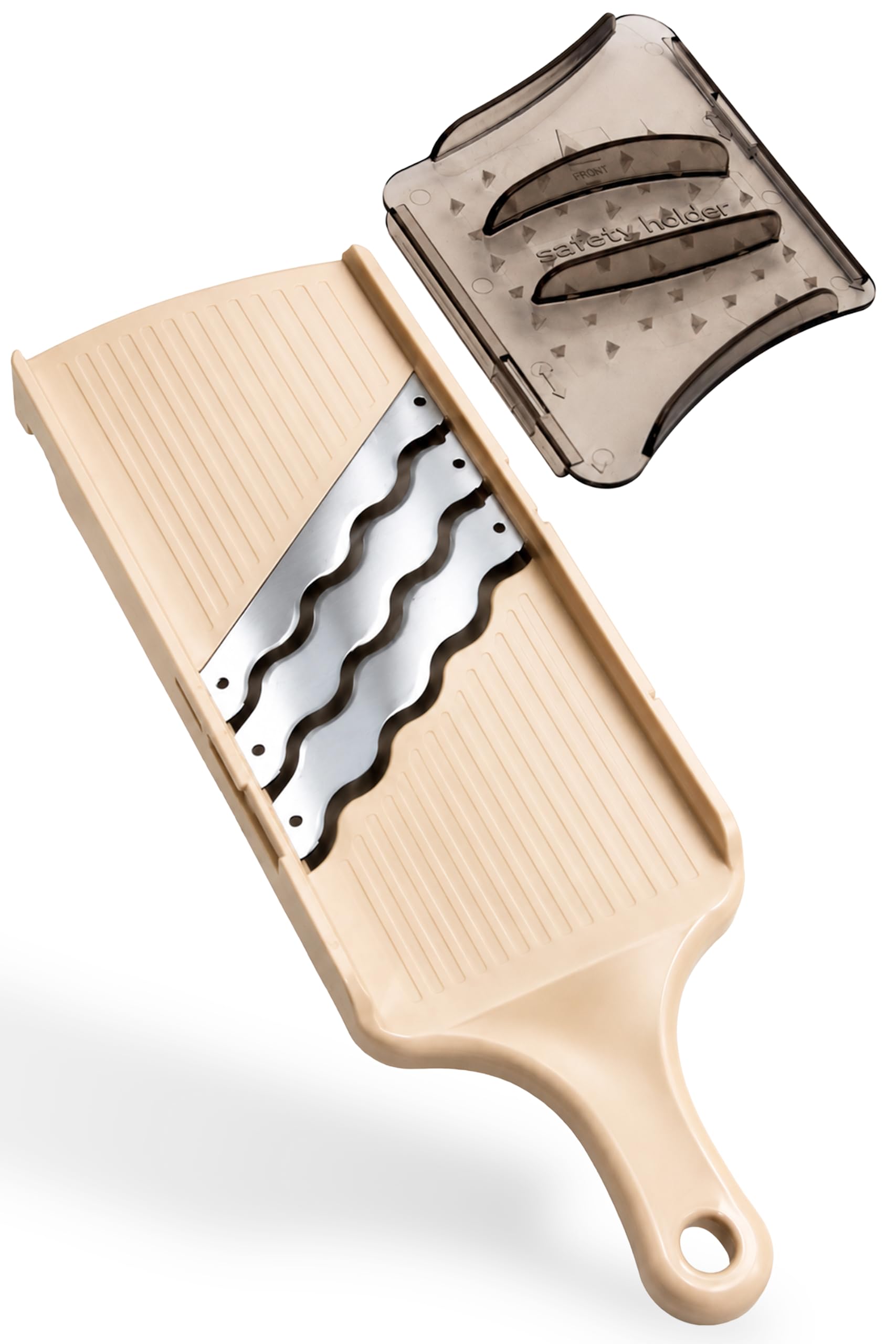
Three wave blades in one frame that turn half a cabbage into a mountain of shreds.
Arnest’s claim here — three blades working at once — is not marketing flourish; it is geometry. The triple wave stainless blades sit in one frame so each push hits three cutting edges, and the wavy shape lets vegetables slide across with less drag and sticking than a flat blade. The result is a 4.7-inch (12 cm) cutting area wide enough for a halved cabbage, and a slice thin and uniform enough for tonkatsu cabbage, katsu bowls, and okonomiyaki.
Speed is the experience. Buyers describe it making quick work of paper-thin vegetables and hard cheeses and it earns especially loud praise for sauerkraut prep. The safety holder grips food and stores attached to the slicer, so it does not wander off. The whole body is dishwasher safe up to 176°F, which makes cleanup a rinse-free job — just avoid higher heat cycles or the resin can warp.
The limitation is thickness. It is designed for very thin slicing, and buyers who expected a versatile adjustable mandoline found they only got fine strands. If you want one board for thick chips and thin cabbage alike, this is not that. If you want thin cabbage, fast — this is exactly that.
The speed factor: three wave blades in one pass means a full cabbage is shredded in a fraction of the strokes a single-blade board would take.
The single job: this is a thin-slice specialist, not an adjustable board — plan for fine strands only.
Bring it home for: tonkatsu nights, okonomiyaki, and anyone who shreds cabbage every week and wants it fast.
Pass it over if: you need thick slices or varied thickness from a single tool.
11. KYOCERA Adjustable Ceramic Mandoline

A ceramic blade that sidesteps rust entirely — and four dialed-in thickness settings to match.
Ceramic is the differentiator. Where steel eventually dulls and can rust if left wet, the Kyocera’s ceramic blade keeps its edge for years and does not rust at all. Four click-in settings — 0.5 mm, 1.3 mm, 2.0 mm, and 3.0 mm — cover paper-thin onion to a thick slice, and the included handguard supports controlled slicing. At 0.11 kg it is one of the lightest adjustable boards here, and it stores flat in a drawer.
The cutting experience is clean. Owners use it on onions, potatoes, garlic, carrots, cucumbers, cabbage, apples, and zucchini, and the ceramic blade keeps fruit from browning the way a steel blade can accelerate. Corner notches let it sit over a bowl so slices fall straight in. For a light-duty daily slicer, that combination of easy cleanup, adjustable depth, and blade longevity is a real bargain.
Three honest issues come up. The thinnest settings are genuinely thin but the thickest 3 mm slice may read as slightly shy of claimed depth to some users. The plastic body and side plastic guard feel light-duty; it is not a restaurant-grade tool. And ceramic blades are brittle, so do not bang it on the sink. Treated gently and kept off the sink edge, it is a reliable daily slicer.
Ceramic’s real payoff: the blade resists rust and keeps its edge for years, which is a genuine advantage over steel for a slicer you use lightly and clean often.
Handle with care: ceramic is brittle, and the plastic guard is not the most reassuring for heavy use.
Buy it for: light daily slicing where you want a rust-proof blade and four set thicknesses without touching a sharpening stone.
Not the one for: a heavy, restaurant-grade slicing schedule — the plastic frame is built for home duty.
12. Benriner Mandoline Jumbo Slicer

The wide-open Benriner for the cooks whose vegetables are too big for a standard board.
A five-inch-wide slicing surface is the whole point — cabbage, melon, and other oversized produce slide straight across without being quartered first. The straight-edge blade is a Japanese stainless steel piece set into a BPA-free plastic body, and a dial lets you set thickness anywhere from 0.5 mm to 10 mm. That range is one of the widest here, covering paper-thin cucumber and proper thick slices for stir-fry or casseroles. At 600 g it sits heavily on the counter; a non-skid rubber base and a large open handle make it comfortable to push through dense produce.
The safety guard holds smaller pieces and hooks over bowls, and the body disassembles for cleaning and top-rack dishwasher use. Owners who own both this jumbo and the standard Benriner say it slices even stubbornly soft things cleanly and takes the vegetables that never fit a smaller board. For cooks working with big vegetables, that extra real estate is worth the weight.
The recurring complaint is adjustment consistency — the dial mechanism is simple, but on some units the setting does not hold. If your board arrives with a sticky or inconsistent dial, exchange it rather than fight it. Buyers who got a good one rate it among the best slicers they have owned.
Where the extra inches earn their keep
- Five-inch slicing surface fits whole cabbage and melon.
- Dial covers 0.5 mm to 10 mm — one of the widest ranges here.
- Non-skid base and large handle for dense produce.
- Disassembles for cleaning and is top-rack dishwasher safe.
What to watch on arrival
- Some units arrive with an adjustment dial that does not hold its setting.
- At 600 g it is the heaviest board here and takes up drawer room.
- The wide body makes it more awkward to store upright than a slim slicer.
Worth it for: cooks who wrestle whole cabbages, melons, and celeriac — the five-inch face is the reason to choose it over the standard Benriner.
Check on arrival: the adjustment dial on some units does not hold its setting, so test it as soon as it lands.
13. Japanese Double-Edged Slicer

A stainless Sanjo knife-shaped slicer you can push and pull without resetting.
The double-edged blade is the unusual feature: you can slice on the push stroke and again on the way back, so a long carrot or a cucumber becomes a pile of paper-thin coins in half the strokes. An angled blade helps ingredients slide past instead of catching and clogging, and the design is sized to fit a 20-centimeter bowl or donburi. At 0.38 lb it handles like a large kitchen knife, and the tip and handle are shaped for a firm grip.
The Sanjo connection is real — the maker’s shop is in the Japanese city known for traditional steel toolmaking, and the stainless construction resists rust and rinses clean. Owners mention build quality as its strongest quality, and it takes up remarkably little space compared to a plastic board, storing upright or laying flat in a drawer. If you cook in an apartment kitchen with limited counter room, that slim profile is a genuine benefit.
The obvious limitation is that it is a slicer, not an adjustable mandoline. There is no dial to change the thickness, no julienne blade to swap in, and the guard is not the full protective style some buyers want. It also stains if not dried immediately. Buyers should treat it as a dedicated, single-cut workhorse.
The double-edged advantage: every push and pull cuts, cutting your slicing time on long vegetables roughly in half.
The single job: no thickness dial and no julienne blade — this is a one-cut slicer for cooks who want thin, fast slicing.
Made for: cooks who like the feel of a knife in hand and want thin slices fast without juggling a board.
Not the one for: anyone who needs adjustable thickness or julienne blades.
14. Benriner Mandoline with Collection Tray and 4 Blades
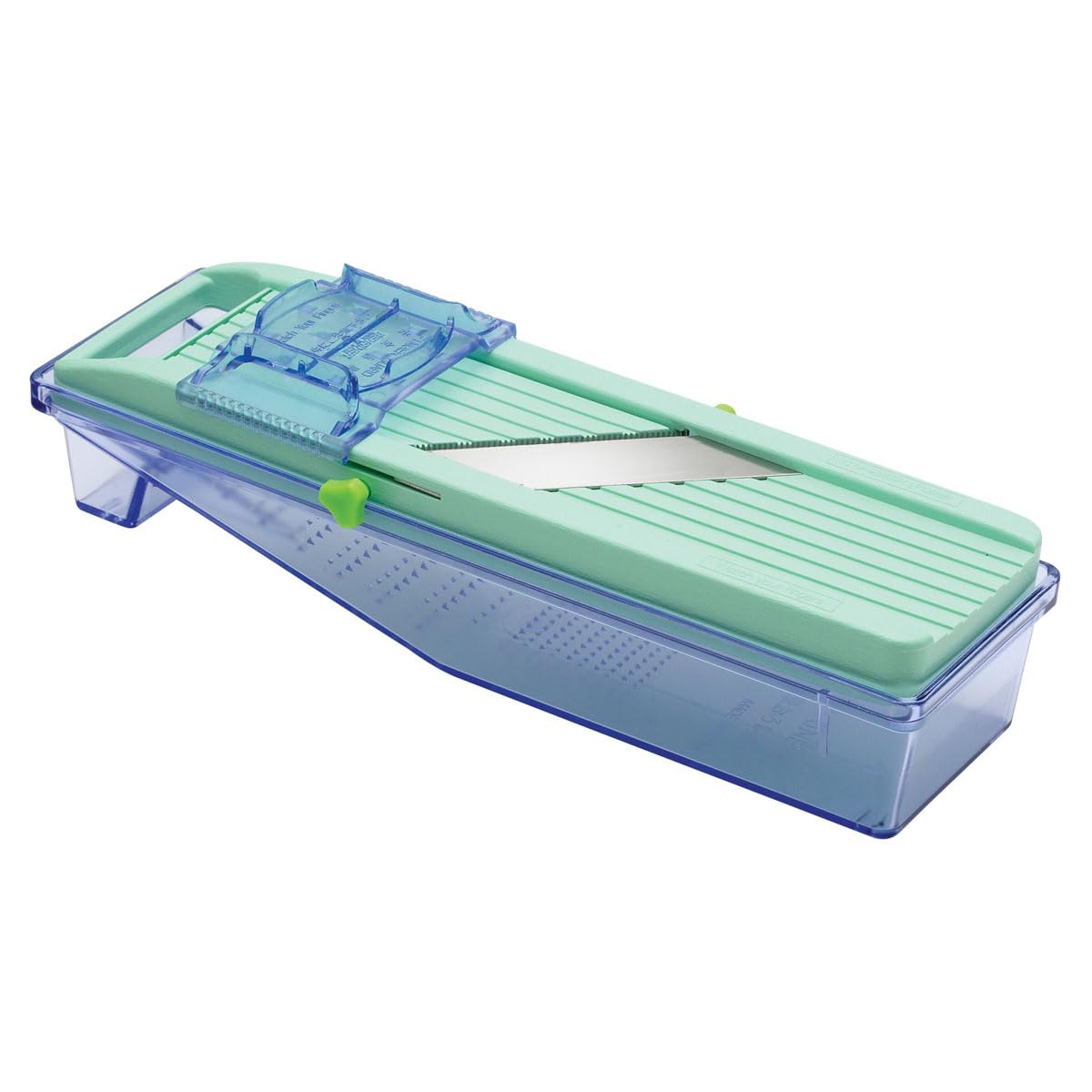
The full-kit Benriner — four blades, a catch tray, and a dial that reaches 8 mm.
This is the Benriner that shows up with everything. One fixed straight blade plus three interchangeable julienne blades (coarse, medium, and fine tooth) means you are covered for wide slices, chunky cuts, and three widths of julienne in one box. The included collection tray sits beneath the blade and catches every slice, so you can work over a bowl without a mess. A dial reaches 0.5 mm to 8 mm of thickness, and the top-rack dishwasher accepts the whole tray for deep cleanup.
The sharpness is what owners notice first — the blades stay effective for years, and the standard straight blade can be honed on a stone to be kept truly sharp. That combination means a real service life for the money rather than a throwaway tool. Owners use it across potatoes, cucumber, cabbage, carrots, and even leftover meat for sandwiches, which is the kind of versatility the tray and multiple blades are built for.
The honest catches are two. Some find the widest side too narrow for a whole large cabbage — it fits most common produce but big heads need reducing. And the finger guard is described as clumsy by many; cut-resistant gloves are the smarter protection. Plan for gloves and a whetstone and this board will cover decades of cooks.
The blade lineup, explained
- Straight blade plus coarse, medium, and fine julienne blades cover every cut shape.
- 0.5 mm to 8 mm dial covers paper-thin through thick.
- Included tray catches slices on the way through.
- Top-rack dishwasher safe for cleanup.
Where it leaves you short
- The widest face suits most produce but not a large whole cabbage.
- The included finger guard is widely disliked and clumsy in use.
- Stains without prompt washing, and blades want honing to stay ideal.
Step up to it if: you want the widest range of cuts — straight slices plus coarse, medium, and fine julienne — with a catch tray built in.
Buy gloves with it: the included finger guard is clumsy enough that cut-resistant gloves do the job better.
15. Benriner Japanese Mandoline Ivory

The ivory Benriner with a secure closure — the finishing detail that keeps blades covered.
This model gives you three stainless steel interchangeable blades in 1.5 mm, 3 mm, and 6 mm widths — a little narrower than the four-blade tray version, but more than enough for most home prep. what separates it is the secure closure: the body fastens shut so the blades stay covered while the slicer lives in the drawer. Owners describe the finish as professional-looking, and the blades cut fruit and vegetables precisely enough that endive and duck breast both come through cleanly.
The extreme sharpness is the standout. Buyers use words like “Japanese quality” and compare the cutting action to other stainless models from major European makers — the Japanese blade takes thinner, more controlled slices with less effort. Wash and dry the blade right after every use and it stays looking new, though let it sit wet and it will dull faster. The 3 mm and 6 mm julienne blades make this a serious shredder as well as a slicer.
The catch is the included hand guard — it is practical for keeping fingers off the blade, but many find it awkward and substitute a mesh cut-resistant glove. That is an easy fix rather than a flaw in the tool. If you want one of the finest-finishing slicers available, this is that.
The finish and feel: a secure closure and three stainless blades in 1.5 mm, 3 mm, and 6 mm mean precise, clean slices with a stowed blade that will not catch your hand in the drawer.
The workaround: the included guard is more awkward than useful — a mesh cut-resistant glove is the smarter substitute.
Best for: cooks who value a fine-finishing slicer with stowed blades and a secure closure in the drawer.
Plan on: bringing a cut-resistant glove of your own — the included guard frustrates more than it protects.
Know the Specs
Blade length and width
Blade length is measured in centimeters and tells you how much food you cover in a single stroke — a 27 cm blade sweeps across a whole half-cabbage, while a 8 cm blade suits small batches. Blade width is the other dimension — a five-and-a-half-inch surface handles a halved cabbage in one push, while a two-inch face does small vegetables only. Buy wide if you shred volume; buy short if you want a drawer-size tool.
Slice thickness and adjustment
Fixed boards lock in at one depth, often about one millimeter, which is the tonkatsu-shop thickness. Adjustable models use a slide or a thumb dial to change that depth, sometimes from paper-thin up to several millimeters. If you make cabbage primarily, a fixed one-millimeter board is fine. If you rotate between chips, slaw, and fries, adjustability covers all three depths.
Blade material — steel versus ceramic
Stainless steel blades can be honed on a stone and replaced, and they hold an edge well but rust if left wet. Ceramic blades stay sharp for a long stretch and do not rust at all, but they are brittle and cannot be sharpened the same way. Both work; steel suits heavy use and honing, ceramic suits light use and no sharpening.
Safety holders and gloves
A safety holder or hand guard grips the last few inches of food so your fingers stay clear of the blade. On some slicers the included guard is clumsy, and a cut-resistant mesh glove is the better option. The sharpest boards — the ones that slice paper-thin — are the ones that most need a guard.
Common Questions
Do Japanese mandolines really cut thinner than a standard mandoline?
Will a Japanese mandoline fit a whole cabbage, or do I have to cut it first?
Can I sharpen a Japanese mandoline blade, or do I replace it?
How do I clean a Japanese mandoline without dulling it?
Are ceramic mandoline blades worth choosing over stainless steel?
Do I need a safety glove, or is the included holder enough?
How much counter or drawer space does a Japanese mandoline take?
Can a Japanese mandoline slice cheese or hard fruit, or is it just for vegetables?
Is an adjustable mandoline better than a fixed-thickness board?
Do Japanese mandolines come with English instructions?
The Bottom Line
For most kitchens, the best Japanese Mandoline is the Benriner Japanese Mandolin Vegetable Slicer — three blades, adjustable screws, and sharp cutting in a drawer-size package that home and professional cooks rely on.
If you shred cabbage weekly, step up to the wide Suncraft BS-271, which handles a halved cabbage in one pass at its one-millimeter depth. If speed is the priority, the three-blade Arnest Wave Shredder turns half a cabbage into a mountain of shreds in a few strokes. And if you want a rust-proof blade with four set thicknesses and no sharpening stone, the KYOCERA Adjustable Ceramic Mandoline is the dependable daily pick.
How we choose
We do not accept paid placement. Every pick is matched to a real buyer and a real use-case; we do not hands-on test units.
Sources
Specifications: manufacturer listings and product documentation. Review insights: verified customer reviews, as of October 2026. Pricing: not shown on this page (it changes often); check the current price via the retailer link.
As an Amazon Associate, Aappliancez earns from qualifying purchases. This does not affect which products we feature.