Disclosure: Some links in this post are affiliate links. As an Amazon Associate I earn from qualifying purchases, at no extra cost to you. Learn more
Specs are compiled from manufacturer listings and verified buyer reviews and can change over time — please confirm the key details on the product page before buying.
Poison ivy wins by cheating. It creeps under the soil, sends runners sideways, and grows back from any root you leave behind — so a spray that only browns the leaves buys you a few weeks, not a season. The concentrates that work are the triclopyr-based ones that move into the root system and stop the plant from resprouting. Below you’ll find the five concentrates worth mixing up, each matched to a different kind of fight: fence-line vines, stump removal, brush-choked pasture, or a driveway full of weeds.
This guide is built by comparing the manufacturers’ published specifications and the patterns across verified customer reviews, so you get each pick’s real strengths and trade-offs instead of marketing spin.
Some formulas brown the leaves in hours and still need a second pass; others take a week but never let go. What separates them is the active ingredient — triclopyr for roots, diquat for fast top burn — and the coverage each bottle delivers. This breakdown of the ivy killer options shows which formula suits vines, stumps, or open ground before you mix a single gallon.
Top Picks


How To Choose The Best Ivy Killer
Poison ivy, kudzu, blackberry, and wild grape are woody vines, not soft garden weeds. They store energy in their roots and crowns, which is why a contact spray that only burns the leaves lets them push new growth a month later. Pick a formula built for brush and woody plants, and you get a product that moves into that root mass instead of stopping at the surface.
Read the active ingredient before the label slogan
Triclopyr is the ingredient most brush formulas lean on because it targets broadleaf and woody plants rather than everything green. The Roundup concentrate pairs triclopyr with fluazifop-P-butyl and diquat dibromide at 2.50%, 2.00%, and 1.50% respectively, which is a mix built for fast leaf burn plus root action. If your target is a vine climbing a tree or a fence post, the ingredient list tells you more than the front of the bottle does.
Match the spray to the job, not the other way around
Ready-to-use bottles suit a handful of spots near the house — you pull the trigger and you are done. Concentrates stretch further for bigger plots, but you have to mix and you have to own a sprayer. If the ivy runs along a long fence line or through a pasture, a concentrate that treats hundreds of square feet per gallon saves a lot of refilling.
Cut-and-treat beats blanket spraying on thick vines
A mature vine with a woody stalk is hard to kill through its leaves alone. Cutting the main stalk near the ground and painting undiluted concentrate onto the fresh cut sends the chemical straight into the root system. Bonide’s label describes exactly this for stump removal — undiluted product applied with a paintbrush to the entire freshly cut surface.
Plan around rain and replanting windows
Rainfast times vary widely. Roundup claims rainproof in as fast as 30 minutes, Ortho says rainproof in 2 hours, and Spectracide says rainfall 15 minutes after application will not wash it away. The replanting window matters too: Roundup allows planting 1 to 30 days after application per its booklet, so read that before you seed a bare patch.
Side-by-Side Comparison
| Model | Best For | Active Ingredient | Coverage | Volume | Amazon |
|---|---|---|---|---|---|
| Roundup Poison Ivy Plus Tough Brush Killer2 Concentrate★ Best Overall | Fence lines and mixed tough brush | Triclopyr, Fluazifop-P-Butyl, Diquat Dibromide | 1500 square feet | 32 fluid ounces | Amazon |
| Ortho MAX Poison Ivy & Tough Brush Killer Ready-To-UseEasiest to Use | Spot work without mixing | Not listed in source data | Non-selective broad spectrum | 24 fluid ounces | Amazon |
| Bonide Poison Ivy & Brush Killer BK-32 | Stumps and lawn-safe weed control | Not listed in source data | 1000 square feet | 32 fluid ounces | Amazon |
| Southern AG 01113 Brush Weed Killer | Undiluted stump and vine work | Triclopyr | 512-1024 square feet per gallon | 32 fluid ounces | Amazon |
| Spectracide Weed and Grass Killer Concentrate with Accumeasure | Driveways and walkways | Diquat Dibromide | 1,350 sq ft | 32 fluid ounces | Amazon |
Detailed Reviews
1. Roundup Poison Ivy Plus Tough Brush Killer2 Concentrate 32 fl. oz.
Our pick — 4.5+★ from 950+ verified ratings; the strongest balance of quality and price.
Three active ingredients, one big coverage number, and a very short rain window.
Coverage is where this bottle separates itself. One 32 fluid ounce container treats 1500 square feet, so a single mix session handles a long fence line without a refill. The Southern AG quart, by comparison, is rated at 512-1024 square feet per gallon — a much smaller footprint from a similar bottle size.
The formula is a three-way blend: triclopyr at 2.50%, fluazifop-P-butyl at 2.00%, and diquat dibromide at 1.50%. In plain terms, that is one ingredient aimed at woody broadleaf plants, one at grasses that creep in alongside, and one that burns the leaves down fast so you see progress in hours. Roundup says it is rainproof in as fast as 30 minutes, which means a surprise shower an hour later does not undo your morning.
The concentrate mixes to whatever strength your tank or hose-end sprayer calls for. Buyers report some plants go down in a single pass while the stubborn ones come back for round two: “Took two applications to kill Virginia Creeper around garage.” That is the honest picture. Several also note the price has climbed noticeably between purchases. The one hard rule: this is non-selective enough to kill regular grass, so keep it off the lawn you want to keep.
Where it pulls ahead
- 1500 square feet of coverage from a single 32 fluid ounce bottle
- Rainproof in as fast as 30 minutes, the shortest window in this lineup
- Three active ingredients cover woody vines, brush, and grass together
- Mix strength is adjustable for a tank or hose-end sprayer
What to plan around
- Heavy vines like Virginia Creeper can need a second application
- It will kill grass as readily as weeds, so aim carefully
- Repurchase cost has risen noticeably for repeat buyers
Reach for it when: you have a fence line or trail edge overrun with mixed brush and want the widest coverage per bottle.
Look elsewhere if: you need to spray inside a manicured bed — the non-selective action will take your border plants with it.
2. Ortho MAX Poison Ivy & Tough Brush Killer Ready-To-Use 24-Ounce
No tank, no measuring cup, no math — just point and spray a patch by the garage.
This is the bottle you hand to someone who has three patches of poison ivy and no interest in owning a sprayer. It arrives ready to use in a 24 fluid ounce trigger bottle and lists over 60 types of tough brush and weeds on the label, including poison ivy, poison oak, kudzu, and wild blackberries. At 24 fluid ounces it is the smallest volume here — the Southern AG quart holds 32 fluid ounces of concentrate in comparison.
The foaming spray clings to waxy ivy leaves instead of beading off, which is why it stays on so many garage shelves. Buyers describe leaves browning within days and the vine gone shortly after: “Sprayed on foamy, stuck to plant leaves and leaves turned brown in 3 days. Plant was dead in a week.” Others used it on wild berry vines that had shrugged off ordinary Roundup and saw them die off over weeks. The tacky foaming action is the trick — it clings to waxy ivy leaves instead of beading off.
Two things to know before you buy. First, the label says rainproof in 2 hours, so watch the sky more closely than you would with the Roundup bottle. Second, it is a ready-to-use spray, which means a small volume that goes fast on a big job — fine for spot work, wasteful for a whole property. Cover nearby desirable plants before you pull the trigger, because overspray does not discriminate.
The case for it: Zero setup, a foaming spray that sticks to slick ivy leaves, and a trigger bottle you can keep in the shed for a quick hit.
The catch: 24 fluid ounces is the smallest volume in this group and rainproof takes 2 hours, so it rewards small targeted jobs over big cleanups.
Best suited to: a homeowner with a few isolated patches who wants to skip mixing entirely.
Skip the shortcut if: your ivy covers a long fence or a bank — you will burn through a ready-to-use bottle quickly.
3. Bonide Poison Ivy & Brush Killer BK-32, 32 oz Concentrate

The one you brush undiluted onto a fresh stump cut and walk away from.
Stump removal is where this bottle earns its keep: undiluted, brushed onto a fresh cut, no sprayer required. The label spells out the method: apply the undiluted product with a paintbrush to the entire freshly cut stump surface. No mixing, no sprayer, no overspray. For a vine with a woody stalk you no longer want to fight, that is the fastest path to the root.
It also covers the widest plant list here — brush, woody weeds, vines, poison ivy, poison oak, kudzu, wild blackberries, chickweed, dandelion, clover, thistle, and over 240 other tough weeds, across 1000 square feet. Bonide states it is designed to kill weeds, not lawn grasses, and lists Bluegrass, Fescues, Rye, Bent, Bermuda, Bahia, and Zoysia as safe residential turf when used as directed. Note the extra heft: at 16 ounces the bottle weighs twice what the Roundup concentrate weighs at 8 ounces, because it ships full of undiluted formula.
The field reports are mostly positive with a clear ceiling. Owners mention it handling the heavy stuff: “It killed an intrusive THICK Vine that’s been choking out the fence.” A few note misses — bindweed and heavy overgrowth can shrug it off, and the same buyer who praised the thick vine also ruined a patch of lawn by letting drift land where it should not. Read the label rates carefully and this is a reliable, easy-to-mix concentrate.
Why it earns a spot
- Undiluted stump application with a paintbrush — no sprayer needed
- Over 240 tough weeds listed, the broadest plant list in this group
- Safe for listed lawn grasses when used as directed
- Instantly mixes with water for tank or hose-end spraying
Where it needs care
- Bindweed and dense overgrowth can survive a full-strength mix
- Drift onto lawn will kill a patch — precision matters
- Concentrate requires a sprayer for anything beyond stump work
Worth grabbing for: stump painting, fresh-cut stalk treatment, and weed control inside a listed lawn.
Not the tool for: a blanket spray over a huge brush lot where you want maximum coverage per bottle.
4. Southern AG 01113 Brush Weed Killer, 1 Quart (32 oz)

A single-ingredient triclopyr quart built for fences, pastures, and clean-cut stumps.
If you want triclopyr and nothing else, this is the uncomplicated version of it. Southern AG’s formula is triclopyr, full stop — the same active that shows up in more expensive brush killers, without a second or third chemical riding along. It is labeled to kill vines and hard-to-control plants and to prevent sprouting on clean-cut stumps, for use on non-crop areas like roadsides, rangeland, pastures, and fences.
Diluted for spray use it treats 512-1024 square feet per gallon, so a quart goes further once you mix it. Undiluted it is a stump and vine specialist. Customers note undiluted concentrate taking down pokeweed within a week with no regrowth — “Undiluted concentrate in pump sprayer killed pokeweed leaves/stems within a week with no new shoots” — and one user killed five pruned crepe myrtles by painting the cuts, with the wood staying dead six months on.
The honest part: this is a formula for people who will read dilution rates and wait a week for visible decline. Patience is required too — brush killer works on its own schedule, and a stretch of days before visible decline is normal rather than a failure.
What it brings: A pure triclopyr option with stump-sprout prevention, and the flexibility to run it full strength or cut it down for pasture and fence lines.
What to watch: Undiluted, it is aggressive enough to wipe out a prized shrub or tree that shares the root zone. Mix deliberately and spot-test first.
Right choice for: pasture edges, fence rows, and stump work where you want one proven active ingredient and control over the mix.
Think twice if: you want a no-measuring, no-sprayer job — this one rewards careful dilution.
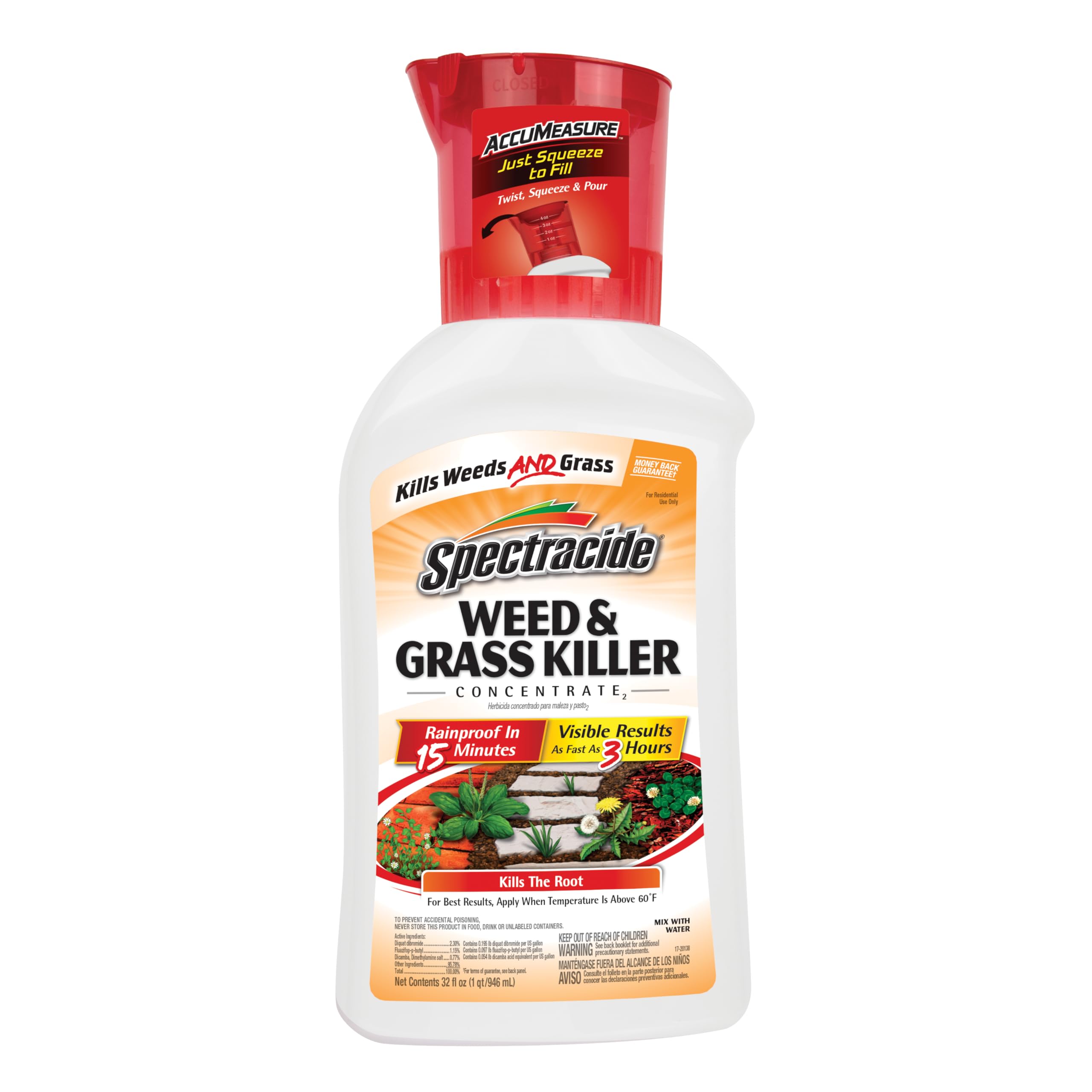
5. Spectracide Weed and Grass Killer Concentrate 32 Oz
Three-hour visible results and the shortest rain window here — but it is not an ivy specialist.
Be clear on the job this one does. Spectracide’s concentrate is a weed and grass killer built for driveways, walkways, patios, and the ground around fences, trees, flower beds, and shrubs — not a woody-vine brush formula. Its active is diquat dibromide, which burns down green tissue fast. The label promises visible results in as fast as 3 hours, and it covers 1,350 sq ft from a 32 fluid ounce bottle.
Two specs stand out on a comparison sheet. It is rainfast 15 minutes after application — better than the Roundup bottle’s 30-minute claim and far quicker than Ortho’s 2 hours — and it is listed for replanting the same weekend, which suits anyone clearing a bed before putting new flowers in. The Accumeasure cap lets you twist, squeeze, and pour without a separate measuring cup.
The caveat is in the name. If your target is poison ivy on a fence post or kudzu on a tree trunk, this is the wrong formula — it is a top-growth burner for open walks and edges. And the dispensing cap splits opinion. Some find it a convenience and others find it fussy, with a handful noting leaks. What it does well, it does quickly: “kills the weeds along my curb within a day” is the typical experience when mixed per the label in a pump sprayer.
The strong points
- Visible results in as fast as 3 hours
- Rainfast just 15 minutes after application — the quickest here
- 1,350 sq ft of coverage from a 32 fluid ounce concentrate
- Replant flowers and shrubs the same weekend per the label
The trade-offs
- Not formulated for woody vines like poison ivy or kudzu
- The Accumeasure cap divides opinion, with some reporting leaks
- Full-surface leaf coverage is required for it to work
Pick this when: the job is a driveway seam, a concrete walk, or a flower bed you want to replant within days.
Keep walking if: you actually have poison ivy on a tree — reach for one of the triclopyr concentrates above instead.
Know the Specs
Active Ingredient
The chemical that does the killing. Triclopyr is the one most brush formulas rely on because it moves into broadleaf and woody plants and reaches the root. Diquat dibromide, by contrast, is a contact burner — it browns green tissue fast but works best on open weeds and grass rather than woody vines. Match the ingredient to the plant — triclopyr for woody vines, diquat for open weeds — or you will be reapplying.
Coverage in Square Feet
How much ground one bottle treats at label strength. This tells you how many refills a fence line or pasture will demand. Note the difference between coverage from a concentrate as sold and coverage after dilution — Southern AG lists 512-1024 square feet per gallon, which is a different measure than the 1500 square feet listed for the Roundup bottle.
Common Questions
Will this kill the ivy roots or just the leaves?
How long before I see the ivy start to die?
Can I spray ivy on a tree without hurting the tree?
What happens if it rains after I spray?
Will an ivy killer also kill my lawn grass?
Do I need a sprayer or can I just use the bottle?
How soon can I plant after treating an area?
Is it safe to use around pets and kids?
Why did the same ivy come back after one spray?
The Bottom Line
The strongest all-round pick for the ivy killer job is the Roundup Poison Ivy Plus Tough Brush Killer2 Concentrate, because its three active ingredients cover woody vines, brush, and the grass creeping between them, and one bottle stretches across 1500 square feet. If your problem is a thick stalk that needs to die from the stump, reach for the Bonide Poison Ivy & Brush Killer BK-32 and paint it undiluted onto the fresh cut. For smaller spots that just need a quick hit with no mixing, the Ortho MAX Ready-To-Use bottle keeps things simple. And if the ivy fight is really a driveway weed problem in disguise, the Spectracide concentrate knocks it back in hours.
How we choose
We do not accept paid placement. Every pick is matched to a real buyer and a real use-case; we do not hands-on test units.
Sources
Specifications: manufacturer listings and product documentation. Review insights: verified customer reviews, as of October 2026. Pricing: not shown on this page (it changes often); check the current price via the retailer link.
As an Amazon Associate, Aappliancez earns from qualifying purchases. This does not affect which products we feature.