Disclosure: Some links in this post are affiliate links. As an Amazon Associate I earn from qualifying purchases, at no extra cost to you. Learn more
Specs are compiled from manufacturer listings and verified buyer reviews and can change over time — please confirm the key details on the product page before buying.
A regular ironing board is the wrong shape for most sewing work. Sleeves slide off the wide end, small quilt blocks sit lost in the middle, and you end up pressing seams on a towel over the kitchen counter. The fix is a board or mat sized for the piece in front of you — narrow enough to slide inside a sleeve, flat enough to press a block without dragging out the full-size board.
This guide is built by comparing the manufacturers’ published specifications and the patterns across verified customer reviews, so you get each pick’s real strengths and trade-offs instead of marketing spin.
The picks below split into two jobs: narrow sleeve boards for curved seams and cuffs, and flat pressing mats for quilt blocks and small projects. Every entry earns its place on a real spec or a repeated owner experience, and the crowd favorite holds 4.5+ stars across 500+ ratings. Here is what actually matters in the best ironing board for sewing.
Top Picks


How To Choose The Best Ironing Board for Sewing
Sewing changes what you need from a pressing surface. You are not standing over a basket of laundry — you are pressing a 6-inch seam, a narrow cuff, or a quilt block that has to stay square. That means the size and shape of the board matter far more than the colour or the frame finish.
Sleeve board versus full board versus pressing mat
A sleeve board is a narrow plank, usually around 4 inches wide at one end, that slides inside a sleeve or a pant leg so you can press the seam without creasing the rest of the garment. A full-size floor board gives you length for whole shirts and skirts. A wool pressing mat is a flat pad you set on your sewing table and press directly onto, which suits quilters working block by block.
What the padding and cover actually do
The pad is the layer between the hot iron and the hard surface. Dense padding lets the iron glide and pushes steam through, so a seam sets crisply. Thin or loose padding means you feel the frame underneath and get a wavy press. Look for a heat-resistant cover and a pad described as thick rather than just present.
Stability is the spec that matters most
A board that shifts under pressure is worse than no board, because a hot iron tips with it. On a tabletop model, check for non-slip feet or silicone caps. On a floor board, check the leg bracing. If you press hard on long seams, a light board that rocks is a real hazard, and it is the most common complaint on any board of any size.
Storage and your actual sewing space
Most sewers press right next to the machine, so the board has to live within arm’s reach. A tabletop board that folds to under 2 inches slips behind a door or into a closet. A pressing mat rolls up into a bag. A full-size floor board needs a corner you can spare. Measure the gap before you buy, because a board that is annoying to set up simply will not get used.
Side-by-Side Comparison
| Model | Best For | Type | Pressing Surface | Weight | Amazon |
|---|---|---|---|---|---|
| Newhouse Specialty Padded Sleeve Ironing Board★ Best Overall | Sleeves, cuffs and narrow pant legs | Tabletop sleeve board | Dual-width, flannel padded | 1.22 kg | Amazon |
| RAINHOL Gray Mini Tabletop Ironing BoardBest for Small Spaces | Small apartments and quick touch-ups | Folding tabletop board | 31.88 x 12 in, metal mesh panel | 3.9 lb | Amazon |
| Quilter’s Cut’n Press | Cutting and pressing at the machine | Two-sided mat | 11″ x 11″ grid mat / cushioned press side | — | Amazon |
| NEEDLES QUILT STUDIO Wool Pressing Mat | Large quilt blocks | Roll-up pressing mat | 36″ x 18″, half inch thick wool | 1.11 kg | Amazon |
| DE-LIANG Padded Chest & Sleeve Board | Curved seams, tailored garments | Wooden tabletop sleeve board | 22.2 in long, tapered 4.3 to 2.7 in | 1.67 kg | Amazon |
| Jacobson Products Padded Chest & Sleeve Ironing Board | Dress shirts and blazers | Tabletop sleeve board | Two widths, aluminum frame | 2.6 lb | Amazon |
| DIAMONDFORGE 43″×13″ Ironing Board with Iron Rest | Full garments alongside sewing | Floor-standing board | 43″ x 13″, 4-layer padding | 9 lb | Amazon |
Detailed Reviews
1. Newhouse Specialty Padded Sleeve Ironing Board
Our pick — 4.5+★ from 500+ verified ratings; the strongest balance of quality and price.
Two widths on one flannel-padded board — the shape that finally makes a sleeve seam sit flat.
The Newhouse is a tabletop sleeve board built around one smart idea: a standard-width side for bigger press jobs and a narrow side for sleeves and pant legs. That narrow end is the part that earns its keep. It slides inside a sleeve so you can press the seam without setting a crease down the front of the garment. The surface is flannel, described by the maker as resistant to high temperature, and the frame is heavy-duty aluminum.
For sewing, this board works almost like a dedicated tool. Its 24-inch length takes a full sleeve or a narrow pant leg with room to spare, and it is slender enough to tuck away between projects. Owners press toddler clothes on it, tailor suit sleeves on it, and set cuffs and small openings that would be fiddly on a full-size board. As one owner put it: “The narrow end is a standout for toddler sleeves and cuffs that need small press jobs.”
Its 4.5+ stars across 500+ ratings is the strongest score in this group. The one honest caveat is scope: this is a sleeve and small-garment tool, not a board you press a whole bedsheet on. If your sewing is mostly quilt blocks or full dresses, the wider surfaces below will serve you better. Buttons worth knowing about: it weighs 1.22 kg, so it stays put on a table without pinning you down.
Where it wins
- Two widths in one board — narrow side for sleeves, standard side for longer press jobs
- Flannel surface the maker describes as resistant to high temperature, so a hot iron does not scorch it
- Heavy-duty aluminum frame holds steady while you press a seam
- 24 inches long, enough for a full sleeve or narrow pant leg
What to weigh first
- It is a small-garment board, so a bedsheet or full skirt has nowhere to sit
- Tabletop only — you supply the table it rests on
Reach for this if: you sew garments and need a narrow surface for sleeves, cuffs, and small openings.
Look elsewhere if: your pressing is mostly large flat pieces like quilt backing.
2. RAINHOL Gray Mini Tabletop Ironing Board 31″x12″
A full pressing surface that folds down to under two inches and tucks into a coat closet.
The RAINHOL solves the problem of having nowhere to press between sewing sessions. Opened out it gives you a 31.88 x 12 inch surface; folded it is 1.96 inches thick, and a dampened hinge keeps it shut so it does not flop open in the closet. A metal mesh panel under the cover helps heat escape quickly, and the cover is heat-resistant over 100% cotton padding. Those two layers are what let you press a seam and lift the iron without the board soaking up heat.
What wins people over here is the fit for tight rooms. It is built for laundry corners, dorms, and apartments, so it earns a following among sewers who work at a kitchen table and pack everything away after. It comes with an iron holder made of iron mesh, and the non-slip silicone caps on the feet keep it planted while you press. The folding hanger hook is the detail that makes it easy to live with — it hangs flat in a coat closet like a garment.
The trade-off is weight and firmness. It weighs 3.9 lb, and you press on a tabletop that catches some of the force. The U-bar folding mechanism on the legs takes a firm squeeze to work open, and the iron rest is a light aluminium piece that droops under a heavy iron. Neither stops it doing the job, but if you press long seams with real pressure, give it a stable table and keep the iron on its own stand.
The space maths: folded at 15.74″L x 12″W x 1.96″H, this board slips almost anywhere, and it is the widest pressing surface in this group that does not need a permanent corner.
One real limit: a tabletop board is only as stable as the table under it, so a wobbly table becomes a wobbly press.
The fit: a sewer in a small apartment who presses in short bursts and stores the board after each session.
Think twice if: you need to lean hard into every seam — a light folding board will move with you.
3. Quilter’s Cut’n Press

One portable block does both jobs — flip the cutting mat over and press the same piece you just trimmed.
The June Tailor Cut’n Press is not a board in the traditional sense. It is a two-sided mat the size of a small pressing station: one face is a grid rotary mat with permanent angles and bias lines, and the other is a cushioned pressing surface. That combo is exactly what a quilter wants at the machine, because you cut a block, flip the mat over, and press without moving your chair.
What it does well is the back-and-forth. It goes to sewing days and classes with small projects, with a carry handle that makes it a grab-and-go item, and it fits inside a machine case. Owners flip between cutting fabric or vinyl and ironing the same piece, and the surfaces hold up — one long-running mat is described as lasting from 2010 with near-constant use before wearing out. That is real evidence of how much cutting and pressing the surface takes.
The honest limit is the 11″ x 11″ grid. That is fine for small piecing and trims, but it will not take long seams or a full quilt block without shifting the piece. It is a helper for small tasks, not a replacement for a board. The maker also notes hand wash only, so keep the wool and vinyl dust out of it and it will look after you.
At the machine: the cushion side sits beside your machine so you can press a block the moment you sew it, which is how quilting stays square.
The size call: an 11″ x 11″ grid is generous for trims and small blocks, and too small for anything bigger — know which job you have.
Choose it for: quilting, classes, and any sewer who wants cutting and pressing in one portable piece.
Not your pick if: you press long seams or full garment lengths.
4. NEEDLES QUILT STUDIO 36″ x 18″ Wool Pressing Mat

Half an inch of New Zealand wool that holds a block in place and presses both sides at once.
For quilters the whole job is keeping a block square while it sets. This mat is 36 x 18 inches of 100% natural wool, half an inch thick, which the maker says grips blocks so they do not slide mid-press. That thickness also lets the mat retain heat, so the underside of the fabric gets some of the press, not just the top. You can iron on the wool setting with steam without worrying about the surface.
What earns it a place in a sewing studio is the lack of ridges and loose fibre. The wool is compacted so no stray fibres transfer onto your project, and the maker states it has no pungent smell — wool pads often do, and that is the repeated gripe on cheaper mats. Owners like that it presses small seams better than a traditional board, and that it sits on a desk extension for quick presses without dragging out a full board. The included cotton bag lets it roll up and breathe between uses.
The size is the point and also the practical limit. At 36 x 18 inches it takes large blocks and big projects, but it does not replace a board for pressing a whole garment — you cannot stand a sleeve on it. If you only ever press garments, a sleeve board earlier in this list is the better tool. If you piece quilts, this mat is what keeps your blocks flat and square.
The quilter’s case
- Half-inch wool holds blocks in place so they stay square while you press
- Heat retention presses from both sides for a firmer set
- Compacted wool so no loose fibre transfers to your fabric
- Rolls into the included cotton bag for storage or class
Worth knowing
- It is a pressing mat, not a board — no narrow end for sleeves
- Some owners note a smell on cheaper wool mats; this one is made to avoid it, so check before you trust the listing
Reach for it when: you piece quilts and want a flat, gripping surface next to your machine.
Pass if: your press jobs are garments and sleeves, where this mat has nothing to grip.
5. DE-LIANG Padded Chest & Sleeve Tailor Ironing Board

A tapered ash wood sleeve board with a sponge pad — the one for curved seams and fitted garments.
This is the board for a sewer who tailors. It is handmade from ash wood, sanded smooth so it does not catch on fabric or your hands, with a sponge and cloth pad on top. The shape is the clever part: 22.2 inches long, tapering from 4.3 inches wide at the front to 2.7 inches at the back. That taper lets you work a curved shoulder seam or a sleeve head without the board poking through the other side of the garment.
What it does that a flat board cannot is support a curve. Owners use it for tiered skirts, dress seams, and trouser seams, and it is stable enough to press against without sliding. The flat wooden base sits firmly on a table, and the board is compact enough to store on a shelf between projects. It also sits nicely on a sewing machine table, so you can press a piece without leaving your seat.
The honest note is technique. This is a shaped board, so it takes a little practice to position it under a curve before you press — it is not as plug-and-play as a plain plank. At 1.67 kg it has some heft, which helps stability but makes it a tabletop tool rather than a lap one. Sewers who tailor regularly will get the hang of it in an afternoon.
The shape advantage: a 4.3 to 2.7 inch taper follows a sleeve head, so you press a curve on a surface shaped like the curve.
A fair caution: the shaped surface asks you to position the garment first — expect a session or two to learn the angles.
Suits you if: you make or alter garments and want to press curved seams, sleeves, and skirt tiers properly.
Skip the upgrade if: your pressing is flat seams and quilt blocks, where the taper adds nothing.
6. Jacobson Products Padded Chest & Sleeve Ironing Board

Two board arms on an aluminum frame — one for sleeves, one for wider seams, and light enough to move.
The Jacobson is the sleeve board to reach for if you press dress shirts and blazers. It gives you two board arms of different widths on one 2.6 lb aluminum frame, so the narrow arm slides into a sleeve and the wider arm takes a chest seam or a trouser seam. That two-arm layout is why it suits a sewer who also wants to stop sending shirts to the dry cleaners.
Owners describe it as well-padded and steady, and the two widths do real work — one arm for sleeves and one for pant legs. It also works with a garment steamer, so you can shape a wool blend without pressing a hard crease into it. For sewing, the aluminum frame keeps the board rigid while you press a seam, and it is light enough to lift from the table when you are done.
There are two practical notes. The board arms are engineered wood rather than cast aluminium, and one owner found a smell on first use that faded over time. The covers also ship shrink-wrapped with a hidden layer of padding tape underneath, which takes around ten minutes to remove before the first press. Neither affects how it presses once you are set up, but factor the setup time in.
The two-arm design: a narrow arm and a wide arm in one board means you stop swapping tools between a sleeve and a seam.
Before you press: plan the ten-minute tape removal first — pressing over that tape will affect your surface.
The right call for: sewers who also press shirts and blazers and want one board to cover both.
Look past it if: you want a board that works straight out of the wrap with no setup.
7. DIAMONDFORGE Ironing Board, 43″×13″ with Iron Rest
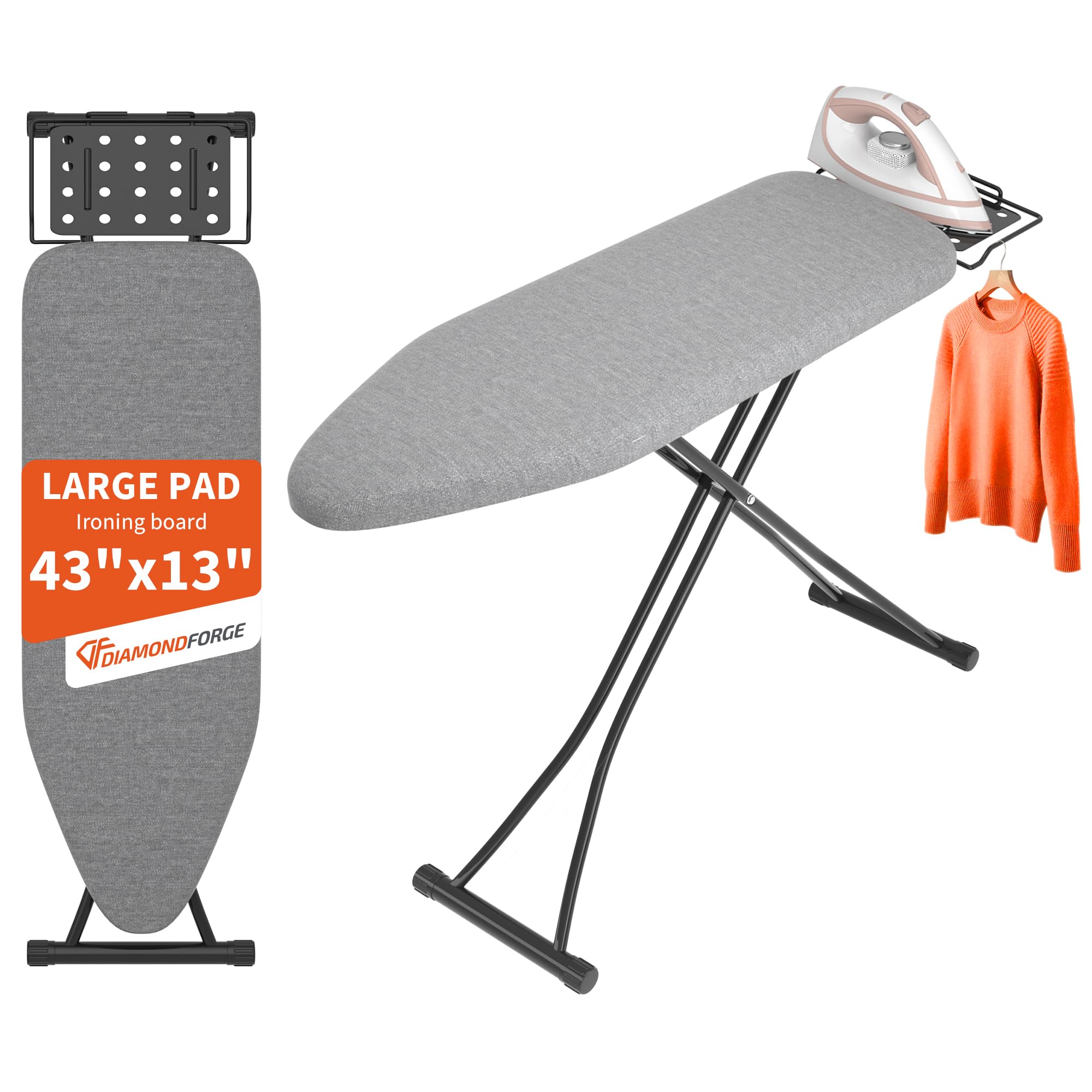
The floor-standing board for whole garments, with a 43-inch surface and seven height settings.
When the job is a full skirt or a long dress, you need length. This board gives you a 43 x 13 inch surface on reinforced steel legs, with a heat-resistant cover over 4 layers of padding so steam passes through quickly and the iron glides. The 13-inch width is narrower than a standard household board, which makes it easier to fit into a sewing corner while still taking a full garment.
The height range is what makes it comfortable for sewing. Seven settings let you raise the board to match your chair or drop it for pressing a long hem, and a safety latch holds it folded flat behind a door or in a closet. It also includes a heatproof iron rest and a hanging bar for clothes you have just pressed. That combination makes it the anchor board in a sewing room rather than a second tool.
Stability is the honest question with any floor board, and this one is 9 lb with reinforced steel legs. Reviews split on it — some find it rock-solid on non-slip feet, while others find it wobbly under pressure. If your floor is uneven or you press hard on long seams, set it on level ground and check the feet first. Level ground and firm feet are the difference between a board you trust and one you fight.
Why it belongs
- 43 inches of length for full garments and long hems
- Seven height settings so you can match it to your sewing chair
- Heatproof iron rest and hanging bar keep a hot iron and fresh press to hand
- Safety latch folds it flat for storage
The honest catch
- Stability is mixed — set it on level ground and check the feet
- At 9 lb it lives in one spot rather than moving between rooms
Worth it for: sewers who press whole garments and want a floor board with a height that suits sitting or standing.
skip it if: you only press sleeves and blocks — a smaller board does those jobs better.
Know the Specs
Board width and taper
A sleeve board is measured at its widest and narrowest points because the narrow end is what slides inside a sleeve. A taper — like the 4.3 inch to 2.7 inch shape on the DE-LIANG — follows a curved seam, while a straight plank is better for flat pant legs. Wider boards take whole garments but cannot get inside a cuff.
Padding layers and cover
The pad sits between the iron and the hard frame. More layers, like the 4-layer padding on the DIAMONDFORGE, hold steam and absorb pressure for a smoother glide. A heat-resistant cover protects the pad itself. Thin padding means you feel the frame and get a wavy press, which is why padding is the spec to check on any folding board.
Folded thickness
On a tabletop board, folded thickness decides whether it lives within reach. A board that folds to 1.96 inches, like the RAINHOL, slips behind a door or into a closet. Thicker boards need a shelf. In a small sewing space this matters as much as the pressing surface, because a board you have to unpack simply does not get used.
Frame material and weight
Aluminum frames stay rigid without much weight, which is why sleeve boards like the Newhouse and Jacobson stay steady on a table. Wood frames, like the DE-LIANG, are heavier but very stable. On a floor board, weight and leg bracing decide stability — a 9 lb board with reinforced steel legs holds better than a light one, but only on level ground.
Common Questions
Can I use a sleeve board for quilting blocks?
Is a wool pressing mat better than a regular ironing board for quilters?
How thick should the padding be on a sewing ironing board?
Can a tabletop ironing board be used next to a sewing machine?
Will a tabletop ironing board damage my table?
What is the difference between a sleeve board and a chest board?
How much space do I need for a folding ironing board?
Do I need a full-size ironing board if I already own a sleeve board?
Is a wooden sleeve board more stable than an aluminum one?
The Bottom Line
For most sewers, the ironing board for sewing winner is the Newhouse Specialty Padded Sleeve Ironing Board because its dual-width surface handles a sleeve and a longer seam on one flannel-padded board, and it carries the strongest score in the group. If your space is tight and you press in short bursts, the RAINHOL Mini Tabletop Ironing Board folds to under two inches and hangs in a closet. And for quilt blocks that need to stay square, the NEEDLES QUILT STUDIO Wool Pressing Mat gives you a half-inch wool surface that grips and presses from both sides.
The Newhouse is the one to start with if you sew garments, since the narrow end is the tool that makes sleeves, cuffs, and small openings easy to press properly.
How we choose
We do not accept paid placement. Every pick is matched to a real buyer and a real use-case; we do not hands-on test units.
Sources
Specifications: manufacturer listings and product documentation. Review insights: verified customer reviews, as of October 2026. Pricing: not shown on this page (it changes often); check the current price via the retailer link.
As an Amazon Associate, Aappliancez earns from qualifying purchases. This does not affect which products we feature.