Disclosure: Some links in this post are affiliate links. As an Amazon Associate I earn from qualifying purchases, at no extra cost to you. Learn more
Specs are compiled from manufacturer listings and verified buyer reviews and can change over time — please confirm the key details on the product page before buying.
You plug in at 11 p.m., wake up to a dead phone, and the cable is the last thing you suspect. Lightning cords die quietly, usually right at the neck where the plug meets the wire. The fix is not the priciest cord on the shelf. It is one with a certified Lightning chip inside and strain relief built into both ends, so the cord survives being yanked off a nightstand a thousand times.
This guide is built by comparing the manufacturers’ published specifications and the patterns across verified customer reviews, so you get each pick’s real strengths and trade-offs instead of marketing spin.
Below you get five cords ranked by who they actually suit, from a two-pack workhorse to a 15-foot reach that crosses a bedroom. Worth knowing up front: an uncertified cord can trigger that “accessory not supported” pop-up, so the picks below all carry an Apple MFi chip.
Top Picks

How To Choose The Best iPhone Charging Cables
A failing Lightning cable rarely fails loudly. It just stops connecting overnight, or starts demanding you flip the plug over every time. Four things separate a cord that lasts from one that ends up in a drawer, and none of them is the brand name on the box.
Look for the MFi chip before anything else
MFi stands for Made for iPhone, Apple’s licensing program, and a certified cord carries an Apple-approved chip in the Lightning plug. That chip is what stops the “this accessory may not be supported” warning and keeps charging predictable. An uncertified cord can work for a week and then start refusing to charge after an iOS update, which is exactly the frustration you are trying to avoid.
Match the length to where you actually charge
Six feet covers a bedside table to the nearest outlet, and lets you keep scrolling while the phone tops up. Three feet is the right call for a car mount or a laptop bag, where a long loop just tangles. Fifteen feet exists for one job: reaching across a room so the phone can stay in your hand on the sofa. An oversized cord leaves a coil on the floor; an undersized one leaves you charging standing up.
Check what plugs into the wall end
Every cord here is USB-A to Lightning, meaning the flat rectangular plug goes into a standard wall charger or laptop port and the small Lightning end goes into the phone. Charging tops out around 2.4 amps with these cords, and it slows on older iPhones that cap their own intake. If your charger brick is a modern USB-C one, you need a USB-C to Lightning cord instead, not any of these.
Understand what braiding and strain relief really do
Braided nylon (a woven fabric sleeve over the wire) resists fraying where a rubber jacket splits. Reinforced connectors add a collar of extra material at the two ends, which is where nearly every cord breaks. Neither makes a cable unbreakable. Both buy you months of daily plugging and unplugging, and one of the picks below is rated for 90-degree bends over 12,000 times.
Side-by-Side Comparison
| Model | Best For | Length | Pack Size | Connector Type | Amazon |
|---|---|---|---|---|---|
| Anker USB-A to Lightning (2-Pack)★ Best Overall | Everyday all-rounder | 6 ft | 2-pack | USB-A to Lightning | Amazon |
| Amazon Basics Nylon Braided (Dark Gray)Best for the Car | Car charging and daily use | 3 ft | Single | USB-A to Lightning | Amazon |
| ohbox Extra Long 15FT Cord | Reaching across a room | 15 ft | Single | USB-A to Lightning | Amazon |
| Apple Lightning to USB Cable | CarPlay and sync reliability | 1 m (3 ft) | Single | USB-A to Lightning | Amazon |
| Amazon Basics 2-Pack (White) | Spare cords around the house | 6 ft | 2-pack | USB-A to Lightning | Amazon |
Detailed Reviews
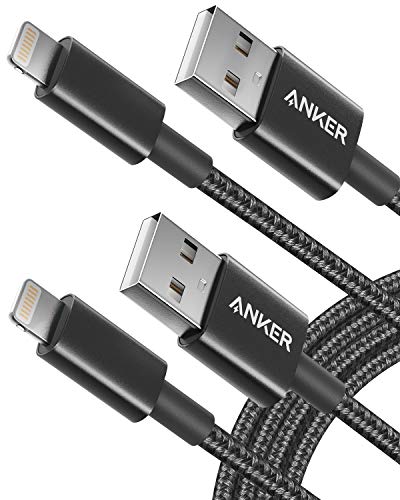
1. Anker USB A to Lightning Cable 2-Pack
Our pick — 4.5+★ from 110,500+ verified ratings; the strongest balance of quality and price.
A bend-tested workhorse that survives 90-degree folds 12,000 times over.
What earns it top spot is the bend rating: 12,000 folds at a full 90 degrees, plus a build the maker says shrugs off 88 lbs. In plain terms, the reinforced ends keep the wire from snapping at the neck when you yank it off a nightstand. Each cord is MFi certified with an Apple C48 Lightning plug, so the phone recognizes it instead of flashing a rejection warning.
The two-pack gives you 6 ft on each cable, which the maker pitches as “walk and talk” reach — enough slack to talk on the phone while it sits plugged in on a counter. Nylon covers the whole run and holds up against the slow fray that kills cheaper cords. As buyers put it when comparing old failures: “Cheaper cables failed after ~10 days (stopped charging).” It is the crowd favorite at 4.5+ stars across 110,000+ ratings, and durability is what wins people over.
The honest catch is speed. The USB-A plug caps charging performance, and the spec sheet notes a limited charging speed for the iPhone 14, while some buyers report slow charging or the occasional disconnect. Treat it as a dependable every-night charger, not the fastest top-up in the drawer. It is also stiffer than you might expect from a braided cord, so coil it loosely rather than cramming it into a pocket.
What wins people over
- The 12,000-fold 90-degree bend rating is the durability figure to remember — that is the stress point where cords usually fail.
- MFi certified with an Apple C48 Lightning plug, so it avoids the unsupported-accessory pop-up.
- Two 6 ft cables in one order, so one lives by the bed and one goes in the bag.
- Nylon jacket resists the fraying that ends most cord lives.
Where it asks for patience
- USB-A limits charging speed, and the spec sheet flags a limited speed on the iPhone 14.
- Stiffer than a soft rubber cable, so it fights a tight coil.
- Charging and connectivity draw mixed reports rather than universal praise.
Buy this if: you want one dependable cord per room and value a cable that outlasts the phone it charges.
Think twice if: your priority is the fastest possible charge on a newer iPhone, where a USB-C setup does better.
2. Amazon Basics USB-A to Lightning Cable 3 Foot
Short enough to skip the dashboard tangle, braided enough to survive the gearshift.
At 3 feet, this is the cord that disappears into a cup holder and never loops over the steering column. Compare that to the 15 ft ohbox further down, which runs 15 feet — this one is a fifth of the reach by design, and that is the point. It charges at up to 2.4 amps through wide-diameter wires built to cut resistance, and the C89 smart chip inside the connector keeps it Apple-certified.
What gets praised most is overall quality, and the long-run stories back it up. Plenty of owners run these for years — the recurring theme is “Used daily for 2 years and still working,” with the fabric sleeve holding while the connectors stay snug. It also transfers data at 480 Mbps, which is enough to move photos without a fuss. Dark gray hides the smudges a lighter cable shows after a winter of glovebox duty.
There is a wear pattern to know about. The fabric can start to separate from the plastic collar at the ends after heavy use, and the Lightning connector may eventually work in only one orientation. That is a slow decline, not an early failure, and careful coiling delays it. If it lives permanently in a hot car, plan on it being the first cord to show age.
What holds up: The braided jacket keeps the wire from tangling, and the unibody connectors seat firmly on every insertion, so it stays put over bumpy roads. Owners who run these for years call out the value against pricier cords.
The slow-wear note: Watch the join between fabric and plastic at each end; that is where the sleeve eventually separates with rough handling.
Reach for this if: you want a dedicated car or desk cord with a short run and a firm fit.
Look elsewhere if: you need slack to charge from a distant outlet — 3 feet will not stretch across a room.
3. iPhone Charger Cord 15FT
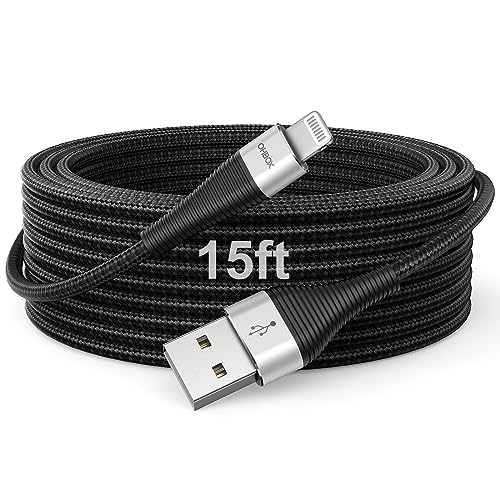
Fifteen feet of slack so the phone can stay in your hand on the far sofa.
This is the reach play, and the gap is stark: 15 feet here against 3 feet on the Amazon Basics dark gray cord. That is the difference between charging from the wall across a bedroom and being stuck sitting beside the outlet. It also carries more than 30,000 bending tests behind its reinforced build, and the braided jacket protects an Apple Lightning plug and USB-A end.
Physically, the cable is built for lounging. You can lie on the sofa, work at a desk, or hand a phone to someone in a hospital bed without unplugging anything. It pushes up to 2.4 A over thicker copper and moves data at 480 Mbps, and the connectors snap in tight with no wiggle. A two-year warranty comes with it, which is a longer commitment than most cords offer.
The trade-off shows up in speed and long-term faith. Charging speed reports split both ways, and some owners hit the “unsupported accessory” message even though the listing claims MFi certification — a mixed signal on a cord this long. Reach this far also means more voltage drop, so a full charge can take longer than from a short cord. One unit broke inside a month, so treat the braid well and do not yank the plug.
The length advantage: Charge while reading in bed, streaming, or working at a desk across the room — no more parking yourself next to the outlet.
What to watch: While the listing claims MFi certification and buyers like the snug fit, a few report unsupported-accessory warnings, so verify it behaves before trusting your only backup cord to it.
Best suited to: bedrooms, care facilities, and desk setups where the outlet sits far from where you sit.
Skip only if: you want a short, snappy charge — go with the dark gray Basics instead.
4. Apple Lightning to USB Cable (1 m)

The original Apple cord: boring, dependable, and the one CarPlay trusts.
When a third-party cord keeps dropping CarPlay mid-drive, the fix tends to be the genuine article. This one is a 1 m (3 ft) USB 2.0 Lightning cable built by Apple, and it connects a phone to a Mac, Windows PC, or a wall adapter for syncing and charging. The USB power adapter is sold separately, so bring your own brick. It weighs just over an ounce, which makes it the lightest cord in a bag.
Its reputation rests on one thing: it just works. Owners who tried cheaper cords come back to it after CarPlay dropouts and flaky charging, and the short run keeps a phone cradle tidy. Some owners replaced a faulty work-issued cord and found their car connection came back to life. The 3 ft length also makes it the pick for a vehicle, where a longer loop would only get in the way.
The limit is durability, and it is the most-discussed weakness. The wire can crack or fray at the base near the connector with heavy daily plugging — the classic Apple-cable failure. Cost per foot is also the steepest here, so this is not the cord you buy in bulk to drape around the house. Buy it as the reliable one for a specific job.
Why Apple buyers stay: Certified-by-manufacturer compatibility, a snug 1 m run, and syncing that works the first time on a computer. For CarPlay and dependable daily charging, it removes the guesswork.
Choose it for: a car, a work laptop sync, or any spot where you want zero compatibility risk.
Look past it if: you need long reach or buy cords in multiples — its short run and steep per-foot cost work against both.
5. Amazon Basics USB-A to Lightning Cable 6 Foot

Two six-foot cords for the whole house, white jacket and all.
Two 6 ft cables in one order, each MFi certified with Apple’s original C89 smart chip inside the plug. That chip is the reason it avoids the rejection warning and behaves like an OEM cord. It moves power at up to 2.4 amps and data at 480 Mbps, and the additional layer of protection at both ends is meant to slow the fray that kills cords. The white jacket matches the standard Apple look, which is the appeal if you want cords to blend in.
What earns its keep is convenience and CarPlay compatibility — owners mention it hooks up to Apple CarPlay for GPS navigation where non-certified chargers only charged. A 6 ft run reaches from a wall outlet up to a bedside table without stretching. Its connectors are unibody and seat firmly, so the plug does not wobble once it is in.
Be ready for a stiff coating. The jacket is not soft, and the white finish and slight rigidity are the main gripes rather than durability. If you need cords that coil up small for travel, this is not the friendliest option. As a pair of table-side spares that just need to work, it does the job.
The value read: Two certified 6 ft cords beat one short cord for someone who charges in several rooms, and the OEM-style white jacket keeps the look consistent.
Fit note: The cable is a little stiff and the white surface shows dirt, so a darker braided cord wins if you care about tidiness.
Worth it when: you want a matching pair of spares to leave in different rooms.
Not your pick if: you want a soft, tangle-free cord for a compact travel bag.
Know the Specs
MFi Certification and the Chip in the Plug
MFi is Apple’s licensing stamp, and a certified cord carries an Apple-approved chip that tells the phone it is safe to draw power. Without that chip, the phone may flash an unsupported-accessory message or refuse to charge after an update. The Apple cord is built by the manufacturer itself, while the other picks here name their own certified chip — the Anker carries an Apple C48 plug and the Amazon Basics cords use a C89 chip. Look for the certification on the listing and you skip the guessing.
Charging Speed: Amps, USB-A, and What Slows It Down
The cords here support up to 2.4 amps of charging current through a standard USB-A plug. That is plenty for an overnight top-up, but a USB-C to Lightning setup can push more on phones that accept it. Anker’s own spec sheet flags limited charging speed for the iPhone 14 on its cord. Length also adds resistance, so a 15 ft run can trickle slower than a 3 ft one. Match speed expectations to your phone and your wall brick, not just the cable.
Length, Reach, and Where You Charge
Pick the shortest cable that still reaches your outlet, and you skip a floor full of tangled wire. A 3-foot cable (about 0.9 m) fits a car mount, a laptop bag, or a desk right beside the outlet. A 6-foot cable (about 1.8 m) is the bedside balance — long enough to scroll while charging, short enough to coil neatly. A 15-foot cable (about 4.6 m) solves one specific problem: an outlet far from where you sit, like a hospital bed or a sofa across the room.
Durability: Bends, Braiding, and Strain Relief
Most cords break right where the wire meets the plug, so that joint is what to inspect. Braided nylon resists splitting and fraying compared to a plain rubber jacket. Reinforced connectors add a collar of extra material at both ends. The Ankercord is rated for 90-degree bends 12,000 times, and the ohbox cord points to more than 30,000 bending tests. Data transfer at 480 Mbps is also a factor if you sync photos and music to a computer rather than only charging.
Common Questions
Will these cables charge an iPhone 14 or newer?
What does MFi certified actually mean on a charging cable?
Will a 15-foot cable charge as fast as a 3-foot one?
Can these cables handle data transfer and syncing, not just charging?
Which cable is best for CarPlay in the car?
Why do some cheap cables show an unsupported accessory message?
How long should an iPhone charging cable last with daily use?
Do these cables work with iPads and AirPods as well as iPhones?
Is a stiffer cable a sign of poor quality?
What do I need besides the cable to charge?
The Bottom Line
For most people, the iphone charging cables winner is the Anker 2-Pack because a 12,000-fold bend rating and an Apple C48 plug give you two cords that stand up to daily abuse. If a short cord for the car is all you need, grab the Amazon Basics dark gray at 3 feet. And when the outlet sits across the room, the ohbox 15 ft cord is the one to reach for. Match the cord length to your outlet, insist on the MFi chip, and the 11 p.m. dead-phone problem stops for good.
How we choose
We do not accept paid placement. Every pick is matched to a real buyer and a real use-case; we do not hands-on test units.
Sources
Specifications: manufacturer listings and product documentation. Review insights: verified customer reviews, as of October 2026. Pricing: not shown on this page (it changes often); check the current price via the retailer link.
As an Amazon Associate, Aappliancez earns from qualifying purchases. This does not affect which products we feature.