Disclosure: Some links in this post are affiliate links. As an Amazon Associate I earn from qualifying purchases, at no extra cost to you. Learn more
Specs are compiled from manufacturer listings and verified buyer reviews and can change over time — please confirm the key details on the product page before buying.
The hardest part of buying an intercom headset is not the radio inside it — it is whether two people can actually hear each other over wind, engines, crowd noise, or a running generator. Pick wrong and you get a headset that sounds fine on the sofa and falls apart the moment a motorcycle hits highway speed. This guide sorts the real differences: how each set connects, how long it runs on a charge, and how well it keeps your voice clean when everything around you is loud.
This guide is built by comparing the manufacturers’ published specifications and the patterns across verified customer reviews, so you get each pick’s real strengths and trade-offs instead of marketing spin.
Every set below was chosen for a different kind of team, so the right answer depends on whether you are on a bike, on a film set, or directing a crew from a deck. Each pick below is matched to a specific crew size and noise environment, from a two-rider motorcycle link to a five-person broadcast setup.
Top Picks


How To Choose The Best Intercom Headsets
Start with the number of people who need to talk, because that single fact rules out half the market. A two-person set cannot be expanded into a five-person crew without buying more hardware, and some systems top out at two by design. Get the headcount right first, then worry about sound.
Full duplex versus push-to-talk
Full duplex means both people can speak and listen at the same time, like a phone call — no button held down, no waiting for a gap. That is the standard on film sets and boat decks where hesitation costs you. Push-to-talk (PTT) saves battery and cuts background chatter, but it forces turn-taking. Several sets here offer both, so you can switch modes mid-shift.
Range claims and real range
Published range figures almost always assume clear line of sight with nothing between the two headsets. Walls, a hull, or a concrete floor will cut that number down. If your crew works inside a building or below deck, treat the headline range as an outdoor best case and plan for less.
Noise cancellation and hearing protection
Two different jobs get called “noise cancellation.” One cleans up your outgoing voice so the other person hears you, not the engine. The other physically blocks loud sound from reaching your ears. Industrial and racing headsets often publish a Noise Reduction Rating (NRR) in decibels for the second job — a number worth checking if you work beside machinery or at a track.
Battery, charging, and swappable packs
Look at whether the battery is built in or replaceable. A replaceable pack means a long shoot or a full riding day continues after a quick swap instead of a charging break. USB-C charging and pass-through power (running while plugged in) both stretch a working day.
Side-by-Side Comparison
| Model | Best For | Connection | Rated Range | Battery / Runtime | Amazon |
|---|---|---|---|---|---|
| Rugged Radios H41★ Best Overall | Racing and loud industrial sites | 5-pin radio port + 3.5mm jack | — | Wired | Amazon |
| COSMUSIS Trucker Bluetooth HeadsetBest Value | Drivers and all-day call work | Bluetooth 5 | 10 meters | 50 hours | Amazon |
| Fodsports FX-S | Two riders on motorcycles | Bluetooth 5.4 | Up to 1000m | 2-hour charge, USB-C | Amazon |
| SYNCO XTALK X2 | Filming and production teams | 2.4GHz wireless | 350 m / 1148 ft LOS | 24 hours, replaceable | Amazon |
| COMICA Seekcom S1 | Broadcast crews up to 5 users | Dual-antenna wireless | 500 meters | 12 hours, 2-hour charge | Amazon |
| Hollyland Solidcom SE | Small TV and film teams | 2.4GHz wireless | 1100ft / 350m | 12 hours master, 10 hours remote | Amazon |
| Eartec UL2S Ultralite HD | Two-person pro crews and marine | DECT 6.0 on 1.9 GHz | Up to 1000 ft | Up to 6 hours talk time | Amazon |
Detailed Reviews
1. Rugged Radios H41 Headset
Our pick — 4.5+★ from 550+ verified ratings; the strongest balance of quality and price.
The one headset here that doubles as hearing protection and a serious radio link.
Most headsets on this list are trying to make your voice sound good. This one is trying to save your ears while you stand three feet from a screaming engine. The H41 carries a 24 decibels NRR rating — short for Noise Reduction Rating, the standard score for how much loud sound the headset physically blocks from reaching your ears. At a track or a construction site, that is the number that decides whether you can work a full shift without ringing in your head afterwards.
The smart part is what you can plug into it. A 5-pin universal radio port connects to two-way radios from Rugged Radios, Baofeng, Motorola, Kenwood, HYT, TYT and more, and a separate built-in 3.5 mm jack takes audio from a phone, race receiver, or scanner. In practice that means you can run a race scanner in one ear while a handheld radio keeps your crew in contact, both at once. One racing fan described exactly this setup, listening to team radios and running an FRS/GMRS intercom in the stands at the same time.
The microphone is an adjustable dynamic noise-canceling boom, so your outgoing voice gets cleaned up before it transmits. A detachable cable and nylon carry bag make it easier to stow and replace parts than a sealed molded unit. Duck behind the head and it still clears a helmet, which is why track safety crews and pit marshals keep coming back to this design.
Why the workshop set has a reputation
- 24 dB NRR blocks loud machinery and engine noise instead of just masking it.
- 5-pin port plus a 3.5 mm jack run radio traffic and outside audio together.
- Behind-the-head band sits clear of a racing helmet.
- Detachable cable and repairable metal fittings keep it serviceable long-term.
What to know before you buy
- Outgoing volume can be low on a plain handheld radio with no mic gain — it leans on a powered Rugged Radios box.
- The behind-head clamp runs tight for some wearers, and the flat band is not everyone’s favorite shape.
- The stock noise-cancelling mic needs you close to speak — a fixed boom can feel fussy.
Reach for this if: you need hearing protection and crew radio in one, whether that is a race pit, a speedway, or a heavy-equipment cab.
Look elsewhere if: you want a plug-and-play wireless crew intercom — this is a wired radio headset that needs a two-way radio to talk.
2. COSMUSIS Trucker Bluetooth Headset
The headset you put on at the start of a shift and forget about until it ends.
The number that sells this one is the battery: a rated 50 hours of average life, with 200 hours of standby time, on Bluetooth 5 wireless. For a driver or a call-center worker, that means days of use between charging sessions instead of a nightly ritual. Owners routinely describe getting ten or twelve hours of daily talk time from a single charge, and one reviewer noted it lasted three days without plugging in.
What makes it flexible is the dual/single-ear switch. Fold the second earcup up and you keep one ear on your surroundings — handy in a depot, a warehouse, or at a counter. Put both ears in and you get stereo sound for music or podcasts on a break. The concave memory-foam earpads mold to your shape, and the adjustable headband keeps the weight light across a long call day.
There is one-touch mute on the boom, so you can kill the mic instantly during a meeting or a private moment. Bluetooth range is rated at 10 meters, and a wireless connection this simple also works with a desktop, laptop, or tablet, not only a phone. The Bluetooth version here is 5, one step behind the newer 5.4 spec on the Fodsports helmet set later in this list — the practical gap is minor for calls, but the Fodsports wins on paper for low latency.
The honest trade-off: background noise gets handled well and voices come through clearly, but the boom-mounted buttons can sit behind the mic arm when it is raised, so volume changes take some hunting. A few heavy users also find the plastic build light in the hand — it holds up, but it does not feel premium.
Who it beats: pricier Bluetooth headsets that never last a full shift and cost you a charging break.
The one caveat: if you need true dual-direction intercom between two people, this is a one-way call headset — it talks over a phone or app, not a dedicated radio link.
3. Fodsports FX-S Motorcycle Bluetooth Headset V5.4
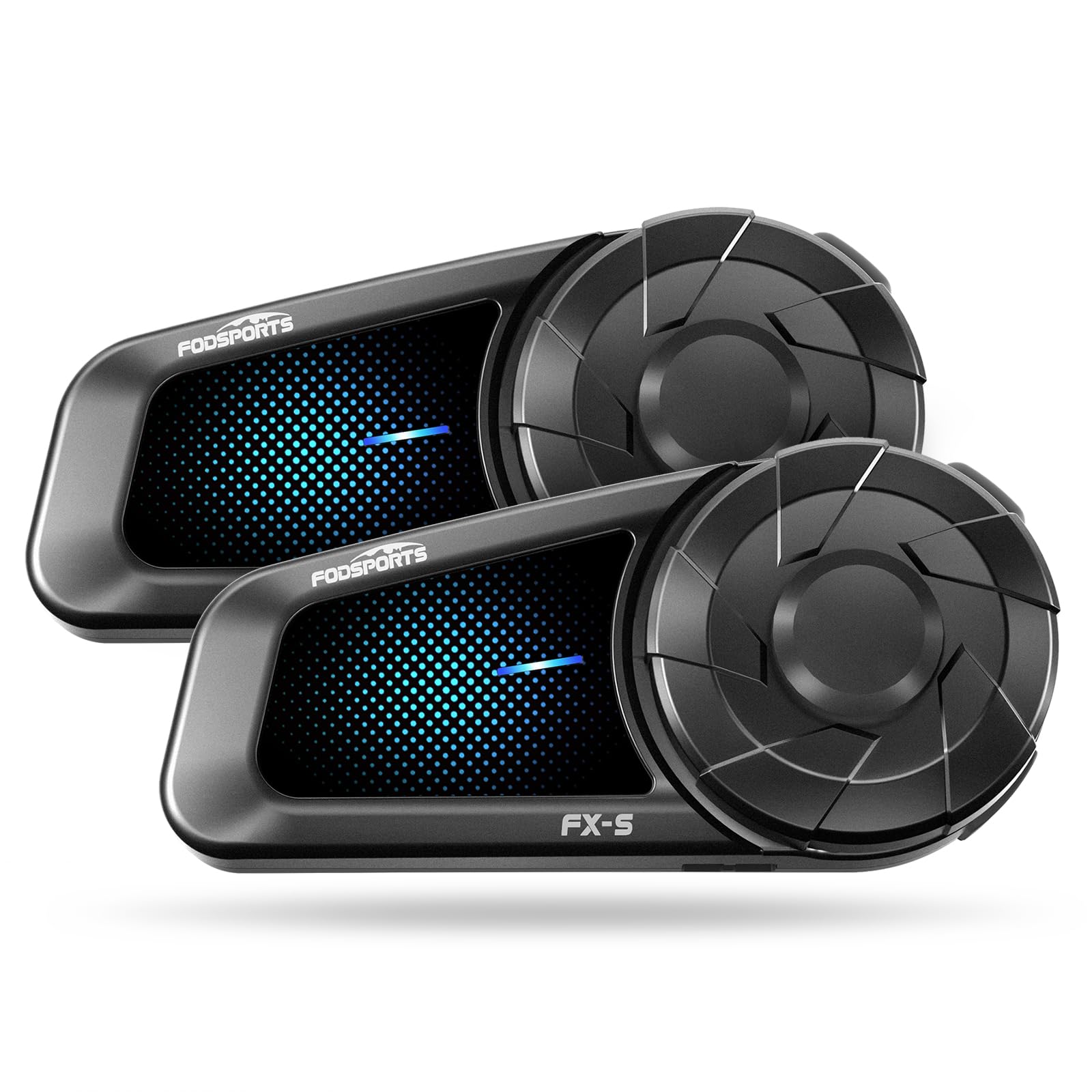
An IP67 helmet set that pairs two riders on a Bluetooth 5.4 chip and shrugs off rain.
Two riders, one clear channel, and a waterproof rating that means you keep talking through a downpour. The FX-S runs the Qualcomm Bluetooth 5.4 chip — the newer spec against the 5.0 on the COSMUSIS trucker headset — for a more stable signal and low latency over a rated intercom range up to 1000m between two riders. That is a two-person link only; it will not host a group.
The speakers are 40mm wide and 9mm tall, sized to slide into a helmet shell without pressing on your ears. Owners riding with the wind howling report callers on the other end cannot tell they are on a motorcycle, thanks to CVC and DSP noise cancellation — one described the noise handling as excellent and the range flawless to 200-plus yards, more on open terrain. An IP67 rating means it is fully sealed against dust and short water immersion, so road spray and rain are not a concern.
Installation is deliberately easy: two mic types ship in the box (a button mic for full-face helmets and a boom mic for open-face), plus surface and slide-on mounts. The oversized controls are built for gloved hands, and one-touch voice assistant handles calls, music, and GPS prompts. Type-C charging and use-while-charging keep a long ride going, and at 0.08 pounds the unit adds almost nothing to the helmet.
Where it shines: noise cancellation strong enough to keep your voice clean at speed, an easy clamp mount, and weather sealing that a fair-weather set will not match.
What you give up: the sound leans bright — thin bass and strong highs — so wear earplugs on long highway stretches to tame the tinniness. And two riders is the ceiling; no group riding intercom here.
Best fit: a pair of riders who want reliable helmet-to-helmet talk, music, and GPS in any weather without paying flagship prices.
Not your set if: your riding group is three or more and you all want to be on one channel.
4. SYNCO XTALK X2 Wireless Intercom Headsets
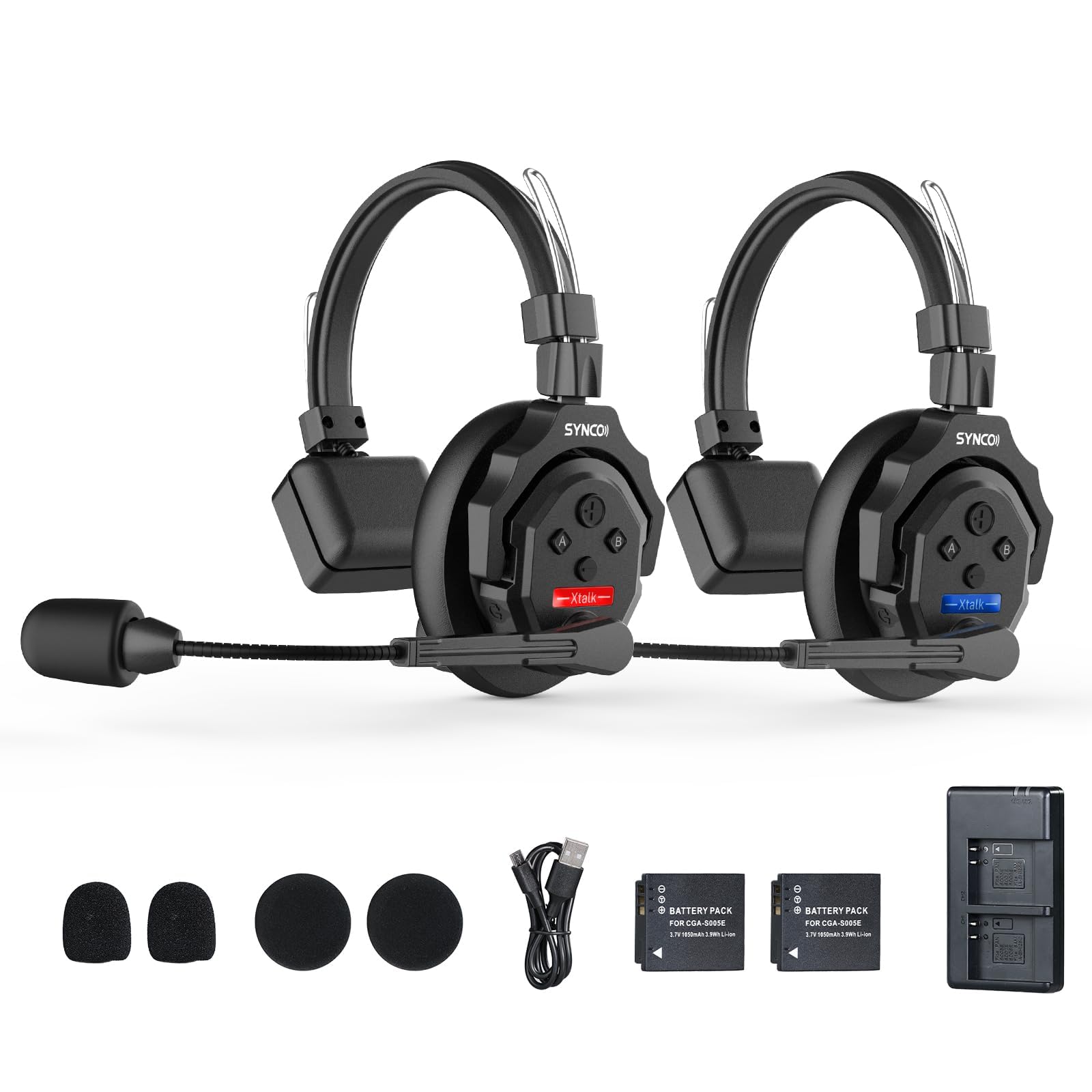
A full-duplex crew system that ships pre-paired and lasts a 24-hour shooting day.
The big draw here is battery and range together: a rated 24 hours of working time from a replaceable battery, with a 2.4GHz link rated up to 350 m / 1148 ft line of sight. On a two-day shoot, a swappable pack means you are never hunting for an outlet mid-scene. Each battery recharges in 2.5 hours, and Type-C pass-through power keeps a unit running while it tops up.
Full duplex means everyone on the channel talks and listens at once, no button jabs. The AEC (acoustic echo cancellation) processing covers a 150Hz–7kHz ultra-wideband range, which is the slice of sound that carries human speech — that is how it strips echo and ambient rumble while keeping voices forward. One buyer running a five-headset crew reported strong connections at around 100 yards, with the link only dropping inside an elevator before reconnecting on its own.
The 3.5 mm port is what separates this from a plain talk set: you can monitor camera or recorder audio while staying on comms, which is exactly what a director or field commander needs to call a shot. A rotate-up boom mutes the mic, and a master/remote hierarchy lets one person hold the floor. It ships pre-paired, so day one is plug in and talk rather than menu-diving.
The production-crew case
- 24 hours per replaceable battery keeps multi-day shoots moving.
- 350 m / 1148 ft line-of-sight range with fast reconnect.
- 3.5 mm port lets you monitor camera audio while on comms.
- Arrives paired and ready, with a hard carrying case and charging station.
Where it asks patience
- A roughly one-second audio delay shows up at close range.
- The earpiece can leave a small gap on some head shapes.
- Two headsets are the base kit — extra units cost extra.
Take this one: directors, camera operators, and event crews who need all-day runtime and camera-audio monitoring on set.
Think twice if: you are riding a motorcycle — this is a crew production system, not a helmet intercom.
5. COMICA Seekcom S1 Wireless Intercom Headset System

A five-user crew system built for broadcast, with dual antennas and an OLED status screen.
This is the set for a larger team that still wants everyone unclipped and free to move. Full-duplex two-way talk runs up to 5 users at once, and a wired cascade pushes it to 8. A dual-antenna design rated up to 500 meters in open areas handles the reach, with the system shifting frequency bands to dodge interference. A small OLED screen shows signal strength, battery, volume, and noise-reduction status right on the headset.
The noise tools are the interesting part. CalMix AI noise reduction works alongside traditional ENC (environmental noise cancellation) and switches with one button, aimed at wind, crowd, traffic, and set clatter. Owners testing around 200-plus feet report reliable links and clear voice, and a full-duplex test over a few hundred feet ran until the tester could not get far enough away to drop out.
Roles switch freely between host and guest, and the modes cover overall broadcast, one-to-one talk, and recording. Talk, PTT, and mute each have their own mode, so you can save battery during long downtime. A 3.5 mm input takes external audio or a monitoring device, USB-C outputs digital audio to a PC, and the COMICA Audio app handles control and firmware updates. The built-in battery charges in 2 hours and runs up to 12 hours, and IPX3 adds basic water-spray protection for outdoor shoots.
Most impressive: a large crew stays in sync over serious distance, and the OLED readout saves a lot of guessing on set.
The catch: there is a small audio delay that shows up clearly at close range, and the noise reduction is tuned for crowds and wind rather than heavy engine or road noise — one in-vehicle test found it unsuitable for driving.
Pick it for: film, broadcast, and live-event crews who need up to 5 people talking freely with app control and status readouts.
Skip the idea if: you need zero-latency response at very close range, such as a driver-guiding setup in a moving vehicle.
6. Hollyland Solidcom SE Full Duplex Intercom Headset System

A plain-and-simple two-person set that punches well above its bracket on wind noise.
Small crews who want out-of-the-box simplicity get the most from this one. It runs a 2.4GHz full-duplex link rated up to 1,100ft / 350m, expands to 5 headsets, and adds auto frequency hopping — the system switches channels on its own when it hits interference, so the link stays steady in a crowded wireless environment.
The audio engineering is the real selling point. A 70dB signal-to-noise ratio keeps your voice above the background, and dual-mic ENC (environmental noise cancellation) pulls the noise down. Water and wind resistance comes from an internal protective coating and a wind-noise algorithm — one wedding DJ facing straight into the wind reported no wind noise coming through at all. The single-ear design keeps you in touch with the room, and the pivoting boom flips up to mute with one press.
Runtime runs 12 hours for the remote headset and 10 hours for the master, with detachable batteries and USB-C charging, plus use-while-charging so a shoot never stalls. A 6-slot charging base comes in the box, along with number stickers to tell units apart. The replaceable over-ear pad is a small thoughtful touch in hot weather, and the whole thing is built to stay comfortable across long wear. Note that it is not compatible with Solidcom C1 or C1 Pro.
What wins people over: the noise handling in loud, outdoor settings and the genuinely plug-and-play setup that needs no menu work.
Temper your expectation: it tops out with no grouping controls, single-ear leaves some sound leaking in, and 2.4GHz can be crowded in dense venues. A rare unit has arrived with pairing trouble, so test the pair the day it lands.
Suits you if: you are a two-person video, wedding, or waterside crew who wants clear talk with almost no setup.
Keep shopping if: you need to split a big crew into separate talk groups — this set has no grouping.
7. Eartec UL2S Ultralite HD Wireless Intercom Headset System

DECT wireless on 1.9 GHz that stays clear of Wi-Fi and Bluetooth clutter.
If you have ever watched a 2.4GHz intercom stutter in a room full of routers and phones, this is the fix. The UL2S runs DECT 6.0 on the 1.9 GHz band — a secure, license-free channel that sits apart from Wi-Fi, Bluetooth, and two-way radio traffic. That means no base station and no FCC license, with a rated range up to 1,000 ft line of sight.
Full duplex keeps both crew members talking at once with no buttons. The single-ear headset has a pivoting mic that auto-mutes when flipped up, and the electronics and rechargeable lithium battery live inside the earcup, so there is no body pack dangling. Pairing is a one-to-two-second affair, and the system is field-programmable and expandable to 5 users. Runtime is rated up to 6 hours of talk time per charge.
The comfort and quiet are where it earns its keep. The noise-cancelling mic keeps voice clean near machinery, crowds, and water — docking a large vessel without yelling is the scenario owners describe most. Two seasons of RV-parking duty left one pair working with zero issues, and the charging case plus a dual-bay charger make daily turnover simple. A pack of cleaning wipes for the earcups and mic ships in the kit.
Why the pro crews pay up: DECT’s clean band, a pivot-to-mute mic, and no body pack to tangle with make it a genuine daily-driver for two-person teams.
The trade-off: 6 hours of talk time is a shorter shift than the 24-hour SYNCO or 12-hour COMICA, and the price tag is the highest here — you are paying for interference-free reliability, not marathon runtime.
Worth it for: boat docking, film and stage crews, coaching, and RV work where a clear two-person link beats a longer battery.
Not for you if: you need a full-day runtime from one charge or a crew bigger than two without buying more units.
Know the Specs
Full duplex explained
Full duplex means both people talk and listen at the same instant, like a phone call, with no button held down. Half-duplex and push-to-talk systems make you take turns. For a film set, a boat deck, or two riders, full duplex is the difference between a natural back-and-forth and a walkie-talkie rhythm.
What NRR in decibels measures
Noise Reduction Rating (NRR) scores how much loud sound a headset physically blocks from reaching your ears, measured in decibels. A rated 24 dB NRR is a real protective number for machinery or racing, and it is separate from the noise cancellation that cleans up your outgoing voice. Read them as two different jobs.
DECT versus 2.4GHz versus Bluetooth
Bluetooth handles phone calls and music well but is meant for short links. 2.4GHz wireless gives crew systems longer range but shares airspace with Wi-Fi and can get crowded. DECT on the 1.9 GHz band stays clear of both, which is why professional crews reach for it in dense venues.
IP ratings for weather
An IP rating shows how well a headset resists dust and water. IP67 means fully dust-tight and able to survive short water immersion; IPX3 covers light water spray. A higher number means more protection against rain, spray, and dust on outdoor shoots or rides.
Common Questions
Can I add a third person to a two-person intercom headset?
Will a motorcycle intercom headset fit my helmet?
Is a trucker Bluetooth headset the same as an intercom?
How much range do I really get from a wireless intercom?
Do these intercoms block loud noise or just cancel mic noise?
How long does the battery last on a full charge?
Can I use an intercom headset while it charges?
What is the difference between full duplex and push-to-talk?
Can an intercom headset connect to my two-way radio?
Are these headsets safe to use outdoors in rain?
The Bottom Line
For most people buying the best intercom headsets, the winner is the Rugged Radios H41 because it does two jobs at once — a 5-pin radio link and a rated 24 dB NRR for blocking loud sound — which no other set here combines. If you want a full-duplex crew link with big battery and camera-audio monitoring, step up to the SYNCO XTALK X2 and its 24-hour replaceable battery. And for a clean two-person team on a dense set or a dock, the Eartec UL2S and its DECT interference-free band is the one to reach for.
How we choose
We do not accept paid placement. Every pick is matched to a real buyer and a real use-case; we do not hands-on test units.
Sources
Specifications: manufacturer listings and product documentation. Review insights: verified customer reviews, as of October 2026. Pricing: not shown on this page (it changes often); check the current price via the retailer link.
As an Amazon Associate, Aappliancez earns from qualifying purchases. This does not affect which products we feature.