Disclosure: Some links in this post are affiliate links. As an Amazon Associate I earn from qualifying purchases, at no extra cost to you. Learn more
Specs are compiled from manufacturer listings and verified buyer reviews and can change over time — please confirm the key details on the product page before buying.
If your floors feel cold in winter and warm in summer, the concrete slab is likely missing a layer. A radiant barrier roll with a closed-cell foam core (a foam with sealed bubbles that blocks air and moisture) has a shiny aluminum skin plus real foam. It sits between your concrete and the room above. In winter, it stops heat from draining into the ground. In summer, it stops heat from radiating up through the slab. This guide covers five rolls that homeowners use for slab and crawlspace work. They are ranked so you can pick the right thickness and width in one pass instead of guessing.
This guide is built by comparing the manufacturers’ published specifications and the patterns across verified customer reviews, so you get each pick’s real strengths and trade-offs instead of marketing spin.
Thickness, width, and reflectivity decide how well a roll performs under concrete — the picks below split cleanly into thin value rolls, a mid-weight all-rounder, and thick premium options. Whether you are retrofitting a crawlspace or insulating a fresh pour, this shortlist covers insulation for under concrete slab.
Top Picks

How To Choose The Best Insulation for Under Concrete Slab
Under-slab insulation has one job: stop heat from moving between the concrete and the room. A reflective roll does that by bouncing radiant heat off its aluminum skin, while its foam core adds a physical break between the slab and the ground. Understanding the four specs that matter will tell you which roll belongs in your project.
Thickness in millimeters — the foam core, not the foil
The foil is only millimeters thin, and the foam core is what adds real separation. A 3 millimeter roll is thin, flexible, and easy to staple into a crawlspace or lay flat under a slab. A 5 millimeter roll gives you more physical material and a stiffer sheet that holds up better under foot traffic. A 5.5 millimeter thickened roll sits at the heavy end of the range — more foam mass, and more weight per roll to handle during installation. Thicker cores also resist punctures and tears from gravel and tools better than a thin sheet, which matters on a construction site.
Roll width and total footage — plan against your slab footprint
Widths here run from 16 inches to 48 inches, so measure your slab or crawlspace before you order. Wider rolls mean fewer seams and less tape, which reduces the chance of a heat bridge along a joint. Total length matters just as much — a 25 foot roll versus a 50 foot roll is the difference between covering a closet-sized crawlspace and a full bay. A roll that comes up short leaves an exposed strip of concrete, which is exactly where heat leaks back in.
Reflectivity and vapor control in one layer
Foil-faced rolls here reflect 95 percent of radiant energy per the manufacturers, and that same foil layer doubles as a vapor barrier — it stops moisture from migrating through the slab without a separate sheet of plastic. Look for a full foil sandwich (foil on both sides) if you want the material to do double duty. Non-toxic polyethylene foam means no skin or eye irritation during handling, which is a real consideration when you are crouched in a crawlspace for a weekend.
R-value and where the numbers get fuzzy
Some rolls carry an R-value label like R17, and some only list a millimeter thickness. Read carefully — R-values published for reflective rolls assume specific mounting and gap conditions, so they are not directly comparable to the R-value on a fiberglass batt. Treat the R-value as a marketing shorthand and rely on the millimeter thickness and reflectivity percentage instead. Manufacturers claim the material pays for itself in reduced heating and cooling costs; buyers consistently report real temperature changes after installing it.
Side-by-Side Comparison
| Model | Best For | Thickness | Roll Size | Material | Amazon |
|---|---|---|---|---|---|
| INSULATION MARKETPLACE SmartSHIELD -3mm★ Best Overall | Crawlspaces and slab overruns | 3 mm | 24 in x 25 ft | Polyethylene closed-cell foam | Amazon |
| SIMOND STORE Ceramic Fiber Insulation BoardHigh-Temp Specialist | High-temp furnace and stove shielding | 0.47 in | 18 in x 24 in | Ceramic fiber | Amazon |
| SmartSHIELD -5mm R17 Reflective Roll | Whole-slab radiant barrier jobs | 5 mm | 16 in x 50 ft | Aluminum-faced foam | Amazon |
| VEVOR Double Reflective 3.2 mm Roll | Garage and slab edge work | 3.2 mm | 48 in x 50 ft | Aluminum foil + EPE foam | Amazon |
| VEVOR Double Reflective 5.5 mm Roll | Thick core for exposed slab faces | 5.5 mm | 48 in x 50 ft | Aluminum foil + EPE foam | Amazon |
Detailed Reviews
1. SmartSHIELD -3mm 24 Inch x 25 ft Reflective Foam Core Insulation Roll
The 3 millimeter workhorse that out-sells everything else in this category.
Start with the material, because that is where this roll wins: 3 millimeter closed-cell polyethylene foam — not bubble wrap — sandwiched between engineered foil on both faces. That construction reflects 95 percent of radiant energy while doubling as a vapor barrier, so you do not need a separate sheet of plastic under the slab. At 24 inches wide and 25 feet long, this is the roll people reach for when they want to lay a strip under a crawlspace, tape the seams, and be done. It reads as a thin sheet in hand, but that is the point — thin means it lays flat against concrete without a bulky lip.
What wins people over is the floor-temperature change, not any spec sheet. Buyers report laying three strips across a cold basement slab and stapling the same material along a drafty crawlspace — the space went from a 50°F starting point to a stable 65°F once the seams were taped. The same roll covers a drafty sliding glass door in an apartment and cuts the cold rolling across the floor in freezing weather. A fifth-wheel owner lined the interior walls and pantry with it and reported the RV ran much cooler at 90°F outside. If temperature control is your goal, this 3 mm roll delivers the biggest reported floor-temperature jump for the least fuss.
The honest catch is physical, not thermal. At 3 millimeters (about 0.12 inches), the foil skin is thin enough to rip or peel if you drag it across gravel or handle it carelessly. The 24-inch width means more seams on a wide slab than a 48-inch roll would need. It also comes as a single 25-foot roll, so a full garage floor takes more than one. Compared with the SmartSHIELD 5 millimeter roll above in weight class, this one is noticeably thinner in the hand — the difference is 3 millimeters versus 5 millimeters. That is why the 5 millimeter version is the better pick for a fresh pour where the slab will compress the layer.
Where this roll pulls ahead
- 95 percent radiant reflectivity from a double-sided foil sandwich
- 3 millimeter closed-cell polyethylene foam core — foam, not bubble wrap
- Serves as both vapor barrier and sound deadener in the same layer
- Non-toxic, non-allergenic, and easy to cut and clean on site
Where it asks for care
- Thin foil face can rip or peel if dragged over rough ground
- 24-inch width creates more seams than wider rolls
- Sold as a single 25-foot roll — large slabs need multiple
Reach for this if: you want the most-proven slab and crawlspace roll with the strongest homeowner track record and a vapor barrier built in.
Think twice if: your slab is wide and you would rather trade up to a 48-inch roll to cut the seam count.
2. SIMOND STORE Ceramic Fiber Insulation Board
A rigid board for hot-face shielding, not a roll for slab undersides.
This is the odd one out on this list, and that is the whole point. Ceramic fiber board is a rigid, vacuum-cast panel rated to a maximum use temperature of 2300F — the kind of material that lines the inside of a wood stove, pizza oven, forge, or kiln. At 0.47 inch thick and 18 by 24 inches in face size, one board covers 3 square feet. Density runs 20 to 24 pounds per cubic foot with a compressive strength of 78 PSI at 25 percent deformation, so it holds its shape under load in ways a soft reflective roll never could. If your project involves a hot surface rather than a slab cavity, this is a fundamentally different tool from everything else here.
Buyers praise how well this board fits, and cutting is a close second. You trim it to size with a utility knife or hacksaw blade. You can also drill or machine it to match odd opening shapes. Wood-stove owners use it as an affordable baffle board (a heat shield inside the stove). They order oversized and cut to fit rather than paying for a name-brand replacement panel. During install it behaves like brittle sheetrock, so you cut carefully. Once it is in place, it holds up. After curing mortar against it, one buyer with a relined stove found the exterior stayed touchable at temperature rather than scalding.
The trade-off is durability under heat cycling. Some owners mention the board crumbles after a season inside a stove. That is why it needs gentle handling during removal and reinstallation — and why it is a fit for a firebrick replacement job, not a structural under-slab layer. It also arrives as a flat board rather than a roll, so it does not lay down as a continuous membrane. That is the correct design for a hot face; it is the wrong shape for a crawlspace run. Keep it to hot-face jobs like stove and kiln linings, and this board earns its place.
What it is built for: a 2300F maximum use temperature paired with 78 PSI at 25 percent deformation gives you a rigid heat shield that stays flat against a combustion chamber wall.
What to plan around: the 0.47-inch panel is brittle by nature — crumble after a season of heat cycles is a known reality, so treat every removal as a careful one.
Your pick if: you are lining a stove, fireplace, kiln, or forge and need a board that survives direct flame contact.
Look elsewhere if: your goal is a continuous reflective layer under a poured concrete floor — that job needs a roll, not a panel.
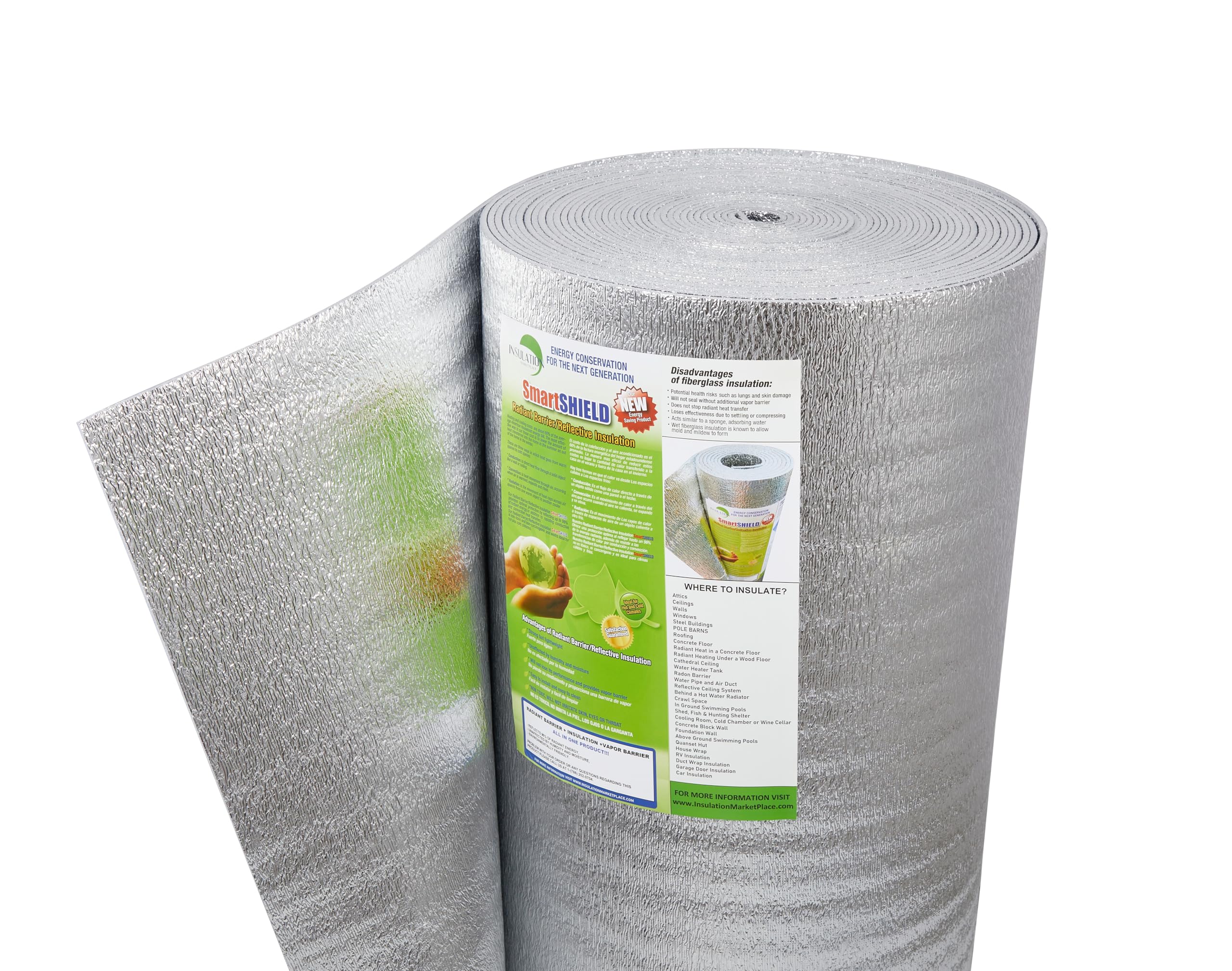
3. SmartSHIELD -5mm 16” x 50 ft Reflective Insulation Roll
Fifty feet of 5 millimeter foil-faced foam for people covering a whole slab.
Where the 3 millimeter roll starts to feel flimsy, this one keeps going — 5 millimeters of aluminum-faced foam, sold as a 600-inch by 16-inch roll. That is 50 feet of material at R17, with both faces reflecting 95 percent of radiant heat. The foil skin is engineered to be tear and puncture proof, so you can drag it across gravel, walk on it during install, and it survives. Class A fire rating and corrosion resistance per the manufacturer round out a roll built for real job sites rather than one-off patches.
Temperature control is the standout here, and it is the top praise in the owner feedback. In one headline case a homeowner measured the inside glass temperature drop a full 10 degrees after adding this layer. Another lined a 24 by 30 foot garage under the ceiling and wall cavities and found the garage running cooler than the house at 103°F outside. A separate install on a portable AC exhaust hose blocked all the heat bleed into the room and, as an unexpected bonus, deadened the noise. If you have a whole slab to cover and want the biggest measurable temperature swing, this 50-foot roll is the one to buy.
Two honest notes before you buy. First, this roll is 16 inches wide — narrower than the 24-inch SmartSHIELD above — so a wide slab needs more parallel passes and more taped seams. Second, the material compresses under screws when it is fastened through drywall, and one buyer found it will bulge through if you countersink the fasteners too deep. Plan your fastener depth to avoid compression bulges, and this 50-foot roll covers a full garage or basement floor.
The case for it over the thinner roll: at 5 millimeters versus 3 millimeters on the SmartSHIELD -3mm above, the core is stiffer, the foil layers resist punctures, and 50 feet covers a real slab in fewer passes.
The caveat to plan for: 16-inch width plus compression under fasteners means you need to think about seam placement and screw depth before you lay the first strip.
Best matched to: a homeowner covering a full garage or basement slab who wants maximum reflective performance and does not mind running extra seams.
skip it if: you are working a narrow crawlspace run where the wider 48-inch rolls would cut your taped seam count noticeably.
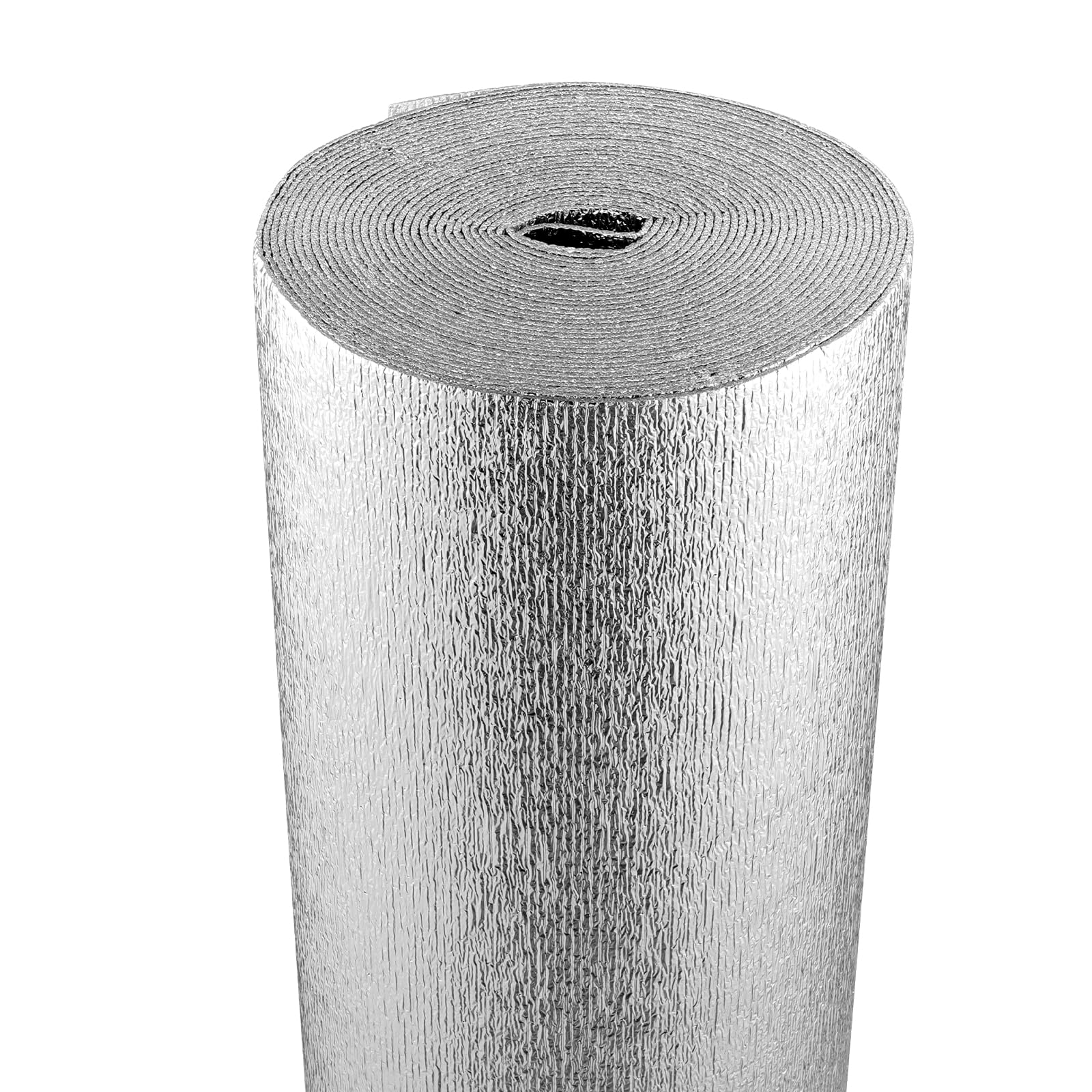
4. VEVOR Double Reflective Insulation Roll 3.2 mm
The widest roll here at 48 inches — fewer seams, faster slab coverage.
Width is the reason to look at this one first. A 48-inch face means one pass covers four feet of slab instead of two, which cuts the number of taped seams you have to get right. The build is 3.2 millimeter EPE foam core clad in double reflective aluminum foil, and the foil reflects more than 95 percent of solar heat while the core blocks transfer in both directions. The 3-in-1 design rolls radiant barrier, insulation, and vapor control into a single layer, and the whole sheet weighs 4.2 pounds while unrolled — light enough for one person to handle on site.
Quality of the material is what gets praised most in the owner feedback, and functionality comes right behind it. Owners use it on garage doors, skylights, and front doors facing the morning sun. One skylight install was fastened to the roof side of the frame with nothing more than Velcro and duct tape, and the heat and light both dropped substantially. Another owner covered a garage door and found the garage noticeably cooler. The same material lines a bedroom wall that radiated summer heat and drafted in winter — doubled up, it made the room usable.
Here is the trade-off. The core is 3.2 millimeters thick — thin compared to the 5 millimeter SmartSHIELD above and the 5.5 millimeter VEVOR roll below. So if you are building up a slab and want material volume rather than pure radiant reflection, the thicker options give you more to work with. It is also sold as a single 50-foot roll, and covering a full garage will take careful measuring so you do not come up short on the second half. Plan the layout before you start cutting.
The strongest arguments for it
- 48-inch width covers a slab in roughly half the passes of a 24-inch roll
- 3-in-1 radiant barrier, insulation, and vapor control in one layer
- 3.2 millimeter EPE foam core with double reflective aluminum foil on both faces
- Weighs 4.2 pounds total — one person can roll it out alone
The fine print
- Thinner core than the 5 mm SmartSHIELD and 5.5 mm VEVOR options — less material volume underfoot
- Single 50-foot roll means layout planning matters on a full garage floor
Reach for this if: your slab is wide and the seam count is your biggest worry — 48 inches per pass solves it fast.
Move on if: you specifically want the stiffer, denser core of a 5.5 millimeter roll for a slab you will walk across before the pour.
5. VEVOR Double Reflective Insulation Roll 5.5 mm

The widest, thickest roll in the lineup — maximum building material per foot.
Take the 48-inch VEVOR roll above and add 2.3 more millimeters of foam: that is the difference here. This version runs a 5.5 millimeter thickened EPE core with double reflective aluminum foil on both faces, still at 48 inches wide and 50 feet long. It weighs 5.7 pounds per roll — heavier than the 3.2 millimeter version’s 4.2 pounds, and that extra weight is the extra foam you are buying. Reflectivity is unchanged at more than 95 percent per the manufacturer, so the upgrade is pure material thickness rather than a stronger foil.
Owners use it in exactly the hot spots you would expect. One garage-door install cut a 20-to-30-degree jump inside the garage versus the 90-degree outside air — effectively eliminated, in the owner’s words. An Arizona homeowner blocked summer heat on windows facing the afternoon sun, cut the material to size, and reported a drop in energy costs. Reflective performance on interior walls holds up the same way. At 5.7 pounds per roll, it folds away between seasons and resists tears through repeated install and removal.
The one honest issue to know about is packaging on delivery. One buyer received a roll with four four-inch cuts running through three layers — clearly made before it shipped, despite intact outer packaging. That is a single reported case rather than a pattern, and the material itself arrived thick, highly reflective, and holding up fine. Inspect the roll edge for cuts when it lands and you are covered. Otherwise this is the thickest roll in the lineup at 5.5 mm, the right answer when you want maximum core thickness.
The upgrade logic: 5.5 millimeters of EPE foam beats the 5 millimeter SmartSHIELD on core thickness and matches it on reflectivity, while adding 48-inch width the narrower roll cannot offer.
Before you buy: delivery handling is the risk — a small number of units arrive with knife cuts through the roll, so open the box and check the edges the day it lands.
Go with this one if: you want the thickest core and widest face in the lineup for a full slab or garage-door job, and weight is not a concern.
Stay with the thinner VEVOR if: you are covering a large area and want to save on both roll weight and installation effort — the 3.2 millimeter version still reflects the same 95 percent.
Know the Specs
Millimeter Thickness
Thickness here refers to the foam core, not the foil — the foil is a thin reflective skin on each side, and the millimeters describe the foam sandwich in the middle. A 3 millimeter roll is a flexible, light sheet you can lay flat against concrete. A 5 millimeter roll is noticeably stiffer and holds up better under foot traffic. A 5.5 millimeter roll is the heaviest of the group, with the most material by volume and the most weight per roll. Every millimeter of core adds stiffness and puncture resistance, which matters when the slab above will press the material down or when you are walking on it yourself.
Reflectivity Percentage and R-Value
Reflectivity is the share of radiant heat energy the aluminum surface bounces back — manufacturers here quote 95 percent. That is the number that controls how much heat the material stops from crossing between the slab and the room above. The R-value on a reflective roll like R17 is a different claim, measured under specific mounting and air-gap conditions, so it does not translate directly into the same number you would see on a fiberglass batt. Use millimeter thickness and reflectivity as the practical comparison, and treat the R-value as a manufacturer label rather than a like-for-like number.
Common Questions
Will reflective foil insulation work directly under a concrete slab?
Should I use a ceramic fiber board or a foam roll under my slab?
Is 3 millimeter reflective insulation enough for a cold floor or should I go thicker?
How do I calculate how many rolls I need to cover my slab?
Do I still need a separate plastic vapor barrier if I use a reflective roll?
Can I use reflective foil insulation in a crawlspace and also under a slab in the same project?
Will the aluminum foil face hold up if I walk on it during installation or lay concrete over it?
Does 5 millimeter reflective insulation make a real difference over 3 millimeter in a garage or crawlspace?
What is the difference between R17 rated reflective insulation and fibreglass batt R-value?
The Bottom Line
For most slab and crawlspace jobs, the winner is the INSULATION MARKETPLACE SmartSHIELD -3mm Reflective Foam Core Insulation Roll — its 3 millimeter closed-cell core, 95 percent reflectivity, and dual vapor-barrier function cover the two things you actually need from under-slab insulation: a reflective skin and a moisture stop in one layer. If you are covering a full garage or basement slab and want the stiffest, densest roll of the group, grab the VEVOR 5.5 mm Double Reflective Insulation Roll. And if seam count is your biggest headache on a wide slab, the VEVOR 3.2 mm Double Reflective Insulation Roll at 48 inches wide cuts the taping work roughly in half.
How we choose
We do not accept paid placement. Every pick is matched to a real buyer and a real use-case; we do not hands-on test units.
Sources
Specifications: manufacturer listings and product documentation. Review insights: verified customer reviews, as of October 2026. Pricing: not shown on this page (it changes often); check the current price via the retailer link.
As an Amazon Associate, Aappliancez earns from qualifying purchases. This does not affect which products we feature.