Disclosure: Some links in this post are affiliate links. As an Amazon Associate I earn from qualifying purchases, at no extra cost to you. Learn more
Specs are compiled from manufacturer listings and verified buyer reviews and can change over time — please confirm the key details on the product page before buying.
If noise is your problem, the fix is rarely “more foam” — it is putting the right dense material in the right place. Soundproofing works by blocking sound (stopping it passing through a wall or floor) and absorbing sound (soaking up echo inside a room). Those are two different jobs, and the seven picks below are sorted by which job you actually need done. Car owners get the butyl mats, renters and studio builders get the panel stacks, and anyone fighting a thin wall or floor gets mass-loaded vinyl or spray foam.
This guide is built by comparing the manufacturers’ published specifications and the patterns across verified customer reviews, so you get each pick’s real strengths and trade-offs instead of marketing spin.
Each pick below is chosen for a specific room, vehicle, or wall problem, so you can match the material to the noise instead of guessing. That is the whole point of this shortlist of the best insulation for soundproofing.
Top Picks


How To Choose The Best Insulation for Soundproofing
The first thing to settle is what kind of noise is bothering you. A neighbour’s television bleeding through a shared wall is airborne noise — it travels through the air and through gaps. A footstep, a drum kit, or a subwoofer is impact noise — vibration carries through the structure itself. Airborne noise is fought with mass and sealing; impact noise needs a decoupling layer plus mass. Buy for the wrong one and even a good product will disappoint you.
Mass versus absorption — pick your tool
Heavy, dense materials block sound from passing through. That is mass-loaded vinyl, butyl car mats, and cured spray foam. Porous, fibrous panels absorb sound inside a room so it stops bouncing off hard walls. That is polyester acoustic panels. Neither replaces the other: panels quiet a room’s echo but will not stop noise coming through the wall, and a vinyl barrier stops transmission but does nothing for a fluttery echo.
Read the thickness number, not the photo
Automotive mats are sold in mils — thousandths of an inch — so a 120 mil mat is 0.12 inches of material and a 200 mil mat is 0.2 inches. Thicker material adds mass and deadens panel vibration better, but it also costs more and is harder to press into tight curves. For car doors and floor pans, a thinner mat conforms faster; for a firewall or wheel well, the extra thickness earns its keep.
Adhesive is where installs go wrong
Self-stick dots and glue tabs are permanent on drywall — they will pull paint and paper when removed. Brick, concrete block, and textured surfaces need a different fixing entirely, usually construction adhesive or mechanical fasteners. If you rent, plan the removal before you stick anything up.
Side-by-Side Comparison
| Model | Best For | Coverage | Thickness | Format | Amazon |
|---|---|---|---|---|---|
| Siless Max 120 mil★ Best Overall | Car doors and floor pans | 30 square foot | 120 mils | Peel-and-place roll | Amazon |
| JaneTech 8-Pack Art Acoustic PanelsBest for Studios | Home studio echo control | Approx. 10.33 square feet | 0.4 inches | 8 adhesive panels | Amazon |
| Soon Global Acoustic Wall Panels | Decor-friendly wall treatment | 84.5 square feet (8-pack) | — | 8 panels plus sticky dots | Amazon |
| Siless Hybrid 3in1 200 mil | Exhaust and road noise plus heat | 25 sqft | 0.2 inches | 3-layer peel-and-place | Amazon |
| 6 Pack Acoustic Panels, Walnut | Large statement wall on a budget | 6 panels, 47.2″ x 23.6″ each | — | 6 veneer-faced panels | Amazon |
| BEEST FullStop Spray Foam Kit | Sealing gaps in walls and attics | 240 sq.ft. | 2 inches | 12 cans, gun, safety gear | Amazon |
| Trademark Soundproofing MLV 1lb | Blocking thin shared walls | 100 square feet | 3.18 millimeters | 4′ x 25′ vinyl roll | Amazon |
Detailed Reviews
1. Siless Max 120 mil 30 sqft Car Sound Deadening Mat
Our pick — 4.5+★ from 850+ verified ratings; the strongest balance of quality and price.
The door-slam fixer — 120 mils of butyl that turns a tinny panel into something that shuts with a thud.
If your complaint is a car door that rings when it closes, or an exhaust drone that wears you down on the motorway, this is the mat to start with. The Siless Max is 120 mils thick — 0.12 inches of dense butyl rubber with an aluminum skin — and it covers 30 square foot across the roll. Because it is a peel-and-place sheet, you cut it with scissors, press it on, and roll it flat. No spray, no glue pot, no drying time.
What wins people over is the install: scissors cut it to shape, it sticks on the first press, and it moulds into door-skin contours. It takes scissors to any shape, sticks firmly on the first press, and moulds into the contours of a door skin without fighting back. Owners also rate it against premium car-audio mats and report similar deadening for far less money. One owner summed up the whole job after stripping a full cabin: “Made a world of difference in my 05 gmc canyon helps with sound vibration in my old truck good quality a little heavy but thats expected very versatile you can place them anywhere.” There is a second benefit beyond quiet — the aluminum facing helps spread heat, which is why it turns up on floor pans and firewalls.
The honest catch is thickness itself. At 120 mils this is a heavy, stiff sheet, so it does not drape over sharp compound curves the way a thinner mat would, and it adds real weight to whatever panel you cover. Summer heat helps it conform; a cold garage makes it stubborn. And you will want a roller — the mat is only as good as how hard you press it down. It sits at 4.5+ stars across 800+ ratings, and the pattern in those reviews is that a properly rolled install quiets the cabin. Unlike the thinner budget mats, this one is built for the panels that actually vibrate, not just for a cosmetic covering.
What earns its place
- 120 mil butyl with an aluminum skin adds real mass to a vibrating panel
- Scissors, peel, press — no spray adhesive or drying time
- 30 square foot covers a full set of doors with room to spare
- Consistently compared favourably against far costlier car-audio brands
What to plan around
- Heavy and stiff — awkward over sharp compound curves
- Needs a roller for proper adhesion; the install is only as good as the pressure
- Cold weather makes it harder to work into shape
Reach for this if: you are chasing door rattle, exhaust drone, or road boom in a car, truck, or van and want a mat you can install in an afternoon.
Think twice if: you are soundproofing a room — butyl mat does almost nothing for airborne noise coming through a wall, which is where the vinyl and panel picks below come in.
2. JaneTech 8-Pack Art Acoustic Panels, 48×32 Inch
Echo control you would actually hang on a living-room wall, in a stack small enough for a spare bedroom.
Each panel here measures 16 x 12 inches and 0.4 inches thick, and the eight-pack covers roughly 10.33 square feet — about a 4′ x 2.7′ focal area on the wall behind your desk or mic. That is a small footprint on purpose: these are for taming reflections in a podcast corner, a home studio, or a gaming room, not for blocking a neighbour’s television. The material is high-density polyester fibre rather than cheap open-cell foam, which is why the panels feel substantial in the hand.
The wave pattern reads as art rather than a foam tile, so most first reactions are about how it looks. The wave-like pattern reads as art rather than as a foam tile, so the reaction from anyone in the room is usually about how it looks. Behind that, the panels do their quieter job: speech stops bouncing off bare walls, and calls and recordings come out tighter. The nano glue stickers set fast and hold, which is good news until you want to move one. The recurring gripe is that the adhesive is permanent — line each panel up before you commit, because pulling one off takes the paint with it.
Set expectations carefully, though. These absorb echo; they are not a soundproofing barrier, and they will not silence a noisy neighbour through a shared apartment wall. Buyers who wanted that have been candid about it. The other thing worth knowing is scale — eight panels cover a modest focal patch, so a larger room will want two packs. For the money, this is the most visually pleasant way to knock the ring out of a hard-surfaced room without turning it into a studio cave.
What the room feels like after: the sharp slap of a bare wall softens, voices stop bouncing, and the space reads warmer — with the panels doubling as decor instead of an eyesore.
Best for: podcasters, streamers, and home-studio builders who need echo control in a small room and refuse to hang ugly foam.
Look elsewhere if: your goal is stopping noise coming through a wall or floor — this is an absorber, not a barrier.
3. Soon Global Acoustic Wall Panels Teal Aura

Eighty-four square feet of treated wall from one box, at a weight you can carry up a ladder.
Coverage is the number that separates this pack from the rest. Eight panels at 48″ x 32″ add up to 84.5 square feet of wall, and the whole bundle weighs 1.8 pounds — light enough to press into place one-handed with the 50 transparent double-sided sticky dots that come in the box. Compare that footprint to the Siless car mat’s 30 square foot roll and you can see the difference in ambition: this is a wall-scale treatment, not a door-panel patch.
The panels are made of polyester fibre with a printed art face, and the finish is convincing enough that visitors read them as decor first. What owners keep coming back to is how quick the install is — a full 8ft x 11ft accent wall goes up in about two hours, and the dots grip drywall firmly. On brick or rough surfaces you will want your own tape, because the included pads want a smooth, flat substrate. Once up, they soften the hard-edged ring of a bathroom, hallway, or brick feature wall.
Two things to keep straight before ordering. First, these are absorbers — they take the echo out of a room, they do not block sound passing through the structure, so do not expect them to mute a drum kit for the neighbours. Second, the printed colours run a little softer than the listing photos suggest, and the panels measure slightly under the stated size. Neither is a deal-breaker; both are the sort of thing you notice for a day and then forget. The bigger payoff is how much more finished the room looks once the panels are up.
The install reality: the sticky dots are strong — you can lift and re-seat a panel a couple of times while you line up a pattern — but once they cure on painted drywall, that bond is permanent.
Pick this one when: you want to cover a big, bare wall with something that both deadens echo and looks intentional, and you are working on a smooth surface.
Pass if: your walls are brick or heavily textured and you do not want to source your own adhesive — the included pads need a flat, smooth face.
4. Siless Hybrid 3in1 200 mil 25 sqft Car Sound Deadening Mat

Three layers in one sheet — butyl, foam, and a mass-loaded membrane — aimed at the exhaust drone a single mat cannot reach.
Where the Siless Max is a pure damping mat, this Hybrid is a sandwich. It stacks butyl mastic, PE foam, and a mass-loaded butyl membrane into a 0.2-inch composite, and that third layer is the point: it blocks low-frequency noise and heat as well as damping panel vibration. You get 25 sqft on the roll, cut to 15.39″ x 9.76″ sheets, and it still installs with the same peel-and-place motion — trim, press, roll. The manufacturer notes the instructions are in the box but a roller is not, so budget for one.
The results owners describe are the kind you feel in your ears after a drive. Cabin noise drops away sharply once you have covered the floor and firewall, and an aggressive exhaust that used to dominate the cab fades to a background hum. The layer also blocks heat, which matters on a firewall sitting above a hot engine. It is softer and more flexible than a plain butyl mat, so it follows contours and cuts with scissors without the hand fatigue of working dense rubber. One caveat that repeats across builds: in hot weather the adhesive can stick to its own release paper, so cool the box before you open it.
There is a small safety note worth repeating from an RV install — the PE foam layer can ignite under some conditions, so seal cut edges with aluminized tape and keep the material away from direct heat sources. And because the mat is thick, you get one shot at placement: once it is pressed down, it does not want to move. That 0.2-inch thickness is what delivers the low-frequency blocking, so accept the one-shot placement as the trade-off.
Where it pulls ahead
- Three layers in one sheet tackle vibration, low-frequency noise, and heat together
- 0.2-inch thickness maps directly to the extra blocking versus a single-layer mat
- Soft and flexible — cuts with scissors and follows contours without fighting
- Noticeably quieter cabin and a cooler firewall after a full floor install
The trade-offs
- Not repositionable — one firm press is the decision
- In hot weather the adhesive can cling to the release paper; cool it first
- The foam layer needs edge sealing with aluminized tape near heat sources
Go with the Hybrid if: a single-layer mat has already been tried and exhaust boom or engine heat is still the problem.
Stay with the Max if: you only need to kill door rattle and want a thinner, easier-to-shape sheet — that is the simpler job.
5. 6 Pack Acoustic Panels Walnut Color
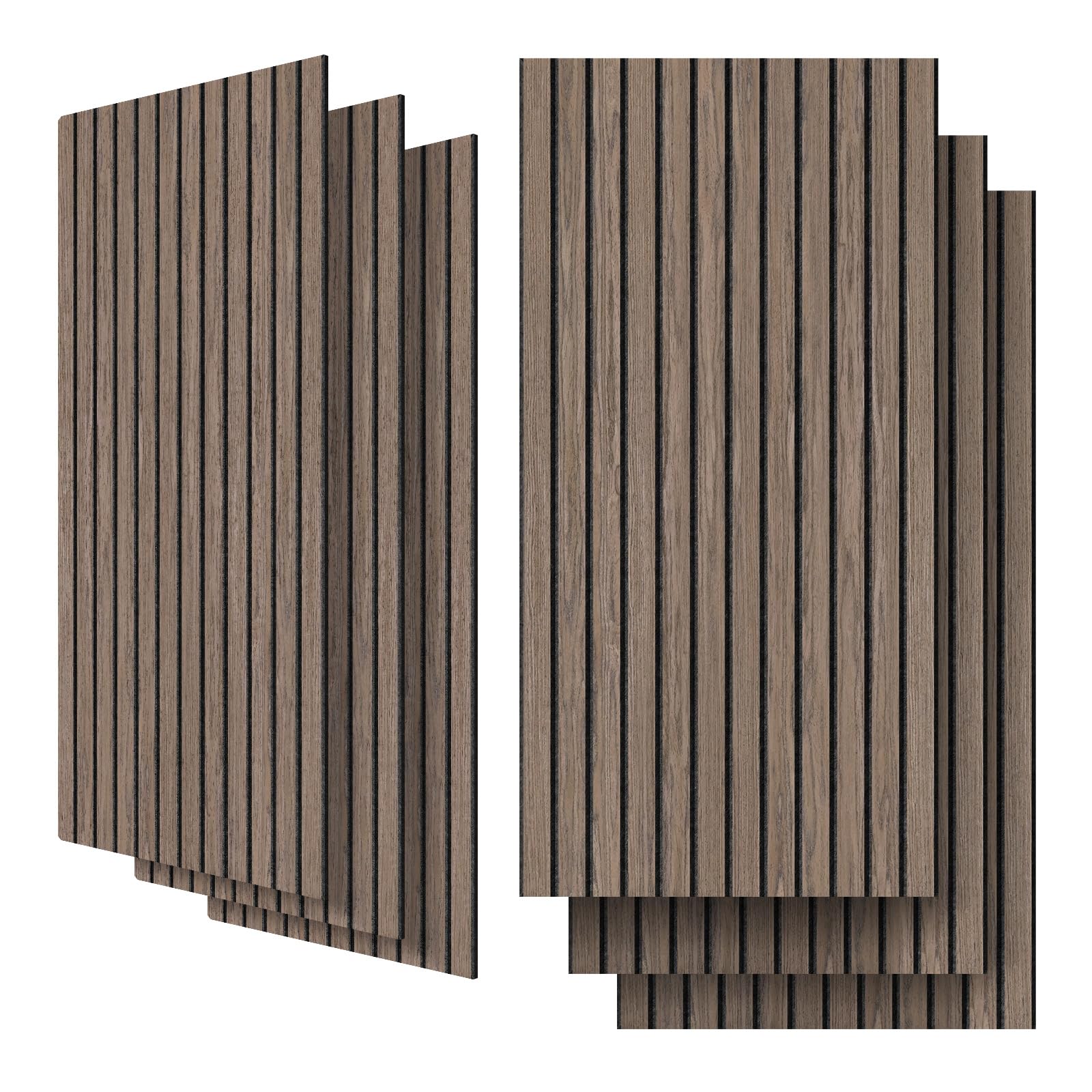
Big walnut-look panels for a feature wall — just do not read “sound proof” as a promise.
Six panels at 47.2″ x 23.6″ is a lot of wall for the outlay, and the walnut-look veneer is the reason to pick this pack over a plain tile. The core is 100% polyester fibre with a veneer face, which keeps the panels light, flexible, and easy to cut with a utility knife. Install is your choice: construction adhesive, nails, or 3M double-sided tape. There is a slight twist in the spec sheet worth flagging honestly — the panels weigh 22.1 pounds as a pack but the surfaces are flexible and bendable, so treat “wood look” as a finish, not a material.
In a church hall, small meeting room, or tiled bathroom, they visibly soak up the ring. A church hall, a small meeting room, a bathroom with hard tile — anywhere echo has taken over — and the panels visibly soak up the ring. They are unfussy to hang and forgiving if you need to re-cut an edge around an outlet. The walnut colour is dark and rich, and once up it reads as a finished feature rather than treatment. It also wipes clean, which is more than you can say for open foam when a toddler gets curious.
The honest caveat, and it comes through clearly in the reviews, is that these stop echoes rather than sound transmission. One sharp verdict called them “just a piece of foam with a thin printed stripe on it”, and if you bought expecting to silence a neighbour through a wall you would agree. They also shed black felt dust when cut, so lay a sheet down first. If you want a large, decor-forward wall treatment at an accessible price and need echo absorbed rather than sound blocked, this pack delivers.
The real use case: think of these as the best-looking way to take the slap out of a hard room — a bathroom, church hall, or home office — where the panels earn their keep on both look and livability.
Choose these when: you need a big, dark, decor-forward wall covering and your complaint is echo inside the room.
Skip if: you literally need to stop sound travelling to another room — the veneer gives a convincing wood illusion, not soundproofing.
6. BEEST FullStop Spray Foam Insulation Kit

For the gaps you cannot reach with a roll — twelve cans, a pro gun, and the safety gear in one box.
This kit is the answer to a specific and very common problem: sound leaking through the small gaps around pipes, outlets, and joists that a panel or vinyl sheet cannot cover. The foam fills those voids and creates an airtight seal, which is where a lot of airborne noise gets through in the first place. You get 12 cans, an applicator gun, a solvent-based cleaner, gloves, goggles, and a coverall — enough to start working without a separate trip. Rated coverage is 240 sq.ft. at 2-inch thickness.
The numbers that matter most here are the fire ratings, because spray foam goes inside walls and attics where you want a guaranteed profile. It was tested to ASTM E84 and achieved a Flame Spread Index of 0 and a Smoke Developed Index of 120, meeting Class A surface-burning criteria. It also carries an R-Value of 8.24 at 2-inch thickness — the R-value being the measure of how well it resists heat flow, so the same material that seals noise also helps keep the attic comfortable. It bonds to wood, metal, drywall, concrete, and brick, and cures hard and dense in roughly 20 minutes so you can build up layers.
The coverage is the honest weak spot. The can claims 240 board feet, but an owner who measured carefully found their first kit delivered closer to 164 sq ft at an average depth of 1.75 inches, not the 2 inches advertised. Treat the rated number as a best case at full expansion and order a little extra if the job is critical. It also wants an application temperature between 68 and 77°F to expand consistently. None of that changes what the foam does when it works — the kit is a genuinely better route for a determined DIYer than paying a contractor, and the gun delivers precise control that cans alone cannot.
Best for: attics, rim joists, and around-window voids where noise and drafts leak through the same gaps — the seal handles both jobs at once.
Buy it for: sealing and insulating an attic or wall cavity yourself, with the fire-rated numbers and the gear to do it safely.
Heads up: order above your measured area — real-world coverage runs under the rated figure, so a second kit is easier than a stalled job.
7. Trademark Soundproofing Mass Loaded Vinyl 1lb, 4′ x 25′

Pure mass in a roll — a 27 STC vinyl sheet for the wall or floor you cannot rebuild.
Mass-loaded vinyl solves the one problem panels cannot: blocking airborne sound from travelling through a thin shared wall or floor. This roll is rated at 27 STC — STC being the Sound Transmission Class, a single number that estimates how much sound a material stops, with higher being better. It weighs 1 pound per square foot, runs 1/8 inch thick, and covers 100 square feet at 4′ x 25′. It is non-toxic and odorless, made from virgin material with no regrind, which matters when it goes into a bedroom or a nursery. It is also dramatically heavier than any panel here — a full 100 pounds on the roll — which is the whole point.
The reviews point to one scenario over and over: a downstairs neighbour whose conversation or sneezing carries up through a wood floor. Cut sections, lay them under rugs or over subfloor, and high-pitched voices go quiet while low rumble becomes far more bearable. It cuts easily with a knife, pairs well with mineral wool and drywall for a layered barrier, and leaves no smell behind. For a renter or a condo owner who cannot demolish a ceiling, it is the most direct fix available: add mass, stop transmission.
Be realistic about the shape of the problem, though. MLV is a flexible mass layer, not a magic stop — sound can travel around it, through flanking paths, and through the structure itself, so it knocks the edge off what you hear rather than eliminating it. The weight is also a handling consideration: moving and hanging a 100-pound roll is a two-person job, and it wants proper support when it goes vertically into a wall. Buyers split on value — some see it as well worth the money, others find the price steep for the coverage — so measure your wall or floor area first and buy the number of rolls the job actually needs.
Reach for this when: noise crosses a floor or wall you cannot rebuild, and you need mass rather than absorption.
Know before you buy: a 100-pound roll takes two people to move and hang, and it softens the noise rather than erasing it — flanking paths still leak.
Know the Specs
STC and NRC — the two ratings that matter
STC (Sound Transmission Class) is a single number estimating how much sound a material blocks from passing through — it is the rating you care about for a wall or floor barrier. NRC (Noise Reduction Coefficient) measures how much sound a surface absorbs inside a room. A product with a high STC blocks; a product with a high NRC absorbs. The Trademark vinyl carries a 27 STC rating, which tells you it is a blocker, while polyester panels are absorbers without an STC claim — which is exactly why neither one replaces the other.
Mils, millimetres, and pounds per square foot
Thickness for automotive mats is quoted in mils (thousandths of an inch), so 120 mils is 0.12 inches and 200 mils is 0.2 inches. Thicker means more mass and better damping of panel vibration. For barrier vinyl, weight per square foot is the real spec — 1 pound per square foot of mass-loaded vinyl is a dense sheet by any standard. For spray foam, thickness drives the R-value: the BEEST kits deliver an R-Value of 8.24 at 2-inch thickness, and that thermal number only holds if the foam expands to full depth.
Common Questions
Will acoustic panels stop noise coming through a shared apartment wall?
What does 120 mil versus 200 mil mean for a car sound deadening mat?
How much wall area does one box of acoustic panels actually cover?
Are the adhesive dots strong enough to stay on brick or textured walls?
Is spray foam worth it for soundproofing, or is it just thermal insulation?
Does mass-loaded vinyl really block noise, and what is the 27 STC figure?
How much spray foam coverage should I plan for?
Why do the panels say “soundproof” in the listing if they only reduce echo?
Can I use car sound deadening mats on walls or floors indoors?
Do I need a roller and special tools for these materials?
The Bottom Line
The insulation for soundproofing winner for most people is the Siless Max 120 mil, because it delivers the most direct result on the noise most owners complain about — rattle, drone, and vibration in a vehicle — with an install that needs nothing but scissors and pressure. If your problem is echo inside a room rather than sound passing through a wall, the JaneTech Art Acoustic Panels will quiet a home studio or office while doubling as decor. And for a thin wall or floor that leaks noise from a neighbouring unit, the Trademark Soundproofing MLV adds the mass that actually blocks transmission. Whichever you choose, the trick is matching the material to the noise — absorb echo, block transmission, or damp vibration, and pick the tool that does that one job well.
How we choose
We do not accept paid placement. Every pick is matched to a real buyer and a real use-case; we do not hands-on test units.
Sources
Specifications: manufacturer listings and product documentation. Review insights: verified customer reviews, as of October 2026. Pricing: not shown on this page (it changes often); check the current price via the retailer link.
As an Amazon Associate, Aappliancez earns from qualifying purchases. This does not affect which products we feature.