Disclosure: Some links in this post are affiliate links. As an Amazon Associate I earn from qualifying purchases, at no extra cost to you. Learn more
Specs are compiled from manufacturer listings and verified buyer reviews and can change over time — please confirm the key details on the product page before buying.
If your 2×4 walls feel cold to the touch and you can hear every conversation through them, the fix is simpler than you think: you need insulation that fits a 3.5-inch stud cavity without squashing. Squash fiberglass and you lose the air pockets that do the actual insulating. The picks below all fit that depth, and they split into two jobs — fiberglass rolls that stop heat and mineral wool boards that stop sound and fire.
This guide is built by comparing the manufacturers’ published specifications and the patterns across verified customer reviews, so you get each pick’s real strengths and trade-offs instead of marketing spin.
Fiberglass handles the everyday gaps, but the sound-control picks earn their place with density — the Rockboard 60 packs 6 pounds per cubic foot into a rigid board. Whether you are closing a garage gap or building one studio wall, this guide to the insulation for 2×4 walls covers the rolls, batts, and boards that actually fit.
Top Picks


How To Choose The Best Insulation for 2×4 Walls
A 2×4 wall gives you a 3.5-inch-deep pocket between the studs, and that depth is the whole game. Fill it with a batt that is thinner than the cavity and you leave an air gap that lets heat and sound travel. Fill it with a batt that is thicker and you crush it — crushed fiberglass loses the trapped air that makes it work as an insulator, so you end up paying for R-value that never shows up in a cold room.
Match thickness to the cavity
A standard 2×4 stud wall takes a 3.5-inch batt. That is exactly why R-13 and R-15 rolls list 3.5 inches as their thickness — they fill the cavity without bulging past the stud face. If a batt is thinner or thicker than the space, you are either leaving a gap or squeezing the material, and both cost you performance.
Decide whether you are stopping heat or stopping sound
Fiberglass rolls are the budget route for thermal control — they slow heat moving through the wall. Mineral wool batts and boards cost more and weigh more, but their density absorbs sound energy instead of reflecting it. If your goal is a quieter room rather than a warmer one, density is the spec you check first.
The faced versus unfaced decision
Kraft facing is a paper layer bonded to one side of a fiberglass roll, and it acts as a vapor retarder that also helps hold the batt in the cavity. Unfaced and rigid mineral wool boards have no facing, so they go where a frame or structure can support them. Check your local code requirements before you commit, because the facing rules change with climate.
Side-by-Side Comparison
| Model | Best For | Coverage | Thickness | Weight | Amazon |
|---|---|---|---|---|---|
| Owens Corning OCRF10, R13 Kraft Roll★ Best Overall | Standard 2×4 thermal insulation | 40 square feet | 1 inches | 10 pounds | Amazon |
| Owens Corning R-15 Faced Fiberglass ROLLBest for Wall Depth | Higher R-value in a 2×4 cavity | 30 square feet | 3.5 inches | — | Amazon |
| R-13 EcoRoll Kraft Faced Fiberglass Roll | Eco-minded small jobs | 5760 square inches | 3.5 inches | — | Amazon |
| ROCKWOOL AFB Acoustical Fire Batts | Sound booths and studio walls | 8 Square Feet | 2 inches | 28 pounds | Amazon |
| ROCKWOOL Rockboard 60 Rigid Board | Bass traps and rigid panels | — | 2 inches | 32 pounds | Amazon |
| 3 pk 12″x12″x2″ Rockwool ProRox | Small acoustic projects | 3 sq ft | 2 inches | 3 pounds | Amazon |
| 3 pk 12″x12″x2″ Rockwool ProRox (Alt Pack) | Small acoustic projects | 3 sq ft | 2 inches | 3 pounds | Amazon |
Detailed Reviews
1. Owens Corning OCRF10 R13 Kraft Roll Insulation
Our pick — 4.5+★ from 200+ verified ratings; the strongest balance of quality and price.
The roll that covers a whole wall section for the price of two lunch runs.
This is the pick for the homeowner filling a cold garage wall or patching a basement gap who does not want to buy a builder-sized bundle. One roll covers 40 square feet, which is enough to close a real section of open framing before winter. It is also the one product in this whole lineup that Amazon shoppers keep circling back to — the crowd favorite.
The numbers explain why. At 10 pounds, this roll is heavier than the small 3-pound Rockwool ProRox packs, so the fiberglass has real body to it as you unroll it along the studs. It ships compression-packed, which is what makes a 32-foot roll manageable to carry and store before you cut. Recommended for interior wall insulation, energy conservation, and noise reduction, it is doing three jobs with one material.
The quality of the material is what owners keep coming back to. Buyers report cutting it with a box cutter rather than a specialty knife, and one buyer who insulated a very cold garage that drops to minus temperatures wrote that it “dramatically warmed the garage and it hang smoothly,” with no weird bulging. That same evenness is why people say it works great on unexpected projects — a drum riser, a shed, a basement seam. One honest note: a few buyers find it on the pricier side at the register, and the 1-inch listed thickness is worth checking against your cavity depth before you buy for a full 2×4 wall.
What sets this roll apart
- 40 square feet of coverage per roll, so one order usually finishes the job
- 10-pound roll holds its shape and recovers well after compression packing
- Cuts clean with any sharp utility blade — no special tools
- GREENGUARD Gold Certified and validated formaldehyde free
Where it asks for care
- Listed thickness is 1 inch, so measure your stud cavity if you need full 3.5-inch fill
- Cost complaints pop up on review pages for larger jobs
Reach for this if: you want one reasonably priced roll that reseals a garage, shed, or basement wall this weekend.
Look elsewhere if: your job needs a full 3.5-inch cavity fill or you are insulating a whole house — this is a patch-and-seal roll, not a whole-building bundle.
2. Owens Corning R- 15 Faced Fiberglass Insulation ROLL
When you want the fuller fill and the higher R-value that comes with it.
Here is the difference that matters against the Best Overall roll: this one lists 3.5 inches of thickness, against the EcoRoll’s 3.5 inches and the OCRF10’s 1 inch. That 3.5-inch figure is exactly the depth of a 2×4 stud cavity, so the batt sits flush with the stud face instead of leaving an air pocket. R-15 is also the higher thermal rating of the two Owens Corning picks in this roundup.
The practical result is a wall that is both warmer and neater. Faced fiberglass in a full cavity means no visible gaps and no unexpected dip in performance once the drywall goes on. At 30 square feet of coverage, one roll is sized for a smaller wall rather than a whole house, so measure your section before ordering.
Owners describe this as straightforward to work with — no surprises, no fighting the material into place. One reviewer noted the “product arrive ahead of initial eta and was in perfect shape,” and added that the price was reasonable. That said, the listing copy on this page is a mismatch — it describes lawn and landscape replacement parts, which is clearly leftover text. Ignore that line and look at the specs, which are all fiberglass insulation.
Best fit for: someone whose framing really does measure a full 3.5-inch cavity and who wants the higher R-value in a face-framed wall.
Worth knowing: coverage tops out at 30 square feet, so a full room will take more than a single roll.
Pick this one: when your stud depth is a full 3.5 inches and you want a faced roll that fills it cleanly.
Not here: if you are covering a wider wall — you will go through rolls fast at this coverage.
3. R-13 EcoRoll Kraft Faced Fiberglass Insulation Roll

The greener fiberglass roll — full 3.5-inch depth without the added dye.
This is the roll for the buyer who cares where the material comes from as much as what it does. The binder here is made from corn, sand, and recycled glass instead of added dyes, and the roll is GREENGUARD Gold certified and free of Red List chemicals and formaldehyde. It is a naturally brown batt, not the dyed pink you may picture.
On the specs, it holds its own against the best picks. At 3.5 inches thick it fills a 2×4 cavity the same way the Owens Corning R-15 does, and the kraft facing gives it a vapor retarder for moisture control — though you should check your local code requirements on facing before you install. At 40 square feet of coverage, it matches the Best Overall roll’s coverage on the same job.
There is one real caveat to weigh on this one. A batch of these rolls has drawn complaints about odor, with one buyer writing that it “reeked of a urine smell,” and a couple of others finding the color came in considerably darker than the same brand’s fiberglass. The majority of buyers describe it as thick, wide, and easy to cut with the right thickness — but if you are sensitive to smell in a living space, air out a small piece first before committing a whole wall.
Why the eco angle feels real
- Binder made from corn, sand, and recycled glass with no added dyes
- GREENGUARD Gold certified and formaldehyde free
- 3.5-inch thickness fills a 2×4 cavity exactly
- Softer to touch and easy to cut and split
What some buyers run into
- Odor complaints have appeared in some batches
- Colour can arrive noticeably darker than other EcoRoll rolls
This earns its slot if: you want recycled content and no added dyes at a matching 3.5-inch depth.
Pass if: a fresh-roll smell in a closed living space would bother you — the odor reports are a dealbreaker for the sensitive, not the majority.
4. ROCKWOOL AFB Acoustical Fire Batts Mineral Wool Insulation

Six flexible batts that turn a hollow wall into a sound buffer.
If your project is a studio wall, a sound booth, or a laundry room you want to mute, this is the pick. You get 6 pieces of 24″ x 48″ x 2″ acoustical fire batt mineral wool, and the flexible batts are designed to sit inside a wall cavity, behind a panel, or anywhere a frame can support them. They are not rigid like fiberglass board, so they will not hold their own shape without a frame — that flexibility is exactly what makes them easy to stuff into odd spaces.
The density spec is the reason they work for sound. At 2.5 pounds per cubic foot, the listing makes the case that higher densities absorb sound only slightly better while costing a lot more, so 2.5 pcf is the cost-effective choice for absorbing sound. For a 2×4 wall, the standard play is to use a 1×3 furring strip on each stud to bring the depth to a full 3.5 inches, then fill it. That combination gives you real sound control without breathing a sealed cavity.
Owners push these through real acoustic projects and are not shy about results. Owners mention a 36×36 sound booth lined with fire batts between 1/4″ luan plywood, 3″ acoustic tiles, and a 1″ rubber mat floor, with a 110 dB chainsaw inside reading 68 dB outside — barely above ambient. Drummers use them on waffle board wrapped in a bed sheet; RV owners pull them apart for stuffing. Wear a mask and gloves when installing, as the review pages often advise, and this is the safest sound-money move for an interior wall.
Pick this when: your goal is quieter walls, not just warmer ones. The density is the entire reason to buy these over fiberglass.
The catch: they ship as a 28-pound, 6-batt block and a dock or truck-only delivery is common, so plan for a pickup window; a few buyers also found them soft enough on ceilings that stacking is required.
Worth it for: the home studio, the drum room, the mudroom you want to keep quiet.
Skip if: you need a rigid self-supporting board — these need a frame or furring to hold shape in a wall.
5. ROCKWOOL Rockboard 60 Mineral Wool Rigid Insulation Board

Four rigid slabs at six pounds per cubic foot — the densest board in the lineup.
This is the product for the person building serious acoustic treatment rather than just filling a wall. At 6 pounds per cubic foot and a Noise Reduction Coefficient of 1.0 out of 1 — a rating that means it absorbs essentially all sound energy hitting it — the Rockboard 60 is the most absorbing material here. It carries a Class A fire rating per ASTM E84, and it is popular for bass traps and other acoustical products precisely because it holds a shape.
For a 2×4 wall, this board gives you real density and a rigid face you can cut and stack. The trade-off is weight and stiffness. At 32 pounds for four 24″ x 48″ x 2″ pieces, this is a two-person lift and needs real framing to mount. It is not a sponge-and-go fiberglass roll.
The result, customers note, is dramatic. One person described the boards shutting down “slap back and phase cancellation straight away” in a live 12 x 15 room with speakers firing along the long dimension — one on each sidewall and two behind the listening position. That is the kind of direct effect you feel in a treated room. The honest limit worth knowing: a few experienced builders note this is not a standalone soundproofing solution — it works best as one component alongside Mass Loaded Vinyl and a sealed cavity.
Where this board wins hard
- 6 pounds per cubic foot is the highest density in this roundup
- NRC of 1.0 out of 1 absorbs virtually all sound energy it faces
- Rigid structure holds its shape for cutting and mounting in a bass trap
- Class A fire rating per ASTM E84
Real-world friction
- 32 pounds across four pieces is a two-person lift
- Not a standalone fix — needs airtight assembly and, usually, a mass layer to fully block sound
This is your pick if: you are treating a dedicated room and want rigid panels you can cut and mount behind the listening position.
Not this one: for a wall you just want warmer — rigid board is overkill where fiberglass will do the job.
6. 3 pk 12″x12″x2″ Rockwool ProRox Mineral Wool, Replaces Owens Corning Thermafiber, BMW211-3PK-NA
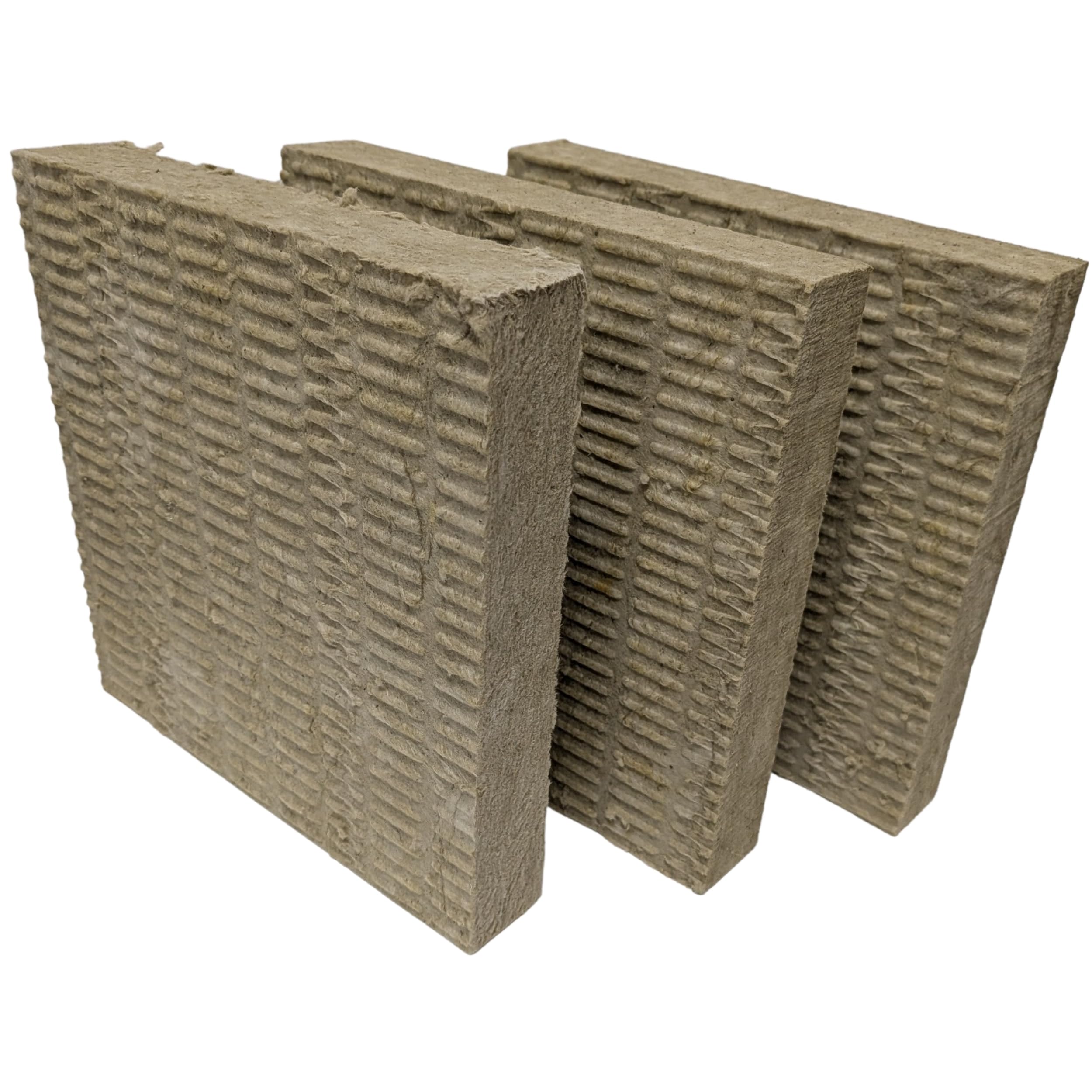
Three grab-and-go squares of six-pound stone wool for a fast corner fix.
Not every project is a whole wall — some are one bass trap, one computer enclosure, or one pottery shed. These 3 sheets of 12″ x 12″ x 2″ Rockwool ProRox SL960 fit that need, and at 6lb/ft³ they are the same heavy density as the Rockboard 60, which is what makes them fight sound instead of ignoring it. They are fire resistant and insulate well, so they pull double duty if you are building a small enclosure.
The size is the whole point here. You do not have to cut a 24″ x 48″ board in half to make a small panel — three 12-inch squares cover a small frame with almost no waste. At 3 pounds per pack, they are light enough to hang on a 1×2 wood frame wrapped in burlap, which is exactly how one panel-builder is using them. They cut easily with a knife, though the fine stone fibers mean a mask is worth the minute it takes to put on.
The most common note on these is how hard it is to find stone wool in small amounts — the format is genuinely the selling point. For a 2×4 wall, three 12-inch squares only cover 3 square feet, so this is a spot-fix and small-enclosure product, not a full-cavity fill. That is the honest sizing call before you load up a cart.
Where these shine: small acoustic panels and small enclosures where a full board would be pure waste.
Where they do not: a full 2×4 wall. Three square feet goes fast, so buy by the frame, not by the wall.
Best for: the small bass trap, the computer cabinet, the pottery shed corner.
Move up if: your sounds are coming through a 2×4 wall you want quiet — you will need far more coverage.
7. 3 pk 12″x12″x2″ Rockwool ProRox Mineral Wool, Replaces Owens Corning Thermafiber, BMW211-3PK-NA
The same three stone wool squares, listed on a separate page.
This is the identical product to the pack above — 3 sheets of 12″ x 12″ x 2″ Rockwool ProRox SL960 at 6lb/ft³ density, fire resistant and cuttable with a knife. If the other listing is out of stock or you land here first, the material is the same. Same coverage, same thickness, same 3-pound-per-pack weight.
The use cases are what sold people on these small panels. One person built soundproof panels with 1″x2″ wood frames and burlap covering; another placed squares above a suspended ceiling to break up modal pile-up in a 1:2 room ratio, which lowered the ceiling and cut the boominess. A third lined canvas photo frames in a music studio for subtle absorption. The common thread is that small, dense squares beat cutting big boards for tight framing work.
On a 2×4 wall specifically, the limits are the same as the other pack: 3 square feet of coverage means this is a spot fix, not a wall fill. Buy it for the small project where a full 24″ x 48″ board is too much material and too much waste. For a whole wall, step up to the fiberglass rolls or the bigger Rockwool batts.
Choose this listing: when you want the same dense Rockwool ProRox squares and this page is the one in stock.
Choose a roll instead: when your target is a full 2×4 wall and 3 square feet of coverage will not get you close.
Know the Specs
R-Value And The 3.5-Inch Cavity
R-value is a measure of how well a material resists heat moving through it — higher numbers mean slower heat flow. In a 2×4 wall, that number only counts if the insulation fills the 3.5-inch stud cavity at its rated thickness. Squash a batt into a thinner space and you crush the trapped air pockets that do the actual insulating, so the number on the bag stops matching what your wall delivers. This is why 3.5-inch rolls and batt rolls like the R-13 and R-15 fiberglass options are the natural fit for the cavity.
Density, PCF, And Sound Absorption
Density is written as PCF, which stands for pounds per cubic foot — essentially how much weight is packed into a given block of material. Denser mineral wool absorbs more sound energy, which is why the 6 PCF Rockboard and ProRox picks fight noise better than a lighter batt. But density also brings weight and stiffness, so a dense board needs a frame or structure to hold it. The 2.5 PCF AFB batts take the middle path: flexible enough to stuff into a cavity or frame, dense enough to absorb sound.
Common Questions
What thickness insulation fits a 2×4 wall?
Can I use 2-inch Rockwool in a 2×4 wall?
Is mineral wool or fiberglass better for a 2×4 wall?
Do I need the kraft facing on insulation for 2×4 walls?
How do I cut Rockwool board without crumbling it?
Will insulation alone soundproof my 2×4 wall?
Do I need a mask and gloves to install mineral wool?
How much wall does one roll of insulation cover?
Is R-13 enough for a 2×4 wall or should I go R-15?
Can I reuse Rockwool batts if I open the wall back up?
The Bottom Line
The winner here is the Owens Corning OCRF10 R13 Kraft Roll — it delivers 40 square feet of coverage in a single roll and installs clean enough that people report no bulging. If your framing really measures a full 3.5 inches, step up to the Owens Corning R-15 Faced Roll for the higher thermal rating in that exact cavity depth. And when the goal is a quieter wall rather than a warmer one, the ROCKWOOL AFB Acoustical Fire Batts are the move. The review pages back that up in numbers that matter — the Rockboard 60 carries a Noise Reduction Coefficient of 1.0 out of 1, and at 32 pounds for four pieces, real mass, real quiet.
How we choose
We do not accept paid placement. Every pick is matched to a real buyer and a real use-case; we do not hands-on test units.
Sources
Specifications: manufacturer listings and product documentation. Review insights: verified customer reviews, as of October 2026. Pricing: not shown on this page (it changes often); check the current price via the retailer link.
As an Amazon Associate, Aappliancez earns from qualifying purchases. This does not affect which products we feature.