Disclosure: Some links in this post are affiliate links. As an Amazon Associate I earn from qualifying purchases, at no extra cost to you. Learn more
Specs are compiled from manufacturer listings and verified buyer reviews and can change over time — please confirm the key details on the product page before buying.
If your feet throb by mid-afternoon, the fix is rarely a softer insole — it is a firmer one that holds your arch up instead of letting it collapse with every step. That single idea separates the picks below. The firm, structured inserts keep their shape through a twelve-hour shift, while the plush memory-foam ones feel lovely for an hour and then flatten. Below you will find fifteen insoles sorted by what they actually do to a tired foot, so you can match one to your shoe, your weight, and how long you stand.
This guide is built by comparing the manufacturers’ published specifications and the patterns across verified customer reviews, so you get each pick’s real strengths and trade-offs instead of marketing spin.
Some inserts are built to cushion, some to correct alignment, and a few can do both. The trick is knowing which job your feet need before you spend a cent on insoles for standing all day.
Top Picks


How To Choose The Best Insoles for Standing All Day
Standing still is harder on your feet than walking. When you walk, your arches load and unload with each step; when you stand, the same spot takes steady pressure for hours. That is why the insoles that win on a concrete floor are the ones with a shaped arch and a heel cup that keeps your foot from rolling inward, not the thickest slab of foam.
Firm or soft: which one saves your feet
A soft memory-foam insert feels great in the first hour, then compresses under steady standing weight and stops supporting you. A firmer insert — cork, dense foam, or a rigid shell — holds your arch up so the tissue under your foot is not stretched all day. If your feet ache from flat, unsupportive shoes rather than a specific injury, a medium-firm insert is the friendlier starting point. If you have plantar fasciitis or a very high arch, a firm orthotic-style insert usually does more work.
Full-length versus 3/4-length inserts
A full-length insert replaces the whole factory footbed and gives cushioning from heel to toe. A 3/4-length insert stops before your toes, so it leaves room in the toe box and slides easily into dress shoes and boots. The trade-off with the shorter style is that it can shift inside a loose shoe, and some people layer it on top of the original insole to stop it moving. Check how much depth your shoe has before you choose.
Match the support to your weight and shoe
Heavier bodies put more load through the arch and heel, which is why several picks here are explicitly built for people over a stated weight. Also check the shoe: an insert needs vertical room, so a snug sneaker may feel tight once you add one. If your shoe has a removable factory insole, take it out first — that is where the new insert belongs.
Side-by-Side Comparison
| Model | Best For | Style | Stated Weight Target | Support Feel | Amazon |
|---|---|---|---|---|---|
| PowerStep Pinnacle★ Best Overall | All-day plantar fasciitis relief | Full-length | — | Firm arch, cushioned heel | Amazon |
| Dr. Scholl’s Heavy Duty SupportBig and Tall Pick | Big and tall, wide feet | Full-length, trim to fit | 200 lbs+ | Extra heel cushioning | Amazon |
| WalkHero Heavy DutyHard-Floor Hero | Heavy standing on hard floors | Full-length | 220+ lbs | Rigid nylon arch sheet | Amazon |
| WalkHero Plantar Fasciitis | Work boots and wide shoes | Full-length | — | Deep heel cup, firm | Amazon |
| Sof Sole Athlete | Active movers and athletes | Full-length | — | Neutral arch, gel cushion | Amazon |
| VALSOLE 250+ lbs | Heavy feet, flat arches | Full-length, trimmable | 220+ lbs | Rigid TPU heel cup | Amazon |
| Spenco PolySorb Heavy Duty | Long shifts on concrete | Full-length | — | SpenCore heel and forefoot pads | Amazon |
| Timberland PRO Anti-Fatigue | Timberland boot owners | Full-length | — | Soft, gel-like | Amazon |
| SOLE Performance Medium | Custom moldable comfort | Full-length | — | Firm cork base | Amazon |
| Superfeet All-Purpose High Arch | Roomy shoes, high arches | Full-length, trim to fit | — | Firm, dense foam | Amazon |
| CURREX SupportSTP | Choosing your own arch profile | Full-length | — | Shell with foam top | Amazon |
| Airplus Plantar Fascia 3/4 | Dress shoes and safety boots | 3/4-length | — | Foam shell, gel heel | Amazon |
| 4D Cloud Memory Foam | Budget cushioning | Full-length, trimmable | — | Soft memory foam | Amazon |
| Happystep Memory Foam | Everyday low-profile cushion | Full-length, trim to fit | — | Memory foam, fixed arch contour | Amazon |
| Memory Foam Shock Absorption (Amitataha) | First-timers on a budget | Full-length, cut lines | — | High-arch memory foam | Amazon |
Detailed Reviews
1. PowerStep Pinnacle Insoles M 12-13
Our pick — 4.5+★ from 31,500+ verified ratings; the strongest balance of quality and price.
The firm arch that keeps working when soft foam has already quit.
The Pinnacle is the pick for someone whose feet burn by the end of a standing shift and who wants a shaped arch rather than a pillow. It is built around dual-layer cushioning with a contoured arch that holds your foot in a stable position, so the underside of your arch is not stretched flat against the floor all day. It is ordered by your shoe size, so there is no trimming to get wrong.
What wins people over is the combination of a firm arch and a padded heel. Buyers describe it as “rock-hard” in a way they mean as praise — the rigidity is the point when you are on your feet for hours. One long-term user reported the pain easing and no throbbing after 90 minutes of daily gym cardio, and a heavier buyer got roughly three years of support from the same pair. It runs 2.4 ounces and measures 13.5 x 4.5 x 1.8 inches, so it is a slim full-length insert rather than a bulky slab. The pitch is simple: this is the crowd favorite, and its star rating across tens of thousands of owners backs that up.
The honest catch is fit inside the shoe. Several buyers found it somewhat thick, so a snug gym trainer may feel tighter once it is in. The firmness also takes a few days of adjustment — the arch pressure is noticeable at first, and buyers with flat feet or bunions say it is worth pushing through. Plan on removing the factory insole before this goes in, and size to your normal shoe size.
What earns the top spot
- Dual-layer cushioning with a shaped, supportive arch for steady standing load
- No trimming needed — ordered by shoe size
- Works in athletic, walking, running, work and some casual shoes
- Made in the USA and backed by a 30-day money-back guarantee, HSA and FSA eligible
Where it asks patience
- Somewhat thick — tight shoes get tighter
- The firm arch takes a few days to feel normal
- Needs shoes where the factory insole can be removed
Buy it for: standing or walking shifts where you want real arch structure under your foot, not just padding.
Walk on by if: your work shoes are already snug and cannot spare the vertical room.
2. Dr. Scholl’s Heavy Duty Support Insole Orthotics, Big & Tall
Built for a bigger body — 200 lbs and up, wide feet included.
Dr. Scholl’s aimed this one squarely at men over 200 lbs, taller men, and anyone with a wide foot, which is a very specific target for a mass-market brand. The defining feature is extra supportive heel cushioning that surrounds the heel to take pressure off the lower back and legs. It trims to fit and covers men’s sizes 8 to 14 in a single pair, so it slides into work boots and wide shoes.
Owners say their feet stop aching and their legs stop dragging by the end of a long day on hard floors. That tracks with the design — a deeper, padded heel cup and a pressure-distributing footbed. It is also built durably, and at 7.04 ounces it has some substance to it, which is part of why it stands up to heavier use.
The trade-off is fit. Some buyers find it makes a shoe feel tight, and the arch support is one of those love-it-or-wish-it-were-different features. If your boots are roomy, you are fine. If your shoes are already close-fitting, order with that in mind, or plan to pull the factory insole first.
The weight-class angle: this is one of the few inserts here that names a body weight in its design brief, which matters because extra load is exactly what flattens a soft insert.
Right for: heavier men and wide-footed wearers who need real structure under a work boot.
Not for: narrow shoes with no spare room above the foot.
3. WalkHero Heavy Duty Arch Support Insoles 220+ lbs
A rigid arch plate for anyone over 220 lbs who stands on concrete.
WalkHero built this for heavier standing work, and it says so in the design: an orthopedic arch nylon sheet (a stiff plate under the arch that resists collapsing) paired with shock-absorbing layers. The stack is a 2mm high-density EVA foam layer, a 3mm high-resilience OrthoLite layer, and a soft PU heel cushion. That combination targets the two things that wear you down on a hard floor — arch collapse and heel impact.
What people come back for is the load-bearing feel. One kitchen worker who stands eight-hour shifts on hard tile wrote that after comparing a long list of brands, these won — they fit without cutting, stayed put, and felt right from the first wear. Another reported relief from sciatica and getting through long standing hours without exhaustion. It comes in 12 sizes and fits work shoes, sneakers, casual shoes, and leather boots.
The catch: firm arch support feels like pressure at first. WalkHero recommends 2 to 3 hours a day for the first week or two, building up. That is a real adjustment period, not a defect, and it also gives your feet time to accept the change in posture.
Worth knowing: a rigid nylon arch sheet is what stops a heavier foot from flattening the insole — that is the piece doing the standing work, front to back.
Reach for it if: you are over 220 lbs and your shift is spent on hard surfaces like tile or concrete.
Look elsewhere if: you cannot spare a week of short wear to break them in.
4. WalkHero Plantar Fasciitis Relief Arch Support Insoles
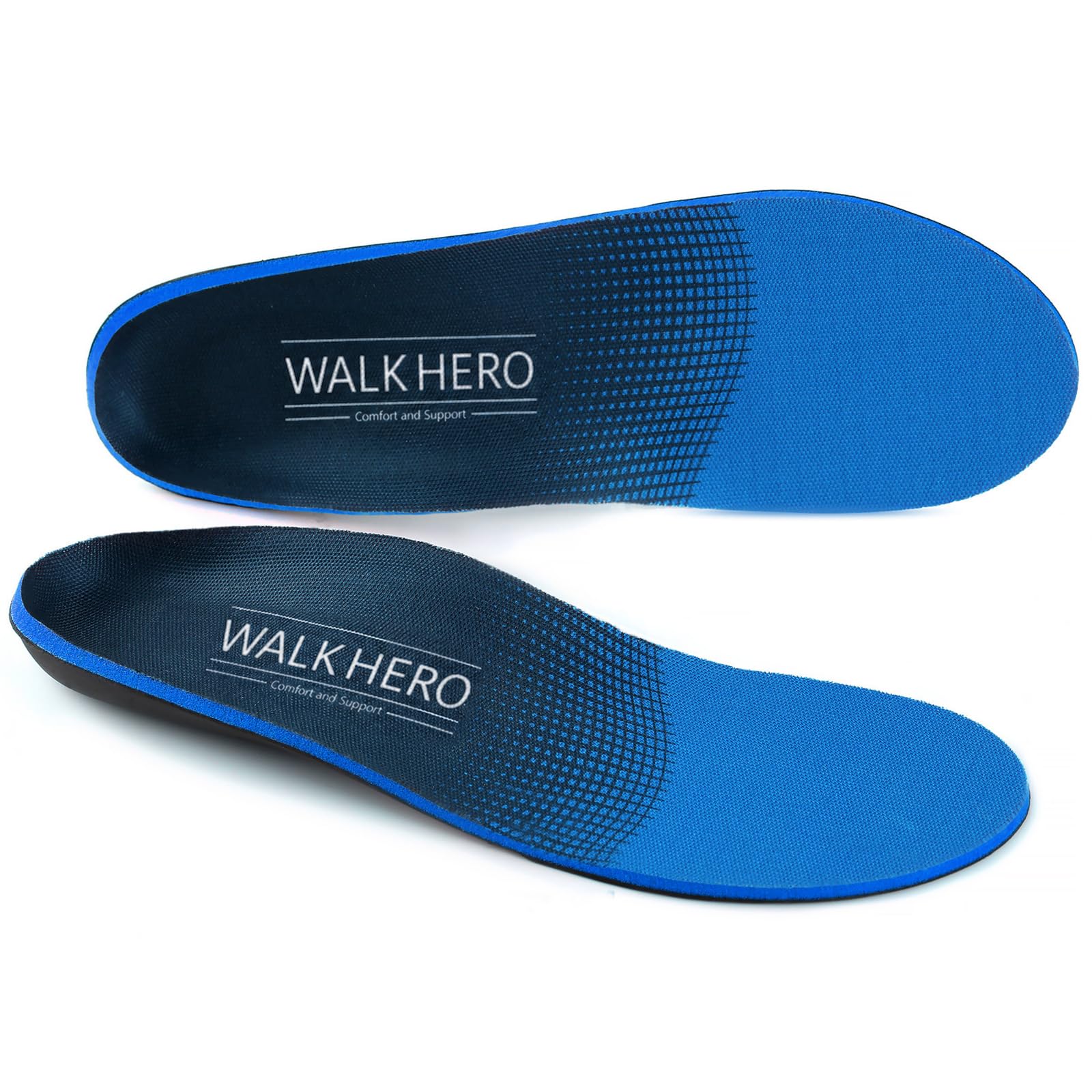
A full-length liner with a deep heel cup, sized for roomy boots.
If you live in work boots or wide athletic shoes, this WalkHero model was shaped for that volume, not for a slim dress shoe. The deep heel cup keeps your foot from rolling around during the heavy landing of each step, and the premium EVA material is there for shock absorption and to ease foot fatigue. It supports moderate control, which suits everyday standing and walking more than hard orthotic work.
The firmness is the honest divider here. Some find the arch height exactly right and report the pain settling; the most common complaint is that it is too firm at first. If you have very sensitive arches or highly flexible feet, that will matter. The fabric top also helps keep the foot from feeling clammy over a long day, and the full length means cushioning runs heel to toe.
Best told in one line
- Deep heel cup stabilizes the foot from heel strike
- Firm arch support built for plantar fasciitis and flat feet
- Fits wider, higher-volume shoes like work boots and running shoes
Second thought
- Firm feel is the thing people most wish were softer
- Not made for narrow, low-volume shoes
Suits: boot-wearers who want a firm, stable arch they can count on for a full day.
Skip if: your feet need soft, forgiving cushioning all the way through the heel.
5. Sof Sole ATHLETE Performance Men’s Insoles

For the days that mix standing with a lot of moving around.
Sof Sole’s Athlete is aimed at runners, walkers, and athletes, so it leans toward shock absorption over hard corrective support. Full-length gel in the heel and forefoot takes the sting out of each foot strike, and the foam insert adds comfort without bulk. A Hydrologix moisture control layer and midfoot ventilation keep the foot cooler, and a neutral arch shape is meant to suit most foot types — high, low, or neutral.
The comfort and fit are what buyers praise most about it, and it works in athletic and casual sneakers alike. On the durability side the picture is mixed — some buyers report long life, others describe the insert coming apart after minimal use. It is also a neutral insert, so it is not the pick for a specific arch problem that needs real correction.
Trade-off to size up: neutral arch support helps a normal foot but does little for a fallen arch, so if your problem is a collapsed arch rather than impact soreness, aim for a firmer pick instead.
Great choice when: you want a light, breathable, cushioned insert for running, gym, or frequent moving about.
Think twice if: your main problem is arch collapse and you need firm structure.
6. VALSOLE 250+ lbs Plantar Fasciitis High Arch Support Insole

Firm TPU structure for feet that carry real weight all day.
VALSOLE’s design brief names the people it is for — over 220 lbs — and the build reflects it. There is a black rigid TPU support piece in the heel cup (a stiff plastic shell that wraps and stabilizes the heel), plus forefoot metatarsal pads and Poron heel pads for shock absorption. That pairing addresses both the weight at the back of the foot and the pressure at the ball.
Where it shines is stability. The design targets rearfoot and midfoot control to reduce overpronation (the inward roll of the foot), and buyers with flat feet say it does the alignment work they needed, relieving heel and mid-arch pain. It trims to fit a range of shoes — walking, running, athletic, work, boots, and hiking. The fabric top is there to reduce odor and keep the foot fresh across a long shift.
The honest note is that the firmness is divisive; it is built hard on purpose, and some people find it too hard at first. VALSOLE suggests starting at 2 to 3 hours a day for 3 to 7 days. A few also say it does not sit quite right in their shoe. If you have roomy boots, that is seldom an issue.
Buy this if: you carry extra weight and want a rigid heel cup holding your foot in line.
Look on if: you want a soft, immediate pinch-free feel and will not accept a break-in period.
7. Spenco PolySorb Heavy Duty Insoles

Padded in all the right places for concrete floors and long shifts.
Spenco packs cushioning into the spots that matter when you stand still for hours. A thick SpenCore heel pad sits right at the heel strike zone, and a matching forefoot crash pad eases the front of the foot — with a first-ray drop zone for a natural toe-off. A deep heel cup and arch support keep the foot aligned, and the low-friction top cover cuts down on rubbing.
Owners in demanding jobs come back to it. A veteran valet wears it in every work shoe and says it eliminates sharp foot pain even on shifts past ten hours. Others say it eases back and knee discomfort from long standing. One detail matters more than any spec: these take up space. Owners mention needing roughly a half inch of room and shoes at least three inches deep, so break your boots in first.
The mixed note is durability and fit across different shoes — some report long wear, others quicker breakdown, and they are not shaped for every shoe. For heavy use, expect to replace them after a solid year or so.
One-line read: the SpenCore pads put padding exactly under your heel and ball, so you feel support where you stand, not just a flat sheet under the whole foot.
Choose it for: long work shifts where heel and forefoot padding beat fancy shaping.
Give it a miss if: your shoes are already tight and cannot take a thicker insert.
8. Timberland PRO Anti-Fatigue Technology Replacement Insole

The cushioned drop-in for refreshing a pair of Timberland boots.
This one is a replacement footbed first and a support insert second. It is poured for the feel of walking on gel — buyers describe it as super soft underfoot — which makes it the softest, least corrective pick on this list. The 2-pound pair has real substance, and the point is cushioning and a fresh lay-in for a well-worn boot rather than arch correction.
That softness is the appeal for some and the letdown for others. The recurring fit note is that it runs narrow, and the arch support is only moderate, so anyone needing firm structure will find less of it here. It works best as a direct replacement in Timberland boots sized for this insole, not as a universal fix dropped into any shoe.
Where it lands: soft, springy comfort with a moderately shaped arch — a comfort replacement, not an orthopedic device.
Matches with: Timberland PRO boots that need a fresh, cushiony footbed.
Skip for: narrow shoes or a foot that needs firm arch correction.
9. SOLE Performance Medium Insoles – Custom Moldable

A cork base that softens and molds to your arch when warmed.
SOLE offers one feature no other pick here does: a heat-moldable ReCORK base. Warm it, wear it, and it adapts to your specific arch height — low, medium, or high — instead of forcing your foot to fit a pre-set shape. The firm cork and cushion construction has a zero-drop platform to encourage neutral alignment, which helps reduce strain from overpronation, flat feet, and heel pain.
There are three thickness options, and this Medium builds in 3.2mm total with 1.6mm of cushioning, a balance of comfort and response for running shoes, athletic shoes, and cross-trainers. It is trim-to-fit, and SOLE advises matching your usual shoe size or measuring your factory insole, sizing down if you are between sizes. Buyers who found the right fit describe it as comfortable and effective for arch support and plantar fasciitis.
The catch is really fit and noise. Some find it slightly too narrow for certain shoes, and a few mention squeaking while walking — which is worth checking against your own floors. Trimming is your job here, so measure carefully.
For you if: you want an insert that adapts to your arch rather than one fixed shape.
Reconsider if: a narrow shoe or a squeak-free floor matters more than moldability.
10. Superfeet All-Purpose Support High Arch Insoles (Green)
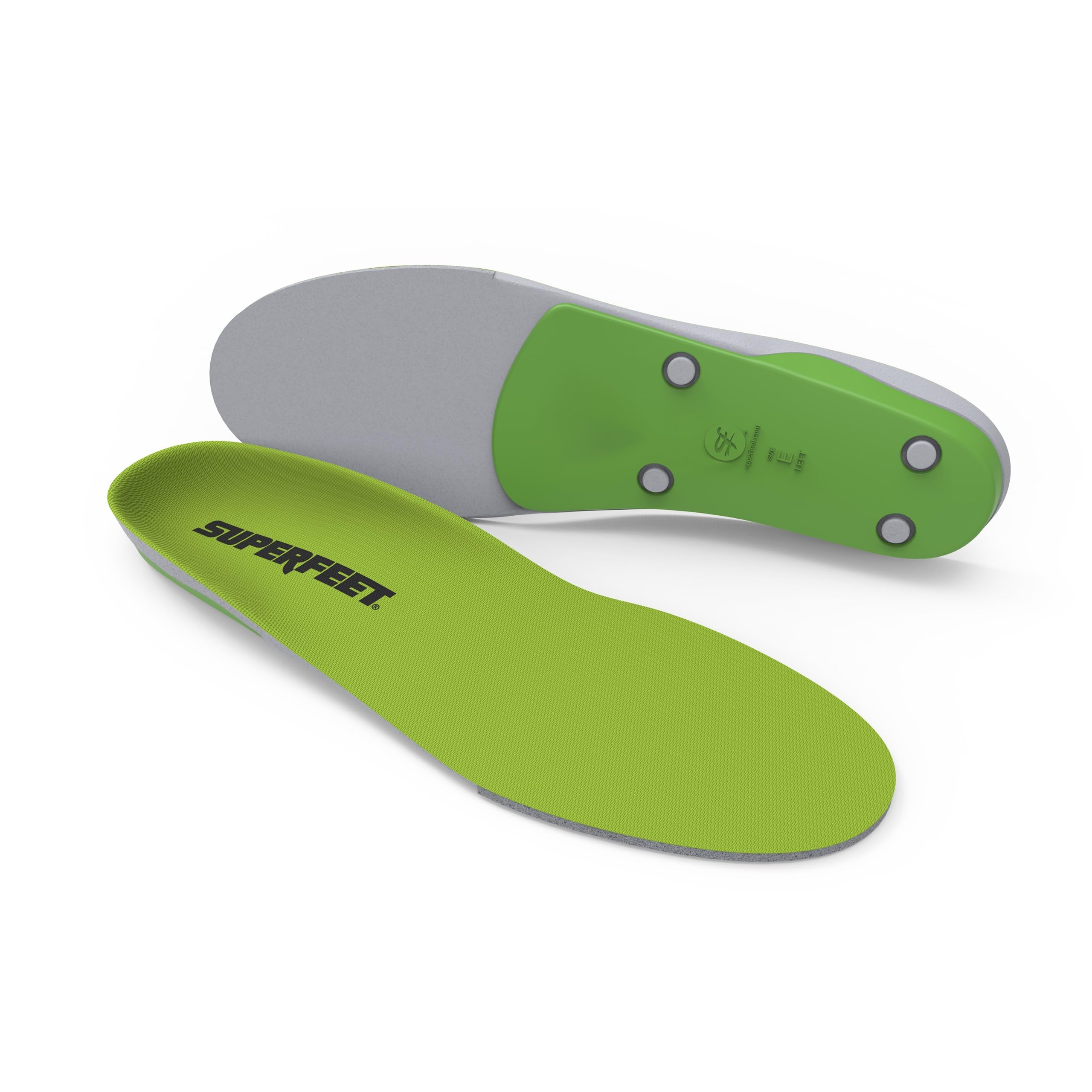
Firm, dense support for high arches — and the patience to break it in.
Superfeet’s Green earns its spot with a sculpted heel cup that cradles your heel for natural shock absorption. The high-density closed-cell foam (a firm foam that holds its shape rather than squashing flat) supports your whole foot. The Moisturewick top cover helps keep odor down. It is designed for roomy footwear, so it works best in athletic shoes and boots with space.
The firmness is the headline, and the payoff shows up over weeks, not hours. One 60-year-old walker reported gradual improvement and a return to thousands of daily steps without pain, and another owner is on their fourth pair. It is 3.03 ounces and trim-to-fit. Note it is not adhesive, so it swaps easily between shoes — just order half a size smaller if you are between sizes.
Expect a break-in that feels stiff before it feels good, and expect it to shift how your shoe fits and even soften the shoe’s own feel. If a very firm, structured arch is not for you, this is not your insert.
Best for: high arches in roomy shoes, with the willingness to break them in.
Not your pick if: you need instant softness or your shoe has very little room.
11. CURREX SupportSTP Arch Support Insole

Pick the arch profile that matches your foot, not the other way around.
CURREX gives you a choice most inserts do not. SupportSTP comes in three arch profiles — low, medium, and high — and each has a different shape, height, and flex, so you can match the insert to your own arch. A dynamic arch support and deep decoupled heel cup work to wrap and lock the foot in place, which reduces the side-to-side fatigue you feel after hours of standing.
A mesh top layer and premium foam keep the foot dry while you stand, and air vent technology is there for breathability. It is designed for work, athletic, and casual shoes alike, and buyers mention noticeable comfort improvements and pain relief, along with use in work shoes. Note the replacement guidance: CURREX says swap to a fresh pair after 500+ miles or 12 months, whichever comes first.
The honest note is price perception — some feel it is well worth it, others find it dear for what is, at its core, a shell and foam insert. And it is not a plush cushion, so do not buy it expecting softness. Choose the correct profile or the whole point is lost.
Why the profiles matter: a high arch and a low arch need different shapes, so a set of three profiles is a smarter fit than one universal slab.
Go for it if: you know your arch type and want a shape matched to it.
Hold off if: you want a soft, cushioned feel rather than a structured shell.
12. Airplus Plantar Fascia Orthotic 3/4 Length Shoe Insole

A three-quarter insert that fits boots and dress shoes without crowding toes.
If a full-length insert makes your toes feel pinched, this is the shape to try. The Airplus 3/4 design stops short of the toes, so it slides into high heels, casual shoes, athletic shoes, and dress shoes while leaving the toe box free. An arch plate props up the plantar fascia (the band running under your arch), a gel drop in the heel cushions heel spurs, and a deep heel cup keeps the foot from sliding around while you stand.
At 3.84 ounces and 11.83 x 4.12 x 1.75 inches, it is a slim shell rather than a bulky pad. The quality is what buyers praise most, and it carries APMA certification from the American Podiatric Medical Association. One safety-boot wearer found the 3/4 length left plenty of toe room and stayed durable across months of use; another describes it as thin yet sturdy for nine-hour standing shifts.
Two things to know. The fit is mixed — some report it stays put, others find it rocks or slides, especially in narrow shoes, so layering it on top of the factory insole solves the drift for many. It is also just a heel-and-arch piece, not full-foot support.
Works in its favour
- 3/4 length leaves toe room in slim and dress shoes
- Gel heel and deep cup cushion and steady the foot
- APMA certified, HSA and FSA eligible
Where to watch out
- Can shift inside loose or narrow shoes
- Only supports heel and arch, not the whole foot
Pick it when: your shoes are snug at the toe and you still want arch and heel support.
Pass if: you want a single full-length insert that will not budge.
13. 4D Cloud Insoles Memory Foam Arch Support Inserts

Plush memory foam for anyone whose feet just feel beaten up.
The 4D Cloud is the budget pick for general soreness rather than a specific arch problem. It is a soft PU memory-foam insert with a U-shaped heel for shock absorption and a flexible gel insert at the bottom. A honeycomb top design is meant to let air circulate and keep the foot cooler and drier through the day.
For comfort at this level, it holds up well. Customers note it replaces the flimsy factory insole nicely and eases the ache after ten-hour workdays. At 2.89 ounces it is light, and it can be trimmed for a fit — reviewers point out minor trimming for larger sizes. The softness is what people like most, and it is a great value for casual everyday comfort.
The honest limit is support. This is not a true orthopedic insert — the arch support is modest and the foam can compress over time, so it works best for cushioning a decent foot, not correcting a fallen arch. If you need real structure, aim higher up this list.
The value question: a light, soft layer under tired feet for very little outlay — a cushion, not a correction.
Right pick for: low-cost everyday cushioning when your feet are beat but your arches are fine.
Not the one if: you need firm, corrective arch support.
14. Happystep Memory Foam Orthotic Insoles
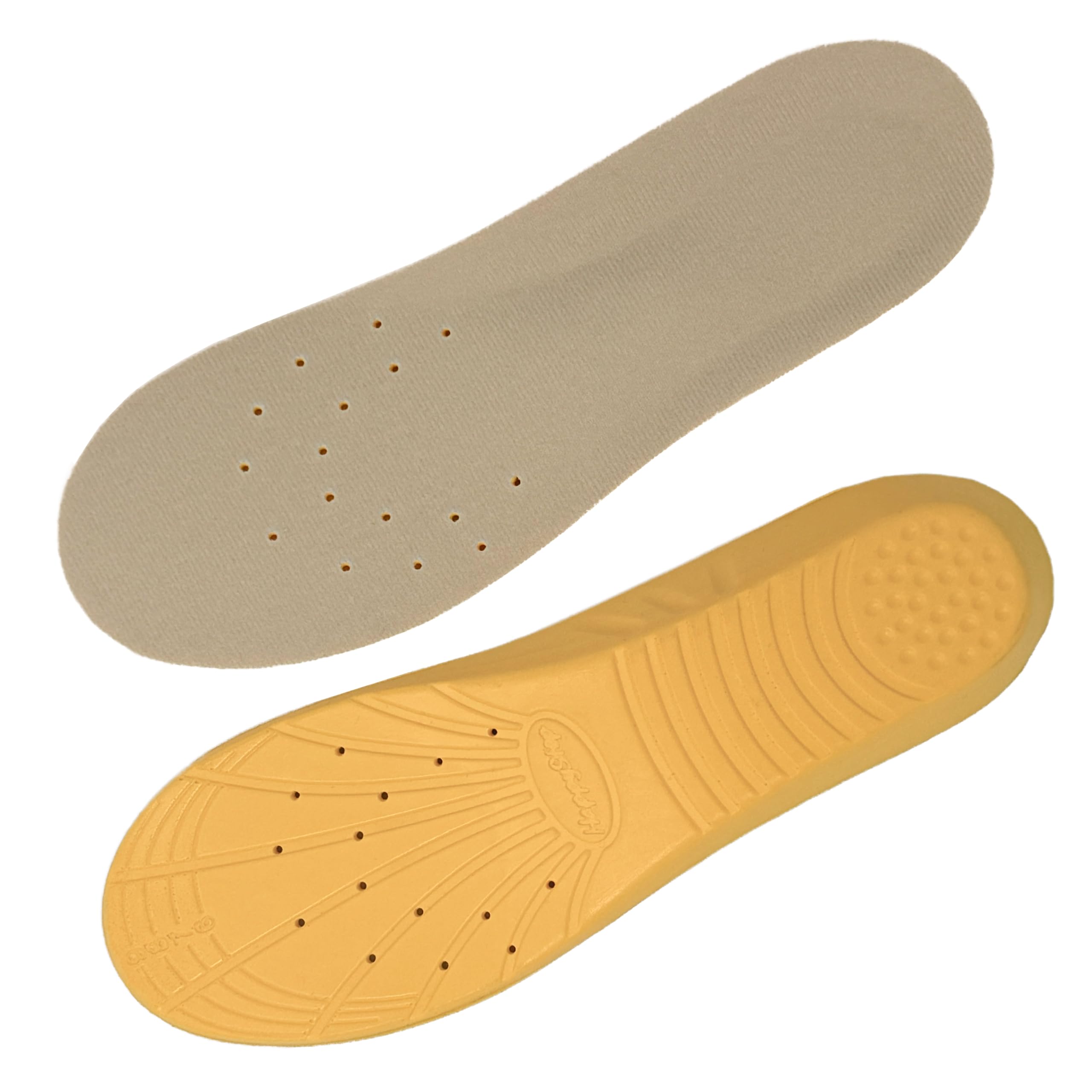
A low-profile memory-foam layer that quietly takes the edge off.
Happystep takes a different route from the firm orthotics: high-density memory PU foam that slowly conforms to your foot, with a defined arch contour and a shaped heel. The numbers tell the comfort story — 0.20 inches of foam through the forefoot and 0.59 inchesat the heel, cushioning under the spot that takes the most standing load. It is designed for shoes with removable factory insoles, and it comes in three colors to match your footwear.
Owners value it for gentle, adaptive cushioning and low cost. The fixed arch contour is a set shape, so how high it feels varies with your foot and the insole size — the fit is the most-split topic, and the foam can compress somewhat with heavy daily use. What it is not is a rigid orthotic; it is comfort that molds to you rather than structure that corrects you.
Fits your day if: you want a soft, full-length cushion for everyday shoes and light standing.
Look past it if: you need a firm arch to hold a fallen foot in place.
15. Memory Foam Insoles Large

A cut-to-fit starter insert with printed size lines to guide your scissors.
This is the low-risk way to test whether an insole helps you at all. It combines a high-arch memory-foam shape with velvety PU material, and it comes with three sizes to cover most feet. The useful detail is the printed cut lines on the back — you trim to the size marking that matches your shoe, so you can size it accurately without guesswork. It runs 3.53 ounces and about 0.6 inches thick.
Owners say the shock absorption makes a real difference under the heel and ball during long days on the go, and it fits sneakers, work boots, and casual shoes. It keeps feet dry and it stays put thanks to a non-slip rubber backing. A festival-goer and a long-distance walker both found it kept their feet comfortable through hours on their feet.
What to weigh first: it is a thicker insert, so you may need to pull the factory insole to make room, and after that a snug shoe can still feel close. One buyer found it too bulky for their shoe and wound up with heel rubbing.
Best-told-as: the entry-level gamble with clear cut lines, high-arch foam, and a real chance of relieving an aching heel.
Worth a shot if: you want a cheap first insert with an arch shape and easy trimming.
Leave it if: your shoes already fit close with no room to spare.
Know the Specs
Arch height and firmness
The arch support is the raised section under the middle of your foot that holds your arch up. A firm, well-placed arch stops your foot from collapsing under steady standing weight, which is the main reason it beats a soft pad for all-day use. Firmness is a feel choice: some feet want a rigid arch, others do better with a moderate shape, so match it to your foot type and give it a few days of adjustment.
Heel cushioning
The heel takes the first impact of every step and the most steady pressure when you stand. Look for a shaped heel cup that wraps the back of the foot — it keeps the foot steady and cushions the landing. Gel, foam, or dedicated heel pads all do the job; the key is that the cushioning sits right at the heel strike zone rather than being spread thin across the whole insert.
Full-length versus 3/4-length
A full-length insert runs from heel to toe and replaces the whole factory footbed. A 3/4-length insert stops before the toes, so it leaves the toe box free — handy in dress shoes and boots, though it can shift in a loose shoe. If you have room, full-length gives more support; if you are short on toe room, the shorter style fits better.
Trim-to-fit versus sized
Some inserts come in exact shoe sizes, so you just drop them in. Others are trim-to-fit, meaning you cut the edges to match your shoe — often guided by printed cut lines or by tracing your factory insole. Trim slowly and test the fit after each small cut. Never cut the arch or heel area, only the toe area.
Common Questions
How long should I wear new insoles before they feel comfortable?
Will these insoles work in my work boots?
Can I cut an insole to fit my shoe size?
Are firm insoles better than soft ones for standing all day?
Is it fine to add an insole on top of the original one?
How often should I replace my insoles?
Do insoles with a high arch hurt at first?
What weight of person are heavy-duty insoles built for?
Can I wear these insoles in dress shoes or high heels?
Are insoles for standing all day eligible for FSA or HSA?
The Bottom Line
For most people standing all day, the insoles for standing all day winner is the PowerStep Pinnacle. Its firm arch and cushioned heel do the one thing that matters on a long shift: they hold your foot up instead of letting it flatten. If you carry extra weight and want a rigid heel cup, grab the VALSOLE 250+ lbs. And for slim dress shoes where a full-length insert will not fit, the Airplus 3/4 Length is the one to reach for.
One nudge: if you are unsure which firmness suits your foot, start with a lower-cost insert and test it against your shifts. Your feet will tell you quickly if you want more support or more cushion. That answer makes the next choice easy.
How we choose
We do not accept paid placement. Every pick is matched to a real buyer and a real use-case; we do not hands-on test units.
Sources
Specifications: manufacturer listings and product documentation. Review insights: verified customer reviews, as of October 2026. Pricing: not shown on this page (it changes often); check the current price via the retailer link.
As an Amazon Associate, Aappliancez earns from qualifying purchases. This does not affect which products we feature.