Disclosure: Some links in this post are affiliate links. As an Amazon Associate I earn from qualifying purchases, at no extra cost to you. Learn more
Specs are compiled from manufacturer listings and verified buyer reviews and can change over time — please confirm the key details on the product page before buying.
If your ankles roll inward with every step, the right insole can change how your whole lower body feels by the end of the day. Pronation is simply your foot rolling inward as you walk, and when that roll goes too far, it pulls your arch down, your knee in, and your lower back out of line. This guide sorts through the insoles that actually correct that inward collapse instead of just padding it.
This guide is built by comparing the manufacturers’ published specifications and the patterns across verified customer reviews, so you get each pick’s real strengths and trade-offs instead of marketing spin.
Everything below separates the picks that hold your arch in place from the ones that only feel soft for a week. By the end you’ll know exactly which insoles for pronation match your arch height, your shoes, and how many hours you spend standing.
Top Picks

How To Choose The Best Insoles for Pronation
The mistake most people make is shopping for cushioning when they should be shopping for control. Overpronation is a motion problem — your foot keeps rolling inward after it lands — so the fix is a structured arch and a heel cup that limits that roll. Soft foam feels great on day one and flattens by week three.
Match the arch profile to your actual foot
A rigid arch under a genuinely high foot pushes uncomfortably, while a too-soft arch under a flat foot does nothing. Pedag builds three arch profiles — low, standard, and high — so you pick the one that matches your foot. PowerStep and SOLE both use heat-moldable bases that adapt to low, medium, or high arches after a few minutes of molding.
Look for a deep heel cup and a real shell
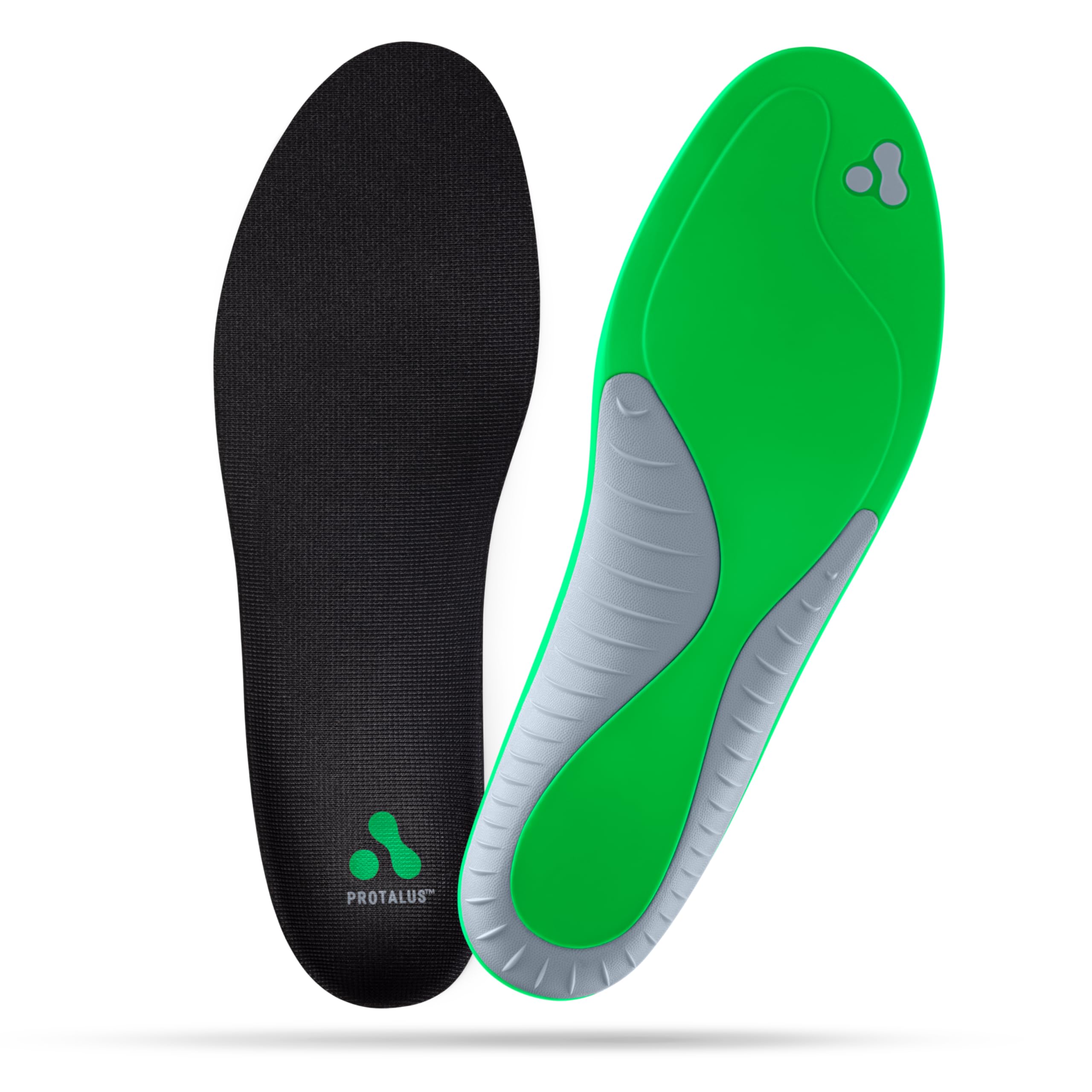
The heel cup is the raised rim that cradles your heel and is where pronation control actually begins. Protalus uses a deep heel-cup that stabilizes your step and limits inward foot collapse. PowerStep PULSE Maxx adds an angled heel to its rigid shell for the same reason — correction, not just cushioning.
Decide between full-length and 3/4-length
Full-length inserts replace the insole your shoe came with and suit running shoes and hiking boots. A 3/4-length insert, like the Dr. Scholl’s CF 110, leaves your toes on the shoe’s own footbed and slides between shoes — a smart pick when your existing insole is not removable, or when you have wide feet and want to keep toe room.
Side-by-Side Comparison
| Model | Best For | Profile Length | Arch / Support Style | Weight | Amazon |
|---|---|---|---|---|---|
| Dr. Scholl’s Custom Fit Orthotics CF 110★ Best Overall | All-day wear in non-removable insoles | 3/4 Length | Custom 3D arch support | 4.94 ounces | Amazon |
| Protalus T-100 EliteBest for Running | Running and rowwork with removable insoles | Full Length | Patented alignment, deep heel-cup | 8.9 ounces | Amazon |
| Pedag Viva Standard | Dress shoes and slim toe boxes | Full Length | Triple zone, rigid plastic arch | 3.7 ounces | Amazon |
| PowerStep Pinnacle Hiker | Hiking boots and roomy footwear | Full Length | Podiatrist-designed arch, semi-rigid | — | Amazon |
| SOLE Performance Thick | Boots, work shoes, high-volume athletic | Full Length (14.5 inches) | Heat-moldable ReCORK base | 4.8 ounces | Amazon |
| PowerStep Pulse Maxx | Running and overpronation correction | Full Length | Angled heel, motion control shell | 4.97 ounces | Amazon |
| FootScientific Arches Type 1 | Flat feet needing correction | Full Length (10 inches) | Form-correcting molded cork | 5 ounces | Amazon |
Detailed Reviews
1. Dr. Scholl’s Custom Fit Orthotics 3/4 Length Inserts, CF 110
Our pick — 4.5+★ from 850+ verified ratings; the strongest balance of quality and price.
The half-length insert that slips between shoes and keeps your toes free
The Dr. Scholl’s CF 110 solves a specific problem: shoes where the factory insole is glued in and cannot be pulled out. Because it stops at 3/4 length, it slides in on top of the existing footbed and leaves your toes their full room. That design also makes it the friendliest pick for wide feet, where a thicker full-length insert crowds the toes.
What wins people over is how quickly it goes to work. It carries custom 3D arch support and a three-layer cushioning stack — a soft top cloth, shock absorption, and a stabilizing arch — aimed at the whole lower body, not just the foot. A 118-lb buyer reports the CF 110 fits, and a nurse on her feet all day used it for ten years for plantar fasciitis. One reviewer with Morton’s neuroma and a bunion walked cobblestones uphill through Germany without sore feet afterward.
The catch is durability. Buyers who got about four years from an older pair report the newer pair breaking down after months — a hole at the heel, the cloth lining peeling. It is still the strongest all-rounder here: the crowd favorite at 4.5+ stars across 800+ owners, with effectiveness the thing people come back to mention most. Custom Fit’s short, flat profile also makes it the natural alternative to the FootScientific Arches Type 1, whose 10-inch full-length cork build needs a shoe that can swallow its thickness.
What it does best
- 3/4 length fits shoes with non-removable insoles and keeps toe box room for wide feet
- Custom 3D arch support plus a three-layer cushioning stack
- Built for walking, running, cycling, court sports, and all-day standing
Where it asks for care
- The 3/4 length gives less heel-to-toe coverage than a full-length insert
- Recent pairs have been reported to break down faster than older ones
Reach for this if: your shoes have fixed insoles, your feet run wide, or you need one insert you can move between pairs.
Think twice if: you want maximum heel-to-toe cushion for a dedicated running shoe — a full-length build covers more ground.
2. Protalus T-100 Elite Premium Insoles
Alignment control built for long shifts on hard floors
The Protalus T-100 Elite is the pick for anyone whose pronation shows up as ache in the ankles, knees, or hips rather than in the arch alone. Its whole pitch is a patented alignment system that guides the foot into a more natural position and eases stress up the chain, supported by a deep heel cup that limits inward collapse. That heel cup is the specific anti-pronation part — it stops the roll where the roll starts.
Where it stands out most is durability and shock absorption. The maker rates it for up to 12 months of consistent wear, and buyers report the cushioning and heel cup holding up for that full year. One owner summed up the value of a spare set — when swapping it between shoes, the difference is strong enough that owning two pairs beats moving one. Who it fits matters, though: the T-100 uses a universal adaptive design meant for shoes and boots with removable insoles, and it works across flat feet and high arches.
At 8.9 ounces, the T-100 is the heaviest insert here — more than double the Pedag Viva Standard’s 3.7 ounces — and it needs a shoe with removable insoles to seat properly. Fit runs large; several buyers found it too big for a walking shoe and trimmed it with scissors, and the recurring note is to size down. High-arch feet in particular should check the arch before committing, since the support has been called insufficient for tall arches.
Alignment over padding: The T-100’s focus is guiding the foot and stabilizing the heel for running, hiking, and long standing, not just softening each step.
Fit is the test: It is the heaviest option here at 8.9 ounces and runs large, so verify it seats in your shoe before relying on it daily.
Strongest match: runners, hikers, and people on their feet for long shifts who want alignment correction and a deep heel cup.
Look elsewhere if: you have very high arches or need the lightest possible insert — this one is built for control, not minimum weight.
3. Pedag Viva Standard Insoles Size 10 Men
Thin enough for dress shoes, firm enough to hold your arch
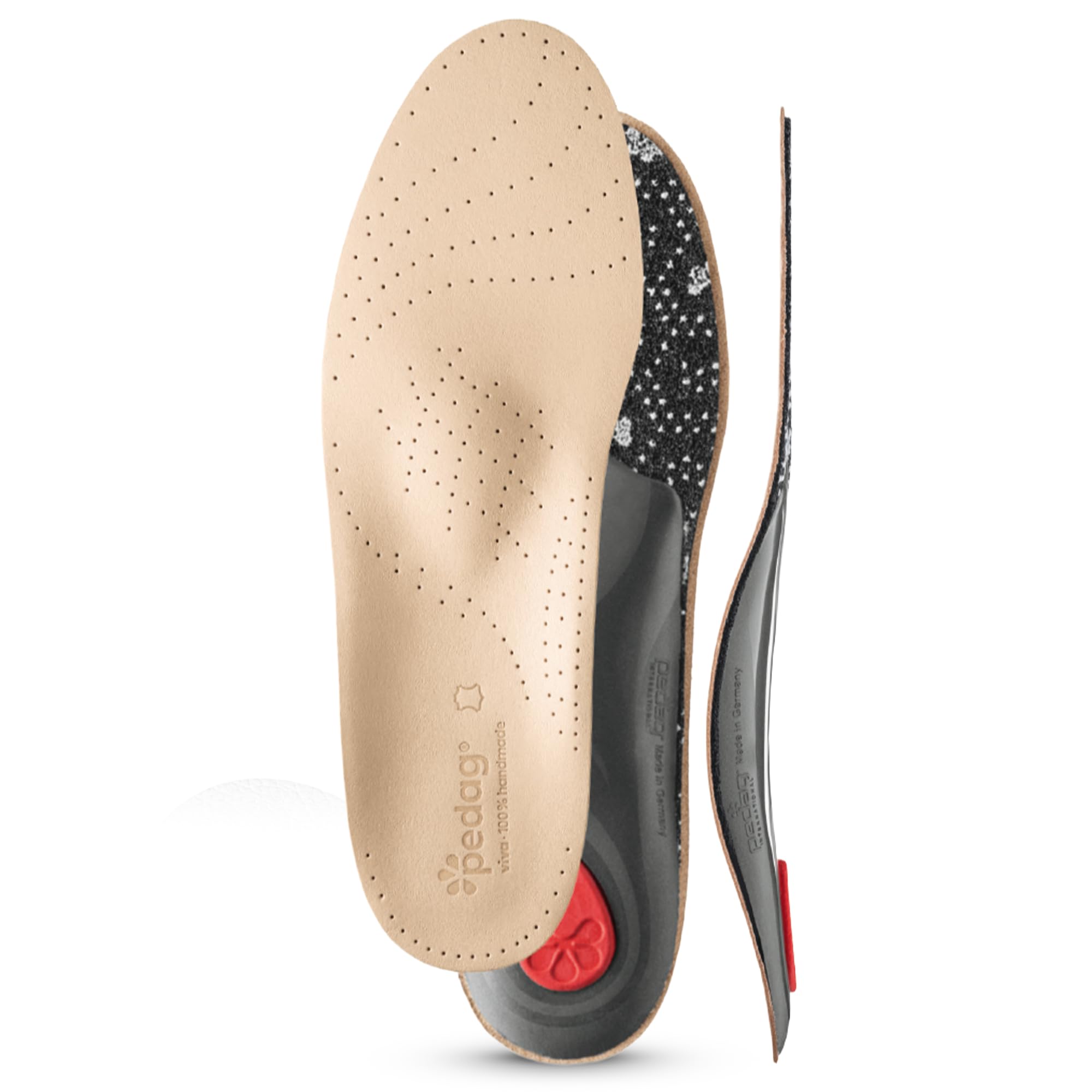
Most pronation inserts add bulk, and bulk ruins dress shoes. The Pedag Viva goes the other way. Its defining number is its weight: 3.7 ounces, the lightest insert on this list and less than half the Protalus T-100’s 8.9 ounces. That low profile is why it disappears into slim, formal footwear where a full-length cushioned insert would crowd the toes.
The build is a vegetable-tanned cowhide leather top over a triple zone support — a metatarsal pad, a heel cushion, and a longitudinal arch that together work to realign the foot. An activated charcoal core is layered in to target wetness and absorb perspiration, which is why the leather surface stays breathable over a long day. Owners mention roughly 30 years of use, calling it the most comfortable and durable insert they have found.
Two honest limits. The arch support is a rigid plastic arch rather than a cushioned one, so it suits a medium arch — high or flat feet will not get the fit they need — and it is stiff enough that swapping it between shoes daily is impractical. Several customers note the leather footbed is slippery compared with a fabric top. The Pedag also plays a different role from the SOLE Performance Thick: SOLE pours cushion into roomy boots, Pedag keeps things thin for a leather shoe.
The dress-shoe answer: Vegetable-tanned cowhide, an activated charcoal core, and a metatarsal pad in one low-profile insert.
Know before you buy: It suits medium arches, and the rigid arch is too stiff to move between shoes every day — buy a pair per shoe.
Best for: medium-arched feet in dress shoes, loafers, or sandals where a thick insert simply will not fit.
Skip if: you have high or flat arches, or you want to move a single insert between several pairs of shoes.
4. PowerStep Pinnacle Hiker Orthotic Insoles

Semi-rigid support that holds an arch through miles of rough trail
If your legs ache after a long day on uneven ground, the Pinnacle Hiker is built for you. Its support is the stiff kind that keeps an arch from collapsing under a loaded pack, and reviewers point out a 16-mile moderate-to-strenuous hike with no foot pain after adding these to boots whose stock insoles had failed. A flat-footed hiker of size 13 wide also finished a long rough-terrain trek pain-free. What most praise in this insert is comfort, followed by the arch support itself.
PowerStep designs around a podiatrist-created arch shape, and the Pinnacle Hiker adds a deep heel cup and a slightly firmer build than the brand’s heat-moldable shoes line. That firmness is what makes it work in boots carrying weight. It is available in unisex sizing, made in the USA, and shoppers say a great fit straight from the start with no cutting needed. People with plantar fasciitis and mild pronation both show up in the reviews.
The recurring caveat is thickness. This is a genuinely thick insert — one buyer found it compressed the toes in a shoe with little extra room, and the honest framing is that it wants a true-to-size or roomier boot, not a snug one. Durability also draws a mixed note, so treat these as a boot insert you rotate rather than one that lives in every pair. If your shoe is already tight, the 3/4-length Dr. Scholl’s CF 110 above leaves far more toe room.
Trail-tested firmness: A podiatrist-designed semi-rigid arch and a deep heel cup aimed at bearing up under a heavy pack on rough ground.
The honest trade-off: It is thicker than a typical insert, so it fits best in boots that have a little spare room over the toes.
Pick these when: you hike or walk rough terrain and want firm arch support that will not collapse under you.
Not your insert if: your boots fit snugly and there is no spare depth over the toes.
5. SOLE Performance Thick Insoles Mens 5

A cork base you bake and mold to your own arch
If you want an insert shaped to your foot rather than a one-size-fits-all curve, the SOLE Performance Thick is the fit-yourself pick. Its cork base is heat-moldable — you warm it, step in, and it adapts — so it can be carved to suit low, medium, or high arches, something a factory boot insole never does. The defining spec is the Thick profile: 4.8mm total with 3.2mm of cushioning sitting on a ReCORK base, built for boots and roomy footwear that have the interior depth to take it.
Durability is the real story. Buyers report the same pair holding strong through three-plus years of rucking, standing, and uneven terrain in military boots, with no flattening, peeling, or odor. Another reports twelve to fourteen hours a day in work boots with the cork arch and cushioning still working as well as day one. Comfort is what comes up most in what owners praise, with arch support a close second. For pronation, the appeal is that a firm molded arch paired with shock absorption helps control the roll while keeping the impact off your joints.
Two things to plan around. The cork build can squeak with every step in some shoes, so a pair that lives in boots is smoother than one swapped constantly. And it is a thick insert by design — the SOLE wants interior depth the way the Pedag Viva avoids it, so match the profile to your footwear. Sizing follows standard North American sizing, with trim-to-fit edges and a size-down recommendation if you fall between sizes.
Where it earns its place
- Heat-moldable ReCORK base adapts to low, medium, or high arches
- Thick 4.8mm profile with 3.2mm of cushioning for boots and long hours on hard floors
- Trim-to-fit edges size down for different widths and toe-box shapes
What to expect
- Can squeak with each step in some shoes
- The thick profile needs interior space, so it is not for slim or tight footwear
Made for: boots and roomy work shoes where you want a firm arch you mold yourself and cushioning that lasts.
A poor match for: dress shoes or low-volume sneakers, or anyone put off by an occasional squeak.
6. PowerStep Pulse Maxx Running Insoles

A rigid shell with an angled heel that corrects the roll where it starts
The Pulse Maxx is the most direct anti-pronation tool in this lineup. It is built around a more rigid shell than PowerStep’s standard PULSE inserts, and that shell carries an angled heel for better correction and alignment. That angle is the whole idea — it stops the inward roll at the heel rather than just supporting the arch. The top layer is a smooth fabric engineered to manage heat, friction, and perspiration, and the insert is designed for advanced running shoes during hard athletic activity.
Owners put it to work across basketball, HIIT (high-intensity interval training), and distance running. Owners mention that with overpronated ankles they had never found inserts that help like these, and credit the difference to support that starts at the heel rather than only at the arch. A college basketball player’s overpronation was corrected with a pair in every game shoe, and the inserts reportedly lasted a full season per pair. Fit is among the most praised traits, along with quality and comfort; the inserts are sized so no trimming is needed, and they can be moved between shoes when necessary.
Two caveats worth knowing. First-time orthotic users may need a transition period, wearing the insoles only a few hours a day until the feet adjust. And the fit runs wide, so narrow toe-box shoes are a poor home for it. The value note is mixed — some find them worth it, others call them pricey — but for correcting an overpronated stride at the source, this is the pick with that as its stated purpose.
Correction at the source: A rigid shell and angled heel make this the most targeted overpronation insert here, aimed at running, basketball, and HIIT.
Give your feet a ramp-up: New orthotic wearers should build up gradually, a few hours a day at first, and the insert is best in shoes with a roomy toe box.
Choose these for: a pronated stride in running shoes or court shoes, where heel-based correction is what you want.
Consider the Pinnacle Hiker instead if: you are sooting up for trail miles — the Hiker’s build is tuned for that surface.
7. FootScientific Arches Type 1 Insoles

A molded cork insert built specifically for flat feet
The FootScientific Type 1 is the one insert here sold by arch type: this model is the flat-feet build. Its frame is form-correcting molded cork, which absorbs shock, holds alignment, and keeps the orthotic’s shape over time, backed by a heel-stabilizing padded foam and an EVA comfort layer for ongoing shock absorption. A Stay Dry B.K. mesh top manages perspiration and adds transitional cushioning. For a foot that flattens completely, that firm cork frame is what supplies the arch the foot does not make on its own.
Because it is sold by fit, it rewards matching to the right foot. The size shown here is men’s 4-4.5 / women’s 06-6.5, so check your size carefully before ordering. The buyers who land it describe it in simple terms — perfect insoles for their feet, walk-all-day comfort — and it holds a perfect score from the owners who bought it, though on a small batch of ratings.
The trade-off is scale. This is a specialty carve with a very thin review pool, so if you want the reassurance of hundreds of owners behind a pick, the Pedag Viva or the SOLE Thick above carry far larger track records. FootScientific is the choice when your foot genuinely runs flat and you want a cork-corrected support sized to the letter.
Purpose-built for flat feet: Molded cork, a padded heel foam, and an EVA comfort layer, topped with Stay Dry mesh.
Fit it to the number: The size here is men’s 4-4.5 / women’s 06-6.5, and it is a narrow-batch pick, so size and confidence both come down to matching the spec.
Best for: flat feet that need the arch built back in with a firm cork frame.
Look to the wider-market picks if: you would rather buy from a model with a long, heavily used track record.
Know the Specs
Arch height and profile
Arch height is the natural curve of your foot, and it decides which support level fits you. Medium arches suit a rigid or semi-rigid support straight away, which is why the Pedag Viva is built for that range. Flat feet want a cork frame that holds a curve your foot does not make, like the FootScientific Type 1 or a heat-molded SOLE base. High arches want a deeper cup that fills the space without pressing.
Heel cup and shell stiffness
The heel cup is the raised rim that cradles your heel, and a shell is the stiff underside of the insert. For pronation control these two matter more than cushioning, because the roll starts at the heel. A deep heel cup, like the one on the Protalus T-100 or the angled heel of the PowerStep Pulse Maxx, limits how far the foot can roll inward. A stiffer shell corrects more; a softer one comforts more.
Profile thickness
Thickness decides which shoes an insert can live in. The SOLE Performance Thick runs 4.8mm total, sized for boots with interior room, while a 3/4-length insert like the Dr. Scholl’s CF 110 leaves the toe box open because it stops short of the toes. Measure your factory insole thickness before you buy, and remember that a snug shoe and a thick insert rarely work together.
Full-length versus 3/4-length
Full-length inserts replace the insole in your shoe and suit running shoes, hiking boots, and work boots that have removable insoles. 3/4-length inserts skip the toes and fit shoes where the insole is fixed, and they are easier on wide feet. Match the length to your shoe and to how much toe room you have before you decide.
Common Questions
Will a pronation insole fit my running shoes?
Do I need a different insole for flat feet versus high arches?
How long should a quality insole last?
Can a pronation insole also help plantar fasciitis?
Are heat-moldable insoles better than rigid ones?
Will a thick insole make my shoes too tight?
Do I need to trim a pronation insole to fit?
Is an insole as effective as a custom orthotic for overpronation?
Can I move one insole between different shoes?
How quickly can I expect relief when I start wearing pronation insoles?
The Bottom Line
Start with the Dr. Scholl’s CF 110 if you want one insert that fits the shoes you already own — its 3/4-length design slots into non-removable insoles and keeps your toes free. If your stride rolls hard and you run or play court sports, reach for the PowerStep Pulse Maxx, whose rigid shell and angled heel correct the pronation at the heel. And for long hours in boots, the SOLE Performance Thick lets you mold a firm cork arch to your own foot. Buy the one that matches your arch height and shoe first — that single decision does more for your feet than any feature list.
How we choose
We do not accept paid placement. Every pick is matched to a real buyer and a real use-case; we do not hands-on test units.
Sources
Specifications: manufacturer listings and product documentation. Review insights: verified customer reviews, as of October 2026. Pricing: not shown on this page (it changes often); check the current price via the retailer link.
As an Amazon Associate, Aappliancez earns from qualifying purchases. This does not affect which products we feature.