Disclosure: Some links in this post are affiliate links. As an Amazon Associate I earn from qualifying purchases, at no extra cost to you. Learn more
Specs are compiled from manufacturer listings and verified buyer reviews and can change over time — please confirm the key details on the product page before buying.
Your heel hurts most in the first steps out of bed, and the insole you bought to fix it either feels like a brick or goes flat in weeks. That is the trap in this category: soft gel cushions the heel but lets your arch collapse, while a rock-hard orthotic stabilizes the arch but punishes you for the first week. The picks below split that trade-off, and the top choice is the PowerStep Pinnacle, a firm dual-layer insole that sells on the strength of its comfort feedback. Know your arch height and your shoe’s removable insole before you buy, and you can skip the trial-and-error.
This guide is built by comparing the manufacturers’ published specifications and the patterns across verified customer reviews, so you get each pick’s real strengths and trade-offs instead of marketing spin.
Cushioning depth, arch height and shoe fit decide whether an insert helps or hurts, so every pick below is matched to a foot type and a shoe. This breakdown of the insoles for heel pain and arch support covers firmness, fit and break-in so you buy once.
Top Picks


How To Choose The Best Insoles for Heel Pain and Arch Support
Most people buy the wrong insole for one reason: they treat heel pain as a cushioning problem. Soft gel feels good on day one, but if your arch is collapsing under each step, the heel keeps taking the load and the pain returns. Support the arch and the heel pressure drops along with it.
Start with your arch height, not the label
A high, hard arch plate suits a neutral or high arch that needs holding up. A medium-height arch needs a softer-flexible shell, which is why some picks here split into Intermediate and Original versions. If you have flat feet, expect a firm arch to feel like pressure for the first few days — that is your foot conforming, not a defect.
Full-length versus 3/4-length: it is a room question
A full-length insole replaces the factory insole from heel to toe, so it needs a shoe where that insole lifts out and there is depth to spare. A 3/4-length insert stops short of the toes, which keeps a tight toe box from crushing your foot and fits dress shoes and boots more easily. The Airplus 3/4 orthotic weighs 3.84 ounces and slides into high heels, casual, athletic and dress shoes for that reason.
Check thickness against your tightest shoe
Every insole takes up room inside your shoe. The PowerStep Pinnacle measures 14.2 x 4.4 x 1.8 inches and weighs 5.61 ounces, so it fills a snug sneaker and you will feel it. The PROFOOT gel insert, by comparison, is 2.4 ounces and 1.5 x 4.25 x 9.75 inches, so the PowerStep is far the bulkier build. If a shoe already feels tight, pull out the original insole before you add anything.
Plan for a break-in window
Firm insoles are supposed to feel odd at first. Makers of the heavier-duty inserts suggest two to three hours a day for the first week or two, then building up. Judge fit after that window, not on the first afternoon.
Side-by-Side Comparison
| Model | Best For | Type | Weight | Arch Style | Amazon |
|---|---|---|---|---|---|
| PowerStep Pinnacle★ Best Overall | All-day support with firm arch | Full-length | 5.61 oz | Firm dual-layer | Amazon |
| Airplus Plantar Fascia 3/4Best for Dress Shoes | Dress shoes and boots | 3/4-length | 3.84 oz | Arch plate with gel heel | Amazon |
| PROFOOT Plantar Fasciitis GelBudget Pick | Light everyday relief | Full-length gel | 2.4 oz | Gel insert | Amazon |
| WalkHero 220+lbs | Heavier users on hard floors | Full-length | 6.38 oz | Rigid nylon arch sheet | Amazon |
| Dr. Scholl’s Heavy Duty | Wide feet and work boots | Full-length, trim to fit | 7.04 oz | Heavy duty support | Amazon |
| STSVZORR 220 lbs+ | Stiff deep-cup support | Full-length | — | Deep heel cup | Amazon |
| PCSsole 3/4 Orthotic | Toe room in tight sneakers | 3/4-length | 4.97 oz | 3.5cm firm EVA high arch | Amazon |
| CRUVHEAL 220+ lbs | Workday standing support | Full-length | 9.14 oz | 1.4-inch arch support | Amazon |
| VALSOLE Heavy Duty | Long shifts on your feet | Full-length | — | Hard TPU deep heel cup | Amazon |
| Superfeet All-Purpose High Arch | Durable long-term support | Full-length | 4.48 oz | High profile, stabilizer cap | Amazon |
| Natural Foot Orthotics Intermediate | Medium-height arches | 3/4-length | 6.74 oz | Medium-soft, four-arch | Amazon |
Detailed Reviews
1. PowerStep Pinnacle Insoles
Our pick — 4.5+★ from 31,500+ verified ratings; the strongest balance of quality and price.
The firm arch plate that wins people over with comfort instead of squish
The PowerStep Pinnacle earns its spot on feedback: it holds 4.5+ stars across 31,000+ ratings, the strongest record in this list. It is a full-length insole with a dual-layer build and a premium arch, measuring 14.2 x 4.4 x 1.8 inches and 5.61 ounces. That bulk does the work: a firm, contoured arch lifts your foot’s structure so your heel stops absorbing the whole step. Comfort is what wins people over, and the relief stories back it up. As one owner puts it: “One owner with lower back pain and plantar fasciitis credits these firm insoles with easing both about 65% (worn with compression socks) and no heel pain after 90 minutes of daily gym cardio.” The firmness is the honest trade-off — this is not a soft pillow underfoot.
Fit is where you have to pay attention. Owners wear these in running shoes, work boots, hiking boots and casual shoes. You order by shoe size with no trimming needed, but that only works in shoes where the factory insole lifts out. At 5.61 ounces the PowerStep is the heaviest build in this guide, while the PROFOOT gel insert at 2.4 ounces is a fraction of that weight — that gap tells you how much structure you are getting. Expect a firm arch and a proper contoured heel, not a pillow.
Break-in matters for the first few days, and a snug gym shoe may feel tighter until the insole settles. Buyers report the arch contour is accurate but slightly wide, and the firm feel is not what you want if your feet need plush cushioning under every step.
Where it earns its keep
- Dual-layer cushioning under a firm, contoured arch that stabilizes the foot and ankle
- Ordered by shoe size — no trimming, quick fit into running shoes, work boots and sneakers
- Made in the USA and backed by a 30-day money-back guarantee, HSA and FSA eligible
- Holds up over years of daily wear for owners with heavier builds
Where it asks something of you
- Firm feel takes getting used to and is not for feet that need soft cushioning
- At 5.61 ounces it adds real bulk and can tighten a snug sneaker
- Needs shoes with a removable factory insole
Reach for this if: you want a firm, structured arch that holds up under daily gym time, long standing and work boots.
Look elsewhere if: your feet need a soft, plush cushion under every step — go firm only when you want support.
2. Airplus Plantar Fascia Orthotic 3/4 Length Shoe Insole
A slim 3/4 insert that slides into the shoes a full-length insole cannot reach
Not everyone can give up their dress shoes for a sneaker. This Airplus insert stops short of the toes, which frees the toe box and lets it slide into high heels, casual, athletic and dress shoes. At 3.84 ounces it is slim enough to disappear, and a gel drop in the heel cushions heel spurs while the arch plate supports the plantar fascia. Deep heel cup, full foot arch support, and a foam shell that softens each step — the recipe is sound.
The value story is real. Owners wear these for distance walking, on vacation in tennis shoes, and through nine-hour standing shifts, and the recurring report is a great fit without the price of a custom pair. A steel-toe and composite boot user found the heel shock absorption the standout. The recurring gripe is the fit — some find them sliding out of place in looser shoes, so snug them down.
Where it shines: a 3/4-length insert that respects a tight toe box, which is the reason to pick it over a full-length insole.
Set your expectations: the arch support here is moderate rather than aggressive, and durability is the one thing buyers flag as uncertain over the long haul. It carries APMA certification and is FSA/HSA eligible.
The straight answer: the right call when your shoes are the constraint and you still need heel cushioning plus arch support.
Go bigger if: you need a large men’s size or an aggressive arch — this one runs thin.
3. PROFOOT Plantar Fasciitis Orthotic Insoles for Men
Gel cushioning that gets heel pain through a two-week window without a big outlay
If you need relief fast and cheap, this gel insert is the entry-level answer. It is 2.4 ounces and 1.5 x 4.25 x 9.75 inches, the lightest and lowest-profile build here — a fraction of the PowerStep’s 5.61 ounces — and it slides into most shoes with minimal fuss. Owners mention early plantar fasciitis symptoms ease within two weeks, and the gel holds up through tennis and pickleball five times a week.
Where it falls short is durability. The consensus is that these hold up for a while and then start wearing, with some needing a replacement pair far sooner than they hoped. Think of it as a relief bridge, not a lifelong arch correction.
Best thing about it: a low-profile gel build that fits into shoes without removing the factory insole, plus a pamphlet of plantar fasciitis stretches.
What fits awkwardly: the gel can be too bulky for slip-on loafers, and the insert is heavier on padding than on firm arch support compared with a structured orthotic.
Worth it when: you need quick, budget-friendly cushioning and nothing more.
Plan for: a fairly short lifespan and a soft, less-structured arch.
4. WalkHero 220+lbs Pain Relief Insoles

A rigid orthotic built for bodies over 220 pounds that still want to stand all day
WalkHero’s whole case is holding its shape under a heavier body. It pairs a lightweight, durable orthopedic nylon arch sheet (a stiff support plate) with a shock-absorbing build for men and women over 220 pounds. On top sit a 2mm high-density EVA foam layer, a 3mm OrthoLite layer and a super soft PU heel cushion, a stack designed to stop shape loss. It comes in 12 sizes and weighs 6.38 ounces. What wins people over is comfort that holds up even in shoes with no arch support of their own.
Owner experience is heavy on long days. A convention trip with 20,000+ steps a day in the flattest shoe came back comfortable. A wearer after 25+ brands in search of an 8-hour-shift pair found them balanced and non-slip. One tradesman reported sciatica relief and hours of standing without exhaustion, though the posture shift felt awkward at first. The recurring note is thickness: shoes feel tighter, so lift the factory insole out before you lay these in.
Why heavy-footed buyers pick it
- Orthopedic nylon arch sheet plus EVA and PU cushion layers built for 220+ lb frames
- Fits work boots, sneakers, casual shoes and leather boots without trimming in 12 sizes
- Customers note relief that lasts through long shifts on hard floors
The honest caveats
- Thicker build can crowd snug shoes (remove the factory insole and expect a break-in)
- Longer length can run about an inch past the toe box in some shoes
- Cushioning and durability come in for mixed reports over long use
Strongest case: heavier frames, hard floors, and a job that keeps you vertical all day.
Least suited to: lightweight feet that want a thin insole and no extra volume.
5. Dr. Scholl’s Heavy Duty Support Insole Orthotics

The wide-feet work-boot insole that arrives trim-to-fit and cradles the heel
Built for men over 200 pounds, tall frames and wide-width feet, this is a full-length insole at 7.04 ounces with extra supportive heel cushioning that wraps the heel and targets lower back pain and leg fatigue. It is designed for work boots and shoes, and the trim-to-fit format means you cut it to your own shoe rather than hoping your size lands. Quality is the attribute owners lean on hardest — at 4.0+ stars with the widest buyer base in this list, durability holds up over years of use.
There is a sizing quirk worth planning for: one buyer of a size-11 shoe had to cut back to an 8, and a sensible shortcut is to trace the original insole rather than trust the printed guide. The arch support is described as noticeable but not extreme, so a standard-arch foot finds it comfortable while someone wanting a high, hard plate should look at the CRUVHEAL and VALSOLE picks instead.
What owns the decision: wide-width and 200+ lb sizing that most off-the-shelf inserts skip, with a heel cushion that surrounds the heel rather than just sitting under it.
Where it needs care: a snug shoe can feel tighter with them in, and the arch is moderate — you are buying all-day support, not an aggressive lift.
Fits well if: you wear wide widths, work in boots, and want to trim once to your exact shoe.
Not the one if: you want a hard, high arch plate from day one.
6. STSVZORR 220 lbs+ High Arch Support Insert

The stiff insert that treats foot alignment as a whole-body job
STSVZORR’s story is biomechanical: extra arch support and deep heel cups that push the foot into alignment with the ankle, knee and hip, which is where the plantar fascia, heel spur and back-pain relief come from. The build is solid and heavy-duty — the kind of rigid shell that presses against the foot without hurting over time. That is what buyers praise most in a build like this, and it is why this pick suits feet that want to be told where to sit.
Treat it as a project. Owners say break-in has to be gradual — start around an hour a day. A wearer with fallen arches called it close to custom insoles that cost much more, and a second checked it against many plantar fasciitis options and got the right foot positioning in sneakers, athletic shoes and Chelsea boots. The recurring caveat is width — the fit comes in for mixed reports, with some feet finding them too narrow a platform for very wide shoes.
Shoe choice matters here more than on the softer picks: pair them with a narrow-heeled shoe if stability under the heel is a concern. Expect warmth from the stiff shell and a stiff feel in the first days.
Go here when: you want a rigid, deep-cup insert to work as a daily orthotic without visiting a clinician.
Pause if: your feet are very wide, or you want something soft from step one.
7. PCSsole 3/4 Orthotics Shoe Insert

A short, firm shell that gives your toes back their room in tight sneakers
PCSsole earns its place with a 3.5cm high arch of firm EVA (a dense foam) that absorbs each step and spreads foot pressure, all in a 4.97-ounce package. It uses the 3/4 approach, so it fills the heel and arch but leaves the toe box free. That height is what lets a high-arched foot stop collapsing into the heel, and the anti-slip top layer keeps the insert still. Arch support is what owners praise most. Buyers with high arches who need an orthotic in every shoe describe these as fitting like a sturdy pair at a fraction of custom pricing.
The length is the selling point. It stops short of the toes, so a tight sneaker no longer crushes the front of the foot, and it fits athletic, casual, work and dress shoes. The mixed reports are about hardness and stability — a handful of owners find the shell too hard or find it shifting in a loose shoe. A first week of adjustment is normal here.
What the arch delivers
- 3.5cm firm EVA high arch takes pressure off the heel and spreads it across the foot
- 3/4-length leaves toe room in sneakers that a full-length insert would overcrowd
- Stays put in fitted shoes thanks to the anti-slip layer, and suits flat feet, pronation and heel spurs
Where it pushes back
- The stiff shell takes roughly a week to stop feeling hard
- Some report the fit comes up too wide or shifts in loose shoes
- Not designed for open-toe sandals or pumps
Pick this for: tight sneakers, work shoes and a firm high arch without paying custom-orthotic prices.
Skip if: you need a plush, soft walk from the first step.
8. CRUVHEAL 220+ lbs Insoles
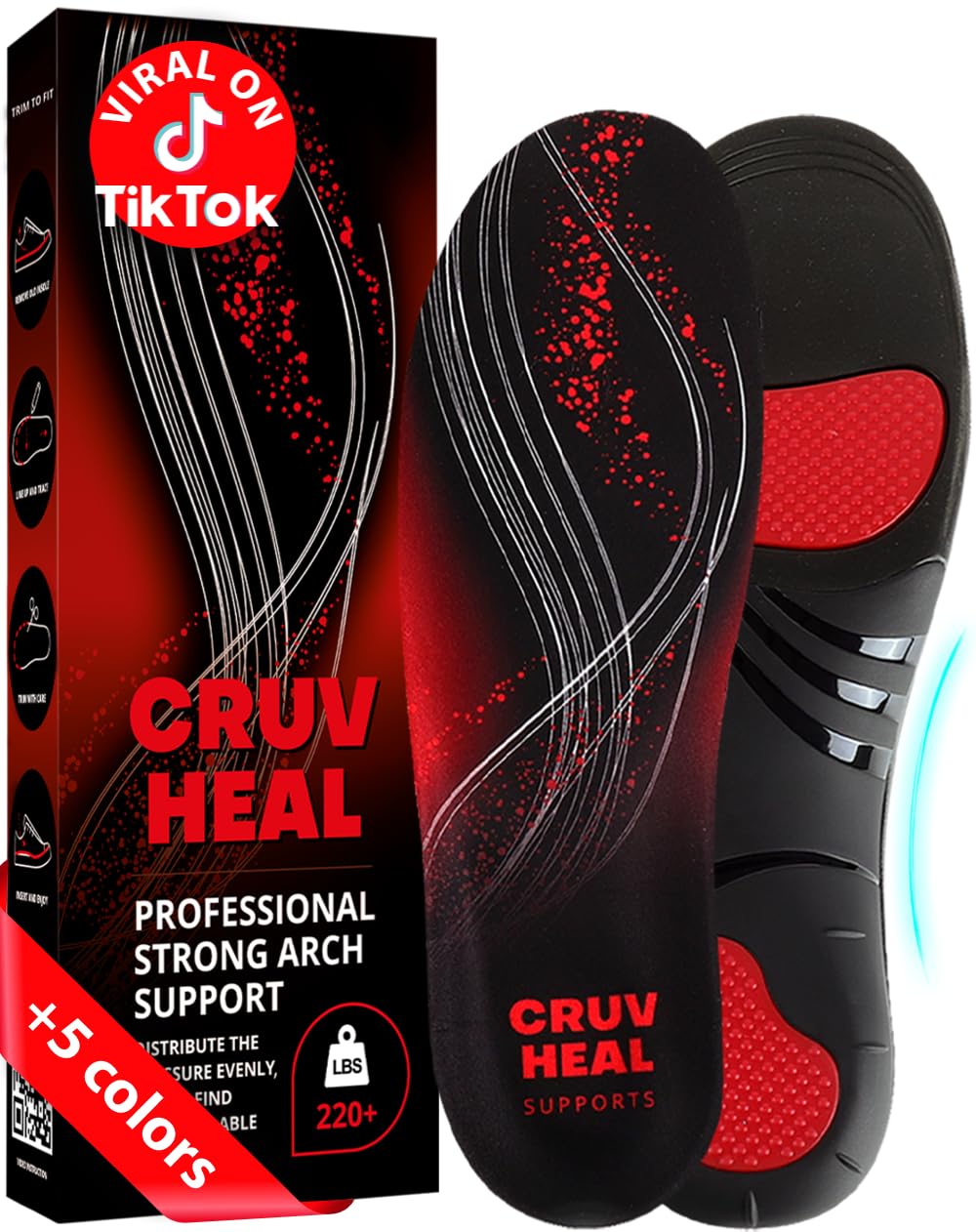
A 1.4-inch arch built to keep its shape under a 220-plus-pound frame
The CRUVHEAL is a high-arch orthotic with a 1.4-inch arch that spreads weight evenly and eases heel pressure, plus shock-absorbing gel pads under the heel for standing all day on hard surfaces. At 9.14 ounces it is the heaviest single insole here — that mass is the shell holding up under a heavy body. Order by the size chart and check the insole length against your boot, because fit is the thing to get right before use. Every pair comes with 1-year customer coverage, and the firm arch simply needs a few days to adapt to.
What it delivers is shift-length relief. A buyer near 250 pounds with plantar fasciitis said the insoles match the foot’s shape without changing how the shoe looks. A worker on 12-hour days with ankle, heel and Achilles pain found the discomfort barely noticeable after a few days. The honest caveat: the support focuses on the arch, so the outer edges of the insert feel far thinner than the middle.
Strongest case: heavy frames, 12-hour workdays and hard floors where a soft insole would flatten in a week.
The trade-off: one buyer described it as a thin rubber feel outside the arch — you are paying for arch structure, not padding everywhere.
Made for: people over 220 pounds who stand on concrete and want a firm arch that holds its shape.
Look elsewhere if: you want cushioning across the whole sole rather than a high arch.
9. VALSOLE Heavy Duty Support Pain Relief Orthotics

The deep-cup orthotic that nurses and shift workers wear for twelve hours straight
VALSOLE builds for long shifts on your feet, with a hard TPU arch (a stiff plastic support) that holds the foot and wraps the heel. A deep heel cup keeps the foot bone vertical, PU padding under the heel absorbs shock, and a no-smell breathable velvet top layer sits over thick OrthoLite cushioning. It serves all arch types — low, neutral and high — and it is designed for men and women over 220 pounds who want to stand all day. Twelve sizes cover most feet without trimming.
Nurses and other long-shift reviewers point out it holding up through 12 to 16 hours a day, with heel pain fading and the firm arch keeping its shape. Others with chronic pain across a wardrobe of shoes found it the fix. The recurring fit note is that the insole can be thick enough to loosen laces in a snug shoe, and a stiff break-in is expected — start at two to three hours a day.
A few owners find it hard rather than cushioned and want a thicker full-foot pad, so if your heel craves plush support this is not the one.
What earns its following
- Hard TPU arch plus deep heel cup keeps the foot vertical and stable all day
- Breathable velvet top and OrthoLite cushioning under a no-smell build
- Runs through 12-16 hour shifts for nurses, teachers and heavy foot traffic
Off-putting parts
- Thicker in a snug shoe, so you may need to loosen the laces
- Firm arch takes two to three hours a day to break in
- Value and firmness come in for mixed reports over long use
Closest fit for: the 12-hour shift worker who wants a deep cup and a hard arch from a single pair.
Not for: feet that want a soft, full-foot cushion without a stiff break-in.
10. Superfeet All-Purpose High Arch Support Insoles
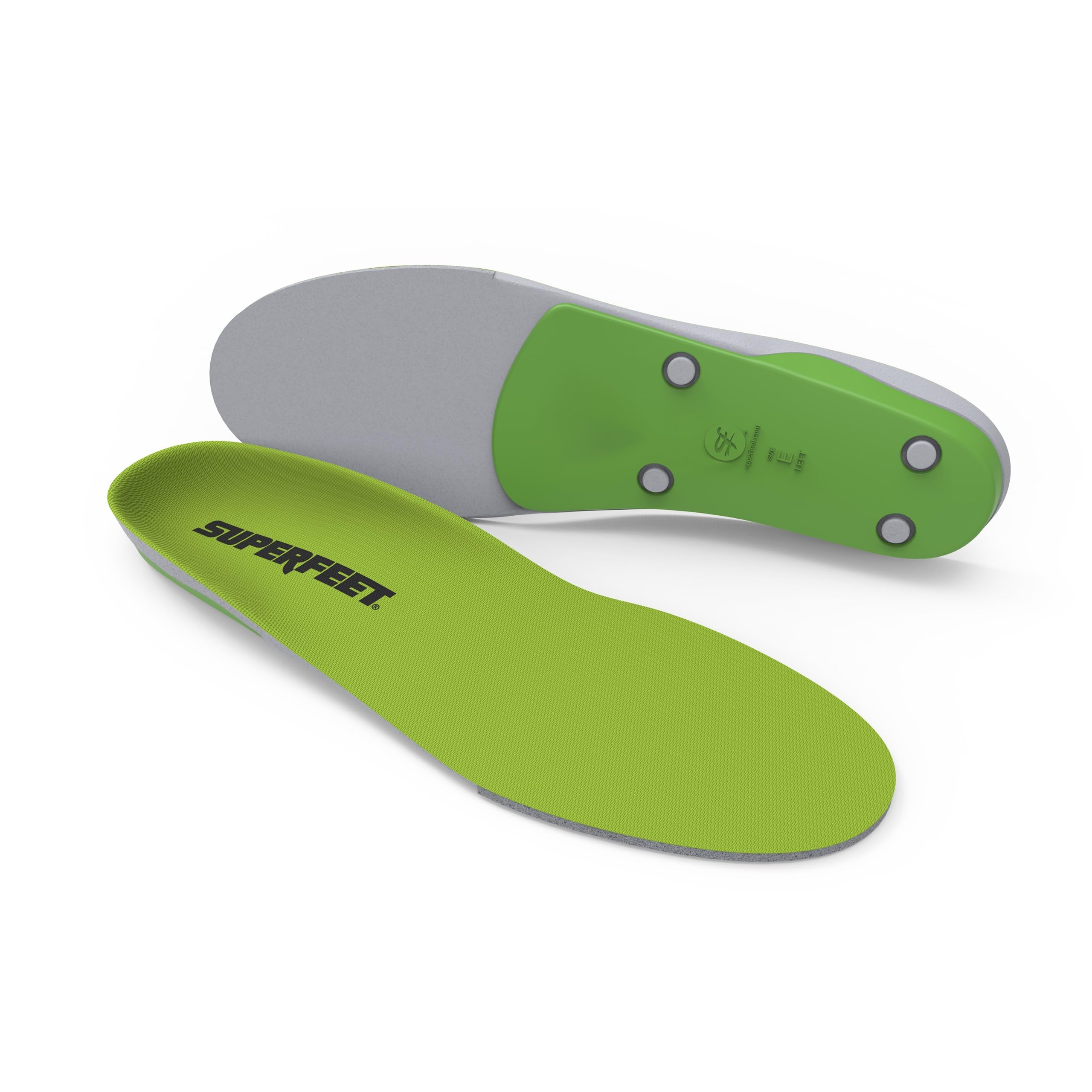
The high-profile, high-volume orthotic that flat feet keep coming back to
Superfeet’s Green insert earns its premium name with the widest and deepest heel cup in this lineup, which handles natural shock absorption. A stabilizer cap acts as the base that supports the rearfoot and gives the foam layer structure. The high profile shape stabilizes the foot and eases the load on feet, ankles and knees, while a closed-cell high-density foam layer cushions for the long run. At 4.48 ounces it stays light. This is a high-volume insert, so it takes up more shoe space than a slim gel pad — check the fit before you commit.
Owners who wear these for years say they hold up under frequent use and outlast store brands. The recurring trade-off is break-in: the dense foam feels hard at first and softens over a week or so. Fit is mixed — they work well in medium and wide shoes but can run long in a smaller shell, so order a half size down if you are between sizes.
What wins people over is the arch and its long-term durability. Those buying replacements every year or so get more consistent support with each pair.
What owns the decision: a high-profile shape with the widest and deepest heel cup in the lineup, built to stabilize the foot and support the rearfoot.
Where it needs care: the dense foam is firm on day one, and the high volume can crowd a slim shoe — this is not the insert for a tight budget or a tight shoe.
Think of it as: the durable long-term investment that fits medium and wide athletic shoes and rewards a patient break-in.
A costlier route if: you want something soft from step one or only wear slim shoes.
11. Natural Foot Orthotics Intermediate Stabilizer

A medium-soft 3/4 shell that reshapes all four arches without dictating every step
This podiatrist-designed 3/4 shell targets medium-height arches with a softer-flexible build, unlike the rigid plates above. The 3/4-length, 6.74-ounce shell is engineered to support all four arches of each foot and send weight evenly across the sole, taking pressure off the heel and forefoot. The design places the foot into a neutral position to ease plantar fasciitis, heel spurs, bunions and hammertoes, and the softer-flexible build is the one to start with if you are unsure. A one-to-two-week break-in is built in, starting at around two hours a day.
Owner experience is strong on the arch and it holds up over years. Buyers who had been told custom inserts were the only route compare these favorably, sometimes against clinician-priced pairs, and report walking quietly without the squeak of store brands. The mixed reports come from fit: some feet find them bulky in flats or low heels, with the heel slipping, and the shell can run long enough to dig in on the first pair.
For high arches, the maker points to the Original version rather than this Intermediate, so buy the version that matches your foot.
Best fit for: medium arches that want a podiatrist-designed, softer-flexible 3/4 orthotic and can give it a real break-in window.
Reward for patience: durable support that holds up in athletic and casual shoes, with a lifetime warranty and dishwasher-safe cleaning.
Know the Specs
Arch height and firmness
The single biggest lever is how high and how hard the arch plate is. A 1.4-inch arch or a 3.5cm EVA plate holds the foot up under weight; a shallow, soft gel insert just cushions. Higher arches suit neutral and high-arched feet; medium-height arches want the medium-soft Intermediate build; flat feet get used to a firm plate over a week.
Full-length versus 3/4-length
Full-length copies replace the shoe’s factory insole from heel to toe and can crowd the toe box. A 3/4 insert stops short of the toes, freeing space in tight sneakers and dress shoes and letting one pair move between shoes. Match the length to your shoe, because this decides whether the toenail takes the pressure instead of the arch.
Heel cushioning and depth
A deep heel cup cradles the heel to stop side-to-side wobble and reduces shock, while a gel or PU pad under the heel adds softness. The deepest cups in this list target heavy-weight users and 12-hour shifts. A shallow cup and thin pad suit people with mild heel pain who want less bulk.
Weight and volume
A light gel pad like the 2.4-ounce PROFOOT disappears into a shoe; a 9.14-ounce CRUVHEAL leaves less room. More weight usually means a stronger structural shell. The honest rule: if your shoe is already snug, lift out the factory insole before adding a thick insert, or you will feel the squeeze rather than the support.
Common Questions
Will an insole for heel pain also help arch pain?
How long does it take to get used to a firm insole?
Do I trim my insoles or order my exact shoe size?
Will a thick insole make my shoes too tight?
Should I pick a 3/4-length or full-length insole for dress shoes?
Are soft gel insoles or firm orthotics better for flat feet?
Do these insoles work in work boots and steel-toe boots?
How long will a pair last before I need a replacement?
Can I use insoles with sandals or open shoes?
Are insoles FSA or HSA eligible?
Is a high arch insole wrong for someone with medium arches?
The Bottom Line
For most people chasing relief from heel pain and a sagging arch, the PowerStep Pinnacle is the pick. Its dual-layer cushioning under a firm, contoured arch does both jobs at once, and it holds the strongest feedback record in this list at 4.5+ stars across 31,000+ ratings. If your shoes are slim and the toe box is the real constraint, the Airplus 3/4 orthotic gets support into dress shoes and heels. And if you carry a heavier frame through twelve-hour shifts, the VALSOLE Heavy Duty pairs a hard TPU arch with a deep heel cup built for that load.
Whichever you pick, give it the break-in window the maker asks for before you judge it — a week of short wear tells you more than the first afternoon.
How we choose
We do not accept paid placement. Every pick is matched to a real buyer and a real use-case; we do not hands-on test units.
Sources
Specifications: manufacturer listings and product documentation. Review insights: verified customer reviews, as of October 2026. Pricing: not shown on this page (it changes often); check the current price via the retailer link.
As an Amazon Associate, Aappliancez earns from qualifying purchases. This does not affect which products we feature.