Disclosure: Some links in this post are affiliate links. As an Amazon Associate I earn from qualifying purchases, at no extra cost to you. Learn more
Specs are compiled from manufacturer listings and verified buyer reviews and can change over time — please confirm the key details on the product page before buying.
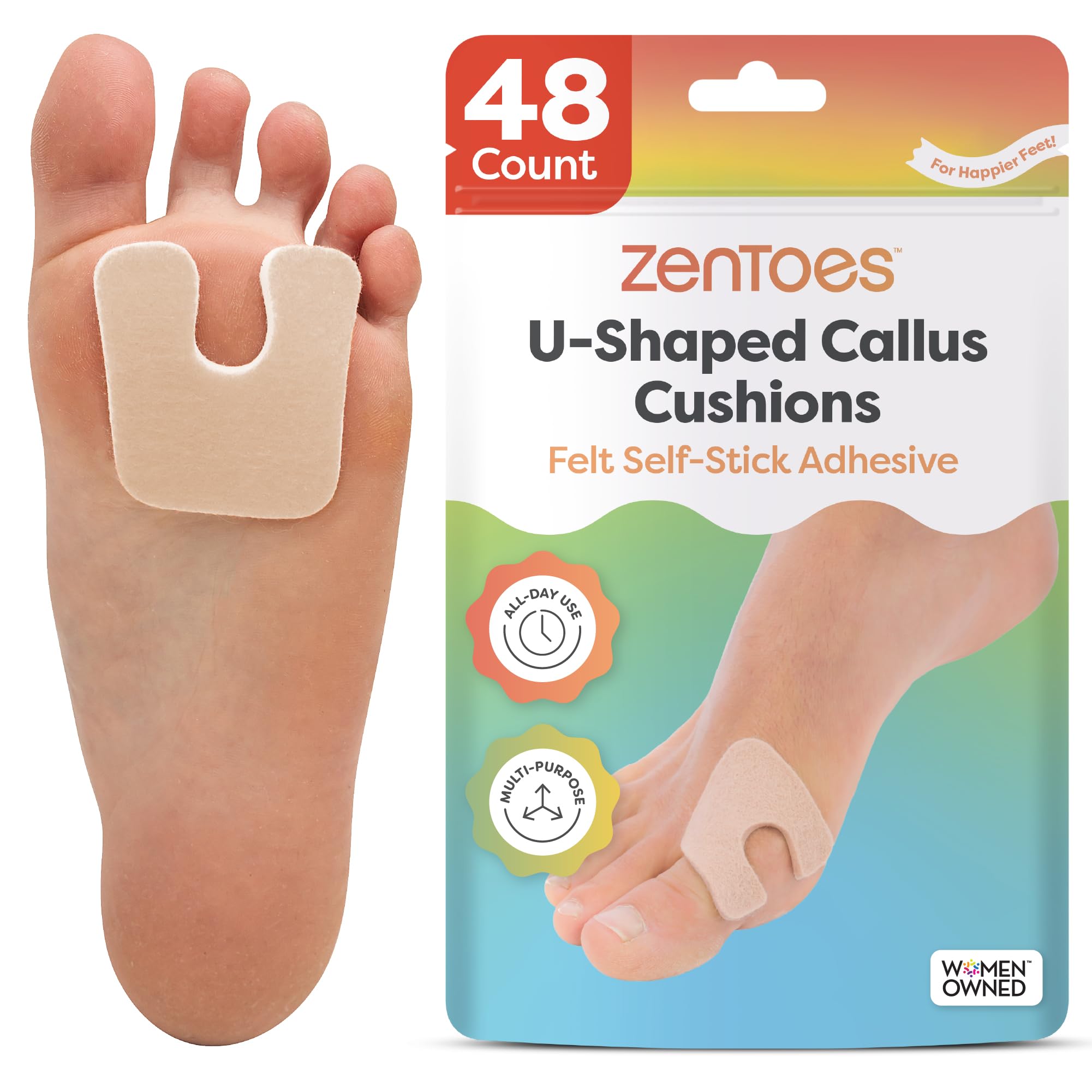
That hot, hard spot under your foot will not go away by changing shoes. You need a small pad that lifts pressure off that exact point before the shoe touches it. The five picks below each do that job a different way. The winner is the ZenToes U-Shaped Felt Callus Pads: a 48-count box of self-stick felt cushions rated 4.5+ stars by 6,000+ owners. It rings the sore spot with a 1/8″ felt horseshoe instead of pressing on it.
This guide is built by comparing the manufacturers’ published specifications and the patterns across verified customer reviews, so you get each pick’s real strengths and trade-offs instead of marketing spin.
Below you will see how felt rings and gel pads differ, and which shapes suit corns on top of toes versus calluses under the ball of the foot. You will also learn why a pad that lasts a full workday is not the same as one that survives a shower. That difference decides the right insoles for corns and calluses.
Top Picks

How To Choose The Best Insoles for Corns and Calluses
Buying the thickest pad you can find is the most common mistake. More cushion does not mean more relief on a corn. A corn is a hard cone of skin pressing on the bone underneath. So the goal is to take pressure off its center, not to pile soft material on top of it. That is why so many of these products are rings with a hole in the middle, not solid slabs.
Ring pads versus flat pads
To spare a sore spot, a ring pad surrounds it with a raised border. The hole in the middle is called a center aperture, and it lets the tender center sit in open space. That hole is the whole point. Dr. Jill’s cuts a removable center circle into each felt ring. Use it as a window over a corn, or leave it in as a plain cushion. If your corn sits on the top or side of a toe, a flat gel pad that wraps the whole toe often works better. There the pressure comes from the shoe rubbing sideways.
Thickness, in fraction-of-an-inch terms
Felt pads in this group run about 1/8″ thick. That is roughly the depth of two stacked coins, and it lifts a callus clear of the insole without making the shoe feel tight. Thickness is also the most common complaint line: a pad that is too thick for one person’s callus is exactly right for another’s. If you have room in your shoe, go thicker. If your shoes are snug, a thin gel pad like the PediFix slides in without changing the fit.
Adhesive life and the shower question
Self-stick pads are made to be peeled and pressed, not washed. Damp heat is their enemy: the adhesive softens and the felt curls up at the edges. Expect a sticky pad to last about a day of wear, and longer if you peel it off at night and let it dry flat. Want a pad you can leave in the shoe for a week? Look at the ones that hold themselves in place with no glue at all.
Side-by-Side Comparison
| Model | Best For | Pad Type | Count | Thickness | Amazon |
|---|---|---|---|---|---|
| ZenToes U-Shaped Felt Callus Pads★ Best Overall | Calluses and blisters under the foot | Self-stick felt U-ring | 48 | Approx. 1/8″ | Amazon |
| Profoot Multi Use Gel PaddingMost Versatile | Cut-to-shape relief anywhere on the foot | Self-stick soft gel sheet | Pack of 2 | 0.16″ | Amazon |
| Dr. Jill’s Felt Corn Pads | Corns on toes, long wear | Felt ring with removable center | 100 | 1/8″ | Amazon |
| PediFix Visco-GEL Corn Pads | Toes that rub inside snug shoes | Adhesive-free gel toe sleeve | 12 | Thin, flexible | Amazon |
| Customizable Corn & Callus Relief Insoles | Ball-of-foot and heel pressure | Full-length silicone and memory foam | 1 pair | 0.26″ | Amazon |
Detailed Reviews
1. ZenToes U-Shaped Felt Callus Pads
Our pick — 4.5+★ from 6,500+ verified ratings; the strongest balance of quality and price.
A horseshoe of felt that lifts the shoe off a sore spot and keeps it there through a shift.
The shape earns this box the top spot. The pad is a U, not a solid oval, so it fences off a tender spot and leaves the middle open. It measures about 1.9″ across the top, 1.7″ across the bottom, and 2″ tall. The interior width of roughly 0.6″ is wide enough to clear a decent-sized callus or blister without pinching it. Felt thickness holds at about 1/8″, enough lift to feel the difference the moment you stand up but not so much that your shoe goes tight.
Owners bring up one thing far more than anything else: the thing does its job. Buyers report a stubborn callus on the inside of the ball of the foot that had been painful for months finally going quiet. It stayed quiet through yoga, a full workday, and a dog walk, all in the same pair of pads. Another buyer with a cyst on the ball of the foot was back on the pickleball court the same day. The 48-count box is the quiet hero here: at 3.84 ounces it is a light, flat stack you can keep in a drawer, and you will not be rationing them.
The honest catch is water. These are sticky felt, and sticky felt does not like a hot shower. The edges soften and curl, and the pad has to come off. That is a fit note, not a fault: plan to peel them at night and press on a fresh one in the morning. A few people also find the 1/8″ felt a touch thick for their callus, particularly in tight dress shoes. If your shoes are already snug, take a thin gel pad instead.
Where The U-Shape Pays Off
- Open center means the sore spot stays free of pressure instead of being pressed on
- Roughly 1/8″ of felt lifts the callus clear of the insole without a tight-shoe feel
- Trim-to-fit felt takes a pair of scissors, so awkward spots are still covered
- 48 pads in one box means you can change them daily without thinking about it
What To Plan Around
- The adhesive gives up in a hot shower — plan to swap the pad after bathing
- Lotion under the pad weakens the hold, so apply to clean, dry skin
- A few find the felt too thick inside close-fitting dress shoes
Reach for this if: your sore spot sits under the ball of the foot or on the heel and you want a pad you can replace every morning without a second thought.
Look elsewhere if: you need a pad that survives showers and stays glued for days — a felt ring will not do that.
2. Profoot Multi Use Gel Padding
One soft gel sheet you cut yourself, so the pad fits the lump you actually have.
Instead of a pre-cut ring, you get a blank sheet of soft gel with a sticky back, and you decide the shape. Scissors turn it into a ring for a corn, a strip for a bunion edge, or a small square over a blister. The sheet is 0.16″ thick, thin enough to sit inside most footwear without changing how the shoe fits. The two-pack gives you a spare sheet for a second pair of shoes. It can stick to either the foot or the inside of the shoe, which matters if you would rather leave the pad in one shoe than wear it all day.
The gel is the soft, squishy kind that spreads pressure rather than blocking it. That suits a spot where the skin is threatened by rubbing against a seam or a strap. Profoot says chiropodists use the gel to cut pressure and rubbing. That flexibility is what makes it work in places a rigid felt pad cannot reach. It is the pick for someone whose sore spot moves around, or who has more than one problem area and does not want a separate product for each.
The trade-off is that you are the fitter. Cutting a clean ring takes a steady hand, and a ragged edge can roll under the finger. The good news is the sheet forgives a rough cut, because gel does not fray the way felt does. If you want to open a box and stick a pad on without measuring anything, the pre-shaped felt rings are the easier route.
The real advantage: 0.16″ of soft gel is slim enough to disappear inside a shoe. Sticking it to the shoe rather than the skin lets you build a permanent cushion point in one pair of work shoes.
Buy it knowing: it is a sheet, not a finished pad — the shape is your job, and a pair of sharp scissors is part of the process.
Who it beats: anyone juggling a bunion and a corn at once, since one sheet covers both.
Who it does not: buyers who want a ready-made ring from the start — this one asks you to cut it first.
3. Dr. Jill’s Felt Corn Pads with Center Aperture, 100 Count

A hundred felt rings with a pop-out center, built to ring a corn and hold through a long day.
100 rings decide this one: more than double the 48 in the ZenToes box, which means a fresh ring every day for months. The felt carries a 1/8″ thickness and a non-medicated, medical-grade build. The removable center circle is the clever part. Pop it out and the pad works as a window over a corn; leave it in and you have a plain cushion for a tender toe. The shape runs a little longer and squarer than a standard oval, which adds coverage on the top and side of a toe.
Owners mention the adhesive holds firmly enough to be peeled off at night and reused for up to three days. That stretches the 100 count even further. The felt does not slide under a sock and leaves no sticky residue behind. For corns on the toes specifically, this is the shape to beat: the ring surrounds the hard spot so every step lands on felt instead of on the corn itself. One 5-star buyer who is latex-sensitive switched to these because the felt build avoids the latex that aggravated the problem in other pads.
Nothing is perfect. The stick can give up sooner than you would like on a sweaty day, and one buyer wished the adhesive were stronger so the pad would stop shifting. It also will not survive a shower, so treat a pad as a one-day item and the box lasts a long time. If you need a pad that grips like glue for a week straight, this is not the one.
Best used on: a corn sitting on top of or beside a toe, where the long squarish felt shape covers more of the rubbing surface than a round pad.
Worth knowing: peel it off gently at night and the same ring can go back on for up to three days. That is how the 100 count turns into far more wears than it sounds.
The pick for: frequent corn sufferers who want a large supply of ready-made rings and a center that pops out for a true pressure window.
Think twice if: you need an adhesive that ignores sweat and damp — this felt holds well but not forever.
4. PediFix Visco-GEL Corn Pads 12/Pack S/M
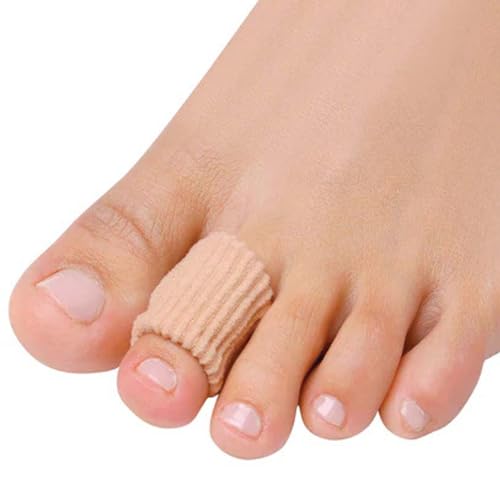
No glue, no peeling — a gel sleeve that wraps the whole toe and stays put by friction alone.
No glue is the whole idea here. The sleeve slips over the toe, the gel cushion lines the entire inside, and it holds itself in place through the natural grip of the sleeve. Every other pad here sticks to you; this one does not stick at all. At 0.8 ounces for the pack it is the lightest thing on this list and the least fussy to live with. The soft gel cushions a corn and takes the friction a shoe applies to the top and sides of a toe. That is the opposite pressure from a callus under the foot.
Buyers like the full wrap best. The gel goes all the way around the inside of the sleeve, so the sore spot is covered from every angle rather than one. It works well on a small toe that keeps rubbing against its neighbor, and it does not slip the way a plain cushion can. That makes it a strong match for a toe corn that flares up in one particular pair of shoes and settles when you change into something roomier.
The limitation is lifespan. Visco-GEL is soft by design, and soft gel stretches out of shape with use. Customers note the pads lose their shape and stop being reusable after a while, so the 12-pack is a supply you work through, not a box that lasts a season. A few also find the small/medium size is the wrong width for their toes, and one buyer found them more irritating than helpful over several hours of wear. Weigh fit and duration before you buy.
The reason to pick it: zero adhesive means nothing to curl in the shower and nothing to replace. Slide it off, let it dry, slide it on again.
The thing that ages: the soft gel gives up its shape over time, so treat this as a consumable sleeve rather than a long-term pad.
Suits you if: your corn is on a toe that rubs against a shoe or a neighboring toe, and glue-backed pads keep curling on you.
Not for you if: you want one purchase to last months — the gel goes soft and loses shape with repeated wear.
5. Customizable Corn & Callus Relief Insoles Small – Medium
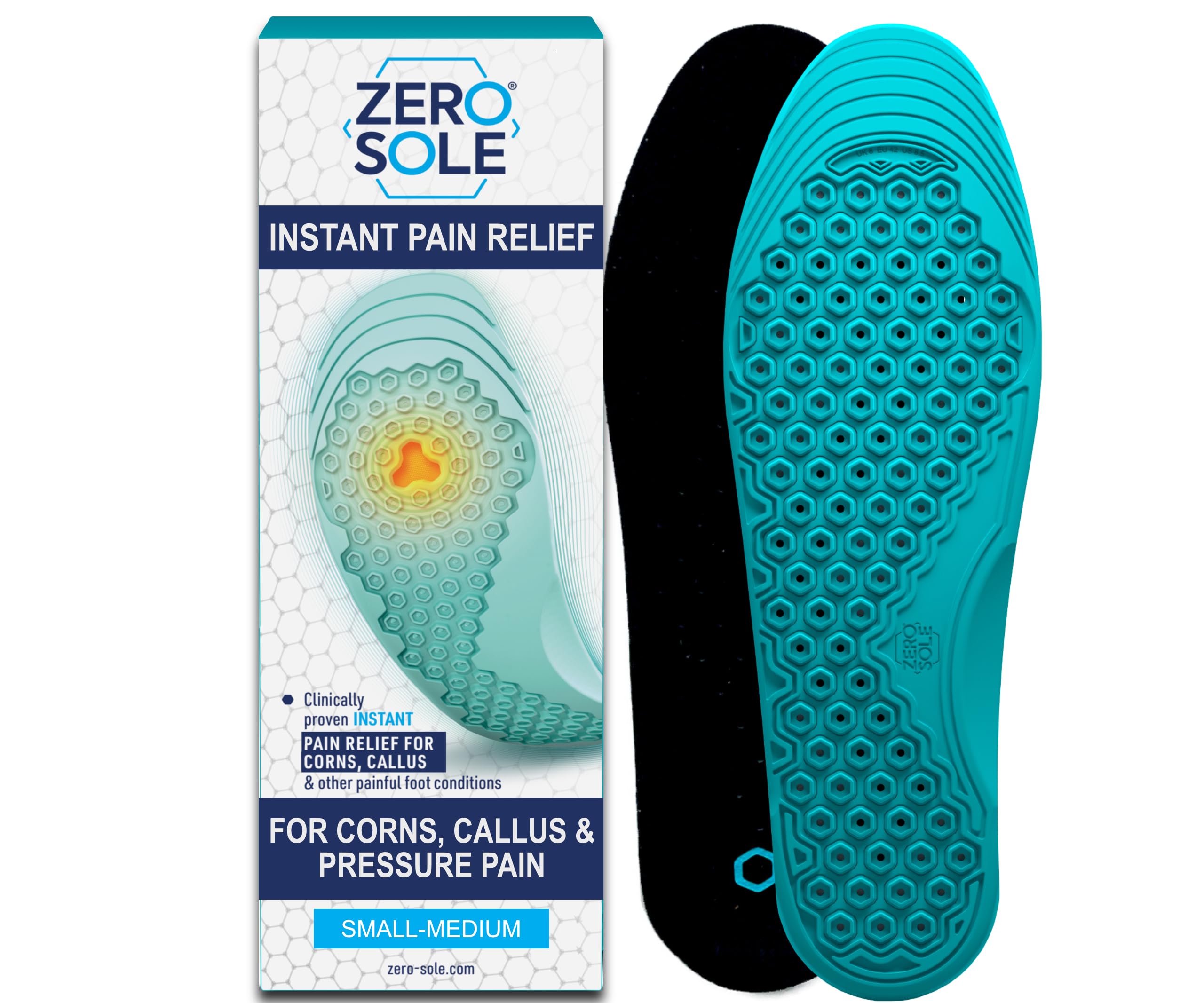
Instead of a pad over the sore spot, you pull a plug out and create a hole exactly under it.
Pulling a plug out is what sets this apart from every pad above. It is a full-length insole with a grid of hex-shaped (six-sided) plugs running through it. You find the spot that hurts, pop the plugs out from underneath, and now the insole has a zero-pressure well directly under your pain. The makers say UK podiatrists developed the design and Cardiff Metropolitan University tested it. The makers cite pressure mapping showing up to 30% less pressure at the pain sites. It is built from medical-grade silicone and soft memory foam, and the makers list 6-8 months of everyday comfort.
This insole is meant for a different problem than a toe corn. Ball-of-foot and heel pain, metatarsalgia (pain across the ball of the foot), and calluses that build up under a hard, flat sole all get addressed by removing the plugs where you need relief. It is billed as a chemical-free alternative to acid-based corn plasters. That matters if you have had a bad reaction to those in the past. Trimming to fit takes a pair of scissors, and the insole goes into sneakers, work boots, trainers, and casual shoes. Buyers who stand all day try it precisely because it addresses the cause of the pressure, not just the sore spot. One is a dog groomer who is on her feet for hours.
The honest part: it is the most expensive pick here. It takes a little adjusting to get the plug map right, and relief is not instant for everyone. Some wearers find it makes little difference to a stubborn callus, and comfort builds over a few wears as the foam beds down. Size Small-Medium covers US 5-8, so anyone with a larger foot needs a different size range. For a callus directly under the ball of the foot and a budget to match, though, the customizable well is a genuinely different approach to the problem.
What Makes This Different
- Removable hex plugs let you build a zero-pressure well exactly under the sore spot
- Makers cite pressure mapping showing up to 30% less pressure at the pain sites
- Medical-grade silicone and memory foam, listed for 6-8 months of everyday use
- No chemicals, no acids, and no adhesive to replace daily
- Trim-to-fit length runs into sneakers, work boots, and casual shoes
Where It Falls Short
- The custom fit takes some trial and error with the plug layout
- Small-Medium covers US 5-8 only, so larger feet need a different range
- A few wearers find little change to an established callus
Pick this one when: your callus sits under the ball of the foot or your heel, and you would rather shape the insole to your foot than stick a pad on it every morning.
Pass on it when: your problem is a corn on a toe — this insole covers the sole, not the toe.
Know the Specs
Felt rings and the center aperture
A felt ring is a flat disc of dense wool-blend felt with a hole in the middle, and the hole does the work. Pressure from your shoe lands on the felt border instead of the sore spot inside it, so the corn or callus sits in open space. Felt is firm, so it keeps its shape against a shoe. It can also be trimmed with scissors for an awkward spot. It is the material most likely to soften in a hot shower. A center aperture that pops out, like the one on Dr. Jill’s, lets one pad serve as either a ring or a plain cushion.
Gel versus silicone for pressure
Gel is soft and spreads force over a wider area instead of blocking it. That is why it suits a spot that rubs against a seam or a strap. It comes as a cut-to-shape sheet, a toe sleeve, or a full-length insole. Silicone mixed with memory foam, as in the customizable insole, is firmer and holds a shaped well where a plug has been removed. Neither material is universally better. Gel forgives a rough cut and hugs a curve, felt holds a firm border, and silicone-plus-foam can be shaped to a whole foot. The right choice depends on what your sore spot needs: a protective ring above it, a soft wrap around it, or a hole underneath it.
Common Questions
Should I use a ring pad or a flat pad on a corn?
How long does a self-stick felt pad actually stay on?
Can I wear these pads inside tight dress shoes?
Will corn pads help a callus under the ball of my foot?
What is the difference between a toe corn pad and a full-length insole?
Do these pads contain latex?
Can I cut a corn pad to fit an awkward spot?
How often should I replace corn and callus padding?
Will a pad fit inside a work boot or trainer?
Do corn pads replace seeing a professional about a corn?
The Bottom Line
The winner of this list is the ZenToes U-Shaped Felt Callus Pads. Its open horseshoe shape takes pressure off the sore spot instead of pressing on it. The roughly 1/8″ felt is thick enough to feel without crowding the shoe, and the 48-count box means you can change a pad every day without rationing. It is also the highest-rated pick here at 4.5+ stars across 6,000+ owners, which is a reassuring cushion for a product you wear against your skin. If your corn is on a toe rather than the sole, grab the Dr. Jill’s Felt Corn Pads — 100 rings with a pop-out center beats every other supply here. And if the pain sits under the ball of the foot or the heel, the Customizable Corn & Callus Relief Insoles are the one to reach for. Pulling a plug out creates a true zero-pressure well under the sore spot.
One note before you choose: any felt or gel pad is a daily consumable. The moment the adhesive slackens, the pad slides and rubs harder than no pad at all. Buy the box that gives you enough spares to swap on demand, keep your skin clean and dry before you press one on, and your feet will do the rest.
How we choose
We do not accept paid placement. Every pick is matched to a real buyer and a real use-case; we do not hands-on test units.
Sources
Specifications: manufacturer listings and product documentation. Review insights: verified customer reviews, as of October 2026. Pricing: not shown on this page (it changes often); check the current price via the retailer link.
As an Amazon Associate, Aappliancez earns from qualifying purchases. This does not affect which products we feature.