Disclosure: Some links in this post are affiliate links. As an Amazon Associate I earn from qualifying purchases, at no extra cost to you. Learn more
Specs are compiled from manufacturer listings and verified buyer reviews and can change over time — please confirm the key details on the product page before buying.
If your arch collapses and a bunion rubs the side of every shoe you own, the fix is a support insole that lifts your midfoot without crowding your toes. The short list below covers five insoles built for exactly that — flat feet, high arches, and the wide forefoot that comes with a bunion. The winner is the OUOKK Arch Support Insert, a 3/4-length insole with three swappable arch heights so you can dial in support instead of guessing.
This guide is built by comparing the manufacturers’ published specifications and the patterns across verified customer reviews, so you get each pick’s real strengths and trade-offs instead of marketing spin.
You will see which picks are cut short to spare a bunion, which ones need trimming, and which stand up to a full shift on concrete. Read on for the honest breakdown of the insoles for bunions and flat feet that actually hold up under daily wear.
Top Picks
How To Choose The Best Insoles for Bunions and Flat Feet
Two problems pull in opposite directions. Flat feet need a firm, raised arch to stop the midfoot from rolling inward. A bunion needs empty space at the big-toe joint, so nothing presses on the bump. A good insole solves both at once, and the way it does that is mostly about length and arch shape.
Length decides whether your bunion gets room
A 3/4-length insole stops under the ball of your foot instead of running to the toes. That leaves the front of the shoe free, so your bunion is not squeezed against a slab of plastic or foam. It also means you can move the same pair between shoes without trimming. Full-length insoles cover more of the foot but take up toe-box space, which is the last thing a bunion wants.
Match the arch height to your own foot
A flat foot does not want the same arch as a high one. Insoles with a fixed arch either fit or they do not. A model that ships with several arch heights lets you pick the one that fills the gap under your midfoot without pushing your foot sideways. If you are unsure of your arch type, check it before you buy — a wet footprint on cardboard shows whether you have a low, medium, or high arch.
Look at the weight rating and heel cup
Heavy-duty orthotics often list a body-weight rating, such as over 220 lbs, because a heavier body presses harder on the arch. That rating tells you how firm the support really is. A deep U-shaped heel cup matters too, because it holds the heel upright and stops the inward roll that flat feet tend to produce. Both features work together: the arch holds the middle of the foot, and the heel cup keeps the back of it steady.
Side-by-Side Comparison
| Model | Best For | Length | Arch Height | Weight | Amazon |
|---|---|---|---|---|---|
| OUOKK Arch Support Inserts★ Best Overall | Dialing in your arch | 3/4 length | 24 mm, 3 heights | 2.89 ounces | Amazon |
| Psveb Professional Heavy DutyHeaviest Duty | Heavy bodies, work boots | Full length | Ergonomic, three-point support | 5.93 ounces | Amazon |
| DynWalker Arch Support Insoles | Flat feet on hard floors | Full length | Approx. 4 cm 3D arch | 2.12 ounces | Amazon |
| Copper Fit Arch Relief Orthotics | Dress and work shoes | Trim-to-fit | Adaptive, medium arch | 4.7 ounces | Amazon |
| VALSOLE Heavy Duty Orthotics | Long shifts, 220+ lbs | Full length | High arch, hard TPU | — | Amazon |
Detailed Reviews
1. OUOKK Arch Support Inserts
Our pick — 4.0+★ from 350+ verified ratings; the strongest balance of quality and price.
Three arch heights you swap yourself — the insole that adapts instead of guessing your foot.
Here is the number that matters for a bunion: this insole stops at 3/4 length. That means it ends before your toes, so the front of the shoe stays open and the bump on your big-toe joint is not pressed against anything. It sits in the shoe like a shoe, not like a slab, and the low-profile edges are thin enough that it saves space.
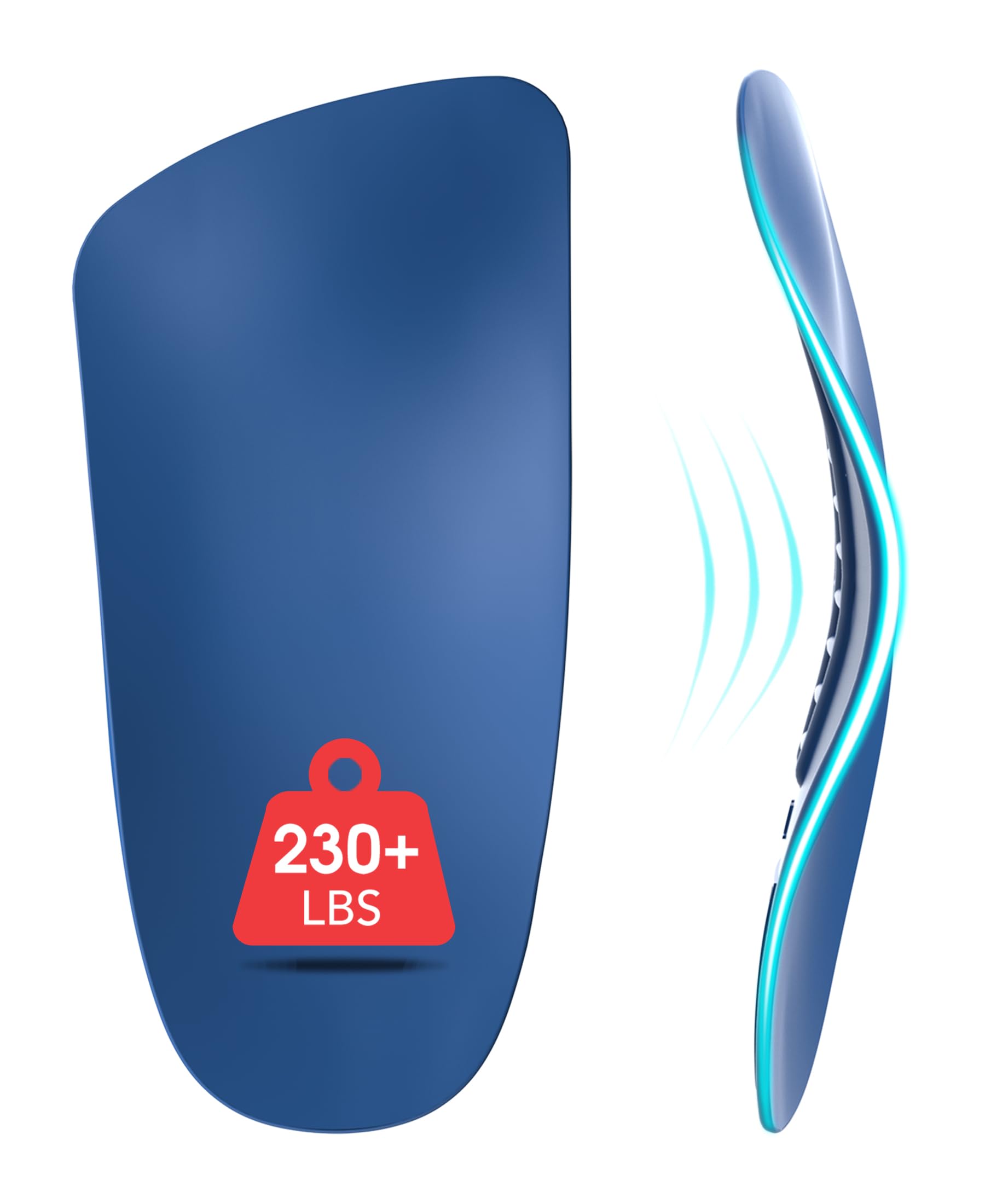
The arch itself is 24 mm tall, and you get three separate height options for different arch types. A flat foot can step up to a taller arch; a high arch can take the lower one. The 3/4 design also means no trimming — you slide it in and go, and the same pair moves between shoes in seconds. It is rated for heavy-duty support over 230 lbs, so the TPU arch is built to stay firm under a real body rather than mush down after a week.
What wins people over is how well it holds up as an everyday insole without feeling bulky. The comfort is consistent across long standing and walking, the cushioning stays put, and the arch does not sag. The one honest catch comes up in fitting, not in support: a few buyers with narrower feet find the medium size sits loose and shifts out of alignment, so check your size carefully against the listed range before you commit.
Where it earns its place
- 3/4 length leaves the toe box clear, so a bunion is not squeezed
- Three arch heights let a flat or high arch get a true fit
- 24 mm arch rated over 230 lbs keeps support firm
- No trimming needed — swap it between shoes in seconds
The fit note worth knowing
- Narrower feet can find the medium size sits loose and shifts
- 3/4 length means no cushioning under the toes
Worth it for: anyone with a bunion who wants arch support without giving up toe room, in most everyday shoes.
Double-check first: measure your foot against the size range — this is a fit-sensitive insole, not a one-size trim job.
2. Heavy Duty Support Orthotics
Built like a boot sole for heavier bodies — this one is dense, and it wants a roomy shoe.
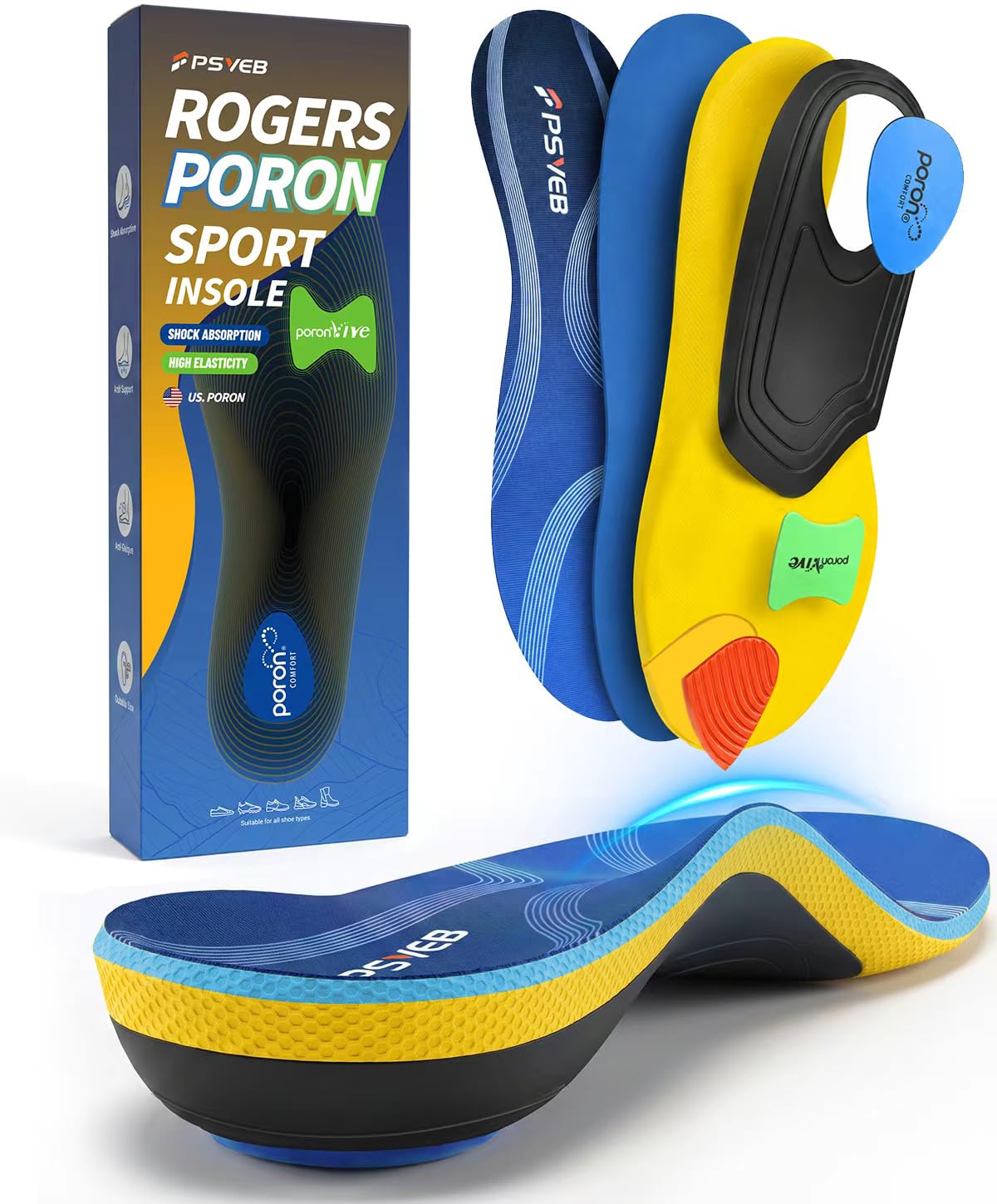
At 5.93 ounces this is nearly three times the weight of the DynWalker below, and that mass is the point. It is a full-length insole with a full PU layer and double PORON cushioning, an open-cell foam that springs back under repeated impact. The result is a firm, stable platform under a heavier foot — the kind of support that does not fold under pressure after a few hours.
The ergonomic “Golden Triangle” design puts support at three points: the forefoot, the arch, and the heel. A deep U-shaped heel cup wraps the back of the foot so it does not slip sideways while you walk or run. There is no cutting required, which makes it ready for work boots and tennis shoes straight from the pack. Most of the praise lands on the quality and comfort of the build, and the stability in the heel stands out on long days.
The honest trade-off is thickness. Some buyers find it chunkier than expected, and one heavier reviewer noted that after several hours of walking the feet felt the soles of the shoes again — a hint that this works best with a little extra room up top. If your boots are snug, loosening the laces gives the insert the space it needs to do its job.
Built for body weight: rated for over 230 lbs, with a firm base and a heel cup that holds the foot steady — a solid match for work boots and long days on hard ground.
Mind the bulk: the same density that gives support also eats shoe space, so pair it with footwear that has room to spare.
Reach for this if: you carry extra weight and want a firm, stable insole for boots or sneakers, and your shoes have room for a thicker insert.
Look elsewhere if: you wear slim shoes or want something light underfoot — the 5.93-ounce build is notably heavier than the short-length options.
3. DynWalker Arch Support Insoles M
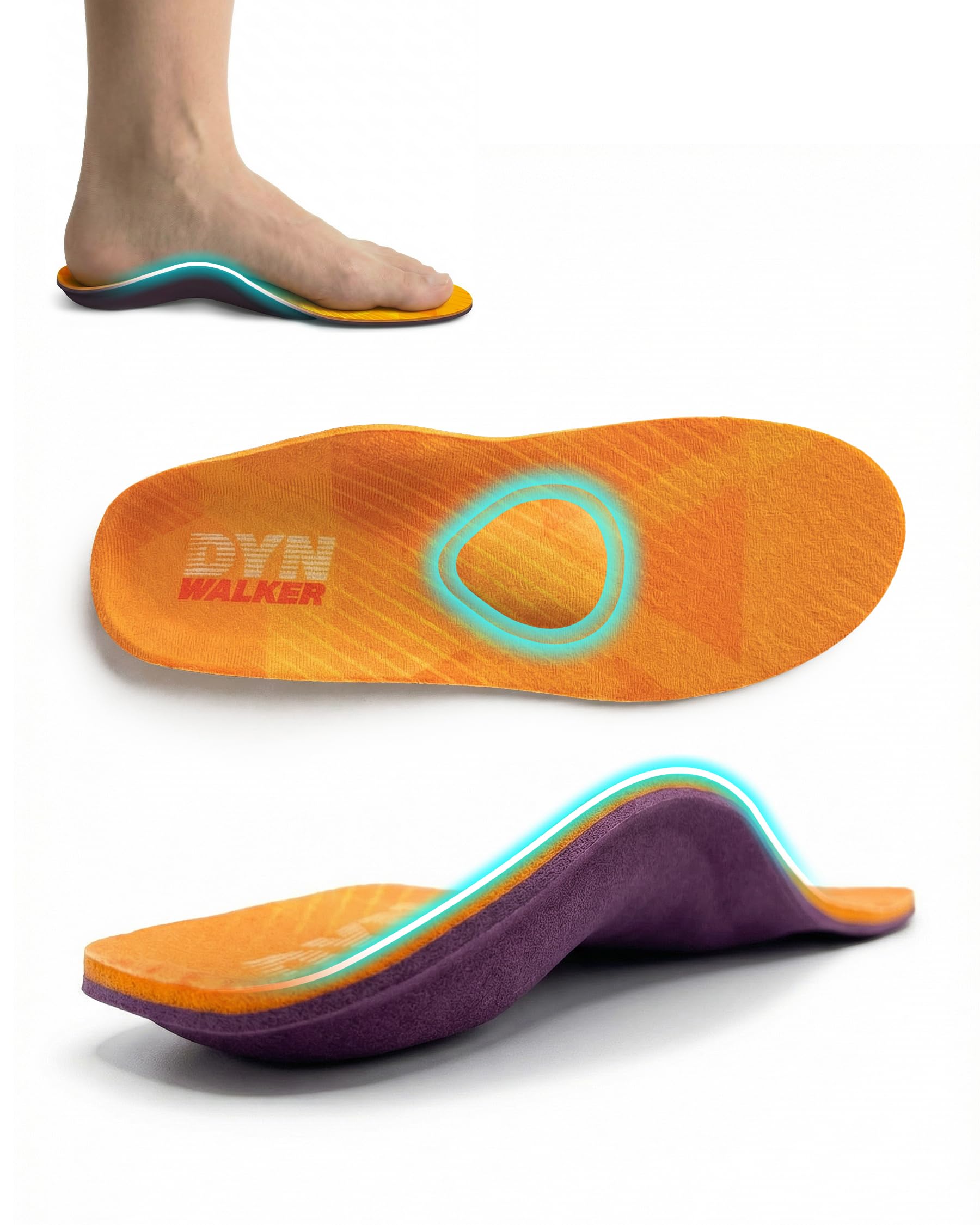
The lights-out option — 2.12 ounces of layered foam that soften hard floors under a flat foot.
Weighing 2.12 ounces, this is the lightest full-length insole on the list, and it is built for the person who stands on tile or concrete all day. The approximately 4 cm 3D arch sits closely under the foot to spread pressure, and the multi-layer build stacks high-density TPU, memory foam, and high-resilience EVA to soak up impact from heel to forefoot. That means the shoe feels softer on the first step, not just supported.
A deep U-shaped heel cup wraps the back of the heel to cut slipping and wobbling, and it is aimed squarely at feet that roll inward — the common pattern with flat feet. Breathable materials keep the foot from getting stuffy during long wear, and a latex forefoot pad eases the pressure a bunion-prone foot can feel near the ball. It works in sneakers, work shoes, and boots, so it moves with you across a normal week.
The catch sits in the arch. Support here rates mixed in the feedback, and a few buyers find the arch height falls short of what a very high instep or a strong flat-foot collapse needs. It also gives up some durability over a long year of daily wear. Treat it as a comfort-first insole for moderate support, not the firmest brace in the lineup.
The comfort read: the softest, lightest ride here, with a 4 cm arch and layered foam that take the sting out of hard floors and long standing shifts.
The honest limit: arch support is softer and more moderate than the heavy-duty picks, so a strong flat-foot collapse may need more lift.
Best match: a flat-footed nurse, server, or warehouse worker who wants cushioning over hard floors for a full shift.
Think twice if: you need maximum firm arch lift or expect a single pair to last more than a season of hard daily use.
4. Copper Fit Arch Relief Orthotics
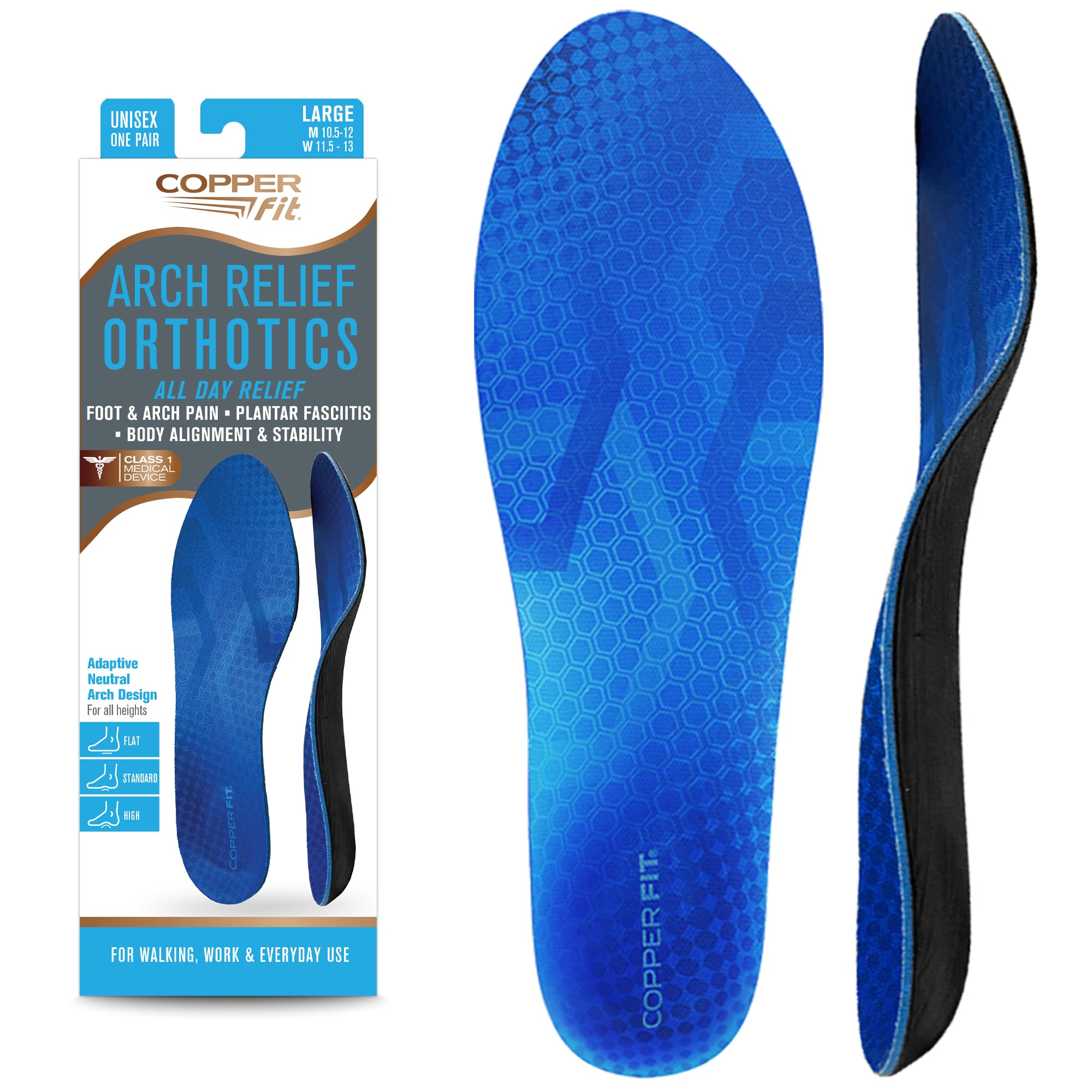
Slips into slim dress and work shoes, then trims to fit — the low-profile option for a bunion-friendly shoe.
This is the pick for the shoe you cannot swap out. It is a low-profile insole with adaptive arch support that adjusts to the shape of your foot, aimed at flat, medium, and high arches alike. Memory foam and a shock-absorbing heel pad take the hard edge off each step, and a stabilizing heel cup helps hold the foot in its proper position through the whole stride.
The trim-to-fit design is the real selling point for a bunion. You cut it to your shoe’s outline, so it works inside dress shoes, casual shoes, and work shoes where a full-length slab would crowd the toes. A layer of cushion sits under the foot to cut fatigue on all-day wear. The maker also suggests a short break-in: a few hours a day for the first couple of days before you wear them full time.
The honest caveat is stiffness. Some buyers find the arch support firm rather than cuddly — one described the feel as stiff as a board — and a couple report the cushioning runs warm underfoot. It is a firmer, more structured ride than the soft DynWalker, so if you want a plush, pillowy insole this is not that. It is the one that fits a dress shoe and stays put.
What fits and works
- Low profile sits inside dress, casual, and work shoes
- Trim-to-fit shape lets you spare room at the toes
- Stabilizing heel cup helps hold foot alignment
- Memory foam and a heel pad soften each step
Where it may not suit you
- Firm, structured feel — not plush cushioning
- Needs a short break-in before full-day wear
Suit yourself with: a shoe you cannot change — dress shoes, loafers, or a snug work pair that needs a slim, trim-to-fit insert.
Pass by if: you want a plush pillow underfoot or a firm high-arch brace; the adaptive arch here is medium, not maximum.
5. VALSOLE Heavy Duty Support Pain Relief Orthotics – 220+ lbs

The crowd favorite — a hard TPU arch for heavier bodies that want firm support, not squish.
Designed for men and women over 220 pounds, this is the firmest insole on the list. A hard TPU arch plate supports the midfoot and wraps into the heel, while a PU heel pad absorbs impact and a thick Ortholite layer adds cushion up top. The idea is to spread the load of a heavier body across the whole foot so each step presses less on the heel and arch.
The material build is deliberate: a non-slip breathable velvet cover, a cushioning Ortholite layer, and an extra-stable EVA layer under that. A deep heel cup keeps the foot bone upright and adds side-to-side stability. It fits casual shoes, sneakers, and wide work boots, and it comes in pre-cut sizes so you can usually skip the trimming. The maker recommends easing in — a couple of hours a day to start, then build up.
The recurring gripe is how hard it feels. Firmness and fit rate mixed in the feedback, and the stiff arch can press uncomfortably if your foot is used to soft foam. A buyer with a strong foot issue may find it takes real getting used to, and a slightly thinner foot can feel the toes crowd once the insert adds height. Those who stick with it tend to prize the firm, stable base that holds up under long shifts.
Why it leads the pack: a hard TPU arch and a deep heel cup make it the sturdiest choice for heavier foot support, and its popularity reflects how many people it suits.
The firmness trade: this is not a soft insole — the rigid arch takes adapting to, and a narrow foot can feel the extra height squeeze the toes.
Right for you if: you are a heavier walker or on your feet for long shifts and want a firm, structured arch that holds up under pressure.
skip it if: you want a soft, pillow-like insole or have a narrow forefoot that cannot spare toe-box room.
Know the Specs
Arch Height
Arch height is how far the insole lifts your midfoot, often listed in millimeters or centimeters. A flat foot needs enough lift to fill the gap under the arch so the foot does not roll inward. A model with only one arch height either fits your foot or it does not, while a swappable or adjustable arch lets you match the lift to your own instep. Too low and a flat foot keeps collapsing; too high and a high arch gets pushed sideways.
Insole Length
Length decides how much of the shoe the insole takes up. A 3/4-length insole stops before the toes, leaving the toe box open — a real advantage when a bunion needs room. A full-length insole covers the whole footbed and usually needs a roomier shoe or some trimming. A trim-to-fit design lands in between: you cut it to your shoe’s outline to free up space at the front.
Weight Rating
Heavy-duty orthotics list a body-weight rating, such as over 220 lbs or over 230 lbs, because a heavier body presses harder on the arch. The rating tells you how firm and durable the support is meant to be. A heavier walker gets more arch support from an insole rated for their weight than from a soft foam insert that flattens under load.
Heel Cup Depth
The heel cup is the bowl-shaped back of the insole that cradles your heel. A deep U-shaped heel cup cradles the heel so it does not slip side to side, and helps hold a flat foot from rolling inward as you walk. That heel-cup stability reduces the side-to-side sway that can tire the whole leg over a long day.
Common Questions
Will a 3/4-length insole really help a bunion?
How do I know if I have flat feet or high arches?
Do these insoles require trimming to fit my shoes?
Can I wear these if I am over 220 pounds?
How long should insoles last with daily wear?
Should I wear the insoles all day right away?
Which insole is best for plantar fasciitis?
How do I keep the insoles from sliding inside my shoes?
Can I move the insoles between different shoes?
The Bottom Line
For most people buying the insoles for bunions and flat feet, the OUOKK Arch Support Insert is the one to start with. Its 3/4 length protects a bunion by leaving the toe box clear, and its three arch heights mean you dial in support instead of hoping one size fits. If you carry extra weight and wear boots, the firm Psveb is your heavier-duty match. And for slim dress shoes that cannot take a full insert, the trim-to-fit Copper Fit is the one to reach for. Check your size carefully on any of them — the arch does the work only when the insole sits still.
How we choose
We do not accept paid placement. Every pick is matched to a real buyer and a real use-case; we do not hands-on test units.
Sources
Specifications: manufacturer listings and product documentation. Review insights: verified customer reviews, as of October 2026. Pricing: not shown on this page (it changes often); check the current price via the retailer link.
As an Amazon Associate, Aappliancez earns from qualifying purchases. This does not affect which products we feature.