Disclosure: Some links in this post are affiliate links. As an Amazon Associate I earn from qualifying purchases, at no extra cost to you. Learn more
Specs are compiled from manufacturer listings and verified buyer reviews and can change over time — please confirm the key details on the product page before buying.
If your ankles roll inward when you walk or run, the fix is not a softer insole — it is a firmer one with a deep heel cup and real arch height. That is the whole answer in one line, and every pick below is here because it does that specific job. The list swings from a custom-fit insert you can match to your own arch and body weight, to rigid motion-control shells built for overpronation, to a moldable pair you heat in your own oven. You will see exactly which one suits your foot shape, your shoes, and how many hours you spend on your feet.
This guide is built by comparing the manufacturers’ published specifications and the patterns across verified customer reviews, so you get each pick’s real strengths and trade-offs instead of marketing spin.
Pronation is normal until it goes too far, and then the wrong insert can make it worse. Below you get the arch heights, heel-cup depths, and materials that actually control the inward roll, plus the honest fit limits of each pair. The right pick among these inserts for pronation can steady your whole stride, from the heel strike to the toe-off.
Top Picks


How To Choose The Best Inserts for Pronation
Overpronation means your foot rolls too far inward on each step, and the arch collapses toward the ground. The job of an insert is to stop that collapse early — at the heel and midfoot — before the roll travels up into your knees and lower back. Two specs do most of that work: how deep the heel cup sits and how firm the arch shell is. Everything else is comfort tuning.
Depth of the heel cup holds the foot first
A deep heel cup (the raised bowl around your heel) catches the back of your foot and keeps it centered as you land. A shallow cup lets the heel drift inward, and the arch follows. Look for wording like “deep U heel cup” or “deep heel-cup” if controlling the inward roll is your main goal — several picks here list it outright.
Firm shell versus soft cushion
A rigid or semi-rigid shell resists the roll, while a gel or foam-only insole flattens under your weight and does little to stop it. Firmer inserts often need a break-in period — one to two hours a day at first is common advice. Soft, cushioned inserts suit low arches and long standing shifts better than heavy correction.
Arch height has to match your foot
An insert built for a high arch will feel like a lump under a flat foot, and a low-arch insert will not touch a high instep. Match it to your own arch, and if you are between sizes, size up and trim down where the maker allows it. A 3/4-length insert stops before the toes, so it fits shoes where the factory insole is glued in and cannot be removed.
Side-by-Side Comparison
| Model | Best For | Length Style | Arch / Support | Weight | Amazon |
|---|---|---|---|---|---|
| Dr. Scholl’s Custom Fit CF 110★ Best Overall | Custom-fit correction | 3/4 length | Custom 3D arch, 3-layer | 4.94 ounces | Amazon |
| Tread Labs Pace Extra HighHigh-Arch Pick | Very high arches | Full length | Extra high, deep heel cup | 8 ounces | Amazon |
| Dr. Scholl’s Custom Fit CF320Most Popular | Total lower-body relief | 3/4 length | Adaptive 3D arch, triple layer | 5.93 ounces | Amazon |
| Plantar Fasciitis 3/4 Insoles | Firm overpronation control | 3/4 length | 3.5cm high, deep U heel cup | 3.53 ounces | Amazon |
| Redi-Thotics Flex | Everyday arch cradle | Full length | Plastiflex shell | — | Amazon |
| SOLE Active Thick | Heat-moldable fit | Full length | Custom moldable, any arch | 4.8 ounces | Amazon |
| PowerStep Pulse Maxx | Running correction | Full length | Rigid shell, angled heel | 4.97 ounces | Amazon |
| Superfeet Run Cushion | Flat feet on the run | Full length | Low arch, medium heel cup | 5.28 ounces | Amazon |
| Superfeet Hike Women’s | Trail and long hikes | Full length | Medium-high, carbon fiber blend | 4.8 ounces | Amazon |
| Protalus T-100 Elite | All-day alignment | Full length | Deep heel-cup, universal | 6 ounces | Amazon |
| MOVE Game Day Pro | Court and field sports | Full length | High arch, X-Frame support | 3.53 ounces | Amazon |
Detailed Reviews
1. Dr. Scholl’s Custom Fit Orthotics 3/4 Length Inserts, CF 110
Our pick — 4.5+★ from 850+ verified ratings; the strongest balance of quality and price.
The one that reads your arch, weight, and shoe size before it does anything else — the crowd favorite at 4.5+ stars across 800+ owners.
This is the pick that gets its shape from you rather than a shelf. The CF 110 is tuned at the in-store kiosk to your arch type, body weight, and shoe size, which is exactly what a pronating foot needs — correction built around your own collapse pattern instead of a one-size guess. Three layers do the work: a soft top cloth against your foot, cushioning underneath, and a custom 3D arch support (a shaped shelf that props the arch up) that stabilizes the foot before it rolls inward.
The 3/4 length is the quiet win for pronation. It stops before the toes, so it drops into shoes where the factory insole is glued in, and it moves from shoe to shoe without trimming. For a 74-year-old owner walking cobblestones, hills, and stairs all day in Germany, the result was no sore feet and no body aches — though they note it needs a supportive shoe to work. A nurse on her feet all day wore hers for a decade after a plantar fasciitis diagnosis, and a 118-lb buyer finds the CF 110 fits cleanly.
The honest tension is durability and value. The same firm support that controls pronation is also the part that wears — one buyer reports a hole in the heel and peeling lining after a few months in house slippers, even though an earlier identical pair held up for roughly four years. That is a fair caveat, not a dealbreaker, since the comfort and effectiveness are what most owners come back for. Expect to treat the top layer kindly and replace when the arch starts to flatten.
What earns its spot
- Custom fit to your arch, weight, and shoe size — correction shaped to your own foot.
- 3/4 length slips into shoes with non-removable insoles and swaps between pairs.
- Three-layer build (top cloth, cushioning, 3D arch) balances comfort with real support.
- Leaves toe room for wide feet, so the forefoot doesn’t feel crowded.
Where it asks more of you
- The top layer and heel can break down after a few months of heavy use.
- Best results depend on pairing it with a supportive shoe, not a flimsy one.
- Value splits opinion — the correction works, but the lifespan is the question.
Best if: you want correction built around your own arch and a pair that hops from shoe to shoe.
Think twice if: you expect a single pair to outlast a couple of seasons of daily wear.
2. Tread Labs Pace Insoles, Extra High Arch
For the foot that swallows every “high arch” insert and still wants more — this one goes extra high.
The defining spec here is the arch height option itself: the Pace comes in low, medium, high, or extra high, so you can pick the level of lift your instep actually needs. For a pronating foot with a tall arch, that extra-high setting props the midfoot up and a deep heel cup catches the rear of the foot, which together resist the inward roll. The shell is a firm, medical-grade support, so it holds its shape instead of collapsing under weight.
The system is built to last in a way most inserts are not. It is a two-part design: a molded arch support plus a replaceable foam top cover. Peel the cover off and swap in a fresh one, and the orthotic feels new again without buying a whole new pair. The top cover is an open-cell polyurethane foam with a PURE treatment, meant to keep feet fresh through the day. As buyers put it: “I almost never write reviews, but I searched and searched for an insert with a high enough arch, and I finally found it!”
The catch is the sizing and the bulk. At 14 x 4 x 2 inches and 8 ounces, it is a full-length, substantial insole — noticeably heavier than a 3/4-length insert, so it wants a roomier shoe. Even a buyer with very high arches reports the arch barely brushes the end nearer the toes, so if you are between the high and extra-high options, the higher one is the safer bet. This is a deliberate, firm insert, not a plush one.
What it does best: the extra-high arch and deep heel cup give genuine lift and stability for a tall instep, and the replaceable cover means the support outlives the foam.
The real limit: full-length and 8 ounces, it needs a shoe with room to spare — it is not the insert you slip into a snug dress shoe.
Reach for this if: your arch is high enough that standard inserts feel flat under your foot.
Look elsewhere if: you need something slim and light for tight or low-volume shoes.
3. Dr. Scholl’s Custom Fit Orthotics 3/4 Length, CF320
The broadest-reaching insert on the list — three layers tuned to your arch, weight, and shoe size, with the deepest pool of happy feet behind it.
Where the CF 110 targets general comfort, the CF320 aims wider across the whole lower body — feet, knees, back, hips, and ankles. It is tailored to your arch type, body weight, and shoe size, and the triple-layer build (shock-absorbing cushioning, an adaptive 3D arch, and a pressure-reducing top cloth) is what stabilizes the foot against the inward roll. The quality of the build is the thing that wins people over most, and the foot comfort runs a close second.
The 3/4 slip-in design is a genuinely useful detail for pronation: it drops into most shoes without trimming and works where the factory insole cannot be removed, so the same pair moves between work shoes and weekend shoes. One buyer rotated four pairs for years and found them softer and longer-lasting than a podiatrist’s custom inserts. Another buyer’s nerve pain in the ball of the foot settled almost immediately, and their plantar fasciitis improved. A runner’s daughter wears hers across every sport and everyday shoe for ball-of-foot relief and arch support.
Firm support at this level means a firm tradeoff, and the most honest one is lifespan. A nurse budgets a replacement roughly every six months, then machine-washes the old pair, air-dries it, and reuses it in slippers for extra life. Getting the right model matters too — the in-store scanner picks the correct CF number for your foot, and buyers consistently say that step is worth doing rather than guessing online.
Why it leads the pack: custom tuning plus a triple-layer 3D arch gives strong correction with comfort that holds up through long days on concrete.
The honest caveat: expect to refresh them periodically under heavy use — the support is what wears, and the fit depends on matching the right CF model to your foot.
Pick this one when: you want the widest spread of relief and a slip-in that travels across your shoe rotation.
Skip the guesswork first: get scanned in-store so you land the correct CF model for your arch and weight.
4. Plantar Fasciitis 3/4 Orthotic Insoles, High Arch Supports

A firm, high-walled shell that names overpronation outright — the most controlling insert in the budget-friendly tier.
If you want a rigid, corrective feel rather than a soft cushion, this is the one to look at first. It stands on a 3.5cm high arch support thickened through the midfoot, paired with a deep U heel cup (a raised bowl around the heel that holds it centered). That combination controls the inward roll directly — the maker lists overpronation among the conditions it targets, alongside flat feet, shin splints, and heel spurs. The shell is a high-polymer EVA foam, firm with good elasticity, wrapped in a skin-friendly anti-slip velvet fabric.
A podiatrist reviewer calls it a well-made functional orthotic that neutralizes foot position and controls pronation — near custom-orthotic quality at a fraction of the cost. The same firmness makes it a poor match for rigid flat feet, but excellent for flexible flat feet that need to be held. It also demands a gradual break-in; starting with an hour on day one and building up is the smart way in. These use a harder, more rigid build than the cushioned Dr. Scholl’s CF 110 above, so expect to feel the correction working.
Two things to plan around. First, it is a wide insert — a buyer with leather dress shoes could not get them inside, though they fit fine in canvas-sided tennis shoes that expand. The podiatrist’s advice lines up: best in athletic shoes, not dress or narrow ones. Second, if your feet are rigidly flat rather than flexible, this much correction will feel like too much. Pair it with room to break in and the right shoe, and it earns its keep.
What makes it corrective
- 3.5cm high arch plus deep U heel cup directly resist the inward roll.
- Firm EVA shell holds shape instead of flattening like gel or foam-only inserts.
- Podiatrist-grade motion control — near custom quality per a podiatrist reviewer.
- Fits running shoes, work boots, sneakers, and other roomy everyday shoes.
Who should think twice
- Wide build will not slide into snug leather or narrow dress shoes.
- Firm correction needs a gradual break-in — start at an hour a day.
- Poor match for rigid flat feet; it is built for flexible arches that collapse.
The right call for: flexible flat feet and overpronation that need firm, controlling support in athletic shoes.
The wrong call for: narrow dress shoes or genuinely rigid flat feet that cannot tolerate hard correction.
5. Redi-Thotics Flex Orthotic Insoles

A softer, cradling take on arch control — the Plastiflex shell supports the arch while comfort foam does the cushioning.
The Flex splits the difference between correction and comfort. A Plastiflex shell supports and cradles the arch to help hold off the inward roll, while a Pedura-HD foam layer sits on top to cushion each step. The Barrettex top cover wicks moisture away and keeps the upper soft and dry, which matters if you are on your feet sweating through a shift. It is a gentler feel than a full rigid shell, so it suits a foot that wants support without a hard edge.
Functionality is what people come back for — it earns praise for how it works in tennis shoes specifically, and it is credited with more arch support than other inserts some buyers had tried. One owner calls it light years better than a far pricier prescription pair, and it has cleared a foot problem bad enough to prompt a second pair bought. A buyer diagnosed with plantar fasciitis found it eliminated the pain and now keeps one in each shoe.
Two fit realities worth knowing. The heel is on the wider side, so it may not slide cleanly into a snug training shoe with a narrow heel — check your shoe’s width before you commit. And the maker has changed the build over time; some long-time buyers feel the newer version’s support now stops mid-foot where an older one carried it heel-to-toe. If you loved an old pair, check the current fit carefully.
Where it shines: a cushioned foam layer over an arch cradle makes it comfortable for all-day wear in tennis shoes while still supporting the midfoot.
The trade to weigh: the wider heel can fight a narrow-heeled shoe, and the support stops short of the toe box by design.
Suits you if: you want arch support with a softer, cushioned feel and run mostly in roomier athletic shoes.
Pass it over if: your shoe has a tight, narrow heel or you need hard rigid correction.
6. SOLE Active Thick Insoles, Custom Moldable

Mold it in your oven and it becomes your foot — a shinier take on pronation control for the DIY-minded.
The hook is that you shape it yourself. Heat the oven to 200°F, bake the insoles for 2 minutes, then lace up and stand in a neutral position for 2 minutes, and the foam sets around your arch — whatever height it happens to be. The maker lists pronation as one of the things it targets, and the signature shape is built to reduce strain and promote neutral alignment. There is also a built-in metatarsal pad (a raised bump behind the toes) that supports the bones of the forefoot in their natural spread.
Owners who overpronate say it helps. A long-term user who prefers it over cork (which they say degrades faster) says it cleared plantar fasciitis, lasted over a year, and works in steel-toe work shoes. For a factory worker doing 10 to 12-hour shifts, the trick was ordering a size up for thick boots, trimming, and heat-molding at 170°F to get one foot pain-free. The thin version of this line also carries a met pad and is mentioned as a gentler alternative if the thick one feels like too much.
The catch is bulk and commitment. The Active Thick needs a shoe with some wiggle room or a removable factory insole — work boots, hiking boots, and looser runners, not a slim dress shoe. And once you trim or heat-mold it, it is generally non-returnable, so get the sizing right on the first try. If you wear a half size, the maker recommends rounding down to the nearest whole size.
The moldable advantage: oven-setting the footbed to your own arch is as close to custom as you get without a scan, and a met pad adds forefoot support.
The commitment: it wants a roomier shoe, and trimming or molding usually removes the option to send it back.
A good match if: your arch is hard to fit off the shelf and you want a footbed that adapts to it in your own kitchen.
Not for you if: you wear slim shoes or want the freedom to return after trying them.
7. PowerStep Pulse Maxx Running Insoles

Built for the overpronating runner: a rigid shell and angled heel that correct alignment from the ground up.
This is the most overpronation-specific build on the list. The Pulse Maxx pairs a more rigid shell than the standard Pulse line with an angled heel, so the correction starts at the rear of the foot for better alignment. Dual-layer cushioning absorbs impact to take stress off the feet, ankles, joints, and tendons. It is made in the USA and sized to your shoe, meaning no trimming — you order the size, not a blanket fit.
What sells it is heel-driven support. A buyer with overpronated ankles says the difference is that these support from the heel, where the arch actually begins, rather than only at the arch — and the effect on a serious runner holds up. A college basketball player uses a pair in every basketball shoe, gets a full season out of each, and credits it with fully correcting his overpronation. Shin-splint and lower-leg soreness drop within days for another runner, who notes it does not flatten like a gel insert.
Plan for a wide fit. The insert runs wide, so it is a poor match for narrow toe-box shoes; pulling the factory insole out and loosening the laces is the standard workaround. New orthotic wearers should ease in with a few hours a day until the feet adjust. Value is the split point — some find it pricey and note the odor-control fabric peeling on one edge, though it does not affect how it functions.
Why runners grab these
- Rigid shell plus angled heel corrects alignment starting from the rear of the foot.
- Dual-layer cushioning softens impact to spare joints and tendons on the run.
- Sized to your shoe — no trimming, and they swap between pairs.
- Holds up through a full sports season for demanding players.
What to plan for
- Runs wide — tight or narrow toe-box shoes will crowd it.
- First-time wearers need a gradual break-in of a few hours a day.
- The top fabric can peel at the edges over time, without affecting function.
The one for you if: you run or play hard and your ankles roll in — this corrects from the heel first.
Steer clear if: your shoes run narrow up front or you want a plush, soft underfoot feel.
8. Superfeet Run Cushion Low Arch Insoles
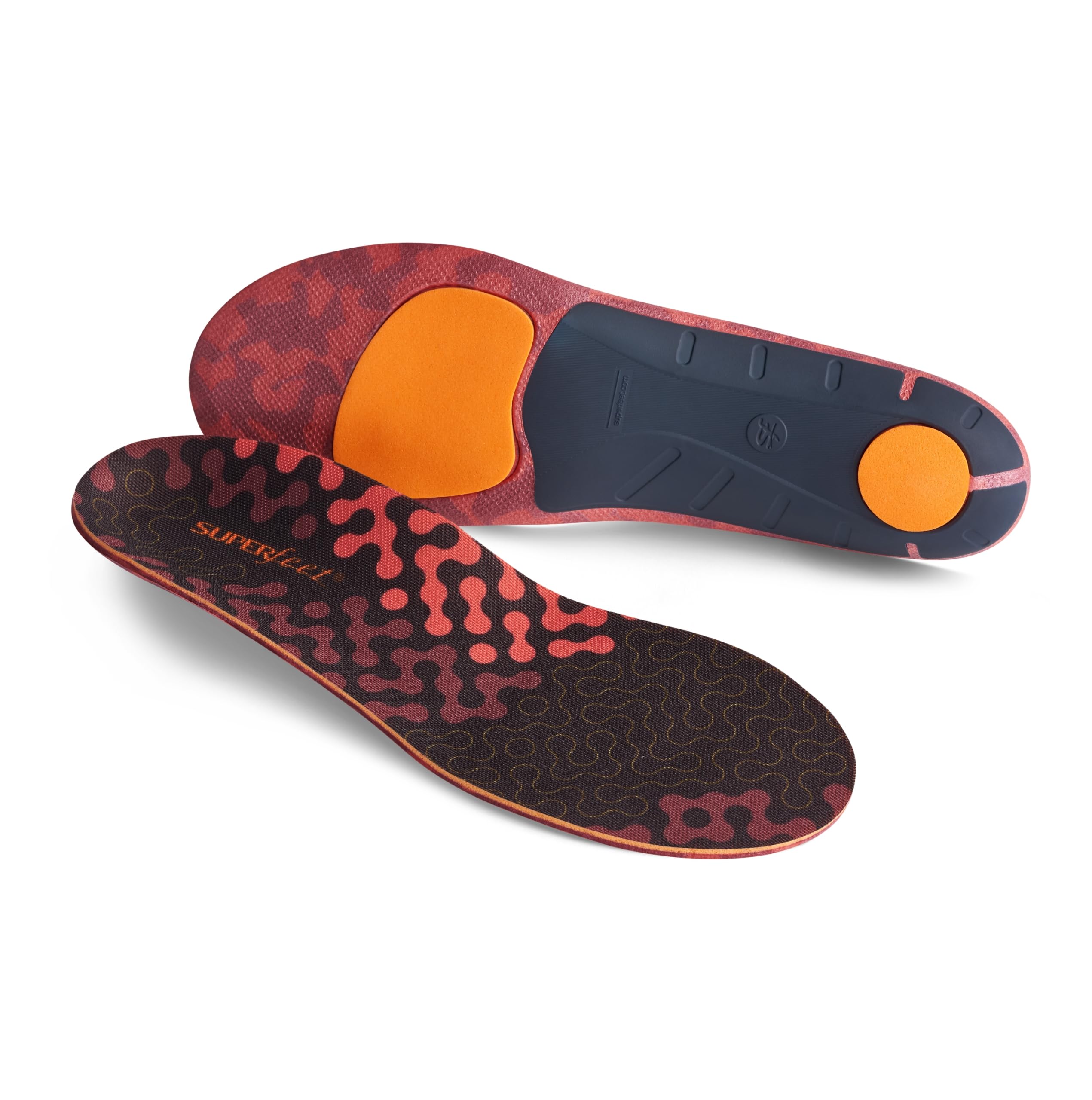
For flat feet that overpronate but hate a hard lump — flexible support that flexes as you run.
If a high, rigid arch feels wrong against a flat foot, this is the softer correction. The Run Cushion is built for low arches, delivering flexible support while running and walking rather than a hard wall of foam. Patented Adaptive Comfort Technology flexes with the foot for an efficient heel-to-toe turnover, and a moisture-wick top cover helps keep feet fresh. A medium heel-cup depth steadies the rear of the foot without a deep bowl that crowds the shoe.
The fit story is where this insert wins people over — a flat-footed buyer on their feet on concrete for long stretches calls them great, with plenty of cushion and support. Another with low arches and plantar fasciitis ran them against several rival low-arch and heel-cup inserts and found them the strongest, needing no trim and fitting popular running shoes and boots without sizing up. A buyer’s son wears his in school shoes and football cleats, with help to his ankle and knee alignment.
The honest limit is longevity. Some report the insoles coming apart after relatively few uses, and the firm support that helps can register as a slight burning on the soles during longer walks before feet adjust. Sizing runs by range, so trim to fit and, if you are between sizes, size up and cut down. Treated as a replaceable part of your running kit, it holds up well; treated as a buy-once item, the durability will disappoint.
Why flat-footed runners like it: low-arch, flexible support turns over with the foot and fits a range of running shoes and cleats without trimming.
The durability question: there are reports of the layers separating, so watch the wear and treat these as a consumable rather than a forever pair.
For you if: you have flat or low arches that overpronate and want flexible support that moves with your stride.
Not ideal if: you plan to run in the same pair for years — check the layers periodically.
9. Superfeet Hike Women’s Support Insoles

A women’s-specific support insert that steadies the foot on rough ground and keeps knees and ankles tracking straight.
This one is shaped specifically for women’s feet and built around a medium to high arch, which stabilizes the foot on uneven terrain and reduces the stress that overpronation pushes up into ankles, knees, and back. The support layer is a proprietary EVOLyte carbon fiber and polymer blend — the reason it stays responsive and holds its shape under a loaded hike instead of mushing down. The moisture-wick top cover keeps feet fresh through long, sweaty days on the move.
Hikers notice the difference over distance. In Altra Lone Peak 6 shoes on rocky, root-filled North Carolina trails, a pair eliminated foot soreness and throbbing that standard foam insoles could not prevent. A buyer on cement floors with joint issues calls them the best non-custom option, surprisingly cushioned for how thin they are. Sized for women, they drop into an 8.5 shoe with no adjustment, hold up in tall riding boots once trimmed for a tight toe box, and carry a 12-month/500-mile guarantee.
The trade-off is cushioning and fit range. The cushion is on the firmer side, and some want a touch more arch height or extension — the fit is close but not always perfect. Trim to fit, and if you are between sizes, size up and cut down. It is built for the trail and long walks first; treat it as a supportive hiking insert rather than a do-everything one.
Where it delivers: the carbon-fiber-blend support gives trail-ready stability for women’s feet, cutting fatigue and soreness on long, uneven hikes.
The honest edge: the arch feels a little short of perfect for some, and the cushion is firmer than plush walking insoles.
Grab it if: you hike, walk long distances, or stand on hard floors and want stable, women’s-specific support.
Look elsewhere if: you want a thick, cloud-soft cushion or a tall arch you can feel pushing up.
10. Protalus T-100 Elite Unisex Insoles
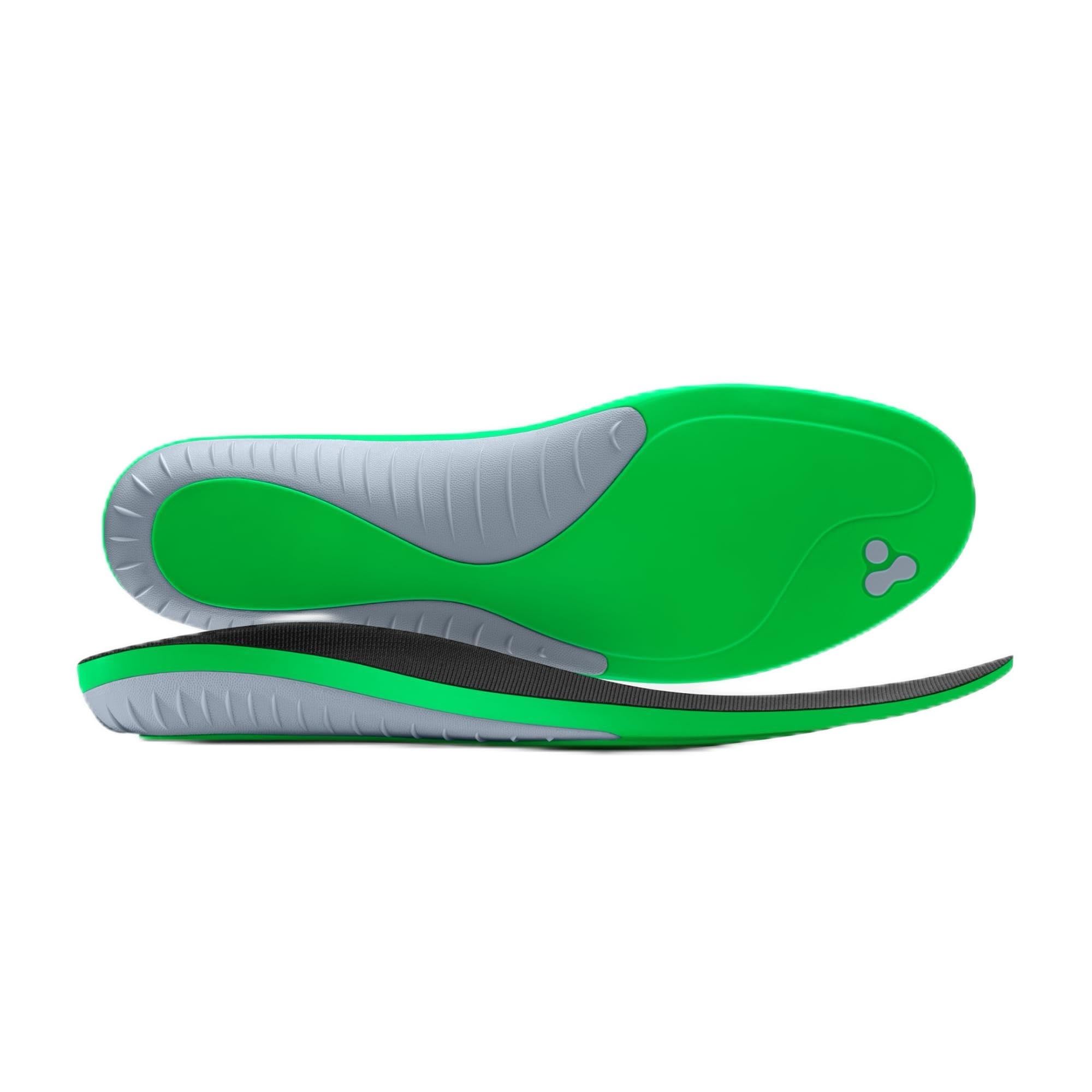
A universal insert that guides the whole foot toward alignment — built for long shifts on your feet, not just the run.
This is the pick for someone who overpronates through a full workday rather than an hour of exercise. The T-100 Elite runs patented alignment technology that gently guides the foot into a more natural position, easing stress through ankles, knees, hips, and lower back. A deep heel-cup stabilizes each step and helps counter inward foot collapse, while a responsive cushioning layer soaks up impact from walking, standing, and errands. The maker rates the construction for up to 12 months of consistent wear.
Comfort while standing on the job is the throughline. Buyers who are on their feet for prolonged shifts report less foot and leg fatigue, and it fits most shoes without feeling tight or bulky. One warehouse worker says that since wearing them there has been no pain, with a quality feel and no excessive thickness. Others back that up on long walks — the sense that you can stay on your feet longer before discomfort sets in. The universal adaptive design is meant to work across flat feet and high arches alike.
The caveat is fit-dependent comfort and cost. The design requires shoes with removable insoles to seat properly, and a few owners note it wants a wide shoe to fit its best. Standing all day still brought heel pain for some, even with the insert in place, so it is not a universal cure. It is a premium-priced pick, so the plan should be to use it daily and get the full rated year out of it.
The everyday angle: a deep heel-cup and alignment-focused build cut fatigue through long shifts and daily miles, with a cushioning layer that softens each step.
What to weigh: it wants a shoe with a removable insole and often a wider fit, and all-day standing may still leave some heel pressure.
Best suited to: anyone standing or walking all day — warehouse, retail, long errands — who wants alignment support built to last a year.
Hold off if: your shoes have fixed insoles or run narrow, or you expect a single insert to erase every ounce of heel pressure.
11. MOVE Game Day Pro Performance Insoles
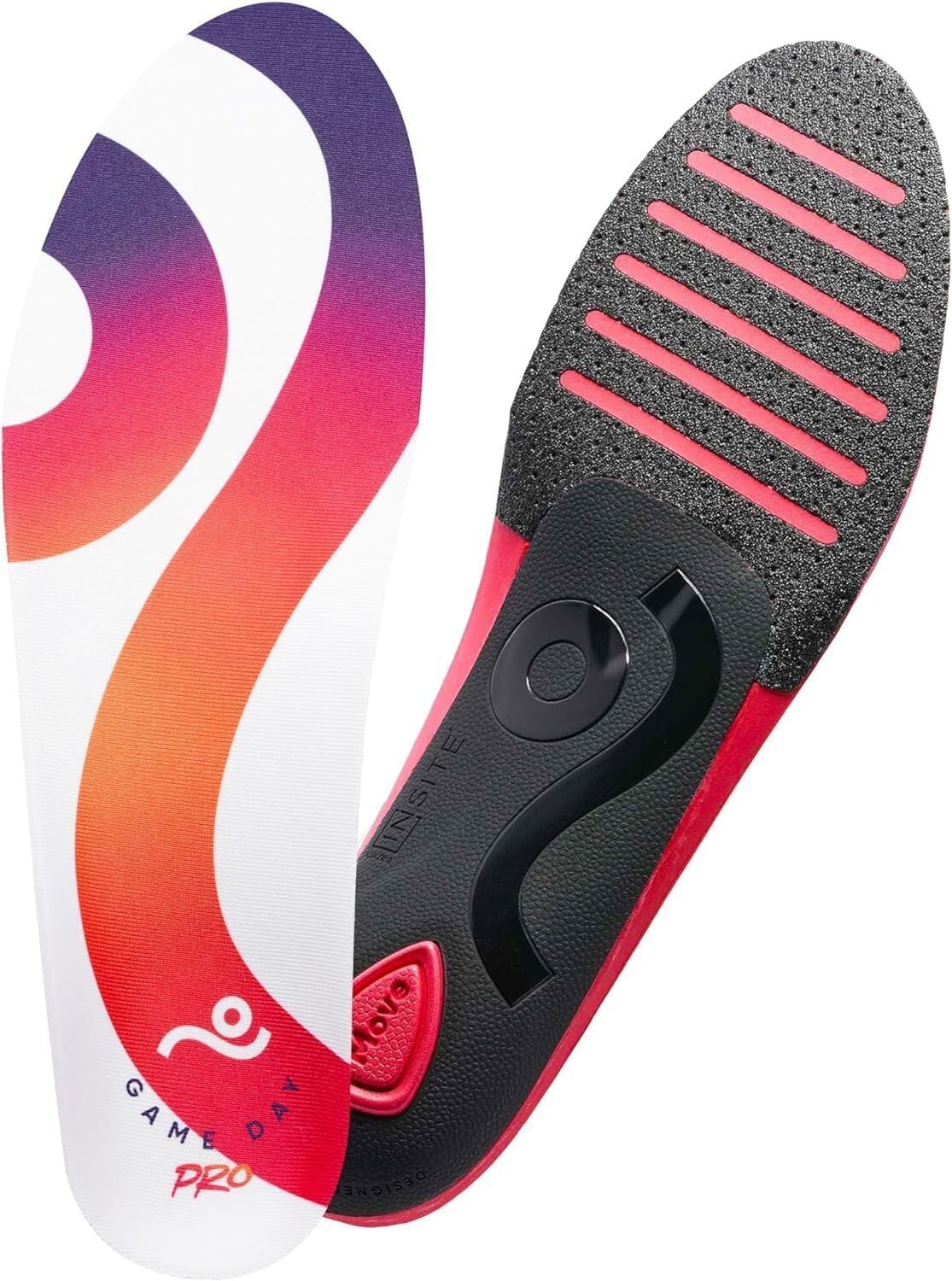
Court-sport armor for the ankle that rolls — an X-Frame heel and midfoot support that locks you in for the push-off.
The Game Day Pro is aimed at the athlete who plants, cuts, and lands hard. Its X-Frame torsional support stiffens the heel and midfoot to hold the foot stable through quick lateral moves while leaving the forefoot free to move. High arch support combats overpronation-related strain, and Active Heel Technology targets pressure points under the heel during long wear. The co-founder is NBA All-Pro Damian Lillard, and the line is worn across a range of pro sports. It is a lightweight 3.53 ounces, so it does not load down the shoe.
Court players feel the difference fast. In pickleball shoes, a firm, supportive arch aligns the feet through long sessions, with a springy push-off and a cushioned landing that lets them play longer. For basketball, it fits the shoe well and eases post-session discomfort while adding agility on lateral movements and quick stops. Runners who swap out factory insoles immediately say these fit perfectly and are extremely comfortable. Student athletes across cleats and basketball sneakers no longer complain about sore feet.
The practical notes: sizing runs to the shoe, and one buyer recommends ordering shoes a half size up to make room — 8.5 feet going into size 9 shoes with the insoles inside. With heavy weekly use, that buyer replaced theirs around month four, which tells you this is a wear item under hard play, not a lifetime insert. Value is the one split point, so buy it knowing it performs but will need replacing with frequent court time.
What court players need and get
- X-Frame support stiffens heel and midfoot for stability on cuts and stops.
- Active Heel Technology targets pressure points during extended play.
- High arch support helps control overpronation-related strain.
- Lightweight at 3.53 ounces, with a springy push-off and cushioned landing.
The practical costs
- You may need a half size up in shoes to fit the insert comfortably.
- Under heavy weekly court time it wears and needs replacing within months.
- It is a premium price for a piece of gear that gets used up.
Made for: basketball, pickleball, tennis, and volleyball players whose ankles roll under fast direction changes.
Weigh before buying: heavy play burns through a pair in a few months, so budget for replacements as part of your kit.
Know the Specs
Heel cup depth
The heel cup is the raised bowl that wraps the back of your foot. A deep cup holds the heel centered so it cannot slide inward — the first place overpronation starts. A medium cup (like the Superfeet Run Cushion’s) is easier to fit into shoes but offers less outright control. If your ankle clearly rolls in, a deep cup is the spec to chase.
Arch height and firmness
Arch height is the amount of lift under the midfoot, and firmness is how much it resists collapse. A firm, high arch (like the 3.5cm support in the RooRuns insoles) controls pronation hard but needs a break-in. A low, flexible arch (like the RunCushion’s) suits flat feet but corrects more gently. Match firmness to how much support your foot can take.
3/4 length vs full length
A 3/4-length insert stops before the toes, so it drops into shoes where the factory insole is glued in and easily swaps between pairs. It also leaves more forefoot room for wide feet. A full-length insert supports the whole foot and suits roomier shoes, running shoes, and boots where you can pull out the stock insole.
Trim to fit and sizing
Trim-to-fit inserts are sized by range and cut down to your shoe, so if you are between sizes, size up and trim down. Sized inserts like the PowerStep Pulse Maxx are ordered to your shoe with no cutting. Heat-moldable insoles like the SOLE Active Thick shape to your arch in the oven, but once trimmed or molded they are generally non-returnable.
Common Questions
Will an insert actually stop my ankle from rolling inward?
How do I know if I overpronate?
Should I choose a 3/4 length or a full-length insert for pronation?
Can I move one pair of inserts between different shoes?
How long will a pair of inserts last before I need new ones?
Are softer or firmer inserts better for overpronation?
Do I need to break in a supportive insert?
Can I trim a full-length insert to fit my shoe?
Will inserts for pronation fit in dress shoes or narrow shoes?
Is it worth starting with a custom-fit insert before trying motion-control ones?
The Bottom Line
For most people overpronating through everyday life, the inserts for pronation winner is the Dr. Scholl’s Custom Fit CF 110, because it tunes the correction to your own arch, weight, and shoe size and slips into shoes where the factory insole is stuck in place. If your foot rolls hard during runs or court play, grab the PowerStep Pulse Maxx, whose rigid shell and angled heel correct alignment from the rear of the foot. And for a flat foot that wants flexible support without a hard lump, the Superfeet Run Cushion Low Arch is the one to reach for.
Whichever way you go, match the insert to your arch height first — that single fit decision matters more than any other spec. Get it right and the correction works with your foot instead of fighting it.
How we choose
We do not accept paid placement. Every pick is matched to a real buyer and a real use-case; we do not hands-on test units.
Sources
Specifications: manufacturer listings and product documentation. Review insights: verified customer reviews, as of October 2026. Pricing: not shown on this page (it changes often); check the current price via the retailer link.
As an Amazon Associate, Aappliancez earns from qualifying purchases. This does not affect which products we feature.