Disclosure: Some links in this post are affiliate links. As an Amazon Associate I earn from qualifying purchases, at no extra cost to you. Learn more
Specs are compiled from manufacturer listings and verified buyer reviews and can change over time — please confirm the key details on the product page before buying.
If you want the short answer: for spiders on siding, eaves and foundation walls, reach for a residual liquid spray that keeps working after it dries, and save the dusts and granules for nests and lawn. The picks below split cleanly along that line — a bonide dust with a snorkel tube for ground nests and cracks, a Harris liquid that kills on contact and after drying, a Wet & Forget barrier spray that aims for months of protection, plus a granular lawn treatment and a systemic for anyone whose spider problem starts in the garden or in pots.
This guide is built by comparing the manufacturers’ published specifications and the patterns across verified customer reviews, so you get each pick’s real strengths and trade-offs instead of marketing spin.
Choosing the right insecticide for spiders outdoors starts with the surface: dust for a crack, spray for a wall, granules for the yard.
Top Picks

How To Choose The Best Insecticide for Spiders Outdoors
Spiders do not behave like ants. They do not march a trail back to a nest you can bait, and many outdoor species spend their lives in the same few feet of siding, eave or crack. That is why most outdoor spider work is about treating surfaces and hiding spots rather than luring them in. Pick the form that matches where you actually see the webs.
Match the form to the surface, not the spider
A dust that puffs into a gap keeps working in a place rain never reaches — that is what the snorkel-tube Bonide does for ground bee and spider nests in brick and siding gaps. A liquid spray covers broad flat areas like foundation walls and eaves. Granules are for the lawn, where you need volume across a big area rather than precision in a crack.
Understand what “residual” buys you
Residual means the treated surface keeps killing after the spray dries. It matters most outdoors, where a spider crossing a treated foundation wall next week is still stopped. Some products state a specific control window on the label; treat that printed figure as your re-application clock and ignore anything else you hear.
Plan around rain and re-entry
Rain and sun, not the product, are what most often undo an outdoor treatment. If rain is coming, a spray can wash off before it sets. The label tells you how long to keep people and pets off a treated area — read it before you spray, not after.
Read the label for what it does not kill
One of the picks here is explicitly not formulated for Black Widow and Brown Recluse. That is a label limit, not a defect — know it before you buy. Check the label’s controlled-species list against the spiders you are actually seeing.
Side-by-Side Comparison
| Model | Best For | Form | Active Ingredient | Size | Amazon |
|---|---|---|---|---|---|
| Bonide 363 Spider and Ground Bee Killer (2 Pack)★ Best Overall | Cracks, nests and hard-to-reach gaps | Dust | Permethrin.25% | 2 × 10 oz | Amazon |
| Wet & Forget Miss Muffet’s Revenge Spider Killer SprayLongest Barrier | Long-lasting perimeter barrier | Spray | Bifenthrin | 64 oz | Amazon |
| Harris Spider Killer Liquid Spray (2-Pack) | Indoor and outdoor spot spraying | Liquid spray | Deltamethrin | 2 × 32 oz | Amazon |
| Ortho Lawn Insect Killer Granules | Whole-yard coverage up to 10,000 sq. ft | Granules | — | 10 lbs | Amazon |
| Bonide Systemic Granules Insect Killer | Plants in pots and hanging baskets | Granules | — | 1 lb | Amazon |
Detailed Reviews
1. Bonide 363 Spider and Ground Bee Killer, 2 Pack of 10 oz
Our pick — 4.5+★ from 900+ verified ratings; the strongest balance of quality and price.
The dust that reaches the gap no spray bottle can touch.
Here is the outdoor spider problem nobody solves with a sprayer: the nest is behind the siding, under the brick ledge, or down a hole in the ground. That is exactly where this Bonide powder is built to go. The snorkel tube applicator is a long narrow nozzle that lets you puff dust directly into a crack instead of soaking the surface around it. It comes as a 2 pack of 10 oz canisters, and the active ingredient is permethrin at.25%.
What wins people over is straightforward effectiveness — it is the thing this product gets praised for above everything else. The other recurring theme is that the treated area simply goes quiet. Buyers report that after a single application, ground bees behind brick came out powder-coated and then never came back, and one summed up the whole job with: “Yellow jackets got behind the siding. Used this and with only one application they are gone overnight!!” That is the scenario this dust was made for, and it costs a fraction of calling a pest service.
The honest catch is texture. This is a powder, not a liquid, so if you want to wet down a wall or coat a wide surface, you will find it awkward — a few buyers wished for a spray-type liquid instead. Application leaves visible dust, and you will want the pump applicator some owners order separately for bigger jobs. It is also best aimed at nests and cracks, not broad perimeter work.
Where the powder pulls ahead
- Snorkel tube delivers dust straight into cracks, siding gaps and ground holes
- Permethrin.25% dust lingers in dry, sheltered spots where sprays wash away
- 2 pack of 10 oz canisters means a spare on the shelf for the next nest
- Treated areas go quiet fast — owners mention nests cleared after one application
Where it asks more of you
- Powder, not liquid — poor fit for coating wide walls or broad surfaces
- Leaves visible residue where you apply it
- Bigger jobs go faster with a separate pump applicator
Reach for this if: your spiders or ground bees live in a specific crack, gap or hole and you want to hit that exact spot.
Pass it over if: you need to cover a long fence line or a whole foundation wall — a liquid spray will serve you better.
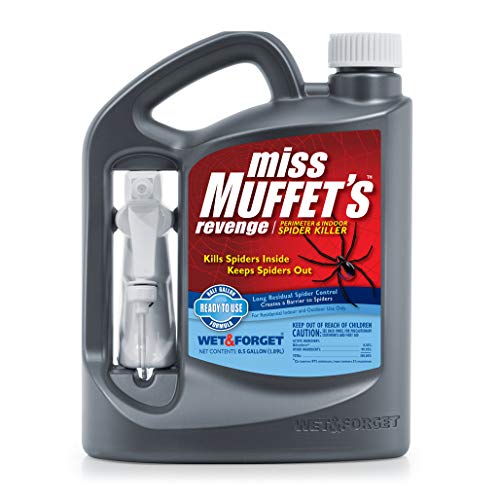
2. Wet & Forget Miss Muffet’s Revenge Spider Killer Spray, 64 Oz
One bottle, one afternoon, and a barrier that is designed to hold for months.
The number that defines this pick is 12 months — that is the barrier window Wet & Forget claims from a single application, and it is the longest stated control period on this list. The 64 oz bottle carries an attached sprayer with a range up to 10 feet, so you can reach eaves and upper siding without a ladder. The active ingredient is bifenthrin. It is especially formulated for all spiders except Black Widow and Brown Recluse, so check what you are dealing with first.
The scale of owner experience here is what makes it the crowd favorite — 4.0+ stars across 9,000+ ratings, with spiders being the thing people rave about most. Boaters report daily stern-rail webs dying within minutes and staying gone for a week. The recurring gripe is the sprayer itself, and streaks on vinyl siding are a real trade-off if you coat the whole exterior.
Where it beats the Harris below is reach and duration: a 10-foot spray range and a stated 12-month barrier against a spray you would reapply in weeks. Where it falls short is fine control — it is a coarse, wet application that wants calm weather and no rain for 24 hours, and it needs to dry completely before people and pets go back out.
Volume advantage: a single 64 oz bottle with an attached 10-foot sprayer covers eaves, siding and foundation in one session instead of a pump-and-refill routine.
The barrier claim, sized honestly: if the 12-month figure holds, you spray once a year and skip the monthly re-application that shorter-lived products demand — that is the whole appeal here.
Built for: anyone with a whole-house exterior web problem who wants to treat it thoroughly and then leave it alone for as long as possible.
Not for: Black Widow or Brown Recluse — this formula is explicitly not made for those two, so choose a product labeled for them instead.
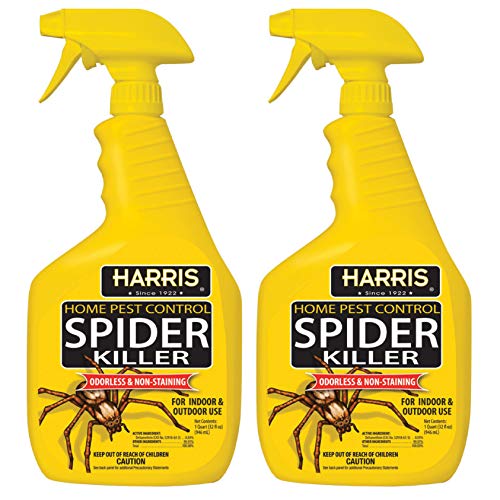
3. Harris Spider Killer Liquid Spray 2-Pack
Kills after it dries — so the surface keeps working while you get on with your day.
Most sprays kill what you hit. This Harris liquid is built around a different idea: it kills once completely dried, so an outdoor surface you coat today is still lethal to a spider that walks across it later. You get two 32 oz bottles, 64 fluid ounces total, in an odorless and non-staining formula that the maker says will not damage fabrics when used per the label. It is EPA registered under No. 3-11 for indoor residential use and cleared for indoor and outdoor application.
The ingredient doing the work is deltamethrin, and the standout story involves a buyer with a heavy infestation in a wooded area — hundreds of spiders — who reports zero sightings for four months after spraying, compared with a leading brand where webs reappeared within days. Beyond spiders, it is labeled for ants, roaches, Asian lady beetles, crickets, silverfish and more, and owners consistently note it works on Joro spiders too. The review pages sum it up with: “I have used it on numerous occasions on the inside and outside of the house and it works for about three to four weeks.”
That three-to-four-week window is the honest limit, and it is why this pick sits below the Wet & Forget for whole-house perimeter duty. Some users also hit trouble with the spray mechanism, so treat the trigger gently. Against the Wet & Forget, the trade is a shorter stated window but a finer, odorless, non-staining application that hurts nothing on walls or concrete.
What the odorless formula actually buys you: you can spray around doors and windows without a chemical smell, and the non-staining claim means walls and concrete come through clean when you follow the directions.
Pick this one if: you want an odorless, fabric-safe spray you can use at thresholds and along walls both outside and in.
Look elsewhere if: you want to spray once and forget the perimeter for a whole season.
4. Ortho Lawn Insect Killer Granules 10 lbs

Ten thousand square feet of spider territory in a single 10 lb bag.
When spiders are all over the lawn rather than up on the house, a bottle of spray is the wrong tool. This Ortho bag holds 10 lbs of granules and treats up to 10,000 sq. ft, and the label states 3 months of outdoor control. The method is simple: spread with a Scotts spreader, water the granules thoroughly, let the area dry, then let people and pets back out. It kills by contact and works above and below the ground, and the label lists ants, spiders, fleas, ticks and more than 100 insects.
Effectiveness is what it is known for, and the use cases in the reviews are concrete. One owner describes the yard staying clear of the little bugs that come out when rain gets heavy, with a small Yorkie playing out there regularly. Another with a flea-allergic dog found that treating the dog alone was not enough and the granules cleared the yard. Spread-and-water is genuinely the whole job — no pump, no nozzle, no overspray on your siding.
The trade-off is precision. Granules go everywhere in the spread zone, which is fine for a lawn and pointless for a siding crack. This also is not a knock-down for a web you can see right now; it is a long, broad treatment for ground and garden. If your problem is the eaves, look at the Wet & Forget instead.
Ground-level logic: 10,000 sq. ft of coverage with 3 months of stated control makes this the one pick here that treats a whole yard rather than a wall.
Timing matters: water it in, let it dry, then keep kids and pets off until it does — the label spells out re-entry and that is not optional.
Right for: homeowners whose spiders, fleas and ticks are coming up out of the lawn and garden beds.
Wrong for: a quick hit on a single eave web — there is no precision in a spreader.
5. Bonide Systemic Granules Insect Killer 1 lb.

This one works from inside the plant — a different job entirely.
A systemic works from inside the plant, not on the surface. Sprinkling these ready-to-use granules into the soil is followed by watering, and the plant takes the insecticide up into its own tissue, where it kills aphids, whiteflies, miners and scales on trees, flowers and shrubs. The 1 lb container is sized for hanging baskets and containers — the spots where you can water it in cleanly and keep it near the plant’s roots.
Effectiveness carries this pick, and the results land fast. Customers note that “It took only a couple of days to get rid of the gnats,” and it has cleared a pothos mealybug infestation in around two weeks. But the most common gripe is not the product at all — it is the container looking half full. In fact, several buyers weighed it and confirmed the actual contents match the advertised 1 lb, so there is no shorting, just an oversized bottle.
There is a real placement caveat here, and it is worth taking seriously: it belongs in pots, not broadcast outdoors, because the label carries an environmental warning against outdoor use.
Why plant owners keep this on hand
- Ready-to-use granules go on and water in with no mixing or measuring
- 1 lb container suits hanging baskets and containers exactly
- Clears gnats and mealybugs fast — days to weeks in owner accounts
- Systemic action reaches pests the plant itself is hosting
What to know before you buy
- Bottle arrives looking half full — the contents do match 1 lb
- Dusty with a lingering smell during application
- Label warns against outdoor use, so keep it indoors and in pots
- Heavy infestations may need more than the suggested dose
The fit: indoor houseplants and container gardens where the pests live on the plant itself.
The mismatch: you want to treat a yard or a siding line — this is not that product, and the label says so.
Know the Specs
Active ingredient and percentage
The active ingredient is the chemical that actually does the killing, and the percentage tells you how concentrated it is — permethrin.25% in the Bonide dust is a dust-strength concentration. Ingredient choice matters because different actives behave differently; deltamethrin in the Harris spray kills once dry, while bifenthrin in the Wet & Forget is aimed at longer barrier control. Always match the ingredient to the label’s stated species list, and never assume one ingredient covers everything.
Residual control window
Residual is how long a treated surface keeps killing after the spray dries or the granules are watered in. It is the single biggest reason two products with the same job feel so different. Wet & Forget states up to 12 months; Ortho states 3 months of outdoor control; the Harris liquid is reported by owners as good for about three to four weeks. Pick based on how often you want to re-treat.
Rain and re-entry timing
Outdoor treatments live or die by weather. Wet & Forget wants calm conditions and no rain for 24 hours. Ortho needs a thorough watering followed by a dry period before people and pets return. Ignoring these windows wastes a full application and can put family on a wet, treated lawn too early.
Coverage and form factor
Dust covers cracks; spray covers walls; granules cover ground. Ortho’s 10 lbs treats up to 10,000 sq. ft, which is lawn scale. Wet & Forget’s attached sprayer reaches 10 feet. The Bonide dust’s snorkel tube reaches into a gap your hand cannot. Choose coverage by the square footage you need to treat, not by the size of the spider.
Common Questions
Can I spray a spider insecticide on vinyl siding without staining it?
Do I need to keep pets off an outdoor spider treatment after applying it?
Will one spray application really last twelve months?
Why is a dust better than a liquid for some outdoor spider jobs?
Does the Wet & Forget spider spray work on Black Widow and Brown Recluse?
Should I use granules or a liquid spray on my lawn?
Can I use the Bonide systemic granules outdoors on shrubs?
Why does my systemic granule bottle arrive looking half empty?
How long should I wait before re-spraying for spiders?
Do I need protective gear to apply a spider dust outdoors?
The Bottom Line
If your spiders live in cracks, siding gaps or ground nests, the Bonide 363 Spider and Ground Bee Killer is the one that hits the problem where it actually lives — a snorkel-tube dust with permethrin.25% working inside the gap a sprayer can only wet. If your problem is a whole perimeter wall and you want the longest stated barrier on this list, the Wet & Forget Miss Muffet’s Revenge states up to 12 months from one 64 oz application with a 10-foot sprayer. For a finer, odorless spray you can use near doors, windows and fabric, the Harris Spider Killer earns its place. And if the spiders are crawling up out of the lawn, the Ortho Lawn Insect Killer Granules covers up to 10,000 sq. ft and gets to the ground-level source instead of the webs you can see.
How we choose
We do not accept paid placement. Every pick is matched to a real buyer and a real use-case; we do not hands-on test units.
Sources
Specifications: manufacturer listings and product documentation. Review insights: verified customer reviews, as of October 2026. Pricing: not shown on this page (it changes often); check the current price via the retailer link.
As an Amazon Associate, Aappliancez earns from qualifying purchases. This does not affect which products we feature.