Disclosure: Some links in this post are affiliate links. As an Amazon Associate I earn from qualifying purchases, at no extra cost to you. Learn more
Specs are compiled from manufacturer listings and verified buyer reviews and can change over time — please confirm the key details on the product page before buying.
Bagworms don’t announce themselves. By the time you spot those little brown cones hanging off your arborvitae, juniper or spruce, they have already chewed through a season of new growth. The fix is a spinosad or B.t. spray that coats the foliage the young caterpillars are eating, applied before they build their cases — and the five options below are the ones worth your time. Each one is a spinosad or B.t. formula you mix or spray straight, so you are not handling harsh chemicals around your lawn, your pets or your kids.
This guide is built by comparing the manufacturers’ published specifications and the patterns across verified customer reviews, so you get each pick’s real strengths and trade-offs instead of marketing spin.
Bagworms are easy to kill when they are young and near-impossible once the cocoon hardens, so timing matters as much as the bottle. Below you will find the honest trade-offs on each formula — how much spray you get, how fast it works, and which one suits a single shrub versus a whole hedge line. The short version: pick your insecticide for bagworms by matching spray volume to the number of trees you need to cover.
Top Picks

How To Choose The Best Insecticide for Bagworms
Spraying for bagworms is not like spraying for aphids. The caterpillar lives inside a silk-and-leaf case it drags around with it, and once that case is fully built and hanging, sprays bounce off it instead of soaking in. Everything about choosing a product comes back to that one fact: you want a formula that gets onto the foliage the worm is eating, applied while the worm is still small and feeding openly. Spray during that hatch window and even a mild B.t. formula kills the young larvae. Spray once the cases have hardened and the strongest spinosad concentrate bounces off.
Match the bottle volume to how many trees you are treating
A single bottle goes a lot further than most first-timers expect — or a lot less, depending on what you bought. A 16-fluid-ounce concentrate that dilutes at a set rate gives you many gallons of mixed spray, which is plenty for a row of shrubs. A ready-to-use trigger bottle gives you exactly what is in it, no more. Count your trees before you buy. If you are treating one arborvitae, a small bottle is fine. If you have a hedge line of ten junipers, buy concentrate and plan to refill a sprayer.
Spinosad versus B.t. — which one suits your yard
Spinosad and B.t. (Bacillus thuringiensis, a naturally occurring bacteria that stops caterpillars from feeding) are the two active ingredients on this list, and they behave differently. Spinosad tends to knock worms down faster and covers a wider range of listed insects. B.t. is the more targeted choice — it is aimed squarely at caterpillars and worm-type insects, and the labeling notes it has no effect on birds, earthworms, or beneficial insects such as honeybees or ladybugs when used as directed. If you keep bees or prize your pollinators, that distinction matters.
Look for the OMRI listing if you garden organically
OMRI stands for the Organic Materials Review Institute, a body that checks whether a product fits organic production standards. A bottle carrying that listing has been reviewed against those standards, which is a useful signal when you are spraying around vegetables or fruit trees you plan to eat from. Several products here carry it. It is not a safety guarantee for you personally — you still follow the label — but it tells you the formula has been checked against organic rules rather than just marketed as natural.
Timing beats concentration every single time
Bagworms hatch in late spring and early summer, and the young larvae are exposed and feeding for a short window before they build their protective cases. That hatch window is when a bagworm spray earns its money. Once the cases are mature and hanging, most sprays will not penetrate them. So a mid-priced spinosad concentrate applied during the hatch beats a premium bottle applied after the cases harden. Watch your evergreens in early summer, catch the tiny worms while they are still crawling, and spray then.
Side-by-Side Comparison
| Model | Best For | Active Ingredient | Volume | Form | Amazon |
|---|---|---|---|---|---|
| Fertilome (16062) Spinosad Insecticide★ Best Overall | Most yards — best all-round pick | Spinosad | 16 fluid ounces | Concentrate | Amazon |
| Summit Caterpillar and Webworm ControlBest for Big Hedges | Big hedges and tall trees | B.t. (per labeling) | 32 fluid ounces | Hose-end concentrate | Amazon |
| Southern Ag Conserve Naturalyte | Value per gallon of spray | Spinosad | 16 fluid ounces | Concentrate | Amazon |
| Monterey Spinosad Garden Spray | Small jobs and spot treating | Spinosad | 8 fluid ounces | Concentrate | Amazon |
| Monterey B.t. Caterpillar Killer Spray | Pollinator-safe caterpillar control | B.t. (per labeling) | 32 fluid ounces | Ready-to-use | Amazon |
Detailed Reviews
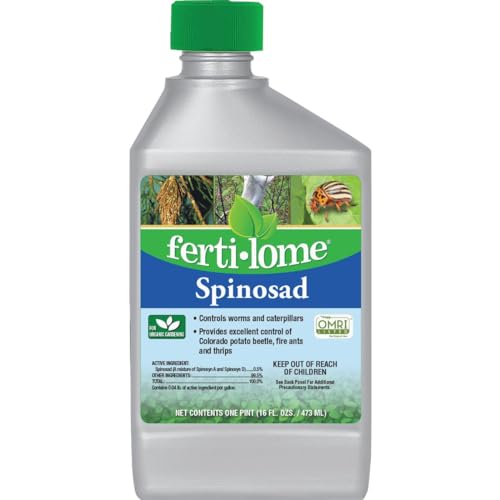
1. Fertilome 16062 Spinosad Insecticide 16 oz.
Our pick — 4.5+★ from 150+ verified ratings; the strongest balance of quality and price.
The bottle that names bagworms right on the label — and backs it up.
If your arborvitae is hung with those little brown cones and you want the straightest path to a dead caterpillar, start here. This is a 16-fluid-ounce spinosad concentrate, and spinosad is the active ingredient most bagworm sprays are built around because it works on the worm while it feeds. The label lists bagworms, tent caterpillars, leafminers, borers, thrips, Colorado potato beetles, armyworms, sod webworms, loopers and cat fleas among the insects it targets.
You can spray your fruit trees, citrus, and vegetables without worrying about organic rules, because this formula carries an OMRI listing (a certification that it meets organic production standards). That listing means the formula was reviewed against organic production standards, not just labeled “natural.” It is cleared for outdoor use on vegetables, trees, shrubs, flowers, fruits and citrus, so one bottle covers both your ornamental hedge and your vegetable patch. The size gap is the clincher: the Southern Ag Conserve bottle is listed as a 1-fluid-ounce unit count, while this one is 16 fluid ounces — 16.0x more product at your door.
What wins people over is that it kills bagworms on shrubs with a straightforward spray. Buyers report: “Sprayed by shrubs for bag worms. Did the job” — that is the whole experience in two sentences. Others use it as a season-long perimeter spray through a battery-operated sprayer, hitting the yard and the foundation beds to keep crawlers off the house, and it holds up across several years of that routine. The one thing to plan for is the mixing: you are measuring concentrate and water each time, so a dedicated gallon jug or pump sprayer makes life easier. A 4.5+ star rating across 150+ ratings puts it at the top of this shortlist for a reason.
Where this bottle earns its place
- Names bagworms directly on the label, so you are not guessing about coverage
- 16-fluid-ounce concentrate stretches across many gallons of mixed spray
- OMRI listed and cleared for vegetables, trees, shrubs, flowers and citrus
- Owners mention it clearing bagworms off shrubs with a straightforward spray
What you should plan around
- You mix it yourself at 4 tablespoons per gallon, so it needs a jug or sprayer
- Comes as a single bottle — no trigger sprayer included
Reach for this if: you want one concentrate that covers bagworms, tent caterpillars and a long list of other listed pests across shrubs and edible plants.
Think twice if: you would rather grab a pre-mixed bottle and spray — this one asks you to measure and dilute.
2. Summit Caterpillar and Webworm Control 1 Qt
A quart of concentrate that clips to your garden hose and covers the whole tree line.
When the bagworm problem is up in the canopy rather than on a knee-high shrub, you want reach and volume, and this is the pick built for that. It is a hose-end concentrate — the bottle attaches to your garden hose and mixes as you spray, so you can hit the top of a spruce without hauling a pump sprayer up a ladder. The bottle holds 32 fluid ounces of concentrate, and against the Fertilome’s 16 fluid ounces that is 2.0x the liquid in the same style of formula. For a long hedge line or a stand of evergreens, that extra volume buys you real coverage.
The active ingredient behaves the way caterpillar sprays should: worms stop feeding and die rather than dropping instantly, so you need to give it a day or two before judging results. The people who use it well plan for repeat applications, especially on a heavy infestation. That is normal for this class of product, not a flaw — but it does mean you should buy with the expectation of spraying more than once. It is 2.2 pounds in the bottle, light enough to carry around the yard while you work.
What comes through in owner experience is patience paying off. Customers note boxwood caterpillars dying within about a day of hatching, with no new ones showing up in the days after, when the spray is applied as a fine mist at the label dilution. Others note that it is gentler on birds and pets than the harsher poisons — “nice not to worry about harming birds or pets” — and accept that they may need a second pass. That trade-off between gentleness and outright kill speed is the honest heart of this pick.
The hose-end advantage: 32 fluid ounces of concentrate that mixes itself as you spray, so tall trees and long beds are a one-person job instead of a ladder-and-pump chore.
The honest catch: it is a slower kill on heavy infestations, and the label mindset is repeat application — buy knowing you may go through more than one bottle in a bad year.
It beats a hand sprayer for: anyone treating mature trees, windbreaks or a stretch of hedge that a small bottle could never reach.
Not the one for: a single potted shrub where a precision trigger sprayer would be easier to aim.
3. Southern Ag Conserve Naturalyte Insect Control, 16oz – Pint

Small bottle, eight gallons of spray, and a reputation for knocking out stubborn pests.
Here is the pick for the gardener who reads labels and does the math. This is a 16-fluid-ounce bottle of spinosad concentrate that the manufacturer says makes up to 8 gallons of spray. For a bagworm job across several shrubs and a fruit tree or two, that is a lot of coverage from one small bottle. The label targets foliage-feeding worms and caterpillars, citrus leafminers, and fire ants in ornamentals — a broader job list than its size suggests.
What people talk about most is plain effectiveness, and it is not limited to bagworms. Owners have used it to clear scale that neem oil, agricultural oil and insecticidal soap all failed on. It has taken out spider mites on houseplants with a clean-up spray and a follow-up application days later. On fire ants it works, though it takes more than one pass over a couple of weeks to finish the job. Even the honest reviews land on the same note: small bottle, very effective product.
The recurring gripe is the price for the volume — a small bottle that makes 8 gallons will go fast if you are drenching fire ant mounds at the label rate of 1 to 2 gallons each. If your only job is bagworms on a few shrubs, you will not feel that squeeze. One thing worth knowing: it is concentrated, so a little goes further than the bottle size implies, and it has no smell to speak of. Many owners keep a bottle on the shelf year-round for exactly the odd pest that shows up.
Where it shines: a broad, effective spinosad concentrate that makes up to 8 gallons of spray and covers worms, caterpillars, citrus leafminer and fire ant control.
What to weigh: the value math gets tight when you are treating fire ants at 1 to 2 gallons of drench per mound rather than spot-spraying shrubs.
The right call for: a multi-pest yard where bagworms are one item on a longer list — worms, scale, mites and fire ants all in the same bottle.
Look past it if: you only need a splash for one small shrub and would rather not mix concentrate.
4. Monterey Spinosad Insecticide Garden Spray, 8 oz with Spoon
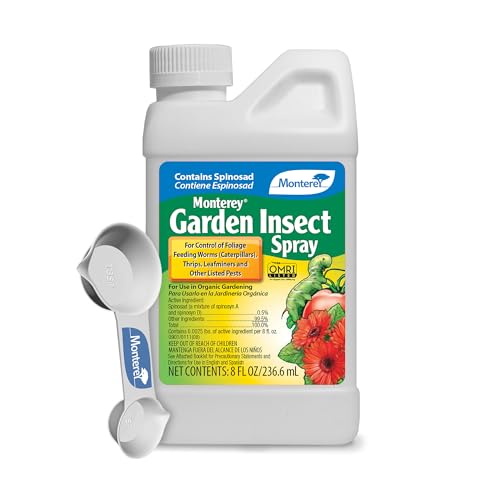
The small-batch bottle for a garden that needs precision, not a flood.
Not every bagworm call is a hedge emergency. If you are treating a couple of ornamentals, a vegetable bed and a flowering shrub, an 8-fluid-ounce bottle is the sane buy — it keeps you from mixing up gallons of spray you will never use. This is a spinosad concentrate made with a naturally occurring bacteria, it is OMRI listed for organic gardening, and Monterey includes a measuring spoon so you are not guessing at the dilution. The label covers caterpillars, leafminers, codling moths, tent caterpillars, gypsy moths, thrips, borers, fire ants and more, on ornamentals, lawns, vegetables and fruit trees.
The application flexibility is the quiet selling point. You can put it through a trigger sprayer, a hand-held, a backpack, or a hose-end sprayer — so the same bottle works whether you are misting one juniper or treating a long fence line. It is also odorless, which sounds minor until you have sprayed something pungent near a patio and smelled it for hours. And it works: reviewers point out bougainvillea that neem oil and Sevin dust could not save recovering after this, and a marked drop in caterpillars and chewing insects after a couple of treatments.
The honest caveat is the size. At 8 fluid ounces it is the smallest bottle here, so if your bagworm problem is large the concentrate will run out faster than you expect. Plan to spray early morning or late evening per the label, and expect to follow up. The users who love it are the ones treating a modest garden carefully rather than the ones trying to save a whole tree line on one bottle.
Why it is the precise pick: OMRI listed, odorless, comes with its own measuring spoon, and works through any sprayer you already own — trigger, hand-held, backpack or hose-end.
The size you must accept: at 8 fluid ounces it is the smallest bottle on this list, so match it to a small garden or plan to buy more than one.
Suits you best when: your bagworm fight is a few shrubs and beds, and you want a clean, odorless, organic-listed concentrate with the spoon included.
skip it if: you have a long stand of evergreens — you will want the bigger Summit or Southern Ag bottle instead.
5. Monterey B.t. Caterpillar Killer Spray 32 oz
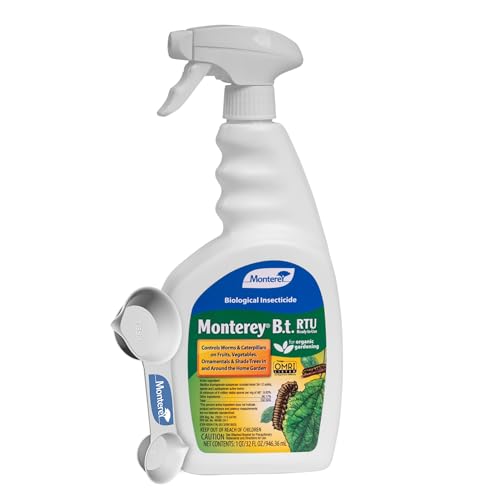
Targeted caterpillar control for the gardener who keeps bees and worries about the good bugs.
This is the pick for the yard where the bees matter. Monterey B.t. is built around Bacillus thuringiensis — a naturally occurring bacteria that stops caterpillars and worm-type insects from feeding — and it targets bagworm, cabbage looper, gypsy moth, fall cankerworm and elm spanworm among others. When used as directed, the labeling states it has no effect on birds, earthworms, or beneficial insects such as honeybees or ladybugs. If you keep hives or lean hard on pollinators, that is the sentence that should decide your purchase.
It is 32 fluid ounces and ready to use — already mixed, so there is no measuring and no concentrate to dilute. You get a trigger sprayer and a spoon in the box, and you can spray broccoli, cabbage, melons, lettuce, tomatoes, shade trees, ornamentals and more. It is OMRI listed for organic gardening. Shoppers say the bottle does not leak and is easy to use precisely because it comes pre-mixed, and tomato and flower gardeners describe it clearing caterpillars they could not shift otherwise.
The catch is real and worth saying plainly: this is a slower, more targeted tool, not a chemical hammer. The label mindset is spraying every 7 to 10 days to stay ahead of new hatchings, and rain means reapplying once it clears. Some owners have run into a faulty trigger toward the end of a bottle. But for the bee-keeper or the gardener who wants to keep ladybugs on the roses, that gentleness is exactly the point.
Why it fits a pollinator garden
- Labeling states no effect on birds, earthworms, honeybees or ladybugs when used as directed
- 32-fluid-ounce bottle comes ready to use — already mixed, no dilution
- OMRI listed and labeled for a long range of vegetables and ornamentals
- A targeted caterpillar and worm formula, including bagworm on the label
What to go in knowing
- Slower and more targeted than a knock-down chemical — expect repeat spraying every 7 to 10 days
- Occasional faulty trigger reported toward the end of a bottle
- Rain means reapplying once it clears
Choose it when: bees, ladybugs and birds share your garden with the bagworms, and you want a formula built to leave them alone.
Pass on it for: a fast knock-down on a heavy infestation — this is a patience tool, not a sledgehammer.
Know the Specs
Spinosad vs B.t. (the active ingredient)
Every product on this shortlist uses one of two active ingredients, and your choice depends on speed versus selectivity. Spinosad (a fermentation-based ingredient) tends to hit worms faster and covers a wider listed range — the Fertilome, Southern Ag and Monterey Spinosad bottles are all spinosad. B.t. (a bacteria that stops caterpillars from feeding) is more targeted, which is why the Monterey B.t. labeling notes no effect on birds, earthworms or beneficial insects like honeybees when used as directed. If you keep bees, lean B.t.; if you want a fast, broad knock-down, lean spinosad.
Concentrate vs ready-to-use (and the volume math)
A concentrate is a bottle you dilute with water before spraying; a ready-to-use bottle comes pre-mixed. The trade-off is coverage versus convenience. A 16-fluid-ounce concentrate like the Fertilome or Southern Ag can make many gallons of mixed spray depending on the label rate — the Southern Ag label states up to 8 gallons. A ready-to-use 32-ounce like the Monterey B.t. gives you exactly what is in the bottle. Concentrate is more economical for a hedge line; ready-to-use is simpler for a quick spot spray. Count your trees before you buy either.
Common Questions
When is the best time to spray for bagworms?
Will spinosad kill bagworms that are already in their cases?
Is spinosad or B.t. safer for honeybees?
How long does one bottle of concentrate last for a hedge?
Can I use these bagworm sprays on arborvitae and juniper?
How often should I reapply a bagworm spray?
Do these products harm birds, pets or earthworms?
What does OMRI listed mean on a bagworm spray?
Will one spray kill bagworms for the whole season?
The Bottom Line
You can only kill a bagworm while it is still feeding on exposed needles, so the spray that wins is the one you apply during the late-spring hatch. For most yards, the Fertilome (16062) Spinosad Insecticide is the pick: it names bagworms on the label, comes as a 16-fluid-ounce concentrate that dilutes at 4 tablespoons per gallon, is OMRI listed, and holds the strongest owner satisfaction on this list. If your problem is up in tall evergreens or a long hedge, grab the Summit Caterpillar and Webworm Control — its 32-fluid-ounce hose-end concentrate is 2.0x the liquid of the Fertilome bottle and saves you the ladder. And if bees and ladybugs matter in your garden, the Monterey B.t. Caterpillar Killer Spray is the one built to leave them alone.
How we choose
We do not accept paid placement. Every pick is matched to a real buyer and a real use-case; we do not hands-on test units.
Sources
Specifications: manufacturer listings and product documentation. Review insights: verified customer reviews, as of October 2026. Pricing: not shown on this page (it changes often); check the current price via the retailer link.
As an Amazon Associate, Aappliancez earns from qualifying purchases. This does not affect which products we feature.