Disclosure: Some links in this post are affiliate links. As an Amazon Associate I earn from qualifying purchases, at no extra cost to you. Learn more
Specs are compiled from manufacturer listings and verified buyer reviews and can change over time — please confirm the key details on the product page before buying.
The trick to buying an inflatable paddle board on a tight budget is knowing which number actually decides whether you stay dry. That number is pressure, measured in PSI (pounds per square inch — how hard the board gets). A board that tops out low will feel soft under your feet and sag in the middle, no matter how many extras it ships with. Every board below lists its real maximum pressure, real weight limit, and real dimensions, so you can pick the one that suits your body, your car boot, and your local water.
This guide is built by comparing the manufacturers’ published specifications and the patterns across verified customer reviews, so you get each pick’s real strengths and trade-offs instead of marketing spin.
Some boards here inflate to a rock-hard 20 PSI, others carry two adults and a dog, and a couple fold small enough to drop in a hatchback. Below you’ll find the pick that matches how you actually paddle, plus the honest catch on each one so nothing surprises you at the water’s edge when you shop for the best inflatable paddle board under $200.
Top Picks
How To Choose The Best Inflatable Paddle Board Under $200
Most first-time buyers assume a longer accessories list means a better board. It doesn’t. What decides whether you enjoy the day is how stiff the board gets, how much weight it floats, and whether you can carry it from the car to the shore without cursing.
Start with maximum PSI, not the freebies
PSI is the pressure you pump the board to. A higher ceiling means a firmer platform, so it doesn’t bow when you push off. On calm water a board that hits 15 PSI feels solid; one that only reaches 13 PSI can flex under a heavier paddler. The SLOOSH Ripple goes furthest here at 20 psi, and the SUDOO tops out at 13 psi — the softest of the group — so match that to your weight and ambitions.
Match width and length to your body and your water
Width is the stability dial. A 33-inch-wide deck is forgiving for a beginner, while a 31-inch board turns faster but asks more balance. Length controls glide and tracking. Boards around 10 feet are nimble; an 11-foot-6 board tracks straighter over distance but takes more room in the garage. If you’re sharing with a partner or a kid, lean toward the wider and longer end of the range.
Read the weight capacity against your real load
Weight capacity is the total the board floats comfortably: you, plus a dog, plus a cooler, plus the paddle. A 250-pound ceiling is a solo board with little margin. A 450-pound or 500-pound rating leaves room for a passenger or a pet. Be honest about your own weight before you reach for the biggest-sounding number.
Don’t discount the pump and the backpack
The hand pump is the part that wears you out, and the backpack decides whether the board lives in your car or gathers dust in the shed. Look for a dual-action pump (it pushes air on both the up and down stroke) and a bag with padded straps. Both are the details that separate a board you use weekly from one you use once.
Side-by-Side Comparison
| Model | Best For | Max Pressure | Weight Capacity | Dimensions | Amazon |
|---|---|---|---|---|---|
| Bifanuo Inflatable SUP with Backpack★ Best Overall | Families wanting the widest deck on a budget | — | 350 lbs | 128″L x 30″W x 6″ thick | Amazon |
| SUDOO 10’6″ Inflatable Paddle BoardFamily Pick | Beginners, families and pet paddlers | 13 psi | 450 lbs | 126″L x 33″W x 6″ thick | Amazon |
| SLOOSH Ripple 10’6″ SUP | Paddlers who want the stiffest ride | 20 psi | 300 lbs | 126″L x 33″W x 6″ thick | Amazon |
| TIGERXBANG Defender Collection | Quick-setup solo paddlers | 15 psi | 250 lbs | 120″L x 31″W x 6″ thick | Amazon |
| HEYBOARD 10’6″ SUP | Kids and family adventures | — | 400 lbs | 126″L x 32″W x 6″ thick | Amazon |
| Hiwave 11′ Extra Wide SUP | Big paddlers and tandem trips | 15 psi | 420 lbs | 11′ x 34″W x 6″ thick | Amazon |
| UPWELL 11’6″ SUP with Seat | Paddle-or-kayak versatility | — | around 500 lbs | 11’6″ x 35″W x 6″ thick | Amazon |
Detailed Reviews
1. Bifanuo Inflatable Stand Up Paddle Board
The widest deck on the list, built for wobble-free family afternoons.
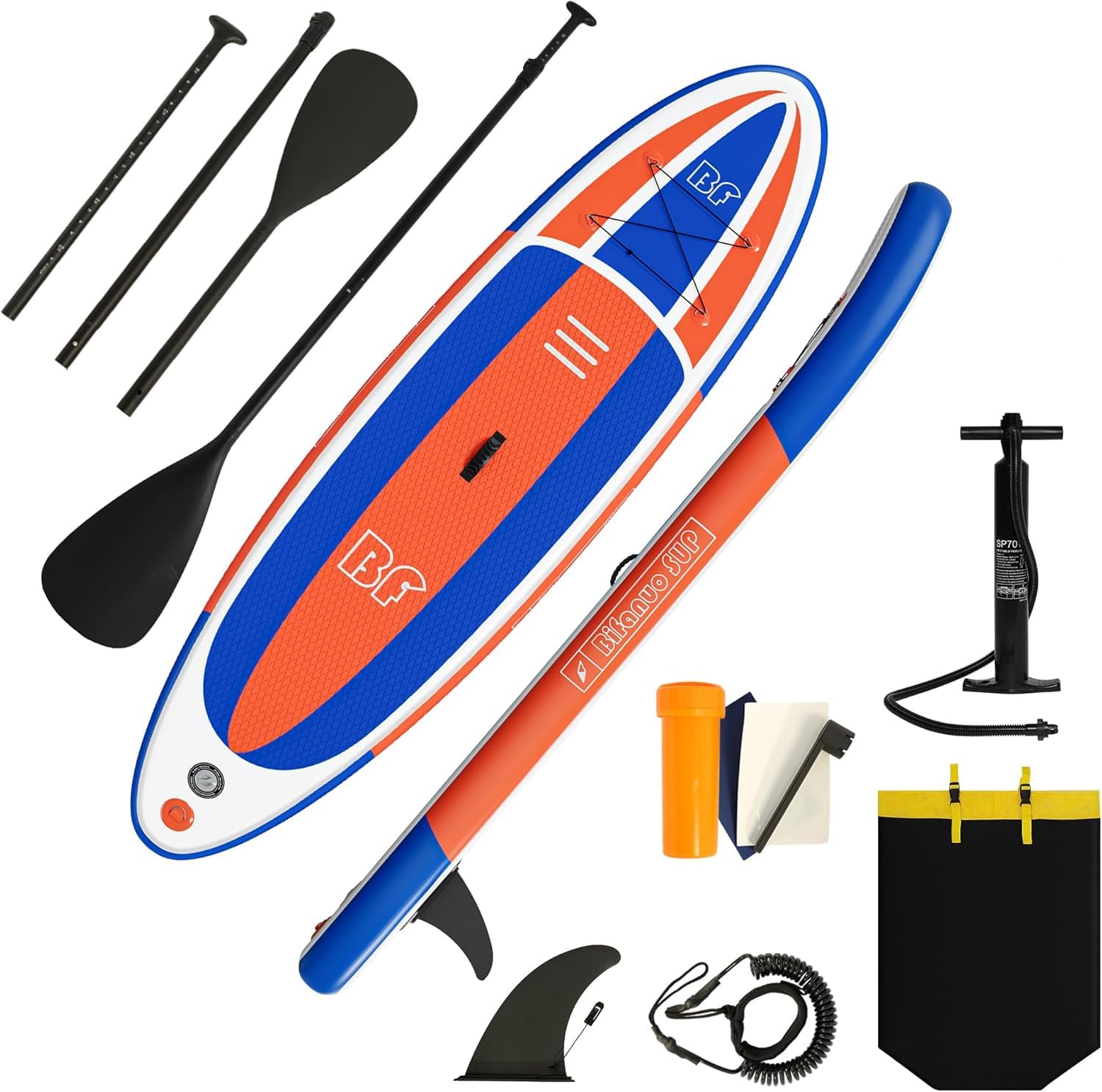
The Bifanuo is the board that says yes to a friend or a dog. Its EVA deck (a soft, grippy foam surface you stand on) is built into a 128-inch-long, 30-inch-wide hull, and it floats a stated 350 pounds. At 128 inches it’s the longest board here, and its 30-inch deck matches the SLOOSH’s width, so a heavier rider plus a passenger stays level.
What wins people over is the build. Owner reviews keep coming back to the same word — quality — and the deck stays solid enough to run the board onto rocks when you paddle up to shore. Setup follows the usual drill: roll it out, pump it up through the dual-action hand pump, and clip the fin on. The carry backpack folds flat and slides into a car trunk easily, so stashing it between trips isn’t a chore.
The catch is an honest one. The hand pump draws mixed feedback, and it isn’t the fastest in the lineup. If you plan to inflate it every single weekend, budget for an electric pump down the line. Otherwise this is a stable, forgiving board at the entry price point.
Why buyers keep it
- Wide 30-inch stance keeps new paddlers upright
- 350 lbs capacity carries a passenger or a pet
- Full kit: aluminum paddle, dual-action pump, leash, repair kit, backpack
- Grippy EVA deck handles rocks and launches
Where it gives a little
- Hand pump earns mixed feedback and isn’t the quickest
- No stated PSI ceiling, so firmness depends on your pump gauge
Best all-rounder: Pick it if you paddle with kids, a partner, or a dog and want an easy platform to learn on.
Plan ahead: Spring for an electric pump if you’ll inflate it weekly.
2. SUDOO 10’6″ Inflatable Paddle Board for Adults
A 450-pound float that carries two people and still tracks straight.
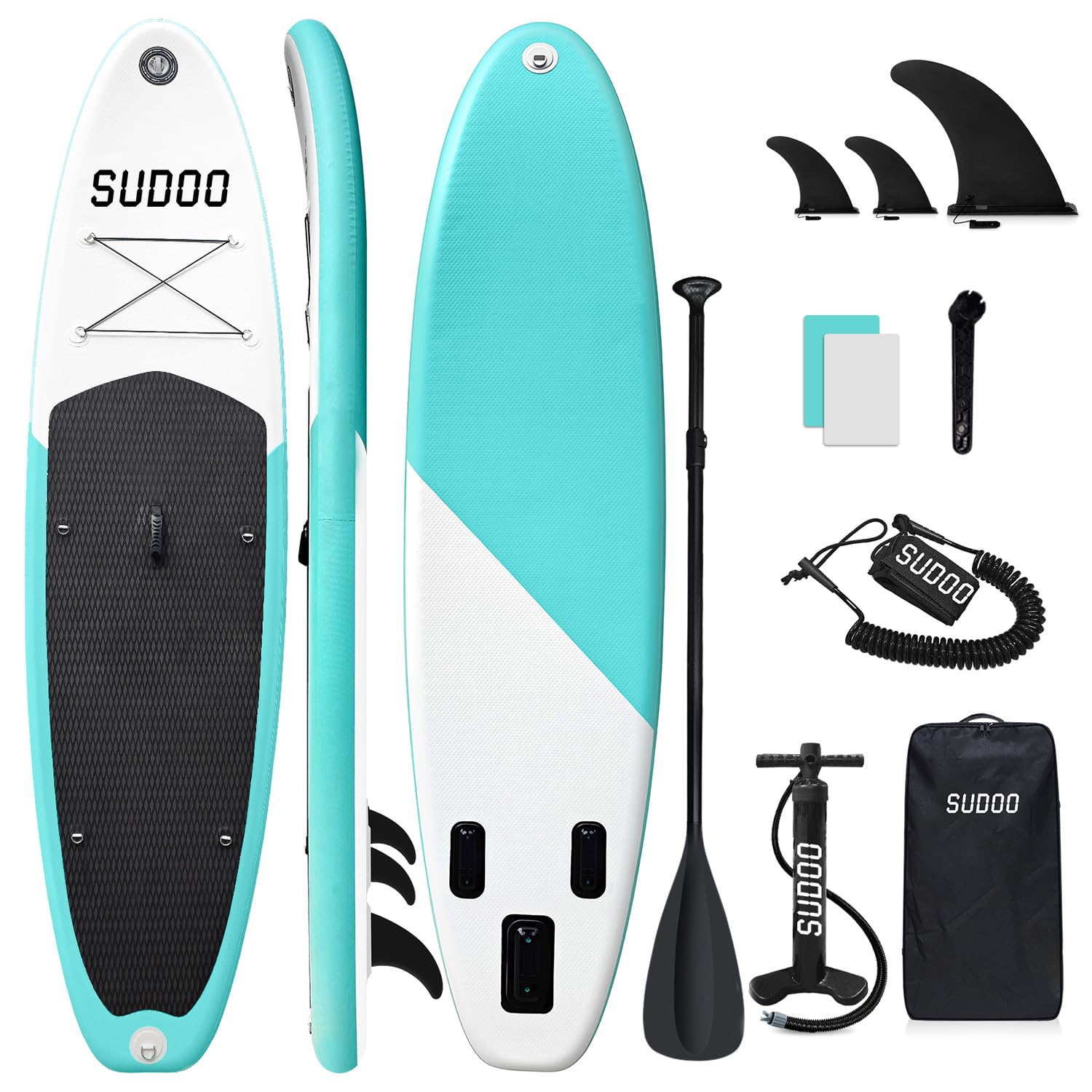
If you want one board the whole family can share, this is the one. Against the SLOOSH’s 300 pounds, the SUDOO’s 450 pounds is the clear headroom king, and it sits on a 126-inch by 33-inch deck that’s 6 inches thick. That thickness, paired with four D-rings, lets you strap on a kayak seat, a cooler, or clip two boards together for group days.
You stay steady on this board, and that is the main draw. The 33-inch width gives beginners a wide platform, so you can stand up without wobbling. The reinforced PVC with drop-stitch construction (thousands of threads that lock the top and bottom layers together) holds its shape. Owners use the included backpack to carry the whole kit. Deflating and packing it back up goes quick — buyers report: “Manual inflation takes 5–10 mins; deflates/packs quickly.” One paddler took it out for a whole summer of use with no leaks.
Two things to weigh. The board only inflates to 13 psi, the lowest ceiling here, so it feels a touch softer underfoot than the 20 psi SLOOSH. And the air gauge on the pump has been known to fail on some units — many simply keep their old pump. Neither stops it from being the best-tracking value in this tier.
Where the value sits: You get a wide, family-friendly deck, four D-rings, a backpack, and a 450-pound float without jumping tiers.
The honest limit: 13 psi is the softest inflation here — firmer riders may want to top up with a better gauge.
Reach for this if: You need a board that carries a second paddler, a dog, or a cooler without fuss.
Think twice if: You want a rock-hard, high-pressure deck and don’t mind paying for it elsewhere.
3. SLOOSH Ripple 10’6″ Inflatable SUP

Pumps to 20 PSI — the firmest platform you can inflate on this list.
The number that matters here is 20 psi. That’s the highest pressure ceiling in this lineup — 54% more headroom than the SUDOO’s 13 psi — and it means the SLOOSH can hold a genuinely rigid, hard-board feel underfoot. The reinforced double-layer sidewalls (marketed as FortaFusion) back that up.
For the paddler who wants a solid deck, this pays off. The tri-fin setup helps it track and turn, and the 33-inch width is designed to sit between twitchy and sluggish. Owners mention a high-end feel at this price, 4-mile paddles, and a 50-pound dog aboard without trouble. The dual-action pump claims a 30% faster fill, and three handles make the 15.22 kg carry to the water easier than the weight suggests.
The honest trade-off is the 300-pound capacity, the lowest here, so a heavy rider plus a passenger isn’t the plan. And with a high-pressure deck this weighty, carrying it solo to a distant launch takes some effort. Seal in that rigidity and you’re set — but check the weight against your own back first.
The case for it
- 20 psi max pressure for the firmest underfoot feel
- Dual-action pump with claimed 30% faster inflation
- Three handles for easier carrying
- Waterproof phone pouch and full kit included
What to know
- Heaviest board here at 15.22 kg
- 300 lbs capacity is the lowest of the group
Go for it if: You want a stiff, high-pressure ride and mostly paddle solo or with a light passenger.
skip it if: You’ll be carting it long distances or need to float two adults.
4. TIGERXBANG Defender Collection Inflatable Paddle Board

A tool-free snap-in fin that gets you from bag to water fast.
The Defender is the board for the paddler who hates fiddling. Its center fin snaps in without tools, so setup means little more than pumping and clipping. It measures 120 inches long by 31 inches wide, 6 inches thick, and inflates to 15 psi. At 22 pounds it’s a manageable carry, and the military-grade PVC (a tough, wear-resistant plastic) shrugs off scuffs when you beach it.
On the water, it handles more than its 250-pound capacity suggests. Owners get it out in heavy waves and wind and report it tracks well, with a non-slip surface that feels confident in choppy water. A full trip with a heavy cooler and dogs is doable. The Velcro paddle system keeps your stick stowed when you’re swimming or resting, and the included double-action pump with gauge gets you firm fast.
Two honest notes. The 250-pound capacity is the tightest here, so a big paddler with gear needs to watch the load. And the paddle grip feels cheap in the hand, though it does float. Neither is a deal-breaker for a solo paddler who values quick launches.
Why it earns its place: Tool-free fin, 15 psi inflation, and a 22-pound weight make it the fastest board here to deploy.
The trade-off: At 250 lbs capacity it rewards solo paddlers, not tandem loads.
Made for: A solo paddler who wants minimal setup time and doesn’t carry much gear.
Not for: Two-up trips or heavier riders needing extra float.
5. HEYBOARD 10’6″ Inflatable Stand Up Paddle Board

A 400-pound float with a tri-fin hull that kids master in one afternoon.
Families keep coming back to this one for a reason. The 10’6″ by 32-inch deck with its tri-fin setup (three fins that keep the board tracking straight) gives beginners a stable platform, and the 400-pound capacity covers a teen, a dog, or a parent following behind. It’s 18.7 pounds, light enough for a teen to haul down the beach.
Setup is where it shines. The high-pressure pump with a sensitive gauge fills it fast and deflates just as quickly, and it rolls into the backpack with all the accessories — paddle, leash, phone case, fin. Kids take to it quickly; the bright camouflage deck gets noticed on the water and the non-slip EVA pad keeps grip firm while they find their feet.
The niggles are minor. Some units have arrived missing the ankle leash or with a dud pump gauge, and a few paddlers prefer an electric pump to the manual one over time. Treat it as a backup and you’ll be fine. For family use on a lake, this is a friendly, forgiving board.
Why families like it: Fast inflate and deflate, a backpack that swallows the whole kit, and a 400-pound platform that suits teens and adults.
The small print: Occasional units ship missing a leash or with a faulty gauge, so check the box on arrival.
Best for: Households with kids or teens who’ll share one board on calm lake days.
Look elsewhere if: You’re a heavier solo paddler wanting maximum stiffness.
6. Hiwave 11′ Extra Wide Inflatable SUP
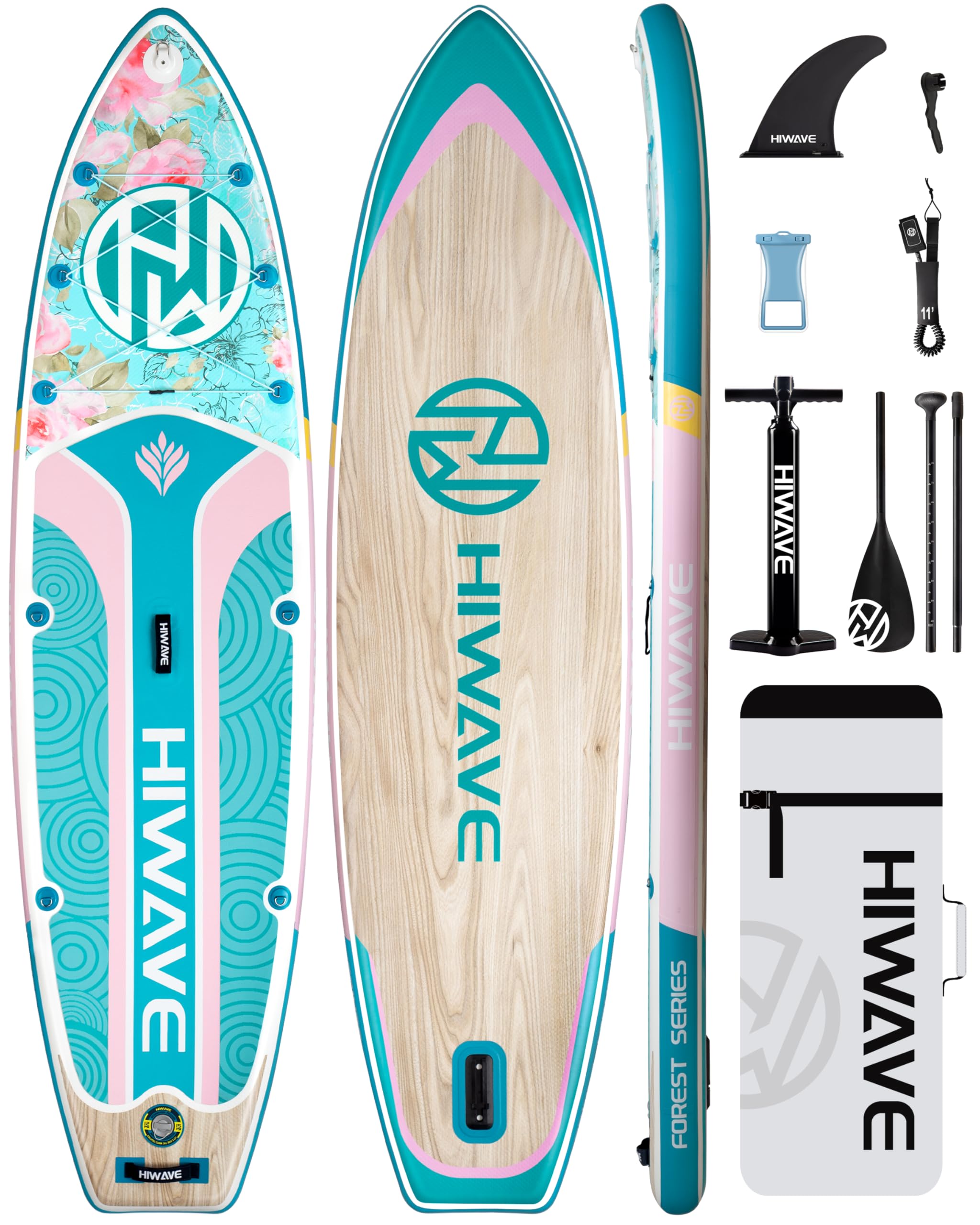
Eleven feet long and 34 inches wide — a stable deck for bigger riders.
At 11 feet by 34 inches, this is the widest and longest board here, and it’s built for a heavier or taller paddler. The 420-pound capacity sits just under the UPWELL and well above the 300-pound SLOOSH, so a tall rider plus a child passenger fits comfortably. The anti-slip EVA deck is a generous platform, and the 15 psi ceiling keeps it firm at full pressure.
Owners who paddle several times a week report the wider deck adds real stability, and one notes it stays comfortable even for a tall or plus-size rider with a child aboard. Double handles and detachable tail fins make it easy to drag over sand and lift from the middle. The hand pump gauge has proved accurate against other PSI gauges, and the board held air for days in hot weather with no leaks.
Two things to size up. The included pump is the weak link — a few paddlers note the airflow hole design slows suction and doubles the inflate time compared with a better pump. And at 13.2 kg it’s no featherweight. Even so, its 34-inch deck and 420-pound capacity make it the best board here for a large paddler who wants a wide, steady platform.
Standout strength: 34-inch width and 420-pound capacity give larger paddlers the stable deck they’ve been missing.
The honest catch: The bundled pump inflates slower than others; a better pump speeds the job up.
Ideal for: Taller or heavier riders who want a wide, steady board that still carries a passenger.
Unlike the SUDOO: It’s wider and longer, but slower to inflate on the stock pump.
7. UPWELL 11’6″ Inflatable Paddle Board with Seat
Stand up or sit down — one board that turns into a kayak in seconds.
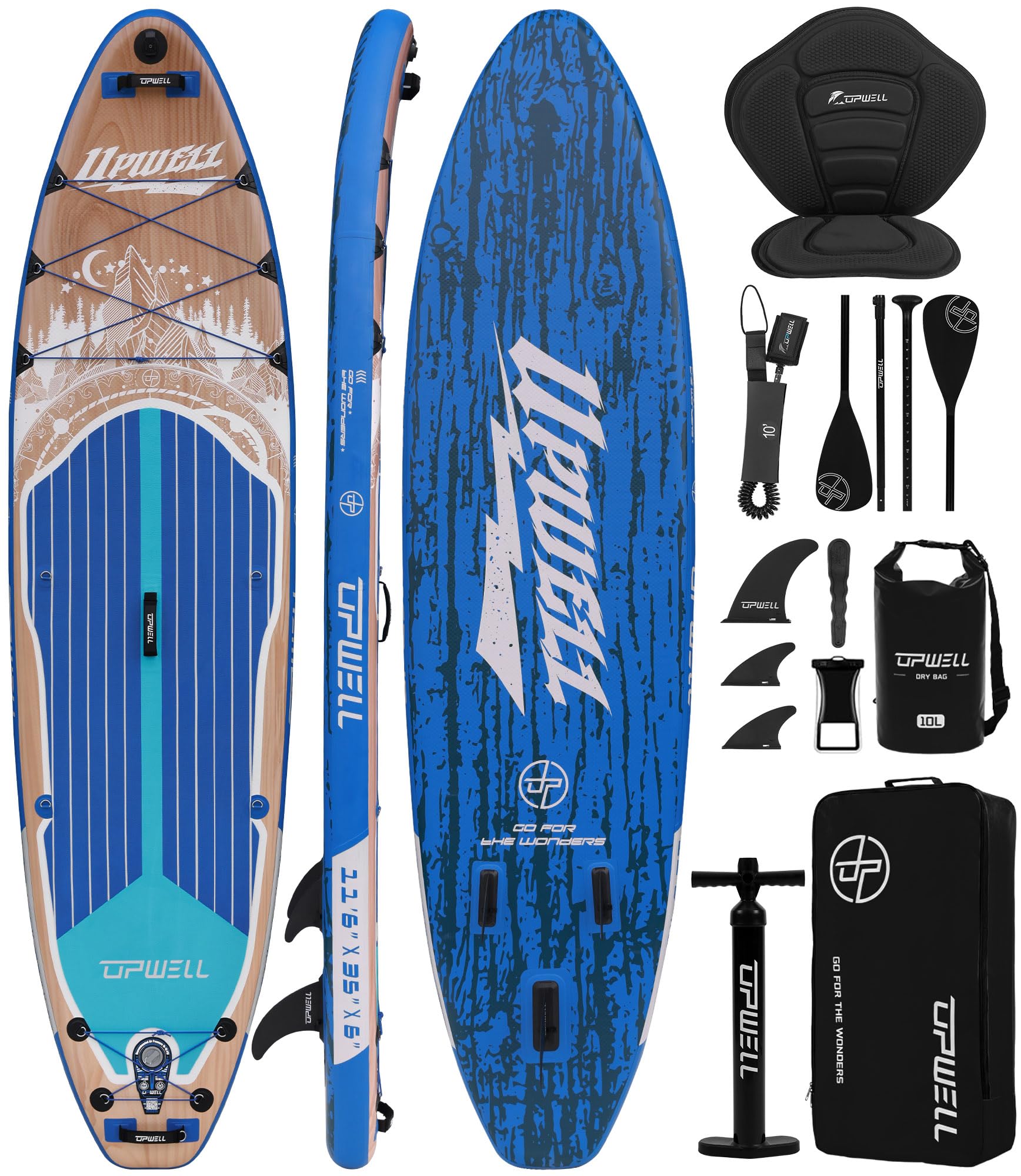
The UPWELL is the only board here that genuinely switches modes. Its 2-in-1 paddle converts from a single-blade paddleboard stick to a double-sided kayak paddle by locking the center shaft. Slot in the included kayak seat and you’re sitting low in the water with a different stroke altogether. The board itself is 11’6″ by 35 inches — the widest here — with a capacity up to around 500 pounds, the most generous of the group.
The width and length make it the roomiest platform for exploring, yoga, or fishing on flat water. The ultralight double-wall PVC construction is built to resist wear and corrosion, and the soft non-slip EVA pad stays comfortable underfoot for long sessions. Overnight fans love how it looks on the water, and the included 120L backpack swallows the board plus the 10L waterproof bag and all the fittings.
The catch is weight. At 17.1 kg, it’s the heaviest board here and the most to carry from the car. That extra bulk is the price of a 35-inch deck and a seat. The kit is the most complete in the lineup, but the portability trade-off is real.
what separates it
- 2-in-1 paddle converts between SUP and kayak
- Widest deck here at 35 inches
- Capacity up to around 500 pounds — the highest of the group
- Full kit with kayak seat, 10L dry bag, and 120L backpack
What to weigh up
- Heaviest at 17.1 kg — a real carry
- Longer and wider means more storage space needed
Pick it for: Paddlers who want one board for standing, sitting, and everything in between.
Be ready for: A heavier haul to the launch — this is a big, roomy board.
Know the Specs
Maximum PSI and what it does
PSI (pounds per square inch) is how hard the board inflates, and it’s the closest thing to a “firmness” rating you’ll find. A board that reaches a higher ceiling, like the 20 psi SLOOSH, feels solid underfoot and resists bowing in the middle. One that stops at 13 psi can flex under a heavier paddler. Pump to the board’s stated PSI ceiling and stop there — going beyond it risks over-pressuring the hull.
Weight capacity in plain terms
Weight capacity is the total the board floats comfortably: you, plus any passenger, plus a cooler or a dog. A 250-pound ceiling suits a solo paddler; a 450-pound or 500-pound rating opens up two-up trips and pet rides. Always compare the capacity to your own body weight before the add-ons, then leave a little margin for gear.
Width and length for balance and glide
Width is your stability dial. A 31-inch deck turns fast but asks for balance; a 33-to-35-inch deck forgives a beginner. Length controls tracking and glide. A 10-foot board is nimble around the shore; an 11-foot-6 board holds a straight line over longer distances but needs more storage room at home.
Deck material and puncture resistance
Most boards here use a PVC shell over a drop-stitch core — a construction that gives an inflated board its rigidity. A non-slip EVA pad on top gives you grip and keeps your feet from sliding when the deck is wet. Military-grade or double-wall PVC adds wear resistance against rocks and sand, which matters if you launch from a stony shore rather than a dock.
Common Questions
How firm should my inflatable paddle board feel when it’s fully pumped?
Can two adults share one of these boards?
Will an inflatable board puncture on rocks or sticks at the shore?
How long does it take to inflate one with the hand pump?
Do I need a different pump than the one in the box?
Will a paddle board fit in the trunk of a small car?
Is a longer or wider board better for a beginner?
How should I store an inflatable paddle board between trips?
What’s the difference between a 10’6 board and an 11’6 board?
Do I need a leash every time I paddle?
The Bottom Line
For most paddlers, the inflatable paddle board under $200 that earns the nod is the Bifanuo. It pairs a wide, grippy deck and a 350-pound float with a full accessory kit, so a family can share one board without a wobble. If you crave a rock-hard, high-pressure deck, the SLOOSH Ripple pumps to 20 psi (pounds per square inch — how hard the board gets) and gives you that firm, hard-board feel. And for two-up trips or a big paddler, the SUDOO floats 450 pounds with room for a passenger. Match the board to your weight and where you launch, and you’ll spend less time pumping and more time on the water.
How we choose
We do not accept paid placement. Every pick is matched to a real buyer and a real use-case; we do not hands-on test units.
Sources
Specifications: manufacturer listings and product documentation. Review insights: verified customer reviews, as of October 2026. Pricing: not shown on this page (it changes often); check the current price via the retailer link.
As an Amazon Associate, Aappliancez earns from qualifying purchases. This does not affect which products we feature.