Disclosure: Some links in this post are affiliate links. As an Amazon Associate I earn from qualifying purchases, at no extra cost to you. Learn more
Specs are compiled from manufacturer listings and verified buyer reviews and can change over time — please confirm the key details on the product page before buying.
You want a watch that locks onto satellites and still has charge left on Friday. That is the whole promise of this shelf, and it is easier to hit than the marketing suggests. The picks below all carry real built-in GPS, skip the mandatory monthly subscription, and get you through a week or more between charges. The crowd favorite here holds 4.5+ stars across 1,000+ ratings, and it costs less than several picks below.
This guide is built by comparing the manufacturers’ published specifications and the patterns across verified customer reviews, so you get each pick’s real strengths and trade-offs instead of marketing spin.
Some watches here pair a bright AMOLED panel (a screen that lights each pixel itself, so it stays readable in direct sun) with week-long battery life. Others lean on a transflective display (a screen that uses sunlight instead of fighting it) and a featherweight build. Below you will find the honest trade-offs laid out plainly, so choosing an inexpensive gps watch stops feeling like a gamble.
Top Picks

How To Choose The Best Inexpensive GPS Watch
Start with the battery number, not the screen size. A watch that lists days in smartwatch mode and a separate figure for GPS mode tells you honestly how it behaves on a long run. A single headline number usually hides the drop you feel the first time you leave GPS on for an hour.
Two battery numbers, not one
Every watch here should state everyday battery life and GPS battery life as separate figures. The Garmin Forerunner 55 spells it out — up to 2 weeks in smartwatch mode, up to 20 hours in GPS mode — and that second number is what decides whether it survives a marathon. The Amazfit Active Max lists up to 25 days in its product copy and 24 days in its spec sheet, so treat long figures as your everyday ceiling, not your GPS ceiling.
What the satellite chip actually buys you
Multi-GNSS support means the watch listens to several satellite networks at once instead of one. That is why the Amazfit Active 2 lists 5 satellite positioning systems and the Instinct E lists multi-GNSS support. In a city with tall buildings or a canyon trail, that redundancy is the difference between a clean track and a line that zigzags across the map.
Subscription traps worth checking first
A budget watch stops being a budget watch if the useful features sit behind a monthly fee. Coros and Amazfit both push your data to a free companion app, and Amazfit’s copy explicitly states no hidden mandatory subscription fees. Fitbit’s premium tier is sold separately, though both the Charge 6 and Versa 4 include a 3-month trial. Read that line before you fall for a low sticker.
Side-by-Side Comparison
| Model | Best For | Battery (Everyday) | Display | GPS Battery | Amazon |
|---|---|---|---|---|---|
| Amazfit Active Max★ Best Overall | Big screen, week-plus battery | 24–25 days | 1.5″ AMOLED | — | Amazon |
| Amazfit Active 2Best Value | Feature-per-pound value | 10 days | 1.32″ AMOLED | — | Amazon |
| Fitbit Charge 6 | Google Maps on your wrist | 7 days | — | — | Amazon |
| Garmin Forerunner 55 | Race training on a budget | Up to 2 weeks | MIP | Up to 20 hours | Amazon |
| Fitbit Versa 4 | Smartwatch feel plus fitness | 6+ days | — | — | Amazon |
| COROS PACE 3 | Serious runners, tiny weight | 17–24 days | 1.2″ transflective | 38 hours | Amazon |
| Garmin Instinct E | Rugged backcountry wear | 16 days | — | — | Amazon |
Detailed Reviews
1. Amazfit Active Max Smart Watch
Our pick — 4.5+★ from 1,000+ verified ratings; the strongest balance of quality and price.
The wrist screen you can actually read at noon, with the battery to back it up.
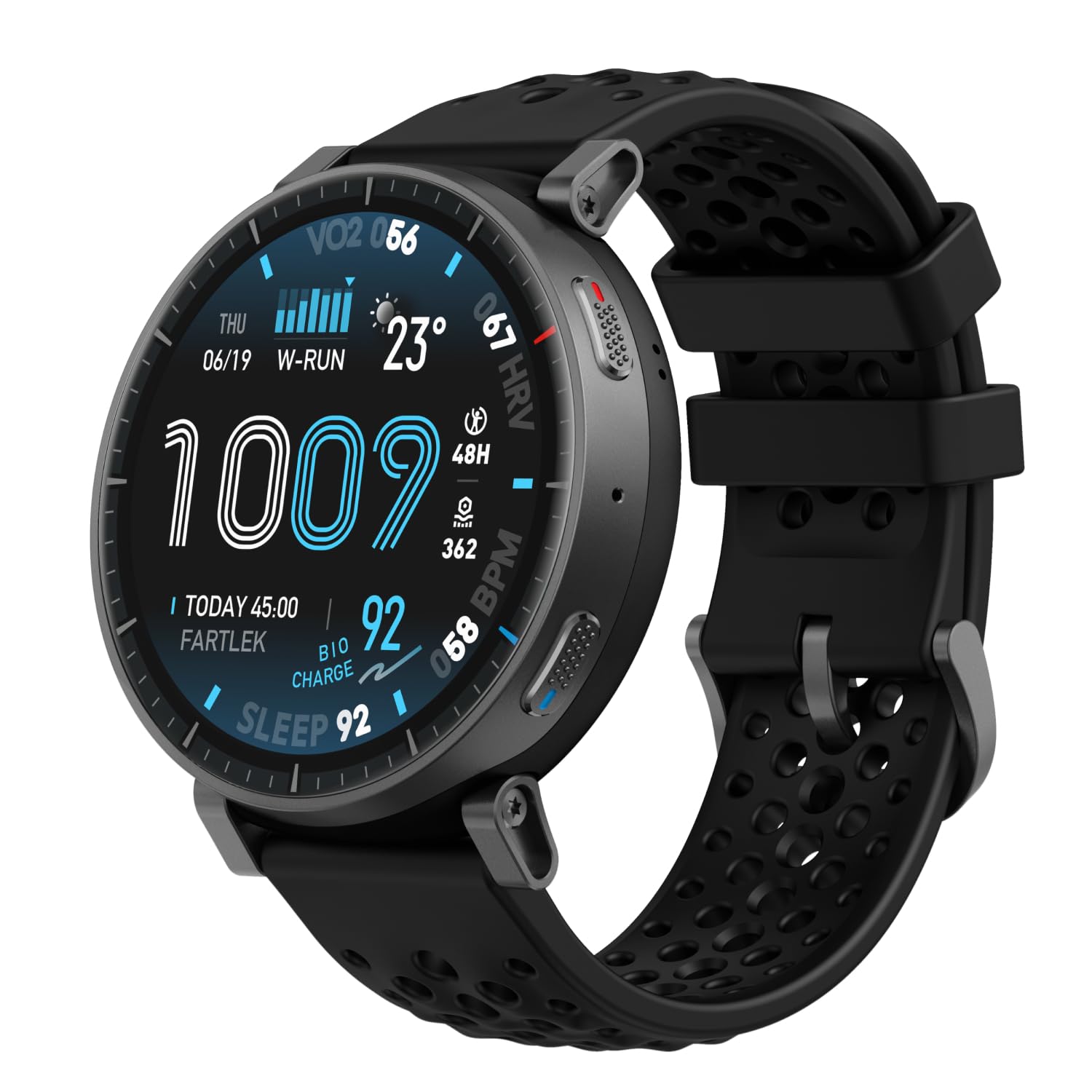
A 1.5-inch AMOLED panel rated at 3,000 nits is the headline. Nits measure brightness, and 3,000 is enough to cut through direct afternoon sun instead of washing out to a grey smear. That matters the moment you glance at your pace mid-run without slowing down. It is the biggest screen here — the Amazfit Active 2 sits at 1.32 inches, a distinction you feel every time you raise your wrist.
You get up to 25 days of battery life, which is why this watch earns its top spot. The product page advertises up to 25 days, and the spec sheet lists 24 days. Buyers confirm that in real use: as one owner put it, “Battery at 45% after 5 days with 5 GPS walks, 3 elliptical workouts, nightly wear.” That means a full week of mixed use without hunting for a charger, and it dwarfs the 10-day figure of the smaller Active 2.
The 4GB of onboard storage is the sneaky-useful part. You can load maps with turn-by-turn directions and music directly onto the watch, then leave your phone at home. Five satellite systems handle positioning, so the track stays tight even between buildings. Appearance is the most-praised trait in owner reviews, and on the wrist it reads like a watch costing far more.
Where It Wins
- 1.5″ AMOLED at 3,000 nits stays legible in harsh sunlight
- Long battery life measured in weeks, not days
- 4GB storage for offline maps and music
- 170+ workout modes plus AI Zepp Coach plans
Where It Pulls Up Short
- The 1.5″ face is large — smaller wrists may find it oversized
- App ecosystem is thinner than Garmin or Apple
- Some advanced health metrics drift during hard workouts
Reach for this if: you want one watch that reads clearly outdoors and skips the charger for a week or more.
Size check first: that big 1.5″ panel is genuinely large on a narrow wrist.
2. Amazfit Active 2 Smart Watch
A stainless steel case, a bright screen, and ten days between charges for entry-level money.
Here is the trade against the Active Max above, and it is a real one. The Active Max runs 24 days on its 200 milliamp-hour cell; this one runs 10 days on a larger 270 milliamp-hour battery. Same brand, and the smaller watch holds more charge — proof that the screen and feature load, not raw capacity, drain a watch. You give up two weeks of runtime and a 1.32-inch panel instead of 1.5 inches. In exchange you get a stainless steel case that looks dressier and 160+ sport modes, including HYROX Race and padel.
The 5 satellite positioning systems lock on fast for runs, walks, cycling and hiking, and downloadable maps give you turn-by-turn guidance on-screen or through Bluetooth headphones. Water resistance is rated to 50 meters, so pool laps and ski days are covered. The draw is features per dollar: it covers what watches costing several times as much do, and one buyer reports “~10-day battery (40% after a week, GPS/notifications off).”
The honest caveat is connectivity. Bluetooth pairing works cleanly for many and stumbles for others, and accuracy lands in mixed territory too. Pair it and forget it, and you will likely be fine; expect to fiddle, and you may not be.
What buyers actually get: a light, sleek stainless steel watch with a bright touchscreen, free watch faces and a subscription-free Zepp app. Owners repeatedly rank it the best feature-per-dollar pick against the big-name brands.
The fine print: no Spotify control and no auto workout detection — you start sessions manually.
It beats the Active Max on: battery capacity and price-to-feature ratio.
Steer away if: you need rock-solid Bluetooth pairing every single day.
3. Google Fitbit Charge 6 – Fitness Tracker – Obsidian/Black

A slim band that turns into a Google Maps screen the moment your run goes wrong.
This one is a fitness tracker rather than a full smartwatch, and it wears like a band instead of a brick. The standout trick is turn-by-turn directions from Google Maps on your wrist, plus Google Wallet tap-to-pay and YouTube Music controls. If you already live in Google’s world, that integration is the reason to pick it over a rival. Built-in GPS and 40+ exercise modes cover the basics without a phone tether.
Battery life sits at 7 days, though charging behavior varies — some owners get a full week, others find it needs a top-up more often. Charging takes about 2 hours. The tracker links to compatible treadmills and ellipticals for a live heart rate read, and the nightly Sleep Score plus stress management score give you something to actually look at. Build quality is the most-repeated theme in owner feedback, and the band feels solid in hand.
Here is where honesty matters. Reliability, durability and connectivity all land in mixed territory among the review data, with a minority reporting units that fail outright or stop syncing. The 2-year-old Charge 5 screen-death stories are real too. Treat a protective approach as sensible and buy from a seller with a clean return path. Weigh the numbers: this watch has far more reviews than the Forerunner 55 — the order of thousands against a couple hundred — so the mixed feedback is spread across a much larger crowd.
The Google Advantage
- Google Maps turn-by-turn on your wrist
- Tap-to-pay with Google Wallet
- 40+ exercise modes and live heart rate from gym machines
- Slim band silhouette that stays comfortable overnight
The Honest Notes
- Premium coaching is a paid tier; free trial only
- Battery life reports split between a full week and daily charging
- Some units arrive unreliable mid-life
Pick it for: Google Maps on your wrist and a slim band you can sleep in.
Think twice if: you want a guaranteed multi-year lifespan — some units age fast.
4. Garmin Forerunner 55 GPS Running Watch

The marathon-training watch that survives rain, snow and sun — and it is refurbished.
Two numbers carry this watch. Up to 2 weeks in smartwatch mode and up to 20 hours in GPS mode, which is the real measure of whether it will outlast a marathon. The Garmin Forerunner 55 is built around that, with PacePro giving GPS-based pace guidance for a selected course or distance. Race time predictions and finish time estimates round out the training tools.
It weighs 37 grams, so it stays out of your way on a long run. The MIP display (a low-power memory-in-pixel screen that reflects light rather than emitting it) is exactly why the battery stretches — it is dimmer than an AMOLED panel and much easier on charge. Against the Active Max up top, this is a stripped-down tool, not an entertainment center. No music, no flashy screen, and that is the point.
The recurring gripe is size. Several owners find the case much smaller than expected, with one describing it as fit for a lady’s wrist but too small for a man’s. Buyers also note the screen runs dark even with the light function on. If you want a big readable face, look elsewhere; if you want a disciplined running coach on your wrist, this is it. The refurbished angle also has a following — as one buyer put it, “the battery lasts longer than the original watch I had.”
The plain-English spec read: 20 hours of GPS is the number that lets you run multiple long efforts on one charge. Two weeks in smartwatch mode keeps it on your wrist as a daily watch too.
What it is not: a smartwatch with a big bright screen or music control.
Best for: runners who want pace guidance and marathon-grade endurance over flash.
Avoid if: you need a large, bright face or built-in music.
5. Google Fitbit Versa 4 Fitness Smartwatch

Fitness tracking plus Alexa, texts and Google Wallet, but not the smoothest ride in the data.
The Versa 4 is the most smartwatch-flavored pick here. Built-in GPS, 24/7 heart rate and a 40+ exercise mode list sit alongside Bluetooth calls, texts, notifications and Amazon Alexa built in. Battery life is rated at 6+ days on a 350 milliamp-hour cell. Both a small and a large band are in the box, with the small fitting wrists 5.1–7 inches and the large fitting 6.5–8.6 inches — useful if you have never measured your wrist.
Daily Readiness Score, Active Zone Minutes, a stress management score and a Sleep Score give you a lot to look at, and both models pair with a 3-month Google Health Premium trial. The touchscreen feels responsive and the interface is streamlined. Where it earns its keep is as a whole-day watch: notifications on your wrist, workouts tracked, sleep scored, all without pulling your phone out.
The reviews sit in mixed territory on both functionality and battery — heart rate during exercise draws the most disagreement, with some calling it accurate and others way off. It is not the most reliable performer on this list, and the band has caused skin irritation for a few owners. Size check: it is bulky on a small wrist. If you want a Fitbit name with a bigger screen and a fuller feature set, this is it; if you want the most dependable fitness data, the Forerunner 55 above is the safer bet.
What it does well: real smartwatch features — calls, texts, maps, Alexa — with a multi-day battery.
The thing to verify: exercise heart-rate accuracy varies, so trust the data with a pinch of salt.
This suits you if: you want smartwatch convenience with fitness tracking on a big screen.
skip it if: you need reliable exercise heart-rate numbers above all else.
6. COROS PACE 3 GPS Sport Watch

Thirty grams on your wrist, thirty-eight hours of GPS tracking — the runner’s math.
Start with the weight: 30 grams with the nylon band, on an 11.7mm profile. That is light enough to forget it is on — which is why so many owners wear it overnight for sleep tracking. Then the endurance: 38 hours of continuous GPS or 24 days of daily use on a single charge. The spec sheet offers 17 days as the everyday figure, so treat that as the realistic range depending on how often you train.
The Dual-Frequency satellite chipset is the part serious runners care about. It keeps your GPS track tight even in high-rise cities, and it records air pressure and elevation gain. The 1.2-inch transflective touchscreen stays visible under daylight and dims indoors, and the route planner lets you build custom routes in the COROS app before syncing them to the watch. Breadcrumb navigation keeps you on track without hiding your pace data. Relative to the Active 2, this is a heavier-duty GPS unit; relative to the Forerunner 55, its 38 hours of GPS tracking beats the Garmin’s 20 hours.
The recurring complaint is the charging cable — the port connection loosens over time and demands precise positioning. A few owners have dealt with it for months. It is a genuine annoyance, not a reason to write the watch off, but plan on treating that cable gently.
Built For The Long Run
- 30g featherweight build for all-day wear
- 38 hours of GPS tracking on one charge
- Dual-frequency satellite chipset for city accuracy
- Transflective screen readable in full sun
What To Watch
- Charging cable connection loosens over time
- Screen runs dim indoors and in the dark
- Open-water swim distance can overestimate
Worth it for: runners and triathletes chasing GPS hours and a weightless feel.
Look elsewhere if: you want a bright screen indoors or trouble-free charging for years.
7. Garmin Instinct E, Rugged GPS Smartwatch, 45mm, Charcoal

The 45mm rock that shrugs off shock, heat and a dunking, then keeps counting.
Two ratings define this watch. It is 10 ATM water-rated, and it is built to MIL-STD-810 for thermal and shock resistance. In plain terms: it handles depth and heat and impact that would finish off a fashion smartwatch. The 45mm fiber-reinforced polymer case and silicone band give it that chunky field-watch look. Battery life is up to 16 days on a 300 milliamp-hour cell, and its 22mm band width means you can swap in standard straps easily.
Navigation runs on a 3-axis compass, a barometric altimeter and multi-GNSS support — three satellite networks working together for a fast, accurate fix in places where a single system would struggle. Health monitoring covers wrist-based heart rate, advanced sleep monitoring and Pulse Ox, with the standard caveat that it is not a medical device. Garmin notes Pulse Ox is not available in all countries, so check before you rely on it. Connect IQ integration lets you add apps and watch faces when paired with your phone.
You control this watch with buttons instead of a touchscreen, and that splits reviewers. One owner compares it fondly to a Casio, while another calls setup hard going. Garmin’s manual is not the friendliest, and the compass can drift out of calibration. The band is also on the short side, with one owner swapping it for an aftermarket strap. Owner feedback keeps returning to build quality: the case and buttons feel sturdy rather than clever.
The headline you can act on: MIL-STD-810 and 10 ATM are a rare pair on a budget body — this thing is built to be abused.
The honest triangle: ruggedness, battery and value are strong; the buttons and setup are not beginner-friendly.
Buy it if: you want an indestructible trail companion that charges every other week.
Know before you click: no touchscreen, and the manual is not holding your hand.
Know the Specs
Battery Mode vs GPS Mode
Every watch here should quote two battery figures: everyday smartwatch mode and full GPS tracking mode. The Forerunner 55 shows the gap best — up to 2 weeks in smartwatch mode, but up to 20 hours in GPS mode. The PACE 3 goes the other way at 38 hours of GPS. When someone says “days of battery,” they almost always mean smartwatch mode. For a long race, check the GPS number instead.
AMOLED vs Transflective
An AMOLED panel (each pixel lights itself) is bright, colorful and visible in direct sunlight — the Active Max hits 3,000 nits. The cost is battery drain. A transflective screen (the PACE 3’s 1.2-inch panel) uses ambient light to reflect rather than emit, so it is easier on charge but dimmer indoors. Which you want depends on whether you glance at your wrist under office lights or out on a trail.
Multi-GNSS Satellite Support
GNSS stands for Global Navigation Satellite System — the cluster of satellite networks that locate you. A watch that listens to multiple networks (the Active 2 lists 5, the Instinct E lists multi-GNSS) locks faster and holds a cleaner track in cities with tall buildings. Single-network watches tend to zigzag. Nothing else on the spec sheet buys you as much real-world accuracy.
Water Resistance Ratings
Water ratings run in atmospheres. 10 ATM on the Instinct E means it clears everything from a shower to a swim to a dive. The Active 2 and Versa 4 stop at 50 meters, which covers pool laps and rain. Plain silicone bands resist sweat and water; leather ones are for dry days only. Check this before your first open-water swim.
Common Questions
Do these watches need a phone to work as a GPS watch?
How long does a GPS watch battery actually last on a run?
Is a Fitbit Charge 6 accurate enough for distance runs?
What is multi-GNSS and why does it matter?
Can I swim with these GPS watches?
How does the Amazfit Active Max compare to the Active 2?
Do I need a paid subscription to use these watches?
Will a 45mm Garmin Instinct E fit a smaller wrist?
What is a transflective screen and is it better than AMOLED?
Is a renewed or refurbished Garmin Forerunner 55 a good idea?
The Bottom Line
If you want one dependable pick, the inexpensive gps watch winner is the Amazfit Active Max because it pairs the biggest, brightest 1.5″ AMOLED screen here with three-plus weeks of runtime, and 1,000+ owners have rated it 4.5+ stars. If you want the best feature-per-pound ratio and a stainless steel case, grab the Amazfit Active 2. And for serious runners who care most about GPS hours and a weightless feel on the wrist, the COROS PACE 3 is the one to reach for. It also carries the largest reviewer base of the seven, which suggests everyday buyers keep it.
How we choose
We do not accept paid placement. Every pick is matched to a real buyer and a real use-case; we do not hands-on test units.
Sources
Specifications: manufacturer listings and product documentation. Review insights: verified customer reviews, as of October 2026. Pricing: not shown on this page (it changes often); check the current price via the retailer link.
As an Amazon Associate, Aappliancez earns from qualifying purchases. This does not affect which products we feature.