Disclosure: Some links in this post are affiliate links. As an Amazon Associate I earn from qualifying purchases, at no extra cost to you. Learn more
Specs are compiled from manufacturer listings and verified buyer reviews and can change over time — please confirm the key details on the product page before buying.
If you are shopping for a genuine industrial sewing machine, the real question is not which brand looks shiniest, it is how much fabric you can run under the needle without the machine bogging down or drifting off your seam line. This guide breaks down eleven machines, from compact computerized units you can set on a table to heavy cast-iron lockstitch beasts that come with their own stand and motor. Every pick here is aimed at a different kind of buyer, so you can match the machine to the actual work sitting on your cutting table.
This guide is built by comparing the manufacturers’ published specifications and the patterns across verified customer reviews, so you get each pick’s real strengths and trade-offs instead of marketing spin.
Hemming denim, upholstering a couch, or running a small production line out of a spare room — each job needs a different motor, feed system, and stitch speed. This guide walks you through those three specs so you can pick a machine that fits your workbench and your workload. Our rundown of the best industrial sewing machines covers the trade-offs in plain terms.
Top Picks


How To Choose The Best Industrial Sewing Machines
Industrial sewing machines are a different animal from the home machine. They are built to run for hours, punch through leather and canvas, and hold a seam straight across a hundred feet of fabric. That power changes what you need to check before buying.
Motor type and wattage
Servo motors give you needle positioning control and quieter operation, and they use less power at idle than clutch motors. Clutch motors are the older design, louder and always spinning. Most modern machines here use servo, and that means smoother speed control at low speeds so you can place stitches precisely.
Feed system
Drop feed moves fabric from below the needle plate only. Walking foot (or compound feed) uses a foot that steps with the needle, so thick canvas and leather feed evenly without shifting. If you plan to upholster or stitch heavy layered work, walking foot is the feature to look for.
Stitch speed and stitch length
Stitch speed is measured in SPM, or stitches per minute. Higher SPM means faster production, but thick materials generally slow you down regardless. Stitch length in millimeters tells you how long each individual stitch is, and longer stitch lengths are used on leather and canvas.
Side-by-Side Comparison
| Model | Best For | Stitch Type | Max Speed | Motor | Amazon |
|---|---|---|---|---|---|
| Janome JW8100★ Best Overall | Garments & quilting | Computerized lockstitch | — | — | Amazon |
| SINGER 6700C Heavy DutyBest for Small Spaces | Thick fabrics & décor | Computerized lockstitch | 1100 stitches/min | — | Amazon |
| VEVOR JK9808TMost Powerful Value | Denim & canvas production | Industrial lockstitch | 5000 SPM | 550W servo | Amazon |
| Juki DDL-8100 | High-volume straight stitch | Single-needle lockstitch | 4500 spm | 550W DC servo | Amazon |
| Juki DDL-8700-H | Heavy leather & denim | Single-needle lockstitch | — | 1/2 H.P DC servo | Amazon |
| Juki DDL-8700 (iKonix) | Workshop straight stitch | Single-needle lockstitch | 4000 rpm | 0.5 HP servo | Amazon |
| Consew 206RB-5 | Upholstery & marine | Walking foot compound feed | — | Servo | Amazon |
| Juki DU-1181 | Multi-layer hard materials | Walking foot top & bottom feed | 2000 sti/min | 3/4 H.P DC servo | Amazon |
| Juki DU-1181N | Canvas & heavy upholstery | Top & bottom feed | 2000 stitches/minute | Clutch motor | Amazon |
| Janome MC6650 | Quilting & tailoring | Computerized lockstitch | 1000 stitches per minute | — | Amazon |
| Smartstitch S-1001 | Commercial embroidery | 10-needle embroidery | 1200 SPM | — | Amazon |
Detailed Reviews
1. Janome JW8100 Fully-Featured Computerized Sewing Machine
Our pick — 4.5+★ from 950+ verified ratings; the strongest balance of quality and price.
An all-metal computerized machine that fits on a standard desk and runs for years
The Janome JW8100 takes the top spot because it covers more ground than anything else in its class. You get 100 built-in stitches and 7 one-step buttonholes packed into a body that weighs 12 pounds. That is the whole pitch — enough variety to handle garments, quilting, and home décor without ever leaving the table.
What really sets this one apart is the 7-piece feed dog system. Feed dogs are the little teeth under the needle plate that pull your fabric forward, and having seven of them means fabric travels evenly, which keeps cotton, knits, and layered seams from shifting or puckering under the needle. The free arm is a quick reveal too, just remove the front drawer and you have a narrow arm for cuffs and sleeves. Compared to the SINGER 6700C Heavy Duty sitting below, this Janome is lighter at 12 pounds versus 14.6, and its footprint of 7″D x 16″W x 12″H is slightly more compact than the SINGER’s 7.5″D x 17.5″W x 11″H.
The extras box is genuinely complete. You get an extra-wide extension table, a hard cover, an even feed foot, a ¼-inch quilting foot, and a pin cushion, on top of the standard presser feet and accessories. Quilters will appreciate the extension table immediately, because it supports a large quilt block so you are not wrestling the weight of the fabric alone. And the sewing flow holds up over years — buyers report: “I love this machine. I have had it for a few years now and it’s still chugging along.”
What earns the top spot
- 100 stitches and 7 buttonholes cover garments, quilting, and décor in one machine
- 7-piece feed dog system holds fabric steady on knits and layered seams
- 12 pounds and a compact 7″D x 16″W x 12″H frame fit on a standard work table
- Bonus accessories include extension table, hard cover, and even feed foot
- Built-in threader, needle up/down control, and jam-proof drop-in bobbin simplify daily use
What to weigh before you buy
- Some owners wish the included light were brighter for fine-detail work
- It is a home-style computerized machine, so it will not match a 5000 SPM industrial head for all-day production volume
Reach for this if: you want one machine for garments, quilting, and light home production without dedicating a shop corner to it.
Think twice if: your day job is running the same heavy seam for eight hours straight, which is where the VEVOR and Juki industrial heads below earn their place.
2. SINGER 6700C Machine
Four hundred and eleven stitch options squeezed onto a desk that barely fits a laptop
The pitch for the SINGER 6700C is simple: it puts a huge library of stitches and real piercing power into a footprint that lives happily in a one-bedroom apartment. You get 411 stitch applications, including a lettering font, plus 7 styles of one-step buttonholes. A lettering font means you can monogram a tote or a garment directly on the machine instead of buying a separate attachment.
Speed tops out at 1100 stitches per minute, and you can dial the maximum speed up or down with the built-in speed control. That matters when you are guiding fabric around a tight curve — slowing the machine lets you steer instead of fighting it. The LCD screen shows your selected stitch plus the length and width settings, so you are not guessing at dial positions by feel.
Owners mention the small-apartment angle constantly, and the buyer voice backs it up: “I bought this because I was tired of paying for basic alterations and I do not have space for anything huge in my one bedroom. I hemmed my work pants and stitched a canvas tote and it powered through both.” The honest trade-off is a different feel under the hand — some owners describe the build as having more plastic than older Singers, so if you plan to run it for hours every day, keep your expectations on long-term durability modest and treat maintenance as routine.
Where the value sits: the accessory kit is the seller — ten presser feet including an even feed / walking foot, a cording foot, and a button sewing foot, plus the CREATIVATE app for manual and tutorials.
What to know up front: stitch count is enormous, but the machine still sits in the home-heavyweight class, so thick leather stacks are not its job.
Suits the maker in a small flat: 411 stitches, an LCD screen, and ten presser feet give you an instant workshop on a side table.
Look past it for: all-day production on heavy leather, where a 550W servo industrial head belongs.
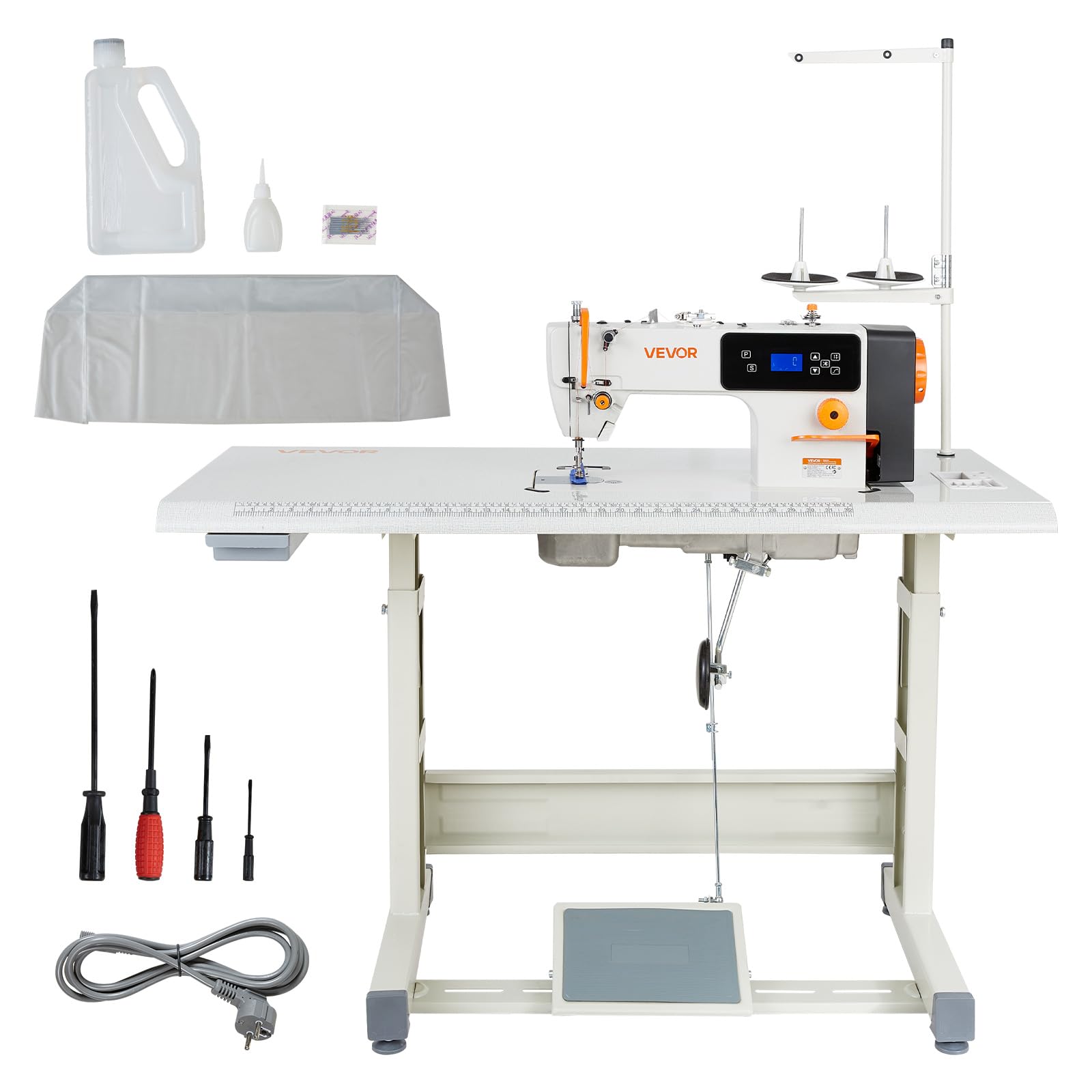
3. VEVOR Industrial Lockstitch Sewing Machine with Table Stand
Ten layers of denim is the demo, and nobody in this lineup is arguing with that number
If the thing that has kept you away from industrial machines is the price tag on the big names, the VEVOR JK9808T is the machine that closes that gap. It pairs a 550W servo motor with a top speed of 5000 SPM and claims to sew up to 10 layers of denim. Ten layers is production-grade territory — that covers denim jeans hems, canvas totes, and automotive trim in a single pass.
The metal body uses auto lubrication so the working parts stay oiled as you sew, and the noise output is held to 80 dB or less. If you have ever stood next to a clutch-motor machine, you know that number matters. The lockstitch head also comes with an LCD display that lets you set speed, needle up/down position, and soft start, plus a 0.5-inch knee lifter so you can keep both hands on the fabric while you reposition. The table height adjusts from 22.4 to 29.1 inches so you can set it to your shoulder level.
Owners praise the build quality more than any other feature. The honest catch is assembly and setup. The table and head arrive in pieces, directions are sparse, and owners describe putting it together as a three-hour job with occasional frustration. Occasionally a unit arrives with a cracked or broken part, but the seller’s customer service has a reputation for exchanging quickly when that happens.
The engineer’s read: a 550W motor driving a lockstitch head at 5000 SPM is not a toy; this is real industrial punching power at value pricing.
What you take on: budget three hours of assembly, read the manual twice, and expect to tune the machine before your first real seam.
Built for: the sewist transitioning from home machines who needs true industrial power without the premium-brand markup.
Buy in only if: you are comfortable with a wrench and a level, because the table assembly is on you.
4. Juki DDL-8100 Machine

A single-needle straight-stitch workhorse rated to 4500 stitches per minute
The Juki DDL-8100 is the classic shop-floor straight-stitch machine, and its headline figure is speed: 4500 stitches per minute. That is not a fast walk, that is a sprint, and it is the number that tells you this machine was engineered for volume work. It comes complete with a 550-watt energy-saving DC servo motor and the machine table, so you are getting the full infrastructure in one buy.
A DC servo motor spins only when you press the pedal, which means quieter operation and lower power draw than a constant-running clutch motor. The head itself is a single-needle lockstitch with a maximum foot lift of 13 mm and a maximum stitch length of 5 mm. It uses 9-18 DBX1 needles, so once you settle on a needle size you can buy them in bulk.
The one thing you cannot skip is assembly. The machine, table, and motor arrive unassembled in multiple boxes, and getting it running will take an afternoon. The bright side is that Juki has been building this head for years, so YouTube walkthroughs and QR-coded instructions from the seller exist for nearly every step. Owner bias on the machine itself is overwhelmingly positive — what buyers single out is the build quality, and the recurring note is that the setup is more about patience than skill.
What it delivers every single day
- 4500 stitches per minute for fast straight-stitch production runs
- 550W DC servo motor runs quietly and uses little power at idle
- Interchangeable with popular Juki 8500, DDL-MS and DDL-888 models
- 13 mm presser foot lift handles thick, folded, or layered fabric
What to prepare for
- Arrives unassembled; budget an afternoon to build and tune it
- Instructions are sparse, so line up YouTube walkthroughs before delivery
- Straight stitch only — no zigzag or decorative options
For: the shop that needs a single-needle factory-rated head for straight seams at production speed.
Not for: the home sewist who wants to unbox and immediately sew a decorative hem, or anyone who refuses to turn a wrench.
5. Juki DDL-8700-H Industrial Straight Stitch Sewing Machine
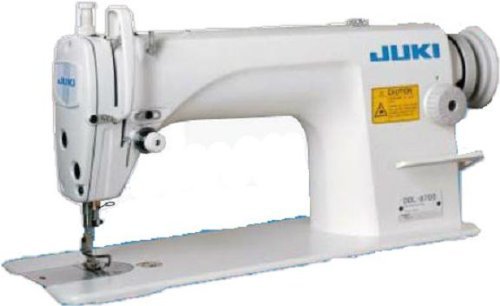
The heavy variant of Juki’s straight-stitch head, tuned for thick material
If you are working in automotive leather, thick canvas, or multi-layer denim, the DDL-8700-H is the Juki built for exactly that job. The “H” stands for Heavy — Juki beefed up the parts compared to the standard DDL-8700 to handle the extra load. Customers note that it sews through four layers of automotive leather without slowing down. That is the exact metric a leatherworker cares about, because at four layers you are working with real saddle thickness, not garment leather.
The machine ships complete with an electronic DC servo motor rated at 1/2 H.P, a table, drawer, belt, tools, lamp, and instruction manual. A 1/2 HP motor is powerful enough to chug through thick stacks, but the servo control means you still get slow, precise needle placement at the start of a seam. The table top is 48 by 20 inches, which gives you room for a large leather panel while you are working through a stitch line.
The one thing every buyer needs to know up front is that this is not a walking foot machine. The needle does the piercing, and fabric feeds from below, so for extremely slippery or layered leather you will need to guide the work carefully. Setup is in the expected range for industrial — three boxes, roughly two hours of assembly, and you will want YouTube videos open. Reliability is what buyers praise most about this head, along with its value, and the machine has a reputation for being ready to run for years with basic oiling.
Why leatherworkers keep buying it: four layers of automotive leather, a 1/2 H.P DC servo motor, and a 48 by 20 inch table top make this a purpose-built leather machine.
The one limitation: it is a lockstitch head, not a walking foot, so very slick leather stacks need careful hand guidance.
The right machine for: leather shops and heavy-bag makers who need genuine heavy-stock capability without adding a walking foot mechanism.
Only reconsider if: you are brand new to industrial machines and want a simpler setup path.
6. Juki DDL-8700 Industrial Lockstitch with iKonix 0.5 HP Servo Motor

A 4000 RPM servo-driven shop standard that clips along through hard days
This version of the DDL-8700 is speced for shops that want honest throughput without stepping up to the 8700-H heavy variant. Max sewing speed is 4000 RPM, max stitch length is 5 mm, and the machine drives through an iKonix 0.5 HP servo motor. Automatic lubrication and a full rotary hook keep the machine running smoothly through long sessions so you are not stopping to oil it every hour.
The setup detail that catches every first-time buyer is the assembly. The stand, table, motor, and head arrive as separate pieces across three shipments. Instructions are thin, and buyers generally figure out the build from Amazon pictures and YouTube videos. Budget an hour or two, and if you have a mechanically inclined friend, invite them over for the setup day.
What buyers do appreciate consistently is the final product. The 8700 is a universally supported platform — parts, feet, needles, and tension assemblies are easy to find — which means a shop can keep one running for years without hunting for spares. It is not a walking foot machine, so heavy, slippery multi-layer work still wants the Consew 206RB-5 or the Juki DU-1181 farther down this list.
Where this machine earns its keep
- 4000 RPM max speed with a 0.5 HP iKonix servo motor
- Automatic lubrication and full rotary hook
- Uses standard Juki DDL-8700 parts and feet, easy to source
- 5 mm max stitch length handles heavier fabric than a home machine
What to arrange before it lands
- Ships in three separate boxes; track every package
- No real assembly instructions; plan on video guides
- Straight-stitch single-needle only
Made for: an established shop that wants a serviceable, endlessly repairable straight-stitch head without the price jump of the walking-foot machines.
Skip if: you want a machine that arrives ready to run, since this one is a build-it-yourself kit at its core.
7. Consew 206RB-5 Walking Foot Industrial Sewing Machine

The triple-feed upholstery machine that keeps leather and canvas moving evenly
If your work is furniture upholstery, leather goods, marine canvas, or auto interiors, the Consew 206RB-5 is the machine that was designed for exactly that job. It uses a walking foot with compound feed — also called triple feed — which means the needle, the presser foot, and the feed dogs all move together through the stitching cycle. That is the technical reason thick, stiff, or slippery materials feed evenly without shifting, and for leather this is the difference between a beautiful seam and a mangled one.
The Consew is a professional-grade platform with a wide range of aftermarket feet and parts, and it comes with the machine table and servo motor. Owners call out the speed — it is a fast machine — and the value, since a machine like this will pay for itself multiple times a year in a shop that does upholstery work regularly. Owners mention speed and stitch quality most often.
The real cost is setup time. There are no assembly instructions in the box, the stock manual is difficult to read, and buyers universally recommend the machine’s YouTube setup guides instead. Expect to spend hours getting the feed timing right the first time, and expect to need some mechanical confidence. Once it runs, owners love it — one buyer’s verdict: “It’s a damned dream!!!”
The pro setup: triple-feed walking foot, table, and servo motor — everything needed for upholstery from the start, minus the learning curve.
The honest caveat: this is not a beginner’s first machine. Setup takes hours, the manual is poor, and the feed timing has to be right before you sew on real leather.
For the upholsterer: furniture, leather, marine canvas, and auto interiors are exactly the jobs walking foot compound feed was engineered for.
Not for: the first-time industrial buyer who has never owned a machine with a separate table and motor.
8. Juki DU-1181 Single Needle Walking Foot Machine

A walking-foot Juki built for the materials that slide under lesser machines
The distinguishing spec on the Juki DU-1181 is its 9 mm maximum stitch length. Nine millimeters is a long stitch — this is the kind of stitch length you see on heavy canvas, thick leather panels, and bag straps, where shorter stitches would perforate and weaken the material. Combined with the machine’s top and bottom feed mechanism, it feeds hard-to-handle materials consistently and keeps stitch pitch even across multilayered sections.
Speed tops out at 2000 stitches per minute, which is slower than a straight lockstitch like the DDL-8100. The machine ships with a knockdown table and a 3/4 H.P DC servo motor, plus the standard oil pan, knee lifter, and accessories.
The recurring gripe is the same one industrial machine buyers run into everywhere — no usable assembly instructions. The parts come in a knockdown kit, and the build requires either mechanical confidence or a paid assembler. Once assembled, it has a strong reputation for build quality.
What makes it shine on hard materials
- Top and bottom feed moves thick, layered, or slick material evenly
- 9 mm max stitch length suits heavy canvas, leather straps, and thick seams
- Automatic lubricating mechanism reduces maintenance
- 3/4 H.P DC servo motor with knockdown stand included
What to plan for
- Arrives as a knockdown kit requiring real assembly
- No usable included instructions; video guides are required
- 2000 SPM is slower than a straight lockstitch by design
Best pick for: the shop that regularly sews multi-layer canvas bags, thick leather straps, and materials that shift under drop-feed machines.
Look past it if: you need only speed for straight garment seams, since the DDL-8100 covers that job better.
9. Juki DU-1181N Industrial Top and Bottom Feed Sewing Machine

A walking-foot Juki with a clutch motor and a 90-day standard warranty
The DU-1181N is the closest cousin to the DU-1181 just above, but a few specs separate them. It runs a maximum speed of 2000 stitches per minute and a 9 mm maximum stitch length, matching its sibling, but it uses a DB X 1 needle instead of the DU-1181’s DP×17 needle. Different needle systems suit different applications, so check before you commit if you already have a drawer of one or the other. It also ships with an industrial clutch motor rather than a DC servo motor, so you get the traditional constant-running feel instead of the variable-speed control of a servo.
The frame supports a 48 by 20 inch work area, and the machine is built as a metal-frame, top-and-bottom-feed unit that handles canvas, heavy upholstery, and multi-layer construction. It is a serious workshop machine, and the buyer verdict leans heavily positive — the recurring issue is that the machine arrives in three boxes and requires assembly. Owners rate it a heavy canvas workhorse with reliable build quality.
The trade-off versus the servo-driven sibling is power draw and idle noise. A clutch motor stays energized while the machine waits, so it uses more electricity and generates more ambient noise than a servo-driven unit. If you plan long shifts and lower power bills, the servo model may be the better call. If you grew up on clutch machines and prefer the classic feel, this one delivers that.
The workshop choice: a Juki top-and-bottom feed canvas machine with a 48 by 20 inch frame and a 90-day standard warranty.
The catch to know: it comes with a clutch motor, so it draws more at idle than the servo-driven sibling — a real consideration if power cost or noise is a deciding factor.
Fits the canvas workshop: heavy upholstery, bags, and outdoor gear get real walking-foot feed with a proven Juki head.
Reconsider if: you want a quieter, more efficient servo powerplant, in which case the standard DU-1181 above is the better fit.
10. Janome MC6650 Sewing and Quilting Machine
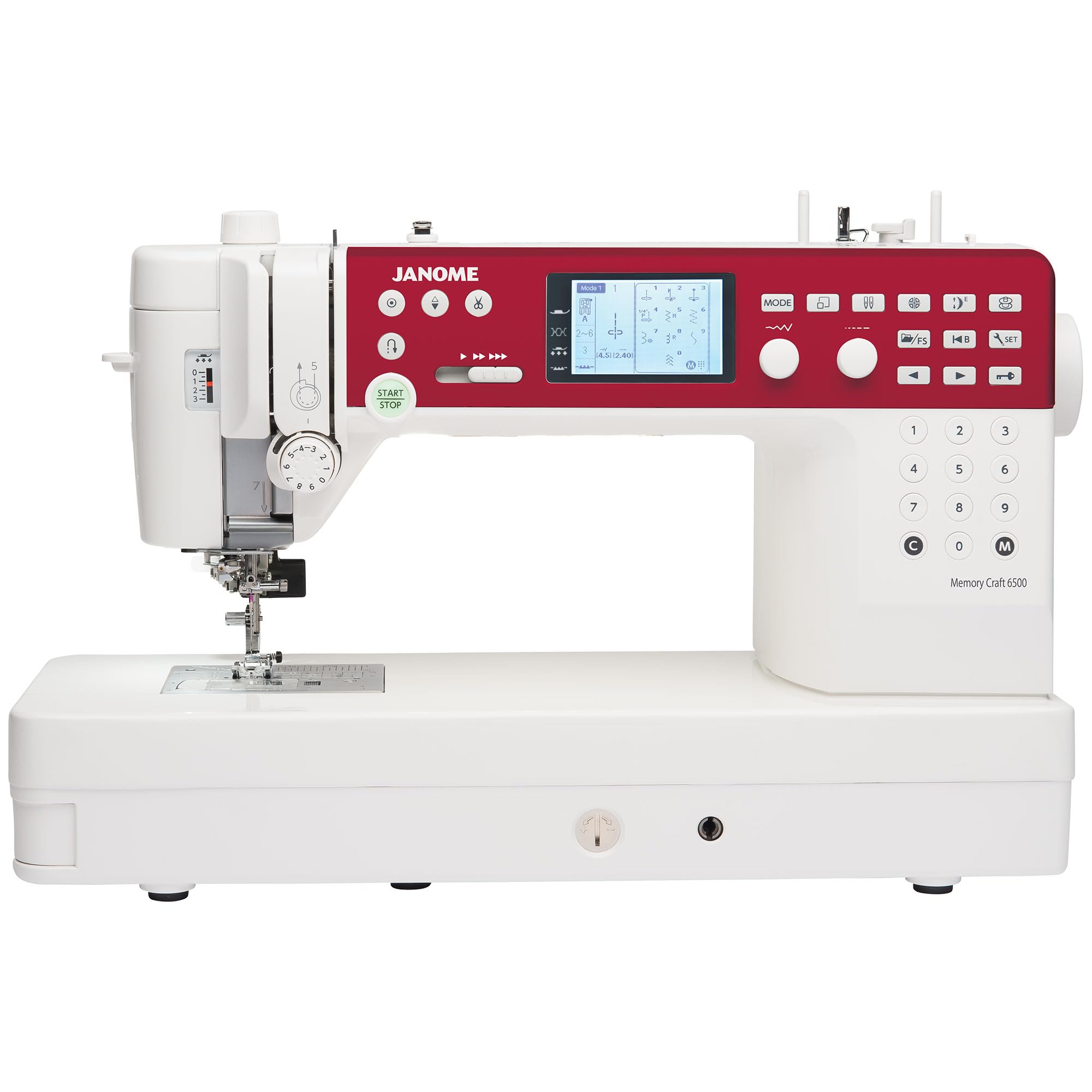
A semiprofessional quilting machine that punches a quilt block in quiet comfort
The number that matters most on the Janome MC6650 is the 10-inch throat space. Throat space is the distance between the needle and the right side of the machine body, and 10 inches is enough room to roll a whole quilt block through the machine without fighting the fabric. For quilters, that number turns a frustrating task into a manageable one, because a larger throat means less bunching and fewer stops to reposition a heavy quilt.
Speed reaches 1000 stitches per minute, which comfortably handles garment construction and quilting work without being wasteful. The machine is built on an all-metal smooth flatbed with an aluminum body frame, and Janome designed it to combine semindustrial durability with modern convenience — that means a built-in needle threader, an independent bobbin winder, and a one-push needle plate conversion, so you can swap between a straight-stitch plate and a zigzag plate without a screwdriver.
Quilting and tailoring reviewers point out the machine handles four layers of heavy denim plus two layers of interfacing, which tells you it has more punch than most home machines and a real working capacity for crafters. There are small things to be aware of: the auto needle threader has a reputation for splitting synthetic threads while handling cotton cleanly, and some owners flag that the price tag is on the higher end for a home-style machine. Owners still call it a genuine workhorse that keeps earning its keep for years.
What keeps quilters coming back
- 10″ throat space gives you room for a full quilt block
- 1000 stitches per minute across quilting, tailoring, and craft work
- All-metal smooth flatbed with an aluminum body frame
- Built-in threader, independent bobbin winder, and one-push needle plate conversion
- 6 LEDs across 3 locations put light where you need it
Worth knowing before you pay
- Auto needle threader has a habit of splitting synthetic threads
- Home-machine category — will not match a 550W industrial servo for volume
- Premium pricing compared with basic computerized machines
The one to reach for: quilters and tailors who want a semiprofessional flatbed with 10 inches of throat and full accessory kit.
Consider elsewhere if: your day job is denim or leather production, where a straight-stitch industrial head is the better tool.
11. Smartstitch S-1001 Machine

Ten needles, a 7-inch touch screen, and auto color changes — a real embroidery shop in a compact frame
The Smartstitch S-1001 is a different kind of machine — this is commercial embroidery rather than lockstitch sewing. Ten needles means you can load ten colors and the machine auto-switches between them without stopping, which is the key feature of a multi-needle commercial embroidery unit. A 9.5 by 14.2 inch embroidery area gives you room for logos on shirts, hats, and bags, and the 7-inch touch screen handles design loading and job setup.
Top speed is 1200 SPM (stitches per minute), and the machine packs in the features that separate a real commercial embroidery head from a home version — auto thread trimming, auto color changing, thread break detection, self-lubrication, laser embroidery positioning, and up to 100 million stitches of memory. It stitches on denim, canvas, leather, vinyl, caps, shoes, and bags, feeding designs from your computer over USB or WiFi using DST and DSB files. There is a physical button set for quick actions, positioned alongside the touch screen.
What buyers talk about most is the setup experience and the support. The machine ships with threads, stabilizers, and bobbin threads in the starter pack, and Smartstitch pairs the purchase with video training and a Facebook user group. That group matters because embroidery has a lot of moving pieces — tensions, hooping, digitizing — and having a live community available shortens the learning curve significantly. The one thing to plan around is physicality: at 93 pounds on a 25″D x 34″W x 33″H frame, this is a floor machine, not a tabletop unit.
Why it gets picked for shops: 10 needles, 1200 SPM, a 7-inch touch screen, and a 9.5″ x 14.2″ embroidery field put this in commercial territory.
What to keep in mind: the learning curve is real, and the machine needs the included training and support group to get you past the first days of tension tweaking.
The machine for: a growing embroidery business that needs multi-color production on caps, shirts, and bags without buying two machines.
Skip if: you want to sew garments and use embroidery as a side feature — the S-1001 is dedicated t o embroidery only.
Know the Specs
Servo motor versus clutch motor
A servo motor runs only when you press the pedal, which means slower needle placement, quieter operation, and lower power draw at idle. A clutch motor keeps the motor spinning constantly and engages a clutch when you press the pedal — louder, hotter, and thirstier for electricity, but with a traditional feel some machinists prefer. Most machines here use servo motors, and for continuous work the servo is the more comfortable choice. The Consew 206RB-5, Juki DDL-8100, VEVOR JK9808T, and Juki DDL-8700 heads all use servo drives, while the DU-1181N ships with a clutch motor.
Walking foot and compound feed
A walking foot machine uses a presser foot that moves in sync with the needle, so fabric is held and advanced by multiple contact points at once — top and bottom feed working together rather than just the feed dogs underneath. That consistent grip is why walking foot machines, such as the Consew 206RB-5 and Juki DU-1181, feed thick, layered, or slick material evenly. Drop-feed machines rely on the feed dogs alone and can let heavy leather shift off course. Straight lockstitch heads like the DDL-8100 move fabric from below only, which is ideal for garment seams but not for stacked upholstery leather.
Common Questions
Will an industrial sewing machine work in a home with standard 110 volt power?
How much assembly is required before I can sew on these machines?
What is the difference between a lockstitch machine and a walking foot machine?
Can I sew leather on these industrial machines?
What stitch length do I need for canvas and denim work?
How many stitches per minute do I actually need?
Do these machines need a dedicated table or can I use a normal desk?
What kind of needles and thread do I need for these machines?
Is a commercial embroidery machine better than a sewing machine plus an embroidery attachment?
How long do these industrial sewing machines last?
The Bottom Line
For most buyers shopping for the best industrial sewing machines, the winner is the Janome JW8100, because it packs 100 stitches, a 7-piece feed dog system, and a full accessory kit into a 12-pound body that a home workroom can actually hold. If upholstery, leather, or canvas is your job, grab the Consew 206RB-5, whose triple-feed walking foot is exactly what keeps stiff material feeding evenly. And for high-speed straight-stitch production, the VEVOR JK9808T is the one to reach for, thanks to its 550W servo motor, 5000 SPM speed, and 10-layer denim capacity at a price below most industrial heads. For anyone crossing into commercial embroidery work, the Smartstitch S-1001 brings 10 needles and auto color changing into a compact frame, and the training and user community it ships with make the learning curve shorter than the spec sheet suggests.
How we choose
We do not accept paid placement. Every pick is matched to a real buyer and a real use-case; we do not hands-on test units.
Sources
Specifications: manufacturer listings and product documentation. Review insights: verified customer reviews, as of October 2026. Pricing: not shown on this page (it changes often); check the current price via the retailer link.
As an Amazon Associate, Aappliancez earns from qualifying purchases. This does not affect which products we feature.