Disclosure: Some links in this post are affiliate links. As an Amazon Associate I earn from qualifying purchases, at no extra cost to you. Learn more
Specs are compiled from manufacturer listings and verified buyer reviews and can change over time — please confirm the key details on the product page before buying.
Blowing into a little plastic tube sounds too simple to matter — until you notice you are climbing stairs on autopilot again. An IMST device (inspiratory muscle strength training: a handheld trainer you breathe through against resistance) does one job, and it does it without batteries, prescriptions, or a gym membership. The trick is picking the right resistance style and the right resistance range for where your lungs are today, not where a product page assumes they are. This guide covers six real options, who each one suits, and the honest trade-offs you will actually feel in week two.
This guide is built by comparing the manufacturers’ published specifications and the patterns across verified customer reviews, so you get each pick’s real strengths and trade-offs instead of marketing spin.
Manual trainers, flutter valves, and app-connected digital units each suit a different set of lungs — so the list below sorts them by who they fit rather than by which box looks flashiest on a shelf. If you want gentle beginner resistance, this breakdown of the best imst device covers the six worth your attention.
Top Picks


How To Choose The Best IMST Device
Almost every buying mistake in this category comes from confusing the three types of resistance — and from starting too hard. Get those two things right and the device itself barely matters.
Know which muscle you are actually training
IMST means inspiratory muscle strength training — you breathe in against resistance, which works the diaphragm and the muscles between your ribs. IMT and IMST are the same idea under two names. PEP and expiratory training work the opposite direction: you push air out against resistance, which is the motion that helps move mucus. A dual-action trainer like the Bigbreathe does both, while a dedicated flow device like the Flutter Valve leans on the exhale side. If you only want to strengthen your inhale, a pure inspiratory trainer is the simpler buy.
Adjustable resistance beats fixed resistance
A trainer you cannot dial back is a trainer you stop using. Look for a device with clearly marked resistance settings, and start at the easiest one — progress is measured in weeks, not sessions. The Breather Pink and the Sonmol both let you step up gradually, and the Breather Pink needs no batteries at all. A device with only one resistance level, like the POWERbreathe Blue, is built for a specific training intensity and leaves you less room to adapt.
Decide if you want data or just a habit
Manual trainers ask nothing of you but five minutes twice a day. App-connected units add digital pressure measurement — MIP and MEP, which are the maximum pressures you can pull in and push out — so you can watch the numbers climb. That readout is genuinely motivating for some people and pure friction for others, since it means pairing a phone every session.
Cleaning and travel are part of the decision
Every device here goes in your mouth, so how easily it comes apart matters. Tool-free designs that rinse under a tap get used; ones with fiddly parts get abandoned in a drawer. If you train away from home, check whether a case or a pocketable shape is included, because a trainer left behind is a training streak broken.
Side-by-Side Comparison
| Model | Best For | Resistance Type | Adjustable Levels | Weight | Amazon |
|---|---|---|---|---|---|
| The Breather Pink★ Best Overall | Beginner-friendly daily lung training | Inspiratory and expiratory resistance | Adjustable resistance settings | 0.1 kg package weight | Amazon |
| Bigbreathe IMT/PEPDual-Action Pick | Dual-action training with mucus clearance | Dual-mode IMT and PEP | Independently adjustable inhale and exhale | 1.76 ounces | Amazon |
| Sonmol Digital | Tracking progress with an app | Inspiratory and expiratory resistance | 6 levels each side | 4 ounces | Amazon |
| THE BREATHER | Established daily training with guided video | Inspiratory and expiratory resistance | Adjustable resistance | 1.59 ounces | Amazon |
| Flutter Valve Device | Mucus clearance with a dial | Flutter valve (oscillating expiratory pressure) | Adjustable resistance dial | 4.16 ounces | Amazon |
| POWERbreathe Blue | Athletes training to a set load | Inspiratory resistance | 1 resistance level | 200 g | Amazon |
Detailed Reviews
1. The Breather Pink
Our pick — 4.5+★ from 400+ verified ratings; the strongest balance of quality and price.
The five-minute session that needs no charger, no setup, and no learning curve
If you want the shortest possible path from unboxing to actual training, this is it. The Breather Pink runs on a battery-free resistance design — you inhale and exhale through the mouthpiece for about 5 minutes, twice a day, and dial the resistance up as your breathing gets easier. There is nothing to install and nothing to pair, which is exactly why it gets used instead of shelved. It is the pick I would hand a first-timer who has never held a breathing trainer before.
What wins people over is build quality — it is the quality of the unit itself, more than any single feature, that earns the most praise, closely followed by how quickly you can learn to use it. Owners describe it as simply designed and easy to clean, and one long-running theme is that you can train with it anywhere, sitting or standing, with no surface or outlet required. One buyer with COPD reports the device is helping noticeably with daily breathing. Another reports smoother breathing after consistent use, and a third credits two weeks of use with reversing a decline their pulmonary visit had been tracking.
The honest follow-up question is value. A portion of buyers feel the device is priced above what a small piece of molded plastic should cost, and one mentions that the older version shipped with a storage container that this one does not include. Cleaning is straightforward — some owners use CPAP wipes or alcohol on the mouthpiece — but without a case, a pet or a crowded gym bag can end the device’s life early. It is also a commitment device: skipped weeks mean skipped results, and a few people find that the full exhale needed to fully empty the lungs takes real abdominal effort at first, which can trigger coughing as bronchial moisture loosens.
What earns it the top slot
- Battery-free, adjustable resistance with a 5-minute, twice-daily routine that is genuinely easy to stick to.
- A guided coaching app adds pacing guidance and progress records so you are not guessing whether your technique is right.
- Compact 7.17 x 2.87 x 2.36-inch package and light build make it a toss-in-the-bag trainer.
- Simple design cleans quickly, and buyers report it holds up over months of daily use.
Where it asks something of you
- No storage container in the box — some buyers think the price asks a lot for a manual trainer.
- Results track directly to consistency; miss sessions and the resistance setting stops feeling easier.
- The full exhale technique takes practice and can provoke coughing as airways clear.
Reach for this if: you want a no-fuss, no-charger trainer you can use at a desk, on a couch, or in a hotel room with a five-minute daily habit.
Think twice if: you want the box to include a case and a digital readout — the Sonmol below covers both.
2. Bigbreathe IMT/PEP Breathing Exerciser
One mouthpiece, two jobs: build inspiratory strength and push mucus out of the airways
Most trainers pick a side. This one covers both inhale and exhale, with resistance you set independently for each direction — so you can load your inspiratory muscles hard while leaving the expiratory side light, or flip that around when congestion is the problem. It is the only device on this list that does both jobs in a single unit, and at 1.76 ounces it is the lightest pick here. That combination makes it the practical choice for anyone whose training goal is not purely athletic.
Portability is where it separates itself from the pack. The whole thing slips into a pocket or a bag, which is why travel comes up so often in owner feedback. As the review pages put it: “I have had this device for almost 3 months now and have actively been using it. It is easy to use, easy to clean, adjustable in resistance for inhalation and exhalation independently as well as being a compact device that is readible slipped in a pocket or bag.” Owners also single out the quality of the build, the ease of the daily routine, and how much resistance room there is to keep pushing as strength returns. The cleaning routine is genuinely tool-free — the structure comes apart and rinses under a tap, no tools involved.
The catch is the learning curve on the dial itself. The two-way layout is not obvious from the instructions alone, and it takes some fiddling to learn that the PEP side sits near the mouthpiece while IMT is at the opposite end, with the white center ring setting pressure and the red rings indicating your setting. Treat those printed directions as a starting puzzle rather than a manual, and budget a session or two to get oriented. A couple of buyers also found the resistance ceiling too high for a gentle start — if you are recovering from an injury and need a light breathing tube rather than a workout, this is more device than you want.
The dual-mode advantage: independent inhale and exhale resistance in one 1.76-ounce body means one purchase covers both inspiratory strengthening and the expiratory work that helps clear mucus.
Plan for the dial: the resistance-setting scheme takes hands-on experimentation before it clicks, so read the markings carefully on day one instead of assuming the default is the easy end.
Pick this one if: your routine needs both directions of resistance and you want something that disappears into a jacket pocket.
Look elsewhere if: you need the gentlest possible starting resistance — a single-mode trainer will ease you in more comfortably.
3. Sonmol Digital Breathing Exercise Device
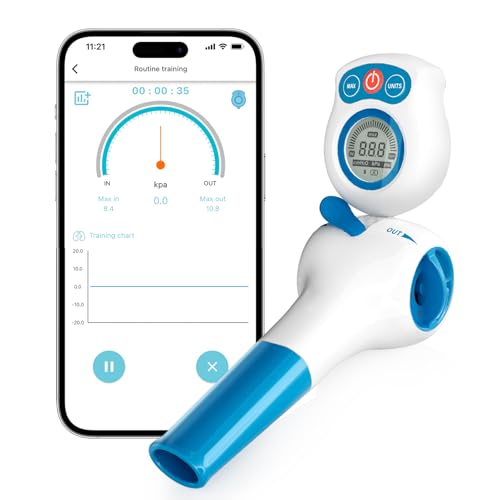
The one that turns your breathing into numbers you can actually watch move
Numbers change behavior, and this is the only device here that gives them to you. It supports MIP and MEP tests — maximum inspiratory pressure and maximum expiratory pressure, the two measurements that show whether your breathing muscles are getting stronger — using a digital manometer and a mouthpiece. You test roughly every 4 weeks and the app charts the difference. Six independent resistance levels on separate inhale and exhale dials mean you can start at the easiest setting in each direction and climb at your own pace.
Effectiveness is the thing it is known for, and the app is what keeps people coming back. It connects over Bluetooth and auto-syncs your training data, so there is no manual logging, and the games — “Little Beluga Whale” and “Inflate the Balloon” — give a post-surgery or recovery routine a reason beyond duty. One owner reports a constant cough eased after regular use. Others point to the kit as a whole: a carrying case for the attachments, easy cleaning, and a build that holds up to repeated use. For someone who has been told to do daily breathing exercises but finds them tedious, the feedback loop is the difference between a habit and a forgotten gadget.
Setup is where the friction lives, and it is worth knowing before you buy. The companion app is not on the Play Store — you download and install it through a browser — and Bluetooth pairs through a button inside the app’s manometer screen rather than through your phone’s settings menu. Guidance inside training mode is on the thin side, mostly telling you to take slow breaths for 5 to 10 minutes. None of that breaks the device; it just means the first session doubles as a setup session. The 4-ounce build and included travel case make it the most genuinely portable of the digital options.
Progress you can see: digital MIP and MEP measurement plus automatic app logging turns a vague “I think I’m improving” into a chart, which is the strongest reason to choose digital over manual.
Budget an awkward first evening: the browser-install app and the in-app pairing button are quirks, not faults, but they will cost you 20 minutes once.
Suits you if: you are the type who sticks with a routine when you can see the line on a graph going up.
Skip the app entirely if: you would rather just breathe for five minutes and close the drawer — the Bigbreathe above does that with no phone involved.
4. THE BREATHER

The category veteran with the deepest track record and the most complete training program
When a device has been around long enough to accumulate thousands of owner experiences, that history is the feature. This one trains both inhale and exhale muscles and pushes you toward diaphragmatic — belly — breathing, which is the technique that actually translates into endurance. At 1.59 ounces it is lighter than the Flutter Valve’s 4.16 ounces and compact enough at 5.1 x 1.7 x 1.8 inches to live in a desk drawer. That is meaningfully more pocketable than the Sonmol, which measures 3 x 2.1 x 6 inches.
The owner stories around this one are unusually concrete. A daily user who started at 92% blood oxygen measured 95% after a month, with resting pulse falling from 70 to 50 as diaphragmatic breathing became habit. Another describes five minutes a day, one week per resistance level, six weeks total, and credits it with better breath endurance in summer cardio sessions. Owners with COPD describe steady improvement over weeks, and the guided app is repeatedly credited with keeping technique correct through paced breaths, reminders, and progress tracking. Durability earns consistent praise alongside that, with the sealing and setup both described as dependable.
The trade-off buyers raise most is cost, and it is a fair question to ask of any manual trainer. The counterweight is longevity: this is a device people describe using for years, which is precisely where cheaper molded trainers fail. One honest note from the ownership record — durability is mostly praised, but breakage has been reported in the range of weeks rather than years on a small number of units, so keep your purchase records. The breathing technique itself demands attention; this rewards someone willing to follow the video protocol rather than someone who wants to wing it.
Why the track record matters
- Guided online video protocol gives you a structured progression instead of guesswork.
- Trains both directions and promotes diaphragmatic breathing, the technique that carries into real endurance.
- Compact and light at 1.59 ounces, well under the Flutter Valve’s 4.16 ounces.
- Sturdy sealing and simple cleaning, with owners describing years of daily use.
What to weigh honestly
- Priced above most manual trainers, which some buyers find hard to justify for the materials involved.
- A small number of units have been reported breaking early, so keep your receipt.
Best fit for: someone who wants a proven protocol to follow and a device that will still be in the drawer years from now.
Not the pick if: you want to skip the program and just improvise — the structure is where the value sits.
5. Flutter Valve Device for Lungs
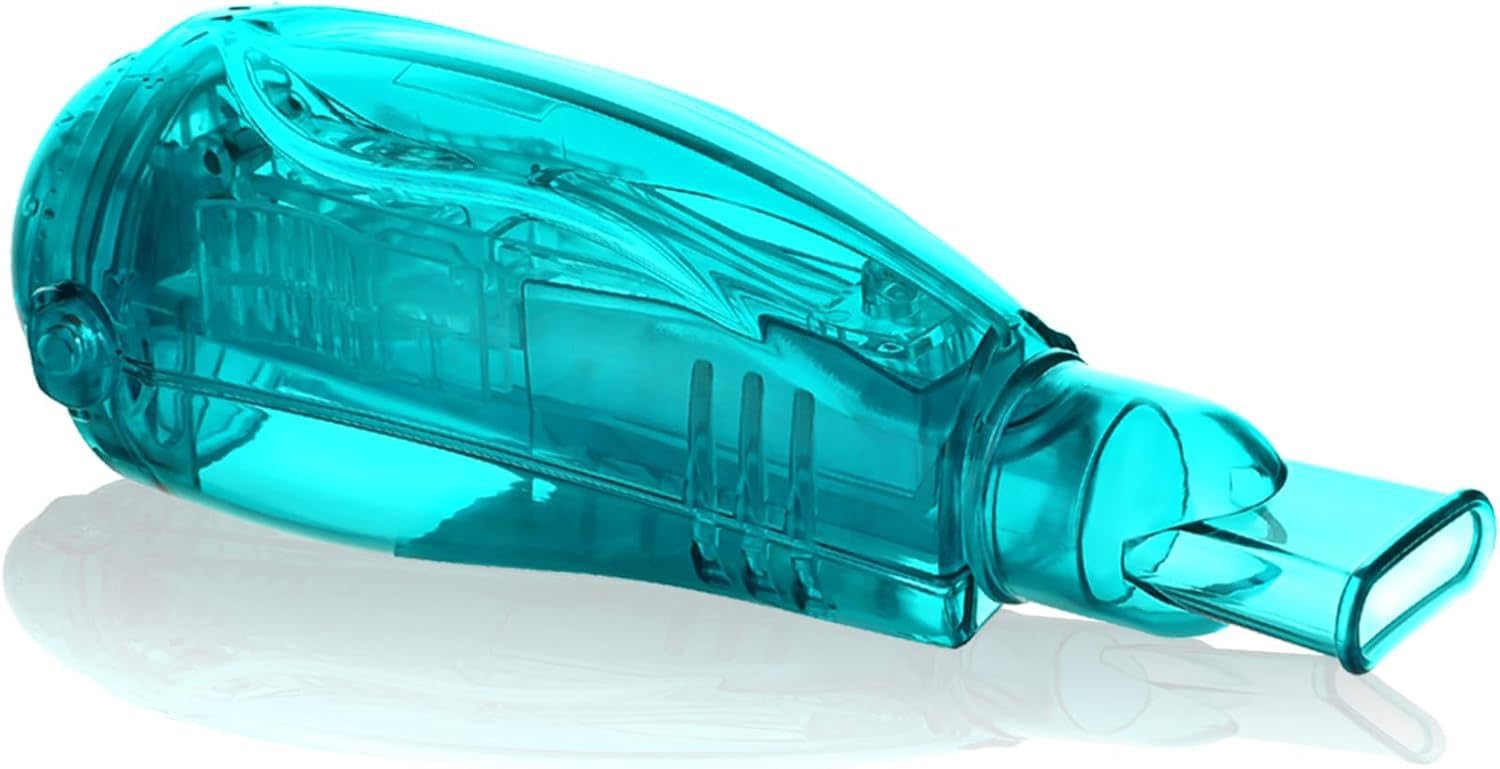
A flutter valve that shakes the airways loose instead of just loading the muscles
A flutter valve works differently from every other trainer here. As you exhale through it, an internal mechanism vibrates the airflow, and that oscillation is what helps loosen and move mucus rather than simply building strength. If your reason for training is congestion you cannot shift — after a chest infection, or with a condition that keeps airways thick — this is the category you want, not a pure resistance trainer. The adjustable dial lets you set the intensity, and the medical-grade construction is built for repeat daily use and easy cleaning.
Effectiveness is overwhelmingly what people talk about, and owners describe breathing more freely after sessions. Assembly is simple, and the resistance dial means you can find a comfortable setting before pushing harder. For post-congestion mucus clearance, the flutter action does work that a straight resistance tube cannot, and a compression-style routine with it becomes second nature within a week or two of daily practice. One owner’s summary captures the family-side experience: “Awesome!! More comfortable than conventional breathing exercise devices. My mom is so happy and our family grateful. Getting better everyday.” Several describe it as comparing favorably to the original Acapella device they had used before.
Where this one asks patience is at the start. The flutter technique is not intuitive — you have to practice the exhale rhythm before the vibrations feel productive, and the first few sessions can feel like nothing is happening. Build consistency is also mixed: durability draws strong praise, while other owners describe the feel as less solid than expected for a medical-grade claim. And value splits buyers down the middle — some consider it a high-value tool, others feel it does not justify its premium-tier price. It is the heaviest device on this list at 4.16 ounces, still small enough for a bag but not a true pocket item.
The flutter advantage: oscillating exhalation pressure is the only mechanism here that directly targets airway clearance, which is why mucus relief dominates owner feedback.
Give it a week: the technique takes practice before it feels effective, and the build feel does not match the premium price for every buyer.
Choose it if: clearing congestion is your primary goal and you want a dial to tune intensity rather than a fixed resistance.
Consider the Bigbreathe instead if: you need strength training in both directions rather than mucus clearance specifically.
6. POWERbreathe – Blue, Medium Resistance

Built for the workout crowd, sold in a fixed medium resistance and honest about it
This is the only device here aimed squarely at exercise and fitness rather than recovery or daily breathing health. It is a single-resistance inspiratory trainer in medium, made of synthetic rubber with a non-slip grip, and it ships with a carrying case — a genuinely useful inclusion that the Breather Pink and the Sonmol differ on. If you are training for running, cycling, or another endurance sport and want a fixed load to work against, the medium resistance is the setting you are choosing deliberately rather than a compromise.
What people consistently value is that it does the job it advertises: improving lung capacity and helping with running endurance. Owners mention measurable lung-strength gains over three months of daily use, and the simple design keeps ease of use off the complaint list. It is a compact, hand-held unit at 200 g, easy to clean, and light enough to carry in the included case to a gym or on a trip. For the fitness-first buyer, the fact that it does not need batteries or an app is a plus, not a limitation.
The honest caveats are durability and price, and both show up in the ownership record. The build is plastic-heavy, and at least one long-term user describes the unit breaking after roughly nine months of five-day-a-week use — though that same buyer also reports the manufacturer replaced it, which softens the concern considerably. Value is the sharper question: a meaningful share of owners feel the price is steep for the simple construction involved. And because resistance is fixed at one level rather than adjustable, you cannot dial back for an easy day or step up gradually the way you can with the Breather Pink or the Sonmol.
What athletes get
- Medium resistance is a deliberate training load aimed at endurance athletes, not a universal setting.
- Compact 200 g body with a non-slip grip and an included carrying case for gym bags.
- Battery-free and app-free — nothing to charge, pair, or maintain.
- Customers note measurable lung-capacity gains over months of consistent use.
What to accept going in
- Only one resistance level — no adjustment for easy days or gradual progression.
- Build is simple plastic, and long-term durability is the recurring concern.
- Many buyers consider the price high relative to the materials.
Reach for this if: you are training for a sport, want a set resistance load, and value a case plus a non-slip grip over app features.
Look elsewhere if: you need to start easy and increase gradually — a device with adjustable levels will serve you better.
Know the Specs
Resistance type: inhale, exhale, or flutter
This is the single most important thing to get right. Inspiratory resistance trains the muscles you use to breathe in — the diaphragm and the muscles between your ribs. Expiratory resistance works the muscles that push air out. Flutter resistance adds an oscillating vibration to the exhale, which is the mechanism aimed at loosening mucus. A dual-mode device like the Bigbreathe lets you set inhale and exhale resistance independently, so you can train one direction harder than the other. Match the type to your actual goal before you compare anything else.
Resistance levels and how to place yourself
Adjustable resistance is what makes daily training sustainable, because your starting point should feel easy rather than challenging. The Sonmol offers 6 resistance levels on separate inhale and exhale dials; the Flutter Valve uses a single adjustable dial; the POWERbreathe Blue is fixed at medium resistance with 1 resistance level. With a manual dial device, set the resistance so you can complete your session without straining, then move up only when the current setting feels light. Progress across weeks, not within a session.
Digital measurement: MIP and MEP
MIP and MEP stand for maximum inspiratory pressure and maximum expiratory pressure — the strongest pull and push your breathing muscles can produce. A digital device like the Sonmol measures both through a manometer and a mouthpiece, and the recommended rhythm is to test roughly every 4 weeks so you can see change over time. Manual trainers do not measure anything; you judge progress by feel and by how easily a resistance setting moves. Neither approach is wrong — measurement motivates some people and adds friction for others.
Portability, weight, and cleaning
Weight matters more than it sounds, because the device only helps if it travels with you. The Bigbreathe is the lightest here at 1.76 ounces with a genuinely pocketable shape; the Flutter Valve is the heaviest at 4.16 ounces. Weight and travel-friendliness are not the same thing, though — the Sonmol weighs 4 ounces but includes a dedicated travel case for its attachments. On hygiene, look for tool-free disassembly: the Bigbreathe rinses under a tap without tools, and owners of several devices here clean mouthpieces with alcohol or dedicated wipes.
Common Questions
What is the difference between an IMST device and a PEP device?
How do I know which resistance level to start at?
How long does a daily breathing training session take?
Do I need a phone or app to use an IMST device?
How often should I clean my breathing trainer?
Can I use an IMST device if I have COPD or asthma?
What is a flutter valve and do I need one?
How long before I notice a difference from daily training?
Should I choose the Breather Pink or the original THE BREATHER?
Are these devices suitable for seniors or someone recovering from surgery?
The Bottom Line
For the widest range of people, the best imst device here is The Breather Pink, because it asks for five minutes twice a day, needs no charging or pairing, and carries the strongest owner consensus in the group on build quality and ease of use. If your routine needs both inhale and exhale resistance in one pocket-sized unit, the Bigbreathe IMT/PEP covers both directions and weighs just 1.76 ounces. And if watching a progress chart is what keeps you honest, the Sonmol Digital turns every session into MIP and MEP data you can compare month to month. One nudge worth acting on: the THE BREATHER carries the deepest ownership record in this category, so if you would rather follow a proven program than experiment, that is where the evidence points.
How we choose
We do not accept paid placement. Every pick is matched to a real buyer and a real use-case; we do not hands-on test units.
Sources
Specifications: manufacturer listings and product documentation. Review insights: verified customer reviews, as of October 2026. Pricing: not shown on this page (it changes often); check the current price via the retailer link.
As an Amazon Associate, Aappliancez earns from qualifying purchases. This does not affect which products we feature.