Disclosure: Some links in this post are affiliate links. As an Amazon Associate I earn from qualifying purchases, at no extra cost to you. Learn more
Specs are compiled from manufacturer listings and verified buyer reviews and can change over time — please confirm the key details on the product page before buying.
An i-cord is a thin knitted tube of yarn, and an i-cord knitting machine makes one in minutes instead of hours of hand-cranking. If you want the short answer: the Caydo Electric F1 is the one worth buying for most people, because it runs off a motor and two hanging weights instead of your arm. Everything below helps you pick between an electric model and a hand-crank one, and tells you which yarns each machine will actually accept.
This guide is built by comparing the manufacturers’ published specifications and the patterns across verified customer reviews, so you get each pick’s real strengths and trade-offs instead of marketing spin.
A knitting machine is only as good as its hook count, its clamp, and the yarn it tolerates, so check those three before anything else. The picks below spell out how an i-cord knitting machine behaves on a real table before you commit to one.
Top Picks

How To Choose The Best I-Cord Knitting Machine
Decide first if you want the machine to do the work or you want to do the cranking. An electric i-cord knitting machine (a motorized tool that makes a knitted tube cord) feeds yarn through on its own, so your arms stay free for moving the weights and watching the hooks. A manual hand-crank model costs less muscle in the setup and more in the using. Neither wins in the abstract — it depends on whether you are making one cord for a bag handle or twenty for a market stall.
Count the needles before anything else
The needle count decides the diameter of the tube you pull off the machine. Four needles give you a slimmer cord for bracelets, bag trim, and lettering. Six needles give you a wider, firmer tube that holds its shape as a bag handle or a coaster edge. If your project list is mostly accessories, the four-needle version covers it. If you want handles that carry weight, look at the six-needle builds.
The weights are not an accessory
Those two little hanging weights are what keep the yarn under steady tension while the hooks lift it. Without them the cord comes off twisty and uneven, and you end up fighting the machine instead of guiding it. Several designs ship with weights, and some come with weights that are too light for thicker yarn, which is where a hand held on the cord comes in. Check that weights are included in the box.
Yarn compatibility is where most frustration starts
A small knitting mill pulls yarn through a fixed gap, so yarn that is too thick will jam or knot. Bulky yarns tangle more often, while medium-weight acrylics tend to run cleanly. Some machines accept a wide spread of thicknesses and some are picky, and a few are limited to cord under 2.50mm. Read the yarn guidance for the specific model rather than trusting the word “versatile.”
Clamp, portability, and where you will actually work
A table clamp is what lets you use one hand instead of two, and a detachable clamp means you can carry the machine to a class or a friend’s table. The clamp also sets how thick your table edge can be, so measure your desk before you buy. Lighter units travel better; heavier ones sit steadier when the motor is running.
Side-by-Side Comparison
| Model | Best For | Drive | Needle Setup | Weight | Amazon |
|---|---|---|---|---|---|
| Caydo Electric iCord Knitting Machine F1★ Best Overall | Most crafters who want the motor to do the work | Electric motor | Hooks (model KC-i1) | 1.56 pounds | Amazon |
| Etcokei iCord Knitting MachinePremium Pick | Hands-free cord-making in a compact housing | Electric motor | Circular form factor | — | Amazon |
| Tulip I-Cord Knitter | Learning the motion before going motorized | Hand crank | 3 looper hooks | 321 g | Amazon |
| Caydo F1 Lite (4-needle) | Travel and budget-friendly cord-making | Manual crank | 4 or 6 hooks | 1.1 pounds | Amazon |
| Caydo F1 Lite (6-needle) | Thicker cords for bag handles and trims | Manual crank | 6 needles | 1.79 pounds | Amazon |
Detailed Reviews
1. Caydo Electric iCord Knitting Machine F1
Our pick — 4.0+★ from 250+ verified ratings; the strongest balance of quality and price.
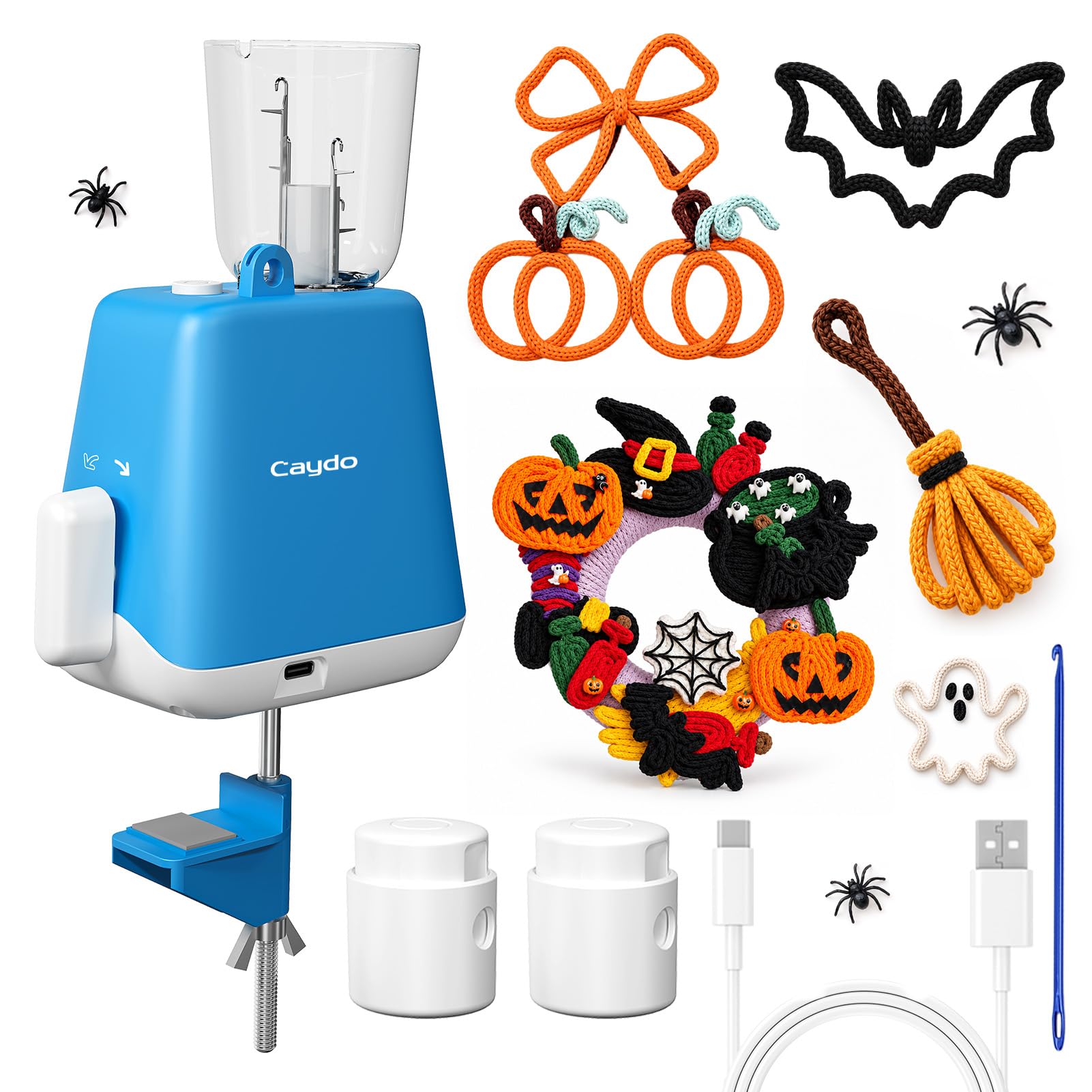
A motor, two weights, and a clamp — the electric Caydo takes the cranking out of cord-making.
This is the pick for the crafter whose wrists ache after a hand-crank session or who wants to batch out handles for a whole run of bags. The Caydo Electric F1 uses a custom motor to turn yarn into i-cords without a handle to pump, so your hands are free to raise the weights and steer the yarn. It weighs 1.56 pounds, which is light enough to shift around a work table but heavy enough to stay planted once the clamp is on. The ABS plastic body — a harder plastic than the PP used on some cheaper housings — is built for repeated sessions rather than a single afternoon.
What wins people over is the build quality, and the smoothness of the finished cord follows from the two hanging weights that hold the yarn under steady tension. You get even, compact tube instead of the lumpy output you fight from a hand-crank. The machine handles larger batches of yarn than a manual mill, so longer cords stay consistent from start to finish. There is a twist as the cord feeds out; looping the cord onto the weights and raising them straightens it as you go.
The catch is yarn. Bulky weights tangle, tangling is the most-discussed snag across the reviews, and medium acrylics run noticeably cleaner than chunky cotton blends. Speed opinions split too, with some crafters calling it fast and others finding it slow on long runs. The honest read: watch the hooks, go slow, and match your yarn to the machine rather than forcing a thick cake through. One buyer did report a hook faulty from the start with unclear replacement instructions and a power button that failed — the motor then ran only while plugged in.
Where it earns its keep
- Electric drive means no hand-cranking fatigue across long cord runs.
- Two weights deliver steady tension and a more even, compact tube.
- ABS plastic body is sturdier than the PP housings on budget builds.
What to watch
- Bulky yarns tangle; tangling is the recurring complaint in the reviews.
- Reports of a faulty hook and a failing power button on some units.
- Speed is a split verdict — fast for some, slow for others.
Reach for this if: you want the motor to do the repetitive work and you plan to make i-cords in volume.
Think twice if: your yarn stash is mostly bulky weights — the machine prefers medium yarns.
2. Etcokei iCord Knitting Machine
Press once and the circular Etcokei spools yarn into a cord while you manage the tension.
You press the button and the automatic rotation does the rest — the Etcokei turns yarn into cord in one motion, and it is aimed squarely at the crafter who wants their hands free. The ABS housing in white and a circular form factor keep the footprint tidy, and the two included weights hold the yarn steady so the tube comes off even. It straps onto a table edge for one-handed work, and the clamp tops out at the thickness of a standard Ikea Lack table.
Reviewers keep praising the same thing: yarn comes off looking like yarn, not a knot. It also suits anyone with arthritic hands, since the electric drive replaces the handle-turning a hand-crank requires. The sound is described as soothing rather than grating, and watching the needles do their round is oddly pleasant for a working session. Medium 100% acrylic runs cleanly; a bulky 50/50 cotton-acrylic blend tangled and failed.
The trade-offs are real. Ease of use and speed both draw split reactions — easy for some, difficult for others, and fast for one crafter while slow for the next. Reliability under constant use is the deeper concern: one unit slowed after two days with a rough-sounding motor and knotted worsted yarn, and it was returned. Keep your projects light to medium and it behaves; push heavy yarn at it for hours and you may not get the same result. The 1 Year warranty takes some of the sting out.
The efficient setup: One press, auto rotation, two weights, and a customer base that calls it effective more than any other trait. For medium-weight projects it is a smooth, hands-free cord factory.
The honest limit: It wants light-to-occasional use. Overworked with heavy yarn, the motor is where the trouble shows up.
Pick this if: you want a compact electric unit that starts on one press and prefers medium yarn.
Look elsewhere if: you plan to run worsted weight through it for hours on end.
3. Tulip I-Cord Knitter – 1 Unit

The grey Tulip is the one that teaches the motion — crank, catch, slide, repeat.
If you have never made an i-cord and want to understand how the loops form before you spend on a motor, the Tulip is the right first machine. It is a hand-crank tool with three looper hooks (the small hooks that catch and form each loop): you turn the handle clockwise until the first hook catches the yarn, slide the yarn behind the second looper with the crochet hook, and keep going until the third catches. It is plastic, grey, and measures 11.02 x 5.91 x 3.54 inches — about the size of a small box on your work surface. The 321 g weight means it sits still under a firm hand.
The point of a manual crank is control, and the first loop is simple once a tutorial shows you where the yarn goes. Tutorial videos from experienced users make the learning curve shorter, and the payoff is a cord that goes together smoothly. Tulip asks that you keep the cord to 2.50mm max — thicker yarn jams — and fine perlé thread works but leaves open stitches in the tube. Watch that yarn limit and the machine behaves.
The reason to think twice is the handle. Some cranks break under steady use, and one user who started on the Tulip ended up moving to a motorized model instead. That is the nature of a manual tool — it is a starting point, not a lifetime workhorse. Buy it to learn the craft, and graduate when your projects outgrow a hand crank.
Start here if: you want to learn i-cord construction and you are comfortable with a hand crank.
Skip if: you need a durable tool for volume work — a motorized unit will serve you better long term.
4. Caydo F1 Lite iCord Knitting Machine
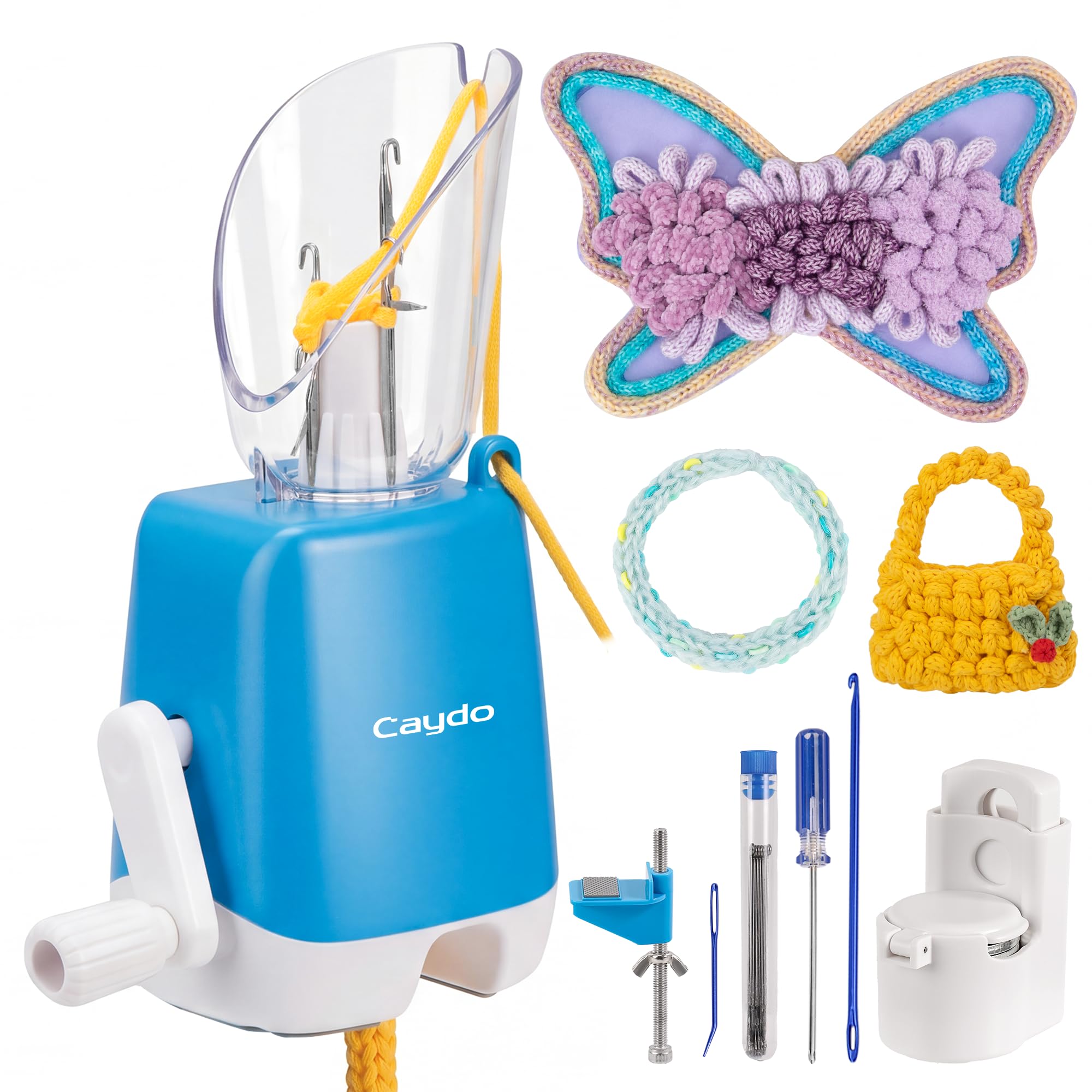
At 1.1 pounds the Lite slips into a project bag and still pulls a clean four-needle cord.
The Lite earns its place by being the lightest thing on this list. At 1.1 pounds it is 0.46 pounds lighter than the Caydo Electric F1 above, so it drops into a craft bag without dragging. The removable desk clip is the other travel win — attach it to a table for one-handed use, or take it off and work with the machine in your lap. The beveled cover lets you watch the hooks as they work, which matters when you are learning the rhythm. The clamp location does restrict mounting positions, though it does not affect how the machine runs.
Yarn flexibility is the standout. It handles thin thread through thick yarns, and the extra hooks let you set it up for a 4-hook or 6-hook configuration depending on the thickness you want. Beads can be threaded in to make bracelets and necklaces. Bulky 5 Caron Macchiato cakes went through cleanly into an even cord — and once you slow down and watch the hooks, a dropped loop can be stopped, corrected, and resumed without starting over. Chenille works on the 6-hook setup when started correctly. One size caveat: the cord diameter comes out the same regardless of yarn thickness.
The included weight is often too light to hold tension, so most crafters end up using a hand to guide the cord instead. Expect a short learning curve. It is a manual crank, so there is no motor to do the work for you — you turn the handle. For a travel-friendly, budget-conscious machine that takes a range of yarn, that trade is fair.
Travel-ready build: 1.1 pounds, removable clamp, beveled sight cover, and a 4/6-hook configuration that adapts to your project. Genuinely portable.
Weight caveat: The included weight is too light for consistent tension — plan to guide the cord with a hand.
Good for: crafters on the move who want a lightweight 4/6-hook crank and can manage tension by hand.
Not for: anyone expecting a motorized feed or a weight that holds tension on its own.
5. Caydo F1 Lite i Cord Knitting Machine
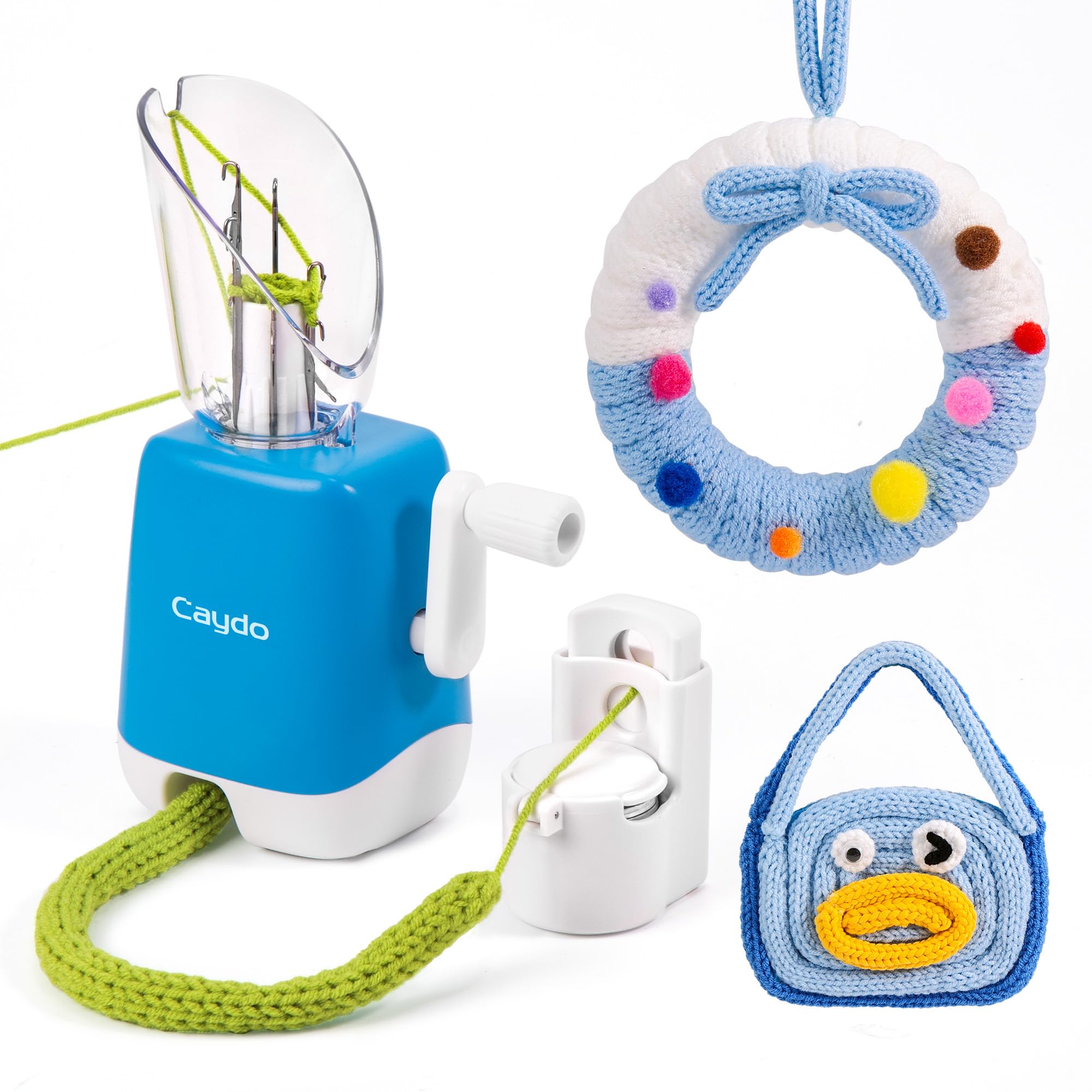
Two extra needles turn the same crank into a thicker, firmer cord built for real load.
The six-needle Caydo is the same manual platform as the Lite above, but with two extra needles that produce a wider, firmer tube. That extra width is what you want for sturdy bag handles, name tags, coasters, and doll scarves and limbs. The detachable clamp makes it a tabletop tool that also travels, and the beveled cover keeps the work visible. At 1.79 pounds it is heavier than the 4-needle Lite, which is part of what gives it that steadier drive when you crank.
When it works, it works well — one buyer ran ropes for metal headbands far faster than hand crocheting, turning a wholesale job into an afternoon. The kit arrives complete, with some yarn included and a spare set of needle/hook parts. Clear color instructions and a QR video walk beginners through the first cord.
The harder truth is that six needles are less forgiving than four. Pins can stick and yarn knots, and the motion is fiddly enough that beginners often find it easier to hand-knit i-cord than to tame this crank. One mechanically inclined buyer could not get it running at all and sent it back; another said it snags easily and makes a continuous tube difficult. The manual crank also means no outlet or USB — you supply the turning. This is a tool for makers who have the patience to learn it, and it rewards that patience with thicker, more substantial cords.
Choose this if: your projects need a thicker, firmer cord and you are ready for a manual crank with a learning curve.
Pass on it if: you are a first-time maker — the four-needle Lite or an electric model is easier to start with.
Know the Specs
Needle count and loop size
More needles mean a bigger loop, and a bigger loop yields a wider cord. Four needles suit bracelets, trims, and lettering; six needles give you the diameter for bag handles and edges that take load. Some machines ship with both counts and let you change them.
Yarn weight and the machine’s tolerance
Every knitting mill has a gap the yarn must pass through, and thick yarns that fill that gap jam or tangle. Medium acrylics flow smoothly; bulky cotton blends often knot. A few manual machines only accept thin cord — the Tulip works up to 2.50mm. Match yarn weight to the machine before you commit to a project.
Weight and clamp for one-handed use
The clamp holds the machine to the table so you can guide yarn with one hand, and the machine’s weight keeps it steady under the crank or motor. A removable clamp means portability; a heavier body means stability. Weigh both against how and where you plan to work.
Tension weights and cord evenness
The hanging weights are the difference between a smooth, compact tube and a lumpy one. They keep the yarn under steady pull so the loops stay uniform and the cord comes off even. When included weights are too light for your yarn, you will need to supplement with a hand.
Common Questions
Will a knitting machine make an i-cord with bulky yarn?
What is the difference between a four-needle and a six-needle i-cord machine?
Do I need a table clamp to use an i-cord knitting machine?
Why does my i-cord come out twisted or uneven?
Is an electric i-cord machine better than a hand-crank one?
How thick is the cord an i-cord knitting machine produces?
Can I use an i-cord mill for bracelets and beaded cords?
What do I do if a hook on my machine misses a loop?
How long does a cord take on these machines?
Do I need special yarn to make an i-cord?
The Bottom Line
If you want one dependable pick, the best i-cord knitting machine is the Caydo Electric iCord Knitting Machine F1 because a motor and two weights do the repetitive work while you keep your hands on the yarn. If you want a compact electric unit that suits medium-weight yarn and starts on one press, grab the Etcokei. And for thicker cords on a manual crank, the 6-needle Caydo F1 Lite is the one to reach for if you are ready to learn it.
How we choose
We do not accept paid placement. Every pick is matched to a real buyer and a real use-case; we do not hands-on test units.
Sources
Specifications: manufacturer listings and product documentation. Review insights: verified customer reviews, as of October 2026. Pricing: not shown on this page (it changes often); check the current price via the retailer link.
As an Amazon Associate, Aappliancez earns from qualifying purchases. This does not affect which products we feature.