Disclosure: Some links in this post are affiliate links. As an Amazon Associate I earn from qualifying purchases, at no extra cost to you. Learn more
Specs are compiled from manufacturer listings and verified buyer reviews and can change over time — please confirm the key details on the product page before buying.
Here is the short answer: buy a cold-climate heat pump only if the listing states its own low-temperature heating limit. A unit rated for mild winters will fall back on resistive backup heat (an electric coil that heats like a space heater) exactly when you need it most. That low-ambient number, not the cooling BTU rating, decides whether your winter electric bill stays sane. This guide breaks down thirteen real systems by that limit, by square-foot coverage, and by how much of the installation you can honestly do yourself.
This guide is built by comparing the manufacturers’ published specifications and the patterns across verified customer reviews, so you get each pick’s real strengths and trade-offs instead of marketing spin.
We’ll walk through what low-ambient heating, SEER2 efficiency, and pre-charged line sets actually mean for your rooms before comparing the strongest options in this hyper heat mini split roundup.
Top Picks

How To Choose The Best Hyper Heat Mini Split
A “hyper heat” mini split is simply a ductless heat pump built to keep heating when the outdoor air drops below freezing instead of handing the job to electric strips. You are buying one appliance that cools in summer and heats in winter. The purchase decision is almost entirely about three questions: how cold your winters get, how many square feet you must cover, and how much of the install you are willing to take on yourself.
Read the low-ambient heating number first
Every manufacturer lists a lowest outdoor temperature where the heat pump still works. Senville AURA models claim operation down to -22°F, while the DELLA Optima Series states -13°F. The ACiQ Essentials 9000 BTU is rated for heating from -4°F to 75°F outdoor temperatures. If your climate regularly dips below the lowest figure a unit publishes, that unit will lean on auxiliary heat and your winter bill climbs. Match the number to your actual winters, not to the cooling BTU rating printed in big type.
Match BTU output and square footage to the room
Oversizing a unit is as wasteful as undersizing it. A 9,000 BTU system such as the MRCOOL Easy Pro covers up to 400 square feet. The 12,000 BTU YITAHOME covers 750 square feet. The 18,000 BTU Senville AURA covers 1000 square feet, and the 24,000 BTU AURA stretches to 1250. Pick the size closest to your room’s actual footprint, then let the inverter modulate from there.
Decide how much of the install you will do
Some systems are explicitly not DIY and require a licensed HVAC technician to keep the warranty. Others, like the MRCOOL 5th Gen DIY, ship with pre-charged 25-foot Quick Connect line sets that remove the flaring and charging work. Even on a DIY-friendly kit you will still need a vacuum pump and gauges. Budget for either tool rental or a technician’s final hookup regardless of which way you go.
Side-by-Side Comparison
| Model | Best For | Cooling Power | Floor Area | Cold-Climate Heating | Amazon |
|---|---|---|---|---|---|
| Senville AURA 24,000 BTU★ Best Overall | Whole-home open plans | 24000 BTU | 1250 sq ft | Down to -22°F | Amazon |
| MRCOOL 24,000 BTU 5th Gen DIYTrue DIY Pick | True DIY installs | 24000 BTU | 1050 sq ft | — | Amazon |
| YITAHOME 12,000 BTUBudget Contender | Tight budgets, bedrooms | 12000 BTU | 750 sq ft | Down to 5°F | Amazon |
| ACiQ Essentials 9,000 BTU | Garages and workshops | 9000 BTU | 400 sq ft | -4°F to 75°F heating | Amazon |
| Senville LETO 9,000 BTU | Small rooms on a budget | 9000 BTU | 400 sq ft | Down to 5°F | Amazon |
| Senville LETO 12,000 BTU | Mid-size rooms | 12000 BTU | 700 sq ft | Down to 5°F | Amazon |
| DELLA Optima 12,000 BTU | Extreme cold on a mid budget | 12000 BTU | 550 sq ft | Down to -13°F | Amazon |
| Cooper & Hunter 18,000 BTU | Large garages and cottages | 18000 BTU | — | Up to 5°F ambient | Amazon |
| TURBRO Greenland 24,000 BTU | Big spaces, high efficiency | 24000 BTU | 1500 sq ft | Down to -13°F | Amazon |
| MRCOOL Easy Pro 9,000 BTU | Small DIY additions | 9000 BTU | 400 sq ft | — | Amazon |
| Senville AURA 18,000 BTU | Heat-first builds | 18000 BTU | 1000 sq ft | Down to -22°F | Amazon |
| Daikin Entra 18,000 BTU | Brand-name reliability | 18000 BTU | 1000 sq ft | Down to 5°F | Amazon |
| Senville AURA 33,000 BTU | Huge zones and garages | 33000 BTU | — | Down to -22°F | Amazon |
Detailed Reviews
1. Senville AURA 24000 BTU
Our pick — 4.5+★ from 550+ verified ratings; the strongest balance of quality and price.
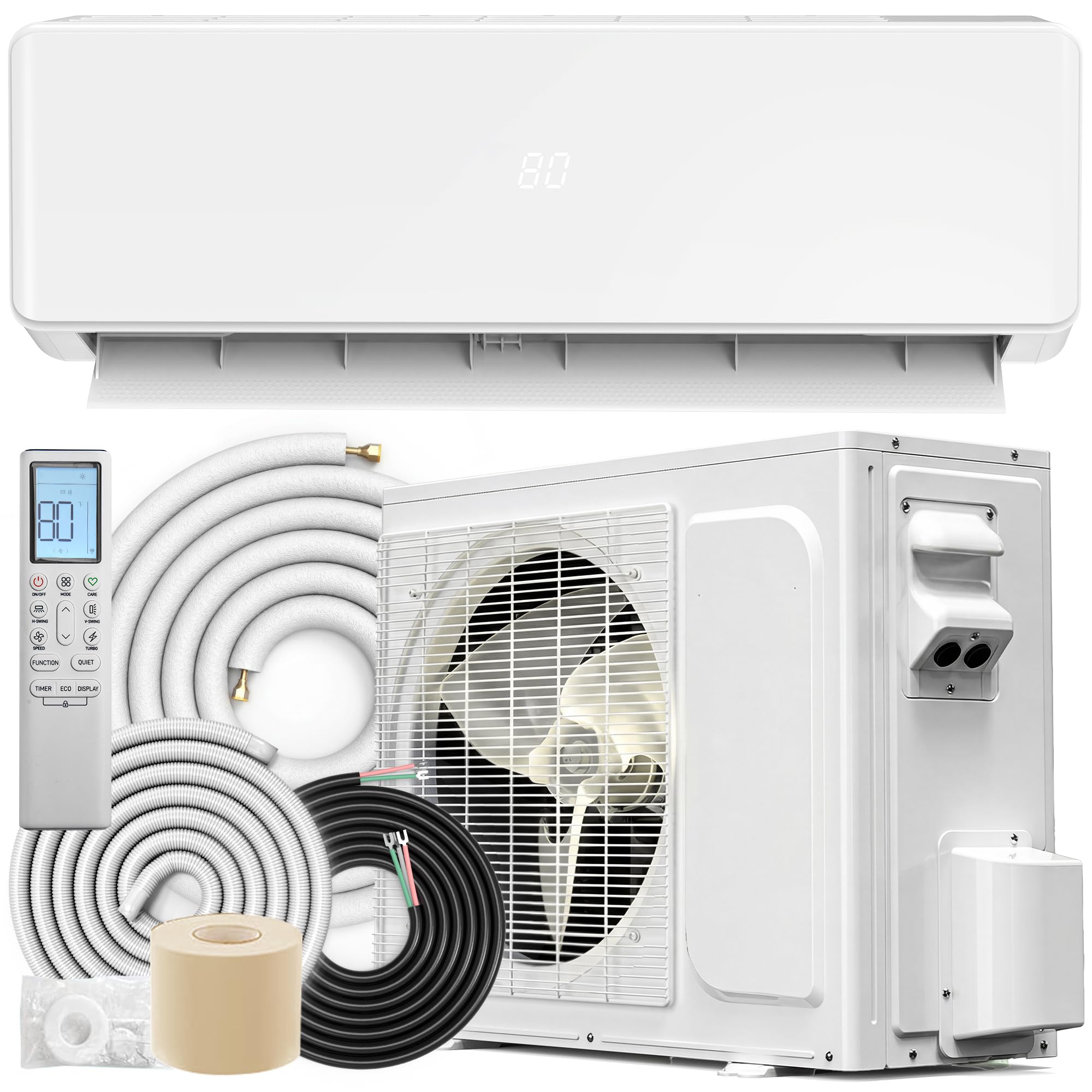
The 24,000 BTU AURA keeps heating claim where most splits quit: -22°F.
This is the pick that treats winter as a normal operating condition rather than an emergency. Senville rates this 24,000 BTU unit for heating all the way down to -22°F (-30°C), which means the compressor keeps working instead of handing off to electric strip heat. That is the whole game in a hyper heat system. It is Energy Star certified and carries a 21.5 SEER efficiency rating, and the 208-230V DC inverter modulates output so it can run low and steady instead of cycling hard.
Coverage is generous: 1250 square feet of floor area on the spec sheet, served at 24000 BTU of cooling power and 2 tons of capacity. What wins owners over, though, is raw heating and cooling performance, with cooling speed right behind it. Buyers report the unit cooling a 1000 square-foot cabin from 84°F down to 68°F in about two hours, controlled by Alexa and phone over a satellite link. Another owner describes a replacement install that cooled fast enough to show 32°F discharge air against 96°F ambient.
The honest note is that Alexa control is a convenience, not a substitute for a professional install, and Senville itself states this is not a DIY system. A 16-foot line set and communication wire ship in the box, so measure your run before booking a technician. Energy draw is stated at 3973 kilowatt hours per year, which is meaningful but not the headline. The thing you will actually notice day to day is how quiet it stays, which is the consistent theme across the whole owner base.
What earns its keep
- Heats down to -22°F, so cold snaps do not force it onto backup heat.
- 1250 square-foot coverage at 24000 BTU handles open living areas.
- Energy Star certified at 21.5 SEER with a 208-230V DC inverter.
- Alexa and app control let you adjust from anywhere.
What to weigh first
- Senville states this is not a DIY system, so plan for professional install.
- The included 16-foot line set may fall short on longer runs.
- Stated annual energy use sits at 3973 kilowatt hours per year.
Best fit: A family room or open-plan zone where winter heating matters as much as summer cooling.
Think twice if: You want a weekend install you can do alone — this one is explicitly a professional-install unit.
2. MRCOOL 24000 BTU 5th Gen DIY
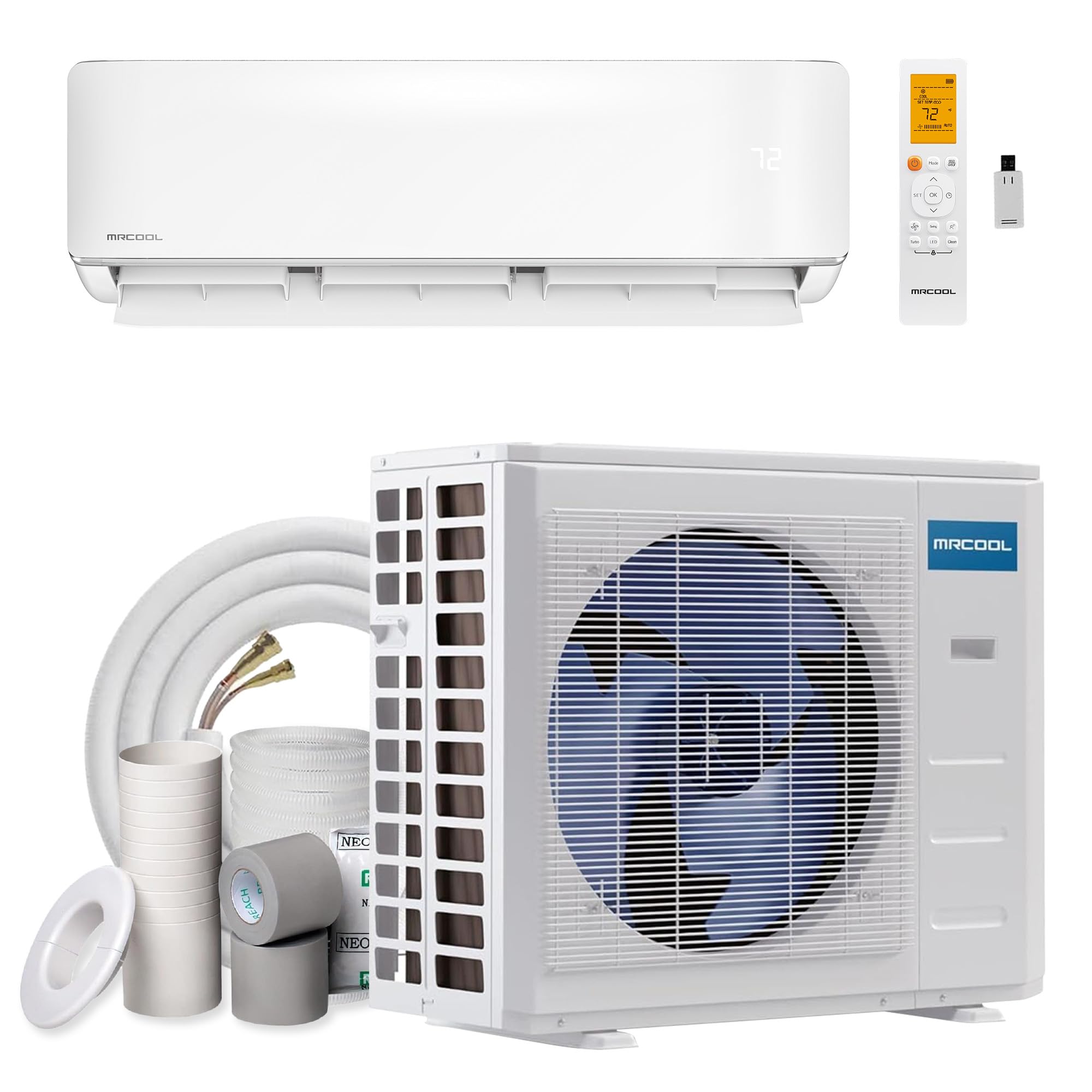
A 25-foot pre-charged Quick Connect line set is the reason this one installs in hours.
Most mini splits hand you a flaring tool, a torque spec, and a vacuum pump. This 5th generation MRCOOL asks for none of the specialty training, because the pre-charged 25-foot Quick Connect line sets arrive sealed with refrigerant already inside. You connect, you vacuum, you open the valves. The maker describes the install as completing in a few hours with no special tools or equipment. That one detail is what separates it from the Senville AURA above, which is a professional-install system.
Output and coverage matter too: 24,000 BTUs covering up to 1050 square feet, with both cooling and heating in one wall-mounted unit. That is a 2-ton system, which gives you double the cooling power of the YITAHOME 12,000 BTU on this list. Voice control runs through Google Assistant and Amazon Alexa with the included smart HVAC controller module. The wall unit itself uses a neutral color that blends into most rooms.
The trade-off worth flagging is that stated annual energy consumption shows 5750 watts and the BEE star rating sits at 1 Star, which is a modest efficiency picture against the SEER2 leaders here. If long-term electricity cost is your priority, weigh that honestly. If getting a working system into a finished room quickly is your priority, the Quick Connect kit is the feature you are actually paying for.
This one is for you: Anyone physically comfortable on a ladder who wants the install done in a weekend without a technician.
The catch to plan around: Efficiency is not the strong suit here, so run the numbers if your unit will cycle all day.
3. YITAHOME 20 SEER2 12000BTU Mini Split AC/Heating System 115V
A 115V system that runs below 41 decibels and sips power on a normal household circuit.
The efficiency story here is genuinely striking when you stack it against the biggest unit on this list. YITAHOME states 600 kilowatt hours per year of annual energy consumption, against 3973 kilowatt hours per year for the Senville AURA 24,000 BTU. That is the single clearest gap in this whole category, and it comes from a smaller unit doing a smaller job — 12000 BTU cooling power for 750 square feet, a 1-ton system against the AURA’s 2 tons. Smaller zone, smaller bill.
The unit runs five modes (auto, cool, dry, heat, and fan), plus automatic defrosting, self-diagnosis, iFEEL mode, a 24-hour timer, sleep mode, and a HEALTH mode with negative ions, electrostatic dust removal, and PM2.5 removal. Noise is stated below 41 decibels, and the remote sets temperature between 60°F and 90°F. It will run from 5°F up to 118°F outdoors, and airflow reaches a stated 50 feet for 4D circulation.
What people actually experience lines up with the spec sheet. An owner running a 1150 square-foot open layout in 90°F-plus heat reports the far living room holding at 70°F with a 68°F set point. The recurring gripe is control drift, where the blower keeps working past the set temperature. The install is stated as licensed-HVAC only, and it ships in two packages that can arrive separately — so check both cartons before you call a technician.
The real draw: Standard 115V power means no new 230V circuit, which saves both money and scheduling pain on an older home or workshop.
The morning-after honesty: That aggressive cooling can overshoot your set point, so treat the remote’s temperature as a starting point rather than an exact thermostat.
Reach for this if: You have one bedroom, a garage, or a basement to condition and want a low operating cost on standard voltage.
Look elsewhere if: You need precise holding temperatures in a room where overshoot would bother you.
4. ACiQ Essentials 9000 BTU
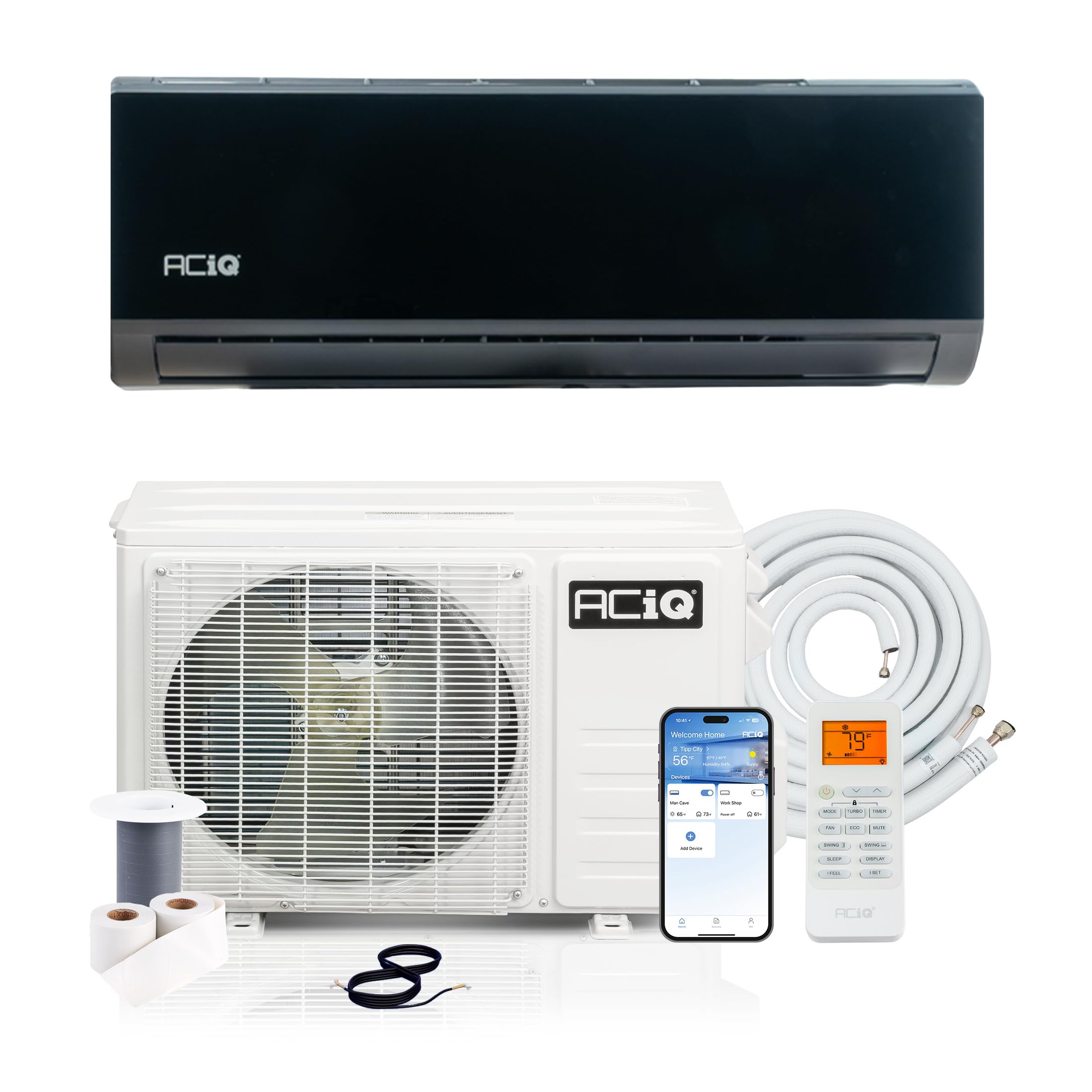
Only 9,000 BTUs, but this black unit heats all the way down to -4°F outdoors.
Small systems typically give up on cold weather, and this one does not. ACiQ rates the 9000 BTU Essentials for cooling from 5°F to 127°F and heating within -4°F to 75°F outdoor temperatures, which is a real cold-climate claim on a unit designed for 400 square feet. The 20 SEER2 and 9.5 HSPF2 efficiency ratings (the seasonal heating figure) are solid for a compact inverter. It is Wi-Fi ready through the SmartLife-SmartHome app for iOS and Android, so you can adjust from anywhere.
The control set is unusually deep for the size: timers, I Feel, Sleep, Eco, Mute, Turbo, Fan Only, and Dry modes, plus an electronically adjustable louver. It ships with a 16-foot line set, remote with mount, power cable, mounting plate, rubber feet, wall cap, drain kit, and screws. Registration online brings 4 years on parts and 6 years on the compressor. ACiQ does state the system must be installed by a professional HVAC tech.
What you should know before ordering is the cosmetic gap: the black finish covers only the face, and the rest of the body is gray. That bothered some buyers who expected a full black cabinet. Its heating and cooling performance is the strongest thing about it, with quiet operation not far behind. Garages, workshops, sheds, and small attics are the natural homes for a unit this size.
Where it stands out
- Heating range reaches -4°F, unusual for a 9,000 BTU unit.
- 20 SEER2 and 9.5 HSPF2 put efficiency well above the small-unit average.
- 4-year parts and 6-year compressor coverage when registered.
- Full accessory kit ships in the box.
Where it asks patience
- Black finish is face-only; the cabinet body is gray.
- Professional HVAC install required for the warranty.
- 400 square feet is the ceiling on coverage, so measure the room.
Worth it for: A detached garage or workshop where you want heat in the cold months without a big-capacity price jump.
Not for: Open-plan spaces or anyone who needs the finish to match all the way around.
5. Senville LETO 9000 BTU

The bedroom unit: 21.5 SEER efficiency at 9000 BTU, and it barely makes a sound.
Quiet is the thing that carries this one, and it carries it further than any other budget pick here. Senville built the LETO around a DC inverter rated 21.5 SEER at 9000 BTU output, which is a genuinely efficient small system. It is a 4-in-1 setup: cooling, a heat pump functional down to 5°F, a dehumidifier, and a fan, plus a turbo function. UL Listed and AHRI Certified with Alexa built in for voice or app control from anywhere.
Coverage is 400 square feet, which lands it in the same room-size class as the ACiQ above but with different priorities. The wiring is a conventional 16-foot line set and communication wire, pre-loaded with refrigerant for up to 25 feet. Senville backs it with 5 years on parts and 5 years on the compressor, plus free technical help. Professional install is required and labor is not covered.
Durability over time is where this gets interesting. Owners who have run LETO systems for years report zero problems across a whole building’s worth of units. One describes cooling an 800 square-foot space to 65°F when it was 90°F outside, with the compressor cycling off for long stretches. The instructions get flagged as the weak point — plan to watch installer videos before you start.
What owners talk about most: The silence. Indoor and outdoor units both run without announcing themselves, which is exactly what you want next to a bed.
Plan around this: The manual is thin on detail, so find a walkthrough video before the technician arrives.
Pick this when: A bedroom, nursery, or small home office needs cooling that will not wake anyone.
Consider the bigger LETO instead if: Your room runs past 400 square feet.
6. Senville LETO 12000 BTU
Same quiet LETO platform, now stretched to 700 square feet of coverage.
If the 9,000 BTU LETO is too small for your room, this is the step up without changing the formula. It covers 700 square feet at 12000 BTU cooling power and 1 ton of capacity, with a 19 efficiency rating. The heat pump runs down to 5°F, and the 4-in-1 layout adds dehumidifier, fan, and turbo modes on top of cooling and heating. Alexa and app control come standard, along with a 16-foot line set pre-loaded with refrigerant for up to 25 feet.
The warranty matches its smaller sibling: 5 years on parts, 5 years on the compressor, with Senville’s complimentary technical help on top. That combination of efficiency, coverage, and support in the mid-range is what makes LETO the repeat pick for people furnishing multiple rooms.
Cold-weather performance is the section people actually care about with LETO. An owner in Pennsylvania runs this model in a basement through winter with strong, consistent heating, and a workshop install keeps a studio warm from 30°F to 110°F after three years of use. The honest limit is that 5°F is the stated floor for the heat pump — below that, a unit like the Senville AURA with its -22°F claim is doing different work. Instructions and cable length are the recurring friction points, so buy a longer line set if your run is long.
Fits best: A living room or converted garage right around 700 square feet that needs both seasons covered.
The real limit: Once your outdoor temps drop well below 5°F, the heat pump stops being the primary source.
7. DELLA Optima Series 12,000 BTU

-13°F heating and 24 SEER2 in a 12,000 BTU package is a hard combination to match.
This is the pick for the person who lives where January means single digits and who does not want to pay premium-tier prices. DELLA rates the Optima for heating down to -13°F using Gold Fin coil protection, and pairs that with 24 SEER2 and 10 HSPF2 efficiency at 12000 BTU over 550 square feet. For comparison, the Senville LETO 12,000 BTU stops its heat pump work at 5°F. That -13°F number is a real difference in how many nights you spend relying on backup heat.
The comfort details are unusually thoughtful for a mid-range unit. Soft, indirect airflow is designed to avoid blowing directly on you, which helps in a bedroom. Mute Mode drops operation to a stated 30 decibels (roughly the sound of a quiet room), which is genuinely sleep-friendly. The I Feel sensor tracks temperature at the remote control rather than at the wall unit, so the reading follows you around the room. You get a 16.4-foot pre-flared copper line set and drain hose, plus a required 15A fuse.
Control runs through Alexa or the Della+ app, and the unit is Energy Star certified and AHRI listed. Just know this: some owners mention the outdoor condenser developing a rattle after several months, and a few need an occasional power cycle if the internet controls stop responding. Both are manageable. Neither touches the indoor quiet, which stays the consistent bright spot.
The number that decides it: -13°F heating at 24 SEER2 is the strongest cold-weather value on this list by a wide margin.
Small thing to expect: The outdoor unit may develop a light rattle over time, and internet control occasionally needs a reset.
Buy this if: You live in a cold climate, your zone is around 550 square feet, and you want real heating without jumping to premium pricing.
skip it if: Your room is larger than 550 square feet — this one wants a tighter footprint.
8. Cooper & Hunter 18,000 BTU

Big output for big rooms: 18,000 BTUs of cooling and 18,000 BTUs of heating in one unit.
This one is for the person heating a large garage or a cottage that used to run on a loud through-wall unit. The MIA Series delivers 18,000 BTU cooling and 18,000 BTU heating at 1.5 tons of capacity, with a 19.2 SEER2 efficiency rating and an inverter compressor for precise control. It is ETL Intertek approved, UL Listed, and AHRI Certified. Heating works with ambient temperature up to 5°F.
The install kit is genuinely complete: 16-foot insulated copper line set, 16-foot communication cable, 16-foot drainage extension, and small accessories. The condenser arrives pre-charged. Smart control runs through the included kit and app, and free U.S.-based technical support backs the unit. Cooper & Hunter do state professional install is required, so budget for that separately.
Two things to know before you buy. First, this ships by freight to the nearest accessible point outside your home, and the carrier coordinates delivery with you — plan for that. Second, the line set has drawn complaints about durability from at least one buyer whose copper burst within a year and who ran into warranty friction. Most owners never touch that problem. The consistent strength is output and quiet: a cottage owner describes replacing a loud through-wall unit and having to check whether the C&H was even running because the inside is so silent.
Why it earns a slot
- 18,000 BTU cooling and 18,000 BTU heating in one 1.5-ton system.
- 19.2 SEER2 with an inverter compressor for steady output.
- Complete 16-foot line set, cable, and drainage kit included.
- Free U.S.-based technical support.
Manage before you order
- Heat pump works with ambient temperature up to 5°F, so extreme cold still needs a plan.
- Freight delivery means coordinating with a carrier, not a doorstep drop.
- Line set durability has been a problem for some owners.
For you if: You have a two-car garage, a workshop, or a cottage that needs real capacity from one wall unit.
Pass if: Your winter regularly drops well below 5°F and you cannot add a secondary heat source.
9. TURBRO 24,000 BTU
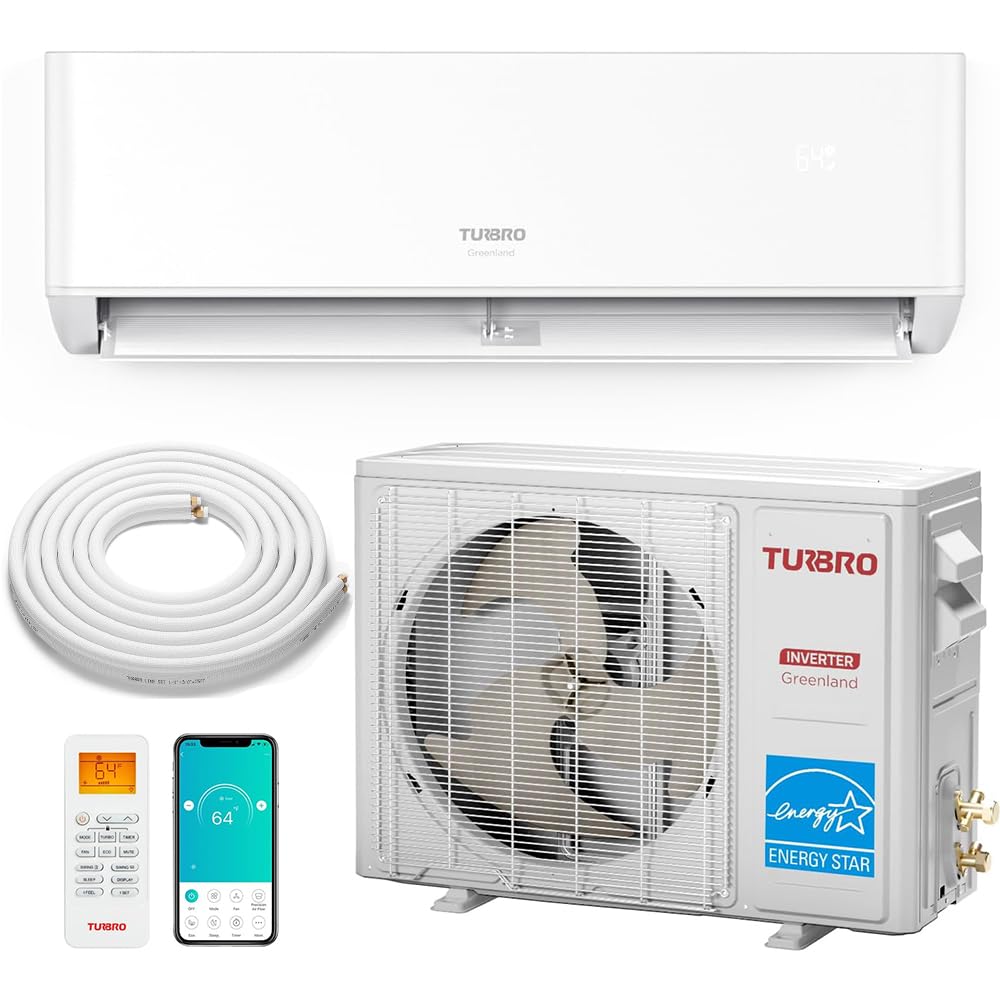
1500 square feet of coverage with a -13°F heat mode and 23 SEER2 efficiency.
Coverage is the headline here: 1500 square feet on a 24,000 BTU system, which is the largest square-foot rating in this entire roundup. It pairs that coverage with a 23 SEER2 rating and heating down to -13°F. Cooling mode runs up to a stated 131°F outdoors. The high-frequency inverter is claimed to cool in as little as 30 seconds and heat in as little as 60 seconds, so the room reaches temperature fast.
Control is flexible with remote, smartphone app, and voice through Alexa or Google Assistant. A large drum-shaped impeller fan pushes air farther, and the dynamic balancing is designed to keep it quiet and extend fan life. If your electricity bill is the deciding factor, the maker claims the high SEER2 rating (a measure of cooling efficiency) qualifies for federal tax credits — confirm current eligibility yourself.
Stated annual energy consumption is 5606.4 kWh, which is the highest figure here and worth knowing since this is also the biggest-coverage unit. Heat flows out to a stated 20 feet, so a three-car garage or open studio gets meaningful circulation. The support experience is the thing to plan for: email is the main channel, and the AI front-line can slow you down before you reach a person.
Go here for: The widest coverage on this list combined with real cold-climate heating at -13°F.
One caveat: Efficiency in absolute terms is the weakest here, so a smaller unit may cost less to run if your room fits one.
10. MRCOOL Easy Pro 9000 BTU
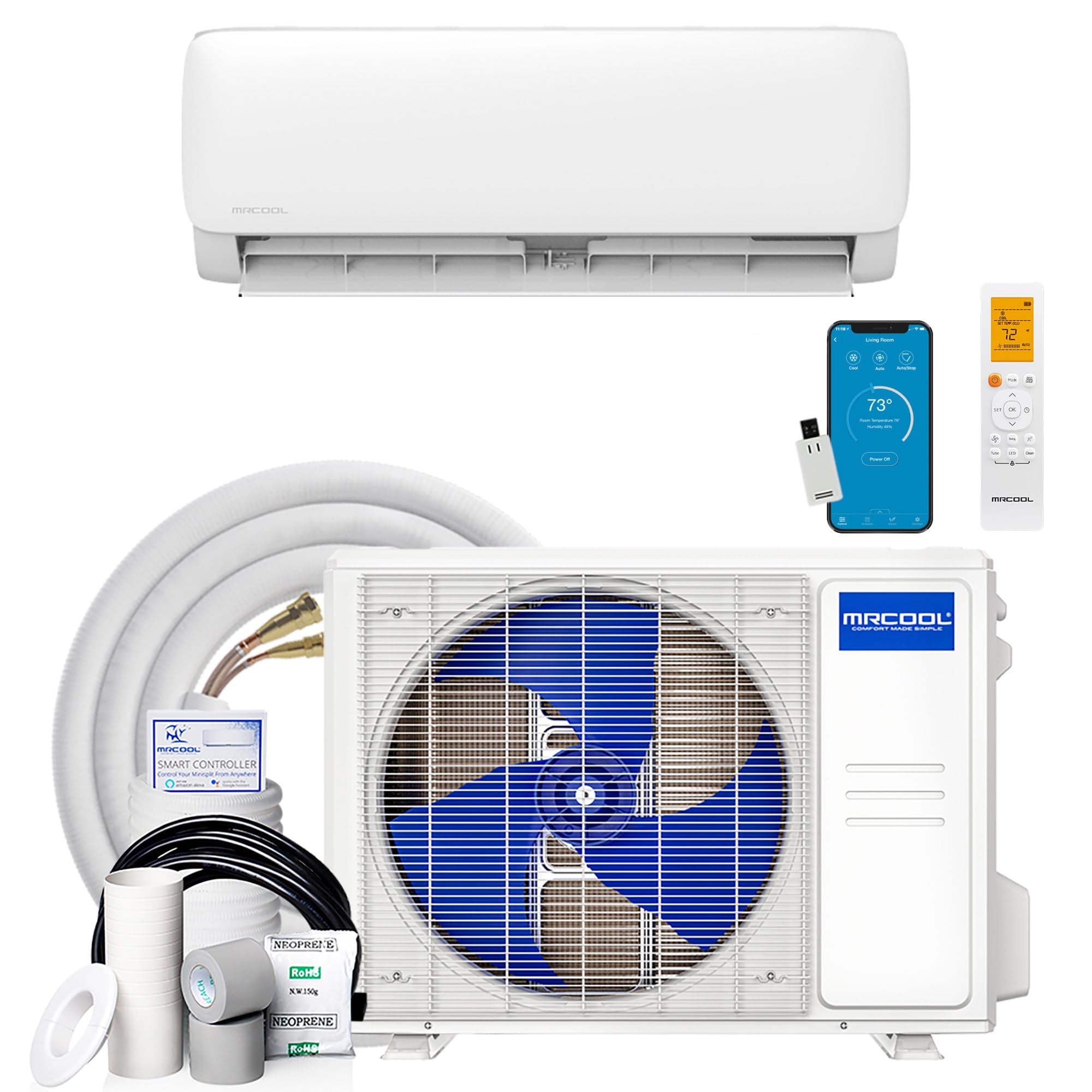
A 115V wall unit that plugs into a standard circuit and installs without HVAC training.
For a sunroom, shop, or bedroom addition where you do not want to run a new 230V line, this is a sensible fit. The Easy Pro delivers 9,000 BTU of heating and cooling across 400 square feet, and it runs on 115V. MRCOOL describes the install as needing no special tools, equipment, or expertise, and owners confirm it: one describes setting it up with a 12 AWG pigtail and extension cord, then cooling a bedroom quietly. Another had it running before the day was out, replacing a set of window units.
Control comes via push button, remote, or voice through Google Assistant and Amazon Alexa. The washable filters rinse clean with water, so filter maintenance is a five-minute task. There is a sleep function that shifts temperature overnight to trim energy use. Coverage sits alongside the Senville LETO 9,000 BTU at 400 square feet, and the difference is in the install experience rather than the room size.
The honest limit is that “DIY” here means physically doable, not easy. One experienced installer notes that drilling a 3-inch hole through drywall and stucco is not a beginner task, and that the fittings need patience. Get the drain slope right or condensate backs up indoors. If those steps sound reasonable to you, this is one of the cleanest weekend installs on the list.
What makes it worth it: 115V power plus pre-charged lines means no electrician and no new circuit for a small zone.
Before you commit: Plan the drain line carefully — it needs a steady fall or water ends up back inside.
Choose this if: You want a small room conditioned on standard household voltage without hiring trades.
Look at the bigger systems if: Your zone runs past 400 square feet.
11. Senville AURA 18000 BTU
When heat is the main event and cooling is the side benefit, -22°F coverage decides it.
It is Energy Star certified, UL Listed, and AHRI Certified, built on a 208-230V DC inverter. That inverter is what lets it hold a steady indoor temperature instead of running full blast and stopping.
The reviewer base reflects a real heating-focused audience. Heating performance is the dominant theme in owner reviews, praised above installation here. One owner describes replacing failing portable units across a studio and a cattery, dropping the room 15°F in five minutes and running seven years without a major failure. Another reports an Oregon DOE rebate covering the professional hookup costs. Alexa and app control are included, and the unit carries a stated 3500 kilowatt hours per year of annual energy use.
The honest caveat here is temperature holding consistency, which is cited as the weak spot. Wi-Fi connectivity has also tripped up some owners who never got the app paired. Running in cool-only or heat-only mode rather than auto is the common workaround. If you want flawless hands-off automation, plan to babysit the remote a little.
Why it’s here
- Heats down to -22°F, the coldest claim on this list alongside the 24,000 BTU AURA.
- 1000 square-foot coverage at 18000 BTU and 1.5 tons.
- Energy Star, UL Listed, and AHRI certified.
- Long-term durability track record across years of ownership.
Worth knowing
- Some owners struggle to hold an exact temperature in auto mode.
- Wi-Fi pairing can be hit and miss depending on the install.
- Senville states this is not a DIY system.
Best for: A heat-first household in a genuinely cold climate where cooling is a secondary need.
Skip if: You want perfect set-and-forget automation — this one rewards a hands-on owner.
12. Daikin Entra R32 18,000 BTU

The name-brand option: 18 SEER2, 9 HSPF2, and a titanium apatite air-purifying filter.
Daikin is the brand HVAC techs recognize on sight, and the Entra series is the entry point into that ecosystem. This 18,000 BTU unit covers up to 1,000 square feet, cooling from 50°F to 115°F outdoors and heating from 5°F to 65°F. That is a narrower cold-weather range than the Senville AURA models, so gauge it against your winters honestly. The headline efficiency numbers are strong: 18 SEER2, 9 HSPF2, 10.5 EER2, and 3.30 COP, all running on R-32 refrigerant through DC Inverter technology.
The output range is wider than the base rating suggests. Cooling runs from a minimum of 6,900 BTU up to a maximum of 20,000 BTU, and heating from a minimum of 5,800 BTU up to a maximum of 22,500 BTU. That turn-down range is what lets a heat pump hold steady instead of cycling. The included kit is complete: an 18,000 BTU indoor fan coil, a pre-charged condenser, a remote, a 15-foot line set with interconnecting cables, and a wall mounting bracket. FEATURES include Blue Fin coil protection, ECO+, Powerful Operation, and a Cold Draft Prevention setting.
Where the honest trade-off lands is warranty registration. At least one owner reports being unable to register the unit for warranty after buying through Amazon, and describes a difficult support call. Daikin does not list that as a policy in the product data, so treat it as something to confirm before you buy. Owners praise its strong heat output, fast cooling on large rooms, and simple install when the instructions are followed.
The draw: Brand-name hardware and R-32 refrigerant at 18 SEER2 with a titanium apatite photocatalytic filter that most competitors here do not include.
Confirm first: Clear up warranty registration for Amazon purchases before the technician arrives.
Right for: Someone who wants a recognized HVAC brand backing their install and does not need extreme-cold heating claims.
Look at the AURA instead if: Your winters drop near or below 0°F on a regular basis.
13. Senville AURA 33000 BTU

2.75 tons of capacity and a -22°F heating claim in one system for whole-building zones.
This is the largest system in the roundup and the one that handles a whole house or an oversized garage. At 33,000 BTU cooling power and 2.75 tons of capacity, it jumps well past the 24,000 BTU units here — 33,000 against 24,000. It carries the same -22°F (up to -30°C) cold-climate heating claim as the rest of the AURA line, running on a 208-230V DC inverter. It is Energy Star certified, UL Listed, and AHRI Certified, rated for both residential and commercial use.
Efficiency numbers here are the lowest annual consumption in the entire AURA family at 2350 KW per year, mostly because a bigger unit does not have to work as hard to hit a large zone. It ships with the standard AURA kit: indoor air handler, outdoor condenser, and a 16-foot line set plus communication wire. The indoor filter is a silver ion anti-microbial design, which is a step up on the basic mesh most competitors use. Alexa and app control cover the smart side.
The realistic caution is around controls rather than cooling. Some customers note the Wi-Fi app fails to connect while the Alexa app pairs without trouble, and one owner had a board fail after install with a replacement delay through customs. Senville technical support is described as genuinely helpful in both cases. The cooling itself is reliable — garage owners running this unit in oversized spaces report it does the job easily.
Why you’d pick it
- 33,000 BTU and 2.75 tons handles large buildings and big garages.
- -22°F heating claim survives real cold winters.
- 2350 KW annual consumption is the lowest in the AURA lineup.
- Silver ion anti-microbial filter included.
What to plan around
- Wi-Fi app connectivity can be unreliable; Alexa often works better.
- Board failures after install have happened, with part wait times.
- Professional install required and not covered by warranty.
It’s the one for: Whole-house coverage, large commercial spaces, or a garage that needs serious capacity plus winter heating.
Downsize if: Your zone is under 1200 square feet — a 24,000 BTU unit will run more efficiently.
Know the Specs
Low-Ambient Heating Rating
Every heat pump has a lowest outdoor temperature where it still works as a heat pump instead of handing off to electric resistance heat. Manufacturers usually print that number as a low-ambient rating, such as -22°F or -13°F. A unit with a higher floor (5°F, for example) works fine in mild climates but leans on backup heat in true cold snaps. In a hyper heat system, the low-ambient figure is the single most important number to match to your climate.
SEER2 and HSPF2 Efficiency
SEER2 is the seasonal cooling efficiency rating, and HSPF2 is the seasonal heating efficiency rating. Higher numbers mean less electricity for the same comfort. SEER2 numbers in the 18 to 24 range are common on modern inverter units; HSPF2 numbers in the 9 to 10.5 range are common on cold-climate models. Match SEER2 to cooling cost, HSPF2 to heating cost, and both to how hard the unit will have to work in your space.
BTU Output and Square Footage
BTU is the heat the system can move per hour. Roughly, 9,000 BTU serves up to 400 square feet, 12,000 BTU reaches 700 to 750, 18,000 BTU hits 1000, and 24,000 BTU presses past 1250. Oversizing wastes money on cycling and shortens compressor life. Undersizing means the unit runs flat out and never quite holds the set point. Pick a size close to your room’s actual footprint, then let the inverter handle the rest.
Pre-Charged Line Sets and Quick Connect
The refrigerant circuit is the part of a mini split install that most people cannot do themselves. A pre-charged system arrives with the refrigerant pre-loaded in the condenser, so the installer’s job shrinks to connecting the lines, pulling a vacuum, and opening valves. Quick Connect line sets go a step further and seal the connectors on arrival. Neither approach removes the need for a vacuum pump, but both shorten the process and reduce the risk of a leaky flare.
Common Questions
What does the “hyper heat” label actually mean on a mini split?
Can I install a hyper heat mini split myself?
How cold can a mini split heat pump run before it stops working?
What is the difference between SEER2 and SEER?
Do I need a 230V circuit or can I run a mini split on 115V?
Why does a mini split over-cool a room past the set temperature?
How many square feet will a 24,000 BTU mini split actually cool?
Will a mini split heat pump handle a whole house or just one room?
How long do the copper line sets and connections usually last?
Is R-32 refrigerant better than the older R-410A?
The Bottom Line
For most buyers, the strongest pick in this hyper heat mini split roundup is the Senville AURA 24,000 BTU. Its -22°F heating claim, 1250 square-foot coverage, and 21.5 SEER efficiency deliver real cold-climate performance at a mid-range tier. If winter heating is your priority and your zone is closer to 1000 square feet, the Senville AURA 18,000 BTU carries the same -22°F limit for less room. And if you want genuine DIY install with a 25-foot Quick Connect line set (pre-charged pipes that snap together without brazing), the MRCOOL 5th Gen DIY is the one to reach for.
One closing nudge that costs you nothing: measure the room before you buy, not after. Almost every buyer complaint across these systems traces back to a unit that was sized wrong for the space or installed without a proper vacuum. Get those two things right and the hardware itself holds up.
How we choose
We do not accept paid placement. Every pick is matched to a real buyer and a real use-case; we do not hands-on test units.
Sources
Specifications: manufacturer listings and product documentation. Review insights: verified customer reviews, as of October 2026. Pricing: not shown on this page (it changes often); check the current price via the retailer link.
As an Amazon Associate, Aappliancez earns from qualifying purchases. This does not affect which products we feature.