Disclosure: Some links in this post are affiliate links. As an Amazon Associate I earn from qualifying purchases, at no extra cost to you. Learn more
Specs are compiled from manufacturer listings and verified buyer reviews and can change over time — please confirm the key details on the product page before buying.
If you want hydrogen-rich water at home without guessing which machine actually delivers it, the answer is simpler than the shelf suggests: match the machine to how much water you drink in a day. A countertop pitcher suits a two-person kitchen; a bottle suits a gym bag. Everything else — the PPB number, the filter, the cycle length — is detail you can check once you know your daily volume.
This guide is built by comparing the manufacturers’ published specifications and the patterns across verified customer reviews, so you get each pick’s real strengths and trade-offs instead of marketing spin.
Hydrogen dissolves into water and leaves it again fast, so the machine you choose needs to fit the moment you drink. This breakdown of the hydrogen water machines covers capacity, concentration and cycle time so you can pick once.
Top Picks
How To Choose The Best Hydrogen Water Machines
The first decision is not brand or plate material. It is how many ounces you will actually drink before the hydrogen fades. Hydrogen gas escapes from water over hours, so a machine that makes more than you can finish is wasted capacity.
Capacity decides your cycle count
A 50-fluid-ounce pitcher fills a family breakfast table in one run. A 10-ounce bottle is one person, one sitting. If you drink two quarts a day, a bottle means repeated refills and repeated cycles; a pitcher means one fill and a pour. Count your real daily glasses before you count PPB.
PPB is a snapshot, not a promise
PPB stands for parts per billion — how much hydrogen gas is dissolved in the water right after a cycle. Makers quote their best number, usually on the longest cycle. The number you get at home depends on your water’s mineral content and how quickly you drink. Low-mineral water such as reverse-osmosis or distilled absorbs hydrogen poorly compared with mineral-rich tap water.
Cycle length and your morning
An 8-minute cycle fits while the kettle boils. A 13-minute or 30-minute cycle does not. Longer cycles usually mean higher concentration, so the trade is time against strength. Pick the cycle you will genuinely run every day rather than the one that looks best on a spec sheet.
Pitcher, bottle, or under-sink ionizer
Pitchers live in the fridge door and serve several people. Bottles travel and suit one drinker. Countertop ionizers plumb into your faucet and produce alkaline and acidic streams on demand, which is a different product class: they filter and ionize rather than infuse a batch you carry to the table.
Side-by-Side Comparison
| Model | Best For | Capacity | Stated Concentration | Cycle Options | Amazon |
|---|---|---|---|---|---|
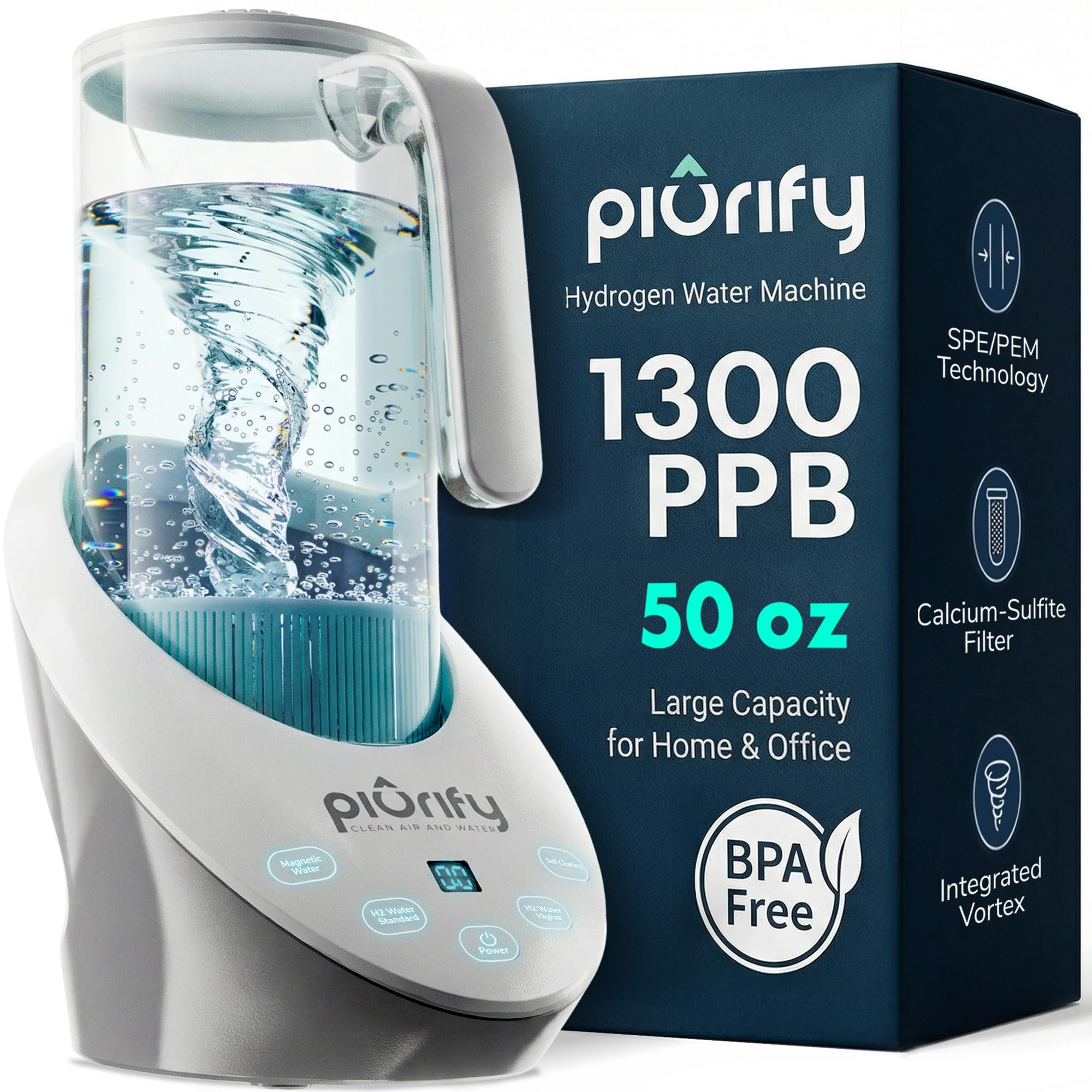
| PIURIFY 3 in 1 Hydrogen Water Machine★ Best Overall | Two-person kitchens | 50 fl oz | 700–1300 PPB | 8 min / 13 min | Amazon |
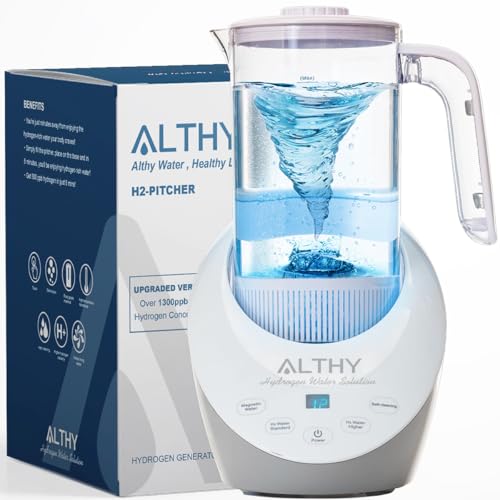
| ALTHY Hydrogen Water Generator PitcherFastest Batch | Fast large-batch fills | 1600 ml | Exceeds 1300 PPB | 10 min | Amazon |
| Sport MAXX Hydrogen Water GeneratorTravel Ready | Commute and travel | 14 fl oz | 1.7 PPM / 3 PPM | 5 min / 10 min | Amazon |
| PUREPEBRIX Hydrogen Water Bottle | Gym and desk use | 10 oz | Up to 9060 PPB | 5 / 10 / 15 / 20 / 30 min | Amazon |
| HydroPitcher 68 Oz | Large households | 68 fl oz | ~1500 PPB | 5 min / 10 min | Amazon |
| Echo Go+ Hydrogen Water Bottle | On-the-go sipping | 10 fl oz | Adjustable levels | — | Amazon |
| Alkaline Water Ionizer Machine 729 | Faucet-mounted ionizing | Up to 8000 L per filter | pH 4–10.5, up to -570mV ORP | Continuous flow | Amazon |
| Aqua Ionizer Deluxe 5.0 | Countertop alkaline setup | 4000 L per filter | pH 4.5–10.5, up to -600mV ORP | 7 settings | Amazon |
| Tyent Q-Series Water Ionizer | Premium plumbed setup | 951 gallons | 4 alkaline / 3 acidic levels | Touch panel settings | Amazon |
Detailed Reviews
1. PIURIFY 3 in 1 Hydrogen Water Machine
Our pick — 4.0+★ from 650+ verified ratings; the strongest balance of quality and price.
One pitcher holds a family’s whole morning, and the hydrogen sticks around for hours.
Fifty fluid ounces from a single cycle is the number that wins this pick. Pour a glass for yourself, your partner and a guest from one run, and you are not standing at the counter refilling a bottle three times before breakfast. It measures 8.3″L x 7.2″W x 13″H, so it sits on the counter without eating the whole surface, and the clear Tritan body is shatter-resistant rather than glass.
Three stages do the work: SPE/PEM electrolysis (a membrane splits hydrogen from oxygen so only H₂ ends up dissolved), a magnetic vortex pre-step that swirls the water before electrolysis, and a calcium-sulfite filter that removes chlorine on the way through. You get two cycles — 8 minutes at 700–900 PPB for everyday drinking, or 13 minutes at 1300 PPB when you want a stronger batch. Hydrogen holds up to 8 hours in the pitcher.
The honest catch: this is a hydrogen infuser, not a water purifier. The maker states plainly that it enriches already-safe water and should be paired with a proper filter if your tap is not clean. The second thing to know is water chemistry — hydrogen absorbs far better into low-mineral water, and a heavily mineral tap will read lower on a test strip than the quoted figure. Owners filling from an RO system report the highest readings. It carries 4.0+ stars across 600+ ratings, and the lifetime warranty replaced pitchers that failed around the two-year mark free of charge. As buyers report of one long-running household, “Used 9 months daily by 2 people, 6–10 pitchers/day; tasteless, odorless, easy to clean, compact.”
What earns it first place
- 50 fluid ounces per cycle serves several drinkers from one fill.
- Two cycle lengths let you choose everyday 700–900 PPB or a stronger 1300 PPB batch.
- Built-in self-cleaning mode and a quick-swap calcium-sulfite filter keep upkeep short.
- Lifetime warranty with a documented pattern of fast, free pitcher replacements.
Where it asks patience
- It filters chlorine but is not a full purification system — dirty tap water needs its own filter first.
- The vortex stage runs separately from the hydrogen stage, so a full-strength batch takes two passes.
Buy it for: a kitchen where two or more people pour hydrogen water daily and want the pitcher to keep up with one fill.
Know first: plan on filtering your own tap water separately if chlorine is only part of what you want removed.
2. ALTHY Hydrogen Water Generator Pitcher Machine
Ten minutes and you have over a liter and a half of hydrogen water at full strength.
Where the PIURIFY gives you two cycle lengths to choose from, this ALTHY pitcher runs one cycle: 10 minutes for up to 54 ounces (1600 ml) with a stated hydrogen content above 1300 PPB. That is more volume in a shorter single pass than most pitchers here manage, which matters if you fill the jug once in the morning and pour from it all day.
The build is food-grade Tritan, and the dual-chamber SPE/PEM electrolysis uses an electrode made of titanium with a platinum coating — the material choice that resists corrosion over repeated cycles. A dedicated button runs the hydrogen cycle and a separate one rinses, and the maker asks you to start the cleaning mode after every 10 electrolysis runs. The calcium-sulfite cartridge handles ozone, hydrogen peroxide and chlorine before the water reaches the plate, and the recommended swap is every 3 months.
One practical note the manual makes explicit: the machine is built for pure water, direct-drinking water and mineral water between 5–38℃, so do not feed it hot water straight from the kettle. The seven-color LED ring and the end-of-cycle tone are pleasant touches rather than features you will rely on. With the pitcher under a year on the shelf, buyer history here is thin — treat the design confidence as untested rather than proven, and check the warranty terms before you commit.
Where it earns its spot: the 10-minute, 1600 ml cycle is the fastest full-batch run in this group, and the titanium-platinum electrode is the right material for a machine you will cycle every day.
The thing to weigh: no customer track record yet, and the 3-month filter swap is a recurring cost you should budget for.
Right pick when: you want a big batch fast and are comfortable being an early adopter on a newer model.
Reconsider if: you would rather lean on a long review history before spending.
3. Sport MAXX Hydrogen Water Generator
A 14-ounce glass bottle that slips into a bag and makes hydrogen wherever you land.
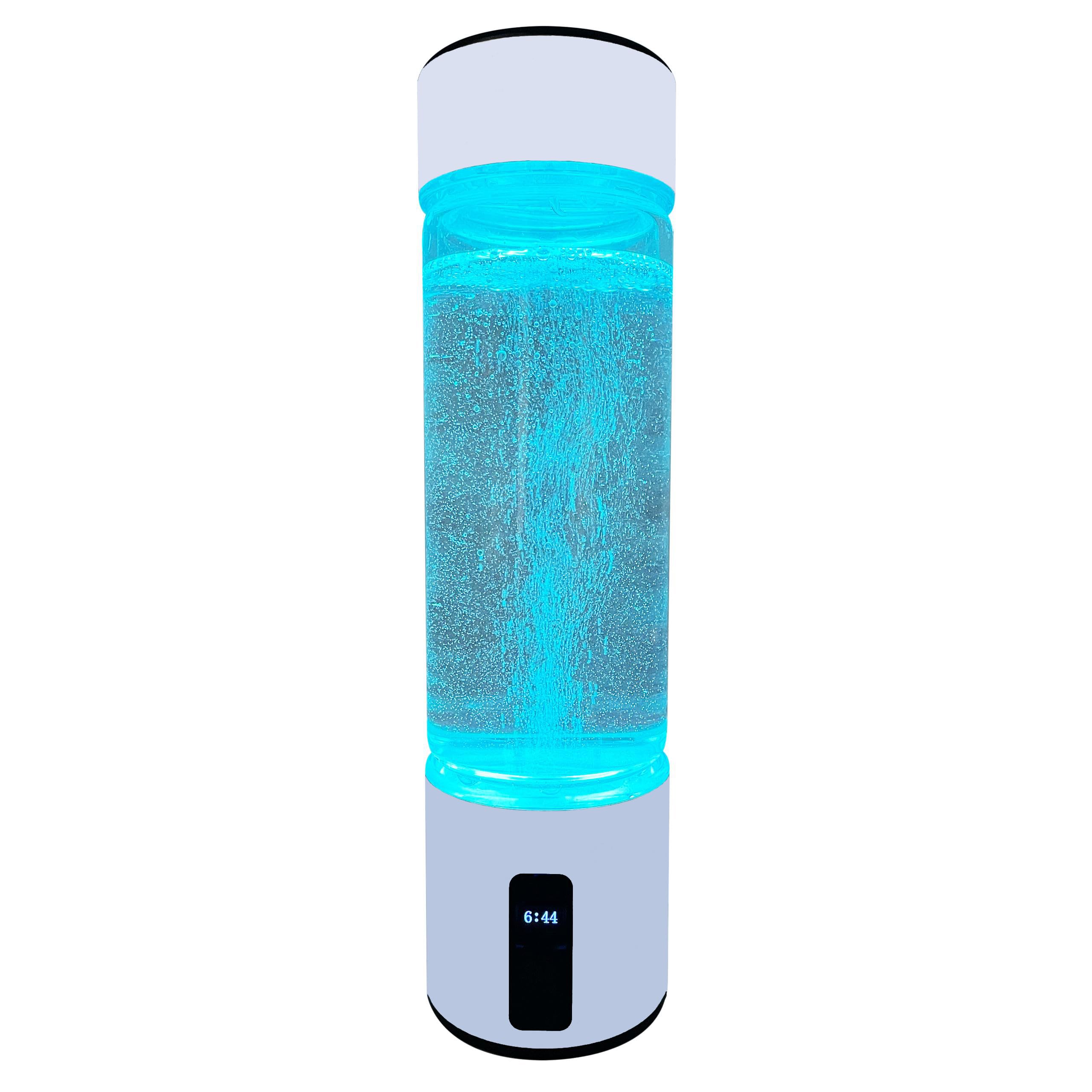
At 2.5″L x 2.5″W x 11″H and 16 ounces, this is the one you carry rather than pour from a counter. The PIURIFY holds 50 fluid ounces; this holds 14, which is the whole point — you drink one serving and refill, rather than leaving a pitcher of fading hydrogen on the counter. It uses platinum-coated titanium SPE plates and a DuPont PEM membrane, and a third-party lab (H2 Analytics) certified the concentration so you do not test at home.
The numbers are 1.7 PPM on a 5-minute cycle or 3 PPM on 10 minutes, with negative ORP from -350 to -600mV. PPM here is parts per million, a coarser way of counting dissolved hydrogen than PPB. The bottle is single-wall borosilicate glass and ships with a sleeve protector; owners describe it surviving a two-foot drop with a small dent and no leaks. A beeping tone can be switched off for office use, and there is a self-cleaning mode to descale the plates. An inhaler adapter is included for when drinking is not practical.
What buyers praise most is build quality, and it shows in the day-to-day — the leak-free seal and the simple assembly come up again and again. The one honest note in the mix is battery life, which is why the maker added a battery meter to this version. A pod-style bottle needs charging, and a battery you forget to drain fully is the failure mode to watch. The 2-year warranty on parts and defects covers genuine faults.
Why travelers keep it
- Third-party certified concentration, so you skip home test kits.
- Simple 5-minute or 10-minute cycle with a visible battery meter.
- Self-cleaning mode descales the plates between uses.
- 2-year warranty on parts and manufacturing defects.
Plan around this
- 14 ounces is one serving — you will cycle it repeatedly.
- Battery life is the recurring weak point; keep it charged and fully drained.
Made for: the person who wants hydrogen water at the gym, in the car, or in a hotel room rather than in one kitchen.
Fair warning: 14 ounces means a lot of refills if you drink by the quart.
4. PUREPEBRIX Hydrogen Water Bottle Generator
The bottle that chases the number: 9060 PPB if you give it a full half hour.
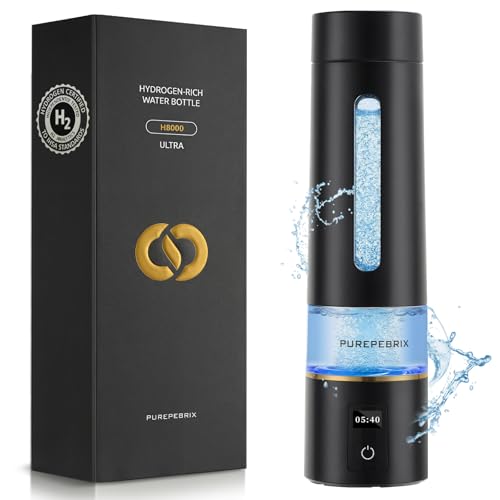
Nowhere else in this group does the concentration climb so high. Using SPE/PEM electrolysis, this bottle reaches a stated mean of 4340 PPB in 5 minutes, 6590 PPB in 10, 7430 PPB in 15, 8160 PPB in 20 and up to 9060 PPB in 30. The figures come from H₂ Analytics testing, and a QR code on the unit opens the full lab report so you can read it yourself.
The electrode is platinum-iridium coated, chosen for corrosion resistance, and a dual-chamber membrane vents exhaust gases out separately so only dissolved hydrogen stays in your 10 ounces. The body is BPA-free Tritan — the higher-pressure material that allows this concentration, unlike the glass bottles that cap lower. It fits a cup holder at 2.48″L x 2.48″W x 8.66″H, and the rechargeable battery runs up to 20 cycles per charge. A nasal cannula and two converters are included for hydrogen inhalation.
Where it needs care is the gap between the paperwork and the experience. Cleaning instructions differ across the card, the website and the listing, and skipping the first wash leaves a plastic taste for a few bottles — wash the bottle and cap before the first fill. Battery is the other soft spot; it drains faster than the 20-cycle claim suggests if you run the 20- and 30-minute settings back to back. On longevity, the maker backs it with a 1-year warranty plus lifetime technical assurance, and offers a 10-fold refund if an independent lab verifies a bottle below spec — a confident stance. Quality is the trait that carries it among buyers, and the concentration and taste both land well.
The case for it: if you want the highest dissolved hydrogen per sip and you are willing to run a 30-minute cycle, nothing on this list climbs as high.
Slow down here: the cleaning instructions disagree with each other, so read the bottle label, not the website photo, and wash before the first fill.
Pick it for: the drinker who treats hydrogen water as a measured daily dose and will run the long cycle for the strongest batch.
Second thoughts if: you want a machine you press once and forget, or you dislike battery upkeep on a portable bottle.
5. HydroPitcher | 68 Oz Hydrogen Water Pitcher – BPA Free
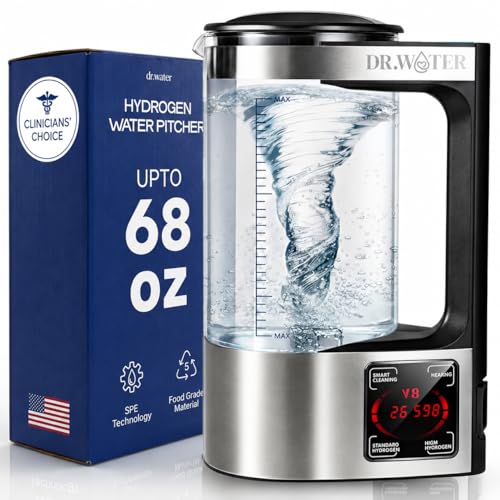
The biggest jug here at 68 ounces, built to fill a whole household’s glasses.
If the PIURIFY’s 50 ounces still means a second fill on a busy morning, this 68-ounce (2 L) pitcher leaves margin. Two presets do the work: a 5-minute run for everyday drinking, or a 10-minute run that drives concentration to roughly 1500 PPB. The maker frames that as comparable to a countertop hydrogenator while staying portable enough to move from kitchen to table.
The controls are as simple as it gets — tap once for five minutes, twice for ten, with LEDs confirming the cycle. Calcium-sulfite beads sit in the base as a dedicated chlorine filter rather than a bulky cartridge, which keeps the taste clean without a big swap job. It ships with the device, a connecting cable and the manual, and the warranty runs 12 months. There is no built-in tester, so if you want real-time readings you will need an external hydrogen water tester.
The honest split here is that this pitcher divides opinion. The build itself holds up and the setup is quick; the recurring gripe is the water not visibly bubbling or swirling on some units, and a faint off-taste until you run the included citrus cleaner through it. Do that first — it takes a little patience but turns the taste around. The other thing to know is that chlorine removal is not full purification, so start with water you would already drink. Owners who stick with it settle into a one-or-two-tap routine and drink more water overall.
What sells it
- 68 fluid ounces is the largest capacity on this list.
- Two-stage touch control keeps the routine to one or two taps.
- 12-month warranty and 24/7 support with replies inside a day.
Read before you buy
- Some units show no visible bubbles, which makes it hard to know the cycle ran.
- Run the citrus cleaner before the first use or the taste can be off.
Good fit: a big household where you fill the jug once and pour for a crowd through the day.
Think again if: you need a visible bubble display to feel confident the cycle happened.
6. Echo Go+ Hydrogen Water Bottle
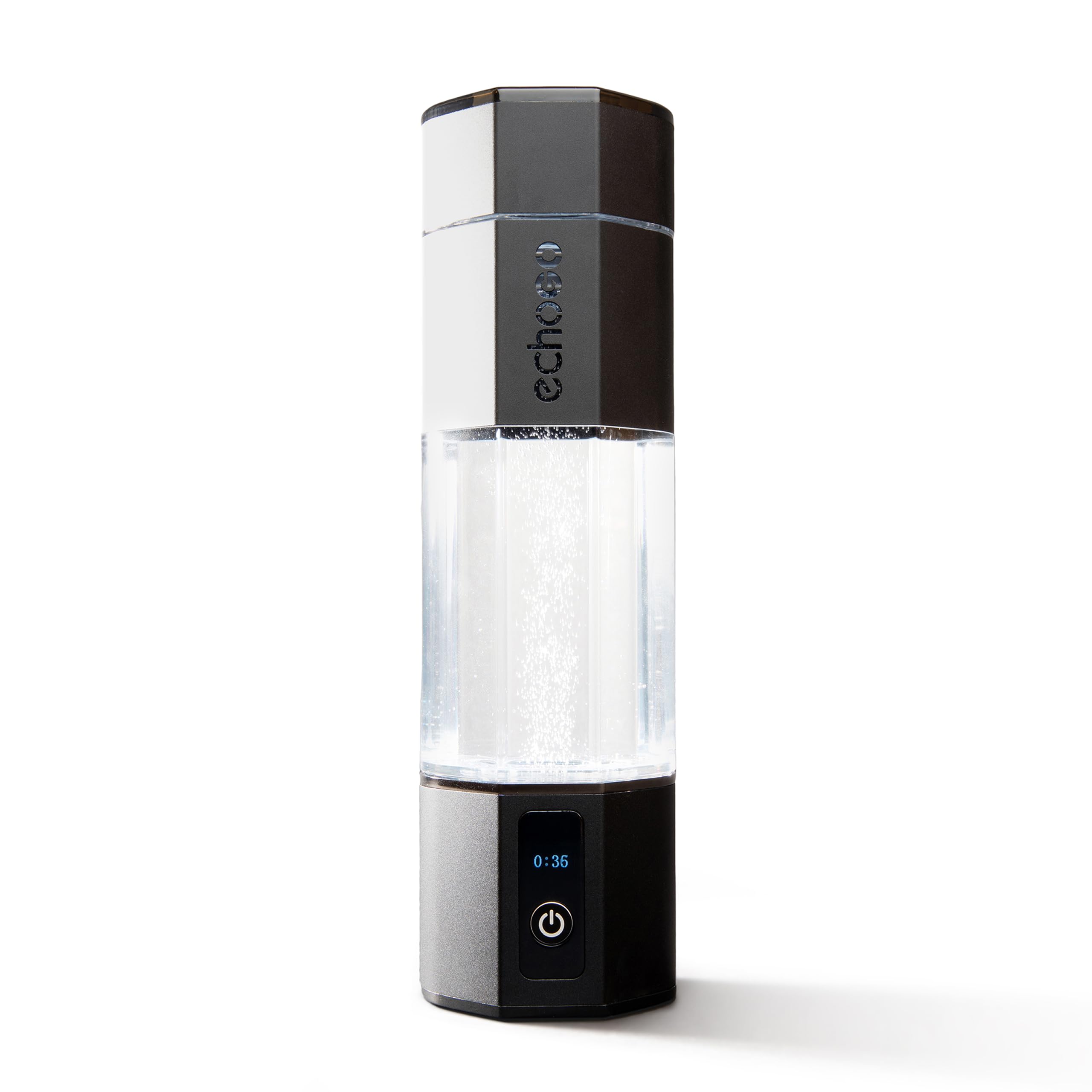
One button, adjustable strength, and a sealed top that survives a commute.
The Echo Go+ is the smallest bottle here at 10 fluid ounces and 1.3 pounds, with a polycarbonate body that is BPA-free. Where the PUREPEBRIX makes you choose a cycle length up front, this one lets you dial the hydrogen level with adjustable settings — one button, no menu. The sealed top means it will not soak your bag, and the rechargeable lithium-ion battery plus USB block and cord come in the box.
It uses SPE and PEM purification with hydrogen infusion, and the maker pitches the water for skin health and immune function support. Treat those as the marketing frame rather than a measurement — what you actually control is the concentration setting and how often you drink. Owners mention drinking more water overall, which is what a one-button 10-ounce bottle is good at. Several describe it surviving a drop onto concrete with a light scratch and continuing to work.
Two things to weigh honestly. First, 10 ounces means frequent refills — comfortable in a bag, less so if you expect a quart in one sitting. Second, the bottle has had real teething trouble: leaks and early failures show up in enough places to name durability as the weak spot, and the warranty has drawn complaints from buyers who felt a pressure loss was ruled cosmetic. Set expectations accordingly and register the warranty the day it arrives. Owners of working units say the adjustable levels and sealed top make it the bottle they actually carry daily.
Where it lands: the adjustable-level control and the sealed rechargeable body make it the easiest bottle to carry and operate one-handed.
Be deliberate about: durability and warranty support are the two areas that divide buyers, so keep the cord and the receipt and register on day one.
Suits you if: you want a light, one-button bottle for desk and commute and will refill it a few times a day.
Look elsewhere if: you expect a bottle that takes abuse without leaks, or you want batch capacity in one run.
7. Alkaline Water Ionizer Machine 729

This one plumbs into the faucet and makes ionized water on demand, not in batches.
This is a different animal from the pitchers and bottles above — it connects to your tap and produces water as it flows, with seven settings across four alkaline, one filtered and two acidic types. The machine runs pH 4–10.5 with ORP down to -570mV, uses five titanium plates with a platinum coating and an imported ionic membrane, and the filter is rated for 8000 L. A 3.8-inch color LCD shows the setting, and both WQA and NSF certification sit behind it.
Atomic detail matters here: it works with normal threaded and thread-less faucets but not shower or unusual faucets, and the flow must stay between 0.8 and 3.5 L/min — the machine stops below the low end and loses alkalinity above the high end. It will not work on well water, and it is 110 volts only. The carbon filter reduces pollutants but is not a softener, so high-TDS tap water will strain it; the stated range is 50–1000 mg/L.
The draw is price-to-capability: long-term customers note the 8000 L filter outlasting expectations, and swapping it is routine. The caution is consistency. A few units drift out of true alkalinity after several months and a pH strip can read near neutral when the display shows high — test with your own strip at the three-month mark and contact support early if they disagree. The cleaning cycle runs roughly every gallon, keeping the plates working between descales.
What it does well
- Seven settings cover drinking, cooking, washing and sanitizing from one tap.
- WQA and NSF certified, with a 3.8-inch color display.
- 8000 L filter capacity keeps replacement costs spread out.
What to plan for
- Will not work on well water and needs 110 volts only.
- Flow must stay inside 0.8–3.5 L/min or the output drops off.
Choose it if: you want ionized water straight from the faucet and have standard threaded plumbing.
Not for you if: you are on well water or a non-standard faucet.
8. Aqua Ionizer Deluxe 5.0 | Water Ionizer | 7 Water Settings
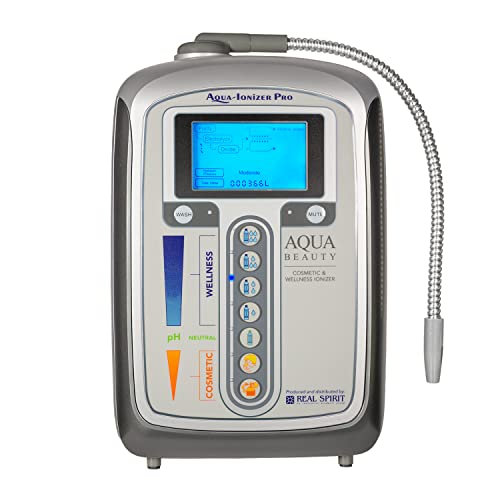
Seven presets on the counter, from a gentle purified glass to a sharp acidic clean.
The Aqua Ionizer Deluxe 5.0 runs seven water options: four alkaline ionized with continuously variable pH from 4.5 to 10.0, one non-ionized purified setting, and two acidic presets. ORP reaches up to -600mV, and the activated carbon filter treats 4000 liters before a swap. It measures 9″L x 12″W x 6″H and weighs 10.6 pounds, so it takes a defined corner of the counter rather than tucking away.
The self-cleaning routine is the part that keeps it honest — it reverses polarity after each use and auto-washes the plates roughly every 10 gallons, so you are not manually descaling often. Maximum flow rate is 3 liters per minute, and like most ionizers in this class it is not compatible with well water. The continuously variable alkaline range is what separates it from the 729’s fixed presets — you can dial in the pH rather than pick from a menu.
Among buyers, installation and pH consistency are the two themes that carry the reputation, and the value relative to far dearer ionizers is the recurring note. The fair caveat is durability at the edges: a unit that stops producing alkaline water and starts tasting off is the pattern to watch, and pre-filtering your source water protects both the plates and the taste. The maker warranty runs a year, and registration gets you the filter and pH testing kit support when you call.
Standout spec: continuously variable pH from 4.5 to 10.0 is the most adjustable alkaline range here, so you can tune the output rather than pick from a fixed ladder.
Trade-off to accept: the motor and plates reward clean source water, so a prefilter is worth adding if your supply is heavy with minerals.
Best for: households that want one countertop machine for drinking, cooking and cleaning water with a pH dial rather than a preset list.
Skip if: your water comes from a well or you have no room for a 10.6-pound counter unit.
9. Tyent Q-Series Water Ionizer
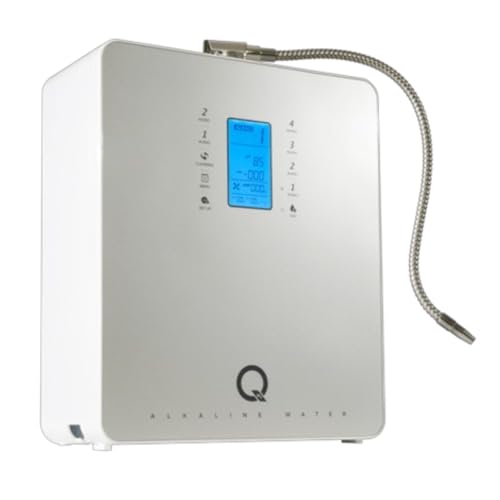
The plumbed luxury option: a 0.01 micron dual filter and a touch panel that remembers your setting.
Four alkaline and three acidic levels give you seven ways to pour, chosen from a backlit color touch panel. The filtration is the headline — a dual system with a 0.01 micron membrane that the maker states removes up to 99% of chemicals and over 200 impurities, including chlorine, bacteria and pharmaceuticals. It supports source water up to 600 PPM TDS, and the front-load filter access plus one-touch reset make swaps quick enough that you will actually do them.
The 951-gallon filter rating sets the maintenance interval far out, and front-load access means one motion to swap. The unit sits at 14″L x 12″W x 5.5″H and is described by one returning customer as more compact than the older MP5500 it replaced, freeing counter space. The gray front and touch panel read as modern, and the auto-flow-stop keeps the dispenser from running over.
What to know before you commit: this is the most premium pick on the list, and the honest weak spot is installation quality. At least one unit arrived with the filters not fully tightened to the water lines and leaked onto the counter before the first proper pour — check every connection before you run the first cycle, and the unit is fine. Support has a strong reputation for walking buyers through setup. For someone who wants a single machine doing alkaline, acidic and purified water with serious filtration, it delivers where the batch pitchers here cannot.
Why it stands out
- 0.01 micron dual filtration handles chlorine, bacteria and pharmaceuticals.
- Four alkaline and three acidic levels from a backlit color touch panel.
- 951 gallons per filter and front-load access for quick swaps.
Check at setup
- Tighten every filter-to-line connection before the first pour to avoid a leak.
- The premium build comes with the highest price in this group.
The right call for: a plumbed-in home setup where you want filtration and pH control from one machine and are happy to check the connections at install.
Look elsewhere if: you want a batch pitcher you can carry to the table, or you are not ready to spend at the top of the range.
Know the Specs
PPB and PPM — the concentration numbers
PPB (parts per billion) and PPM (parts per million) both describe how much hydrogen gas is dissolved in your water right after a cycle. PPB is the finer measure: 1000 PPB equals 1 PPM. Makers quote their best result, usually on the longest cycle, so read the cycle length next to the number. And because hydrogen escapes over hours, what matters is how soon you drink it, not the peak printed on the box.
SPE/PEM electrolysis — separating the good gas
SPE/PEM is a membrane setup that splits water and sends oxygen and ozone out one side while dissolved hydrogen stays in your drinking water. It is the technology behind most bottles and pitchers here. A plain electrolysis plate without the membrane can leave byproducts in the water, so the membrane is the spec to confirm if purity matters to you. Plates coated in platinum or platinum-iridium resist corrosion across thousands of cycles.
Capacity and cycle time — the daily math
Fluid ounces are the real telling spec: a 10-ounce bottle is one serving, a 50-ounce pitcher is a table pour, and a 68-ounce jug covers a crowd. Cycle length trades time for strength. Match the capacity to your daily glasses and the cycle to your morning routine, and you will actually run the machine.
ORP and pH — ionizer-specific specs
Ionizers like the Aqua Ionizer and the Tyent quote ORP (oxidation-reduction potential, a measure of antioxidant activity) and pH levels rather than PPB. A more negative ORP is the target, and the pH range tells you where the dial can go. These machines also filter, so check micron rating and flow rate, and confirm your water source falls inside the supported TDS range.
Common Questions
How long does hydrogen stay in the water after a cycle?
Why does my machine read lower PPB than the box claims?
Does a hydrogen water machine filter my tap water?
Can I use hot water in a hydrogen water pitcher?
How often do I change the filter or cartridge?
Is a hydrogen water bottle better than a pitcher?
Will an ionizer work with my faucet and water supply?
What is the difference between PPB and PPM on these machines?
Do hydrogen water machines need cleaning?
Can I use an external tester to check my machine?
The Bottom Line
For most households, the winner is the PIURIFY 3 in 1 Hydrogen Water Machine because 50 fluid ounces per cycle serves a whole table from one fill, and the two cycle lengths let you choose between everyday 700–900 PPB and a stronger 1300 PPB batch. If you want hydrogen water on the move, reach for the Sport MAXX Hydrogen Water Generator with its 14-ounce glass bottle and third-party certified concentration. And if you want one plumbed-in machine doing alkaline, acidic and purified water with serious filtration, the Tyent Q-Series is the oneto reach for. The PIURIFY backs that up with 4.0+ stars across 600+ ratings and a lifetime warranty that replaced failed pitchers free. That combination of capacity, concentration and backup is why it holds the top spot.
How we choose
We do not accept paid placement. Every pick is matched to a real buyer and a real use-case; we do not hands-on test units.
Sources
Specifications: manufacturer listings and product documentation. Review insights: verified customer reviews, as of October 2026. Pricing: not shown on this page (it changes often); check the current price via the retailer link.
As an Amazon Associate, Aappliancez earns from qualifying purchases. This does not affect which products we feature.