Disclosure: Some links in this post are affiliate links. As an Amazon Associate I earn from qualifying purchases, at no extra cost to you. Learn more
Specs are compiled from manufacturer listings and verified buyer reviews and can change over time — please confirm the key details on the product page before buying.
If you are buying hydrochloric acid, you probably want one of three things: lower pool pH, brightened concrete, or a stain off stone that nothing else touched. Buffered and low-fume formulas deliver all three without the vapor cloud. Buffered and low-fume formulas now do the same job as old-school muriatic acid while cutting the worst of the vapor. This guide separates the five options buyers actually reach for, shows which ones hold their strength and which ones are gentler on your skin and your garage, and gives you the plain-English version of what each bottle really does.
This guide is built by comparing the manufacturers’ published specifications and the patterns across verified customer reviews, so you get each pick’s real strengths and trade-offs instead of marketing spin.
You will see the difference between a buffered acid that barely fumes and a full-strength quart that eats toilet rings but also eats a stainless steel sink. The short version: pick by job first, strength second, and fume tolerance last. Here is the honest read on the hydrochloric acid bottles worth carrying home.
Top Picks


How To Choose The Best Hydrochloric Acid
Hydrochloric acid and muriatic acid are the same chemical under two names — muriatic is simply the older trade word. The bottle you pick should match the surface you are working on. A pool needs a pH reducer you can pour without gassing the patio. A garage floor needs something strong enough to etch. Those are two different products, and confusing them is the most common mistake.
Start with the job, not the strength
Pool water balancing calls for a buffered formula that lowers pH steadily. Buffered means the acid is partly tamed so it releases more slowly, which is why the low-fume versions pour with less sting in the air. Concrete and masonry cleaning is the other main job — that is about brightening a dull slab and lifting rust or mineral stains. If you need to strip a toilet bowl ring or dissolve calcium scale off filter cartridges, you want a concentrated liquid that works on mineral deposits.
Do the simple math on how much you get
Two bottles can look identical on the shelf and hold wildly different amounts. Check the fluid ounces on the label rather than the shape of the jug. A 128-fl-oz container is a full gallon of liquid, which is a season of pool dosing for many owners. A 32-fl-oz quart is a spot-treatment size — right for one bad stain, not for a whole driveway. The fill weight follows the volume, so a heavier jug usually means more liquid inside.
Face the fume question honestly
Classic muriatic acid gives off sharp vapor the moment you open it. Buffered formulas advertise big reductions in those fumes, and that is the single biggest comfort upgrade in this category. If you work in a garage, a shed, or anywhere without a strong crosswind, the low-fume route is worth choosing even if the acid itself is pricier per ounce. Read the label for the vapor claim before you buy; it tells you which family you are in.
Side-by-Side Comparison
| Model | Best For | Volume | Form | Fume Profile | Amazon |
|---|---|---|---|---|---|
| CPDI Acid Blue Muriatic Acid (1 Gallon)★ Best Overall | Pool pH and concrete in one jug | 1 Gallon | Liquid, buffered | Reduces up to 90% of vapors | Amazon |
| Sunbelt Chemicals 1 Muriatic AcidBig-Jug Value | Big-volume pool dosing | 128 Fluid Ounces | Liquid | Standard muriatic | Amazon |
| Sunnyside Corporation 71032 | Spot jobs that need full strength | 32 Fluid Ounces | Liquid | Standard muriatic | Amazon |
| Miracle Sealants Heavy-Duty Acidic Cleaner | Tile, grout and rust stains | Quart | Liquid, dilutable | Strong, harsh | Amazon |
| Acid Magic Muriatic Acid Replacement | Buffered all-round cleaner | 32 Fluid Ounces | Liquid, buffered | 90% fewer fumes | Amazon |
Detailed Reviews
1. CPDI Acid Blue Muriatic Acid
Our pick — 4.5+★ from 800+ verified ratings; the strongest balance of quality and price.
The one gallon that lowers pool pH and brightens the slab without choking the patio.
Acid Blue is the pick here because it solves the two jobs most households actually buy hydrochloric acid for. It controls the pH of pool and hot tub water on one side, and brightens concrete and masonry on the other. The formula is buffered, which means the acid is tamed so it pours with a slower, steadier action than raw muriatic. It comes as a full gallon of liquid weighing 4.3 pounds, so you are not running back to the store mid-season.
Its headline feature is vapor reduction: up to 90% fewer fumes than standard muriatic acid. The maker states the formula cuts up to 90% of the harmful vapors tied to old-school muriatic acid, so you can work with the shed door open instead of a full respirator. It is the same idea you will see on the Acid Magic bottle, but here it arrives in a gallon size built for repeated pool dosing. For a salt water pool owner, that combination of steady pH control and tolerable air is the whole reason to buy.
The catch is honest and worth saying plainly: pH reduction is the part of this formula with the most divided feedback, and some owners find it takes more product to shift a stubborn pool than they expected. Effectiveness is what the brand earns its reputation on, but if you want a hard, fast pH crash you may reach for a concentrated quart instead. The gallon is a marathon runner, not a sprinter. It is also a liquid acid, so it still wants gloves, eye protection, and a breeze.
Where Acid Blue earns its keep
- Cuts up to 90% of the fumes standard muriatic acid gives off.
- A full gallon at 4.3 pounds means one jug covers a long stretch of pool dosing.
- Handles both pool pH balancing and concrete or masonry brightening without buying twice.
- Buffered formula pours with less of the sharp sting that makes raw acid unpleasant.
What to plan around
- pH reduction draws some mixed feedback — expect it to work gradually, not instantly.
- It is still acid, so gloves, eye protection and airflow stay on the list.
Reach for this if: you keep a pool and also have concrete that needs brightening, and you want one buffered jug that will not gas up the yard.
Think twice if: your whole goal is snapping a spa’s pH down in one pour — a concentrated quart does that faster.
2. Sunbelt Chemicals 1 Muriatic Acid
A full gallon of no-frills muriatic acid for the owner who doses the pool weekly.
This bottle does one thing and says so on the label: it lowers the pH level of swimming pool water. There is no low-fume marketing, no buffered formula, no dual-purpose pitch — just 128 fluid ounces of liquid muriatic acid in a single container. At 10.4 pounds it is the heaviest jug in this lineup. Put next to the Sunnyside quart it is a straight size story: 10.4 pounds versus 2.5 pounds, and 128 fluid ounces versus 32. Same family of chemical, four times the liquid in the Sunbelt jug.
For pool owners who treat dosing as routine maintenance rather than a special event, that volume is the appeal. One jug lasts through repeated treatments so you are not reordering every few weeks. The formula suits salt water pools as readily as standard chlorine setups, and owners use it to lift stains off the pool floor as well as to bring pH down. It ships as a single plastic bottle, which keeps the ordering simple.
Here is the honest limit: this is standard muriatic, so it fumes the way standard muriatic does. If your equipment pad sits in a closed garage, the buffered bottles above and below will be kinder to your lungs. And because it is a heavy gallon of acid, plan a steady two-handed carry from the porch to the shed. The payoff for that weight is a long run of doses from one container.
Who this jug suits: a pool owner who already knows their dose and just wants a big, plain supply of pH reducer that lasts the season.
The honest trade-off: no fume reduction and the heaviest pour in the lineup — buy it for volume, not for comfort.
Yes for: high-volume pool dosing where maximum liquid per jug matters most.
Not for: indoor use or anyone who wants the vapor turned down.
3. Sunnyside Corporation 71032 1-Quart Muriatic Acid

The quart that takes a toilet ring down to bare porcelain, if you respect it.
Sunnyside’s 71032 is the fast-acting version of the chemical — also known as hydrochloric acid, as the label notes. It handles two familiar chores: balancing the pH of swimming pool water and cleaning hard mineral buildup that ordinary cleaners leave behind. The bottle holds 32 fluid ounces and weighs 2.5 pounds, which makes it the light touch of this group after the two gallon jugs. It arrives in a plastic bottle, and the maker’s own advice is to read the label carefully before use — take that seriously.
What owners prize most is the sheer strength. This is the bottle for a badly scaled spa or a toilet bowl with a ring nothing else budged, and the recurring theme is that it does not take much to do the job. It is the same strength story as the Sunbelt gallon, just in a quart you can lift one-handed. If you are comparing the two on size alone: 32 fluid ounces here against 128 fluid ounces in the Sunbelt, so this is the spot-treatment bottle rather than the season supply.
Strength cuts both ways, and this is where to be honest. This concentration reacts hard with zinc, and the reaction observed involved violent bubbling, steaming, heating, and caustic gas — so keep it far from zinc anodes. It also attacks stainless steel sinks and metal faucets. Read that as a warning about surface matching, not a reason to skip the product: put it on porcelain or concrete and keep it off bare metal. And no one should touch this one without gloves and eye protection.
Why owners keep it on the shelf
- Very concentrated — a small amount goes a long way on a stubborn stain.
- Removes the worst toilet rings that other cleaners fail on.
- Light enough at 2.5 pounds to handle one-handed.
What it will eat if you let it
- Attacks stainless steel sinks and metal faucets — keep it off bare metal.
- Reacts aggressively with zinc, so zinc anodes must stay away.
- Sharp fumes and full strength; gloves and eye protection are required.
Pick it when: the scaling or the stain is bad enough that mild cleaners have already lost, and the surface is porcelain or concrete.
Leave it alone if: the surface is stainless steel or zinc — this quart is a specialist, not a general spray.
4. Miracle Sealants Acidic Cleaner & Rust Stain Remover

A tile-and-grout acid cleaner that eats soap scum and efflorescence, but wants you dressed for it.
Buy this if your battle is on the bathroom floor rather than in the pool. Miracle Sealants’ Heavy-Duty Acidic Cleaner is a strong acid designed for interior and exterior surfaces, and it is dilutable, so you choose how aggressive you want it. It lifts rust stains, soap scum, and white efflorescence — the chalky bloom that comes through grout and tile — and the recurring win is that floors look new again when it is done. It is the one product here clearly built around hard-surface detailing, not water chemistry.
The method matters as much as the liquid. Homeowners get the best result by applying a small amount, agitating it with a brush, then covering it with a paper towel so the product stays on the stain, and wiping it off after about five minutes. Efflorescence in shower tile may need more than one pass. Pouring it straight onto the floor mostly wastes it down the drain. The heavy soap-scum and grout-buildup jobs are where this earns praise, and it gets there in two applications on a nasty shower.
The catch here is the working environment, not the cleaner. This one is harsh on the air — plan on a respirator, a face shield, goggles, and clothes you do not care about, and open a window. There is also a real caution in the feedback: one owner reported damage to outdoor flooring with a white, powdery residue showing up within 48 hours, so test it on a hidden patch of any unknown stone or finish before you commit. That is a surface-matching risk on a strong acid, and it is worth the five-minute test.
Why the pros in the tile world like it: dilutable strength plus a wipe-and-go method makes short work of soap scum, rust and efflorescence, and it is the surface-cleaning pick rather than a pool chemical.
Be honest with your setup: fume-heavy, and unknown stone should get a patch test first — dress up and ventilate before you pour.
Built for: bathroom and tile jobs where rust, soap scum or efflorescence have already beaten your regular cleaner.
Only after a patch test: unknown or delicate outdoor stone, and never in a closed room without airflow.
5. Acid Magic — Muriatic Acid Replacement (1-Pack)
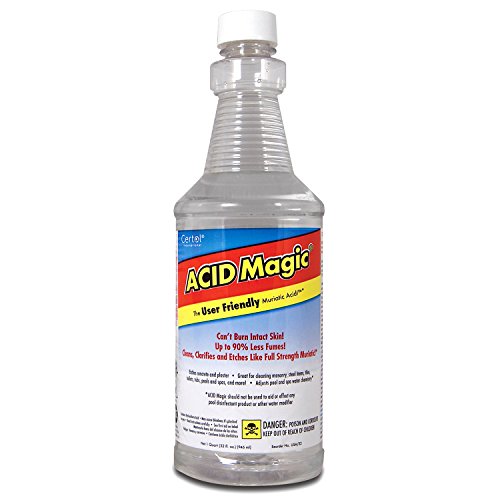
The buffered replacement that dissolves calcium scale without burning intact skin.
Acid Magic is a full-strength, 1-to-1 muriatic acid replacement whose defining claim is that it will not burn intact skin. The maker advertises 90% fewer fumes than standard acid, matching the buffered Acid Blue gallon above. What separates Acid Magic is that it is a 32-fluid-ounce liquid in a bottle, with a stated volume of 946.35 ml, sized for cleaning chores rather than whole-pool dosing.
Where it shines is mineral scale. Dissolving calcium deposits on filter cartridges is its self-described best use, and it cleans tile, concrete, enamel paint, and even seashells — the kind of jobs where you want acid working on the crust, not on your hands. It removes hard water stains from brick and long-standing limescale from porcelain, and it works fast enough that a dip of seconds is all it takes. The maker also pitches it for reducing high pH and total alkalinity in pools and spas, so it is not one-note. Buyers rate effectiveness highest, with its restoration of discolored surfaces a close second.
Two cautions belong with the praise. Undiluted, it can discolor metal, so dilute it for anything with a metallic surface; the safest read is that it is fine on stone and porcelain, careful on metal. The smell is milder, not invisible — it still wants the window open. And some buyers find the small bottle runs out fast on big jobs, since a large area may use most of a container. Reach for it as the gentle, targeted cleaner and it delivers; expect it to treat a whole driveway and you will be reordering.
Where it beats standard muriatic
- Per the maker: 90% fewer fumes and no burns to intact skin.
- Excellent on hard water stains, limescale and calcium deposits on filter cartridges.
- Dilutable, so you tailor the strength to the job.
- Restores dull stone, brick and porcelain to a like-new finish.
Where to slow down
- Undiluted, it can discolor metal — dilute before touching metal surfaces.
- A 32-fluid-ounce bottle goes quickly on a large area.
- Reduced fumes are easier to breathe, but outdoor use is still the smart call.
The smart buy for: cautious cleaners who want the acid to do the hard work on scale and stains without the lung burn.
Know before you buy: dilute it near metal and plan on a bigger container for large-surface jobs.
Know the Specs
Buffered vs full-strength
Buffered acid is formulated to release more slowly, which tames the fumes and the harshness. Full-strength muriatic hits harder and faster but fumes more, so it suits spot jobs with strong ventilation. Both still lower pH and clean mineral deposits; the difference is how the acid behaves on the way in.
Fluid ounces and fill weight
Fluid ounces tell you how much liquid you actually get; weight follows volume. A 128-fl-oz jug is a full gallon and carries a season of pool doses, while a 32-fl-oz quart is a spot-treatment size. Compare those numbers, not the shape of the bottle, when you weigh whether a pick fits your workload.
Vapor reduction claims
Low-fume formulas advertise a percentage reduction in the harmful vapors standard muriatic acid gives off. That claim is the fastest way to tell which family of product you are holding. Pick a vapor-reduced bottle if you work without strong cross-ventilation.
Surface matching
Strong acid brightens concrete and lifts rust, but it attacks bare metal like stainless steel and zinc. Porcelain, stone and concrete are its friends. Always patch-test an unknown stone before a full pour, because a bad reaction can leave pale residue or damage.
Common Questions
Is muriatic acid the same as hydrochloric acid?
Can I pour hydrochloric acid straight into the pool?
How long does hydrochloric acid last in storage?
Will hydrochloric acid damage stainless steel or zinc?
Does buffered acid still lower pH the way standard acid does?
How do I dilute hydrochloric acid for cleaning?
How do I remove rust stains from concrete with this acid?
Is hydrochloric acid safe on a salt water pool?
Can I use hydrochloric acid indoors on bathroom tile?
The Bottom Line
For most households that want pH control and surface cleaning in one jug, the CPDI Acid Blue Muriatic Acid is the winner — its buffered formula cuts up to 90% of the fumes standard muriatic acid throws off, it brightens concrete, and a full gallon keeps you stocked. If you have a big pool and just want volume, the Sunbelt Chemicals Muriatic Acid is the heavyweight, 128 fluid ounces in a single jug. For a fast, concentrated pour on porcelain or concrete, the Sunnyside 71032 quart does the hard work in small doses.
If your battle is soap scum in the shower, reach for the Miracle Sealants Heavy-Duty Acidic Cleaner — test a patch first. And for the gentlest pour of the bunch, the Acid Magic replacement dissolves calcium and limescale without the skin burn. Buy by job: pool, concrete, tile, or scale, and pick the bottle built for it.
How we choose
We do not accept paid placement. Every pick is matched to a real buyer and a real use-case; we do not hands-on test units.
Sources
Specifications: manufacturer listings and product documentation. Review insights: verified customer reviews, as of October 2026. Pricing: not shown on this page (it changes often); check the current price via the retailer link.
As an Amazon Associate, Aappliancez earns from qualifying purchases. This does not affect which products we feature.