Disclosure: Some links in this post are affiliate links. As an Amazon Associate I earn from qualifying purchases, at no extra cost to you. Learn more
Specs are compiled from manufacturer listings and verified buyer reviews and can change over time — please confirm the key details on the product page before buying.
You want a tire that rolls fast on tarmac, doesn’t flinch when the bike path turns to gravel, and doesn’t leave you kneeling on the shoulder with a dead tube. That is exactly what a hybrid tire has to do, and most stock tires fail at least one of those jobs. This guide sorts nine real options by how they handle flats, weight and mixed surfaces — so you can pick the one that matches the roads you actually ride.
This guide is built by comparing the manufacturers’ published specifications and the patterns across verified customer reviews, so you get each pick’s real strengths and trade-offs instead of marketing spin.
Below you’ll find the flat-proof commuter, the fast-rolling trainer, and the budget two-tire bundle — plus the sizing numbers that decide whether a tire even fits your frame. A careful read of these Best Hybrid Bike Tires will save you from buying a set that rubs your stays.
Top Picks


How To Choose The Best Hybrid Bike Tires
The single biggest mistake hybrid owners make is buying a tire by the “700c” label alone. That label only tells you the wheel diameter. The number that decides whether the tire fits your rim — and your frame — is the ETRTO size, the two-part figure like 40-622 molded into the sidewall. The first number is the tire’s width in millimeters; the second is the bead-seat diameter, which stays 622 for every 700c wheel.
Match the ETRTO, then check your clearance
A 700x38c tire and a 700x32c tire both say 700c, but they sit very differently on the bike. Wider tires carry more air, which soaks up cracked pavement and lets you run lower pressure. Narrower tires roll faster and clear tight frames. Before you buy, look at your current tire’s sidewall and copy the ETRTO exactly, then confirm you have room for a size or two wider under your fenders and between your stays. Several riders who jumped from a 25mm to a 28mm or 32mm found the wider tire rubbed because their wheel was slightly out of true — width is a clearance decision, not just a comfort one.
Understand what the puncture layer buys you
Puncture protection is a physical barrier inside the tread. The Michelin Protek uses a 1 mm thick anti-puncture layer. The Schwalbe Marathon goes far heavier with a 5 mm puncture protection layer. That extra material is why the Schwalbe weighs 960 g while a light all-terrain tire like the WTB sits at 455 g. There is no free lunch: more protection means more rotating mass, and you feel it most when you accelerate from a stop. Match that trade-off to your ride — a daily commuter through glass-strewn streets wants the barrier, a weekend fitness rider may not.
Wire bead versus foldable bead
The bead is the wire or Kevlar ring that seats the tire onto the rim. A wire bead is stiff, cheap and strong, but it ships as a full circle and mounts tight — some riders need levers or a second pair of hands. A foldable Kevlar bead lets the tire collapse into a box, which is easier to store and carry, though it can arrive with kinks that need a night laid flat to settle. Neither is “better”; the wire bead favors durability, the foldable favors convenience and travel.
Side-by-Side Comparison
| Model | Best For | Tire Size | Weight | PSI Range | Amazon |
|---|---|---|---|---|---|
| Schwalbe Marathon 28 x 1.50★ Best Overall | Flat-proof daily commuting | 28 x 1.50 (40-622) | 960 g | — | Amazon |
| Bell Flat Defense HybridBest Value | Mixed pavement and light gravel | 700 x 38c (40-622) | — | 50-75 | Amazon |
| WTB All-TerrainMost Versatile | Commuting plus dirt trails | 700 x 32c | 455 g | — | Amazon |
| Continental Ultra Sport III | Fast road and fitness riding | 700 x 32 (32-622) | 300 g | 43-101 | Amazon |
| Michelin Protek 700×35 | Night and urban commuting | 700 x 35c | 730 g | 36-87 | Amazon |
| YunSCM 700x38C (2-pack) | Full replacement kit on a budget | 700 x 38c (40-622) | — | 40-65 | Amazon |
| Vittoria Zaffiro Pro G2.0 | Performance training rides | 700 x 25c | 340 g | 87-130 | Amazon |
| Fincci 700x35c Set | City riders wanting tires and tubes | 700 x 35c (37-622) | 430 g | 50 | Amazon |
| Fincci 700x23c Set | Road and triathlon training | 700 x 23c (23-622) | 290 g | 90 | Amazon |
Detailed Reviews
1. Schwalbe Marathon Bicycle Tire 28 x 1.50
Our pick — 4.5+★ from 700+ verified ratings; the strongest balance of quality and price.
Built like a tank tread, and it earns every one of its 960 grams.
Ride the same debris-strewn street every morning and this is the tire that stops the flat-loop. The protection is the reason: a 5 mm puncture protection layer (a thick shield of rubber under the tread) that Schwalbe calls flat-less. That is thick enough to shrug off thumbtacks and the goat heads that end most commutes early. One cross-country tourist rode 4,600 miles on a single set and reported exactly one flat, with the tread still looking nearly new at the finish. That kind of mileage on a single tube is why the crowd keeps coming back here; the tire is the overwhelming talking point, with ride quality close behind.
Weight is the honest trade-off, and it is measurable. At 960 g, the Schwalbe is 505 g heavier than the 455 g WTB All-Terrain — more than double the rotating mass at each wheel. You feel that when you sprint for a light, and you feel it climbing. What you buy with it is stability and near-immortality: the anti-aging sidewall resists the cracking that low-pressure riding causes. Riders who mounted this in the 38mm size on a 700c wheel (a standard road-bike wheel size) fed it 46 psi front and 51 psi rear and never thought about air again. The wire bead (a steel wire edge that hooks into the rim) makes mounting stiff but doable by hand with clean rim prep and a partially inflated tube.
Where the Marathon delivers
- 5 mm puncture protection layer survives nails, glass and goat heads
- Anti-aging sidewall keeps the casing crack-free under low pressure
- Commuter reviews report 6,000+ miles before the tread wears through
- Available in 16, 20, 24, 26, 27 and 28 inch sizes for multiple bikes
What you accept
- At 960 g it is the heaviest tire here, and acceleration feels it
- The wire bead mounts stiff on some rims
- Stiff sidewalls mean a firmer feel than a light gravel tire
Best used for: the rider whose daily route is a war zone of glass and thorns and who would rather not stop.
Think twice: if you weight-weenie your hybrid or sprint on every block — the 960 g will sit on your mind.
2. Bell Flat Defense Hybrid Gravel Bike Tire
A budget tire that punches in on mixed pavement and light gravel.
The Bell Flex Defense layer is the headline, and it is honest about its limits: a protective layer inside the tire that the maker says provides 25% more strength and extra puncture resistance than a standard tire without it. In real life that means fewer roadside swaps on the packed dirt and chip-seal shoulders where hybrids actually go. One rider past 500 miles called them “indestructible” and said they cut chatter and flats on chip-seal shoulders. The tread has a tightly spaced center for tarmac and open shoulders for grip, so it rolls smoothly on the street and still finds purchase on light gravel.
Here is the honest catch: weight. This is a heavy tire for its size class, and one rider called it the heaviest in the range. If you are racing your commute, you will notice it. Set the pressure at 60 psi for the balance of rolling resistance and tread life, and it feels far better than at max. The steel bead folds “without damage for easy storage,” per Bell, which makes it easy to keep a spare in a drawer or under a bench. Its 700C x 32-45C size and 50-75 psi range cover most hybrid rims without fuss.
What wins people over: the price-to-protection ratio — it is one of the least expensive tires here and still handles Detroit-grade streets, where every inch is a puncture hazard.
What to know: durability is a common split — some riders put on 500+ miles with no trouble, while a few report the tread wearing down fast. That is a normal trade at this price, and the tire still outlasts most stock originals.
Worth it if: you want a solid mixed-surface tire with a real puncture layer and don’t mind a little extra weight.
Pass if: your priority is a race-light feel or you ride mostly fast pavement.
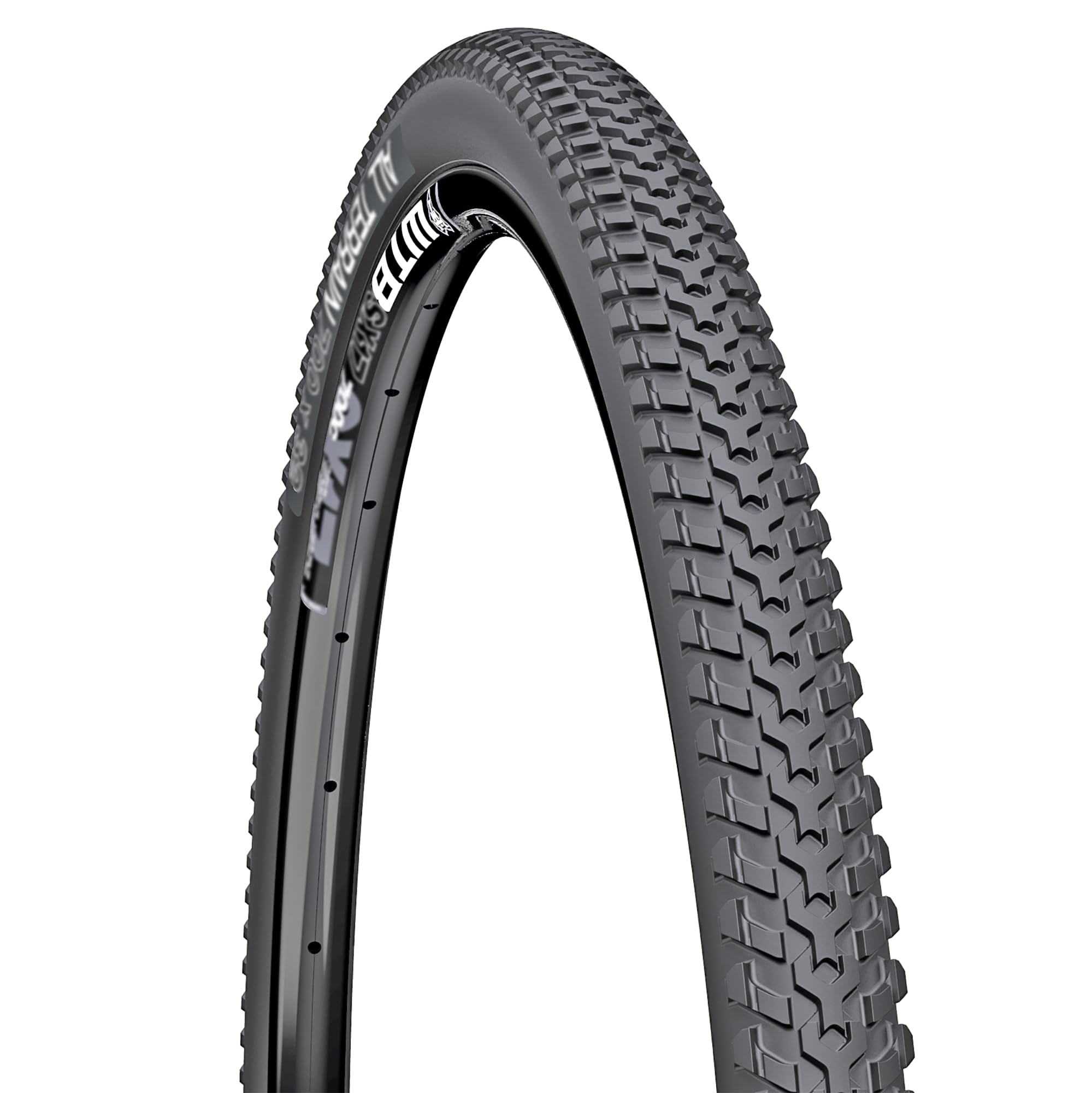
3. WTB All-Terrain Hybrid Bike Tires
The tire for a rider who wants pavement speed and trail grip from one set.
At 455 g, the WTB is 505 g lighter than the Schwalbe Marathon above and 275 g lighter than the 730 g Michelin Protek. That gap is not trivia — it is the reason this tire spins up quickly and holds onto average speed over a long commute. The tightly spaced centerline tread rolls efficiently on tarmac and hardpack dirt, while the open outer knobs grip on loose surfaces. A rider who averaged six flats a year on a 700-32c hybrid switched to these and found they seat perfectly on the rims, mount with a single lever, and handle bumps, glass and dirt trails at 60-80 psi. What lands with people most is how well that works as an all-rounder rather than a specialist.
The WTB is not a puncture-proof tire, and WTB doesn’t claim it is. The carcass is a durable rubber build, but the protection is modest compared with a dedicated flat-defense tire. That is the honest trade for the light weight and the low rolling resistance. It pays off on a mixed loop: smooth on pavement, enough tread for easy trail detours, and comfortable at a lower pressure on washboard and sand. Sizing is the practical piece to plan — it comes in a 700mm diameter at 32mm width, or a 26-inch option, and the 32mm is the faster, more efficient pick of the two.
Pick this if: your rides mix city streets with gravel shoulders and you want speed without drag.
Look elsewhere: if every ride is a glass minefield and you need a hard-core puncture barrier.
4. Continental Ultra Sport III Road Bike Tire

A featherweight 300 g road tire that makes the hybrid feel quicker.
Weighing 300 g, the Ultra Sport III is 155 g lighter than the 455 g WTB and a full 660 g lighter than the Schwalbe. If your hybrid is mostly a fitness machine that eats pavement, that is where you feel the upgrade first: the spin-up from a stop and the way it holds a cruising speed. The PureGrip compound is an activated-silica mix that Continental says balances grip and durability, and the wire-bead clincher runs on 622 mm rims at 43-101 psi. It is rated E25 for e-bikes up to 25 km/h, which says something about how much wear it is built to absorb.
Owners describe a tire that punches above its price on rolling resistance (how easily it rolls) and grip. A rider coming off older Kendas called it “lighter, smooth, good traction” after 100+ miles, and a carbon Trek owner reported “a little more traction and stability.” The 700×32 size is the practical pick for comfort on rough roads — the same rider who tried it noted the 32mm rides nicer than a narrower tire.
The honest fit issue: mounting and clearance. The 32mm width also barely clears some vintage frames — check your stays before you commit to the wider size.
Reach for this if: you want a fast, light training tire and know your frame has room for a 32mm.
skip it if: you have tight stays or want a tire that mounts by hand without a fight.
5. Michelin Protek Road & Touring Tire 700×35

The commuter tire that keeps showing you up after the sun drops.
The Michelin Protek is built around two priorities: a 1 mm anti-puncture layer under the tread and a Reflex reflective sidewall that glows white in headlights. For anyone riding home after dark, that reflective stripe is the feature that changes the ride — visibility, not just protection. Michelin rates it for urban cycling on a 700c/622 mm wheel with widths from 30 to 38mm, at 36-87 psi, on a classic 22 TPI casing with a wire bead. It also works on e-bikes, which matters if you’re thinking of converting down the line.
Riders keep circling back to how the tire feels under them. The urban tread rolls smoothly with reduced rolling resistance, and one rider who swapped from gravel tires on a Trek Dual Sport 2 hybrid found it “much more sturdy than originals” with better grip on the street. Installation on 700c rims is generally a straightforward job — the rubber is pliable enough that most people handle it without levers. At 730 g, it is heavier than the 300 g Continental, but the trade buys you the puncture layer and the reflective wall.
What the Protek gets right
- Reflex reflective sidewall is highly visible at night
- 1 mm anti-puncture layer handles stickers and street debris
- Works on traditional and e-bikes up to the rated spec
- Plush, grippy ride at urban pressures
The trade-offs
- 730 g is not a light tire by any stretch
- Durability splits — some riders get seasons of use, a few see cracking
- Wire bead and stiff sidewall take some patience to seat
Best paired with: a dark commute where you want to be seen as much as protected.
Consider the weight: if you race your commute, the 730 g casing will drag on climbs.
6. YunSCM 700x38C Bike Tires (2-Pack)
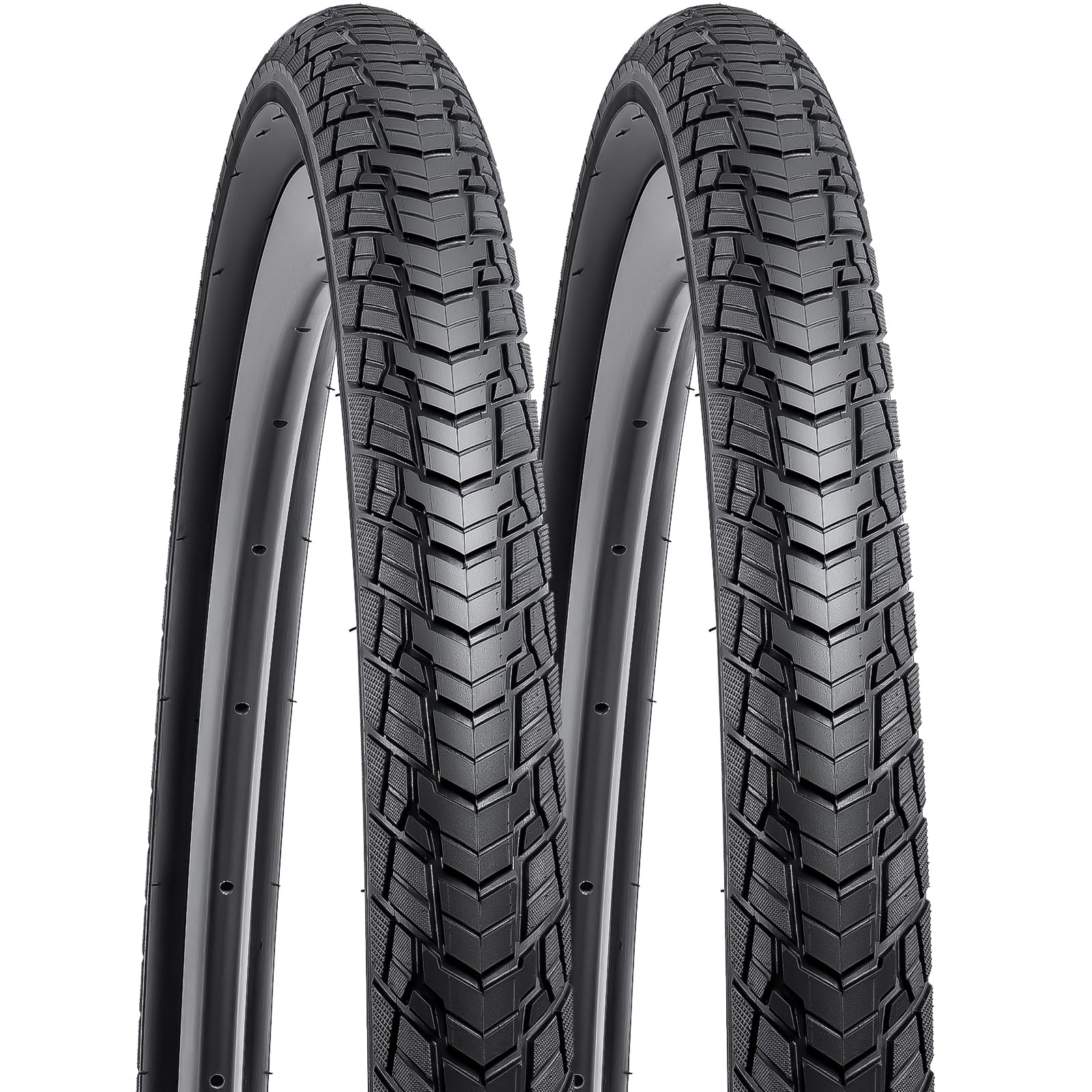
A two-tire box for the rider replacing both ends at once.
The YunSCM set delivers two 700x38C clinchers in a 40-622 size, with a densely arranged block tread that the brand says gives better grip and a light, comfortable ride. For a hybrid that spends most of its life on smooth road and urban paths, that tread pattern is a sensible match. The tires run at 40-65 psi, fold for storage or travel via the soft wire technology, and ship as a pair — which most DIY owners appreciate because the front and rear wear at the same rate. The foldable build is the practical advantage over a wire-bead tire: it packs down for shipping, storage, or a trip.
Installation is the usual foldable-tire challenge. Because they arrive creased from the box, the bead can look wavy until you let them settle, and mounting is smoother with two people and a slightly inflated tube. Riders who expect a quick one-person swap sometimes grumble. The payoff is a smooth, quiet ride once seated, and a set that costs less than many single premium tires. Just remember the tread is directional — check the center pattern before you inflate.
Where the budget shows: sidewalls are on the thin side, and the puncture protection is modest. This is a commuter-set for paved streets, not a gravel-bashing tire.
What makes up for it: two tires for the price of one premium option, plus the convenience of a foldable box.
Good for: a DIY rider replacing both tires on a commuter hybrid and wanting a complete set in one order.
Not for: rough-road riders who need a heavy puncture barrier or one-person quick installs.
7. Vittoria Zaffiro Pro G2.0 700x25c

A trainer tire with racing DNA and a price a weekend rider can live with.
The Zaffiro Pro G2.0 is the tire Vittoria builds for performance training, and its resume is real: Vittoria is the official tire of USA Cycling and the choice across Tour de France, Giro d’Italia and World Championship wins. The Graphene compound (rubber mixed with graphene for durability) and alternating slick profile mimic the brand’s higher-end tires while adding durability. That pedigree matters less than how it feels under an average rider, and here the feedback is positive — one long-time Vittoria rider logging 19,000+ miles gets 2,000-3,000 miles per tire and about one flat a year running liners. At 340 g and 700x25c, it is one of the lighter tires in this lineup.
Pressure is where the Zaffiro asks you to pay attention. It is rated 87-130 psi, and riders settle around 110-117 for a comfortable, fast feel. Mounting is the recurring sticking point — cold, the tire is hard to seat and can break levers; warmed in the sun for 30 minutes, it goes on far more easily. Buyers who ride road bikes regularly tend to be fine with it; first-timers sometimes need a shop’s help.
Where it shines: rolling speed and grip for the money, with a casing rated to high pressures for fast training miles.
The split: durability is mixed — some tires crack at the sidewall after a year, and mounting at room temperature is tough unless you warm the tire first.
Take this if: you train on pavement and want race-adjacent rolling at a reasonable price.
Reconsider if: you need a tire that mounts by hand cold or you log heavy off-season miles on rough roads.
8. Fincci 700x35c City Bike Tires & Tubes Set

Everything for a full swap in one box: two tires, two tubes, no extra trip.
Fincci sells this as a complete replacement kit, and that is genuinely its strongest card. The 700x35c clincher set includes two 37-622 tires and two 48mm Schrader valve inner tubes, plus a 1 mm nylon anti-puncture layer. A Trek Verve 2 comfort hybrid owner who swapped from 700×45 to this 700×35 mounted each tire in about 15 minutes with no tools. At max 80 psi over 16 miles, that rider’s average time improved from 5.3 to 4.25 min/mile, with less rolling resistance and less fatigue — a smooth, confident ride from the start.
Each tire weighs 430 g and each tube 250 g, so the set is not as featherweight as a pure road tire but is reasonable for a city hybrid. The Kevlar wire bead makes the tire foldable, which simplifies storage, and the tread is designed for spring through autumn road riding with good grip on wet roads. The one thing to check is the tube valve type — this set ships with Schrader, which matches most hybrid rims but not all. Inspect the presta-style bikes before ordering.
Ideal for: the rider who wants a one-box tire-and-tube replacement and doesn’t mind a Schrader valve.
Watch out: if your wheels use Presta valves, the included tubes won’t fit your rims.
9. Fincci 700x23c Road Bike Tires & Tubes Presta Set

A narrow, fast road set for training and triathlon prep.
The Fincci 700x23c set is the road-focused twin of the city set above, with a slick tread, Kevlar bead and a 1 mm nylon puncture layer. The 60 TPI casing keeps the tire supple enough for city roads, and each 23-622 clincher weighs 290 g with the inner tube at 125 g. Those 60mm Presta tubes are the detail that matters most — the longer valve stems reach through deep-section rims, which is why this set suits road bikes and triathlon wheels rather than shallow city rims.
Installation is generally an easy job, and first-time tire swappers report it going off without real trouble once they accept a bit of learning time. A beginner outfitted a full set in about an hour and came away calling it “great quality and rides like a dream.” The set includes two tires and two tubes for roughly what one off-brand tire costs elsewhere, which is why value is the other recurring theme.
Where it earns its spot: a complete 700c road set with deep-rim Presta tubes, at a beginner-friendly total.
The real caution: durability is the split point — most sets run fine for hundreds of miles, but a few fail abruptly within the first hundred, and the seller has stepped in with replacements when that happens. It is not a puncture-proof tire, so keep the pressure up and avoid the glass.
Made for: triathletes and road riders who want a full match set with deep-rim tubes and a slick, low-resistance tread.
Not the pick: if you ride gravel, need a puncture barrier, or have Presta-incompatible rims.
Know the Specs
ETRTO Sizing Explained
The ETRTO figure — like 40-622 or 37-622 — is the two-number sizing system molded onto the sidewall. The first number is the tire’s width in millimeters, the second is the bead-seat diameter in millimeters. For 700c wheels, that second number is 622, which is why a 700x38c tire often shows as 40-622 and a 700x35c as 37-622. Matching the first number to your existing width is how you avoid clearance trouble; confusing it with the wheel label is how people end up with a tire that rubs the frame.
Puncture Protection Layers
Puncture protection is measured in millimeters of barrier material inside the tread. The Michelin Protek uses a 1 mm thick anti-puncture layer, while the Schwalbe Marathon uses a 5 mm puncture protection layer. The thicker the layer, the more debris it stops — and the more mass it adds to the tire. A commuter through glass-strewn streets benefits from the heavier barrier; a fast road rider pays for it in weight.
PSI and Pressure Ranges
PSI is pounds per square inch, the pressure you pump into the tube. Each tire lists a recommended range: the Bell runs 50-75 psi, the Continental 43-101 psi, the Michelin 36-87 psi and the Zaffiro 87-130 psi. Lower pressure within the range gives a softer, grippier ride; higher pressure rolls faster on smooth pavement. Running under the minimum risks pinch flats and sidewall wear; running over the max risks a blowout. Riders on the WTB found 60-80 psi a comfortable zone.
Wire Bead versus Foldable Bead
The bead is the ring that holds the tire onto the rim. Wire beads are strong and inexpensive but ship as full circles and mount stiff. Foldable Kevlar or aramid beads collapse into a box for easy storage and travel, though they can arrive creased and need a night laid flat to settle. The Fincci and YunSCM sets both use foldable beads, while the Schwalbe and WTB use wire beads. The bead type also affects weight and how much help you need at the roadside.
Common Questions
Will a 700x38c tire fit my 700c hybrid rim?
How many miles can I expect before a hybrid tire wears out?
Is a wider tire slower on pavement?
What is the difference between a wire bead and a folding bead?
Do I need a puncture-resistant tire for city commuting?
What PSI should I run my hybrid tires at?
Can I use a road tire like the Zaffiro Pro on my hybrid?
What does the ETRTO number on the tire sidewall mean?
Are foldable tires as strong as wire-bead tires?
Will my existing inner tubes fit a new tire of a different width?
The Bottom Line
For most riders, the hybrid bike tires winner is the Schwalbe Marathon because its 5 mm puncture protection layer turns the daily battle with glass and thorns into a non-event. If you want light, fast all-round performance on pavement with light trail detours, grab the WTB All-Terrain at 455 g. And for a complete night-commute upgrade with a reflective wall, the Michelin Protek is the one to reach for.
If a tight budget is your deciding factor, the Bell Flat Defense is worth a long look — it is one of the value champions of this group and still brings a real puncture layer. The most useful nudge we can give: the Marathon’s crowd of happy owners is large enough that a 960 g tire clearly earns its place on commuter bikes, so if flat-stopping is your priority, the weight is the only thing you’ll trade for confidence.
How we choose
We do not accept paid placement. Every pick is matched to a real buyer and a real use-case; we do not hands-on test units.
Sources
Specifications: manufacturer listings and product documentation. Review insights: verified customer reviews, as of October 2026. Pricing: not shown on this page (it changes often); check the current price via the retailer link.
As an Amazon Associate, Aappliancez earns from qualifying purchases. This does not affect which products we feature.