Disclosure: Some links in this post are affiliate links. As an Amazon Associate I earn from qualifying purchases, at no extra cost to you. Learn more
Specs are compiled from manufacturer listings and verified buyer reviews and can change over time — please confirm the key details on the product page before buying.
You want the lights, the fridge and the furnace to keep running when the grid drops — and you want to know which of these units actually does that without a gas can, a pull cord or a noise complaint. The short answer: for most homes the best starting point is the ECO-WROETHY Cubix100 server-rack battery, because it stacks into a true whole-home bank and has the strongest owner track record of the group. Below you will find out how much stored energy each system really holds, how fast it recovers, and which ones can push 240 volts into a water pump or a central air unit.
This guide is built by comparing the manufacturers’ published specifications and the patterns across verified customer reviews, so you get each pick’s real strengths and trade-offs instead of marketing spin.
Battery chemistry, output watts and expandability decide whether a system carries your house or just your laptop. This comparison of the best House Battery Backup separates the plug-and-play stations from the rack-and-inverter builds.
Top Picks
How To Choose The Best House Battery Backup
The mistake most buyers make is shopping by the headline wattage number on the box. A unit that brags about 7200 watts of output can still go dark in three hours if the battery behind it is small — and a small station with a huge battery can run your fridge for days at modest watts. You need both numbers to line up with what you own.
Start with what you actually need to run
Walk your house and write down the three things you refuse to lose: usually the fridge, the furnace blower, and a router or medical device. Those are your essential circuits. A station with a 120V/240V (two-voltage) output can feed a well pump or a dryer that a single-voltage unit simply cannot start, so decide early whether you own any 240V appliances.
Match watt-hours to hours, not to wishful thinking
Capacity is listed in watt-hours, or Wh — the size of the tank. Output is listed in watts, or W — the size of the pipe. A 5040Wh tank running a 500W load is a very different night than a 3600Wh tank running a space heater, so add up the wattage of the appliances you plan to keep alive and be honest about it.
Look hard at recharge speed and transfer time
An outage lasts as long as the storm does, so how fast a system refills matters as much as how much it holds. Look for the AC recharge figure in watts and the switchover figure in milliseconds — a 10 ms or 20 ms switch keeps a desktop computer from rebooting, while a slow one does not.
Side-by-Side Comparison
| Model | Best For | Usable Capacity | Power Output | Battery Type | Amazon |
|---|---|---|---|---|---|
| ECO-WROETHY Cubix100★ Best Overall | Whole-home off-grid bank | 30.72kWh (6-pack) | 100A BMS per unit | LiFePO4 | Amazon |
| OSCAL PowerMax 6000Most Versatile | Split-phase emergency power | 3600Wh | 6000W (9000W peak) | LiFePO4 | Amazon |
| EF ECOFLOW DELTA ProExpandable Kit | Expandable home backup kit | 3600Wh (to 25kWh) | — | LFP | Amazon |
| BLUETTI Apex 300 + B300K | Quiet indoor UPS backup | 5529.6Wh | 3840W (7680W surge) | LiFePO4 | Amazon |
| GROWATT HELIOS 3600 | Dual-unit whole-house 240V | 7200Wh (dual unit) | 7200W parallel | LFP | Amazon |
| EF ECOFLOW DELTA Pro 3 | Whole-home all-rounder | 4096Wh (to 48kWh) | 4000W (6000W X-Boost) | LFP | Amazon |
| ECO-WORTHY Liber 10KP | DIY inverter-plus-battery kit | 10240Wh | 10000W | LiFePO4 | Amazon |
| Jackery Explorer 5000 Plus | Big appliances on 120V/240V | 5040Wh (to 60kWh) | 7200W (14,400W surge) | LiFePO4 | Amazon |
| Generac Guardian 10kW | Indefinite fuel-fed standby | — (gas/propane fed) | 10,000W | Engine (G-Force 400) | Amazon |
| EF ECOFLOW DELTA Pro Ultra | Scalable whole-home power | 6144Wh (to 90kWh) | 7200W | LiFePO4 | Amazon |
| EF ECOFLOW 12kWh Station | Extended multi-day runtime | 12kWh (to 90kWh) | 7200W | LiFePO4 | Amazon |
Detailed Reviews
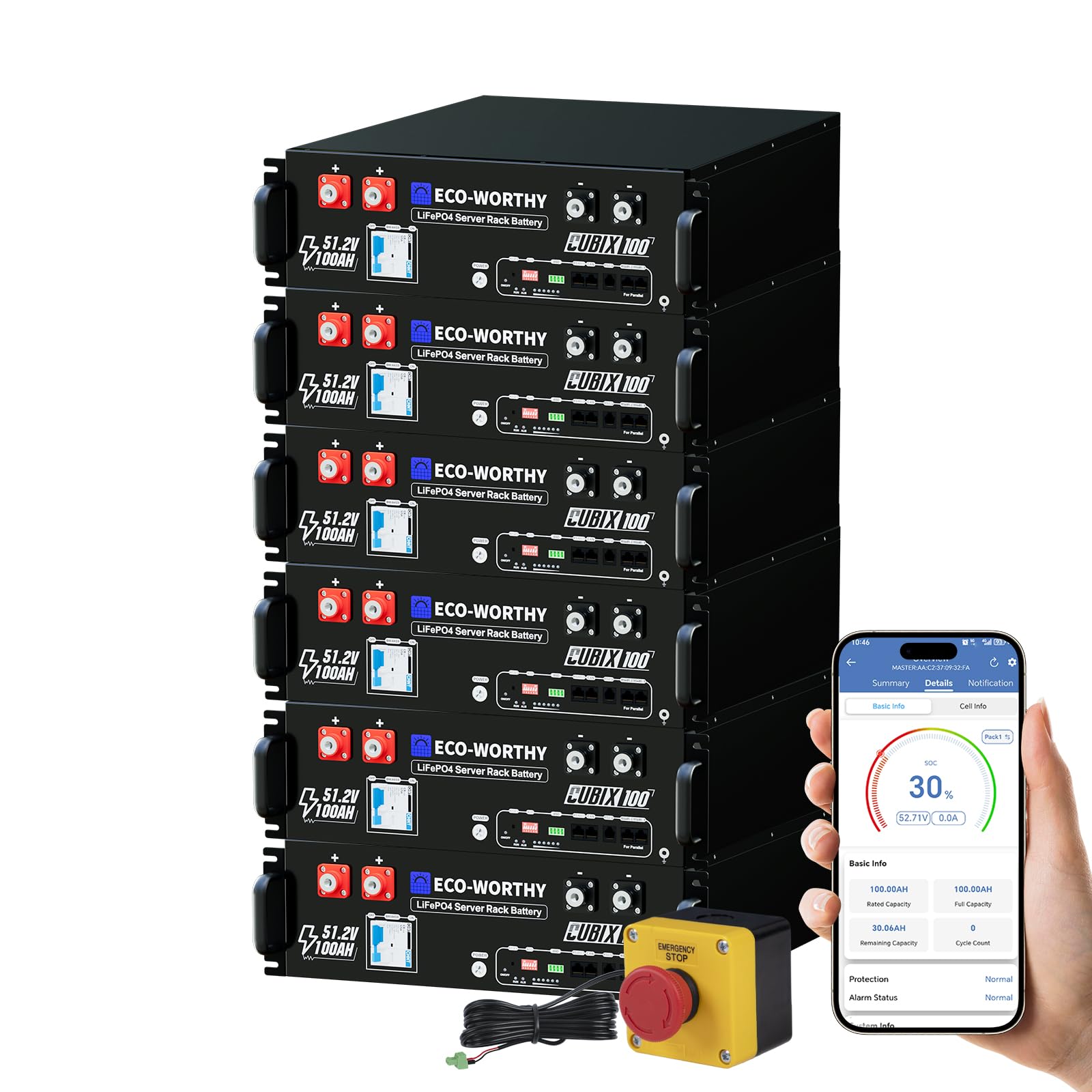
1. ECO-WROETHY Cubix100 48V 600Ah Server Rack Battery LiFePO4
Our pick — 4.5+★ from 300+ verified ratings; the strongest balance of quality and price.
Six rack batteries that add up to a genuine whole-home power bank, not a camping toy.
This is the pick for the homeowner who is done with portable boxes and wants a permanent battery wall. The 6-pack of 51.2V 100Ah units totals 30.72kWh of storage — enough, in the maker’s words, to cover an entire household’s daily electricity needs. Each individual rack unit weighs almost 100 pounds, so plan the install as a two-person job near the final resting spot.
What wins people over is battery quality, and it shows in the spec sheet. Every unit carries UL9540 and UL1973 certification earned through Intertek testing, plus a California Energy Commission listing — the paperwork that tells an inspector the thermal-runaway design has been checked. The 100A BMS (battery management system, the chip that watches overcharge, over-discharge, short-circuit and temperature) is the safety brain behind each pack. As buyers report: “Solid metal server-rack case, 51.2V 100Ah (5.12kWh) per unit, Bluetooth/Wi-Fi monitoring, CAN/RS485, 100A BMS with overcharge/discharge/short-circuit/temp protection, scalable.”
Expansion is where this system separates itself from the portable stations here. You can parallel up to 32 units for a ceiling of 163.8kWh, which is utility-scale territory for a house. Communication runs over CAN/RS485 (the two-way data link that lets the battery talk to a solar inverter), and the ECO-WORTHY app reads state of charge over Bluetooth or Wi-Fi. Owners running Victron gear report it detecting instantly and holding accurate voltage, temperature and state-of-charge readings once cells are balanced. The crowd favorite of this list sits at 4.5+ stars across 300+ ratings — the highest owner score here — but the lower-priced picks above have more reviews; this one still earns the top spot on strength of that score.
Where it earns its keep
- 30.72kWh across six units covers a full household day of use
- UL9540 + UL1973 + CEC listing gives you inspection-ready documentation
- Parallels to 32 units and 163.8kWh when you want to grow
- Plug-and-play kit ships with parallel cables, comms cables and grounding wires
Plan around this
- No rack included and no on-unit screen — you monitor through the app
- Each unit lands near 100 pounds, so bring help and plan the path
- Order can arrive in several packages on different days
Built for the off-grid planner: you want a permanent battery bank feeding a solar inverter, with room to double or quadruple capacity later.
Less ideal if: you want to wheel one unit to the campsite — this is a fixed wall system, not a grab-and-go box.
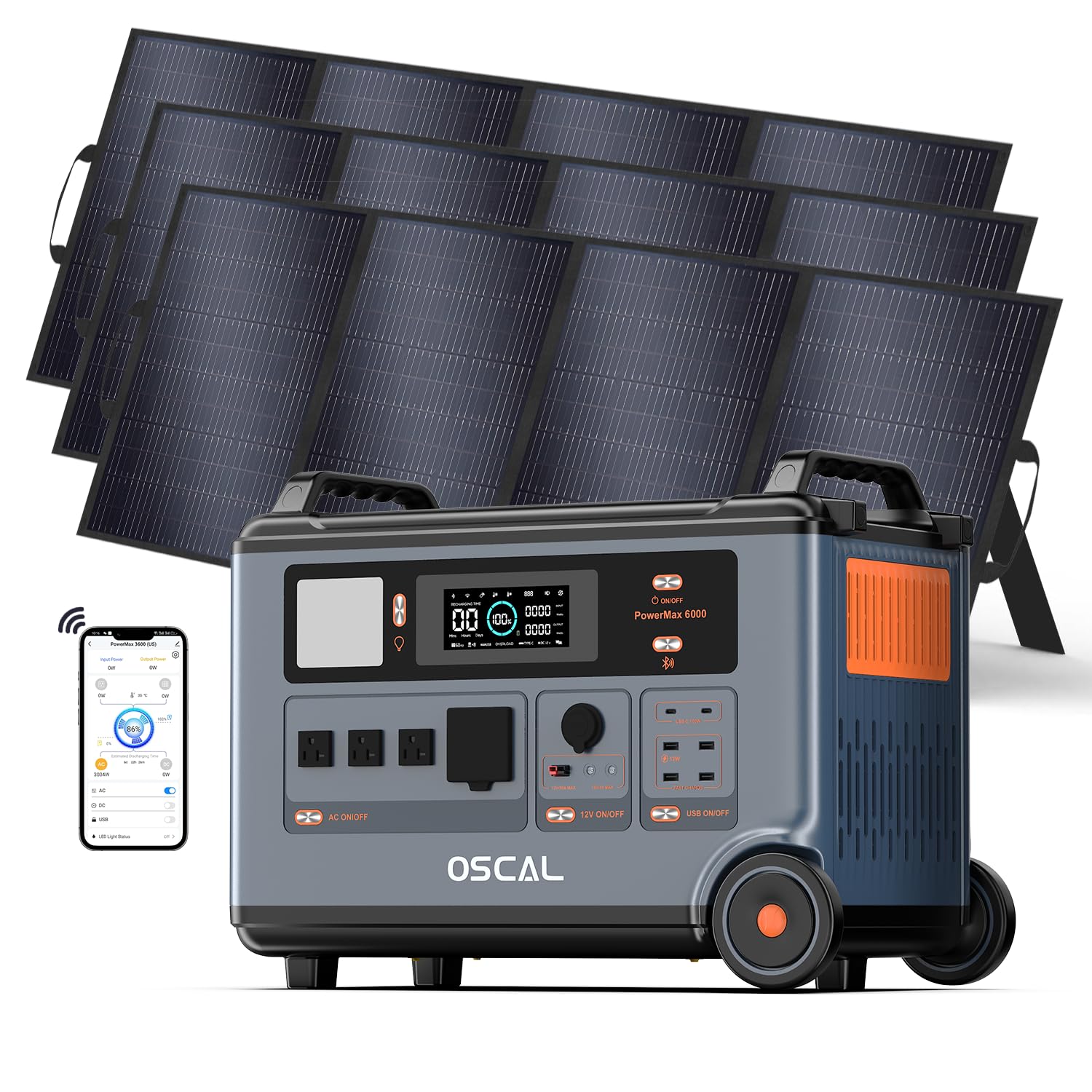
2. OSCAL PowerMax 6000 Solar Generator with 3×400W Solar Panel
A 6000-watt split-phase station that ships with its own solar panels.
Two things sell this one: it puts out both 120V and 240V at 6000W continuous and 9000W surge, and it arrives with 3×400W solar panels in the box. The split-phase output is the part that matters for a house — it can feed a 240V circuit the way a single-voltage portable box cannot. It carries 3600Wh of LiFePO4 storage and offers 14 outlet sources in total, so a family outage can run a router, a fridge and a lamp bank without a power strip shuffle.
The numbers that matter day to day are the refill speeds and the switchover. AC charging runs at 2200W and solar charging at 2400W, so a sunny afternoon tops it up fast. Its EPS (emergency power supply) mode flips to battery in 5–8 ms — a window short enough that a desktop and a router ride straight through a brownout. The LiFePO4 cells are rated to 3500 charge and discharge cycles. It is also the lighter of the big split-phase boxes here at 45.5 kg, and it rolls on a handle and wheels.
What the spec sheet cannot tell you is how it feels to own. As owners mention: “Very heavy, charging speed is quick, haven’t had the opportunity to use it yet.” Weight is the recurring note — 45.5 kg is a two-person lift into a truck bed. The honest caveat is on the bundled panels: the generator itself draws praise for quiet operation and build, while the included solar panels are the weakest link in the package, with at least one owner rating them poorly. If solar matters to you, budget for a quality array. Otherwise the recharge speed and dual-voltage output are the story.
The recharge story: 2200W from the wall plus 2400W from the sun means an outage morning does not mean an empty battery by afternoon.
Sizing reality: 3600Wh is a strong overnight reserve but not a multi-day whole-house tank — for that you want the bigger expandable units further down.
Reach for this if: you want one box that outputs 240V, ships with panels, and rolls on wheels for camping-season duty.
Look elsewhere if: the panels are the main reason you are buying — the generator is the star, not the solar array.
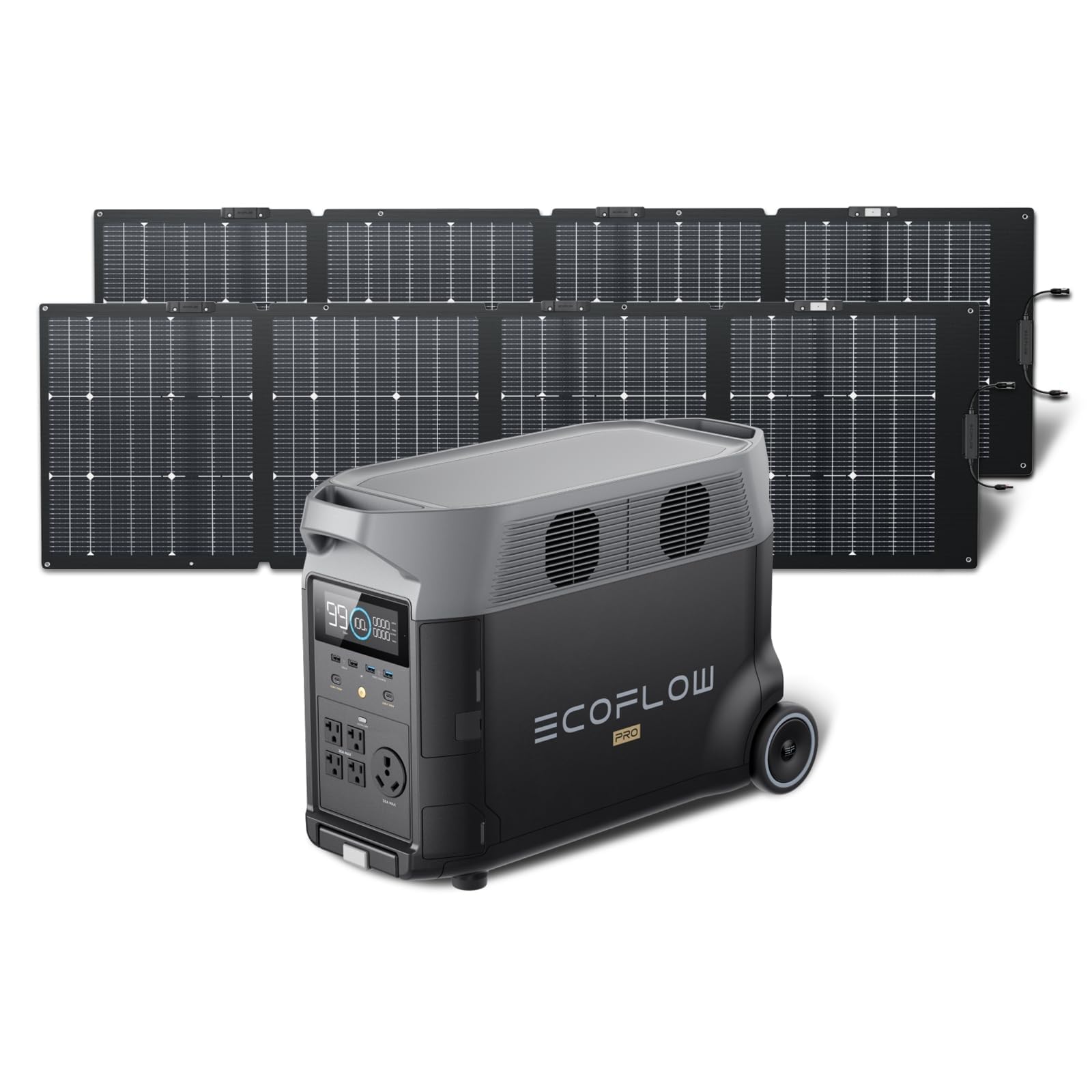
3. EF ECOFLOW DELTA Pro 3600Wh Portable Power Station
The expandable original — start with 3600Wh and grow it to a house-sized 25kWh.
The DELTA Pro is the system for the buyer who wants to begin small and expand rather than buy a finished wall. It holds 3600Wh in an LFP battery, then climbs to 25kWh with extra batteries or smart generators. Pair it with the EcoFlow Smart Home Panel and it backs up up to 6 circuits — fridge, garage door, living-area outlets, light switches — which is the practical middle ground between a single appliance and a full panel.
Owners push it hard and it handles it. It will run a 13.5K RV air conditioner for 4–8 hours without solar, then still run the microwave and the rest of the camper’s appliances. One owner set up three units for whole-home outages and estimated 6+ days of runtime on lights, fridge, room AC, TV and chargers. When the wildfire season outages hit Southern California, another owner charged two units to full off 10×160W solar panels at 1.29kW peak and ran critical appliances overnight, quiet the whole time.
Its footprint is the trade-off you accept for that expandability. The DELTA Pro measures 11.2″L x 16.4″W x 25″H, and against the OSCAL PowerMax’s 23.2″L x 13.8″W x 17.3″H it stands noticeably taller and narrower — a footprint that tucks into a closet corner but stands head-high. The heavier frame demands the wheels in practice; owners uniformly describe it as heavier than they expected. The 220W panels are described by the maker as shipping in a separate package, so plan for two deliveries.
Why owners keep buying in: the expansion path to 25kWh means the first purchase is a floor, not a ceiling.
The catch: that tall 25-inch frame is awkward on stairs and doorways, so pick the room you plan to store it in before it arrives.
The smart buy for: a renter or first-time backup buyer who wants a real circuit-level solution now and more capacity over the next few years.
Pass it by if: you need a finished turnkey panel install on day one — this one rewards you for adding to it.
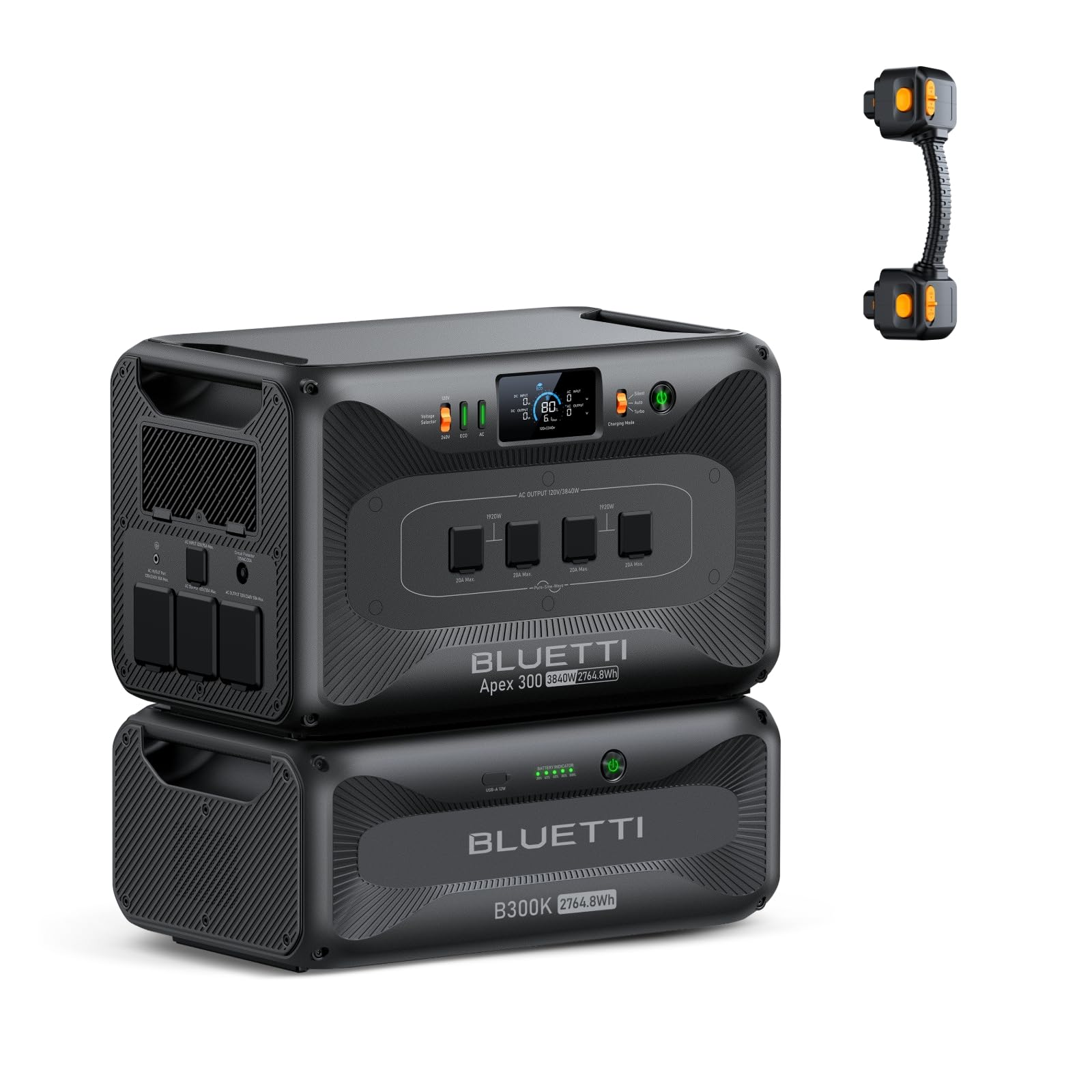
4. BLUETTI Apex 300 Portable Power Station & B300K
5.5 kilowatt-hours of backup that whispers at 22 decibels while it works.
For a bedroom or a living-room install, the noise number decides the pick. This combo runs at 22 dB — roughly a rustling leaf — while delivering 3840W AC and 7680W surge. The Apex 300 station and B300K expansion battery add up to 5529.6Wh, and it can put out 120V and 240V simultaneously, so a fridge, an AC unit and an EV charger can share the load without voltage juggling. What owners praise most is raw power output, followed closely by clean power quality — this is a unit that does not sag under load.
The UPS side is built for sensitive gear. Switchover is rated at ≤10 ms, and there are 14 ports in total. Charging is fast in both directions: AC reaches 80% in 45 minutes with TurboBoost at 2000W, solar is built in at 2400W and expands to 6400W, and a generator can feed it. The second-generation LiFePO4 cells are rated for 6000+ cycles to 80% capacity, which the maker frames as a 17-year lifespan, and the pack is CNAS-certified through 33 extreme tests.
The catch is that not every reviewer sees the full advertised runtime out of it — a few report very short runtimes under heavy loads and question the value. That tracks with the physics: 7680W of surge is a lot of draw, and anything running near peak empties any battery fast. Treat the high-wattage ratings as headroom for motor start-up, not as all-day capacity. Storage capacity itself draws strong marks; it is the power-per-dollar math that some owners dispute. Plan your loads to the 5.5kWh tank and the runtime works out.
What the specs deliver
- 22 dB operation lets it live in a bedroom or office
- 120V and 240V at the same time — no toggle needed
- 80% AC recharge in 45 minutes with 2000W TurboBoost
- 6000+ cycle LiFePO4 life with a 17-year maker claim
The honest trade-offs
- Some owners find the per-watt value hard to justify
- Heavy loads drain the 5529.6Wh tank quickly
- B300K expansion battery ships separately
Best fit for: apartment and bedroom backup where a loud generator would be heard through the wall.
Second-guess it if: you plan to run high-draw appliances all day — this is a silent reserve, not a power plant.
5. GROWATT HELIOS 3600 Home Battery Backup Combo
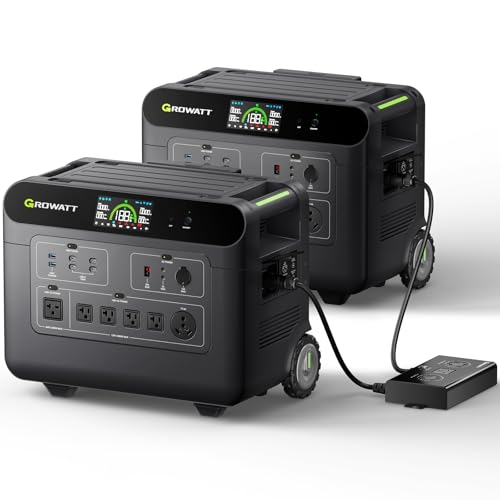
Two 3600Wh units linked into one 240V, 7200W whole-house system.
This kit answers a simple question: what if you want 240V without buying a single giant box? Two HELIOS 3600 stations parallel through a split-phase connector for 7200W at 240V and 7200Wh of combined LFP storage. That is enough to drive what the maker calls heavy household appliances — central AC, dryers, water pumps — and it covers what they estimate as 99% of home power needs. Each unit expands further, and the pair can reach 36kWh fully expanded, a number the maker frames as up to 7 days of continuous home power.
What wins people over is build quality, and the expansion math supports it. Charging comes from three directions: 2000W solar per unit, 120V/240V AC fast charging, and hybrid AC-DC that refills a unit in 1.5 hours. Both units can charge at the same time. Switchover runs under 15 ms, cold-start is rated to -22°F, and the EV-grade LFP cells hold 80% capacity after 4000 cycles — the maker’s 10-year framing. The app manages charge and discharge timing to cheap off-peak hours.
The hardware is not the problem; the software is. Owners consistently report the app is the weak point — connectivity drops, Bluetooth pairing fails, and the display text is hard to read. Battery life and raw power are rated highly and long-lasting in use, with one camper setup running a fridge, router, Starlink dish and TV for 24–30 hours on a 2-hour recharge. The units are also heavy at around 100 pounds each, and the EPS mode cannot be toggled off while plugged in. The honest read: buy it for the machine, and treat the app as a bonus that may frustrate you.
Why two beats one: you get true 240V split-phase output and parallel redundancy — lose one unit and the other still runs essentials.
The trade-off: a clunky app and a 100-pound-per-unit install mean this is not a set-and-forget purchase; it is a planned one.
Go for it if: you want whole-house 240V coverage with a well-regarded brand behind the inverter and no single points of failure.
Think twice if: a polished app and remote monitoring are central to how you plan to run the system.
6. EF ECOFLOW DELTA Pro 3 Portable Power Station

The one that can start a central air conditioner and still hum at 30 decibels.
This is the most complete all-rounder in the guide, and the spec line says why. The DELTA Pro 3 holds 4096Wh in an LFP battery, outputs 4000W (6000W with X-Boost, scalable to 12000W), and supports 120V/240V so it can run a 3-ton central AC or a 1 HP water pump. Capacity expands to 48kWh with extra batteries, which the maker frames as 2–4 days of whole-home backup. What owners praise most is overall performance, and the power output runs a close second — this is the consensus favorite of the big stations.
Two numbers make it livable indoors. It runs at a hum as low as 30 dB under X-Quiet technology, and its UPS switchover is 10 ms — fast enough for a NAS or a desktop. Its IP65 rating covers the battery pack against dust and water spray, which matters if the unit lives in a garage. Owners also stretch it: it runs a 240V well pump off a 30A outlet, recharges from a 7000W gas generator in about 2 hours, and one user kept a house running for three days through a storm on the unit plus a single extra battery.
The honest catch is service, not hardware. It is a high-capacity unit with a small but real share of failures, and getting a damaged 115-pound class-9 battery through a return is genuinely painful — one owner described weeks of back-and-forth and rejected freight shipments. That is the risk to weigh at this size. The 5-year warranty is strong on paper, but keep your original packaging and your purchase documentation. Weight is the other recurring note at 115 pounds; the wheels are not optional in practice.
The strong case
- 4096Wh expandable to 48kWh for multi-day whole-home coverage
- 4000W output runs a 3-ton central AC and a 1 HP well pump
- 30 dB quiet operation and 10 ms UPS switchover
- Recharges from a 7000W generator in about 2 hours
Worth knowing
- 115 pounds is a two-person lift even with the wheels
- If a unit fails, the warranty freight process can be slow and heavy
- Ideal operating temperature is a limited 40–88°F, and it should stay dry
My pick for: the household that wants one unit to carry a central AC, a well pump and the electronics, then grow into more battery later.
Consider another if: you cannot handle the weight or the possibility of a freight-heavy warranty claim at this size.
7. ECO-WORTHY 48V Home Backup Power Liber 10KP
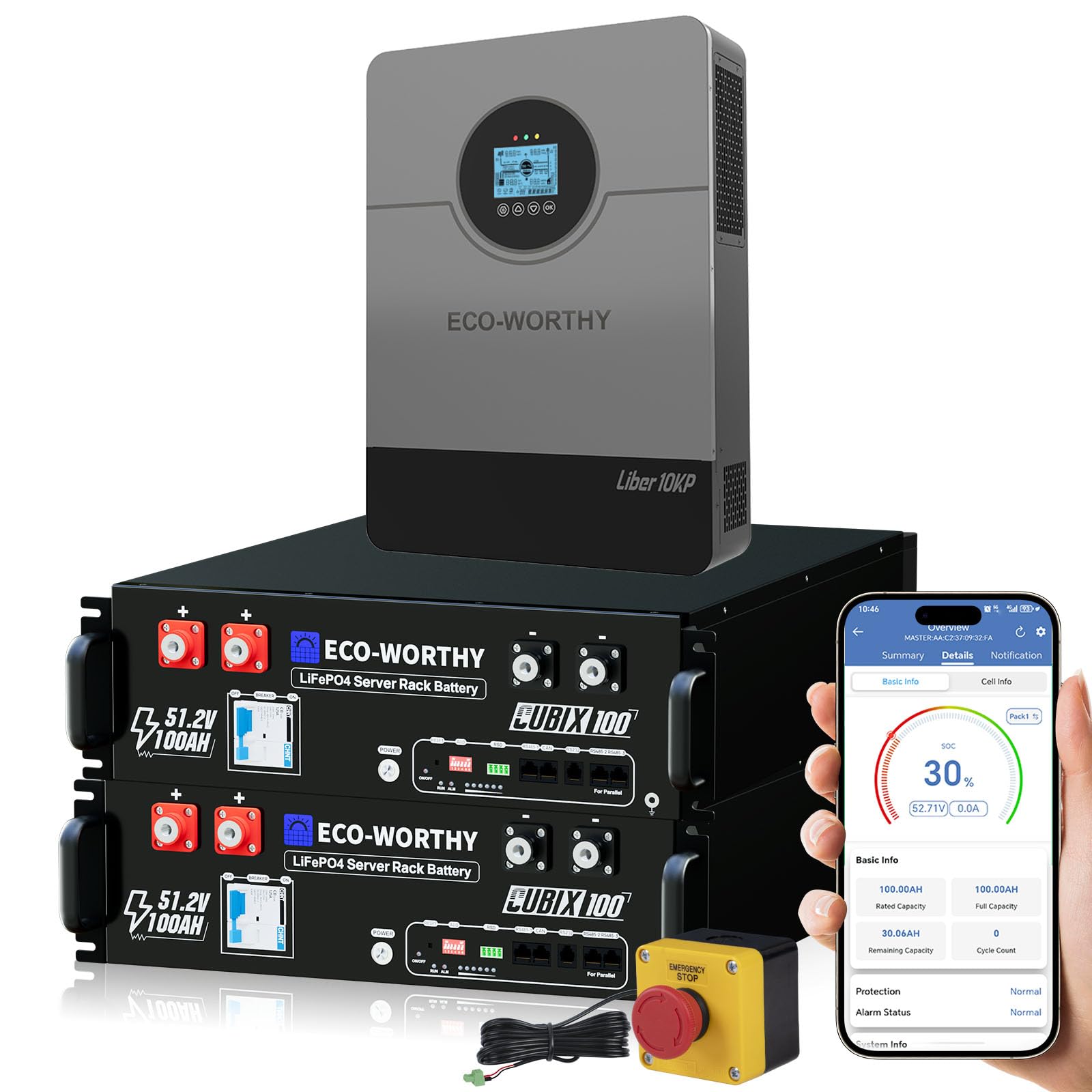
A rack battery plus a 10-kilowatt inverter, sold as one build-it-yourself kit.
This is the pick for the tinkerer who is comfortable wiring a system rather than unboxing a finished box. The kit pairs two 51.2V 100Ah LiFePO4 batteries with a 10000W MPPT inverter for 10240Wh of storage and 10000W of output. That inverter is the headline — enough to feed basic operation of household appliances through an outage, and it puts out a pure sine wave (clean, smooth power safe for motors and electronics). Performance is the thing owners praise most, and it shows in the specs.
The safety paperwork is real: the battery and inverter passed UL1973 and UL1741 testing by Intertek and meet California Energy Commission standards, which matters for permitting and insurance. Communication runs over CAN/RS485 into leading solar inverters, and the built-in Bluetooth and Wi-Fi let you read battery status in the ECO-WORTHY app. The rack battery cells are Grade A LiFePO4. Output is switchable between 120V and 240V to suit your circuits.
The setup friction is the honest caveat here — this is a build, not a plug-in. Battery-life complaints are mixed, with a recurring theme that batteries do not charge properly until the settings are right; the charge cutoffs and communication profile need to be configured deliberately or the inverter will not pull from the grid. Customer service can be slow to reach by email, and a handful of units ship incomplete until a documented fix is applied. Once configured, customers note the whole house and every appliance running off a charge that holds for a long time. Weigh it like this: if you are comfortable with settings menus, you get a lot of capacity and inverter for the tier; if you want no configuration, look elsewhere.
The draw: 10000W of MPPT inverter output paired with 10240Wh of LiFePO4 is a serious amount of backbone for a DIY install.
What to expect: a configuration session before it behaves — and slow support if you get stuck, so read the settings guide closely.
Suits the hands-on owner: you want inverter-plus-battery capacity at a value tier and do not mind dialing in BMS communication settings.
skip it if: you need a system that works correctly the moment you plug it in with no configuration.
8. Jackery Explorer 5000 Plus Power Station
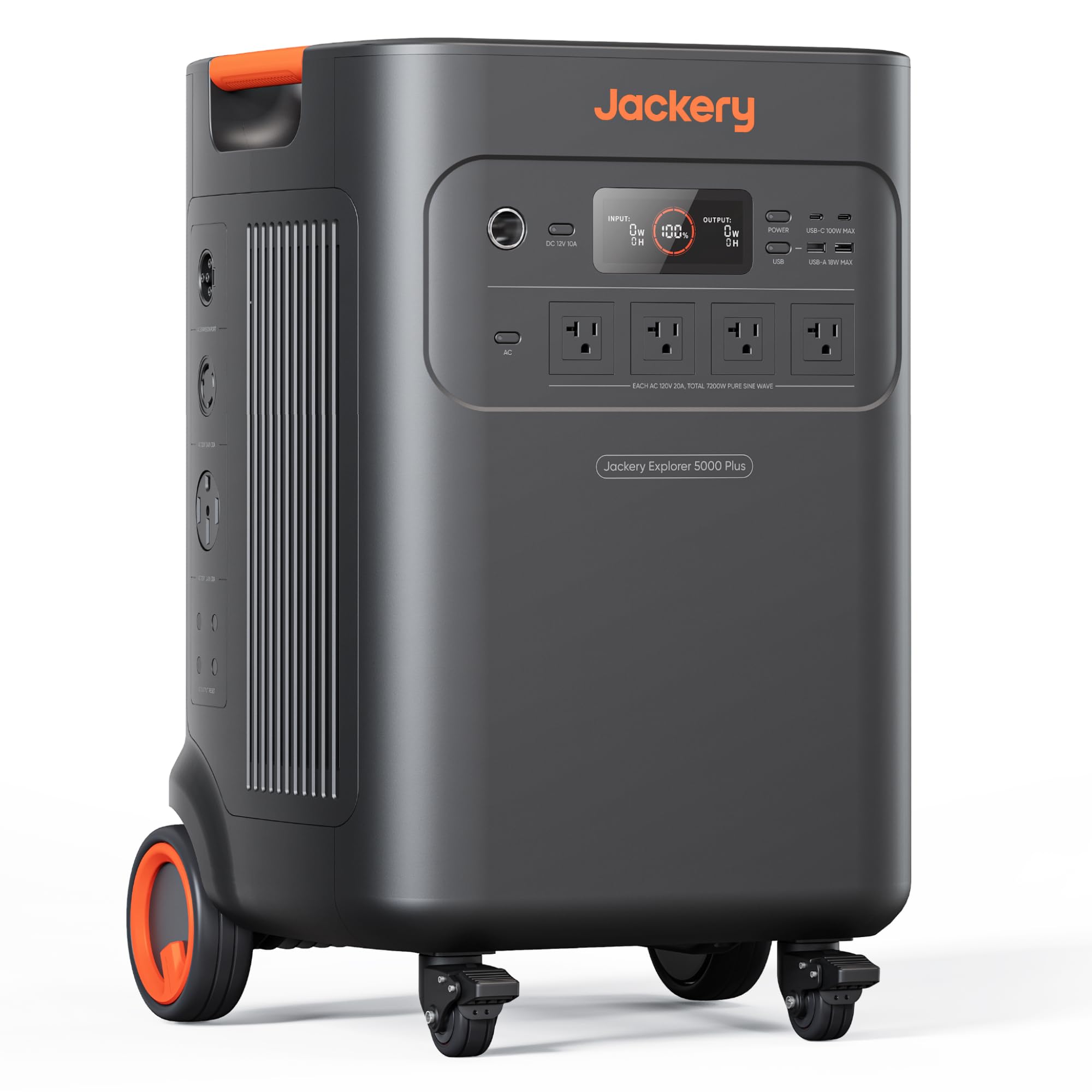
7,200 watts of output — enough for a 5-ton AC or a hot shower on battery.
This is the pick for the homeowner whose outage checklist includes the big-ticket appliances. It puts out 7200W rated with a 14,400W surge and supports both 120V and 240V, so it can run a 5-ton air conditioner or a water heater for a hot shower. Capacity lands at 5040Wh, expandable to 60kWh — a number the maker frames as backup that lasts for 13 days on essentials. Pair it with the Jackery 60A Smart Transfer Switch and you can cover up to 12 circuits at 120V or 6 at 240V. Solar refills it in about 2 hours with up to 4000W input, from both high- and low-voltage panels.
Owners find creative uses for it. One mobile welder bought it precisely because it is quiet and holds a charge for a long time — no gas to start, no roar, and it can be brought indoors to weld where a gas generator would be refused. A longtime Jackery owner running a 250 and a 1000 for 5+ years reports this unit is well built and handles all outlets at once. ChargeShield 2.0 and LiFePO4 cells are rated for up to 11 years of daily use by the maker.
The runtime math deserves a warning, though. One owner’s honest frame-up: plan for roughly 5 hours of whole-house draw at 240V, so decide in advance what runs. The reliability record is the other mixed note — a small number of units arrive throwing error codes (one reported code 6 overloads at only 200W in UPS mode), and the maker’s firmware fixes can take time to land. That is a rare outcome, but at this tier it is worth testing the unit on a real load within the return window.
Built for the heavy hitters: a 5-ton AC and a water heater are not normal loads, and this unit is rated for exactly that.
Plan the watts: 5040Wh runs a whole-house load for hours, not days — size your essential circuits with that in mind, or add expansion batteries.
balance: you own big appliances, want the transfer-switch path to 12 circuits, and value a quiet unit that goes indoors.
Not your pick if: you need multi-day runtime on every circuit without adding expansion batteries.
9. Generac Guardian 10kW Home Generator

A permanently installed standby generator that runs off your home’s gas line — no battery to drain.
This is the different animal in the list: a fuel-fed standby generator, not a battery. Its advantage is endurance — it runs off natural gas or LP gas, so there is no stored energy to empty. It delivers 10,000 watts via Generac’s True Power Technology with under 5% harmonic distortion (a measure of how clean the power sine wave is, so electronics are happy). The kit includes a 100 amp, 16-circuit transfer switch in a durable aluminum enclosure designed for outdoor mounting.
The hardware is built to last and comes with paperwork. It uses the G-Force 400 series engine with 460 cubic centimeters of displacement, engineered and assembled in the USA, and it carries a 5-year limited warranty. Remote monitoring runs through Generac’s Mobile Link Wi-Fi so you can check status and maintenance alerts from anywhere. It is quieter than a conventional generator, with owners reporting it sounds like a power mower outside and is not noticeable inside. One owner’s prior unit lasted 24 years — a real endurance benchmark.
Two practical notes shape the purchase. First, this is not a do-it-yourself install — Generac recommends a certified and licensed electrician, and the distance between the unit, the electrical panel and the gas meter greatly affects installation cost, so consult both an electrician and a plumber before buying. Second, the technical specs list no run time — because run time depends entirely on your gas supply, which is the whole point of a fuel-fed unit. The Wi-Fi setup is the weak spot for some, with one buyer reporting it still not working after install. Pick the outdoor location carefully so sound is blocked from living spaces. That is the practical cost of indefinite runtime.
Why it lasts indefinitely
- Runs off natural gas or propane — no battery capacity ceiling
- 10,000W True Power with under 5% harmonic distortion
- Includes a 100A, 16-circuit transfer switch in aluminum enclosure
- 5-year limited warranty and Mobile Link WiFi monitoring
What to plan around
- Requires a licensed electrician and a plumber to install
- Wi-Fi setup can be fiddly for some buyers
- Site it for sound and for the gas and panel distances, or install cost climbs
The right call for: a homeowner with a long gas-fed outage history who wants indefinite coverage and has a licensed electrician ready.
Wrong tool if: you want portability, no installation, or a quiet unit you can move between rooms.
10. EF ECOFLOW DELTA Pro Ultra 6144Wh Power Station

One inverter and one battery deliver 7200W of 120/240V output, with expansion to 90kWh.
The DELTA Pro Ultra suits homeowners planning a permanent, hardwired whole-home install. A single inverter supports 120V and 240V at 7200W, enough for almost any heavy appliance including a 3-ton central air conditioner, and it holds that 7200W even while charging. One battery is 6144Wh — the maker frames that as two days of essential power — and you can add up to 15 batteries for a total of 90kWh, which they frame as over 30 days of essential power for a standard North American household. Triple the inverters and you reach 21.6kW of output.
Its UL9540 listing and 2-hour recharge set it apart from the other stations here. It is the only portable power station in the maker’s lineup certified to both UL1973 and UL9540 — the latter being the safety standard for energy-storage systems that inspectors look for. Recharge is fast: one 6144Wh battery refills in 2 hours, from wall outlets, solar, EV charging piles or an outdoor generator. The online UPS switchover is 20 ms, so sensitive gear rides through. The EcoFlow app lets you prioritize specific circuits, and the fans stay off for the first half hour of a 2000W output for near-silence.
At this size there are real complaints worth knowing. A frustrated vanlife owner reported EV charging capping at 6100W rather than 7200W, an inaccurate battery percentage reading, 5–10% daily standby drain, and eventual solar-charging failure. A
Check Price on Amazon
One inverter, one battery, 7200 watts of 120/240V power — and a path to 90kWh. The DELTA Pro Ultra is the system for the homeowner who is planning a real permanent install. A single inverter delivers 120V and 240V at 7200W — enough to start a 3-ton central air conditioner — and sustains that 7200W while recharging. Each battery holds 6144Wh, which the maker frames as two days of essential power; stacking up to 15 batteries reaches 90kWh, framed as over 30 days for a standard North American household. Three inverters in parallel push output to 21.6kW. what separates it is certification and speed. It is the only portable power station in the maker’s lineup certified to both UL1973 and UL9540, and UL9540 is the whole-system standard inspectors check for. One 6144Wh battery refills in 2 hours from wall outlets, solar, EV charging piles or an outdoor generator. The online UPS switchover is 20 ms, so sensitive gear rides through. The EcoFlow app lets you prioritize specific circuits, and the fans stay off for the first half hour of a 2000W output for near-silence. At this size there are real complaints worth knowing. A frustrated vanlife owner reported EV charging capping at 6100W rather than 7200W, an inaccurate battery percentage reading, 5–10% daily standby drain, and eventual solar-charging failure. The 70.9-pound inverter-battery unit is genuinely portable compared with the 115-pound stations above, which makes a garage install more manageable. The scaling argument: 90kWh across 15 batteries with one inverter means you can start small and match your household’s appetite over years. The trust caveat: behavior complaints from a few owners suggest stress-testing the electronics (load, solar, EV charging) well inside the warranty window. The mindset it rewards: a planned whole-home build where you are willing to commission the system carefully and grow capacity incrementally. Where it falls short: if you want plug-in, forget-it, no surprises, look at the simpler boxes above.
11. EF ECOFLOW 12kWh Power Station DELTA Pro Ultra

Two batteries and one inverter, for the household that wants the second night covered from day one.
This is the same DELTA Pro Ultra platform, bundled with an extra battery for 12kWh of storage from the start. The inverter delivers 7200W at 120V/240V, and capacity still scales to the platform’s 90kWh ceiling. What changes with this bundle is runtime: an owner running three batteries (18kWh) reported roughly 2 days of essential power on a fridge, freezer and furnace circuit, and another pair in an off-grid box truck fed 16×250W solar panels, running a 12,000 BTU mini split, a fridge, Starlink and eight night-vision cameras around the clock. That is a real-world whole-home load on solar only.
The install path is well-trodden now. Owners pair the system with the EcoFlow Smart Home Panel 2, which gives instant failover for 12 circuits and replaces a 100A subpanel; a full install runs about a day with an electrician. The app is praised for per-circuit monitoring and control, with one limitation reported: it will not run EPS mode and scheduled tasks at the same time. The battery stack adds serious weight — the full three-battery setup lands at 293.6 pounds, so the portable stand and side-mount casters in the box matter.
The same weaknesses reported on the single-battery version apply here, and they are worth running down before a big commitment. Some reviewers point out the charge controller clicking at dawn and dusk, an inaccurate battery percentage, and a slow solar restart after shade. On the plus side, one owner’s warranty claim was honored with a full replacement in about a week after a 110V charging fault traced back to a GFI outlet grounding issue — a real troubleshooting win. For a 12kWh investment, ask the support line directly about your transfer switch and outlet grounding before install. That single conversation prevents the most common service headache.
What 12kWh buys you
- Two 6144Wh batteries mean a second full night of essential power
- 120V/240V at 7200W handles a well pump and mini split
- Scales to 90kWh and 21.6kW with more batteries and inverters
- Pairs with the Smart Home Panel 2 for 12 protected circuits
Counterweights
- 293.6 pounds for the full stack — moving it is a planned event
- Some shoppers say solar and battery-percentage quirks
- The app cannot run EPS mode and scheduled tasks at once
Why this bundle: two batteries from day one cover a full outage night, and the 90kWh ceiling means you never outgrow the platform.
Before you commit: confirm your transfer-switch wiring and outlet grounding with support — those are the two items owners most often hit.
Know the Specs
Watt-hours vs. watts: the tank and the pipe
Watt-hours (Wh) measure stored energy — how big the tank is. Watts (W) measure how fast power comes out — how wide the pipe is. A station with 7200W of output and only 3600Wh of storage can start a heavy motor but drains fast. A unit with 30kWh of storage and modest output is the opposite: it lasts for days but cannot start a big central AC. Match both numbers to the appliances you plan to keep alive, and you will not be surprised mid-outage.
What 120V/240V split-phase really means
A standard wall outlet in North America is 120 volts. Big appliances — dryers, well pumps, central air conditioners — run on 240 volts, which uses two 120V legs working together. A station rated for 120V/240V split-phase provides both, so it can run the small stuff and the big stuff. Units limited to 120V only cannot start those 240V loads no matter how many watts the box claims, so check this line before you buy if you own a well pump or a dryer.
LiFePO4 cells and the BMS
LiFePO4 (lithium iron phosphate) is the battery chemistry inside nearly every unit here. It trades a little energy density for long life and stability — the maker listings frame it in the thousands of cycles (3500 on the OSCAL, 6000+ on the BLUETTI, 4000 on the Growatt). The BMS, or battery management system, is the small computer that watches each cell for overcharge, over-discharge, short-circuit and temperature and shuts things down to protect the pack. The rack battery here runs a 100A BMS per unit.
Transfer time in milliseconds
When the grid drops, a battery system has to detect the loss and switch to battery. That gap is measured in milliseconds (ms). A 5–8 ms switch (OSCAL), a 10 ms switch (DELTA Pro 3, BLUETTI Apex 300) or a 20 ms switch (DELTA Pro Ultra) is fast enough that most electronics ride through — your router stays up, your desktop does not reboot. A slow or non-UPS switch means everything reboots, so if you run a home server or medical gear, this number matters.
Common Questions
Will a house battery backup run my central air conditioner?
How many hours will a 3600Wh battery run my refrigerator?
What is the difference between UL9540, UL9540A and UL1973?
Can I install a house battery backup myself?
How long does LiFePO4 backup battery last?
Do I need solar panels with a battery backup, or will wall charging do?
What is the difference between a standby generator and a battery backup?
Can I put a portable power station in a bedroom or living area?
Does a home battery backup work during a power outage if it’s plugged into the wall?
How much battery capacity do I need for a 1-day or 3-day outage?
The Bottom Line
For most homes, the best house battery backup starting point is the ECO-WROETHY Cubix100 because it stacks into a true whole-home bank — the 6-pack delivers 30.72kWh of UL9540-listed storage with room to parallel to 163.8kWh, and owners consistently rate quality and reliability highest in this group. If you want a finished, plug-and-play system that runs a central AC and charges fast, grab the EF ECOFLOW DELTA Pro 3, whose 4096Wh tank and 4000W output scale to 48kWh over time. And for whole-house 240V coverage that never runs out of fuel, the Generac Guardian 10kW is the one to reach for. Since these listings move fast — and the top pick currently carries the strongest owner score in this group — check availability before you commit and test any unit under real load during the return window.
How we choose
We do not accept paid placement. Every pick is matched to a real buyer and a real use-case; we do not hands-on test units.
Sources
Specifications: manufacturer listings and product documentation. Review insights: verified customer reviews, as of October 2026. Pricing: not shown on this page (it changes often); check the current price via the retailer link.
As an Amazon Associate, Aappliancez earns from qualifying purchases. This does not affect which products we feature.