Disclosure: Some links in this post are affiliate links. As an Amazon Associate I earn from qualifying purchases, at no extra cost to you. Learn more
Specs are compiled from manufacturer listings and verified buyer reviews and can change over time — please confirm the key details on the product page before buying.
If you are watching your blood sugar, the honey question is simpler than most labels suggest: what you want is a raw, minimally processed jar you use by the spoon and not by the pour. Raw honey is still a sugar, so the practical move is a small measured amount — think a teaspoon stirred into tea or coffee rather than a drizzle over everything — and a jar thick enough that you cannot overdo it by accident. The five picks below are all genuinely raw, and each one earns its place for a different reason: honest flavor, a verified potency number, or a big jar that lasts.
This guide is built by comparing the manufacturers’ published specifications and the patterns across verified customer reviews, so you get each pick’s real strengths and trade-offs instead of marketing spin.
Raw honey is not a free pass around carbohydrate counting, and that single fact shapes every recommendation here. Potency ratings like MGO (a number that shows how much methylglyoxal, the compound naturally found in Manuka honey, is in the jar) and UMF (an independent New Zealand certification that verifies that same potency claim) are the labels worth reading before you buy, because they tell you exactly what is in the jar instead of leaving you to guess. That is the whole logic behind this lineup of the honey for diabetics.
Top Picks

How To Choose The Best Honey for Diabetics
Every jar on this list is a real, raw honey — which means every one of them is still a concentrated sugar. The smart approach is not to hunt for a “sugar-free honey,” because that does not exist on this shelf. The approach is to pick a jar that is thick, honest about what is inside, and easy to portion out in one small spoonful. These four checks do the real work.
Start with the potency number, not the pretty label
On Manuka jars, look for two things: MGO (the measured amount of methylglyoxal, the naturally occurring compound that gives Manuka its character) and UMF (the independent New Zealand certification that confirms the number is real and the honey is genuinely monofloral). A jar that prints a number and backs it with certification is telling you something. A jar that only says “Manuka” in big letters is not.
Thickness is a feature when you are measuring spoonfuls
Honey you have to spoon out is honey you cannot accidentally flood your tea with. Several of these jars are genuinely thick — thick enough that a buyer described having to spoon it out rather than pour. That texture is a natural portioning aid, and for anyone keeping a close eye on carbohydrates, a jar that resists pouring is quietly working in your favor.
Raw and unfiltered beats heat-treated every time
Raw honey is never heavily heated or micro-filtered, which is why it keeps its pollen, enzymes, and natural crystallization. That crystallization is not a defect — it is a sign the jar was minimally processed. If your honey stays perfectly clear and liquid for years, it was almost certainly heated to get that way.
Match the flavor to how you actually use it
Buckwheat honey is dark and molasses-like, which makes it a natural in tea, oatmeal, and baking. Manuka is creamier with a distinct aromatic bite. If you take your honey by the spoon or in hot drinks, a stronger flavor means one small spoonful does more work.
Side-by-Side Comparison
| Model | Best For | Honey Type | Jar Size | Certification | Amazon |
|---|---|---|---|---|---|
| Y.S. Eco Bee Farms Raw Honey (3-pack)★ Best Overall | Everyday spoonfuls in tea | Raw, unfiltered, unpasteurized | 22 oz × 3 | — | Amazon |
| P.R.I Manuka Honey MGO 200+Best Verified Potency | Verified potency in a small jar | Monofloral Manuka, raw & cool-processed | 8.8 oz | MGO 200+ | Amazon |
| Cosana Raw Manuka Honey UMF 13+ | Highest potency on this list | Raw Manuka, UMF 13+ (MGO 400+) | 8.8 oz | UMF 13+ | Amazon |
| Sandt’s Buckwheat Honey | Bold flavor in tea and baking | Raw, unfiltered buckwheat | 32 oz | — | Amazon |
| 100% Pure New Zealand Manuka Honey MGO 70+ | Large jar of smooth Manuka | Monofloral Mānuka, raw & unpasteurised | 17.6 oz | MGO 70+ | Amazon |
Detailed Reviews
1. Y.S. Eco Bee Farms Raw Honey – 22 oz Pack of 3
Our pick — over 4.5★ from 850+ verified ratings; the strongest balance of quality and price.
Thick enough that you spoon it out, not pour it — which is exactly the portioning help you want.
The texture here does the controlling for you. Owners describe a honey so thick it refuses to pour, which means you physically cannot flood a mug of tea with it. You take a spoon, you stir, and that is your serving — a small, repeatable amount rather than a free-handed drizzle. For anyone counting carbohydrates carefully, a jar that resists pouring is doing quiet work on your behalf.
Organic since 1995 and made of pure, unfiltered, unpasteurized raw honey from the USA and Canada, this is the everyday jar that carries the whole list. It is the crowd favorite — 4.7 stars across 800+ ratings — and it holds the best score-and-volume combination here. The flavor is the reason most people stay: sweet, smooth, with a slightly gritty texture the review pages compare to peanut butter. One owner sums up the appeal plainly: “I have it as a 5 stars rating because of its taste but it is quite thick and doesn’t pour. You need to spoon it out.” That is not a complaint in this context. It is the feature.
Where it fits versus the Manuka jars below: this is the big, versatile, family-sized option, while the P.R.I and Cosana jars are small, potency-numbered, and stronger in character. Each 22 oz bottle weighs 1.38 pounds, and with three of them in the box you are set for a long stretch of daily tea. The honest catch is that the flavor is genuinely sweet and mild enough to be habit-forming — one buyer’s own summary of the downside was that it is “addictive, hard to limit to 1-3 tsp/day.” With this jar, restraint comes from you, not from the honey.
What Earns It Top Spot
- Raw, unfiltered, and unpasteurized — organic since 1995
- Thick, spoonable texture that naturally caps your serving size
- Three 22 oz bottles per box, so one purchase covers months of tea
- Mild, balanced sweetness that works in coffee as a sweetener
The Honest Trade-Off
- You must spoon it out — if you want a pourable squeeze bottle, this is not it
- The gentle taste makes it easy to over-serve, so measure deliberately
Reach for this if: you want one honest, slice-of-life raw honey you can stir into tea or coffee every morning without thinking about it.
Look elsewhere if: you need a verified potency number on the label — the Manuka jars below are the ones that print one.
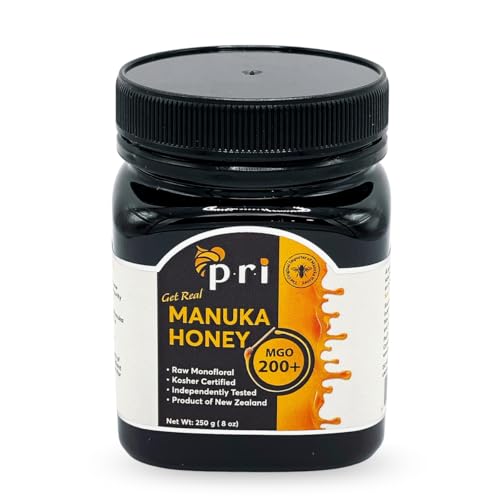
2. P.R.I Manuka Honey MGO 200+ (250g/8.8oz)
Every jar carries a scannable code that links straight to its own lab results — proof, not promises.
Scan the QR code on the lid and it takes you to the batch-specific test results for that exact jar. That is the difference between a Manuka label you have to trust and a Manuka label you can check, and it is why this small 8.8 oz jar belongs on a list for careful buyers. The 200+ in the name is an MGO rating — the measured amount of methylglyoxal, the compound that gives Manuka its distinctive character — independently lab tested for each batch.
The honey itself is raw and cool-processed, meaning it is made using low-temperature methods that preserve natural enzymes and flavor rather than pasteurizing them away. It is monofloral, sourced entirely from New Zealand, and made by a company that has worked with Manuka since 1987. The texture is thick and creamy, which the people who buy it specifically wanted. One buyer’s note captures it: “Yes it has a thick consistency but that’s what I needed.” Others use it as a morning ritual by the spoon.
Compared with the Cosana jar below, this one is the gentler entry point — MGO 200+ versus UMF 13+ (MGO 400+) — and the two jars are close in size, 9.91 ounces versus 8.82 ounces. If you want the bigger number, the Cosana is the one. If you want the traceable middle ground at a smaller commitment, this is your jar. The trade-off is simply that this is a small 8.8 oz bottle, so a daily spoonful habit empties it faster than the three-bottle Y.S. Eco Bee bundle above.
Why careful buyers like it: an independently tested MGO 200+ rating, a scannable QR code that links to that batch’s results, and raw cool-processing that keeps the enzymes intact.
Worth knowing: at 8.8 oz this is a small jar intended for measured daily spoonfuls, not for cooking or baking in volume.
The case for it: you want a Manuka you can verify jar by jar, and you take it by the teaspoon rather than by the tablespoon.
The catch: it is a modest 8.8 oz bottle, so plan to repurchase if it becomes a daily habit.
3. Cosana Raw Manuka Honey UMF 13+ 8.8 oz
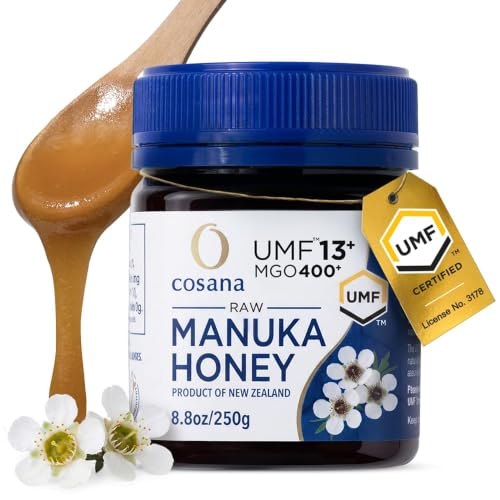
The strongest number in this lineup, and the only jar here carrying full UMF certification.
UMF 13+ means the jar has been certified by an independent New Zealand testing program that verifies both the honey’s authenticity and its MGO 400+ content. If you have been shopping Manuka for a while, you already know why this matters: the letters “Manuka” alone are not regulated, but UMF is a recognized mark that confirms a monofloral jar was tested. This is the highest-rated Manuka on this list — 4.5 stars across 800+ ratings — and the potency claim here is the strongest of the five.
The honey is raw, unprocessed, and free from glyphosate, antibiotics, GMOs, and artificial additives, bottled at the source in a New Zealand facility the company describes as rated A by BRCGS. Quality and taste are what buyers talk about, and the taste feedback is straightforward — sweet, rich, and worth the money. One buyer planning a longer trial put it simply: “Delicious. I will know the real time results for gut repair by Christmas.” That is the right posture for any honey you take daily: patience, not overnight expectations.
Set this against the P.R.I jar, which is the same size class at 8.82 ounces versus 9.91 ounces. Cosana wins on potency, P.R.I wins on traceability — a QR code versus a UMF seal, two different ways of proving the same claim. The honest wrinkle is packaging consistency: the UMF mark can be missing from some physical labels even when the listing describes it, which frustrates the occasional buyer. Order from a listing with the certification clearly shown and this jar is the strong-potency pick.
Why it leads on potency: a verified UMF 13+ certification with MGO 400+ — the biggest number on this page — plus raw, unprocessed honey bottled in New Zealand.
The honest note: it is a pricey specialty jar and the UMF marking can be inconsistent on some physical bottles, so check the listing before you buy.
Best for: the buyer who wants the highest verified potency rating available and does not mind a small premium jar.
Not for: anyone who wants a pourable all-purpose honey for baking — this is a teaspoon-at-a-time jar.
4. Sandt’s Buckwheat Honey 32 oz
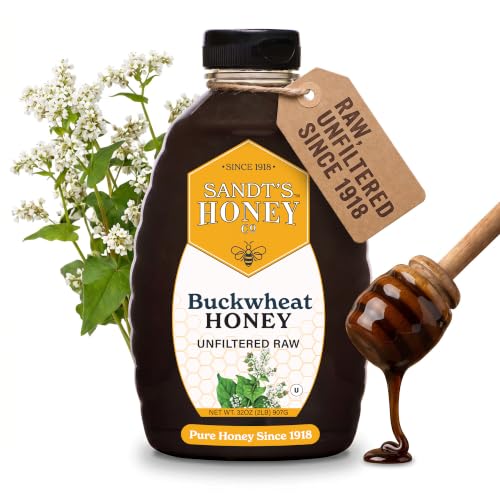
Dark, bold, and molasses-deep — one spoonful flavors a whole mug of tea.
Buckwheat honey is a different species of experience from the pale wildflower jars. It pours out almost black, carries deep caramel notes, and brings a hearty flavor with a nutty aftertaste that buyers specifically hunt for. That intensity is the practical argument for a careful buyer: when a spoonful tastes this strong, one spoonful is genuinely enough. It is the biggest jar here at 32 ounces and 2 pounds, and it is the one that goes in oatmeal, tea, biscuits, pumpkin bread, glazes, and marinades.
Raw and unfiltered, gathered from buckwheat flowers, this jar is sold by a company that has handled honey since 1918. Quality and taste are the two things buyers care about most across its review pages, and the flavor verdicts are enthusiastic — rich, dark, and not cloying. As one buyer put it, it works “especially if you are looking for something flavorful.” Because it is never heavily heated or micro-filtered, expect natural crystallization over time; that is a marker of genuinely raw honey, not a fault.
The most-discussed snag is surprisingly small: the pour-cap. It has a reputation for snapping within about a week on the 2-pound jar, which is the trade-off to know about before your first pour. Compared with the Manuka picks above, this is not a graded medicinal-style jar — it is a big, flavorful everyday honey, and it is the one to choose if your honey goes into cooking as often as it goes into a spoon.
Why Cooks Keep Buying It
- 32 oz / 2 lb jar — the largest on this list by a wide margin
- Raw and unfiltered with deep caramel and nutty notes
- Strong flavor means a single spoonful carries a full mug of tea
- Backed by a honey company operating since 1918
Before You Pour
- The pour-cap is the recurring weak point — it tends to give out quickly
- Natural crystallization is expected and is a sign of raw, unfiltered honey
Buy it if: bold, dark flavor belongs in your tea, your oatmeal, and your baking, and you want the biggest jar for it.
Think twice if: you want a delicate, mild honey — buckwheat is the loudest flavor on this page.
5. New Zealand Manuka Honey MGO 70+ 17.6 Oz
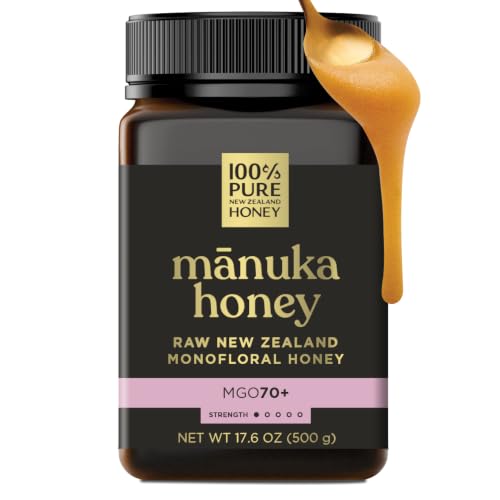
Creamed smooth until it is almost spreadable — a gentler way to take Manuka daily.
At 17.6 ounces, this is double the size of the other two Manuka jars here, and it is creamed through a proprietary process that leaves it exceptionally smooth rather than gritty or sticky. A guaranteed monofloral New Zealand honey with MGO 70+ (at least 70 mg/kg methylglyoxal), it is built for the everyday spoon rather than the strict measured dose. Buyers consistently report the taste works beautifully in hot tea, with comment after comment noting the quality and smooth consistency.
It is a 4.6-star jar with the awards to back the flavor: Supreme Honey Award at New Zealand’s national honey awards in 2021, 2022, and 2023. The texture is the standout — a small sturdy container with a consistency buyers describe as excellent, and several recommend scooping it with a wooden spoon. As one buyer wrote, “excellent consistency taste and quality” accompanied a note to remember the wooden spoon. It is raw, unpasteurised, non-GMO, and harvested glyphosate-residue-free.
Against the P.R.I and Cosana jars, this is the lower-number, bigger-jar Manuka — MGO 70+ instead of 200+ or 400+ — so it suits a daily-wellness routine rather than a potently rated jar. The one recurring friction is the lid: the screw-on top can be fiddly to reseat, and at least one buyer found it easier to decant the honey into a smaller-opening container to control the pour. If a smooth, spreadable Manuka in a large jar is what you are after, nothing else here matches it for size and texture.
The texture story: a creamed, monofloral Manuka smooth enough to spread, in a 17.6 oz jar — twice the size of the other Manuka options here.
The lid caveat: the screw-on cap is the weak point; several buyers simply transfer the honey into a container with a narrower opening.
Pick this one if: you want a larger, smooth, everyday Manuka for hot tea and you prefer a spreadable consistency over a thick one.
skip it if: you specifically want a high potency rating — this jar is MGO 70+, the lowest number of the three Manuka picks.
Know the Specs
What MGO Actually Tells You
MGO stands for methylglyoxal, the naturally occurring compound that gives Manuka honey its distinctive character, and the number after it (200+, 400+, 70+) is a measured amount — higher means more of that compound is present in the jar. A jar labeled MGO 200+ has been counted, not just described. That is why the Manuka picks on this list all print a number: it lets you compare jars on the same scale instead of guessing.
What UMF Certification Adds
UMF is an independent New Zealand certification program that verifies both the MGO content and that the honey is genuinely monofloral — meaning the bees harvested from a single flower source rather than a mix. When you see UMF 13+ on a jar, the mark is confirming a potencies claim that a plain “Manuka” label cannot. If neither MGO nor UMF appears, treat the jar as a flavorful honey first and a specialty one second.
Why Raw and Unfiltered Changes the Jar
Raw and unfiltered honey is never heavily heated or micro-filtered, so it keeps its pollen, enzymes, and natural color. That is also why it crystallizes: crystallization is a sign the jar was minimally processed. The practical consequence is texture — raw honey tends to be thicker, which means you spoon it rather than pour it, and that makes portioning a single small serving far easier.
Portioning Is the Whole Game
Every honey here is still a sugar, which is why the texture and the jar size matter as much as the flavor. Thick, spoonable honey controls your serving for you; large jars invite a heavier hand. If you are watching your intake, choose a jar you take by the spoon, use a consistent small measure, and treat honey as a carbohydrate you are counting rather than a free food.
Common Questions
Is raw honey actually a good choice for someone watching blood sugar?
What is the difference between MGO 70+, MGO 200+, and MGO 400+?
Is UMF certification better than a plain MGO number?
Why does my raw honey get thick or crystallize over time?
Can I cook with Manuka honey or should I only use it raw?
How long does raw honey stay good once opened?
Which honey here has the strongest flavor for tea?
Why is Manuka honey so much more expensive than regular honey?
Which jar is best if I want a large supply for daily use?
Do I need to refrigerate raw honey after opening?
The Bottom Line
For most people, the honey for diabetics winner is the Y.S. Eco Bee Farms Raw Honey because it is raw, unfiltered, unpasteurized, and thick enough that you control every spoonful — and three 22 oz bottles keep it going for a long time. If a verified potency number is what you want on the label, the Cosana Raw Manuka Honey UMF 13+ carries the strongest rating here at MGO 400+, while the P.R.I Manuka MGO 200+ gives you traceable, batch-tested proof in a smaller commitment. And if your honey goes into tea, oatmeal, and baking as much as into a spoon, the big Sandt’s Buckwheat jar is the flavor-first choice. Whichever you pick, treat honey as a small measured spoonful and a carbohydrate you are counting — a jar that pours slowly is helping you more than a jar that flows freely.
How we choose
We do not accept paid placement. Every pick is matched to a real buyer and a real use-case; we do not hands-on test units.
Sources
Specifications: manufacturer listings and product documentation. Review insights: verified customer reviews, as of October 2026. Pricing: not shown on this page (it changes often); check the current price via the retailer link.
As an Amazon Associate, Aappliancez earns from qualifying purchases. This does not affect which products we feature.