Disclosure: Some links in this post are affiliate links. As an Amazon Associate I earn from qualifying purchases, at no extra cost to you. Learn more
Specs are compiled from manufacturer listings and verified buyer reviews and can change over time — please confirm the key details on the product page before buying.
A great home stereo system should make you forget the gear and just listen. The quickest way to get that: match a stereo or streaming amplifier to speakers that actually fill your room, and skip the all-in-one boxes with inflated power claims. Below are nine real systems, ranked by what they genuinely do in a living room, a home office, or a small media room — and which one fits your setup and your budget.
This guide is built by comparing the manufacturers’ published specifications and the patterns across verified customer reviews, so you get each pick’s real strengths and trade-offs instead of marketing spin.
From 100W streaming amplifiers to complete 5.1 bundles, this guide breaks down the specs that matter most for a home stereo system so you can pick the right one the first time.
Top Picks


How To Choose The Best Home Stereo System
Buying a home stereo system can feel confusing because the specs look impressive but rarely tell you how something actually sounds in your room. The rule that cuts through most of the noise: decide how you’ll listen first, then buy the gear that matches that one job. If you mostly stream music, a streaming amplifier with a good DAC and room correction gets you the best result. If you’re building a movie-and-music room, a receiver plus separate speakers gives you more headroom and upgrade options later.
Amplifier power — watts per channel, not peak watts
Look for watts per channel measured continuously, and ignore “peak” or “maximum” numbers. A stereo amplifier rated at 100W drives most bookshelf speakers to party volume without strain. A receiver rated at 30W per channel works fine in a small room but runs out of steam in a large one. More importantly than the number itself: make sure the amp’s power sits in the same range as your speakers’ recommended power handling, so you’re not clipping or under-driving anything.
Inputs that actually matter for a home system
For vinyl, a phono input is essential — it applies the extra amplification and the correct equalization curve that a moving-magnet cartridge needs, so the records don’t sound thin and tinny. For a TV, HDMI ARC lets the system’s remote handle volume on the TV, and HDMI eARC carries higher-quality surround formats over a single cable. Bluetooth with a low-latency codec is fine for casual streaming. Wi-Fi streaming with a Spotify Connect or DLNA connection holds up better for high-resolution music.
Speakers — the single biggest factor in how stereo sounds
A 3-way speaker splits the audio across a woofer for bass, a mid driver or a second driver for vocals, and a tweeter for treble. Two-way bookshelf pairs cover a smaller room well but usually need a subwoofer for real low end. Bass-reflex enclosures (cabinets with a tuned port) go lower than sealed cabinets, but the port needs breathing room from the wall — usually a foot or so — or the bass gets muddy. A subwoofer with its own power and amplifier fills in the bottom octave that even a great bookshelf speaker can’t reach.
Side-by-Side Comparison
| Model | Best For | Amplifier Power | Inputs / Streaming | Format | Amazon |
|---|---|---|---|---|---|
| WiiM Amp Ultra★ Best Overall | Streaming-focused music lovers | 100W | Wi-Fi 6, Bluetooth 5.3, HDMI ARC | Stereo | Amazon |
| Sony STRDH190 BundleBest Value | Budget vinyl + digital starters | 2-channel | Bluetooth, Phono, RCA, 3.5mm | Stereo | Amazon |
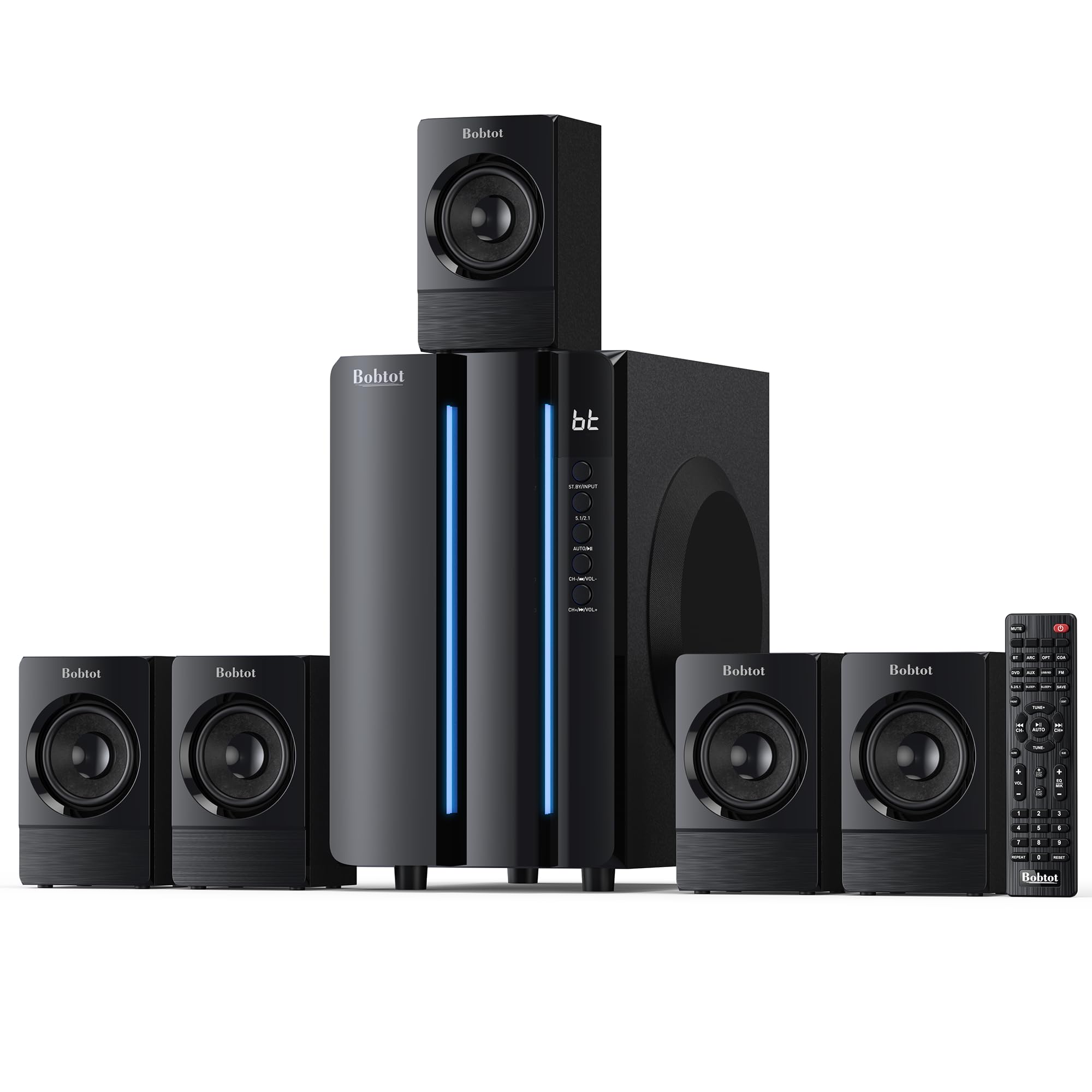
| Bobtot 5.1 Surround SystemBest Surround Entry | Affordable movie-night surround | 800W Peak | Bluetooth 5.3, ARC, Optical, Coaxial, AUX, USB | 5.1 Surround | Amazon |
| Sony SS-CS5M2 | Upgrading on a compact footprint | — | Wired | Stereo | Amazon |
| Philips TAM8905 | All-in-one Wi-Fi + CD listener | 100W | Wi-Fi, Bluetooth, USB, Aux, CD | Stereo | Amazon |
| QLEARSOUL HiFire X | Vinyl collectors wanting one box | 100W RMS | Bluetooth, Aux, RCA Line In/Out | Stereo | Amazon |
| Denon D-M41 | Small-room CD + Bluetooth listener | 30W x 2 | CD, FM/AM Tuner, Bluetooth | Stereo | Amazon |
| Yamaha YHT-5960U | First-time 5.1 movie setup | 80W | HDMI 2.1 (4 in / 1 out), MusicCast | 5.1 Surround | Amazon |
| Klipsch + Onkyo Bundle | Serious Dolby Atmos home theater | 220W per channel (6 Ohms) | HEOS, HDMI, Voice Control | 9.2 Dolby Atmos | Amazon |
Detailed Reviews
1. WiiM Amp Ultra Stereo Streaming Amplifier
Our pick — 4.5+★ from 800+ verified ratings; the strongest balance of quality and price.
One aluminum box that turns any speakers into a streaming hi-fi rig
If your music lives on Spotify, TIDAL, or Qobuz and you already own a pair of decent speakers, the WiiM Amp Ultra is the cleanest way to turn them into a real stereo. Inside is a 100W Hi-Fi amplifier that drives up to four speakers with ultra-low distortion — its THD+N rating is -106 dB, which is a measure of how little unwanted noise the amp adds to your music, so vocals stay clean even when you push the volume. The signal path uses an ESS SABRE DAC (a chip that converts digital files into analog sound) plus dual TI TPA3255 amplifier chips, so the sound you hear stays true to the recording rather than getting colored on the way out.
What most buyers care about after a few months, though, is how easy it is to live with. The built-in RoomFit room correction listens to how your speakers sound in your actual room — including the walls, carpet, and furniture — and auto-calibrates the output to compensate. Wi-Fi 6 streaming is the newest mainstream Wi-Fi standard and holds a stable connection even when other devices are on the network, and Bluetooth 5.3 with LE Audio pairs newer phones and headphones with lower latency. The 3.5” glass-covered touchscreen shows album art and lets you switch sources without touching your phone. Multi-room syncing works with other WiiM devices as well as Alexa and Google speakers, so you can extend music into a second room later.
The honest catch is one compatibility gap: this device is not compatible with AirPlay and can’t act as an AirPlay receiver. If your whole household runs on iPhones and Apple’s wireless streaming, you’ll be stuck using the WiiM app or Bluetooth for everything, which works but doesn’t feel native. The other thing to know is that a 4.5+ star average across 800+ owners doesn’t mean every single stream is flawless — a few iPhone-first users hit the AirPlay wall. For Android, Windows, Roon, and Chromecast households, that limitation doesn’t come up at all.
What it does brilliantly
- 100W amplifier with -106 dB THD+N distortion spec keeps loud music clean
- RoomFit room correction compensates for your actual room, not a lab
- Wi-Fi 6 streaming across Spotify, TIDAL, Qobuz, Amazon Music, and Roon Ready
- Supports up to 24-bit/192kHz high-resolution audio
- 3.5” glass touchscreen plus voice remote for easy source switching
Where it stops short
- Not compatible with AirPlay — no Apple-native streaming
- No built-in speakers; you supply your own pair
Grab this if: you stream from Spotify, TIDAL, Qobuz, or Roon and already own speakers you love.
Think twice if: your household revolves around AirPlay and you’d rather not switch apps.
2. Sony STRDH190 2-Channel Stereo Receiver Bundle
The turntable-and-Bluetooth starter that costs less than a single nice speaker driver
Buyers report this as the receiver that punches far above its class. The STRDH190 is a 2-channel receiver with phono inputs, Bluetooth, and four analog audio inputs plus one output — enough to hold a turntable, a CD player, a TV, and a spare source without a switcher. The bundle also throws in 50 feet of 14AWG speaker wire and five pairs of gold-plated banana plugs, which is the practical reason most people pick this over a bare receiver: you can wire a pair of bookshelf speakers the same afternoon it arrives.
The Bluetooth has a Standby trick worth knowing about. Once you’ve paired your phone or tablet, you can power the receiver on straight from the phone — no walking over to the front panel because you forgot to hit the power button. Owners consistently pair it with Klipsch rp600m and Polk subwoofers, so it’s clearly comfortable with speakers that aren’t starter-tier. The large-capacity power transformer is what gives it the headroom to push real speakers, and the bass and treble knobs give you the adjustability most systems in this price range skip.
Where it falls short is the radio and one detail about the chassis. FM reception is weak compared to what you’d get from a dedicated tuner, and the receiver isn’t deep enough to place a turntable directly on top of it — you’ll need a separate shelf or a dedicated turntable stand. The spring-loaded speaker terminals also don’t feel as solid as binding posts, which matters if you’re planning to swap speakers frequently. For a starter set that plays vinyl and streams from your phone, though, the trade-offs are small compared to the cost savings.
Value that’s hard to argue with: the whole point of this bundle is that it includes the wire and plugs, so you aren’t chasing accessories after the receiver arrives. Owners mention pairing it with Klipsch and Polk gear and never feeling like the receiver is the weak link.
The honest ceiling: the FM tuner is the weakest part, and limited audio adjustments (just bass and treble) mean you can’t fine-tune like a premium receiver.
Best for: a first real stereo where the receiver isn’t the star and the speakers are.
Look elsewhere if: you need FM radio to be strong, or you want on-board digital processing like HDMI ARC.
3. Bobtot 5.1 Channel Surround Sound Home Theater System
Five speakers, a 6.5″ subwoofer, and karaoke inputs for movie night on a budget
If you want the full surround speaker count without a two-thousand-dollar budget, the Bobtot bundle is the direct answer. The package includes one subwoofer with a built-in receiver, five wired speakers (two front, two rear, one center), plus ARC, optical, aux, and antenna cables in the box. The 6.5-inch subwoofer handles the low end, and the 800W peak power figure applies to the whole system at its momentary ceiling — peak numbers always describe short bursts, not continuous output. A wide-voltage digital amplifier accepts AC 100–240V at 50/60Hz, so it works with international voltage without a step-down transformer.
The connection list is genuinely broad: Bluetooth 5.3 for streaming from your phone, plus TV ARC, Optical, Coaxial, AUX, USB, and DVD inputs for hooking up a TV, game console, DVD player, computer, laptop, or projector. EQ presets are Jazz, Country, Classic, Pop, and Rock, and the full-function remote lets you adjust speaker volume individually — useful if your rear speakers are tucked behind the couch and end up louder than you intended. A built-in FM receiver and dual microphone inputs with echo function turn the same system into a karaoke setup for family gatherings.
The honest trade-off that shows up again and again is the amp’s fussiness with source switching. Customers note that some HDMI and optical inputs don’t reliably pass audio, and one remote can’t control the system’s volume alongside the TV’s — so you may end up using the Fire Stick remote or the Bobtot remote depending on what’s playing. Bass response also varies by room; a corner placement facing into the walls helps, but the cables make that positioning difficult. At 4.0+ stars with a few hundred owners, this is a solid “good enough” surround system rather than an audiophile one.
Setup is the real win: buyers find it easy to get all six pieces connected and positioned, and the wired speakers include enough cable to wrap a large living room. Multiple inputs mean you don’t need an HDMI switcher to run a TV, console, and DVD player at once.
Where owners want more: remote control behavior across TV and system is the recurring friction, and bass doesn’t live up to the 800W peak number in practice.
Good fit for: first-time surround buyers who want six speakers and a subwoofer without paying premium prices.
Skip if: you’re chasing reference-level bass or want a single remote to run everything.
4. Sony SS-CS5M2 3-Way 3-Driver Bookshelf Speakers (Pair)

A 3-way bookshelf pair that delivers detail you’d have to pay triple to beat
If you already own a good receiver and just need speakers that pull the whole system together, this pair is where the money goes furthest. The SS-CS5M2 uses a 3-way, 3-driver layout, which means an individual speaker handles bass, another handles the critical midrange where voices live, and a tweeter handles the treble — instead of forcing one driver to do too much. The 5.12-inch woofer and the wide-dispersion super tweeter (a second high-frequency driver aimed wide to spread treble across the room) together give you a frequency response of 53 Hz up to 50,000 Hz, which counts as Hi-Res Audio certified performance.
Compared to the Sony STRDH190 bundle above, this pair is the upgrade conversation: the receiver handles the amplification, and these speakers are the reason you’d buy the receiver in the first place. Owners who loaded these into a home office in place of a PC speaker setup describe crisp vocals and a surprisingly present bottom end for the size. A few buyers compare them favorably to Klipsch models they’d previously owned, which is a good sign that the 3-way geometry is doing real work rather than marketing work. The bass reflex enclosure (a rear-firing port that aims sound out the back) goes deeper than a sealed cabinet of the same size, but it needs wall clearance to breathe.
Two things to plan for. First, these are passive speakers, so nothing plays without an amplifier — a smart speaker or phone won’t drive them. Second, because of the rear-firing bass port, close-to-wall placement smears the bass; reviewers point out that silicone isolation feet and a foot or so of clearance make a real difference. Bass below roughly 50–60Hz is where these hand off to a subwoofer, so if you want chest-thumping action-movie low end, budget for a sub as well. In a small to medium room, though, they can carry the whole system on their own.
Where the pair shines: buyers praise the sound quality most — the 3-way driver layout delivers clarity and detail that punches above the price. Compact size is the second thing buyers mention, and the 5.12-inch woofer keeps the footprint narrow enough for shelves.
One thing to handle: they need an amplifier and a wall gap for the rear port, so tight bookshelves will fight the bass.
Perfect pairing: an existing stereo receiver that needs better speakers than what came in the box.
Not the first stop if: you want a single-box solution or need built-in streaming.
5. Philips Bluetooth & Wi-Fi Stereo System with CD Player

CD, Wi-Fi, Spotify, internet radio, and Bluetooth — the whole stereo in one footprint
For someone who wants a working stereo the day it arrives and refuses to buy separate amp and speakers, Philips has quietly made among the most feature-complete micro systems. The 100W output comes from a wooden-cabinet pair of speakers with 5.25-inch woofers and dome tweeters, plus bass-reflex ports that reinforce low frequencies. Frequency response runs from 50 Hz to 20,000 Hz, which covers the full musical spectrum. The matte aluminum central unit holds a CD player, Wi-Fi and Bluetooth streaming, internet and FM radio with a digital tuner, USB playback, aux-in, and a headphone jack.
What owners appreciate most is the versatility — Spotify Connect for streaming, physical CDs for the collection, internet radio for stations that don’t broadcast locally, and Bluetooth wireless range up to 30 feet so you can control everything from the couch. A remote control ships with the system, plus there’s a color display that shows album art, artist, and track info so you actually know what’s playing. The system is built around an always-on AC power supply, so no rechargeable battery to worry about.
The trade-offs are real but manageable. The setup process draws mixed reactions — Wi-Fi and internet radio configuration occasionally frustrates people who aren’t patient with menu diving. A handful of owners note that the remote is awkward in low light because volume and mute buttons aren’t prominently labeled, and the packaged speaker cables are thin. There’s also a quirk where some CDs that play fine in a car stereo aren’t recognized by this unit. For an all-in-one for a lounge or a home office, though, the compact footprint at 10.09 kg fit nicely on a shelf and the sound is better than the size suggests.
The reasons to pick it
- CD, Wi-Fi streaming, Bluetooth, internet radio, FM radio, and USB in one box
- 100W stereo through 5.25” woofers and dome tweeters with bass-reflex ports
- Spotify Connect plus a color display that shows album art and track info
- Compact footprint with a wooden-cabinet finish that fits shelves and sideboards
- 30 feet of wireless Bluetooth range so you can control music from across the room
The annoyances to plan around
- Setup can be fussy — some users struggle with Wi-Fi and internet radio menus
- Remote is hard to use in the dark, with unlabeled buttons
- Some CDs that play in other players don’t load reliably
You’ll love it if: you want one shelf unit that plays CDs, Spotify, internet radio, and Bluetooth without any extra boxes.
It isn’t for you if: you like to tinker with speaker placement or want to build the system piece by piece.
6. QLEARSOUL HiFire X Vinyl Record Player with 100W Speakers
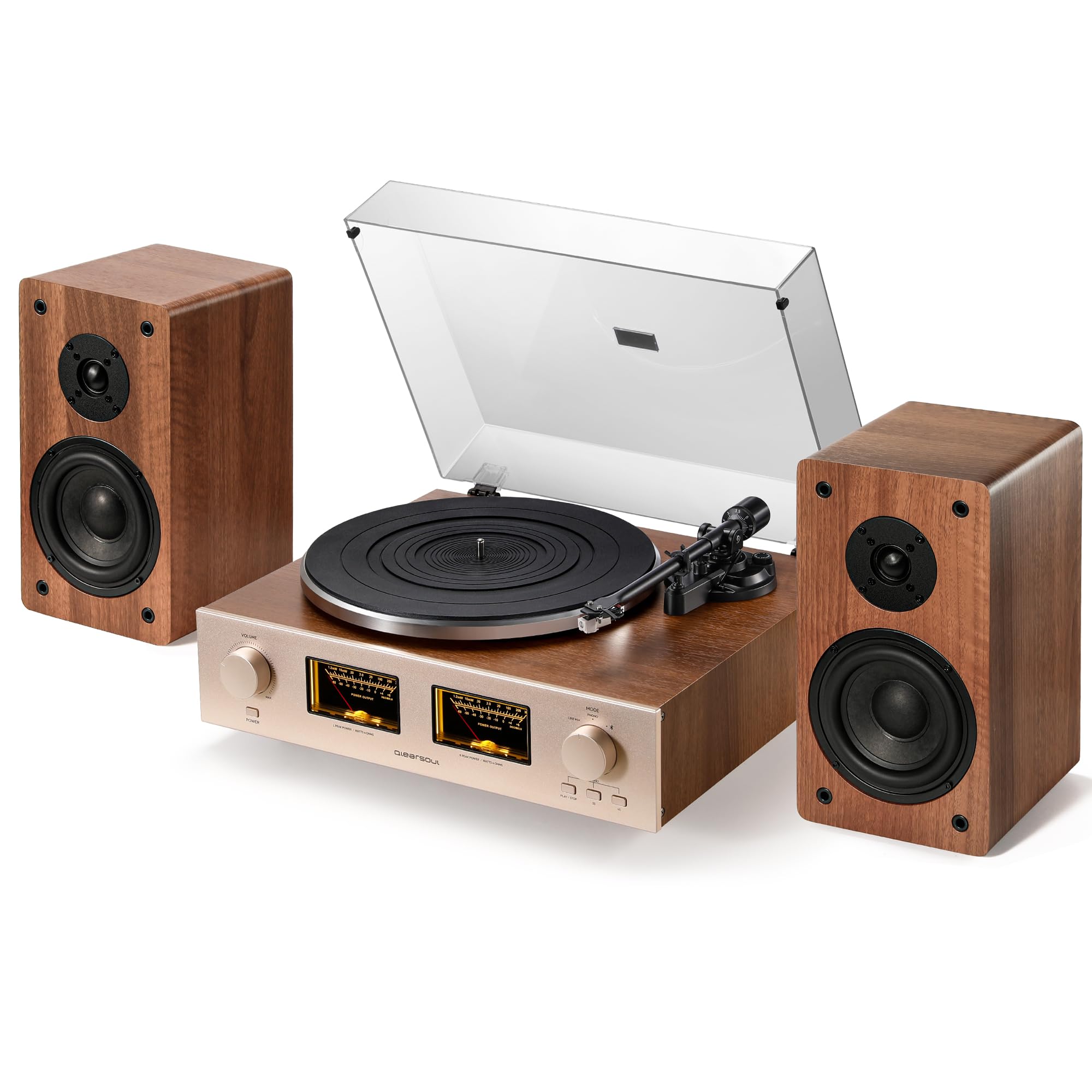
A complete turntable-and-speaker rig with VU meters straight out of a 70s studio
Vinyl buyers often end up with three separate purchases — turntable, preamp, and powered speakers — and the HiFire X skips all of that. The package includes a turntable plus a pair of stereo bookshelf speakers (100W RMS, 400W peak), each with a 5.3-inch woofer for bass and a 1.5-inch silk dome tweeter for treble. A DC motor spins the platter at 33 or 45 RPM, and the built-in DSP preamp (digital signal processor, a chip that adjusts tone for each input) tune EQ depending on whether you’re listening to a record, Bluetooth, or a line-in source. RCA Line In and Line Out jacks mean you can connect a better external preamp later without replacing the turntable.
The retro VU meter is the detail owners fall for — two analog needles that swing with the signal so you can watch music move in real time, a callback to studio consoles from the 60s through the 80s. The control panel is CNC-machined from a solid block of aluminum, so every knob feels weighty and deliberate. Sound quality is the standout praise: buyers describe it as sounding like the artist is right in the room, and a few note it captures the warm character of ’70s stereos. The whole package weighs 35.3 pounds, which is a real indicator of how much actual speaker and turntable mass you’re getting.
The reliability picture is genuinely mixed, and the specific issue is the auto shut-off. A handful of shoppers say the turntable doesn’t stop at the end of a record — no auto-return tone arm — so the stylus keeps riding the inner groove until you lift it yourself. If you like to put on a record and walk away while side A plays through, this one needs you to stay nearby. The DSP does need a bit of break-in to settle, and the RCA outputs mean you can side-grade later if you want a different tone.
Why vinyl fans love it: a single integrated turntable-plus-speakers package that plays records the moment it’s unboxed, with quality and sound quality both drawing the top praise in reviews. The VU meters add a genuine analog touch most modern systems skip.
The one thing to remember: there’s no auto shut-off at the end of a side, so if you drift off mid-record, the stylus keeps going until you lift it.
Great for: vinyl newcomers who want one box to set up and start spinning records on day one.
Consider something else if: you want the turntable to stop itself at the end of a side.
7. Denon D-M41 Mini Amplifier and Speaker Pair

A true mini stereo with a real CD deck, built for a room where space matters
The Denon D-M41 is what you buy when you’ve decided that CDs matter again and you want a small space to sound big without a wall of components. The package pairs the D-M41 CD/FM receiver with a matching pair of SC-M41 bookshelf speakers — each rated at 2 x 30W — built around a 4¾-inch woofer/mid driver and a 1-inch high-definition silk dome tweeter. That’s 30 watts per channel into the speakers, enough to play a small to mid-size room at satisfying volume. The receiver itself runs Bluetooth, a CD player, and an FM/AM tuner, so it covers discs and streaming in one slim chassis.
What earns it a spot is the triple noise-reduction design in the receiver — the circuit keeps three different sources of background noise from bleeding into the music signal so the sound stays clean. A dedicated headphone amplifier jack lets you listen privately without disturbing anyone else in the room. Built-in RCA-style digital inputs accept a TV, set-top box, or another streaming source, so you can use the same receiver for movie audio without buying a separate amp.
Two honest notes. Bass is adequate rather than deep — buyers end up adding a subwoofer for punch, and without one the low end thins out on action-heavy tracks. Limited sound control is the second recurring complaint: you can adjust bass and treble, but not much else, and CD playback runs on the factory flat setting. A rare unit has failed outright (a CD player not being recognized is the one that comes up), but that’s the exception across the reviews rather than the pattern. For anyone with a small home office and a stack of CDs, it’s tough to top a real mini stereo from a brand that’s been building them for decades.
Where the money goes: a genuine Compact Disc deck that plays like a proper hi-fi, plus a very small footprint and easy setup. Buyers pair it with higher-end speakers like the Elac Debut 6.2 and the system keeps up.
Worth knowing upfront: bass is fine for acoustic and jazz but thins out on bass-heavy music unless you add a subwoofer.
The one to grab if: you’ve got a shelf, a stack of CDs, and a small-to-mid-size room that deserves better than a Bluetooth speaker.
Not for everyone: buyers who want deep bass without a separate subwoofer should look at a bigger 2.1 setup.
8. Yamaha YHT-5960U Home Theater System with 8K HDMI

An 8K-ready 5.1 receiver with speakers included — the modern one-box upgrade
This is a Yamaha 5.1 home theater bundle rated at 80W per channel, with four surround speakers, a subwoofer, and an AV receiver in the box. The receiver handles 4K60, 4K120AB, and 8K60B video passthrough over HDMI 2.1 with HDCP 2.3 and eARC support on the four-input, one-output connection set. Those numbers matter if you plan a newer TV or console: HDMI 2.1 is what allows 4K at 120Hz and 8K at 60Hz, and HDCP 2.3 is the copy-protection standard newer streaming services require. Dolby Vision, Hybrid Log-Gamma, and BT.2020 wide-color support fill out the HDR lineup, and gaming-focused ALLM and VRR cut input lag and smooth out frame-rate mismatches on compatible displays.
Setup is straightforward for a surround system — YPAO automatic room calibration does the hard part, measuring your speakers’ positions and adjusting delay and EQ to match. MusicCast support brings Yamaha’s multi-room streaming into the fold, so you can group the system with other MusicCast speakers for whole-home audio. The included speaker wire is per-speaker positioned correctly, saving you the guesswork on lengths.
Two structural limitations are worth flagging upfront. The bundled receiver is bulky, so it won’t squeeze into a slim floating media console without an extra platform underneath. And the speaker wire situation — while conveniently pre-matched — doesn’t give you much slack if your surrounds sit far from the receiver. Older reviews note units that failed after a couple of years, which is a durability question Yamaha’s subsequent builds have addressed; the vast majority of buyers report it running fine for years. At 4.0+ stars, it’s a solid starter package that trades top-end refinement for accessibility.
Why it works: real HDMI 2.1 with 8K passthrough on a 5.1 system at a price that scares away most competitors. Buyers consistently describe sound quality as well above the soundbar setups it replaces.
The physical reality: the receiver is a substantial box — plan for it to sit somewhere that gets ventilation, not tucked under a floating TV console.
Perfect first surround: someone upgrading from a soundbar who wants true rear channels and a proper subwoofer.
Not the pick if: you want a slim, low-profile receiver that hides behind furniture.
9. Klipsch Reference Dolby Atmos Home Theater
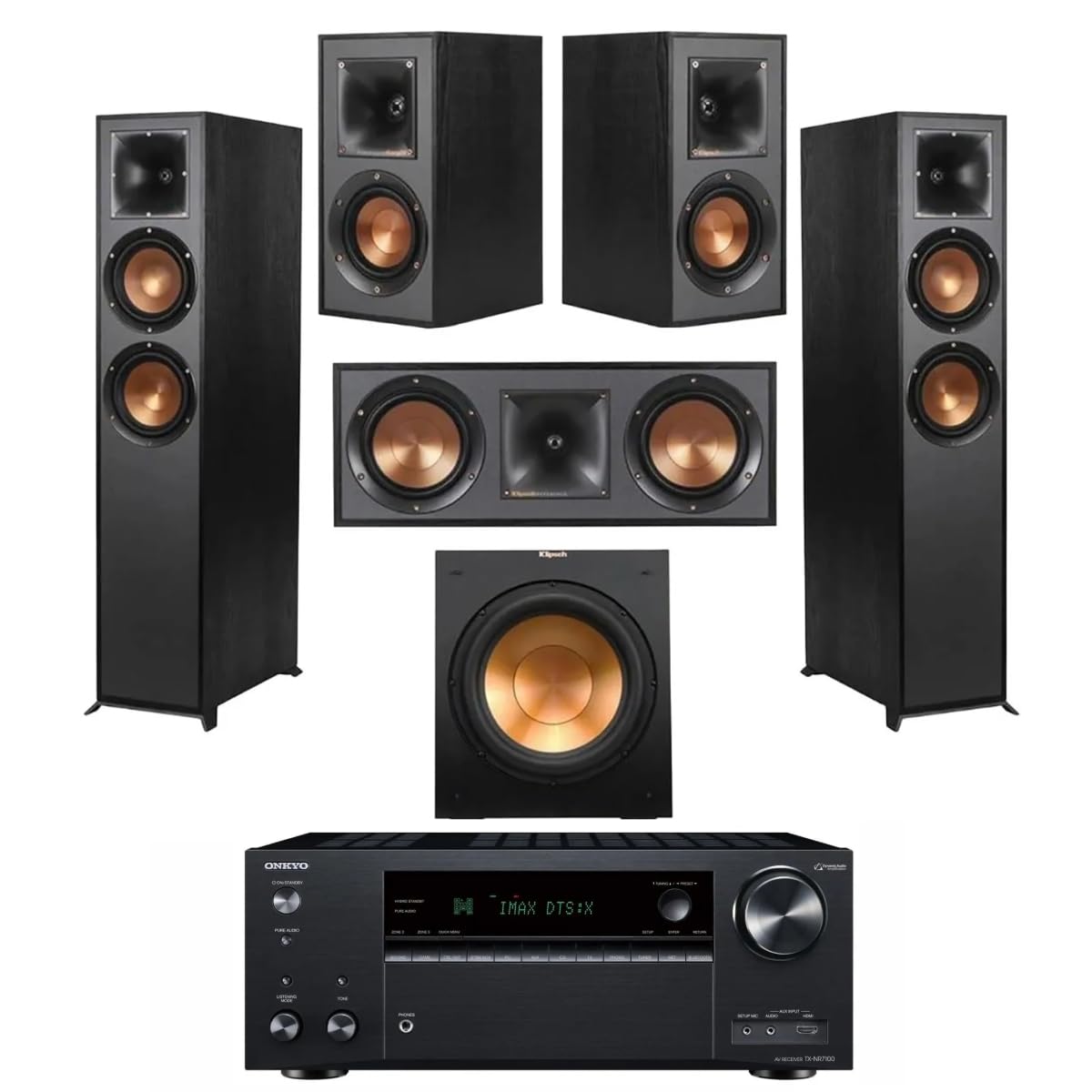
A true 9.2 Atmos rig with height channels that put rain above your head
This Klipsch and Onkyo bundle is the ceiling of this list. The Onkyo TX-NR7100 receiver handles 9.2 channels with 220W per channel at 6 ohms, supports 8K video passthrough, Dolby Atmos decoding, and automatic room calibration. The Klipsch side includes dual R-625FA floorstanding speakers with built-in up-firing elevation channels — the drivers that bounce sound off your ceiling to create overhead effects without ceiling-mounted speakers. An R-52C center channel anchors dialogue, R-41M bookshelf speakers handle the surrounds, and the R-12SW subwoofer uses a 12-inch spun copper IMG driver with its own all-digital amplifier to carry the low end.
If you’ve been chasing the movie-theater-in-your-home experience, the elevation channels are what get you there: Atmos height effects like rain, aircraft overhead, or a helicopter tracking across the room come from the up-firing drivers and place sound above you in a way no 5.1 system can match. Onkyo’s room calibration handles the speaker-by-speaker timing and EQ work automatically. Built-in HEOS streaming brings multi-room audio, voice control support lets you adjust playback hands-free, and the scratch-resistant black wood-grain cabinets keep the aesthetic neat in a dedicated room. Compatibility covers television and home theater setups specifically.
The trade-offs are structural rather than tonal. A 12-inch powered subwoofer and four floorstanding towers take up real floor space, so this is a dedicated-room system rather than a bookshelf solution. Getting a full 9.2 configuration wired up requires careful cable routing, and the Onkyo receiver needs sensible placement with ventilation because of its power draw. At 4.0+ stars with a smaller review pool than the more accessible picks above, it’s a balance for buyers who’ve decided that home cinema is the hobby and not just the product.
What you’re really buying: a receiver and speakers that were built for the same Atmos system, so the calibration and decoding pipeline is home-theater-first. The 12-inch sub and dual floorstanding towers give it bass presence that no soundbar can approach.
Plan for it: this is a room-filling system that needs floor space, cable management, and a spot for four towers plus a full-size sub.
Reach for this if: you’re committed to a dedicated movie room and want Atmos height effects from the start.
Look elsewhere if: you’re building a stereo music system first and a theater second.
Know the Specs
Watts per channel vs. peak watts
The wattage number on a stereo box is among the most misleading specs in audio. A “100W” stereo carries the number as its continuous output into each channel; a “800W peak” surround setup describes the brief moment when the amplifier hits its ceiling on a single transient. Continuous watts correlate with how loud the system plays cleanly. Peak watts look dramatic but rarely describe real listening conditions. When you compare systems, look for the continuous watts per channel figure first and treat peak watts as a footnote.
How room correction works
Room correction is an automatic process where the stereo sends a test sound through your speakers and records the returning audio through a microphone. The system then adjusts the frequency balance and timing to compensate for walls, furniture, and floor coverings, none of which sound the same in any two rooms. Systems like WiiM’s RoomFit, Yamaha’s YPAO, and Onkyo’s automatic calibration all measure the same problem — every room colors sound differently — and each tries to flatten that coloring. It won’t fix bad speakers, but it can make good speakers sound noticeably better in an imperfect room.
Common Questions
Do I need a subwoofer with bookshelf speakers for a home stereo system?
Can I connect a turntable directly to a home stereo system without a separate preamp?
Does Bluetooth streaming sound worse than Wi-Fi streaming on a stereo?
What is HDMI ARC and why does it matter for a home stereo system?
How much amplifier power do I need for a small room vs. a large room?
Is Dolby Atmos worth it over 5.1 surround for a home stereo system?
Will a home stereo system work with myTV and streaming services like Netflix and Spotify?
How do I know if a mono or stereo amplifier is right for vinyl and Bluetooth playback?
Can I wall-mount or place speakers too close to the wall for good sound?
What is the difference between Hi-Res Audio and standard CD-quality sound?
Does a receiver with a 100-year legacy brand matter for home stereo sound?
The Bottom Line
If you already own speakers and want the cleanest path to streaming hi-fi, the WiiM Amp Ultra Stereo Streaming Amplifier is the one to buy — it combines a 100W amplifier with RoomFit room correction and a full streaming stack that covers Spotify, TIDAL, Qobuz, Amazon Music, and Roon Ready up to 24-bit/192kHz. If you’re coming at this from a turntable or a starter CD rack, the Sony STRDH190 Bundle includes the wire and plugs you’d otherwise have to buy separately, and it pairs comfortably with Klipsch and Polk speakers. And if the goal is a full movie-room experience with overhead Atmos effects, the Klipsch Reference Dolby Atmos Home Theater bundle brings the up-firing height channels and the 12-inch powered subwoofer that no bookshelf setup can substitute. Whatever direction you go, match the amp to the speakers, plan for a subwoofer if bass is the goal, and give yourself wall clearance for rear-ported cabinets.
How we choose
We do not accept paid placement. Every pick is matched to a real buyer and a real use-case; we do not hands-on test units.
Sources
Specifications: manufacturer listings and product documentation. Review insights: verified customer reviews, as of October 2026. Pricing: not shown on this page (it changes often); check the current price via the retailer link.
As an Amazon Associate, Aappliancez earns from qualifying purchases. This does not affect which products we feature.