Disclosure: Some links in this post are affiliate links. As an Amazon Associate I earn from qualifying purchases, at no extra cost to you. Learn more
Specs are compiled from manufacturer listings and verified buyer reviews and can change over time — please confirm the key details on the product page before buying.
If your lower back locks up every morning and hanging upside down by your ankles makes you nervous, a home spinal decompression machine that stretches you from a flat-footed or seated position can do the same job without the head rush. The trick is matching the device to the part of your spine that actually hurts. A neck stretcher will do nothing for a lumbar disc, and a full-body table will not reach a pinched nerve at C5-C6 (the sixth vertebra in your neck).
This guide is built by comparing the manufacturers’ published specifications and the patterns across verified customer reviews, so you get each pick’s real strengths and trade-offs instead of marketing spin.
You will see nine devices split by what they decompress, how much weight they carry, and whether they run on air, a cable crank, or gravity, so you can pick the one that fits your body and your pain. This breakdown of every home spinal decompression machine worth comparing covers necks, lumbar discs, and full-spine setups in one place.
Top Picks


How To Choose The Best Home Spinal Decompression Machine
The first decision is not brand or budget — it is which section of your spine needs the pull. A cervical device stretches the neck at a downward angle to open the disc space between your vertebrae. A lumbar machine pulls the lower back from a seated, kneeling, or braced position. A full-body table handles both but takes up real floor space. Get this wrong and no amount of adjusting will fix it.
Match the device to your pain location
Neck pain, headaches, and arm tingling usually point to the cervical section, which is why a wedge or visor-style unit with a forehead support makes sense. Lower back stiffness, sciatica, and hip tightness point to a lumbar setup that uses a lap belt, shoulder pads, or a moving air cell. If you have both, a dual-section device with separate pumps lets you treat each area on its own schedule.
How traction is applied matters as much as where
Air-inflation cells expand gently and let you control pressure by squeezing a bulb or pressing a button. A cable crank uses a dial and a knob to pull directly, which many buyers find holds tension more steadily than a hand pump that slowly loses pressure. Gravity inversion, by contrast, uses your own body weight on a padded backrest — no motor, no cord, just an adjustable pin system holding you at an angle.
Check weight capacity and user height before anything else
A machine rated for 250 pounds or 350 pounds tells you two things: how sturdy the frame is and how much forward lean it will tolerate without tipping. Height ranges matter just as much, because the cushions, ankle holders, and headrest only line up correctly if you fall inside the stated span. Measure yourself against the number before you commit to the footprint.
Side-by-Side Comparison
| Model | Best For | Target Area | User Ratings | Weight / Capacity | Amazon |
|---|---|---|---|---|---|
| Nitrofit Limber Pro Stretch Machine★ Best Overall | Full-body stretch and rehab | Back, hips, hamstrings, calves | 4.6 / 5 | 56 lb frame | Amazon |
| Posture Pump Model 1400-D Dual Disc HydratorDoctor Favorite | Neck and upper-back curve support | Cervical and thoracic spine | 4.1 / 5 | 2.23 oz | Amazon |
| Full Body Massage Mat with Heat and Lumbar TractionMost Versatile | Gentle full-body stretching at home | Neck, back, waist, hip, legs | 4.4 / 5 | 10 lb | Amazon |
| Verakare ITM5850 Heat and Massage Inversion Table | Lower back relief with heat | Full spine with lumbar focus | 4.4 / 5 | 300 lb capacity | Amazon |
| Stamina InLine Traction Control System | Flat-footed lumbar traction | Back, hips, knees | 4.1 / 5 | 250 lb capacity | Amazon |
| HoMedics Fitness Stretching Mat with Air Compression | Athletes and post-workout recovery | Full body with 6 programs | 4.4 / 5 | 10.58 lb | Amazon |
| Posture Pump Model 4100-D Dual Deluxe | Full spine neck and back support | Cervical and lumbar spine | 4.0 / 5 | 3 lb | Amazon |
| iSTIM WeTrac Cervical Neck Traction Device | Portable neck traction | Cervical spine | 3.9 / 5 | 9.3 lb | Amazon |
| Teeter DEX II Inversion and Core Trainer | Inversion plus core strength | Lower back, hips, core | 4.4 / 5 | 350 lb capacity | Amazon |
Detailed Reviews
1. Nitrofit Limber Pro Stretch Machine
Our pick — over 4.5★ from 350+ verified ratings; the strongest balance of quality and price.
A slide-to-fit stretch seat bolted to a 60-pound steel frame, built for daily back and hip work.
Most stretch machines bolt the seat down and hope your body matches it. The Limber Pro does the opposite — the seat itself slides and locks, so you set your own starting distance instead of contorting to fit a fixed position. That single adjustable base is what turns a generic stretch frame into something you can actually dial in for tight hamstrings, hips, glutes, calves, and the lumbar muscles running up your lower back.
The frame is the other half of the story. It weighs 56 pounds and is built from commercial-grade steel with a wide base, so leaning into a deep calf or hamstring pull does not rock the machine or start a tipping wobble under you. Buyers who moved over from pricier name-brand units call out the seat adjustment and the included calf stretch board as the two things that won them over. The general read across the reviews is that the Nitrofit feels more planted than some higher-priced tables. If you are small-framed, that extra stability is the difference between stretching and white-knuckling the handles.
The smaller touches are worth knowing before you buy. There are dual grip handles — inward-facing for seated work, outward-facing when you stand on the slant board — plus safety straps, integrated transport wheels, and a removable phone shelf sized for a phone or tablet, so you can follow a timed stretch video instead of counting in your head. The recurring gripe owners raise is the padding on the front edge of the knee pad, which bites during longer stretches; the fix that keeps coming up is a sliced 16-inch foam roller held on with Velcro. A handful of units have shown a weld at the truss seam over years of use, and a couple of buyers report the printed exercise guide is printed small.
What owners rave about
- Sliding lockable seat lets you set your own stretch depth instead of forcing a one-size setup
- 60 lb commercial-grade steel frame with a wide base stays planted during deep pulls
- Removable calf stretch board and dual grip handles add standing and seated options
- Integrated wheels make it practical to roll out of the way between sessions
Where it needs a tweak
- Knee-pad front edge can dig in during longer stretches — a foam roller fixes it
- A few owners mention weld wear at the truss seam after years of use
- Printed exercise guide text runs small, and the grey start-position placard is hard to read
Reach for this if: you want one machine that covers your whole body from calves to lower back and you have the floor space for a 56-pound frame.
Look elsewhere if: your pain is concentrated in your neck — this is a body-stretch frame, not a cervical traction device.
2. Posture Pump Model 1400-D Dual Disc Hydrator
Two angled air cells inflate to open your neck curve — no straps pulling your chin backward.
Where most neck traction rigs haul on your jaw, the 1400-D inflates two angled air cells that expand gently against the cervical and upper thoracic spine. You squeeze a hand pump to control the pressure at your own pace. The Comfort Visor cradles your forehead instead of your chin, which is the design choice that makes this one usable for long, relaxed sessions rather than a few tense minutes. At least one buyer with a herniated disc and a lost neck curve bought it on a chiropractor’s recommendation.
The manufacturer rates it for adults of most ages and conditions, and builds it in the USA from durable materials. Because it runs on air rather than leverage, it is compact and light enough to use on the floor, in an office chair gap, or on a bed during travel. Neck and upper-back pain relief is the single thing buyers point to most often, followed closely by how well it works. The arm-and-hand numbness from a pinched nerve is the symptom owners most frequently mention fading, with One buyer reports near-total relief after four days of daily use. One long-term user had the pressure-release button fail on the first unit within a month, but the replacement ran clean for six years.
The honest trade-off: consistency is the catch. This works cumulatively — owners describe stiffness and muscle soreness in the first week as the spine realigns, so it is not a one-session fix. The other split is comfort: the hard plastic shell sits fine for some body types and too rigidly under the neck for others.
Best matched to: anyone whose neck pain, forward head posture, or arm tingling points to the cervical spine and who wants air-based control over a strap rig.
Think twice if: you dislike firm surfaces under your neck — the shell material is unyielding, and that is the recurring fit complaint.
3. Full Body Massage Mat with Heat
An airbag mat that twists, curls, and warms your whole spine while you lie there.
This mat does not vibrate, roll, or knead. It uses inflating airbags to traction your body up and down, curve your spine, and twist you left and right from neck to hip. That gentle push-and-release motion is the reason massage therapists who expected nothing have warmed to it — it is far kinder than shiatsu pressure on a tender lower back, and quiet enough to nod off on. Heat is optional across three levels: 115°F, 130°F, and 149°F.
You get 4 programs (Auto, Stretch, Twist, Flow), 3 intensity settings, and 3 selectable zones (Neck, Back, Hip). The adjustable neck section spans users from 5’0″ to 6’2″, and reviewers who are 5’11” and 6’0″ confirm it reaches them fine. When you are done, the Velcro sections fold it down and the handle makes it carryable, and at 10 pounds it stores smaller than a shiatsu or roller unit. It also works on a bed, sofa, or floor — the maker explicitly warns against chairs and recliners.
Where it earns its keep is the between-appointments crowd: people managing a back injury on the days they are not seeing a chiropractor, using it for a short session and reporting the best sleep of their week afterward. A 20-minute auto-off means you cannot fall asleep mid-stretch and overdo it. The honest catch is the intensity spread — owners note the three levels change mostly by how often the pump cycles rather than by a dramatic jump in pull, so the highest setting is still a gentle experience. Some find the thigh squeeze too tight and the neck airbag sits below the collar rather than on it.
Made for: chronic stiffness and post-workout tension where you want heat and a slow stretch, not deep-tissue force.
Not the pick if: you need real lumbar traction pull — the airbag motion is gentle by design and tops out soft.
4. Verakare ITM5850 Advanced Heat and Massage Inversion Table

A gravity inversion table with a heated massage pad running the length of your spine.
The headline here is the vertical massage pad that covers the entire spine, with a contoured lumbar pad built to focus heat and massage on your lower back. It clips on and off, which buyers like because you can use it on its own — one owner keeps it detached for use elsewhere and loves that flexibility. Inversion does the decompression work; the pad adds warmth and a little motion while you hang.
Getting the angle right is simpler than a traditional table because a six-position adjustable pin system locks your setting, and there is a patent-pending protective cover over it for safer inverting. A longer ankle holding knob and ergonomic ankle system make it easier to release yourself back up, and a True Balance System takes the guesswork out of rotating. The frame fits users from 4’10” to 6’6″ with a 300-pound weight capacity, and carries a one-year warranty. Buyers describe getting a comfortable center of gravity and reaching the point where their back cracked out after just a couple of days of use.
Assembly is the one thing to budget for. The table arrives as parts and hardware, and a few owners note slight bolt-to-thread misalignments on the backrest that made construction fiddly — it is held together well once finished, but it wants patience. Some taller and heavier users find the heated massage pad too large for their frame and simply remove it, and the ankle brackets are secure though not the plushest.
Suits you if: you want the full-body pull of gravity inversion and a heated pad for your lower back in one unit.
Pass if: you prefer zero assembly — this arrives in a flat box of parts on a 51-inch package.
5. Stamina InLine Traction Control System
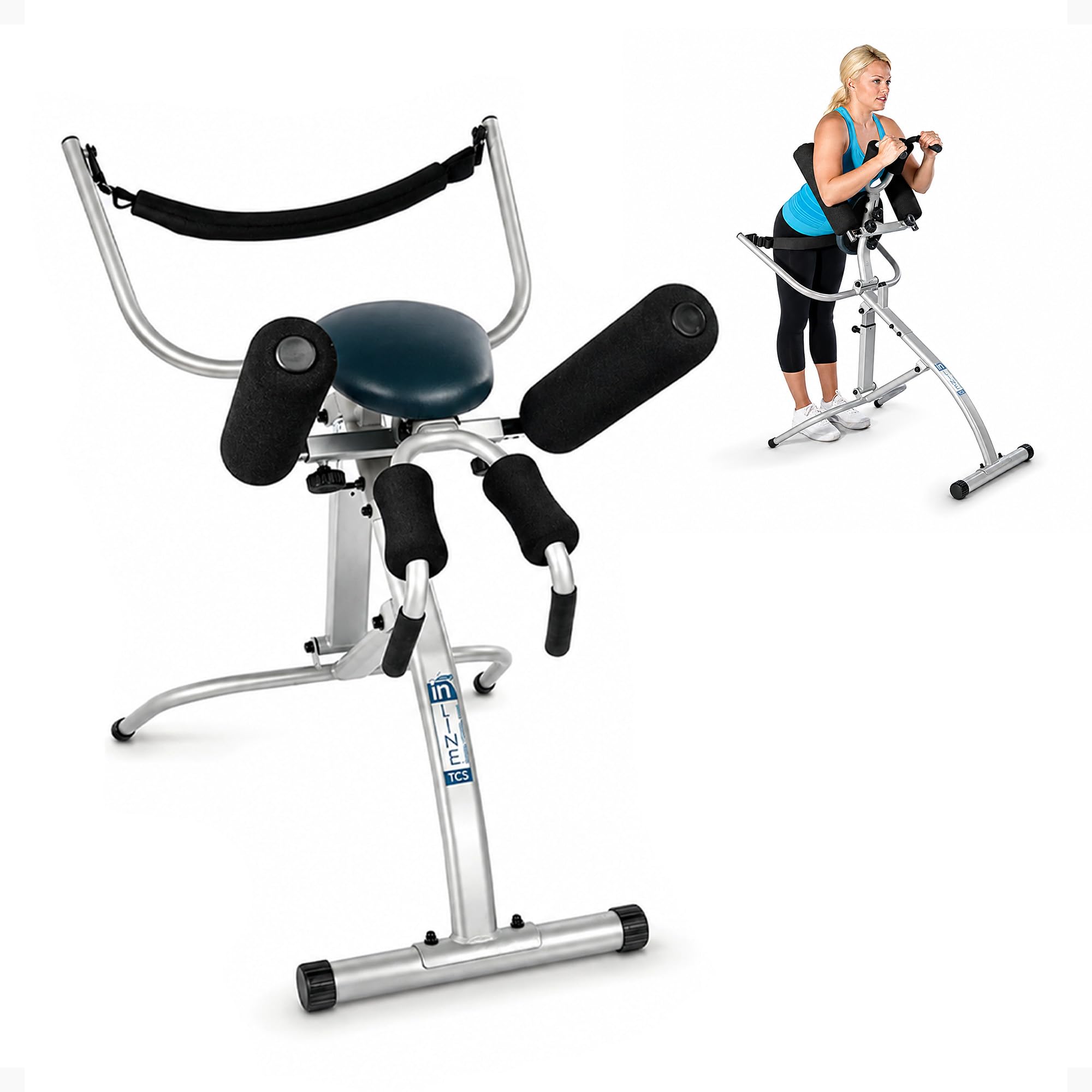
You kneel, hook your knees, and lean forward on a padded belt — no going upside down.
This is the decompression machine for anyone who cannot or will not hang vertically. You stand inside the frame, kneel on the pad, and lean forward against a padded lap belt lined up with your hips, supporting your weight across the knee and elbow positions. There is no inversion, so your blood pressure and balance stay where they are, and it builds from stainless steel with adjustable front and rear supports rated to 250 pounds. It weighs 29 pounds, which makes it one of the more movable pieces here.
The way it works is by height and reach, not by straps: you adjust the lap belt to your hip line, set the arm support width, and lean. That kneeling, flat-footed stance is also why it suits people who would rather not trust their ankles to a set of brackets. Long-time back-pain sufferers describe finally finding a method that targets the right spot after years of trying other approaches, and several note that the pull matches what they got from in-clinic decompression courses — which is exactly why so many owners rate its effectiveness at the top of their priority list.
Two honest limits. Second, the padded rollers that sit under your arms can press on the shoulder joint if you use it for upper-back work, so it is best aimed at the mid and lower back and eased into gradually. The belt adjustment takes some trial and error to dial in, but once set, a two-minute session twice a day is the common rhythm.
Why it holds up
- Flat-footed kneeling stance, so no inversion and no head rush
- Adjustable lap belt, arm supports, and knee pad let you target the exact height
- Stainless steel frame rated to 250 lb, weighs 29 lb
- Short two-minute sessions fit easily into a morning or evening routine
Keep in mind
- Works better for the thoracic and mid back than the lower lumbar area
- Rolling arm pads can press on the shoulder joint during upper-back work
- Belt height takes several tries to dial in correctly
Pick it when: inversion is off the table for you and you want a compact, steel-framed stretch you can step into and lean across.
Consider another route if: your pain sits specifically in the lower lumbar spine — owners say the mid-back responds most.
6. Homedics Fitness Stretching Mat

Six preprogrammed air-compression stretches you control from a handheld pad.
This HoMedics mat is aimed at people who want a guided routine rather than a piece of equipment to figure out. Pick from Twist, Flow, Energize, Stretch, Unwind, and Recover, then set one of three intensity levels and let the air cells work your spine while soothing heat settles in. The whole set runs on a programmed controller, so you alternate between programs with a button press instead of repositioning anything. It comes with a removable pillow for extra neck coverage.
Built for post-workout recovery and long days at a desk, it uses a rubber-coated bottom to grip nearly any surface, and the fold-away design with built-in straps makes it easy to carry or stash between sessions. The reviewer consensus is that the heating and the relaxation side land strongest — One buyer with chronic lower back and sciatica pain says three heated sessions on the top setting wiped out their pain for a full day, and another says the low-intensity Twist program loosens the upper back and neck. There is a two-year warranty behind it.
The trade-off is fit rather than function. The airbags sit under the shoulders for some body types, tilting the head back and hyperextending the neck, and a round neck pillow can help if that happens. It is also not a deep-traction device — this is a stretch-and-relax mat, so if your goal is serious cervical or lumbar pull you want one of the traction-specific machines instead.
Straight verdict: ideal for athletes and desk workers chasing recovery and mobility, less so if you need heavy decompression force.
Best fit: anyone who wants six ready-made stretch routines with heat and a padded pillow for after training or a long day.
Move on if: your neck or low back needs pulling tension, not air compression — this is a relaxation mat.
7. Posture Pump Model 4100-D Dual Deluxe
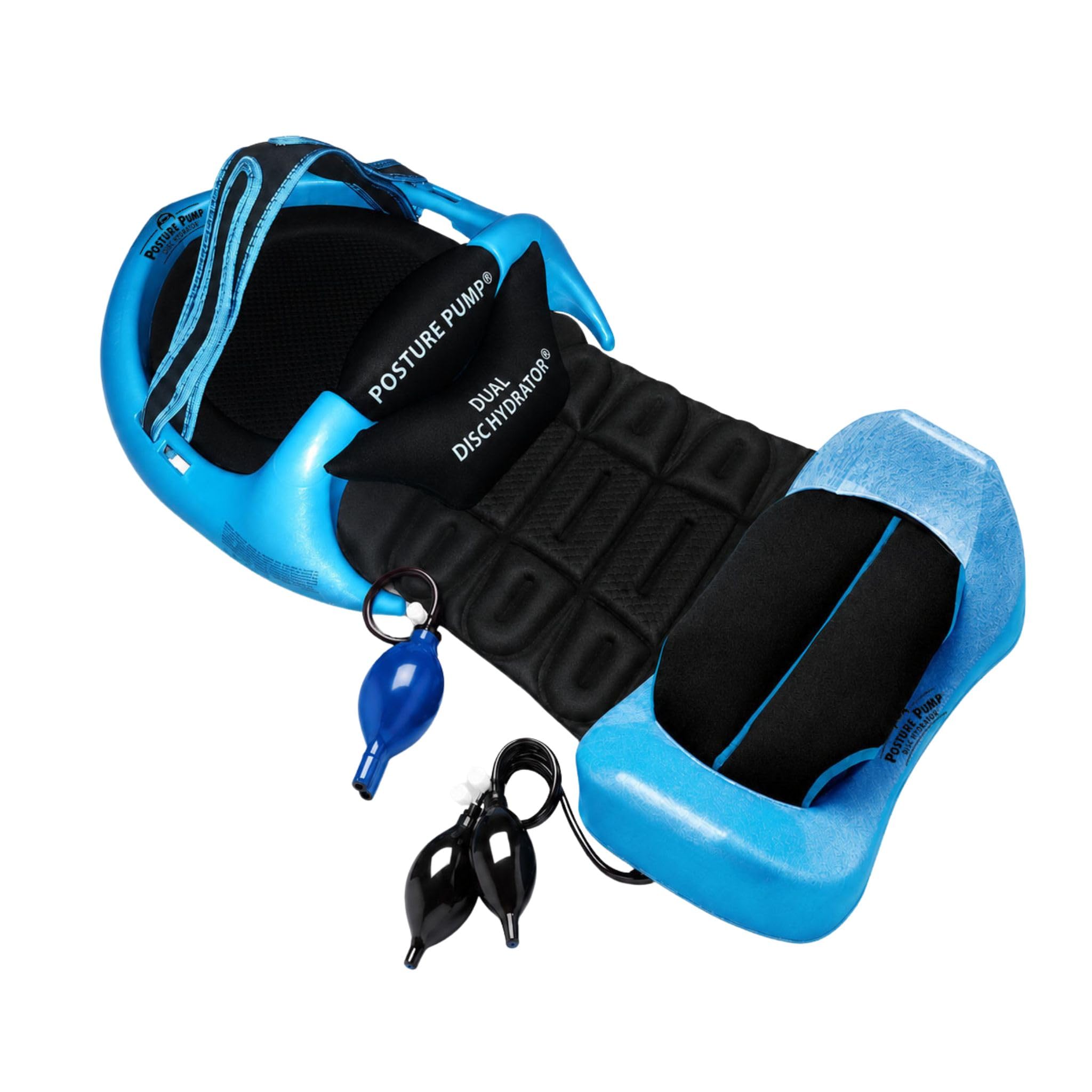
Neck unit plus lumbar rocker in one kit, with separate hand pumps for each section.
The 4100-D packages two Posture Pump pieces together: the Dual Disc Hydrator neck unit and the Elliptical Back Rocker lumbar unit, joined by a black Comfort Pad that cushions the upper back between them. That means one setup covers the whole spine, and you are not choosing between a neck device and a back device. One cervical hand pump and two lumbar hand pumps let you adjust the neck and lower-back sections independently, with white release buttons for controlled pressure drop.
The design is all about pushing vertebrae apart rather than bending you backward. One buyer with a thoracic bulging disc reports the best thoracic decompression they got came from a single 30-minute session, with the air pouches opening the vertebrae rather than arching the spine. Nothing needs assembling, and the adjustable Comfort Visor keeps your head placement steady. There is also a drawstring storage bag, and it is FSA/HSA eligible.
The honest caveat is that this is a manual, non-electronic device at a premium price, and buyers split on whether the materials feel worth it. It also takes patience to find the right placement, and the firm surfaces are uncomfortable for some users. Working with a physical therapist or chiropractor on your starting pressure and session length is the sensible path — start short and build toward the recommended stretch time rather than diving into a full session.
Great for: someone with both neck and lower-back problems who wants one manual kit covering the whole spine.
Skip if: you want fast, hands-off traction — this is a patient, pump-by-hand routine that rewards slow progress.
8. iSTIM WeTrac Cervical Neck Traction Device with Travel Bag

A wedge you lay your neck on and stretch by turning a cable knob.
The WeTrac swaps the usual air bulb for a cable crank, and that one change is the reason people who already own pump-style units reach for it. Cable traction holds its tension steadily instead of slowly bleeding off, so a ten-minute stretch stays a ten-minute stretch. Intensity is controllable up to 50 pounds, and you set the incline with adjustable neck wedges, giving you four angles to work from: 10°, 13°, 15°, and 18°. Your head has to be firmly seated before you turn the knob — the device does not build tension without weight on it.
It arrives ready to use with no assembly, and the carry bag makes it a genuine travel piece rather than a floor fixture. For desk-related neck stiffness, the pattern in the reviews is less pressure and better mobility after several sessions, and the strongest accounts come from users with compressed cervical discs causing arm and hand numbness — One buyer who paid more per physical therapy session than this device costs says the dial-and-release crank did the same job at home. It is made in Taiwan and is FSA/HSA eligible.
Two things to know before you buy. Release the tension slowly with both hands, holding the dial and the red button, so nothing jerks your neck. And at the steeper 15° and 18° settings the base can lift off the floor, so users anchor the handle with a weight — a 16 kg kettlebell comes up in the reviews. The recurring gripe is the tension gauge, which owners say is hard to read in low light and, on rare units, stops working entirely.
Where it shines
- Cable crank holds traction steady where pumps lose pressure over the session
- Four incline angles and up to 50 lb of controllable intensity
- No assembly, plus a carry bag for travel and office use
- Goal of 10 minutes, one to two times a day fits a busy schedule
The reality check
- Tension gauge is hard to read in dim light, and some units have arrived with it nonfunctional
- At steeper angles the base tips up and needs a weight to hold it down
- Tension must be released slowly with both hands to avoid a jerk
Right for you if: your problem is the neck and you want a light, portable device that holds tension during a short daily stretch.
Not the one if: your pain is in the lower back — the WeTrac is a cervical-only wedge.
9. Teeter DEX II Inversion Roman Chair
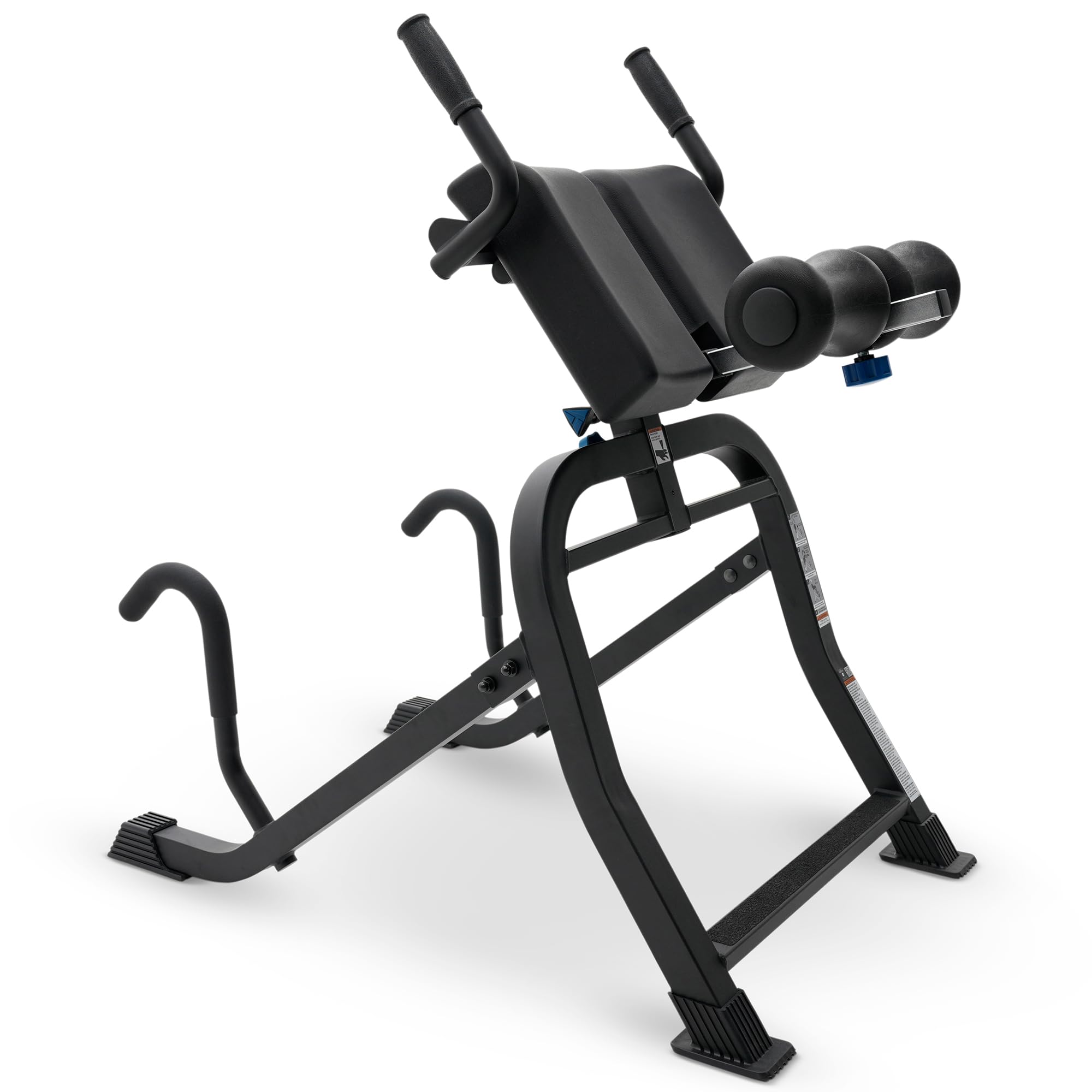
Hip-supported inversion that decompresses your spine without any pull on your ankles.
Instead of locking your ankles and flipping you over, the DEX II rotates you forward into what Teeter calls a 90/90 posture — hips supported, no load on the ankles. That is the clever part for anyone whose ankles or balance make a traditional inversion table a non-starter. It also doubles as an improved Roman chair for back extensions, with the design built to prevent over-extension and isolate the core by neutralizing the hamstrings. Traction grips and lower handles support rotation and stretching, and it opens up to push-ups, pull-ups, dips, crunches, and leg raises, or anchoring resistance bands.
The frame is commercial-grade alloy steel with a powder-coated finish, large stability feet, and a non-slip boarding step, rated for users up to 350 pounds and heights from 4’8″ to 6’6″. A high-density contoured foam lap cushion is spring-loaded to fit multiple users. It is FDA registered for back pain, herniated discs, sciatica, and spinal stenosis, and Teeter backs it with a five-year full warranty plus the free Teeter Move training app. Owners with severe spinal issues report more relief here than from institutional machines, and more than one review describes a vertebra popping back into place within the first minute.
What to weigh honestly: it wants functional strength and tolerance for being inverted, so it is not for someone who is deconditioned or unsteady. It is bulky and heavy, hard for shorter users to mount, and the lap cushion can press into the belly when standing back up, especially for taller users carrying weight around the middle. Assembly is required but buyers find it straightforward with the BILT app.
Bottom line: the most capable unit here for combined decompression and core training, with the widest weight and height range.
One caveat: it demands a base level of strength and mobility to mount and dismount safely.
Choose this if: you want ankle-free inversion plus a full core and back station, and you are strong enough to swing in and out.
Look at a mat if: you are deconditioned or have balance issues — the DEX II rewards mobility you already have.
Know the Specs
Target Area (Cervical vs Lumbar)
The single most important spec is which section of your spine a machine reaches. Cervical devices — a wedge, a visor-style unit, or a neck-only stretcher — pull the neck at a downward angle to open the space between vertebrae. Lumbar machines use a lap belt, hip cushion, or full-table inversion to decompress the lower back. Some full-spine kits, like the 4100-D, cover both with separate pumps. Match this column to where your pain actually sits before anything else, because no adjustment fixes the wrong target area.
Traction Method (Air, Cable, or Gravity)
How a device builds tension decides how the stretch feels. Air-inflation cells expand gently and let you control pressure by hand, which suits tender backs and slow sessions. A cable crank pulls directly and holds tension instead of losing it, which many users prefer for a steady ten-minute hold. Gravity inversion uses your own body weight, so the deeper the angle, the more pull — and the frame has to be rated high enough to hold you leaning or fully inverted without tipping.
Weight Capacity
Listed capacities run from 250 pounds up to 350 pounds on the frames here. This number signals both build strength and how much forward lean or inversion a unit tolerates safely. Buy a frame rated comfortably above your weight so your own body weight is not the thing the machine is straining against.
User Height Range
Machines state the heights they fit — from 4’8″ to 6’6″ on the DEX II, 4’10” to 6’6″ on the ITM5850, and 5’0″ to 6’2″ on the full-body mat. The range matters because cushions, ankle holders, headrests, and lap belts only align correctly inside that span. Outside it, a comfortable setup becomes a fight to position yourself.
Common Questions
What is the difference between a spinal decompression machine and an inversion table?
Will a decompression machine help a herniated disc or sciatica?
Should I choose a cervical or a lumbar decompression device?
How long does a decompression session take?
Do I need to assemble a home decompression machine?
Are these machines FSA or HSA eligible?
Can I use a decompression machine if I have high blood pressure?
What weight capacity do I need for a decompression machine?
Will a full-body massage mat decompress my spine the same as a traction machine?
How do I release tension safely on a cervical traction device?
The Bottom Line
For most people chasing a home spinal decompression machine, the winner is the Nitrofit Limber Pro — its sliding, lockable seat and 60-pound steel frame let you dial in a personal stretch from calves to lower back in one piece of equipment. If your pain lives in your neck, the Posture Pump 1400-D cools a hot cervical spine with its forehead visor and hand-controlled air cells, while the portable iSTIM WeTrac is the one to pack for travel. And for anyone who wants ankle-free inversion and a full core station, the Teeter DEX II reaches the highest weight and height range with the longest warranty behind it. Match the device to the section of spine that actually needs the pull, start short, and build slowly — that is what turns a home setup into a routine that lasts.
How we choose
We do not accept paid placement. Every pick is matched to a real buyer and a real use-case; we do not hands-on test units.
Sources
Specifications: manufacturer listings and product documentation. Review insights: verified customer reviews, as of October 2026. Pricing: not shown on this page (it changes often); check the current price via the retailer link.
As an Amazon Associate, Aappliancez earns from qualifying purchases. This does not affect which products we feature.