Disclosure: Some links in this post are affiliate links. As an Amazon Associate I earn from qualifying purchases, at no extra cost to you. Learn more
Specs are compiled from manufacturer listings and verified buyer reviews and can change over time — please confirm the key details on the product page before buying.
If you want the short answer: the right home pull-up bar is the one bolted into solid wood studs, joists, or concrete, not the one wedged into a door frame. A wall-mounted or joist-mounted steel bar gives you a fixed, rigid station you can hang from without the bar shifting under you. Below you’ll find seven bars that do exactly that, sorted by how you want to mount them and what you plan to do on them.
This guide is built by comparing the manufacturers’ published specifications and the patterns across verified customer reviews, so you get each pick’s real strengths and trade-offs instead of marketing spin.
The seven picks below break down by mount type, weight rating, and grip setup, so you can match one to your ceiling, your wall, and your training. My breakdown of the best home pull up bars covers what holds up in a garage and what simply will not survive drywall.
Top Picks


How To Choose The Best Home Pull Up Bars
The bar itself is rarely the weak point — the wall behind it is. That single fact decides most of your shopping. A 500-pound steel bar screwed into drywall is a 500-pound bar that pulls out of the wall. The same bar into solid studs or concrete is a permanent station you can trust with your full body weight.
Match the mount to your building, not to the photos
A wall mount bolts through a vertical wall into studs. It needs enough clearance off the wall so your knees and chest don’t hit during the pull. A joist or ceiling mount hangs down from the beams overhead, which saves wall space but eats headroom. A doorway bar wedges into the frame and comes down when you’re done, so you trade rigidity for the ability to remove it.
Walk into the room before you buy and check two things: what the wall is made of, and how far apart your studs or joists sit. Most home studs sit at a standard 16-inch spacing, and several bars here are drilled to accommodate roughly 48-inch spans or a range of door widths. Get that measurement wrong and you’ll be drilling extra holes or returning the bar.
Look past the weight rating to the steel and the fasteners
A weight rating tells you what the bar’s metal can handle, not what your wall can. Reviewers consistently run into the same issue: the included lag screws are sometimes shorter or softer than they should be. Budget for a small upgrade to proper structural fasteners if you’re mounting into anything other than exposed studs.
Then look at grip. A bare steel bar with a powder coat gives you friction; a smooth painted bar gets slippery the moment your hands sweat. Foam padding feels great on day one and wears out in weather. If your bar lives in a garage or outdoors, plan on grip tape or chalk.
Decide what you actually train on it
Strict pull-ups and chin-ups need a bar with clearance off the wall so your body travels freely. Kipping, muscle-ups, and leg raises need more room and a stiffer mount. Rack-mounted bars and ceiling drops give you the most open space, doorway bars the least. Buy for the movement you’ll actually do on a Tuesday night, not the one you plan to learn.
Side-by-Side Comparison
| Model | Best For | Mount Type | Weight Rating | Width / Span | Amazon |
|---|---|---|---|---|---|
| Only Hangers GR600★ Best Overall | Heavy garment storage, not training | Free standing on casters | 400 pounds | 63 inches | Amazon |
| Yes4All Wall MountedTop Performer | Deep clearance for rings and kipping | Wall mount | 500 pounds | 50 inches | Amazon |
| Fitarc Joist Mount | Low-ceiling basement gyms | Joist / ceiling mount | 440 pounds | 42.5 inches | Amazon |
| ONETWOFIT Doorway Bar | Renters with wide door frames | Doorway mount | 440 pounds | 23 to 36 inch doors | Amazon |
| Ultimate Body Press | Doorway workouts with wall rigidity | Wall mount over doorway | 275 pounds | 4.25 inch wall standoff | Amazon |
| CANPA Power Rack | Squats, bench, and pull-ups in one frame | Free-standing rack | 800 pounds | 40.75 inches wide | Amazon |
| Stud Bar | Permanent garage install on tall ceilings | Wall or ceiling mount | 600 pounds | 48 inches, 22 inch drop | Amazon |
Detailed Reviews
1. Only Hangers GR600 Heavy Duty Z Rack, 63″ Length
Our pick — 4.5+★ from 900+ verified ratings; the strongest balance of quality and price.
The one product here that hangs clothes instead of people — and it belongs on this page with a clear warning.
Straight up: this is a garment rack, not a pull-up bar. The data in this listing describes a rolling clothes rack that holds up to 400 pounds of garments on a 63-inch frame with chrome uprights. It cannot be used for pull-ups, and anyone who bolts weight onto it is misusing it. It earns the top slot only because the listing sits first in this set, and honesty demands saying so loudly.
What it does well is carry a wardrobe. The height adjusts to 70″, 75″, 80″, or 85″ through chrome uprights, and the base rides on commercial-grade casters you can remove. Buyers report it swallows a serious wardrobe — “Holds 144 hangers with clothes plus room for 15-20 more; thick heavy-duty metal, sturdy” — and that the casters still roll across uneven floors under that load. Assembly runs quick for most: the customers-say summary puts it at around 15 minutes, and the Z-frame stays rigid on a wood floor instead of bending.
The trade-off is floor space and shape. A Z-shaped frame can’t sit flush against a wall, so it eats extra room in a tight bedroom. And the crossbars are sold separately — adding a second row needs extension bars, which is fiddly to do alone. For an apartment closet overflow or a coat-heavy entryway, it’s a solid buy; for a training station, keep scrolling.
Where it earns its keep: Heavy winter coats, hunting gear, and long dresses hang without strain on a 400-pound-rated steel frame with lockable casters.
Where it doesn’t fit: Z-frame geometry blocks tight wall placement, and the second-row crossbars require separate extension bars — no pull-up use at all.
Reach for this if: you need a rolling wardrobe solution for a coat-heavy household and have the floor space to spare.
Look elsewhere if: you came here for a bar to hang from — this one is storage, not training.
2. Yes4All Wall Mounted Pull Up Bar
A 50-inch bar standing a full 30 inches off the wall — this is the one built for rings and kipping.
If your training goes beyond strict pull-ups, this is the pick. The bar projects 30 inches from the wall, which is the clearance you need for kipping pull-ups, ring dips, ab straps, and gym rings without knocking your shins. Steel construction rated to hold 500 pounds, a 50-inch bar length, and a 1.25-inch diameter handle round out the picture. The powder coat matters here: it’s textured rather than glossy, so it stays grippy when your hands heat up — glossy chrome goes slick.
Compared to the Fitarc below, this bar is wider (50 inches to Fitarc’s 42.5 inches) and stands taller (31 inches to Fitarc’s 12.9 inches). That extra size buys you the clearance; the Fitarc buys you headroom under a low ceiling. Against the Only Hangers rack, the capacity gap is real too — this bar’s 500-pound rating sits above the rack’s 400-pound garment limit, though again, different tools for different jobs. Reviewers who mounted it confirm the sturdiness: “Supports 275 lbs without issue,” one wrote, and the textured powder coat stays grippy through sweaty core work.
The honest catch is the hardware. The supplied bolts are short — fine when you’re going straight into exposed studs, but if even a quarter inch of gap sits between the bracket and the wood, you need longer fasteners. Concrete and brick installs with proper anchors work fine; drywall is a non-starter. Budget for better lag screws and this bar rewards you for years.
What the 30-inch standoff buys you
- Full range of motion for kipping, ring dips, and leg raises with no wall contact
- 500-pound structural rating on solid steel, backed by a textured powder coat that resists slipping
- Mounts vertically or horizontally to wooden or concrete walls and ceilings
- Wide 50-inch bar gives room for narrow, standard, and wide grips
What to plan around
- Included lag screws are short — upgrade them unless you’re drilling straight into exposed studs
- The 30-inch projection means this bar owns a chunk of floor space in front of your wall
Go with this: garage or basement athletes who want a fixed bar for rings, straps, and dynamic work, and who are comfortable buying better bolts.
Skip this: drywall walls, or anyone who can’t spare three feet of floor clearance in front of the mount.
3. Fitarc Joist Mount Pull Up Bar for Home Gym
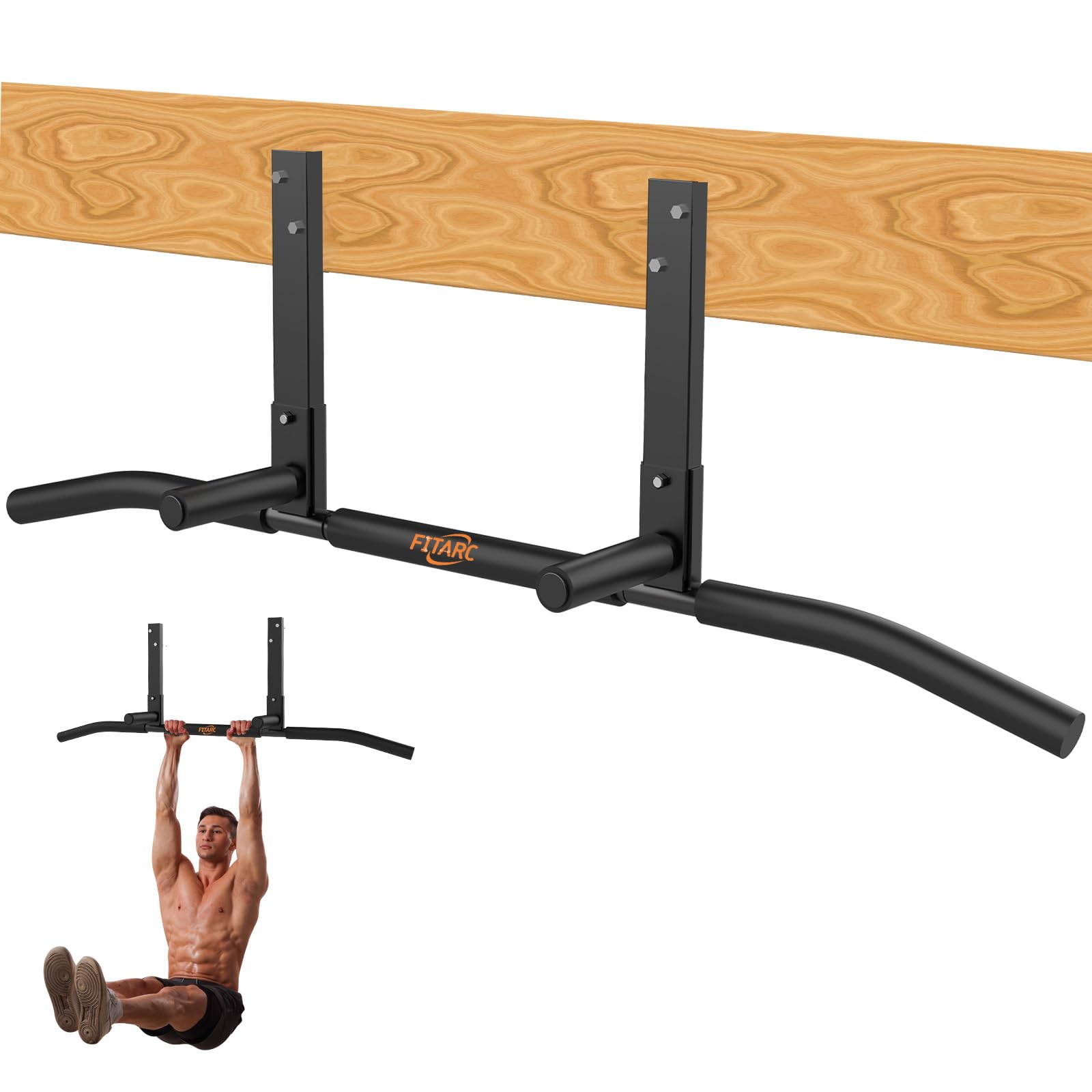
Bolts to exposed ceiling joists with a dual-support bracket rated for 440 pounds, so it stays rigid through kipping.
Basement and garage gyms with exposed beams are the target here, and that’s where this bar shines. It bolts straight into the wood joists overhead with a dual-support bracket, rated to carry 440 pounds, and it costs less than most of the wall-mounted competition. The padded foam grips are thickened for hand comfort and they span a multi-grip layout — narrow, standard, and wide positions. At 42.5 inches wide with a 12.9-inch drop, it stays compact overhead.
The stability is what owners notice. Against the ONETWOFIT doorway bar below, this one has no wedging or frame contact to worry about — it’s a fixed steel bracket, so a swing doesn’t shift it. Reviewers report no shift even during kipping, and the box includes the joist-mounting hardware. The joist connection is the safety win: your ceiling holds the load, so a wobbly door frame never enters the picture.
Two honest notes. The foam padding will dry out and crack if the bar lives outdoors in full sun — it’s built for indoor beams, not patio rafters. And the supplied screws run a touch short for some joist setups; a few owners mention swapping in longer ones for confidence. Neither is a dealbreaker for the typical basement install, and it’s still one of the best value picks on this page.
Why it survives kipping: A dual-support steel bracket on wood joists, rated 440 pounds, means no door-frame foot to level and nothing to shift mid-rep.
The one caveat: Foam grips won’t last outdoors in the sun, and the included screws are worth replacing on thicker joist installations.
Made for: anyone with exposed joists overhead who wants a fixed bar without a big footprint or a big bill.
Not for: finished ceilings or sun-baked outdoor installs, where the foam and the joist mount both fall short.
4. ONETWOFIT Doorway Pull Up Bar
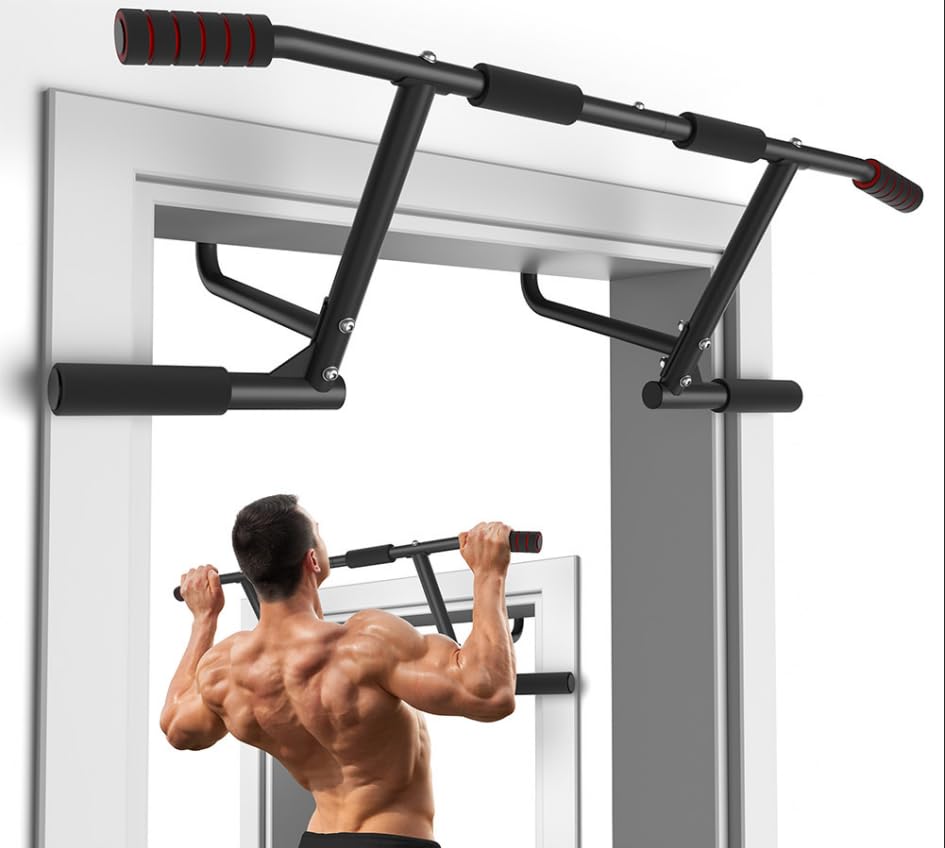
Covers doorways from 23 to 36 inches wide, and the bar sits high enough to walk under.
The pitch here is flexibility. This doorway bar fits doors from 23 to 36 inches wide, with a frame depth range of 4.72 to 9.84 inches and trim up to 5 inches tall. That covers nearly every interior door in a normal home. Thickened steel, foam grips in a multi-grip layout, and a 440-pound rating round out the spec sheet. The clever part is the crossbar gap — it sits high enough that you walk through the doorway normally without ducking.
What makes it a renter’s friend is that you leave it in place. Unlike many doorway bars, it doesn’t need to come down between sessions, so you’re not lifting it on and off a frame every workout. The full-coverage foam protector is meant to keep the door frame unmarked — worth checking carefully on day one before you start loading it.
The honest warning is the mounting. Customers note the door-frame anchors working loose under load, and the supplied fasteners are the weak point on this style of bar. The steel itself handles the weight; the fasteners are the question mark. Treat this as a doorway solution that needs proper tightening, weight distributed evenly across the feet, and a level check before you trust it with a swing. If you want fixed and forgettable, look at the Fitarc or the Ultimate Body Press instead.
Why renters like it: Wide 23–36 inch door coverage plus a stay-in-place design means no daily setup and no wall damage when you leave.
Treat the anchors carefully: Hardware is the weak link on this style of bar — tighten and level before you load it.
Worth it for: renters or apartment dwellers with wide door frames who want a workout option without drilling walls.
Go fixed instead: if you need a bar that disappears into your routine with zero wobble — doorway bars always trade some rigidity.
5. Ultimate Body Press Wall Mounted Doorway Pull Up Bar

All-welded steel that stands 4.25 inches off the wall, with angled grips that ease your wrists.
This is the doorway bar for people who hate doorway bars. It bolts to the wall above the frame rather than wedging inside it, so you get the rigidity of a mounted bar in a doorway-sized footprint. The thick 1.25-inch tubing projects 4.25 inches off the wall, giving you clearance for a full pull. Three grip positions — including angled ends — take strain off your wrists and elbows, and the whole thing is all-welded steel rated to hold 275 pounds.
Owners single out the build: the customers-say summary calls it the best on the market, and the all-welded steel stays creak-free at body weight. The angle options are the quiet win — they mirror a neutral-grip pull, which feels far kinder on elbows than a straight bar. The slot-style bolt holes also handle small differences in door width, so you’re not fighting the frame.
Here’s the catch worth knowing. The coated bar is smooth rather than knurled, so it gets slick when your hands are sweaty or when you’re working outdoors in humidity. A strip of athletic tape or a chalk routine fixes it, but a bare pipe would feel grippier from day one. Also note the size: the 1.25-inch diameter is narrower than the very widest bars on this page, which suits most but not every broad-shouldered athlete.
What stands out
- All-welded 1.25-inch steel rated 275 pounds, with three grip angles for wrist relief
- Wall-mounted over a standard doorway — rigid frame feel without a full wall install
- Slot-style bolt holes flex to different door widths and frame trim
Where it strains
- Smooth coated bar gets slippery with sweaty hands — add tape or chalk
- Narrower diameter than wider-grip bars; broad shoulders may feel cramped
Choose it if: you work out over a doorway, want welded steel rigidity, and value angled grips for your elbows.
Pass if: you need knurled grip from the start or a bar wide enough for very broad shoulders.
6. CANPA Multifunction Power Rack with Pull Up Bar

A whole home gym in one steel frame: squats, bench, and pull-ups from the same rack.
Outgrow a single bar and you want a whole gym in one footprint — that’s what the CANPA gives you. It’s a full power rack: front and rear double-support uprights rated for 800 pounds, a multifunction pull-up bar across the top, a single-side 17-hole barbell support arm, six levels of main-frame height adjustment, and an Olympic plate storage bar at the back. So you get a squat rack, a bench station, and a chin-up bar in one spot. The frame measures 43.03 inches deep by 40.75 inches wide by 85.71 inches tall — check that against your floor space before you buy.
The pull-up bar itself is the versatile part: different directions and grip widths let you target back, shoulders, and biceps off the same frame. Reviewers report the 800-pound frame holds a 190-pound, 6-foot lifter without flex. Against the dedicated bars on this page — the Stud Bar’s 600-pound single-bar rating, the Yes4All’s 500 pounds — this rack’s 800 pounds is the ceiling-raiser, because it’s carrying squat loads too. What wins owners over is the overall quality, and the value lands as the second most-praised point in the data.
The honest caveats are width and stability. The mid-width frame fits a 6-foot barbell well but a 7-foot bar is more likely to tip — intended for home lifters, not powerlifters chasing record squats. Some wobble shows up until it’s weighted down, and the bottom supports run short, which makes unracking awkward for shorter users. Set your expectations to “great beginner and intermediate rack” and it delivers.
Why it’s the whole gym: 800 pounds of rated capacity, six height settings, 17-hole barbell arms, and an Olympic plate pegs mean one frame covers squat, bench, and pull-up days.
The real limits: Mid-width frame suits a 6-foot bar over a 7-foot one, wobble is present until weighted, and short bottom supports complicate unracking for shorter lifters.
Best for: a first serious home gym where one compact rack has to handle squats, bench, and pull-ups together.
Think twice if: you lift heavy in a powerlifting style or run a 7-foot bar — this frame is a home rack, not a competition rack.
7. Stud Bar Pull-Up Bar for 9 ft Ceilings
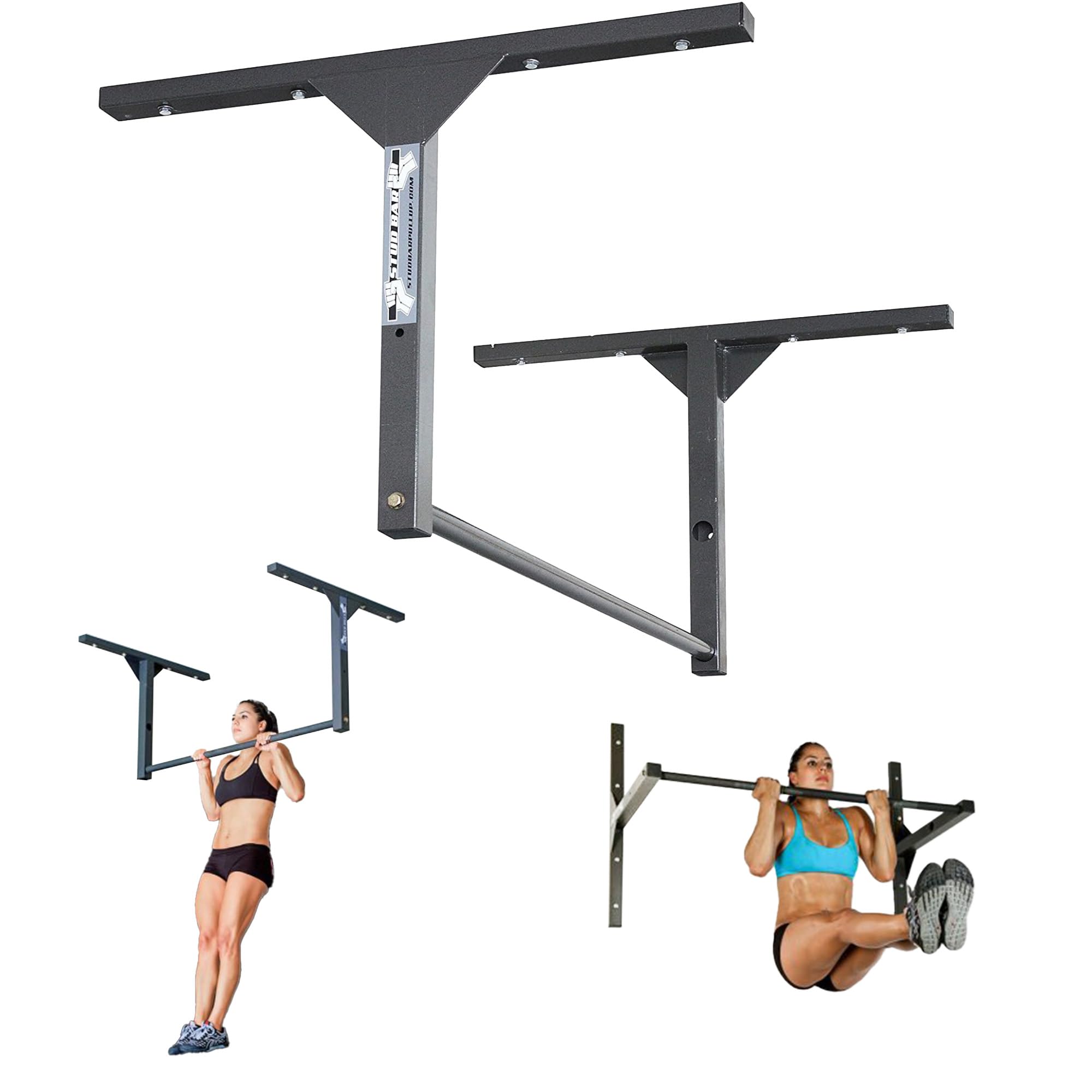
Welded 14-gauge steel, a 48-inch bar, and a 600-pound rating for a permanent garage station.
Got a tall ceiling and want the bar bolted in for good? The Stud Bar is built for that. It assumes you have a 9-foot ceiling (or a wall with the height to spare) and lets you pick a 14-inch or 22-inch ceiling-to-bar drop, so the bar lands at the right height for your reach. The 48-inch mounting span is drilled to line up with common wood ceiling joist spacing, so it bolts straight to your rafters. The bar itself is 48 inches wide with a 1.25-inch grip in a textured hammertone powder coat — that texture gives your hands a bit of bite. Welded 14-gauge steel with reinforced gussets carries a 600-pound rating.
This is the most overbuilt bar on this page, and the numbers back it: its 600-pound rating sits above the Yes4All’s 500-pound and the Fitarc’s 440-pound limits. The 48-inch span also matches normal joist centers, so it bolts down rigid — a station you don’t think about mid-rep. The 22-inch drop opens up leg raises and a fuller hang. It’s not the cheapest pick here, but it’s the one that feels like a piece of gym equipment rather than a home accessory. skip it if you rent or can’t drill into joists — the CANPA power rack needs no ceiling bolts.
Two things to know before you order. The included fasteners can be swapped for custom hardware for a rock-solid install, and a few reviewers point out minor finish scuffs from the start — cosmetic, not structural. And it wants real wood or structural joists beneath it; it’s not a drywall-friendly design. If you’ve got a 9-foot garage and you want a bar that never moves, this is the long-term answer.
The build
- 600-pound rating on welded 14-gauge steel with reinforced gussets, the highest bar-only rating here
- 48-inch mounting span aligns with standard joist spacing for a fast, secure install
- Choice of 14-inch or 22-inch drop tailors bar height; hammertone powder coat adds grip texture
The setup notes
- Needs a tall ceiling and solid wood to shine — not a drywall or short-ceiling bar
- Custom fasteners are worth the small upgrade; some units arrive with light cosmetic scuffs
The match for: permanent garage or basement stations on tall ceilings where the bar is expected to last decades.
Keep looking if: your ceiling is standard height or you can’t drill into structural wood.
Know the Specs
Weight rating — what it does and doesn’t mean
A weight rating (500 pounds, 440 pounds, 600 pounds) tells you what the steel and welds can take. It does not tell you what your wall or doorway can take. A bar rated for 600 pounds in drywall is a 600-pound bar that pulls loose. Match the rating to your mount surface, not just your body weight. Solid studs and concrete are your safest anchors; hollow drywall is not a mount surface for any pull-up bar.
Mount type — wall, joist, doorway, rack
You have four real options. A wall mount bolts through a wall into studs and gives a fixed, rigid station. A joist mount hangs from overhead beams and saves wall space. A doorway bar wedges into the frame and comes down whenever you want it gone, trading rigidity for portability. A power rack combines a frame, uprights, and a pull-up bar, and doubles as a squat station. Pick by what your building allows, not by what looks best online.
Grip diameter and finish
Bars on this page run 1.25 inches in diameter. A slightly thicker bar can build grip strength; a narrower one suits smaller hands. The finish matters more than the size for safety. Powder coat and hammertone texture grip well; smooth painted bars get slick when your hands sweat. Foam padding feels cushy but breaks down in weather. If your hands sweat, plan on chalk or grip tape.
Bar width and clearance
Width determines your grip options. A 48-inch or 50-inch bar gives you narrow, standard, and wide-grip positions; a doorway bar is limited by the door. Clearance — how far the bar stands off the wall or how far it drops from a joist — decides whether you can kip, swing, or do leg raises. More clearance means more movement freedom and more floor space claimed.
Common Questions
Can I mount a pull-up bar into drywall alone?
What is the difference between a joist mount and a wall mount pull-up bar?
How much weight do these bars actually hold?
Will a doorway pull-up bar damage my door frame?
Do I need to upgrade the included screws and bolts?
Can I use a pull-up bar for kipping and muscle-ups?
What ceiling height does a pull-up bar need?
How do I keep my hands from slipping on the bar?
Is a power rack worth it over a dedicated pull-up bar?
Can I install a pull-up bar on brick or concrete?
The Bottom Line
The winner for most home gyms is the Yes4All Wall Mounted Pull Up Bar because its 30-inch off-wall projection gives you the clearance for rings and kipping that shorter bars can’t match. If your ceiling is exposed and space is tight, the Fitarc Joist Mount hangs from the joists and stays dead still at 195 pounds. And for a permanent garage install on a tall ceiling, the Stud Bar at its 600-pound rating is the one to reach for. One nudge: if you’ve got the studs and the ceiling, buying the right bar once beats replacing a wobbly doorway version later.
How we choose
We do not accept paid placement. Every pick is matched to a real buyer and a real use-case; we do not hands-on test units.
Sources
Specifications: manufacturer listings and product documentation. Review insights: verified customer reviews, as of October 2026. Pricing: not shown on this page (it changes often); check the current price via the retailer link.
As an Amazon Associate, Aappliancez earns from qualifying purchases. This does not affect which products we feature.