Disclosure: Some links in this post are affiliate links. As an Amazon Associate I earn from qualifying purchases, at no extra cost to you. Learn more
Specs are compiled from manufacturer listings and verified buyer reviews and can change over time — please confirm the key details on the product page before buying.
If you want a heart rhythm reading at home without booking an appointment, the device that does it best is the KardiaMobile — but only if you understand what a single-lead strip can and cannot tell you. That is the whole game with a home EKG. These gadgets read rhythm, they read rate, and they catch things like AFib and other irregular patterns. They do not diagnose a heart attack, and no listing that calls itself a medical-grade EKG changes that. Below you get ten real devices sorted by what they actually do well, so you can match one to your situation instead of guessing.
This guide is built by comparing the manufacturers’ published specifications and the patterns across verified customer reviews, so you get each pick’s real strengths and trade-offs instead of marketing spin.
A rhythm strip is only as useful as the lead count and the app behind it, so the picks below split into single-lead finger pads, three-lead handhelds, straps, and cuff units that watch rhythm while they take blood pressure. Each one earns its place for a different reason, and the differences are sharp: some take a 30-second reading, some run a 48-hour recording, and some are really blood pressure monitors that flag an irregular beat. Read the pick that matches your own routine and you will land on the right home ekg device.
Top Picks


How To Choose The Best Home EKG Device
Pick by the question you are trying to answer, not by the longest feature list. If you feel a flutter now and then and want a strip in hand for your doctor, a finger-pad single-lead device covers it. If you need a record of a whole day, you need a strap that records on its own. Those two jobs need different hardware, and buying the wrong shape is the mistake that sends most people back to the return page.
Lead count sets the ceiling on what you can see
A lead is one electrical viewpoint of your heart. A single-lead device gives you one viewpoint, which is plenty for rhythm and rate but limited for anything structural. A three-lead handheld gives you more angles of the same beat, so the strip is fuller. Neither replaces a twelve-lead clinic EKG, and no home unit here claims to. Know which you are buying before you rely on the reading.
Reading time: spot check versus continuous wear
A spot-check unit records while your fingers sit on the pads, typically around 30 seconds. That is perfect for “what is happening right now?” A continuous strap runs for hours and days so it can catch an event that happens while you sleep or mid-workout. If your irregular beats are rare and brief, the continuous option is the one that will actually catch them.
What a subscription does and does not change
The hardware reads your heart either way. A paid tier usually decides how many past readings you can keep and whether reports move to a cloud account. A device with on-board storage holds a set number of readings without any app at all. Check that number if you plan to keep a running log for a cardiologist, because a free tier that stores only the latest reading is not a log.
Positioning is a skill the device cannot do for you
Finger pads need steady, dry skin contact for the full recording. Chest straps need to sit snug and be dampened before they read cleanly. Cuffs need to sit on bare skin at the right spot. Every device here rewards a few practice runs, and most complaints about “wrong” readings trace back to placement rather than a broken sensor.
Side-by-Side Comparison
| Model | Best For | Type | Recording Time | Storage / App | Amazon |
|---|---|---|---|---|---|
| KardiaMobile 1-Lead★ Best Overall | Most people who want a quick rhythm strip | 1-lead finger pads | 30 seconds | App; free tier stores last reading | Amazon |
| CONTEC PM10Budget Entry | Budget buyers who want a screen and PC output | Handheld with display | Short single recording | Cloud via Bluetooth app | Amazon |
| Wellue BP2ABest Combo | Blood pressure plus a rhythm check in one | Upper-arm cuff with ECG | 30-second BP reading | On-device 50 readings; Vihealth app | Amazon |
| OVIIN Heart Rate Monitor | Pocket-sized spot checks on a budget | Contact pad with OLED | 30 seconds or 5 minutes | App records and shares | Amazon |
| Beurer ME75 | A fuller 3-lead strip at home | 3-lead handheld | Under 30 seconds | 100 readings on device; optional app | Amazon |
| Polar H9 | Training heart rate, not rhythm diagnosis | Chest strap sensor | Continuous while worn | Polar Beat app; 400-hour battery | Amazon |
| HaSoCare EKG Monitor | Phone and PC sharing with no subscription | Handheld with LCD | 30 seconds | LCD storage; Bluetooth or cable | Amazon |
| OMRON Gold BP5360 | Blood pressure with AFib screening built in | Upper-arm cuff | 30-second BP reading | Omron connect app; 2 users | Amazon |
| Withings BPM Connect | Connected health tracking with auto-sync | Upper-arm cuff | 30-second BP reading | Wi-Fi and Bluetooth to Health Mate | Amazon |
| Biotricity Bioheart | All-day continuous rhythm recording | Chest strap, 3-channel | 48-hour battery | App with PDF reports | Amazon |
Detailed Reviews
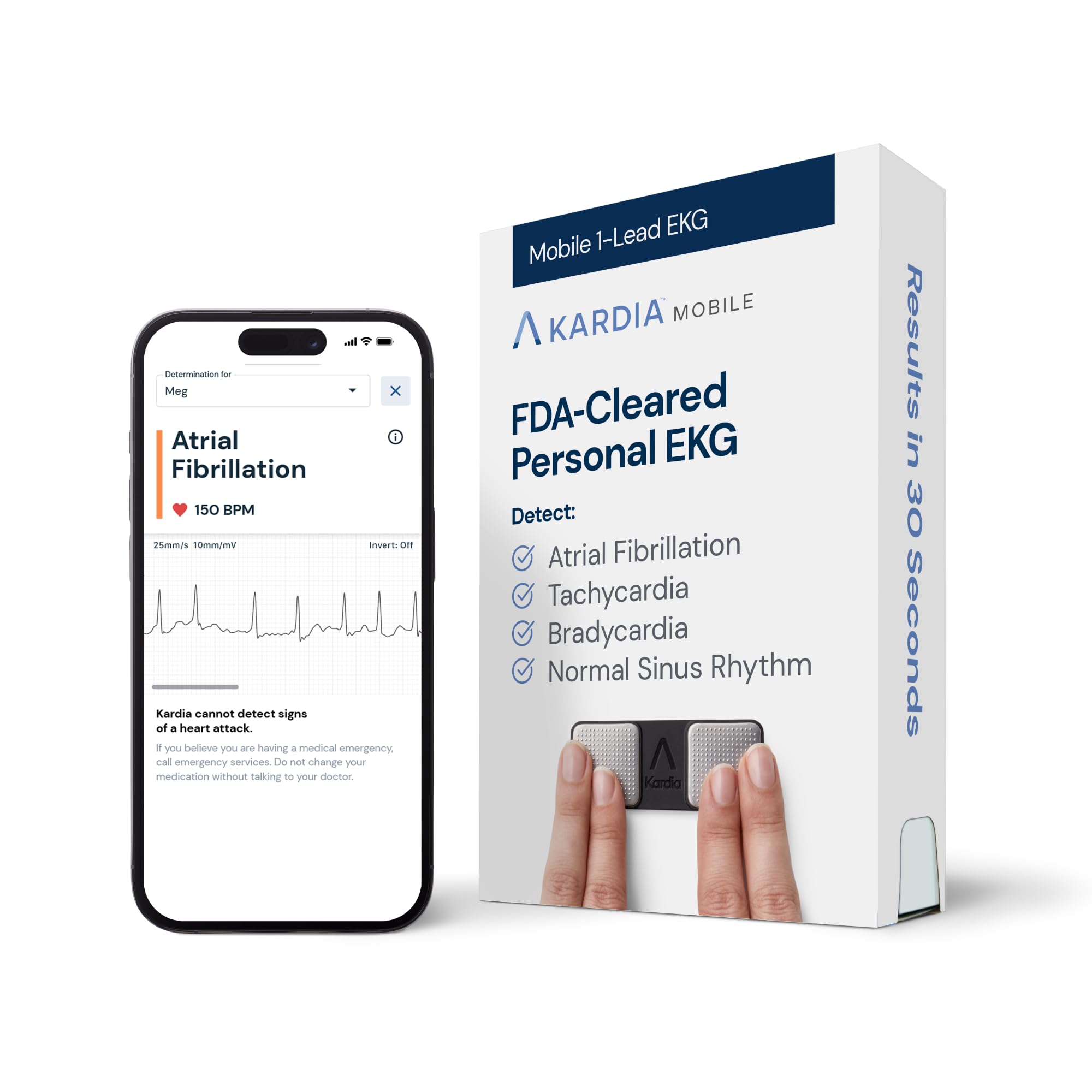
1. KardiaMobile 1-Lead EKG Monitor
Our pick — 4.0+★ from 83,500+ verified ratings; the strongest balance of quality and price.
Two finger pads, thirty seconds, and a rhythm strip on the phone you already own.
This is the pick most people should start with. You rest two fingers on the silver pads, wait half a minute, and the app tells you whether your rhythm reads normal or flags something to discuss. No Bluetooth pairing ritual, no Wi-Fi setup, no cable to a computer — the pads do the work and the phone captures the result. That simplicity helps explain its 4.0+ stars across 83,000+ ratings, the largest review base on this list.
The hardware itself is tiny: a 0.96-inch display area in a body 3.28 inches long and 1.25 inches wide, weighing about as much as a couple of coins. It runs on a lithium-ion battery rated for 12 months, so you are not hunting for a charge cable. The 30-second readout is the number to remember — it is a spot check, not a recording, which suits anyone who wants to capture a flutter the moment it happens.
Where the picture gets complicated is the app. Listing copy promises “no subscription,” and the device genuinely needs none to record. But the free tier keeps only your last reading, and multiple saved readings sit behind a premium plan. Buyers also note that the first EKG takes roughly 24 hours for medical review before it open up, and that readings can come back unclassified at higher heart rates. Neither is a defect — it is how the clearance process works — but plan for it so the first session does not surprise you.
What the finger pads get right
- A complete rhythm reading in 30 seconds with no pairing, cords, or Wi-Fi.
- Pocket-sized body you can carry and use anywhere your phone goes.
- 12-month battery life means it is ready when you reach for it.
- Strips pull up in the app and send cleanly to a cardiologist.
Where it asks more of you
- Free app keeps only the latest reading; a bigger history needs the premium plan.
- First reading holds about 24 hours for medical review before it open up.
- Single lead reads rhythm and rate only — it cannot rule out a heart attack.
- Needs steady, dry finger contact for a clean strip.
Made for: anyone who wants a fast, trustworthy rhythm check at home and already carries a smartphone.
Worth knowing: the free app is a snapshot tool, so a running log for your doctor means paying for the tier — budget for that in your head before you buy.
2. CONTEC Portable ECG/EKG Monitor PM10
A screen on the device itself, so you can read a beat without reaching for your phone.
Start with the hardware, because it is unusually complete for an entry-level unit. The 1.77-inch color TFT-LCD screen is a real display you can look at directly, and the whole thing weighs 2.08 ounces — light enough to forget in a bag. That is a 4.1x gap against the 8.47-ounce Wellue below, and the display is larger than the KardiaMobile’s 0.96-inch panel. It also runs a rechargeable lithium battery rated for up to 500 measurements on a full charge, with an IP22 splash rating for accidental drips.
Under the shell it is more instrument than toy. Sampling runs at 250 dots per second, the heart rate range covers 30 to 300 bpm with a ±1 bpm error, and the noise floor sits at ≤30μV with a ≥60 dB CMRR — the measure of how well it ignores interference. The most useful detail for a fast check is that it only takes a 6-second recording, so a reading is nearly instant compared with the 30-second pads elsewhere on this list.
The honest catch is ease of use for anyone who is not tech-comfortable. The manual draws complaints for being thin on guidance, the software download for PC can be fiddly, and results have been called inconsistent by buyers who saw more artifact than they wanted. This is a device for someone willing to learn it and re-run a reading when the first looks noisy — not a one-tap gadget for a grandparent.
Screen-first thinking: the on-body display means you get a beat reading without fishing out a phone, which is the practical difference here.
Second read: expect to re-run strips to get a clean trace, and reach for the manual’s diagrams before judging the device.
Go this way if: you want a budget screen unit you can learn and keep on the shelf.
Think twice if: you need a device you can hand to someone who wants zero learning curve.
3. Wellue Bluetooth Blood Pressure Monitor BP2A
A cuff that reads blood pressure and records a rhythm strip in the same sitting.
This is the two-for-one option. The upper-arm cuff covers 22 to 42 cm — listed as 8.6 to 16.5 inches — and the machine also records ECG, so a single session gives you pressure and rhythm together. The OLED screen shows your result, and one press returns a blood pressure reading in 30 seconds. On board it stores the last 50 BP readings, and the free Vihealth app takes over beyond that.
The size math tells you what you are handling. The unit measures 5.9 inches long, 1.9 wide, and 1.8 tall at 8.47 ounces, which is the largest and heaviest device in the hand-held group here. That bulk buys you the cuff and the rechargeable battery, rated for 3 months of typical use per charge — so no disposable cells to buy. Quality is the thing that wins people over in the review pages, with ease of use right behind it.
Two honest notes before you commit. A cuff that starts too tight throws high readings, so loosen it first and tighten slowly — that single habit fixes most accuracy gripes. And if you rely on the ECG side, the sensor needs full skin contact, and the app has no share option for ECG strips the way it does for the BP reports. On warranty, one buyer’s unit stopped charging after six months and the maker replaced it under the one-year warranty after emailed proof of purchase.
Two readings, one session
- Blood pressure and ECG recording from one upper-arm device.
- Rechargeable battery rated for 3 months of typical use.
- 50 readings stored on the machine, unlimited in the free app.
- Wide cuff span fits a large range of adult arm sizes.
Where the combo adds friction
- Bigger and heavier than a pad-only EKG; less pocket-friendly.
- ECG strips cannot be shared through the app the way BP reports can.
- Cuff tightness has to be right or readings skew high.
Pairs well with: a household watching both blood pressure and rhythm, where one device should do both jobs.
Set expectations: the cuff and the ECG sensor each need careful placement, so give yourself a few practice rounds before trusting a reading.
4. OVIIN Portable Heart Rate Monitor

A tiny white pad that starts recording the second your fingers touch it.
There is no power button on this one — you just grab the pads and it starts. You can record in three ways (hand, ankle, or chest), the OLED screen is right on the device so you can watch a rhythm without the phone, and a full charge is rated for 500 uses. It weighs in at a stated 27.22 g, which puts it firmly in pocket territory.
The readings run either 30 seconds for a quick check or 5 minutes for a longer strip, and the app logs each one so you can send it to your doctor. For anyone juggling a tight schedule, that longer option matters — a five-minute recording gives a fuller picture of how your beat behaves across a stretch rather than in a single 30-second slice, and it downloads as a report you can hand over.
Two quirks to know. If the app was already open when you record, you may need to close and reopen it so the data pulls across. And on the view settings, you cannot lock 12.5 mm/sec as the default speed, though there is a quick toggle among three options. Both are small app habits, not device faults.
What it earns its place on: a grab-and-go pad with an OLED readout and 500-use battery rating, built for frequent short checks.
The one that got away: a rare unit has arrived not holding a charge — treat that as an outlier, not the pattern, but keep your receipt while you test the first week.
Suits you if: you want a pocket pad that starts on touch and gives both a quick 30-second check and a 5-minute strip.
Not your tool if: you need the full 10-second-plus familiar interface of a bigger named brand with more support behind it.
5. Beurer Cardio Companion EKG Monitor ME75
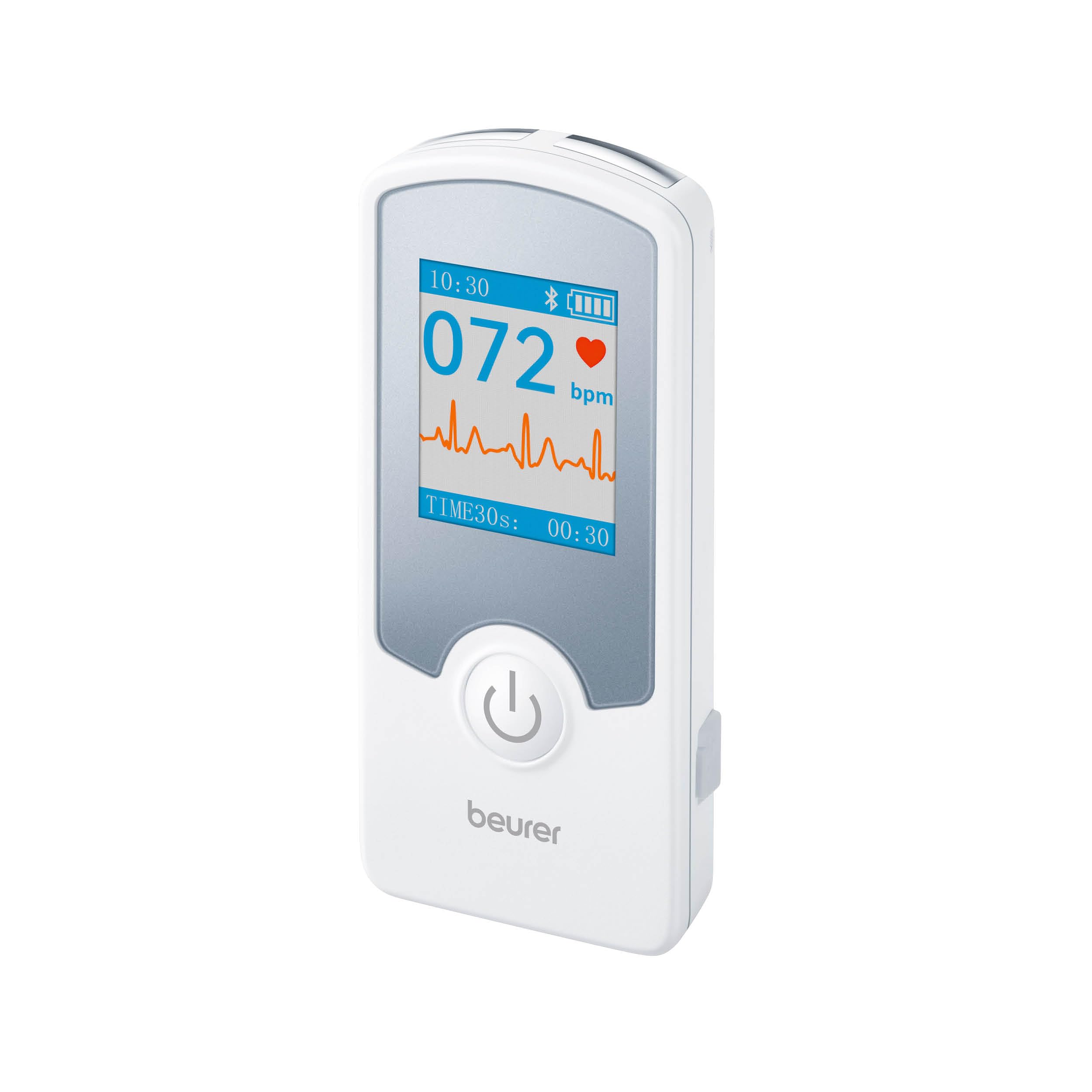
Three leads in a device the size of a small remote, with readings kept on board.
If a single lead feels too thin, this is the step up. The ME75 is a 3-lead handheld that measures rhythm in under 30 seconds and shows the result on a bright color display. It sits third among the compact picks on price but gives you the fuller electrical picture that a one-lead device cannot — a real difference if your doctor wants more of the beat than a single viewpoint.
Storage is the quiet strength. It holds up to 100 readings on the device itself, so the app is genuinely optional rather than required. That suits anyone who does not want a phone in the loop every time. When you do connect, the free app via Bluetooth keeps unlimited readings and tracks trends over time. It is also rechargeable over USB-B, so no disposable battery to source.
The trade-offs are real but narrow. Holding it hand-to-hand takes some fumbling because the sensors sit at each end, and a few buyers find the single strip does not run very long. It also will not suit anyone with a pacemaker, metal implant, or other electrical implant — that is a hard line, not a preference. It is German-engineered and FDA-cleared, but its short strip length is the spec to weigh if you want long recordings.
The 3-lead advantage
- Three leads give a fuller rhythm view than a single-lead pad.
- Holds 100 readings without any app at all.
- Rechargeable battery over USB-B; no cells to buy.
- Four measurement positions: hand-to-hand, hand-to-wrist, leg, and chest.
Where it narrows the field
- Sensors at each end make hand-to-hand placement a little awkward.
- Not suitable for anyone with a pacemaker or electrical implant.
- Individual strips run short compared with continuous wear.
Wins with: anyone who wants a fuller 3-lead strip and on-board storage without a mandatory app.
Check first: if you carry a pacemaker or other electrical implant, this device is off the table by design.
6. Polar H9 Heart Rate Sensor

A chest strap built for workouts and training zones, not for rhythm diagnosis.
Be clear on what this is before you compare it to the pads above. The H9 is a heart rate sensor — it tells you how hard your heart is working in beats per minute, which is exactly what you need for training zones, intervals, and calorie tracking. It is not an EKG strip device, so it will not flag AFib. If your goal is a workout, this is a proven workhorse. If your goal is a rhythm record for a doctor, look at the pads.
Battery life is where it shines: the CR2025 button cell is rated for 400 hours, which at a few sessions a week runs far longer than a season of training. It wears on a soft strap with two size ranges — XS-S covers 20 to 26 inches, and M-XXL covers 26 to 36 inches. The sensor measures a stated 60 g and works with ANT+ and Bluetooth, so it pairs with Garmin watches, phones, and gym equipment.
The honest caveat is reliability in the field. Some long-term users get flawless sessions year after year; others hit mid-run dropouts or spikes, often traced to pairing across too many devices at once or a strap that needs wetting before it reads. The fix is usually dampening the electrodes and connecting to one device at a time. If you want a sensor that simply works, know the strap chemistry matters as much as the electronics.
Training-first design: a 400-hour cell and dual ANT+/Bluetooth make it a natural for anyone with a Garmin or a gym console.
Read the fine print: it tracks heart rate, not rhythm — no AFib detection here, and it needs a damp strap to read cleanly.
Reach for this if: you train hard and want a chest strap that talks to your watch and equipment.
Pass if: you specifically need an irregular-rhythm strip to show a doctor — that is a different device class.
7. HaSoCare EKG Monitor Device

Records on the device and moves to a phone or a computer, with no monthly fee.
This one is aimed squarely at the buyer who hates subscriptions. It records ECG data, shows it on an LCD screen, stores readings, and moves them out over Bluetooth to a phone or a cable to a computer — and none of that needs a paid tier. Three positions cover the reading: hand-to-hand, hand-to-chest, and hand-to-leg, so you can take a few angles and pick the cleanest strip to share with a doctor.
Portability is the other draw. It weighs about 60 g, and the compact body slides into a bag or pocket so the readings can travel with you. Ease of use leads the review conversation, matched by how effective people find it for a quick check, and the app connects to Android over Bluetooth without drama and moves data across smoothly.
The catch is consistency. A few buyers report a reading that does not repeat from one run to the next, and long two-handed sessions can get tiring for your wrists. Treat this as a spot-check device where you sit still and hold a steady grip, and re-run if a strip looks off. For the price range, it is a fair trade — just go in expecting to practice the hold.
The no-fee angle: on-device storage plus phone and PC transfer means the sharing workflow never sits behind a paywall.
The patience tax: expect to re-run a reading now and then, and keep sessions short so your hands stay steady.
Built for: budget-conscious buyers who want readings stored, shared, and free of any subscription.
Look elsewhere if: you want a reading that locks in first try every single time — this one rewards a little practice.
8. OMRON Gold Blood Pressure Monitor BP5360
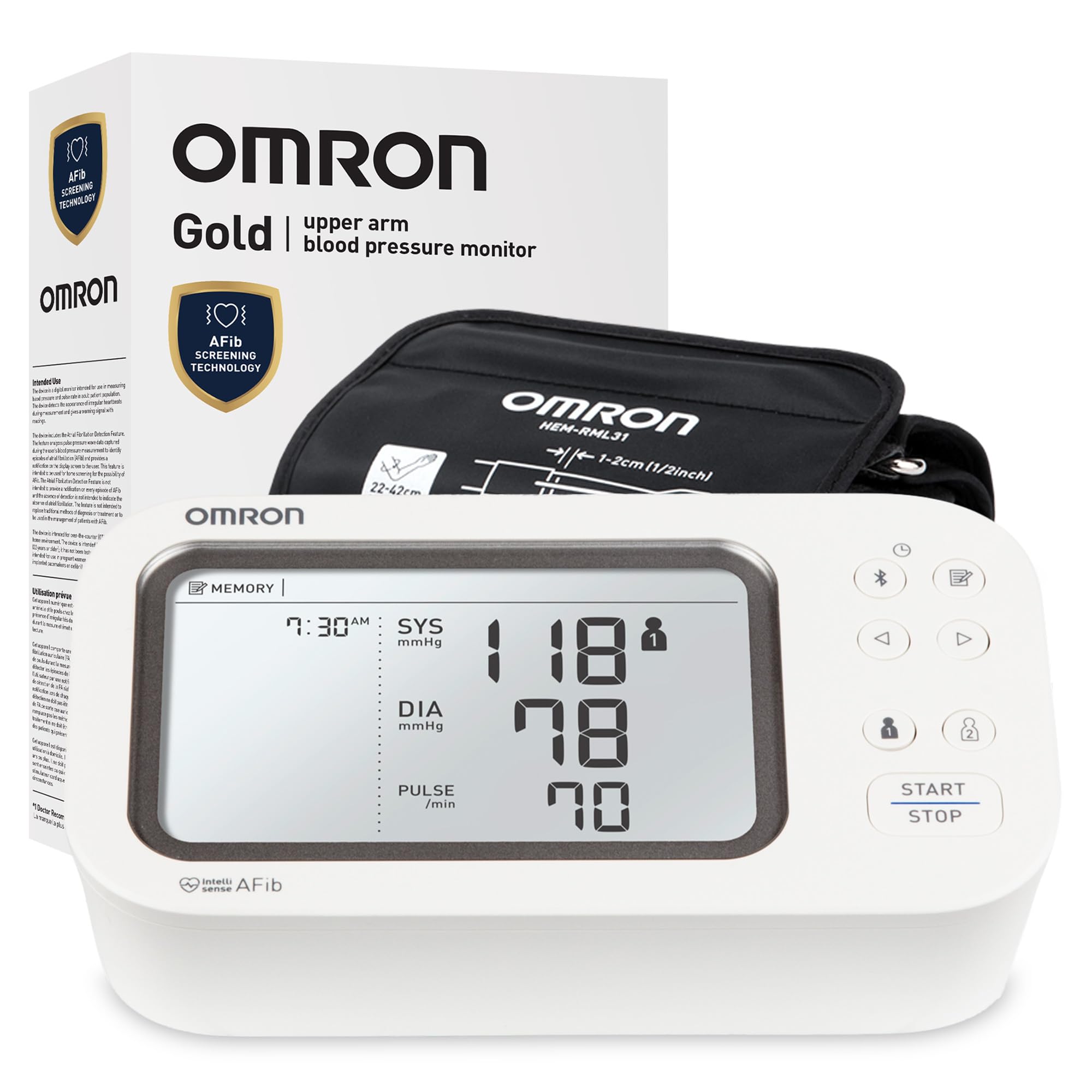
A blood pressure cuff that watches for an irregular beat while it takes the reading.
Think of this as a blood pressure monitor with rhythm screening attached, not a pure EKG. Every time you run a reading, its AFib detection checks for an unusual rhythm, so the twice-daily pressure check doubles as a heartbeat screen. The dual display shows your current reading next to the previous one, and a physical switch toggles between two users — handy in a shared household. It ships with a wide-range D-ring cuff, a storage case, and four AA batteries, so it works the moment it arrives.
The cuff itself is a D-ring design that fits arms from 9 to 17 inches, and a wrap-guide light confirms you have tightened it correctly. TruRead can average three consecutive readings for a steadier number. Bluetooth pushes results into the free OMRON connect app, which stores unlimited readings and shares reports with a doctor.
The one gap that matters: if the cuff detects AFib, it will not display a blood pressure reading for that run. That is a deliberate accuracy safeguard, but it is tucked into the manual rather than the listing — so know it going in rather than discovering it mid-reading. Set-up is quick once you have the cuff placement down, and the app syncs cleanly for day-to-day tracking.
Right for: anyone already tracking blood pressure who wants a built-in irregular-rhythm check on every reading.
One surprise: an AFib flag means no pressure number on that run — plan a second reading rather than read it as a failure.
9. Withings BPM Connect

A connected cuff that logs every reading to your phone without a single button press.
This is for the person who wants their numbers to just appear. The BPM Connect syncs over Wi-Fi or Bluetooth into the Health Mate app automatically, so you do not manually transcribe anything. A rechargeable battery is rated for a 6-month charge, and a color-coded display shows your systolic and diastolic result at a glance. It is FDA-cleared, and its band fits arms from 22 to 42 cm.
The build is clean and the operation is three buttons at most. It rolls up compactly, works with 2 users, and exports PDF reports for a doctor — which is exactly the kind of thing people keep using long term. Ease of use and general functionality are what owners like most, and it slots neatly into an existing health-tracking habit.
The real catch is that this is a blood pressure monitor that checks rhythm, not a rhythm device that checks pressure. The big number is your blood pressure; the rhythm side is a supporting flag. If your whole reason for shopping is an EKG strip, the pads above are the tool you want. If you track pressure and want the phone to do the logging, this is the smoothest way to do it.
Why connected buyers love it
- Wi-Fi and Bluetooth sync readings to the app automatically.
- 6-month rechargeable battery; no cells to swap.
- Fits arms from 22 to 42 cm and supports two users.
- Generates PDF reports you can send to a doctor.
What to keep in mind
- Rhythm checking is a secondary flag, not a full EKG strip.
- Cuff placement has to be right or readings drift.
- Results vary on a single reading; averaging three gives a steadier picture.
Best match: a pressure-tracker who wants readings logged automatically to a phone.
Skip if: you came for a strip of your actual heart rhythm — that job belongs to a lead-based device.
10. Biotricity Bioheart Chest Strap
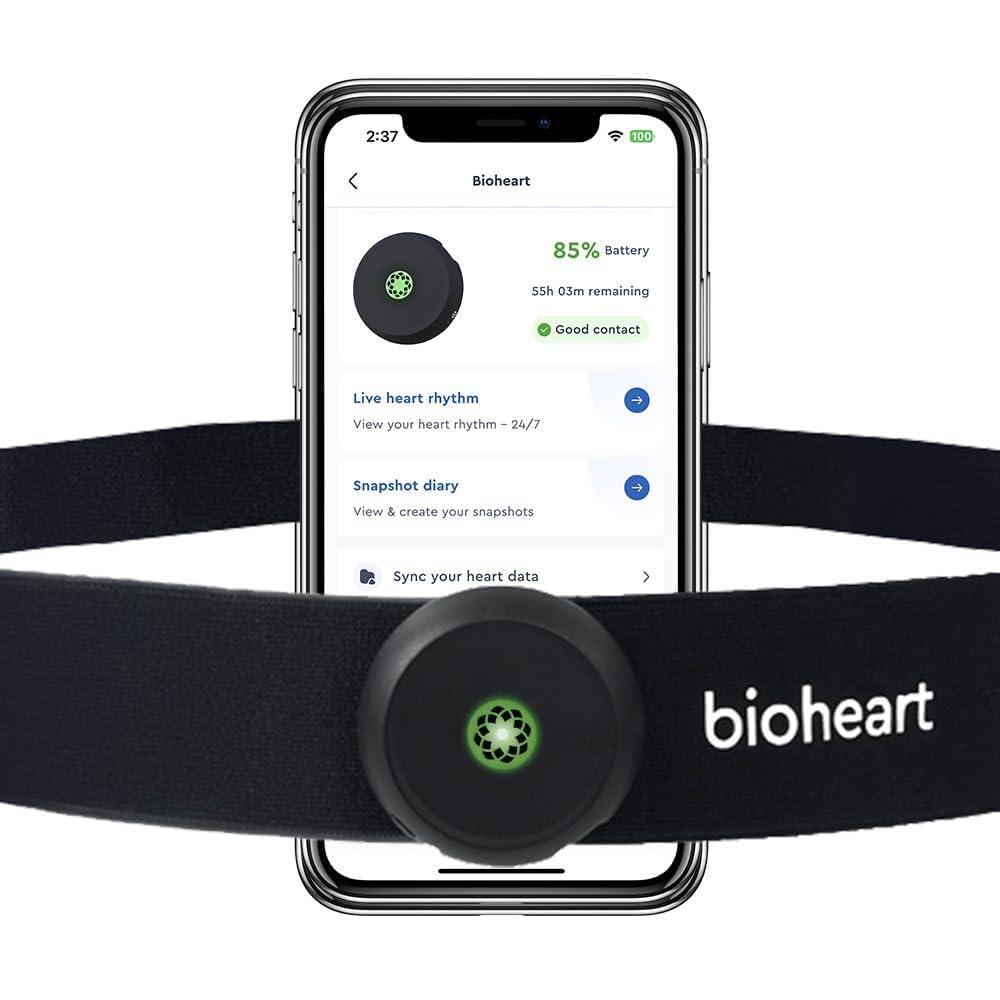
A strap that records your rhythm around the clock instead of asking for thirty seconds.
This is the option for rare or brief events that only show up while you sleep or mid-workout. It records continuously for 24/7 monitoring, uses a 3-channel reading for multiple views of the beat, and runs on a 48-hour battery per charge. The breathable fabric strap comes in three sizes — Small 25.5″–35.5″, Medium 29.5″–41.3″, and Large 40.3″–63.0″ — and it weighs 34 g. It has no prescription requirement and syncs to an app for live rhythm, trends, and PDF reports.
That continuous approach is the whole point. A spot check only catches what happens while you hold the pads, but a strap can log the event you keep missing. The app shows live heart activity, and you can generate data strips to share with a physician. Real-time monitoring is a genuine strength here, and quality wins over buyers who want a wearable rather than a hand-held device.
Be honest about what you are taking on. Comfort matters for anything worn all day, and the strap has to be damp for a clean signal in continuous use. A few owners mention a strap that failed within hours or weeks — test yours hard in the first week and treat early failure as a defect, not the norm. And there is a subscription question in the profile, so confirm what the app keeps after the free period before you build a habit around it.
Where it stands apart
- Continuous 24/7 recording catches what a spot check misses.
- 48-hour battery and three channel views of the beat.
- Three strap sizes cover a wide range of chest measurements.
- PDF reports and real-time data you can show a physician.
The realities of a daily strap
- Needs snug, damp placement for a clean continuous signal.
- Occasional units arrive with early failures — test it fast and keep the receipt.
- App subscription question and strap fatigue over long wear.
Choose this if: your symptoms are brief and you need a whole-day record rather than a single check.
Be honest if: you want something you press and put down — the strap life is a daily commitment.
Know the Specs
Leads: how many viewpoints of the beat
A lead is one electrical viewpoint of your heart. A single-lead pad gives you one angle, which is plenty for rate and rhythm but limited for anything structural. A 3-lead handheld like the Beurer gives you more angles of the same beat, so the strip is fuller and easier to interpret. Twelve-lead is what a clinic uses; no device here claims that. If your doctor has asked for a fuller strip, lead count is the number to weigh before the brand.
Reading time: spot check or continuous
Most finger-pad devices record for around 30 seconds, which is a snapshot of that moment. The CONTEC PM10 records in 6 seconds, the fastest here. A strap like the Bioheart runs continuously on a 48-hour battery, catching events that happen while you sleep or work out. Pick by how often your symptoms show up — frequent flutters suit a 30-second pad, rarer events suit the strap.
Storage and the app tier
The hardware reads your heart the same way whether or not you pay. What a subscription typically changes is how many readings you keep. The KardiaMobile free tier holds only your latest reading, while the Beurer ME75 stores 100 on board and the Wellue keeps the last 50. Decide how big a log you want before you pick — a free tier that keeps one reading is not a history you can hand to a doctor.
Battery: hours, months, or uses
Battery specs come in different units here, so read them in context. The Wellue does 3 months of typical use per charge, the Polar H9 runs 400 hours on a button cell, the OVIIN does 500 uses, and the Bioheart manages 48 hours between charges. A spot-check device that sits in a drawer wants months. A strap worn daily wants hours. Match the battery style to how you will actually use it.
Common Questions
Does a home EKG tell me if I am having a heart attack?
What is the difference between a 1-lead and a 3-lead EKG monitor?
Do I need a subscription to use a home EKG device?
Why does my device show a different result each time I run it?
Can I use a chest strap heart monitor to detect AFib?
How long does a home EKG device battery last?
Will my device share readings with my doctor?
What is CMRR and why does it matter on an ECG monitor?
Can I wear a chest strap over along period, every day?
Is a blood pressure monitor with AFib detection the same as an EKG device?
The Bottom Line
For most people, the home ekg device winner is the KardiaMobile 1-Lead EKG Monitor because it turns a 30-second finger check into a clean rhythm strip your doctor can read, with no cords, no pairing, and a 12-month battery — the simplest path from “I felt something” to a strip in hand. If you want the fuller picture of a three-lead strip with readings stored on the device itself, the Beurer ME75 is the step up. And when your irregular beats are rare and brief, the Biotricity Bioheart strap records continuously for 24/7 so the event does not slip past a spot check.
The single nudge worth making: pick by the question you are trying to answer, not by the longest spec sheet. A pad answers “what is happening right now?” A strap answers “what happened while I slept?” A cuff with rhythm screening answers “is my pressure steady and my beat regular?” Match the device to your question and it does its job well.
How we choose
We do not accept paid placement. Every pick is matched to a real buyer and a real use-case; we do not hands-on test units.
Sources
Specifications: manufacturer listings and product documentation. Review insights: verified customer reviews, as of October 2026. Pricing: not shown on this page (it changes often); check the current price via the retailer link.
As an Amazon Associate, Aappliancez earns from qualifying purchases. This does not affect which products we feature.