Disclosure: Some links in this post are affiliate links. As an Amazon Associate I earn from qualifying purchases, at no extra cost to you. Learn more
Specs are compiled from manufacturer listings and verified buyer reviews and can change over time — please confirm the key details on the product page before buying.
If you want to know your own blood type without booking a lab appointment, a home test kit can give you an answer at your kitchen table in a couple of minutes. The catch is that not every kit sold as a “blood typing kit” actually types human blood. Some are classroom simulations built for fake blood only. Below you will find the real typing kits ranked against the simulated ones, so you can tell them apart before you buy.
This guide is built by comparing the manufacturers’ published specifications and the patterns across verified customer reviews, so you get each pick’s real strengths and trade-offs instead of marketing spin.
Some kits here type real human blood at home, while others are teaching tools made for simulated samples. This breakdown of the home blood type test kit market explains which one matches your goal.
Top Picks


How To Choose The Best Home Blood Type Test Kit
Before you add anything to your cart, you need to answer one question honestly: do you want to learn your own blood type, or do you want to run a classroom demonstration with fake samples? The two goals point to two different families of products: real-blood typing kits and simulated classroom kits.
Real Human Typing vs. Simulated Classroom Kits
A real typing kit is built around a card with dried antibody formulations on it — the antibodies are proteins that react with your blood to reveal your type. You prick your finger with a safety lancet, apply drops to the card, and watch the reaction form. A simulated kit, by contrast, ships with bottles of synthetic blood and anti-sera for teaching purposes. Those bottles are designed for lab-class use on fake samples, not for your fingertip. If testing your own blood is the goal, confirm the kit includes lancets and an ABO/Rh card.
How Many Tests Are Actually Inside
Test count is the number that decides cost-per-answer, and it varies widely between kits. Some packs include a single-use card per test, while classroom kits advertise supplies for whole groups of students. Read the quantity line carefully. A kit described as good for one use per card gives you one answer per card, so a 6-test pack covers six fingertips. A classroom kit’s “supplies for 30 tests” refers to teaching consumables, which is a different kind of count entirely.
Lancet Comfort and Blood Flow
The lancet (the small piercing device that gets the drop of blood) is where most of the real-world friction happens. Improved lancet designs and single-use safety lancets both reduce the awkward fumbling of drawing blood at home. Even so, some fingers simply release blood more slowly, and cold hands make it worse. A warm hand and a steady press usually fix it. Several testimonials mention that fast clotters occasionally struggle to produce a large enough drop, so having an extra lancet on hand is a small but real advantage.
Side-by-Side Comparison
| Model | Best For | Test Count | Blood Type | Weight | Amazon |
|---|---|---|---|---|---|
| Eldoncard Blood Typing Kit, 10 Test Pack★ Best Overall | Typing real human blood at home | 10 tests | Real blood — ABO and RhD | 7.52 ounces | Amazon |
| ALDON Innovating Science Forensic Presumptive Blood Test KitBest for Forensics | Presence-of-blood testing in a lab | 30 tests | Presumptive detection only | 11.36 ounces | Amazon |
| Innovating Science Forensic Chemistry of Blood Typing Lab Kit | Homeschool forensic science | Supplies for two teams | Simulated blood — ABO/Rh | 9.6 ounces | Amazon |
| Original Home Blood Typing Kit – New Package + Improved Lancet | Family blood type projects | 6 tests | Real blood — type and Rhesus factor | 5.29 ounces | Amazon |
| Innovating Science ABO/Rh Simulated Blood Typing Kit IS3101 | Classroom labs of 10 groups | Materials for 10 groups | Simulated — four samples | — | Amazon |
Detailed Reviews
1. Eldoncard Blood Typing Kit, 10 Test Pack
Our pick — over 4.5★ from 200+ verified ratings; the strongest balance of quality and price.
Ten separate cards mean ten answers, so the whole household can type themselves in one sitting.
Ten tests in one box is the number that separates this kit from almost everything else a home buyer will find. That is ten separate chances to find out the ABO group and RhD status (the positive or negative tag on your type) for you and everyone at your table. Each package carries its own set of safety lancets, alcohol prep pads, and printed instructions, so you are not hunting down extra supplies before you start.
What wins people over is the card itself. It is made of a special plastic with dried antibody formulations built into the spots, and once your result develops you can cover the card and keep it for future reference — so a type you learn once stays on paper instead of in your memory. That is a real difference from kits you throw away after a single read. The listing also notes the same card is used by hospitals, blood banks, and blood centers.
The honest catch sits on the accuracy side, where customer feedback is genuinely mixed — some report a clean reaction and others report no reaction at all. A clear, well-covered result tends to come down to technique on the day rather than the card itself. Weigh that against the durability of the plastic and the reference-card design, and it is still the strongest typing pick in this group. The packing weight is 7.52 ounces, and that includes the lancets, wipes, and instructions.
Why it earns the top spot
- Ten separate cards, ten single-use safety lancets, and alcohol prep pads all in one box
- Results in just a couple of minutes per test, according to the maker’s own description
- Once developed, the card can be covered and kept for future reference
- Same card format the listing says is used by hospitals, blood banks, and blood centers
What to weigh before you buy
- Accuracy feedback is genuinely mixed — some get a clean reaction, some get nothing
- You need a steady fingertip and a warm hand to produce enough blood for the card
- It does not teach the science the way a classroom kit does
Reach for this if: you want a fast, at-home read on your own ABO group and RhD status, and you want the card to survive as a permanent record.
Think twice if: you are shopping for a classroom demo with simulated samples — this one is built for real blood, and the mixed accuracy feedback points to technique mattering more than anything else.
2. ALDON Innovating Science Presumptive Blood Test Kit
A forensic tool, not a typing kit — it answers whether blood is present, not what group it is.
This is the one kit on the list that does not type blood at all, and that distinction matters far more than any spec sheet. Its job is to test a swabbed sample for the presence of blood on a material, with a rapid color change acting as the tell. If your goal is “what type am I,” this is the wrong tool. If your goal is a hands-on forensic lesson, it is exactly the right one.
The supply line reads generously: materials for 30 complete tests. That count is the reason this kit stands out in this comparison — it runs five times the test volume of the six-test home typing pack, and at 11.36 ounces it weighs roughly twice what that pack does. Those two numbers sit on opposite sides of the same decision. The 30-test count assumes you are running repeated demonstrations, not one family fingertip session at the kitchen table.
The honest catch is the paperwork. Instructions here have drawn complaint for being confusing and needing multiple re-readings, and the listing pairs the kit with a safety data sheet packet that you are expected to work through. It is rated suitable for ages 13 and older with adult supervision, so the handling context is built into the product. This is a teaching kit through and through, and the confusing instructions are a real friction point worth knowing about before you commit.
Where it shines: 30 complete tests of supplies makes repeated use realistic, and the rapid color-change format gives students an immediate, visible result.
Where it stumbles: Instructions draw regular complaint for being hard to follow, and it is a presumptive test only — no ABO or RhD grouping anywhere in this kit.
Pick it when your goal is demonstration: 30 tests of supplies plus a color-change format is built for a class or a forensic lesson.
Look elsewhere if: you want to know your own blood type — this kit detects blood presence, it does not classify a group.
3. Innovating Science Blood Typing Lab Kit

Built for two students to work a suspect case together — with synthetic blood, never a real prick.
Here is the kit for the parent who wants the blood typing lesson without the blood. The samples inside are synthetic (lab-made blood designed to react like the real thing), so the safety question that hangs over every real typing kit simply does not apply. Supplies are sized for two teams, so two students can work side by side on the same case instead of taking turns.
The kit includes ABO/Rh anti-sera (the reactive liquids that tell one blood group from another), and the whole point of the exercise is to let students determine whether a suspect’s blood type matches the evidence. That is a different job from the home typing kits above — it is teaching the logic of forensic science rather than answering “what is my type.” Nineteen items ship in the box at 9.6 ounces, and a full instruction manual is part of the package.
The honest catch, and it is a real one, is quality control. Buyer feedback here is genuinely divided, and several users report reagents that do not react at all or bottles that arrive barely filled. One reviewer noted only 1 of 4 fake blood samples reacting when four different results were expected. This is a lab-class tool at heart, and if you are counting on it for a specific lesson date, plan a backup.
The case for it: siblings or cooperative classmates can run the same investigation in pairs, and no one has to stick a finger — the synthetic samples remove the safety question entirely.
What some buyers run into: incoming kit quality is inconsistent, and a few reviewers report reagents or sample volumes that fell short of what was needed for the lab.
Best matched to: co-op classes, home-school families, and any teaching setup where two students work a case without a real finger-prick.
Skip if: you want a guaranteed single-take result — the reagent inconsistency means a backup batch is a smart idea.
4. Original Home Blood Typing Kit (6 Kits)
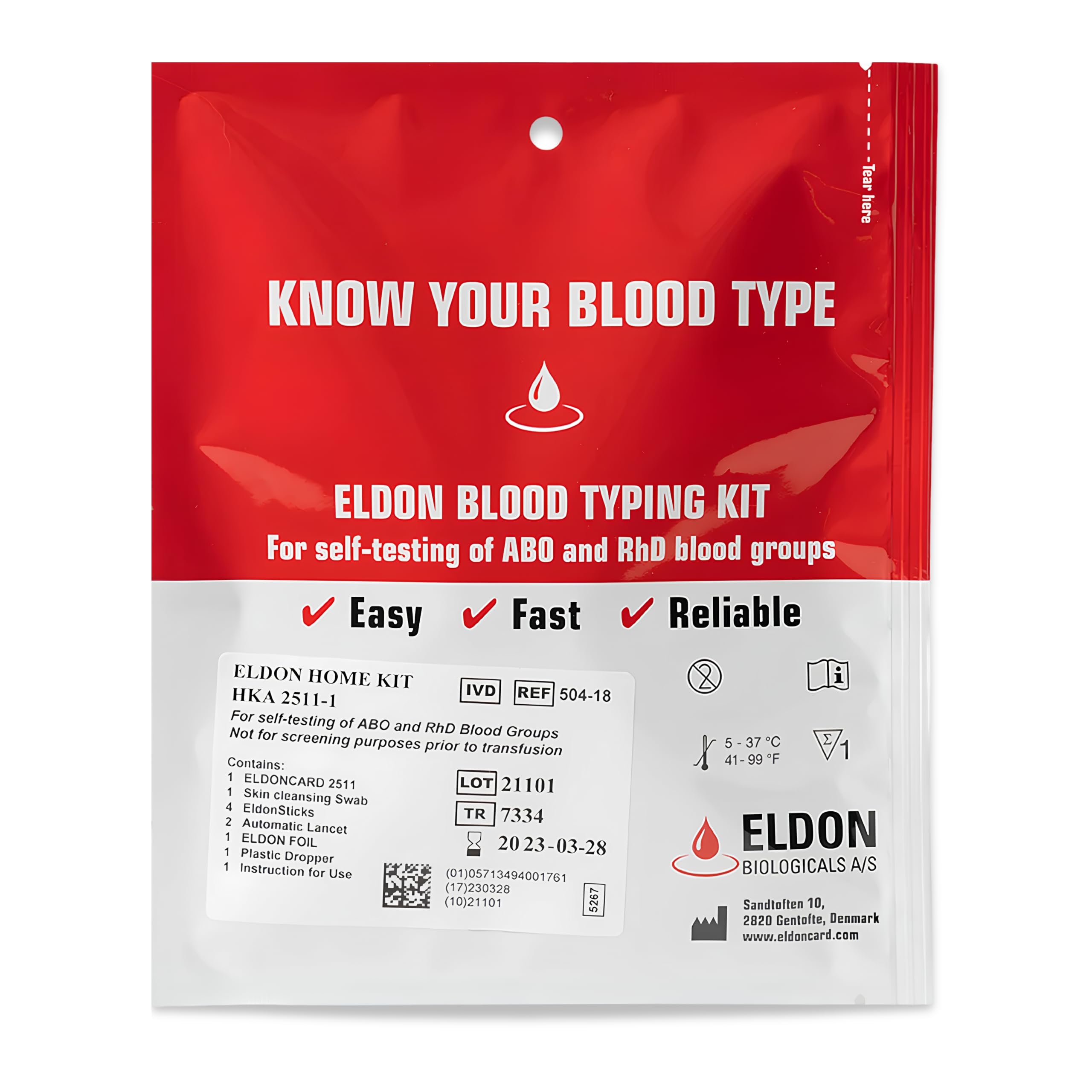
Six sealed kits that turn a family evening into a blood-type reveal, Rhesus factor included.
Six individually sealed kits at 5.29 ounces total make this the lightest real-blood option here, and the lightest just happens to be the easiest to hand around the table. Each kit is good for one use, so two parents and four kids each get a card. The tests ship individually wrapped, which means you can pull out one, type someone, and leave the rest sealed for another day.
Accuracy is what the review pages talk about most, and it holds up well — users report correctly identifying declared blood types and matching them to records they already had. Results come back within minutes according to the maker, and the package is small enough to store in a drawer between sessions. The maker also notes the kit suits people following Dr. Peter D’Adamo’s Blood Type Diet, who need an accurate reading of their own type.
The recurring gripe is blood flow, not the card. Fast clotters and cooler hands can struggle to produce enough blood on the stick, and some readers describe results as light but readable rather than bold. Having a backup lancet or a warm-up routine before you prick solves most of it. The larger 7.24 x 6.81 x 1.77 inch package box holds the six individually sealed kits without cramping them.
Why families like it: six single-use tests at 5.29 ounces means each member gets their own card, and the individually sealed packaging keeps the unused ones fresh.
The one snag to plan around: some hands struggle to give enough blood on the stick — an extra lancet on standby removes the headache.
Good fit for: households of four or more who all want to know their type and Rhesus factor in one sitting.
Less ideal for: a single user who only needs one answer — six tests means five will sit unused.
5. Innovating Science ABO/Rh Simulated Blood Typing Kit IS3101

One box, ten student groups, four simulated samples each — a full period of typing practice.
This is the classroom-scale option, and the number that defines it is ten. Materials cover ten groups of students for hands-on learning, which means a single purchase can carry a whole period without anyone waiting to share. The kit focuses on ABO/Rh blood type determination across four blood samples, so each group works through multiple readings instead of one.
Safety is the second thing that separates this from the real-blood kits. The samples are simulated, so there is no finger-prick, no risk of a mishandled lancet, and no need to source human samples. A teacher’s manual and student study guide copymasters are included, so the lesson plan and the student worksheet come with the kit. That combination — simulated samples plus ready-made instruction materials — is why this pick leads the teaching category.
The honest catch is reagent reliability. Feedback here is divided, and a portion of users report the samples failing to coagulate with any anti-serum in the sets they received, while others report the simulated samples reacting correctly. Real blood is a different story altogether: one educator specifically tested the kit with her own known type as a control, and the reading came back different, so this kit should be treated as a classroom simulation tool, not a typing kit for human samples.
Where it leads the class: materials for ten student groups plus a teacher’s manual and study guide copymasters give you the supplies and the lesson plan in one box.
Where it disappoints: reagent consistency draws mixed feedback, and the design is strictly for simulated samples — real human blood is not what this kit is built to type.
Choose it when: you are outfitting a science classroom or a big co-op group and you need reusable simulated materials for ten teams.
Look past it if: you want to test your own blood type — this is a simulation kit, and the reagent consistency reflects that it is a lab-class supply.
Know the Specs
ABO and RhD Grouping
ABO is the four-letter family system — A, B, AB, and O — that sorts blood by which antigens (marker proteins) sit on the surface of your red cells. RhD is the positive or negative tag you see written after the letter, so O+ and O− are two different answers to the same test. A real typing card carries dried antibody formulations that react with your sample and reveal which group you fall into. Typing kits are built around this ABO/RhD result. Classroom simulation kits chart the same blood groups on fake samples, which is why the format and the reagents look similar even though the purpose is completely different.
Test Count and Per-Test Value
Test count is the number of separate readings you can run before you buy another pack, and it varies widely. A kit described as good for one use per card gives you one answer per card, so a 6-test pack covers six fingertips and nothing more. Classroom kits are measured differently — supplies for a whole group of students or for a set number of lab teams means the count refers to whole workstations, not individual fingertips. Confirming which kind of count you’re looking at is the difference between a kit that lasts a season and a kit that runs out mid-class.
Why the Lancet Is the Real Variable
The lancet is the tiny spring-loaded needle that pierces your fingertip and produces the drop you need. Safety lancets are single-use by design, which prevents accidental piercing by anyone who picks one up after it has been used. The improved-lancet design used in home kits is designed to reduce the awkward fumble of drawing blood at home. Technique matters as much as the hardware: warm hands and a firm press tend to produce a better drop, while cold hands and slow circulation make the same lancet feel unreliable. Extra lancets are never a bad idea.
Presumptive Detection vs. Typing
Presumptive detection is a completely different task from blood typing. A presumptive test answers a yes-or-no question — is there blood on this sample? A color change signals a positive result. It does not tell you A, B, AB, O, positive, or negative. That means a kit sold as a presumptive blood test is a forensic tool for teaching and lab work, not a home typing kit. Reading the product description carefully is the single best way to catch this difference before you buy, especially if the title leans on the word “blood” without mentioning ABO or RhD anywhere.
Common Questions
Can a home blood typing kit give me a lab-accurate result?
Is a presumptive blood test kit the same as a blood typing kit?
How many tests do I actually get in a 6-kit pack?
Can I use a simulated classroom blood typing kit on real blood?
How long do the results last on an Eldoncard once I have tested?
Why can’t I get enough blood out of my fingertip?
Is the Eldoncard blood typing kit suitable for children or school classroom use?
What is the difference between the two Innovating Science classroom kits?
Can I match my blood type to my parents using an at-home kit?
Is the ABO/Rh anti-sera in the simulated kits safe to handle?
The Bottom Line
For most home users, the home blood type test kit winner is the Eldoncard Blood Typing Kit, 10 Test Pack because it delivers the highest test count per box in the human-typing category, ships with every component you need, and lets you keep the developed card as a permanent record. If you are typing a whole family in one sitting, the Original Home Blood Typing Kit, 6 Tests is the one to reach for — its lightweight package and individually sealed single-use tests are built for the reveal-at-the-table moment. And if your goal is classroom teaching rather than personal typing, the Innovating Science ABO/Rh Simulated Blood Typing Kit IS3101 has the group capacity and the teaching materials to run a full lab period. Whichever you pick, confirm whether you are buying a real-blood typing kit or a simulated teaching kit.
How we choose
We do not accept paid placement. Every pick is matched to a real buyer and a real use-case; we do not hands-on test units.
Sources
Specifications: manufacturer listings and product documentation. Review insights: verified customer reviews, as of October 2026. Pricing: not shown on this page (it changes often); check the current price via the retailer link.
As an Amazon Associate, Aappliancez earns from qualifying purchases. This does not affect which products we feature.