Disclosure: Some links in this post are affiliate links. As an Amazon Associate I earn from qualifying purchases, at no extra cost to you. Learn more
Specs are compiled from manufacturer listings and verified buyer reviews and can change over time — please confirm the key details on the product page before buying.
You want a home blood pressure cuff that gives you a number you can actually trust — one that matches what the nurse gets at your checkup, not a reading you have to second-guess. Every pick here suits a different kind of buyer, and one thing decides which you should take home: whether the cuff fits your arm correctly and whether the readings stay steady from one day to the next.
This guide is built by comparing the manufacturers’ published specifications and the patterns across verified customer reviews, so you get each pick’s real strengths and trade-offs instead of marketing spin.
Seven cuffs are below, sorted by who each one genuinely suits, from a budget-friendly all-rounder to a premium monitor with a heart-rhythm alert. The crowd favorite is the Konquest KBP-2704A, at 4.5+ stars across 34,000+ ratings.
Top Picks
How To Choose The Best Home Blood Pressure Cuff
The single biggest mistake buyers make with a home cuff is ignoring arm size. A cuff that is too tight or too loose pinches the artery or leaves a gap of air, and either one throws the number off. Before you compare any features, wrap a soft tape measure around the middle of your bare upper arm and write that number down. Then check it against each monitor’s stated cuff range.
Measure your arm before you shop
A wide-range cuff that covers roughly 8.5 to 16.5 inches (the taping range most of these monitors list) fits the vast majority of adult arms. If your upper arm measures above 16.5 inches, check whether an extra-large cuff is offered separately before you commit. That one measurement rules out a monitor that reads high or low because the cuff never fit.
Decide if you want app tracking
Some monitors store readings on the device only, while a few sync over Bluetooth to a free phone app. In-app tracking is genuinely helpful if you want to show your doctor a clean 30-day trend rather than a scribbled notebook. The trade-off is that Bluetooth pairing adds a setup step and, in a small number of cases, the app itself can be finicky. If you just want one button and a big number, the on-device memory is simpler.
Read the accuracy picture honestly
Every automatic cuff on this list is designed for home monitoring, but accuracy still depends on you: sitting still, feet flat, back supported, arm at heart height, and the cuff on bare skin. Do the reading the same way each time and the numbers become meaningful. Bring the monitor to your next appointment once so you can cross-check it against the office reading — that one habit tells you more than any spec sheet.
Side-by-Side Comparison
| Model | Best For | Stored Readings | Cuff Range | Display | Amazon |
|---|---|---|---|---|---|
| Konquest KBP-2704A★ Best Overall | First-time buyers who want a big screen | Multiple readings (memory function) | 8.5–16.5 in | Backlit LCD | Amazon |
| iHealth Track SmartTop for Tracking | App-based trend tracking | 99 on device + unlimited in app | 8.7–16.5 in | Multi-color backlit | Amazon |
| Braun ExactFit 2 BUA4050US | Simple color-coded checks | 30 | — | Color-coded indicator | Amazon |
| Braun ExactFit 1 BUA5000 | One-button everyday use | Most recent reading | 8.6–16.5 in | Large easy-read | Amazon |
| Medline Digital Monitor | Two-user household tracking | 90 per user (2 users) | 8.6–11.8 in | Digital LCD with color scale | Amazon |
| Microlife BPM2 | Gentle inflation, compact build | 60 + average | 8.7–16.5 in | Large easy-read | Amazon |
| OMRON Gold | Heart-rhythm screening + app | Large on-device history + unlimited in app | 9–17 in | Dual display | Amazon |
Detailed Reviews
1. Konquest KBP-2704A Blood Pressure Monitor
Our pick — 4.5+★ from 34,500+ verified ratings; the strongest balance of quality and price.
The big-screen all-rounder that fits almost every adult arm without extra parts.
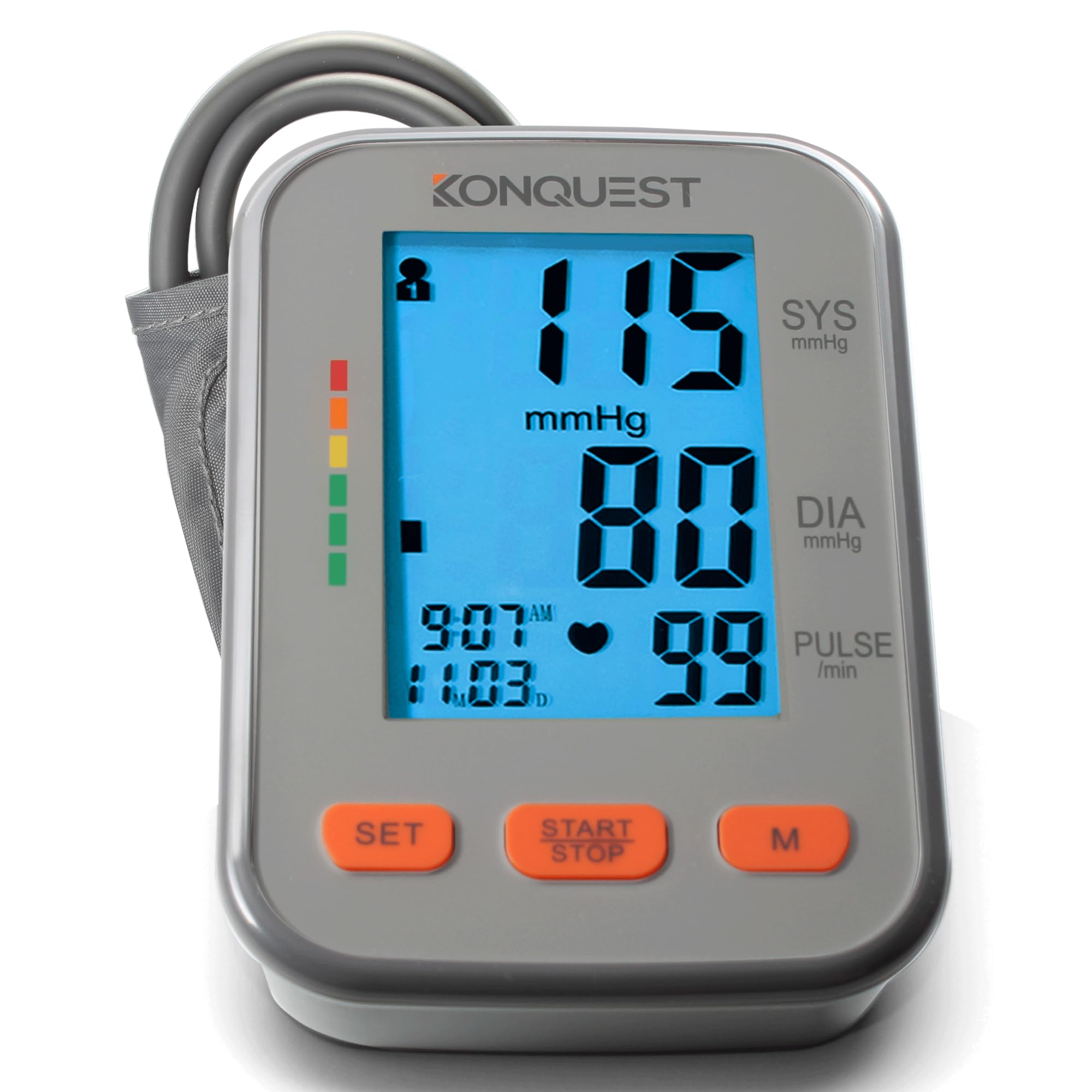
The Konquest KBP-2704A tops this list for a simple reason: the numbers are big. Its bright backlit LCD (a screen that lights up so you can read it in the dark) shows systolic and diastolic pressure (the top and bottom numbers of a reading), your pulse rate, the date, the time, and the active user profile all on one screen — so you can read it in a dim bedroom before the sun is up. Owners keep coming back to that screen. Readability and overall size are the two things reviewers praise most about this unit, and once you squint at a competing display you understand why.
The adjustable cuff is the practical win here. It fits upper arms from 8.5 to 16.5 inches (22 to 42 cm), so a lot of households never need to buy a second size. At 1.3 pounds it is a touch heavier than the Braun ExactFit 2’s 1.2 pounds, but that is desk-weight, not hand-weight — you set it down and press one button. Four AA batteries, an illustrated manual, and a storage case are all in the box, and the WHO blood pressure indicator puts your result on a simple scale so you are not decoding two bare numbers alone.
Here is the honest part. The KBP-2704A automatically alerts you to an irregular heartbeat, but accuracy is the most-discussed topic around this monitor and the split is real — many find it spot on, some find readings inconsistent. Fit is the other recurring gripe: the cuff can feel too tight during inflation. The fix is technique, not repair: rest your arm at heart height, stay still, and take two readings a minute apart. If your numbers wobble on the first try, check your position before you blame the machine.
What earns it the crown
- Backlit LCD puts pressure, pulse, date and user profile on one readable screen
- Adjustable cuff spans 8.5 to 16.5 inches, covering most adult arms from the start
- WHO indicator and irregular heartbeat alert give context beyond two raw numbers
- Complete kit — monitor, cuff, four AA batteries, manual and carry case
Where it asks patience
- Accuracy experiences are mixed; your own technique matters enormously here
- The cuff inflates firmly and can pinch on larger arms
Reach for this if: you want one monitor, a large legible screen, and a cuff that likely fits without a separate purchase.
Look elsewhere if: you need phone-app trend tracking — this one keeps your history on the device.
2. iHealth Track Blood Pressure Monitor
This is the cuff that turns a month of readings into a chart your doctor can read at a glance.
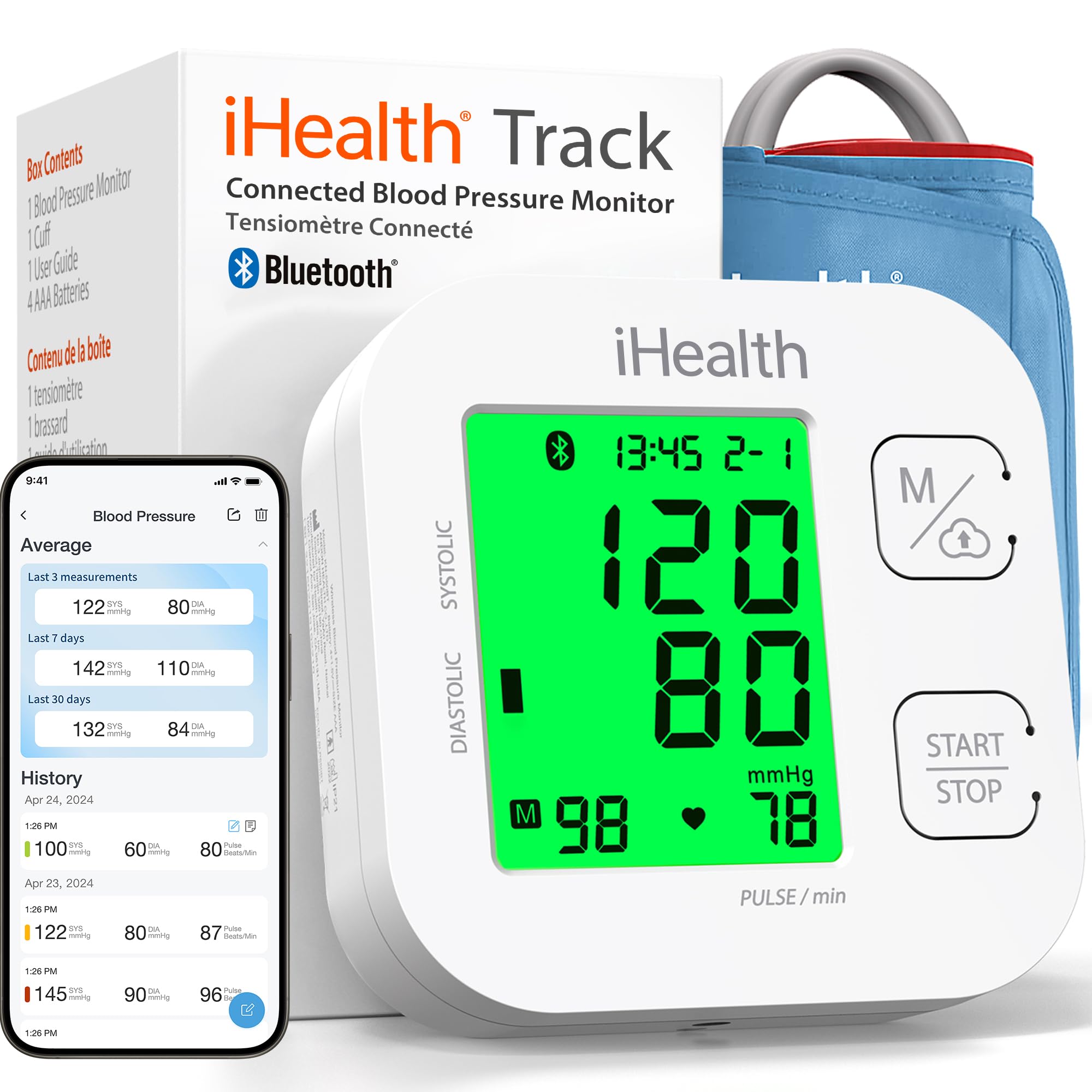
Sheer storage sets the iHealth Track apart. It holds 99 readings on the device itself and unlimited readings in the free iHealth app for iOS and Android — a big jump over the Braun ExactFit 2, which stores 30. That means you can hand over weeks of history instead of a handful of scattered numbers. The two-button operation needs no calibration, and the oversized multi-color screen codes each result green, yellow or red so you instantly know whether the reading falls in the optimal zone.
What wins people over is how little friction there is. Ease of use is the single most-praised quality across thousands of reviews, with build quality right behind it, and the battery-included box (four AAA) lets you measure within a minute of unboxing. The wide-range cuff fits upper arms from 8.7 to 16.5 inches and carries alignment marks that help you seat it over the artery correctly. Daily use, multiple times a day, holds up fine.
One thing to know before you buy: reliability and accuracy are both discussed only in mixed terms, and this unit can take around 60 seconds for a full reading. Some reviewers saw an occasional odd number and found that a retake sorted it. The app is clean and lets you view 3-, 7- or 30-day trends, which is where this monitor truly shines. Just treat the first reading of a session as a settling-in pass and go from there.
Best-fit owner: someone who prefers a phone app to a notebook and wants to spot a trend across weeks rather than single readings — the 99 on-device readings plus unlimited app history make that easy.
What to expect: a roughly 60-second measurement and a Bluetooth pairing step; accuracy depends on proper cuff seating and a still arm, as with any automatic upper arm cuff.
The short version: pick the iHealth if tracking trends matters more to you than one giant display.
Think twice if: you would rather not deal with a phone app — the on-device 99-reading memory still works standalone, but you lose the trends.
3. Braun ExactFit 2 Upper Arm Blood Pressure Monitor BUA4050US
A tidy, well-known brand option that colors your result so you stop guessing what the number means.
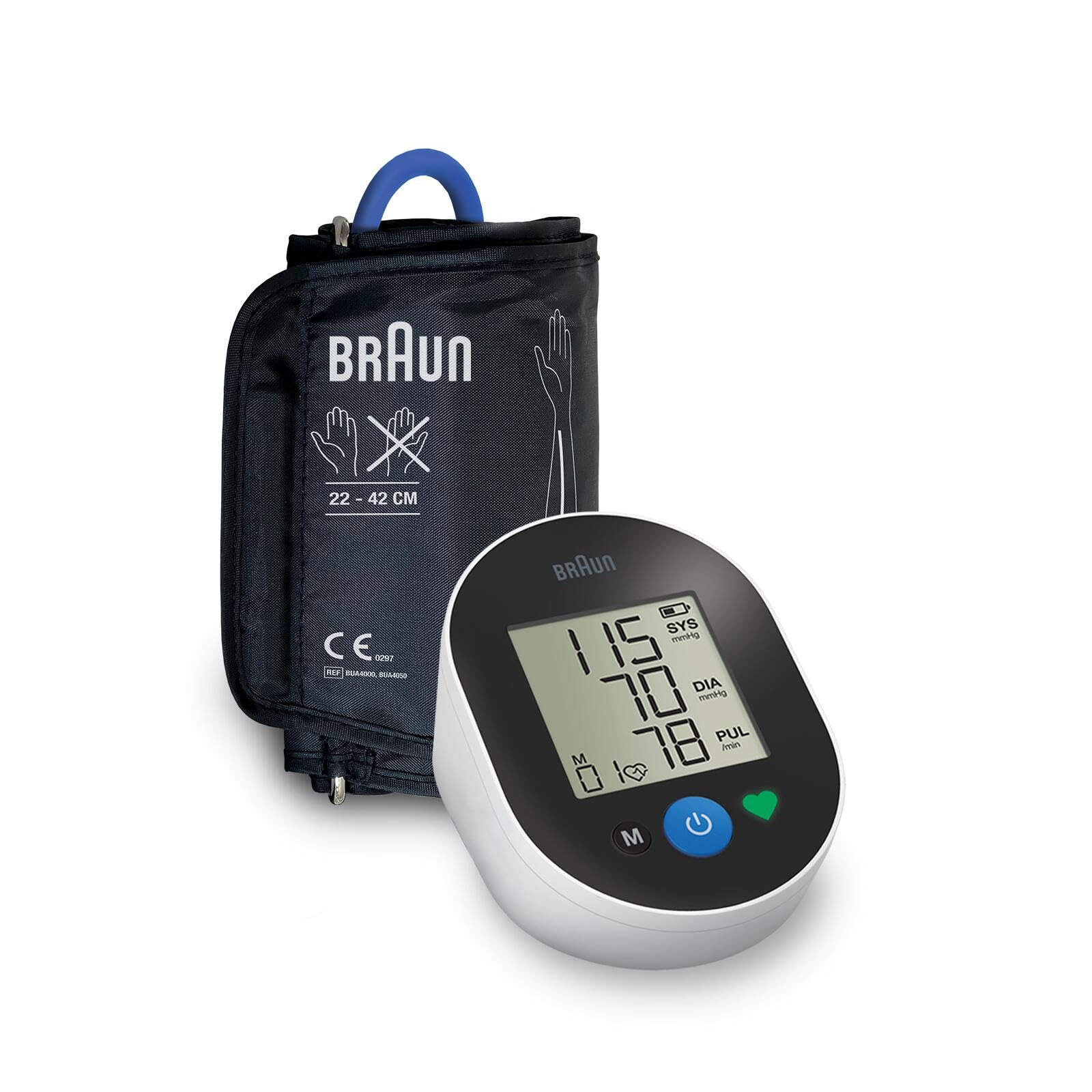
The Braun ExactFit 2 earns its place with a color-coded indicator that simplifies interpretation — your reading lands in a color band so you can tell at a glance whether it sits where it should. It stores up to 30 readings for reviewing your history, and the inflation measurement system keeps the daily routine straightforward. It runs on four AA batteries that come in the box, weighs 1.2 pounds, and has an irregular heartbeat detector to flag anything out of rhythm.
The brand familiarity is part of the appeal. Reviewers come back to a monitor that gives readings consistent with the doctor’s office, and the setup is described as solid and intuitive straight from the start with clear printed instructions. One buyer sums it up plainly: “Simple and does the job. Easy to use, easy to read. Great product.” That low-fuss character is exactly what you want if you are checking once or twice a day and do not want to learn a new interface.
The catch is twofold and worth knowing up front. Accuracy and overall quality both draw split opinions in the review pages, so your measurement technique carries weight here. On larger arms the cuff can squeeze and pinch during inflation, though the placement guide is printed right inside the cuff to help you line it up. And the AA cells can run down quickly with frequent use, so keep a spare set on hand rather than discovering the drain mid-check.
Standout touches
- Color-coded result indicator removes the guesswork from a raw number
- Cuff placement guide printed inside the cuff itself
- Four AA batteries included, so it works the moment you open it
Keep in mind
- Mixed accuracy feedback makes consistent technique important
- Batteries drain quickly with heavy use; keep spares nearby
- Cuff can pinch on larger arms during inflation
Choose it if: you want a familiar brand, a colored result band, and a plain one-button routine.
Pass if: your arm runs large — the inflation squeeze on bigger arms is the main complaint.
4. Braun ExactFit 1 Blood Pressure Monitor, Upper Arm, BUA5000
One button, a big screen, and a universal cuff that reaches a fraction wider than most on this list.
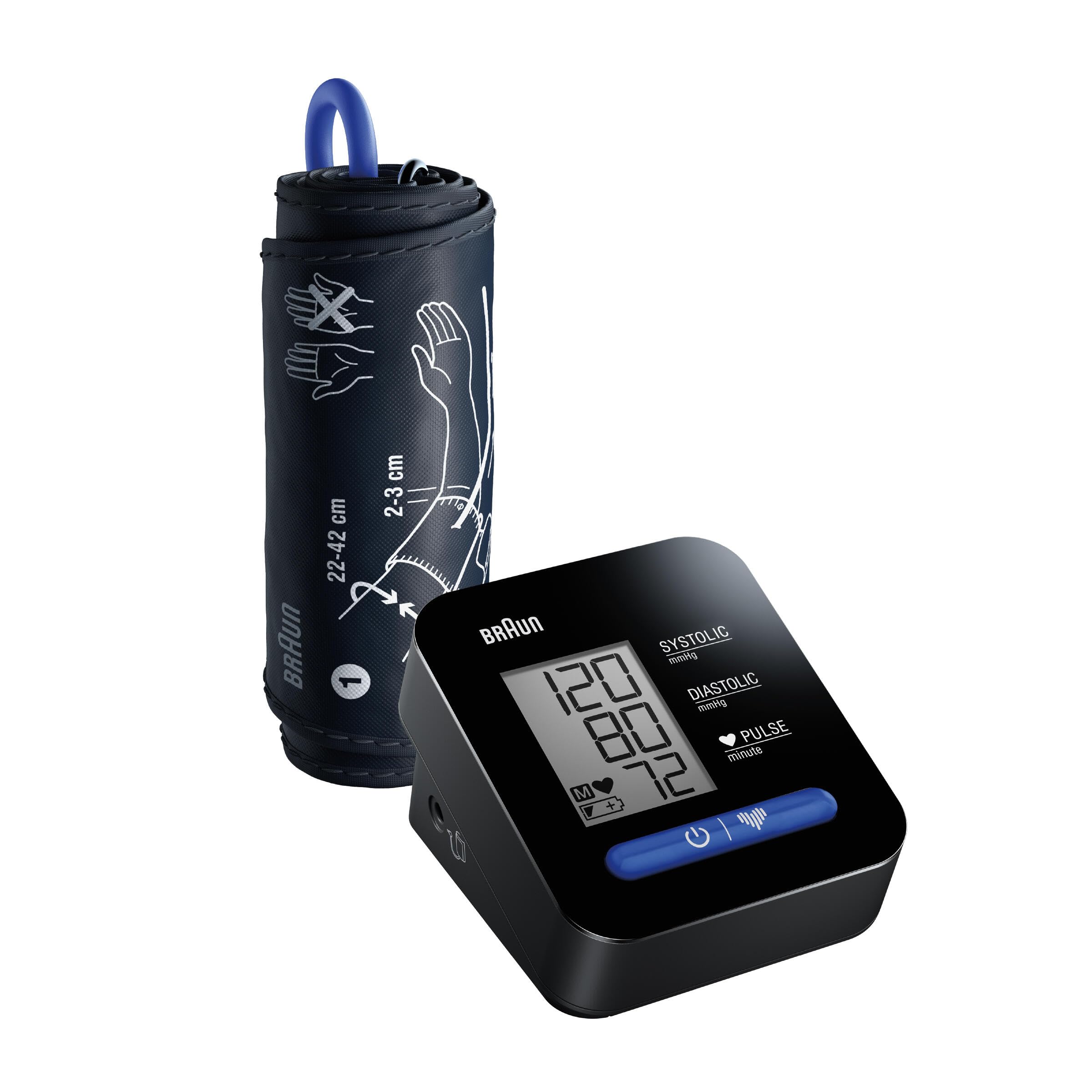
The BUA5000 keeps things almost aggressively simple: one-button operation, a large easy-to-read display, and an irregular heartbeat alert when something is off-rhythm. It is the widest cuff here, too — the universal cuff fits upper arms from 8.6 to 16.5 inches, just a touch wider than the Konquest’s 8.5-inch starting point. It weighs 1.25 pounds and stores your most recent measurement for recall between sessions.
First-time and experienced users alike lean on the lack of faff. The process is quick, and it does not eat much space on a nightstand — “Simple to use. Quick process. Does the job and doesn’t take up too much space,” is how one shopper describes it. The inflation feels like a manual cuff being pumped, which some owners find reassuring. And the cuff has proven forgiving about placement — accurate whether the band sits at the elbow crease or a little above it.
Like its BUA4050US sibling, accuracy and quality opinions split, so steady technique is your friend. The other small snag is the armband: positioning it correctly takes a couple of tries at first, and the instructional graphics in the manual and on the cuff are hard to follow. Just store only the latest reading, so it is not a monitor for long-term trend charts.
Who this fits: a straightforward daily checker who wants one button, a clear screen, and a wide cuff without app screens or menus.
The limitation: it keeps only your most recent reading, so if you want a running history you will need to jot results down or choose a monitor with deeper memory.
My read: the cleanest no-menu experience here if a single saved reading is enough for you.
Consider a different pick if: you want to build a memory log — this one recalls only the latest result.
5. Medline Digital Blood Pressure Monitor, Adult Upper Arm Cuff

The household monitor that keeps two separate histories so nobody’s readings get mixed up.
Two-user memory is where the Medline pulls ahead. It supports two people with up to 90 measurements each, so a couple can track their own blood pressure over time without stepping on each other’s data. The large digital display shows systolic and diastolic pressure plus pulse rate, with a colored scale beside the screen to help you interpret the result. A push of the button starts a customized inflation, and advanced error detection keeps an eye on the reading. Four AA batteries are included, and it carries a 1-year warranty.
Early risers get a genuine perk here, because the results are well lit for pre-dawn checks. It reads consistently from the start for many owners — one describes it matching the doctor’s office across multiple tests and calling bicep cuffs like this far more dependable than wrist monitors. The daily-routine crowd finds it easy to use and steady, which is exactly the quality you want from a monitor built for home checking rather than an office visit.
The one number to watch before you commit is the cuff. It fits adult arms from 8.6 to 11.8 inches (22 to 30 cm) — noticeably narrower than the wide-range cuffs on the Konquest, iHealth and both Braun monitors. If your upper arm measures above that 11.8-inch ceiling, this is the wrong cuff for you no matter how good the memory is. Accuracy opinions also run mixed, so if your readings drift from the office reading, bring the device to your appointment so staff can confirm your arm placement.
Why two people like it
- Separate 90-reading memory for two users keeps histories clean
- Well-lit display suits early-morning checks before daylight
- Colored scale beside the screen helps interpret each result
Check this first
- Cuff tops out at 11.8 inches — too small for larger upper arms
- Accuracy feedback is mixed, so technique and placement matter
Reach for this if: you and a partner both take readings and want a lit screen and clean separate logs.
Think twice if: your upper arm measures above 11.8 inches — the cuff range simply will not fit.
6. Microlife BPM2 Blood Pressure Monitor
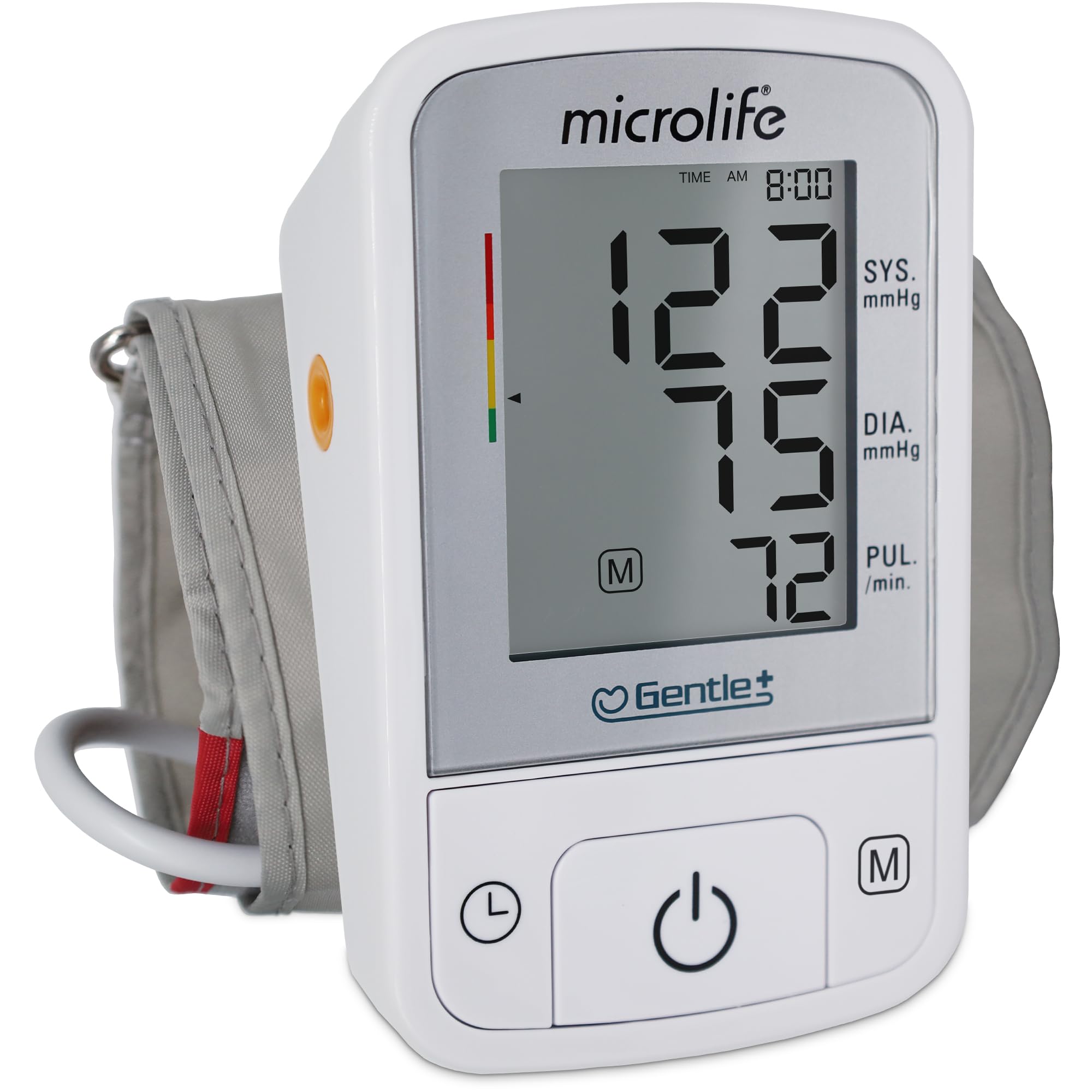
A compact, contoured cuff that inflates with less pressure — built for daily users who hate the squeeze.
In one sitting you get your pulse, systolic and diastolic pressure, a hypertension risk indicator, and an irregular heartbeat reading — a fuller picture than a bare two-number display. The compact body (12.2 ounces) does not hog counter space, and daily users find the large numbers and one-touch start/stop easy to live with. Owners also describe it as reliable and built to last for years of daily checks.
Expect a short adjustment period. Some owners note the cuff starts stiff and loosens after a few weeks of use, and this monitor measures in a slightly different order from other cuffs — diastolic on inflation, systolic on deflation — which surprises people at first. The user A/B switch can also feel backward (left is B, right is A). None of these are faults so much as quirks you learn once. Give it a week and the routine settles into place.
Tuned for comfort: the low-pressure Gentle+ inflation and soft contoured cuff make repeated daily readings easier to stick with, which is the whole game with home monitoring.
Small learning curve: a reverse measurement order and a left-is-B user switch take a little getting used to, and the cuff needs a couple of weeks to soften.
My pick when: comfort during inflation matters most, or you have big arms and want the optional XL cuff path.
Not for you if: you want Bluetooth app sync — this one is a self-contained on-device monitor.
7. OMRON Gold Blood Pressure Monitor
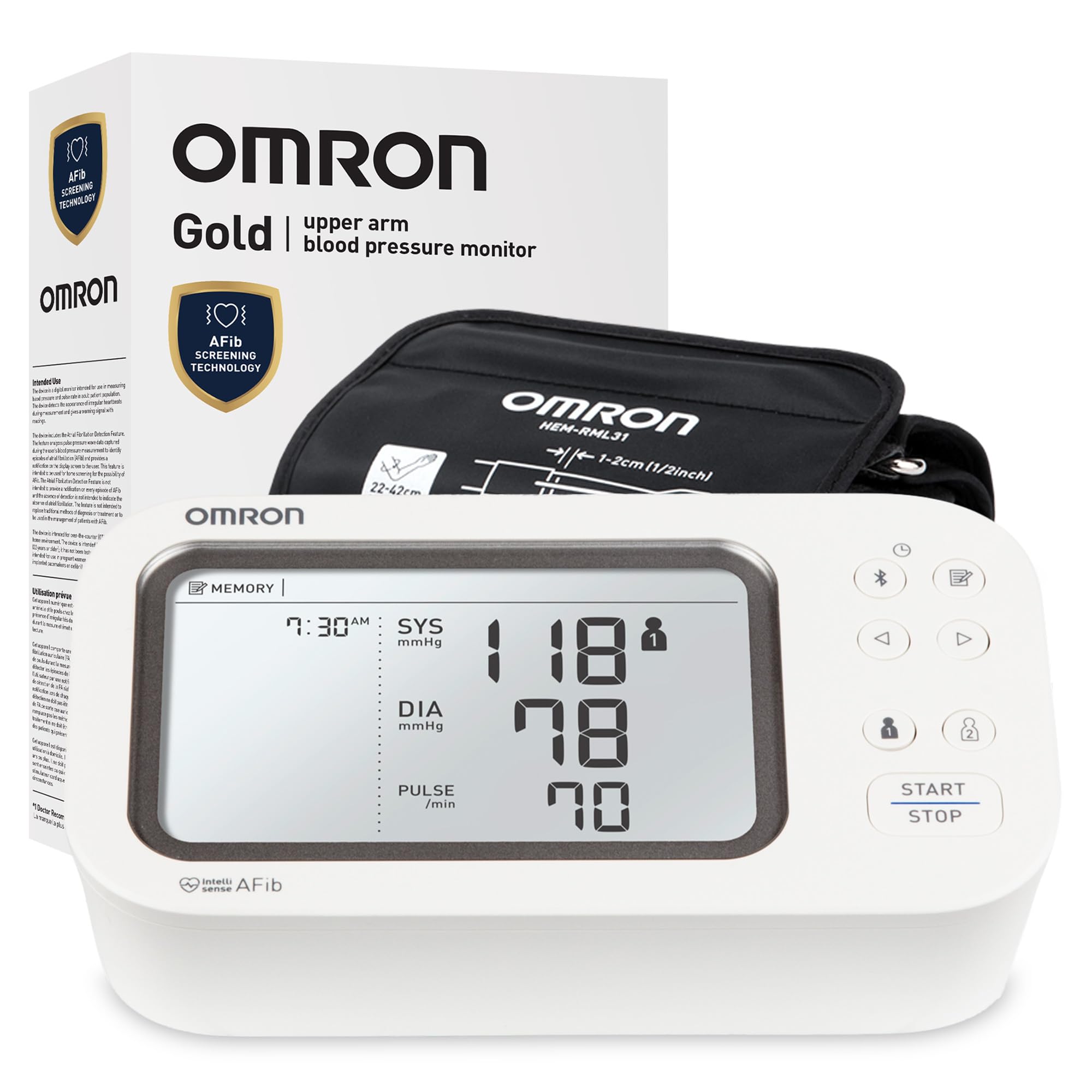
The top-tier monitor that also screens for an irregular heart rhythm called AFib while it reads.
The OMRON Gold does more than take a number. It adds OMRON’s AFib detection, which flags an irregular heart rhythm on every reading, plus a High Morning Average Indicator for morning pressure spikes. It also uses TruRead to average three readings at once, a dual display that compares the current result against the previous one, and a cuff-wrap guide light that tells you when the band is tight enough. The wide-range D-ring cuff fits arms from 9 to 17 inches — the widest range on this list.
Data management is the other headline. It pairs over Bluetooth to the free OMRON connect app to store unlimited readings, track trends, and share reports with your doctor, and it works with Apple Health and Google Fit. On the device you get a large history, a physical User 1/2 toggle for two people, and a travel case in the box with four AA batteries. Accuracy draws split opinions, as it does across this category, but the design intent — turn raw numbers into something you can act on with your doctor — is clear and well executed.
Two honest caveats stand out. First, if AFib (an irregular heartbeat) is detected the unit will not display a reading — that is by design, since a pressure reading taken during an AFib episode is likely inaccurate — but it is worth knowing before you buy, especially if you have AFib. Second, the D-ring cuff (a cuff you thread the end through and pull tight) is bulky for travel, and the app has been known to wipe unsynced data, so back up your readings outside the app. At 1.37 pounds it is the heaviest monitor here, though that weight is mostly on the desk, not in your hand.
The premium extras
- AFib detection plus a High Morning Average Indicator for heart screening
- TruRead averages three readings; dual display shows current vs previous
- Bluetooth app with unlimited storage, Apple Health and Google Fit support
- Widest cuff range here at 9 to 17 inches, plus a travel case included
Know before you buy
- Will not display a reading when AFib is detected — check this if you have AFib
- App can wipe unsynced data, so back up readings externally
- D-ring cuff is bulky for travel
The splurge that earns it: you want the widest cuff, AFib screening, three-reading averaging, and a doctor-shareable app in one device.
Look elsewhere if: you have AFib and need every measurement to display, since detection suppresses the reading.
Know the Specs
Cuff circumference range
This is the arm measurement the band is built to wrap, and it is the spec that decides whether a monitor works for you at all. The bands on this list range from a narrower 8.6 to 11.8 inches up to a wide 9 to 17 inches. A cuff outside your arm size under- or over-compresses the artery, and the reading drifts. Measure your bare upper arm before you shop and match it to the range — no other feature compensates for a poor fit.
Stored readings and memory
Memory is how many past measurements a monitor holds so you can review a trend. Some units keep only the most recent result, others hold dozens, and a few keep 99 on the device plus unlimited history in a phone app. More memory pairs well with sharing: a clean 30-day log is more useful to a doctor than a single number. If more than one person uses the cuff, look for separate per-user memory so histories stay apart.
Irregular heartbeat and rhythm alerts
An irregular heartbeat detector notes when your pulse falls outside a regular rhythm during a reading and shows a symbol on screen. It is a flag, not a diagnosis, and it does not replace a doctor’s evaluation. On some monitors, a detected rhythm issue suppresses the pressure reading itself because the number would be unreliable. Treat any alert as a prompt to talk to your healthcare provider, not as a result to self-treat.
Color indicators and result scales
A color-coded readout or a WHO-style indicator places your reading on a simple scale so you are not staring at two bare numbers. Green, yellow and red bands — or a colored scale beside the digits — help you interpret where a measurement sits. These scales are guides based on established guidelines, not a substitute for your doctor’s reading of your overall health. They are most useful for spotting a drifting trend across many days of checking.
Common Questions
How do I know which cuff size fits my arm?
Why do my home readings differ from the doctor’s office?
Is an upper arm cuff more accurate than a wrist monitor?
What does an irregular heartbeat alert actually mean?
Do these monitors need to be calibrated or plugged in?
Can two people share one blood pressure monitor?
Does a Bluetooth app matter or is on-device memory enough?
Will a monitor with a color indicator tell me if my blood pressure is high?
How often should I take a reading at home?
The Bottom Line
For most people, the winner among these home blood pressure cuffs is the Konquest KBP-2704A, because its backlit screen is easy to read, its adjustable cuff fits a wide range of arms, and the whole kit is ready to use from the box. If tracking trends on your phone is what you are after, reach for the iHealth Track Smart with its 99 on-device readings and unlimited app history. And if heart-rhythm screening and the widest cuff range matter most, the OMRON Gold is the monitor to reach for. Whichever you pick, measure your arm first, keep your technique steady, and let the numbers build over time — that is what turns a cuff into something genuinely useful.
How we choose
We do not accept paid placement. Every pick is matched to a real buyer and a real use-case; we do not hands-on test units.
Sources
Specifications: manufacturer listings and product documentation. Review insights: verified customer reviews, as of October 2026. Pricing: not shown on this page (it changes often); check the current price via the retailer link.
As an Amazon Associate, Aappliancez earns from qualifying purchases. This does not affect which products we feature.