Disclosure: Some links in this post are affiliate links. As an Amazon Associate I earn from qualifying purchases, at no extra cost to you. Learn more
Specs are compiled from manufacturer listings and verified buyer reviews and can change over time — please confirm the key details on the product page before buying.
The short answer: buy a scale with eight electrodes if you want numbers you can actually use. A standard four-pad bathroom scale sends a tiny current up through your legs and then guesses the rest of your body from that one slice. An eight-electrode model — one with metal pads for your hands as well as your feet — reads your arms, legs and torso separately. That difference is the whole ballgame when you are trying to tell fat loss apart from muscle loss. Below you get seven picks worth owning, sorted by who they actually suit.
This guide is built by comparing the manufacturers’ published specifications and the patterns across verified customer reviews, so you get each pick’s real strengths and trade-offs instead of marketing spin.
Most people overpay for a handle they never hold. What matters is electrode count, accurate current path, and whether the app keeps a trend line worth reading. These seven cover the spread; this home bioimpedance scale shortlist starts with the one most people should buy.
Top Picks


How To Choose The Best Home Bioimpedance Scale
Bioimpedance sounds clinical, but the idea is simple. The scale sends a weak, painless current through your body and measures how much resistance it meets. Fat resists more than muscle and water do. From that resistance the scale estimates your body fat percentage, muscle mass and a handful of related numbers. Every pick here does that. What separates them is how much of your body they actually measure, and how well the app presents the result.
Electrode Count Is The First Thing You Check
Four pads under your feet read your lower body well and estimate your upper body from a formula. Eight electrodes — the extra four sit in a handle you grip — let the scale measure your arms and torso directly. The RunStar and the LOFTILLA and the Wyze all use that eight-point layout. If you lift weights and want to know whether a flat week was fat loss or muscle loss, this is the feature that earns its keep.
Dual-Frequency Beats Single-Frequency
A dual-frequency system pushes current at two different frequencies. Low frequency travels mainly outside your cells, while high frequency passes through cell membranes. Running both gives the scale a better handle on intracellular water versus extracellular water, which is the difference between a fat estimate and a hydration blip. Single-frequency scales still work, but they are more easily thrown off by what you drank that morning.
Watch The Increment And Capacity
Readout accuracy tells you how finely the scale divides a pound. Most of these read to 0.1 lb, which is finer than your body actually changes day to day. Capacity matters more for households with bigger family members; several picks here support up to 400 lb. Check both numbers before you buy, not after.
The App Is Half The Product
A body composition scale without a working app is just an expensive bathroom scale. You want automatic sync, multi-user profiles so your partner’s weigh-in doesn’t land in your history, and a trend chart that shows weeks and months. Every pick below connects to a phone app and most sync to Apple Health or Fitbit, so look at which one matches the ecosystem you already use.
Side-by-Side Comparison
| Model | Best For | Electrodes | Metrics | Capacity | Amazon |
|---|---|---|---|---|---|
| Alcedo Smart Body Fat Scale★ Best Overall | Color feedback that keeps you consistent | 4 G-sensors | 20 | 400 lb / 180 kg | Amazon |
| GE Smart Scale CS20FBest Display | Big readable screen without your phone | Standard foot pads | 14 | 400 lb / 180 kg | Amazon |
| RENPHO Elis Evo | Rechargeable with no battery swaps | Dual-frequency ITO | 18 | — | Amazon |
| Etekcity Smart Scale | Wi-Fi cloud sync and voice queries | ITO-coated foot pads | 14 | — | Amazon |
| RunStar FG2422 | Full-body handle scan on a budget | 8 metal electrodes | 28 | 400 lb | Amazon |
| LOFTILLA CS10J | Deep metric library with a big screen | 8 electrodes | 50+ | 400 lb | Amazon |
| WYZE Scale Ultra BodyScan | Segmental analysis without your phone | 8 smart electrodes | 44 | 400 lb | Amazon |
Detailed Reviews
1. Alcedo Smart Body Fat Scale
Our pick — 4.5+★ from 700+ verified ratings; the strongest balance of quality and price.
A color-coded scale that shows gain, hold or loss at a glance before you open the app.
What wins people over here is the glow. The platform lights up in one of 7 app-selected colors, and the color shifts to tell you whether you gained, held or lost since last time. That color cue helps explain its 4.5+ star score across 700+ ratings — the highest score in this group, on far fewer reviews than the biggest sellers here. The GE catalog listing has more ratings behind it, but the Alcedo still takes the top spot on score.
Under the lights it is a real body composition scale. You get 20 metrics through the app — weight, body fat, BMI, muscle mass and the rest — read by 4 high-precision G-sensors (small load sensors under the platform) in 0.1 lb / 0.05 kg steps. Capacity runs to 400 lb / 180 kg, so taller and heavier users are covered. The app syncs over Bluetooth and keeps your history in graphs.
The honest catch is the app rather than the hardware. It does not always open cleanly, and the scale only talks to it when the app is active and your phone is nearby. Bluetooth handoff between two profiles can also misfire if you leave your own profile loaded — you need to be off it when someone else steps on. Set a household rule and that fades into the background.
What earns it first place
- Top score in this lineup at 4.5+, with 20 metrics tracked through the app.
- Color glow shows gain, hold or loss at a glance so you do not open your phone first.
- Reads in 0.1 lb / 0.05 kg increments up to 400 lb / 180 kg.
- Easy setup and a user-friendly app interface, per the consensus of owners.
Where it asks a little patience
- The app must be actively open for the scale to connect, and it occasionally fails to launch.
- Two-profile households need to switch profiles deliberately before weighing.
Reach for this if: you want a scale that nudges you daily with a color cue and tracks 20 metrics, without a premium price tier.
Look elsewhere if: you need a hand-held handle for segmental limb-by-limb readings — this one reads from the feet only.
2. GE Smart Scale
A 5.3-inch color screen big enough to read while you are standing on it, no phone required.
Most smart scales make you crouch to squint at a tiny readout, then open an app for the real numbers. This GE puts 8 key metrics on a 5.3″ color display you can read from a normal standing height — weight, BMI, body fat, muscle mass, water, visceral fat, bone mass and body type. The app is there for the deeper 14-metric breakdown and the trend charts, but you are not forced into it for a morning check.
You get a readout down to 0.1 lb / 0.05 kg, up to 400 lb / 180 kg, so small changes show up clearly. The platform is a compact 11″x11″ with 5mm tempered glass and an anti-slip textured surface, which keeps your feet steady. Setup is a one-time pairing in the Fit Profile app, then it syncs on its own. It also pushes into Apple Health, Samsung Health, Health Connect and Fitbit, and supports unlimited user profiles. One practical note from owners: body weight readings are the most-debated aspect, with some finding the consistency varies and others calling it dead-on — buyers report it landing within 2 lbs of a doctor’s-office reading across consecutive visits, so treat any single weigh-in as one point on a trend line.
Screen that earns its keep: the 5.4-inch-class color panel is the reason to pick this over slimmer rivals. You see eight numbers without digging a phone out of a pocket.
Know before you buy: GE flags this unit as not recommended for people with pacemakers or internal medical devices, or during pregnancy. It also states the BIA estimates are for trend tracking and are not equivalent to DEXA or clinical body composition analysis.
The case for it: households where several people weigh in and nobody wants to hunt for a phone — the on-device screen and unlimited profiles handle that.
The trade-off: it reads from foot pads only, so you get whole-body estimates rather than limb-by-limb segmental data.
3. RENPHO Elis Evo Smart Scale
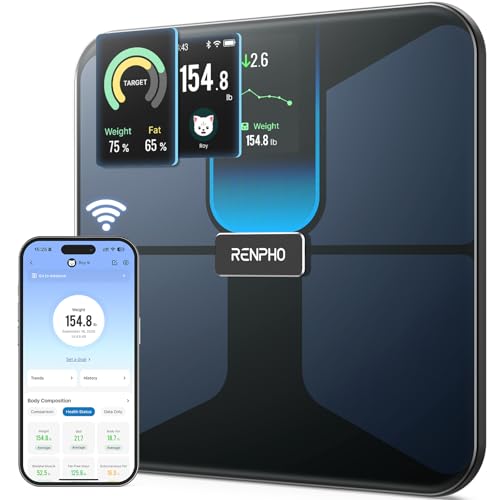
No battery drawer to raid — this one charges, and it pushes data to the cloud over Wi-Fi.
The rechargeable build is the practical win. You plug it in instead of feeding it AAA cells, and it carries both Wi-Fi and Bluetooth, so measurements go to the cloud even when your phone is not in the room. That fits a bathroom where you weigh first thing and pick up your phone later. The body composition side runs on dual-frequency electrodes with a high-conductivity ITO coating, which is the same approach the more expensive picks use to steady their estimates.
On screen you get 18 metrics total — 14 body composition metrics plus 4 target metrics. The TFT display shows weight, BMI and 5 customizable biometrics at a glance, and the app logs meals and calories alongside your weight history. Three modes stand out: Pregnancy Mode, Baby Mode for weighing infants and pets, and Athlete Mode for people training hard. Owners are consistent that entering accurate height and age, and standing barefoot, is what makes the numbers line up — skip those and every reading drifts.
Quality is the most-praised theme by a wide margin, with the app functionality the one area the review pages call mixed. The app itself has no ads or upsells, which is a nice touch, but expect the usual learning curve. It also holds a 4.5+ score at a mid-range price and covers most of what the premium handle scales do, minus the grip electrodes.
Good fit for: anyone tired of swapping batteries who wants Wi-Fi cloud sync and dedicated Baby, Pregnancy and Athlete modes.
Think twice if: you specifically want hand-held segmental readings for each arm and leg — that needs a handle, and this scale reads from your feet.
4. Etekcity Smart Scale

A Wi-Fi scale that answers an Alexa query about how much weight you have lost this month.
This is the most-connected pick in the group. The free VeSync app syncs with Apple Health, Google Fit, Fitbit, MyFitnessPal and Samsung Health, and the scale connects over Wi-Fi so readings land in the cloud without a phone nearby. It even answers an Alexa query — “Alexa, ask VeSync how much weight I have lost this month” — which is a genuinely useful hands-free check when you are getting ready. FSA and HSA eligibility is noted on the listing, worth knowing if you have a flexible spending account.
The on-device TFT display shows up to 9 body metrics without a phone, and the app tracks 14 in total including weight, BMI, body fat and heart rate. An ITO coating on the platform guides your feet into position so the current path stays consistent. The tempered glass build is sturdy, and owners mention the rechargeable battery running for months between charges. The scale supports multi-user profiles and manual weight entry too.
Here is the fair warning: this pick’s accuracy and connectivity are the most-debated in its review pages, with a genuine split between people who find it smooth and people who hit Wi-Fi sync trouble and inconsistent secondary metrics. The core weight reading is solid; the body composition estimates are the part to hold loosely. If your home network is fussy, the Wi-Fi setup may take a couple of tries.
Why it stands out
- Wi-Fi sync plus the widest app integration list here — Apple Health, Google Fit, Fitbit, MyFitnessPal, Samsung Health.
- Alexa voice queries let you hear your monthly loss without touching anything.
- TFT screen shows up to 9 metrics on-device.
- Rechargeable battery and tempered glass frame.
The trade-offs to weigh
- Body fat and the secondary metrics draw mixed feedback — weight is the reliable number.
- Wi-Fi sync has been a trouble spot for some setups.
Best match for: someone already inside the Fitbit, MyFitnessPal or Apple Health world who wants every weigh-in to land there automatically.
Skip the fuss if: you want a scale that works perfectly on a weak or locked-down home network — this one leans hard on Wi-Fi.
5. RunStar Smart Scale
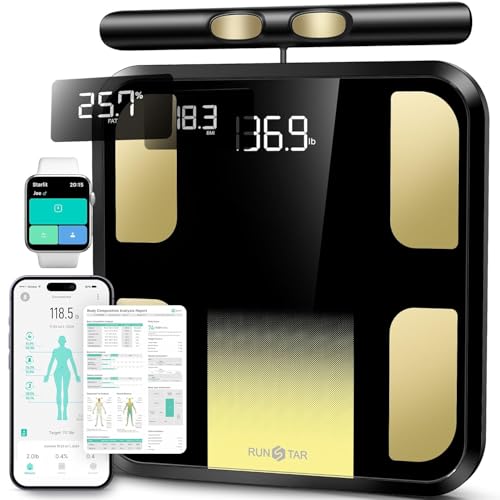
Eight metal electrodes and a dual-frequency scan for people who want the full picture.
This is the cheapest way into a proper full-body scan. The 8 metal electrodes run through a dual-frequency BIA system that captures upper and lower body impedance separately, feeding 28 body composition metrics into the Starfit app — body fat, BMI, visceral fat, muscle mass and the rest. Readout is 0.1 lb up to a 400 lb capacity, and the platform is a 300×300 mm square that gives your feet a stable landing spot.
The everyday build is thoughtful. High-strength ABS edging resists impact, heat and cold, the feet are non-slip, and the cable retracts into the unit. An auto-rotating LED screen cycles weight, body fat and BMI so you see three numbers without opening anything. Offline Mode lets you weigh with no phone and sync later, and family modes cover Pregnancy, Child and Baby. It also pushes to Apple Health, Fitbit and Health Connect.
Size is what people bring up most about this one — the bigger platform is the single most-mentioned theme in its feedback — and the informative readout comes second. The honest caveats are the retractable cable, which some find fiddly rather than helpful, and an app that can be stubborn about logging back in and sometimes confuses two people in the same household. Accuracy sits in the mixed column, so read trends, not single mornings.
Pick this if: you want eight-electrode segmental readings plus 28 metrics without climbing into the premium tier.
Consider the alternatives if: you want a slick app experience — the login friction here is the recurring gripe.
6. LOFTILLA Scale
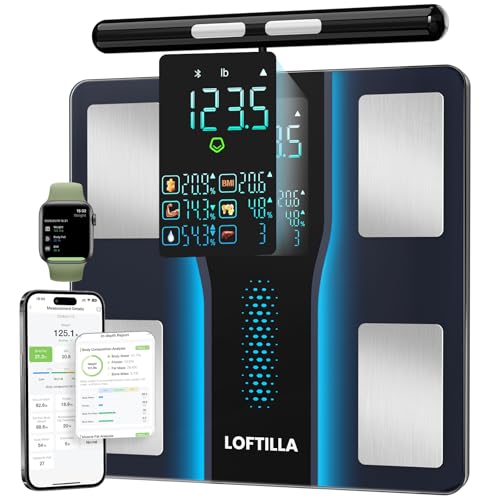
The data hoarder’s pick: 50+ metrics through the app and a 5.4″ screen that shows 8 of them on the spot.
If you like numbers, this is the one. Eight electrodes run through both hands and feet on a dual-frequency BIA system, so the scale analyzes your limbs and torso independently rather than estimating your upper body from your legs. The companion app unpacks over 50 body metrics, including segmental fat and muscle rates, and generates health assessment reports with trend charts. On the unit itself, a 5.4″ LED screen shows 8 core metrics straight after you step off.
Precision is 0.1 lb minimum division up to a 400 lb capacity, with multi-user profiles that auto-recognize each person as they step on. Data syncs automatically to the app and out to Apple Health, Google Fit and other fitness platforms. The tempered glass and ABS body weighs 4 pounds and runs on 3 AAA batteries, included.
What earns the most praise here is build quality — clearly the top theme among owners — with the app’s ease of use close behind. The trade-offs are real but manageable: accuracy splits reviewers, with some finding it dead-on and others seeing inconsistency; you must place it on a solid, flat surface or readings wobble. The app also requires your height and age before full body measurement will start, and it insists on displaying BMI categories, which some people would rather turn off. LOFTILLA notes the unit is not suitable for people with pacemakers or during pregnancy.
Where the money goes: 50+ metrics, eight electrodes, and a screen big enough to read eight numbers without a phone — that is the deepest analysis on this list at a mid-premium tier.
The catch to know: it is picky about placement and needs Bluetooth plus a nearby phone to sync. Weigh on a hard, level floor and it behaves.
Worth it for: data-driven users who want segmental fat and muscle breakdowns and can live with an app that puts BMI front and center.
Not the one for: someone who wants a scale to just show weight and get out of the way — this is a full dashboard.
7. WYZE Scale Ultra BodyScan
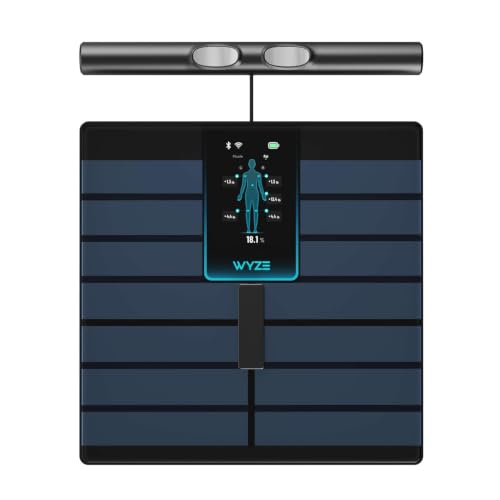
Segmental analysis, a 4.3-inch color screen, and Wi-Fi upload that runs without your phone.
The handle is the point. Eight smart electrodes across both hands and feet measure impedance (how strongly your body resists a tiny current) through your arms, legs and torso individually, then break down 44 metrics — including segmental fat and muscle weight and percentages for each arm, each leg and your torso. You can save and share the report as an image, which makes a doctor’s visit or a coach check-in far easier. That granularity is why it sits at the top of the price tiers here.
Once it is paired to 2.4 GHz Wi-Fi, measurements upload on their own even when your phone is in another room. The 4.3″ full-color TFT screen shows your chosen whole-body metrics without opening the app each time. Up to 8 people get automatic recognition and syncing, guests can take one-off readings, and a Baby/Pet/Luggage mode covers the odd non-human weigh-in. Fitbit, Apple Health and Health Connect are all supported.
Build quality is the runaway theme in its feedback, and ease of use and value follow it. The things to size up honestly: readings can vary by several pounds from one weigh-in to the next, so trends matter far more than any single morning. The app draws split opinions — some find it comprehensive, others find it frustrating. Quality manufacturing is not in question; day-to-day consistency is the part to manage.
Why the premium is fair
- Eight-electrode handle reads arms, legs and torso separately for 44 segmental metrics.
- Wi-Fi auto-upload with no phone required, once set up on 2.4 GHz.
- 4.3″ full-color TFT screen shows selected metrics without opening the app.
- Automatic recognition for up to 8 users, plus guest and Baby/Pet modes.
What to plan around
- Per-reading variability of several pounds — read the trend line, not one number.
- The app divides opinion; some find it clunky.
Choose it if: you want the most detailed segmental breakdown on this list and a color screen that works without a phone.
Pass if: you mostly want a single number on the floor — a four-pad scale does that for a lot less.
Know the Specs
Bioimpedance (BIA) Explained
BIA stands for bioelectrical impedance analysis. The scale sends a weak current through your body and measures resistance. Fat resists more than muscle and water, so the scale estimates body fat percentage from that resistance. It is an estimate, not a lab scan — GE and LOFTILLA both note their BIA data is for trend tracking and is not equivalent to DEXA body composition analysis.
Electrode Count And Segmental Reading
Four pads under your feet read your lower body and estimate the rest. Eight electrodes add hand contacts through a handle, letting the scale measure each arm, each leg and your torso separately. That segmental data is what the RunStar, LOFTILLA and Wyze provide — useful if you are tracking whether a plateau is muscle loss or fat loss in a specific area.
Dual-Frequency Versus Single-Frequency
Current at different frequencies passes through cell membranes differently. Dual-frequency systems run both low and high frequency, which gives a better read on water inside versus outside your cells. That reduces the wobble caused by dehydration or a salty meal. Several picks here use dual-frequency; single-frequency scales still work but are easier to throw off.
Readout Accuracy And Capacity
Increment tells you the smallest change the scale displays, commonly 0.1 lb or 1.6 ounces depending on the model. Capacity is the maximum weight it supports, and several picks here handle 400 lb / 180 kg. Check both against your household before you buy — a scale that tops out low or reads too coarsely is not worth the app space.
Common Questions
How accurate is a home bioimpedance scale for body fat?
Do I need eight electrodes instead of four?
Can I use a bioimpedance scale if I have a pacemaker?
Why does my body fat reading jump around so much between weigh-ins?
Do these scales sync with Apple Health and Fitbit?
Can several people in one household use the same smart scale?
Does the scale need Wi-Fi or just Bluetooth?
Will a big scale fit in a small bathroom?
Are these scales FSA or HSA eligible?
How often should I weigh myself on a body composition scale?
The Bottom Line
For most people, the winner in this home bioimpedance scale shortlist is the Alcedo Smart Body Fat Scale. It pairs a 4.5+ star score with a color cue that tells you at a glance whether you gained, held or lost, and it tracks 20 metrics up to 400 lb — a rounded package for daily consistency without a premium price tier. If you want a big on-device screen and unlimited profiles, reach for the GE Smart Scale. And if segmental, limb-by-limb breakdown is what you are after, the Wyze Scale Ultra BodyScan gives you 44 metrics and phone-free Wi-Fi upload — the pick to own if depth matters more than a single number.
How we choose
We do not accept paid placement. Every pick is matched to a real buyer and a real use-case; we do not hands-on test units.
Sources
Specifications: manufacturer listings and product documentation. Review insights: verified customer reviews, as of October 2026. Pricing: not shown on this page (it changes often); check the current price via the retailer link.
As an Amazon Associate, Aappliancez earns from qualifying purchases. This does not affect which products we feature.