Disclosure: Some links in this post are affiliate links. As an Amazon Associate I earn from qualifying purchases, at no extra cost to you. Learn more
Specs are compiled from manufacturer listings and verified buyer reviews and can change over time — please confirm the key details on the product page before buying.
If your hips feel like they shift or give way with every step, the right brace is the one that holds your pelvis steady without digging into your skin. That is the whole job. Everything else — how soft the fabric feels, whether it hides under jeans, whether you can put it on by yourself — matters only after the brace actually stabilizes you. Below you will find five hip braces that people with joint hypermobility and pelvic instability keep reaching for, each explained in plain terms so you can pick the one that matches your body and your day.
This guide is built by comparing the manufacturers’ published specifications and the patterns across verified customer reviews, so you get each pick’s real strengths and trade-offs instead of marketing spin.
You will see how sizing works around your hips rather than your waist, which materials breathe during long wear, and how a wide stabilization band differs from a stretchy compression sleeve. Every pick here is judged on one thing: how well it keeps a loose pelvis from rolling too far. This breakdown of the hip brace for eds covers sizing by hip measurement, strap adjustment, and how each pick sits under clothing.
Top Picks
How To Choose The Best Hip Brace for Eds
Loose joints need a brace that stops movement at the end of its range, not one that simply squeezes. That single idea separates the picks below, and it is the first thing to get right. Get it wrong and you end up with a band that feels snug but lets your pelvis rotate anyway.
Measure your hips, never your waist
A sacroiliac belt works by wrapping the bony ring where your pelvis meets your lower spine. That ring sits well below your waistline, so a waist measurement will put you in the wrong size every time. Run a tape around the widest part of your hips and seat, then match that number to the maker’s range. Most of the belts on this list list their sizes in hip inches for exactly this reason.
Rigid stability versus soft compression
A belt with a non-elastic layer limits how far your pelvis can roll, which is what hypermobile joints usually need. A stretchy nylon-and-spandex band gives an even hug and stays comfortable all day, but it will not cap that end range the same way. Some people wear both — a firm belt for the joint and a soft band for surrounding muscle. Neither is wrong; they solve different parts of the problem.
Where the brace sits on your body
A stabilizing belt goes low, across the top of your buttocks rather than around your natural waist. If it creeps upward when you sit, it is either too high or too loose. Look for anti-slip backing or a wide band if you plan to wear it through a full work shift.
Will you actually wear it?
Thin profiles disappear under dress trousers, while wide bands with plush straps stay put during activity but add bulk. Think honestly about your day — desk, school run, gym, bed — and pick the shape that fits it.
Side-by-Side Comparison
| Model | Best For | Hip Size Range | Material | Item Weight | Amazon |
|---|---|---|---|---|---|
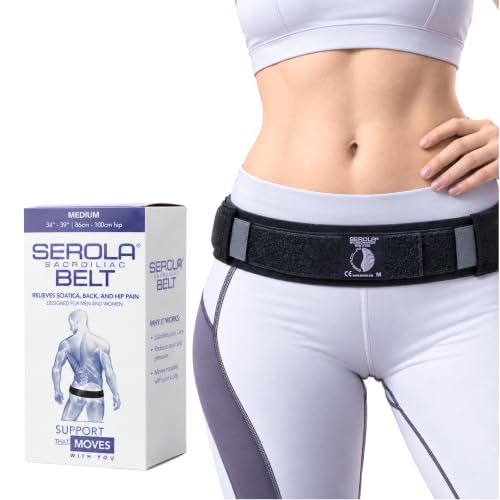
| Serola Sacroiliac Belt★ Best Overall | Firm SI joint stabilization | Small 30–33″ up to XL 46–52″ | Cotton | 4 ounces | Amazon |
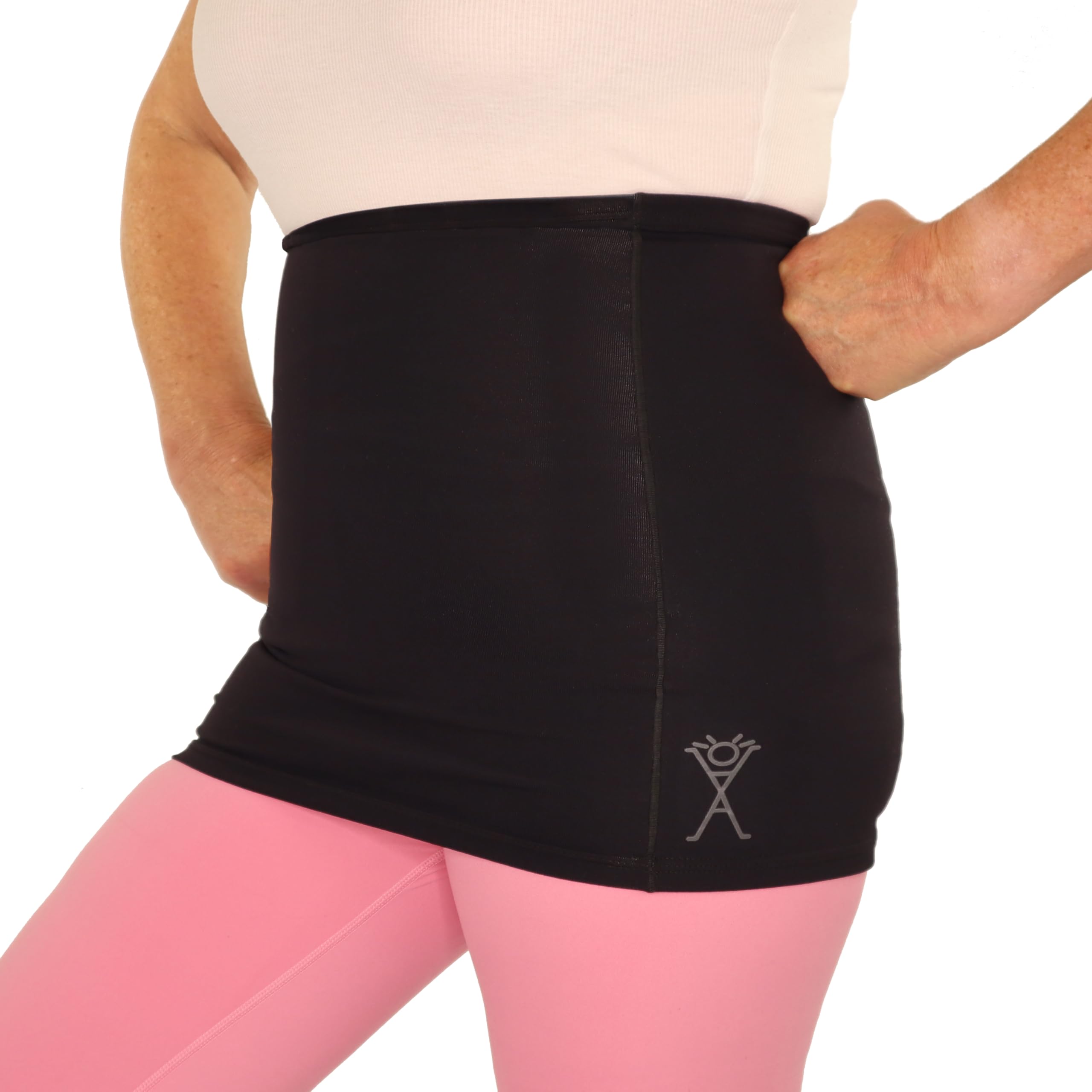
| Alki Active Hip Pain Relief Compression BandBest for All-Day Wear | All-day soft compression for women | Large: waist 30–32″, hips 40–42″ | 20% Spandex, 80% Nylon | 3.53 ounces | Amazon |
| Apecore Sacroiliac SI Hip Belt | Wider hip sizes, easy daily wear | Regular 32–47″, XL-XXL 47–56″ | Neoprene | — | Amazon |
| BraceAbility Hip Support Groin Brace | Groin and upper-thigh wrapping | Fits hip circumference up to 52″ | Breathable neoprene alternative | 8.15 ounces | Amazon |
| ActiveWrap Hip Ice Pack Wrap | Hot and cold therapy around the hip | One size fits most | Neoprene | — | Amazon |
Detailed Reviews
1. Serola Sacroiliac Belt for SI Joint Dysfunction
Our pick — 4.0+★ from 6,500+ verified ratings; the strongest balance of quality and price.
The narrow cotton belt that stops your pelvis from rolling past its limit.
Hypermobile hips fail at the end of their range, and that is precisely where this belt earns its keep. Its patented two-layer build pairs a non-elastic layer that blocks overextension with a secondary elastic layer that adds steady compression. In plain terms, one part says “stop here” and the other part keeps a gentle squeeze on the joint all day. It weighs 4 ounces, so you will not feel it pulling at your waistband.
Wear it low, across the top of your buttocks, and it holds the sacroiliac region without a rigid frame. The fit is measured around your hips, not your waist: Small covers 30–33 inches, Medium 34–39, Large 40–45, and XL 46–52. Get that right and the belt stays put through a full shift on your feet. Long days of standing and driving are what this belt is built around.
What wins people over is simple effectiveness, and it is not a subtle difference. Buyers report walking, sleeping and working again within the first days of wear. The honest catch is comfort, which is the one area that divides opinion. The band is firm and can press into your skin, and getting the placement and tension right takes roughly a month to master. It also wants hand washing, so it is not a toss-in-the-machine item. At 4.0+ stars across thousands of owners, the crowd has clearly made its call.
What holds up under scrutiny
- A non-elastic layer that caps how far your pelvis can rotate, which is the core need for loose joints.
- Narrow enough to sit under jeans and skirts without announcing itself.
- Hook-and-loop closure lets you reset tension on each side.
Before you commit
- Firmer feel than a soft compression band — some skin finds it abrasive.
- Hand wash only, and placement takes practice before it feels automatic.
The one to buy: Choose this if your priority is stopping pelvic rotation during long standing or walking days.
Try something softer first: If skin sensitivity or quick on-and-off matters more than maximum stability.
2. Alki Active Hip Pain Relief Compression Band for Women
A pull-on band you can forget about from breakfast until bed.
Not every hip day calls for a rigid belt. This one slips on like a wide band and stretches over your hips and core in a blend of 20% Spandex and 80% Nylon — the stretchy half giving the hug, the nylon giving it shape. There are no straps to thread and nothing to re-tension. You step in, pull it up, and go. It is designed for women, and it is machine washable, which puts it ahead of the hand-wash-only belts on this list.
The Large is cut for a waist of 30 to 32 inches and hips of 40 to 42 inches. That sizing is tighter than some buyers expect, and the most common misstep is ordering your usual size and finding it will not clear your thighs. The band also measures 14 x 14.5 x 0.5 inches, which is far more material than the compact Serola above at 7 x 1 x 2.9 inches — and at 3.53 ounces it is slightly lighter than the Serola’s 4 ounces despite covering more area.
Arthritic hips draw its best notices: wearers call it comfortable enough to replace a neoprene brace and slim enough to sit flat under clothing. A hair stylist on her feet 10 to 12 hours a day found it eased joint strain, though it needed a tug downward a couple of times a shift. Be clear-eyed about its limit: it hugs, it does not lock. If your sacroiliac joint needs firm external support, this alone will not deliver it — a wearer with a torn labrum put it plainly, that you would pair it with a separate SI brace for real posterior support.
Where sizing bites: Measure your hips before you order, and size up if you are between ranges. The fabric is soft, so an undersized band fights you every time you pull it on.
Made for: Women who want a soft, washable hug through a long shift or a night’s sleep.
Not the answer for: Anyone whose main problem is a pelvis that shifts out of alignment and needs hard resistance.
3. Apecore Sacroiliac SI Hip Belt
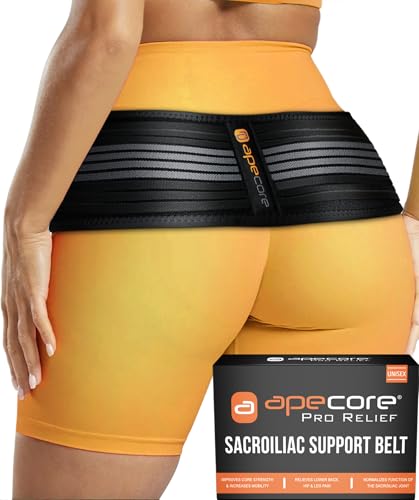
Two-wide sizing bands and grippy neoprene that refuses to ride up.
If you have struggled to find a brace that goes wide enough, start here. The Regular covers hip circumferences of 32 to 47 inches and the XL-XXL covers 47 to 56 inches, and the design is unisex. That spread does more heavy lifting than any feature on the page, because a belt that does not fit cannot stabilize anything. Measure your hips, not your waist, and land squarely inside one of those bands.
The construction is neoprene with an anti-slip surface, so it grips rather than slides up your back when you move. Two elastic tension straps let you set tightness independently, and the hook-and-loop closures come with easy tabs so you are not picking at the edge with your nails. It arrives with instructions and a travel pouch, and it can go over clothing as easily as under it.
Owners cite sciatica relief most often, then build quality — the closures hold instead of slipping, the failure point on cheaper belts. One honest note: the rubberized mesh traps heat, so a muggy afternoon outdoors will leave you clammy. Fit is the other split, with some wearers finding the band narrower than they wanted across the pelvis. Hand wash only, so plan on a sink rather than a machine. If your hips fall between the standard ranges above, this is often the brace that finally fits.
The sizing logic: Two overlapping ranges mean fewer dead zones. Check where you sit before ordering and lean toward the wider band rather than the tighter one.
Wear it over layers: Neoprene holds warmth, so a thin base layer keeps the belt from sticking to bare skin on hot days.
Best match for: Wider hips and anyone who wants adjustable dual-strap tension without a custom order.
Consider the Serola instead: If staying cool and low-profile under clothing outranks grip and size range.
4. BraceAbility Hip Support Groin Brace

The long wrap that reaches the groin and upper thigh other belts skip.
Most hip braces stop at the pelvis. This one keeps going. Its 79-inch groin compression wrap covers hip circumferences up to 52 inches and can be worn on either the right or left leg, so a pull or strain near the crease of your hip finally gets direct pressure. It is marketed for hip flexor strains, labral tears and post-pregnancy pubic symphysis issues. It weighs 8.15 ounces, the heaviest wrap here, because there is simply more fabric.
The material is a breathable neoprene alternative, which keeps the wrap cooler than solid neoprene during sport. A non-slip backing is meant to stop the bunching and rolling that plagues long wraps. It fits under or over clothing, and once you learn the strap path, adjustment is quick — it is the learning that takes a few tries.
Comfort is what this brace does best, and support for the hip flexor comes second in owner experience. Under dress pants it stays quiet, and the compression is enough to walk with less pain. The trade-off is real, though: it is a wrap, not a belt, so it asks more of you when you put it on and take it off. A few wearers also found the current cut shorter than an earlier version and had to fiddle to keep it positioned. Treat it as a targeted groin and thigh tool, and pair it with a proper SI belt if pelvic rotation is your main issue.
Why it earns a slot
- 79 inches of wrap reach the groin and upper thigh where short belts cannot.
- Breathable non-neoprene material stays cooler through activity.
- Works on either leg and under clothing.
What to square away first
- More steps to put on than a simple pull-on band.
- At 8.15 ounces it is the heaviest pick, and the current cut runs shorter than some buyers expected.
Reach for this when: Your pain sits at the groin or hip flexor and a pelvis belt leaves it untouched.
Go elsewhere when: You want a five-second belt for lower-back stability and nothing more.
5. ActiveWrap Hip Ice Pack Wrap

One wrap that does ice, heat and compression without an ice machine.
A reusable gel pack goes into the sleeve and can be frozen or heated, so the same brace handles a fresh swelling day and a stiff, achy evening. The main body runs 14 x 12 inches, side straps 17 x 4.25 inches, with two 22 x 4 inch extenders to dial the fit in. That is the whole kit, no bulky machine required.
Plush waist and leg straps hold the wrap in place while you walk, rest or use mobility aids, which matters when a sliding ice pack stops helping. Because the gel inserts freeze separately from the wrap, they take up far less freezer room than a large pad — a genuine space saver in a shared kitchen. Neoprene construction keeps the wrap soft against skin, and you can wear the brace on its own once the cold is done.
Quality is the feature that stands out most, followed by how simple it is to use, and the wrap keeps its grip through bending and sitting. Where it divides people is temperature and size. Some find the pack holds cold long enough for a full session; others want more cooling than a single pack delivers, so buying a spare is worth planning for. It also comes in one size, and it runs large — a smaller frame may find the coverage generous rather than snug. For hip surgery or a labral tear, this is the recovery tool rather than the everyday stabilizer.
How to get the most from it: Rotate two gel packs so one is always frozen while the other is on your hip. That solves most of the “not cold enough” feeling in one move.
Suits you if: You are in the recovery window after hip surgery, arthroscopy or a labral repair and need repeatable cold therapy.
Keep looking if: You need pelvic stabilization for daily walking rather than symptom relief.
Know the Specs
Hip Circumference Range
Every belt on this list is sized around your hips, because that is where the brace sits. A range like 32 to 47 inches tells you which band of bodies the manufacturer cut the belt for. Fall outside it and the straps either cannot tighten enough or cannot close, and neither situation stabilizes a joint. Measure the widest part of your hips and seat with a tape pulled snug, not slack.
Non-Elastic Versus Stretch Material
A non-elastic stabilizing layer resists being pulled further open, which caps how far your pelvis can rotate. Stretch fabric such as a spandex and nylon blend gives an even hug that moves with you but will not stop end-range roll. For hypermobile joints that sublux, the non-elastic layer matters more. For aching muscle and general discomfort, the stretch band is often the more comfortable long-day choice.
Closure Type
Hook-and-loop closures (the hook side grabs the loop side, like a velcro strap) let you fine-tune tension per side and reset it as your body shifts through the day. Neoprene belts with dual tension straps give more control than a plain pull-on band. The trade-off is that hook-and-loop needs clean contact to hold, so keep lint and fabric fluff off the strap.
Weight and Bulk
A 4-ounce belt disappears under clothing and will not drag at your waist. A wrap in the region of 8 ounces covers more of the groin and thigh but is the heaviest piece here. Weight tells you how much fabric you are committing to, and that in turn tells you whether the brace will stay on through a full day or come off at lunch.
Common Questions
Should I measure my hips or my waist when sizing a hip brace?
Can a hip brace help if I have Ehlers-Danlos syndrome?
How tight should a sacroiliac belt be?
Can I wear a hip brace under my clothes all day?
What is the difference between an SI belt and a hip compression band?
Should a hip brace be worn while sleeping?
Will a hip brace help with sciatica?
Can I machine wash a hip brace?
Do hip braces come in sizes for wider hips?
How long can I wear a stabilizing belt in one go?
The Bottom Line
For most people chasing real pelvic stability, the winner is the Serola Sacroiliac Belt, because its non-elastic layer actually limits how far a loose joint rotates and it stays narrow enough to wear under everyday clothing. If you want a soft, washable band you can forget about during a long shift, the Alki Active Compression Band is the comfortable choice. And if your hips sit above the standard ranges, the Apecore SI Hip Belt is the one to reach for — with two sizing bands reaching 56 inches, it fits where many belts simply do not. Whichever you pick, measure your hips first; that single step decides whether any of these braces can do their job.
How we choose
We do not accept paid placement. Every pick is matched to a real buyer and a real use-case; we do not hands-on test units.
Sources
Specifications: manufacturer listings and product documentation. Review insights: verified customer reviews, as of October 2026. Pricing: not shown on this page (it changes often); check the current price via the retailer link.
As an Amazon Associate, Aappliancez earns from qualifying purchases. This does not affect which products we feature.