Disclosure: Some links in this post are affiliate links. As an Amazon Associate I earn from qualifying purchases, at no extra cost to you. Learn more
Specs are compiled from manufacturer listings and verified buyer reviews and can change over time — please confirm the key details on the product page before buying.
If reading a menu, a phone screen or a pill bottle has turned into a squint-and-guess game, you need stronger magnification than the drugstore rack usually stocks. You also want a lens that blocks screen glare, which drives much of that daily eye ache. Four pairs here do both jobs. They run from a five-pack of 2.00x metal readers to a 2.50x no-line multifocus set that lets you look up without taking them off.
This guide is built by comparing the manufacturers’ published specifications and the patterns across verified customer reviews, so you get each pick’s real strengths and trade-offs instead of marketing spin.
Below you will find the magnification, frame material and blue-light coating of each pair laid out side by side, so you can match one to how and where you actually read. These are the strongest options for high power reading glasses.
Top Picks

How To Choose The Best High Power Reading Glasses
Get the magnification strength right before you compare frames or coatings. A 2.00x pair and a 2.50x pair look nearly identical on the rack, but they pull the clear zone closer to your face. Buy too weak and you keep holding the page at arm’s length; buy too strong and the words sharpen only when the print is very near your nose.
Match the power to the distance you read at
Higher magnification brings the near-focus point in tighter. That makes a 2.50x reader excellent for close handwork like threading a needle or reading tiny type on a bottle label. A 2.00x pair usually sits more comfortably for a book held a little further out or for glancing between a page and a keyboard. If you spend long stretches at a desk, a progressive lens that transitions from a reading zone at the bottom to a lighter zone up top saves you from pushing the glasses up and down all day.
Decide if you need a progressive lens or a single power
A plain reader has one magnification across the whole lens, so everything past a few feet goes soft and you have to remove the glasses to look across the room. A progressive multifocus lens blends several zones into one no-line surface, so you can keep them on to read, look at a screen and see people across the table. The trade-off is that a progressive needs a couple of days of adjustment, and the outer edges of the lens fall out of focus as your eyes move to the side.
Look at the frame and the coating, not just the lens power
Spring hinges and a soft silicone nose pad decide whether a pair stays put and avoids pinching over a long afternoon. Blue-light coating on the lens cuts the glare that bounces off phone and monitor screens, which is what makes a pair comfortable for screen-heavy days. A scratch-resistant hard coat keeps the lens clear after months of pocket and drawer life — a scratched lens scatters light and defeats the whole point of a high-power pair.
Side-by-Side Comparison
| Model | Best For | Magnification | Lens Style | Pack Size | Amazon |
|---|---|---|---|---|---|
| JOLISU 5PCS Reading Glasses 2.00★ Best Overall | Keeping a pair in every room | 2.00x | Single power | 5 pack | Amazon |
| CARA Extremely Lightweight Progressive Multifocus Reading Glasses 2.50x | Desk and screen work | 2.50x | Progressive multifocus | 2 pack | Amazon |
| SKYOAK Premium Durable TR Progressive Multifocus +2.5x | All-day wear without removing them | +2.5x | Progressive multifocus | 2 pack | Amazon |
| GUNNAR Blue Light Reading Glasses Vertex | Heavy computer and gaming use | Reader power | Single power | 1 pair | Amazon |
Detailed Reviews
1. JOLISU 5PCS Reading Glasses 2.00
Our pick — 4.5+★ from 850+ verified ratings; the strongest balance of quality and price.
Five pairs of 2.00x metal readers, so there is always one within reach.
You get five 2.00x pairs in five colors instead of one, so a pair can live in the car, the kitchen and the couch cushions. Each frame is a thin metal half-frame with spring hinges, a design that grips the side of your head instead of pinching at the temples. The lens carries UV400 protection and a blue-light coating, so phone and monitor glare gets filtered while you read. It is a single-power lens, meaning the whole surface is 2.00x and anything past a few feet goes soft.
Buyers single out the metal half-frame for feeling solid rather than flimsy. The metal frame reads as solid in the hand, not flimsy, and the lens holds its clarity without the wavy distortion that plagues cheap drugstore pairs. The soft silicone nose pads sit lightly and the spring hinges stretch to fit wider heads — a genuinely common complaint this pair answers well. And because there are five, a scattered-glasses household stops guarding one precious pair: buyers report keeping them clipped to a shirt, dropped on the floor, and shoved in a bag, and the frames keep going.
Here is the honest catch. If you want to look up from your book and see the room sharply, a single-power 2.00x reader will not do it — you either remove them or look over the top. This is a reading pair, not a walking-around pair. And at 3.53 ounces it is the heaviest option in this group; the premium progressive picks run far lighter, so long desk shifts may push you toward a multifocus frame instead.
Where it wins
- Five pairs in different colors for roughly the cost of one spare
- Spring hinges and silicone nose pads fit a wide range of faces without pinching
- UV400 lens with a blue-light coating and anti-fog, anti-reflective finish
- Metal half-frame holds up to being dropped and pocketed
Where it gives ground
- Single 2.00x power means everything past a few feet blurs
- At 3.53 ounces it is the heaviest pair here
Reach for this if: you want a dependable 2.00x reader parked in every room and you read books and labels more than you read screens.
Look elsewhere if: you need one pair that stays on while you switch between a page, a screen and the person across the desk.
2. CARA Progressive Multifocus Reading Glasses 2Pack 2.50x
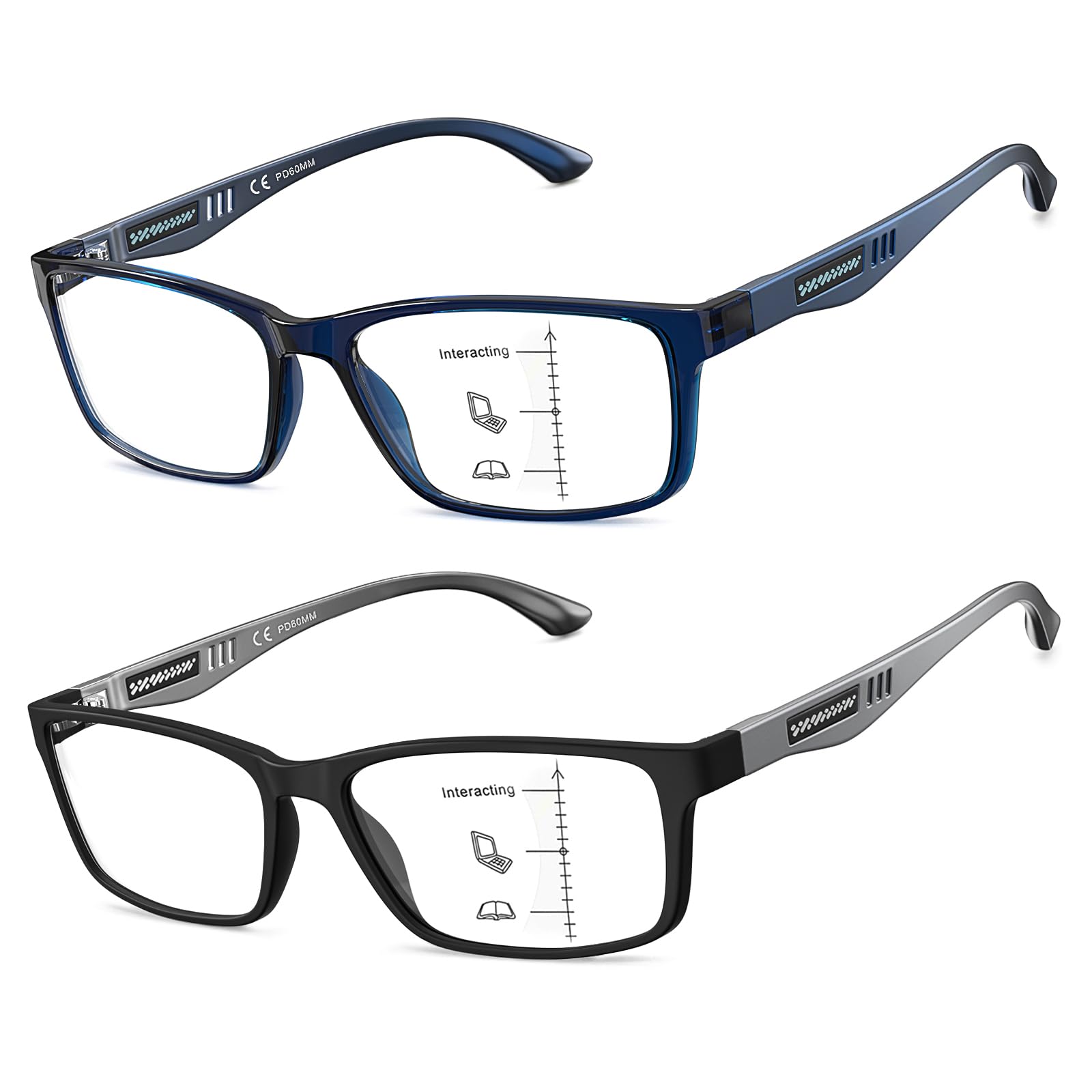
A 2.50x no-line lens on an 11-gram frame, built for people who live at a desk.
This is the strongest magnification in the group at 2.50x, and it goes one step further than a plain reader by blending three zones into one no-line surface. The top is not zero power, so looking up at a coworker stays usable. The middle is a light transitional boost for screen work. The bottom is your full 2.50x for a newspaper or a phone. That layered design is what lets you keep these on through a whole workday, moving from a book to a monitor to a conversa tion without the on-off-on shuffle.
The frame is the other headline: Grilamid TR90, a flexible Swiss-made polymer, at only 11 grams without the lens. That makes it dramatically lighter than the JOLISU multipack’s 3.53 ounces — roughly a third of the weight on your nose all afternoon. A wraparound temple end grips behind the ear so the glasses do not slide when you look down, and the one-piece nose pad is thin enough to ease pressure over long sessions. The polycarbonate lens is anti-scratch with a blue-light coating and UV400 protection, and it carries FSA and HSA approval as a listed feature.
Reviewers praise this pair most for range: they report clear focus from 6 inches to 12 feet, far past the 2-4 feet a standard reader gives you. That means you can read a label up close, then glance across the room, without swapping glasses. The soft spot is the edges. A progressive lens (one lens with a close zone at the bottom and a distance zone up top) asks your eyes to find the right zone, and a few buyers find that transition blurry, especially in dim light. It is also explicitly not a driving or long-distance pair. Expect a day or two to learn where to look.
The real flex: a progressive lens that stretches usable focus to 12 feet on an 11-gram frame, at a two-pack price that undercuts most single progressives.
Set your expectation: this is workspace eyewear, not prescription replacement — no custom tuning per eye, and dim rooms blur the transition.
Suits you if: you bounce between a screen, a page and a short walk across the office and you are tired of taking readers off to look up.
Not your pair if: you need to read a road sign or drive — that is outside what this lens is built for.
3. SKYOAK TR Progressive Multifocus Reading Glasses +2.5x

The half-frame progressive that lets you stay in them from desk to doorway.
This pair is built for the person who never wants to take their glasses off: +2.5x magnification in a no-line progressive lens (one lens that shifts from close-up to mid-range with no visible line). The lower zone handles close reading at 2.5x. The blended zones above let you lift your gaze to a monitor or a face about 3 feet away without a hard blur line. SKYOAK’s own listing frames it around desktop viewing — monitors, desks, spaces roughly 3 feet apart — and that is where a progressive earns its keep. It sits in the same 2.50x territory as the CARA above, so the choice between them depends on frame and feel, not magnification.
Part of why this pair feels so easy to keep on is weight: 0.95 ounces, a feathery half-frame that sits far under the JOLISU’s 3.53 ounces. Your nose is not fighting the frame by mid-afternoon. The build pairs TR90 temples (a flexible, lightweight plastic) with a metal front frame for durability, and the silicone nose pads sit comfortably. The blue-light coating filters screen glare, which cuts the eye fatigue that builds over long sessions. The set ships with two protective bags, a microfiber cloth and an eyeglasses strap — the strap being the one accessory that keeps a half-frame from sliding when you look down.
Reviewers rate the fit and the styling highest, saying the frame looks far more expensive than it costs. The recurring gripe is the outer edges. Looking through the side of a progressive takes a moment to adapt to, a few buyers find the lens thickness noticeable up close, and clarity fades once you look past about 20 feet. Walking around outdoors is where a couple of people notice a little dizziness. That is the nature of a progressive, not a defect. Keep them for close and mid-range work and they stay sharp.
Best for all-day desk wear: the 0.95-ounce frame plus a no-line progressive makes this the pair you forget you have on through a full workday.
Know the outer-edge rule: turn your head rather than your eyes toward the side of the lens, and these stay clear; look out the far edge and focus softens.
Go with this one for: a comfortable +2.5x progressive you can wear continuously at a desk and keep on to talk to people.
Think twice if: you want sharp vision across a room or outdoors — beyond about 20 feet this lens runs out of focus.
4. GUNNAR Vertex Blue Light Reading Glasses
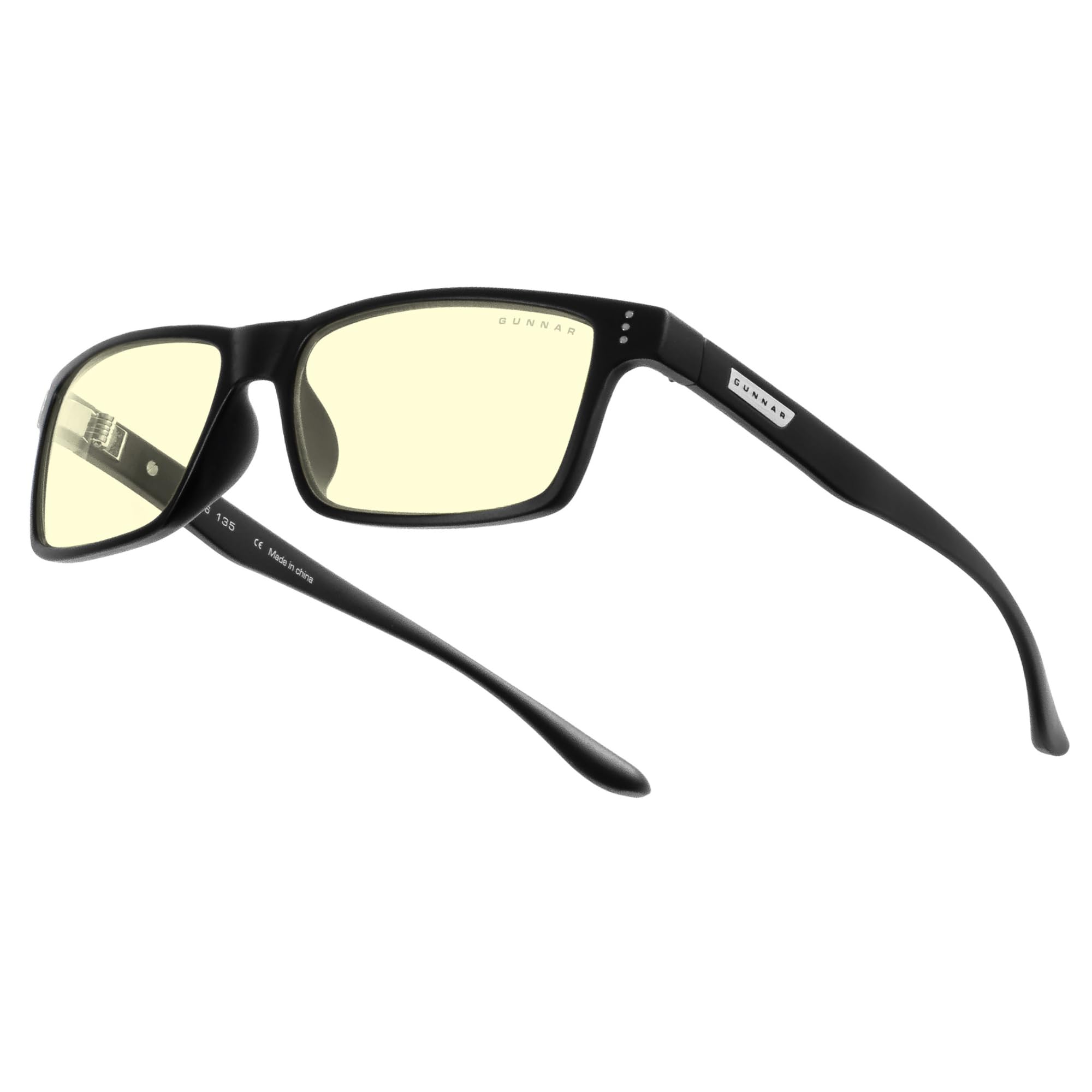
The screen specialist: a tinted lens engineered to block 65% of blue light.
GUNNAR built its name on glare control, and the Vertex is the pick if most of your reading happens on a laptop, a phone or a monitor. The stated 65% blue-light block is the headline spec: the amber tint filters that slice of the spectrum and lifts contrast so text and game detail pop. The patented optical design sharpens detail and eases the focus effort your eyes make hour after hour, and the polymer frame uses multi-barrel hinges. Magnification is right on target for close work, so fine print comes into focus cleanly.
Owners credit the lens for the contrast boost and the drop in screen strain after long sessions. There is a light tint on the lens that most find pleasant rather than distracting, and the clarity through the center is excellent for reading a 6-point font up close. For gaming and long computer sessions, the comfort and focus effect is precisely the job. Because blue-light blocking and lens quality carry the praise, this is the pair to pick when screen time, not paperback reading, is your main complaint.
Two honest points. The tint and the engineered lens make this the premium pair of the group, so it is the biggest single spend — though owners call it worth it. The other is durability: most report a sturdy, scratch-resistant build, while an occasional pair has given out early, so treat the frame with a little care and it serves you well. And one buyer’s fair note — these are superb for reading and light screen work, but if you do color-critical editing, a tinted lens will skew what you see.
Reasons it earns the premium
- Blocks 65% of blue light with a contrast-lifting tint
- Patented optical design that sharpens detail and eases focus effort
- Clear enough for 6-point fine print up close
- Multi-barrel hinges and a scratch-resistant hard coat
The honest trade-offs
- The highest spend of the four, single pair only
- Occasional reports of early frame failure
- The amber tint shifts color, so skip it for color-accurate work
Pick this for: screen-heavy days where glare, headaches and dry eyes are the enemy, and you want the strongest blue-light block in the lineup.
Skip it for: color-critical design or editing work, where the amber tint would throw off what you see on screen.
Know the Specs
Magnification Strength (2.00x vs 2.50x)
The number on the temple — 2.00x, 2.50x — is how much the lens magnifies, and higher power pulls your clear reading zone closer to your face. That makes a stronger pair ideal for very fine print and close handwork. It also means a 2.50x lens feels strong for a book held further out. If you have never worn readers, start where a drugstore pair feels comfortable, then step up only if the print still blurs at your normal reading distance.
Progressive Multifocus vs Single Power
A single-power reader magnifies evenly across the whole lens, so anything past a few feet goes soft. A progressive multifocus lens blends a reading zone at the bottom into lighter zones above, with no visible line, so you can read, glance at a screen and look at a person without removing the glasses. The cost is a short adjustment period and softer focus toward the outer edges of the lens, where you learn to turn your head instead of your eyes.
Common Questions
How do I know whether I need 2.00x or 2.50x readers?
What does progressive multifocus actually mean in reading glasses?
Can I wear progressive reading glasses for driving?
Do blue-light reading glasses really reduce eye strain from screens?
Will the SKYOAK +2.5x progressive fit a wider face?
Is the GUNNAR Vertex better for computer work than a plain reader?
How many pairs do I get and how should I store them?
Are these a replacement for a prescription from an eye doctor?
Why do the edges of a progressive lens blur?
Will a tinted blue-light lens change the colors I see?
The Bottom Line
For most readers, the strongest all-round buy among these high power reading glasses is the JOLISU 5-pack. You get five sturdy 2.00x metal pairs with blue-light lenses, so there is always one within reach, and the fit handles wide heads without pinching. If you want one comfortable pair that stays on through a whole desk day, reach for the SKYOAK +2.5x progressive. Its 0.95-ounce half-frame is the lightest way to keep a multifocus lens on your face. When screen glare and long monitor sessions are the real problem, the GUNNAR Vertex earns its keep with a stated 65% blue-light block. One nudge: if you are torn between a plain reader and a progressive, go progressive. The CARA and SKYOAK both keep you reading, glancing up and talking without the daily on-off shuffle that sends cheap readers to the bottom of a drawer.
How we choose
We do not accept paid placement. Every pick is matched to a real buyer and a real use-case; we do not hands-on test units.
Sources
Specifications: manufacturer listings and product documentation. Review insights: verified customer reviews, as of October 2026. Pricing: not shown on this page (it changes often); check the current price via the retailer link.
As an Amazon Associate, Aappliancez earns from qualifying purchases. This does not affect which products we feature.