Disclosure: Some links in this post are affiliate links. As an Amazon Associate I earn from qualifying purchases, at no extra cost to you. Learn more
Specs are compiled from manufacturer listings and verified buyer reviews and can change over time — please confirm the key details on the product page before buying.
To get the deep, bitter taste of real cacao and the flavanols (plant compounds in cacao) without extra sugar, check the cacao percentage on the label first. That number shows how much actual cocoa mass is inside. A higher percentage means more flavanols and less room for sugar.
This guide is built by comparing the manufacturers’ published specifications and the patterns across verified customer reviews, so you get each pick’s real strengths and trade-offs instead of marketing spin.
Chocolate sits on a spectrum from candy bar to raw cacao powder, and your goals decide where you land on it. If you want the easiest daily flavanol boost, a powder stirs into hot milk or a smoothie in seconds. For a chewable square you can grab on the go, a bar or individually wrapped piece wins. Start here for high flavanol dark chocolate.
Top Picks

How To Choose The Best High Flavanol Dark Chocolate
Flavanols come from the cocoa solids in the bar, powder, or disc. That means the label percentage is your starting point — but it isn’t the whole story. Sweetener type, form (bar vs. powder vs. baking disc), and how the batch was tested all change what ends up in your hand.
Read The Cacao Percentage First
The percentage on a dark chocolate label is the share of the bar that comes from the cocoa bean — cocoa solids and cocoa butter combined. A 72% bar is mostly cocoa with a little sugar and usually some vanilla or soy lecithin to smooth it out. The higher you climb, the more cocoa you get per bite and the less sugar is in there — which is exactly the trade-off flavanol chasers want.
Look For Heavy-Metal Testing On The Label
Cocoa plants pull cadmium and lead from the soil, and those metals get concentrated as beans are processed into dark chocolate. Powders and high-percentage bars use more cocoa solids per gram, so the risk is higher. Third-party lab testing, where an outside lab checks each batch for cadmium, lead, mercury, and arsenic, is the strongest signal that the manufacturer is paying attention.
Match The Form To How You’ll Eat It
Powder dissolves into drinks and baked goods. Bars and squares are for eating straight. Baking discs are designed to melt cleanly and temper for pastry work. Buying the wrong form means fighting your own food — powder clumps in a candy recipe, bars are awkward in a smoothie. Pick the format that matches your daily habit first, then dial in the percentage.
Understand What The Sweetener Does
Sugar-free dark chocolate leans on monk fruit, allulose, erythritol, or a blend. Monk fruit brings sweetness without the cooling aftertaste sugar alcohols like erythritol and maltitol leave behind, so it tends to taste closer to real sugar. If you’ve tried sugar-free chocolate before and disliked the mouthfeel, that’s usually the culprit — not the cocoa.
Side-by-Side Comparison
| Model | Best For | Cacao % | Form | sugar per serving | Amazon |
|---|---|---|---|---|---|
| Aduna Super Cacao Powder★ Best Overall | Daily drinks and smoothies | 100% (unsweetened) | Powder — 275g | 0g (unsweetened) | Amazon |
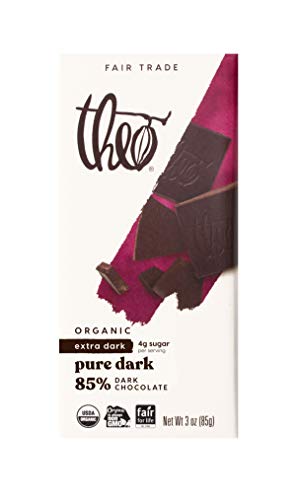
| Theo Organic Dark Chocolate 85%Best Everyday Bar | Everyday dark chocolate bar | 85% | Bar — 6-pack, 3oz each | Low (85% cocoa) | Amazon |
| Bouchard Belgian Dark 72% | Portioned snacking | 72% | Individually wrapped pieces | 1.3g per piece | Amazon |
| ChocZero 92% Squares | Sugar-free keto snacking | 92% | Individually wrapped squares — 4 pack | 0g (monk fruit) | Amazon |
| Valrhona Guanaja 70% Feves | Serious baking and pastry | 70% | Baking discs (feves) — 250g | Not specified | Amazon |
Detailed Reviews
1. Aduna Super Cacao Powder 275g
Our pick — 4.5★ from 900+ verified ratings; the strongest balance of quality and price.
The cleanest route to flavanols without a single gram of added sugar.
Fifty grams of cacao taste pours into your mug — the highest flavanol concentration possible in a food product, because there is literally nothing in the tin but ground Ghanaian cacao beans. No sugar. No lecithin. No vanilla masking a cheap base. If you’re chasing flavanols specifically, this is the format where you get the most of them per spoon because every gram is cocoa. Pour it into hot milk, shake it into a smoothie, or bake it in — it works in all three.
The brand takes heavy metals seriously. Every batch is tested by a third-party laboratory for cadmium, lead, mercury, and arsenic, and the results sit well within EU food-safety limits. West African cacao tends to carry less cadmium than South American cacao, and the manufacturer leans into that. That’s not a marketing flourish — it’s a real distinction that matters for anyone eating cacao daily.
The taste is the other thing buyers rave about. Rich, dark-chocolatey, not bitter — as buyers report: “Aduna brand super cocoa powder is top quality. A product of Ghana, West Africa, it’s rich and mixes well in hot water.” It dissolves cleanly into warm liquid without the chalky clumps cheaper powders leave behind. The tin holds 9.7 ounces of powder.
Weighing the ongoing question most buyers ask: this is more expensive per ounce than grocery-aisle cocoa. If you’re drinking it daily, the cost adds up faster than a bar. That’s the honest trade-off — you’re paying for lab testing, single-origin traceability, and unsweetened purity, not volume. For someone committed to a morning cacao ritual, it’s worth it.
What Makes This The Winner
- 100% cacao — zero filler, zero added sugar, maximum cocoa per spoon
- Third-party lab testing on every batch for cadmium, lead, mercury, and arsenic
- Single-origin Ghanaian cacao with documented heavy-metal profile
- Dissolves cleanly into hot water and hot milk without clumping
- 9.7-ounce tin lasts weeks of daily use
The Honest Catch
- Costs more per ounce than supermarket cocoa powder
- Unsweetened and unflavored — you’ll want to add your own milk or sweetener
- Powder form means no on-the-go eating; it’s a kitchen product
Made for the daily cacao drinker: if your goal is a flavanol-rich mug every morning and you want to know exactly what’s in it, this is the strongest starting point on the list.
Not your pick if: you want something you can eat straight from the package or you need a budget-volume haul.
2. Theo Chocolate Dark Chocolate Bar 85% Cacao 6 Pack
The creamy 85% bar that proves high cacao can still taste smooth.
Most 85% bars land somewhere between bitter and punishing. Theo’s doesn’t — that’s the thing owners keep coming back to. Smooth and creamy enough that you forget you’re eating a bar that’s nearly all cocoa. The fair-trade certification and organic ingredients mean the farming side isn’t a dirty secret either. Six individually wrapped 3-ounce bars per pack, which is enough to get you into a daily habit without committing to one giant block.
Compared to the powder pick above, this is a completely different experience. The powder gives you a drink; this gives you a bar you can break off and carry. Same flavanol story, different delivery. Buyers describe it as “the best chocolate we have found with lower sugar content” — that’s the pitch. 85% cacao keeps the sugar low while still tasting like a treat, not a health-food chore.
The size math is worth noting: the powder comes in a 9.7-ounce tin, while this six-pack weighs in at 18 ounces total. If you’re buying by weight, the bar pack delivers a lot more chocolate for the cupboard. That’s the practical case for keeping a pack of Theo on hand rather than refilling a powder tin every few weeks.
The recurring gripe is freshness — chocolate that was fine in cooler months can arrive showing bloom or white film in warmer weather, which is a delivery problem rather than a formula problem. That’s worth knowing if you’re ordering in summer; otherwise the flavor delivers. Owners also split on value — the same bar that feels like a treat to some feels pricey per ounce to others. Which side you land on depends on how often you’re eating it.
Texture payoff: Smooth and creamy at 85% cacao is genuinely rare — most brands hit that percentage and the bar turns chalky. Theo somehow keeps it silky without dropping the cocoa content, which is why flavor dominates what owners talk about.
Fair-trade factor: Fair for Life certification plus organic and non-GMO ingredients mean the sourcing isn’t the standard commodity chain. If that matters to you as much as the cocoa percentage, this is one of the few picks on this list that delivers both.
Pick this if: you want a shelf-stable, individually wrapped 85% bar that tastes good enough to replace your afternoon candy habit.
Look elsewhere if: you’re ordering in hot weather and can’t guarantee the box won’t sit on a loading dock.
3. Bouchard Belgian Dark Chocolate 72% Cacao
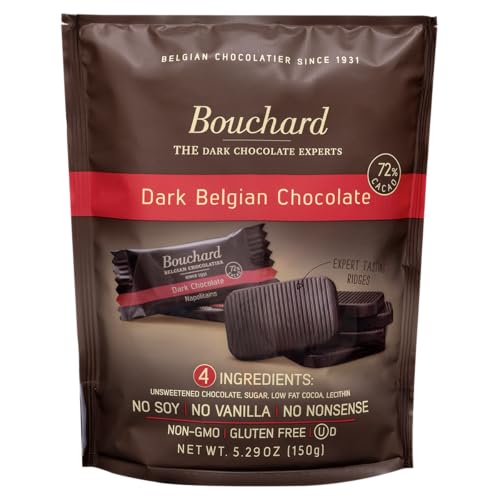
Belgian-made 72% in individually wrapped pieces — snack-sized but real chocolate.
At 72% cacao, this is the mellowest pick on the list. Belgian chocolate makers are known for coaxing smoothness out of mid-range cacao percentages, and Bouchard is no exception. It’s also keto-friendly, vegan, non-GMO, gluten-free, and alkali-free, with 50% less sugar than the brand’s milk chocolate formula and just 1.3 grams of sugar per piece. Twenty-eight calories per piece. That last number matters if you’re watching portions — the individually wrapped squares make it easy to eat one and stop.
The ingredients list is unusually clean for a European-style chocolate. No soy. No vanilla — which is the ingredient many manufacturers use to mask a low-quality cocoa base. Just real cocoa, cocoa butter, and the flavor the beans bring. If you’ve been eating vanilla-heavy dark chocolate your whole life and wondering why it tastes sweeter than the label suggests, that vanilla is usually the answer.
Two honest gripes come up. First, the pieces are small — great for quick snacking, but if you want a full chocolate-square experience, each piece may vanish too fast. Second, warm-weather shipping can be a problem: Belgian chocolate melts easily and may not arrive in its original shape, so a chilled delivery helps if you can set it up.
Portion-control design: Individually wrapped pieces at 1.3 grams of sugar each take the guesswork out of serving size. If you struggle with “just one square” discipline on a big bar, the packaging does the work for you.
What to expect taste-wise: Flavor and quality are what buyers actually enjoy here — clean, rich, and not cloying. A handful of tasters pick up a slight bitter edge versus sweeter Belgian brands, but that’s a preference line, not a quality line. If you like Ghirardelli-level sweetness, drop to a lower cacao percentage.
Right for you if: you want snack-sized dark chocolate squares, Belgian-made, with under-2-gram sugar per piece and zero vanilla masking.
skip it if: you’re ordering in hot weather without a delivery window you can control — the chocolate can melt in transit.
4. ChocZero 92% Cocoa Dark Chocolate Squares 4 Pack
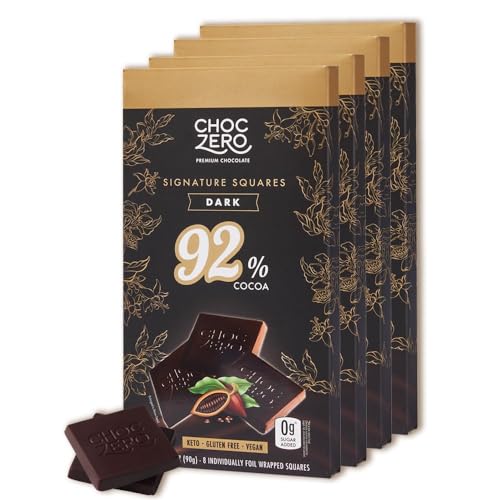
The 92% square that tastes deeper than its bitterness number suggests.
Here’s the technical hook: most sugar-free chocolate leans on sugar alcohols like maltitol or erythritol, and they leave a cool, slightly chemical aftertaste that ruins the experience. ChocZero skips them entirely and sweetens with monk fruit instead. The result is a 92% cocoa square that keeps the deep, roasted flavor of high-cacao chocolate without the “dieter’s chocolate” weirdness. Nine grams of fiber and one gram of net carb per piece, zero added sugar.
The gap between 92% and 85% is bigger than the numbers suggest. At 92% you’re getting more cocoa solids per piece, which means more flavanols, but also a bolder, more roasted profile. Buyers here describe it as “deep, rich, not bitter” — that’s the exact balancing act this product manages. The squares are individually wrapped for portioning and easy to toss in a lunch bag or keep on a desk drawer for a mid-afternoon square.
The dry-ice and melt situation is worth flagging. This product ships with a cold pack because chocolate doesn’t love warm trucks, and in warmer months the cold pack can arrive melted even when the chocolate itself survives. That’s an Amazon logistics story, not a ChocZero formula problem — but if you’re buying this specifically as a gift, timing matters. Chocolate ordered in mild weather arrives in better shape than chocolate ordered at the height of August.
What Owners Actually Praise
- Monk fruit instead of maltitol or erythritol — no cooling aftertaste
- 0g sugar and 9g fiber per serving with 1g net carb for keto
- 92% cacao delivers deep, roasted flavor without bitterness
- Four-pack of 3.2-ounce boxes with individually wrapped squares
- Vegan and dairy-free — cocoa, cocoa butter, monk fruit, vanilla beans
What To Know First
- Cold-pack shipping can arrive melted during hotter months
- 92% cocoa is a bold flavor — lower-percentage fans may find it intense
- Sugar-free sourcing costs more than standard chocolate per ounce
Bought best by: keto dieters and sugar-free eaters who want a genuinely deep 92% chocolate and refuse to compromise on aftertaste.
Think twice if: you’re counting on a gift arriving chilled in the middle of summer.
5. Valrhona Dark Chocolate Discs GUANAJA 70% Cacao

The pastry-chef chocolate discs that make every dessert taste restaurant-grade.
These aren’t a snacking product — they’re an ingredient. Valrhona’s Guanaja 70% is what pastry chefs reach for when the chocolate is the hero of the recipe, whether that’s a mousse, a soufflé, a hot fudge, or a hand-dipped truffle. The “feves” shape (small, flat, teardrop-like discs) melts evenly and tempers cleanly, which is a real difference from chopped bar chocolate that scorches unevenly in a double boiler. 250 grams per bag, and the brand says the cocoa is 100% traceable to the producers.
The flavor is the main draw. Buyers call it “velvety and silky” and say it “melts smoothly with espresso and gives it so much depth.” That warm, bitter taste matches the label’s “intense with bitter notes” — this is not a sweet chocolate, it’s a complex one. If your recipe needs clean chocolate flavor, the difference between Valrhona and a supermarket baking chip is clear even to non-experts.
At 70% cacao, this is the balance for baking: high enough for real cocoa depth without overpowering butter, cream, and sugar. Some buyers notice a slightly chalky surface bloom on arrival — a normal sign of temperature swings in transit. It doesn’t affect flavor or melting, but worth knowing if appearance matters to you. And yes, the price is high for a bag this size. It’s a specialty ingredient, not an everyday buy.
What earns the pastry-chef reputation: The feves shape is the real win — those flat discs melt at a lower, more even temperature than chocolate chips or chopped bars, so tempering, mousse, and hot chocolate turn out more reliably. Buyers making mousses, mochas, and cheesecakes all report the same smooth result.
One caveat for hot-weather bakers: Chocolate that has seen a warm truck can arrive with slight surface bloom, and this brand is not immune. It still melts and tastes the same — the bloom is cosmetic — but if you’re plating a dessert for a photo you’ll want to know it can happen.
Best in the hands of: bakers and home pastry hobbyists who treat chocolate as the star ingredient and don’t want the cheapest chip in the recipe.
Not for you if: you’re looking for a bar to break off and snack on, or your recipe buries chocolate deep enough that a budget chip would work just as well.
Know the Specs
Cacao Percentage
The percentage on a dark chocolate label is the share of the product that comes from the cocoa bean — cocoa solids plus cocoa butter, combined. Everything else in the bar is sugar, a milk powder (in milk chocolate), an emulsifier like soy lecithin, or a flavoring like vanilla. A 92% bar is almost all cocoa; a 70% bar has meaningful room for sugar. For flavanol seekers this matters because flavanols live in the cocoa solids, so a higher percentage delivers more per bite — as long as you’re eating the same weight.
Heavy-Metal Testing
Cocoa plants take up cadmium from the soil, and lead can settle on beans during drying. Both metals concentrate as cacao is processed into chocolate, and the concentration climbs higher in products with more cocoa solids. A third-party lab test for cadmium, lead, mercury, and arsenic is the clearest indication that a maker is monitoring the supply chain rather than ignoring the issue. Cacao from West Africa tends to test lower on cadmium than cacao from South American sources, which is why some brands market their origin specifically.
Sugar And Sweetener Choice
If a bar is labeled sugar-free, look for the sweetener. Monk fruit brings sweetness with no sugar-alcohol cooling effect, so the chocolate tends to taste closer to standard dark chocolate. Sugar alcohols like erythritol and maltitol are cheaper and more common, and they leave a cool, sometimes metallic aftertaste — the reason many sugar-free chocolates get reviewed as tasting “off” even when the cocoa content is high. The sweetener defines the texture and aftertaste more than the cacao percentage does.
Baking Discs Vs Bars Vs Powder
Feves (the disc shape Valrhona uses) are designed for repeatable melting — flat discs hit a more uniform temperature in a double boiler, which matters for tempering and mousse. Standard bar chocolate can be chopped, but chopping creates uneven pieces that heat at different rates. Powder is the right form only when the cocoa needs to dissolve into a liquid or batter, not when it needs to hold structure. Buying the right form for your use saves the most frustration.
Common Questions
What cacao percentage counts as high flavanol dark chocolate?
Does dark chocolate with high cacao actually have less sugar?
Is cacao powder better than dark chocolate bars for flavanols?
How much heavy metal is in dark chocolate and which brands test for it?
Can you eat high cacao dark chocolate on keto or a low carb diet?
Why does sugar free dark chocolate sometimes taste different?
Is 72% or 85% cacao better for baking?
How should dark chocolate be stored and does it melt in shipping?
What does high flavanol dark chocolate actually do for you?
Are the Valrhona Guanaja discs worth the premium over standard baking chocolate?
The Bottom Line
If you drink your cacao instead of eating it, the Aduna Super Cacao Powder is the winner — 100% cacao with zero filler, third-party tested for heavy metals on every batch, and single-origin from Ghana. For a bar you can break off and carry, choose the Theo Organic 85% — a smooth, creamy 85% that doesn’t punish you for wanting a higher percentage. And if you need portion-sized squares with no sugar at all, reach for the ChocZero 92% — monk fruit sweetened, keto-friendly, and one of the few sugar-free chocolates that tastes like real chocolate.
How we choose
We do not accept paid placement. Every pick is matched to a real buyer and a real use-case; we do not hands-on test units.
Sources
Specifications: manufacturer listings and product documentation. Review insights: verified customer reviews, as of October 2026. Pricing: not shown on this page (it changes often); check the current price via the retailer link.
As an Amazon Associate, Aappliancez earns from qualifying purchases. This does not affect which products we feature.