Disclosure: Some links in this post are affiliate links. As an Amazon Associate I earn from qualifying purchases, at no extra cost to you. Learn more
Specs are compiled from manufacturer listings and verified buyer reviews and can change over time — please confirm the key details on the product page before buying.
If you have ever stood in the cereal aisle staring at boxes that promise “whole grain” while hiding a pile of sugar per serving, you already know the frustration. High fiber and low sugar rarely live in the same box, and when they do, the texture can taste like cardboard. This guide sorts out which cereals actually deliver on both counts, using published nutrition specs and the honest experiences of thousands of buyers.
This guide is built by comparing the manufacturers’ published specifications and the patterns across verified customer reviews, so you get each pick’s real strengths and trade-offs instead of marketing spin.
Whether you are managing blood sugar, counting carbs, or just trying to stay full until lunch, the five picks below cover every texture and dietary need. Here is everything you need to find the best High Fiber Low Sugar Cereal for your breakfast bowl.
Top Picks


How To Choose The Best High Fiber Low Sugar Cereal
The label on the front of a cereal box tells you almost nothing useful. “Made with whole grain” can mean a sprinkle of oats over refined flour. “Lightly sweetened” can mean a sugar bomb. What matters is the nutrition panel and the ingredient list, and those two pieces of information separate the cereals that actually work from the ones that just look healthy.
Fiber per serving — the number that keeps you full
Fiber is the reason a high-fiber cereal keeps hunger away until lunch instead of letting it sneak back at 10 a.m. A cereal with 3 to 4 grams per serving is a decent start, while bran-heavy options that push 8 or more grams per serving do noticeably more work. Soluble fiber, the kind found in oats and psyllium, slows digestion in a way that helps you feel satisfied longer. Insoluble fiber from wheat bran adds bulk. Cereals with both soluble and insoluble fiber keep you full longer than either type alone. Check the grams, not the front-of-box claims.
Sugar content — read the added sugar line
The “total sugars” number on a nutrition panel includes naturally occurring sugars from dried fruit or milk ingredients, while the “added sugars” line shows what was poured in during manufacturing. Look at the added sugar line first. Cereals labeled unsweetened should show 0g there. If a cereal does not list added sugar separately, check the ingredient list for syrups, cane sugar, honey, or fruit juice concentrate — all of those land in the same column. For anyone watching blood sugar or cutting carbs, the lower that number, the better the cereal fits your goals.
Serving size — why it changes everything
Nutrition numbers are per serving, and serving sizes vary wildly between brands. A cereal with 8 grams of fiber per 1-cup serving is impressive, but if you naturally pour 2 cups into your bowl, you are getting two servings. That is not a problem — it just means the box runs out faster than you expect and the numbers double. The same logic applies to protein and carbs. When comparing two cereals, make sure you are comparing the same scoop size, or the winner may just be the one with the smaller serving.
Side-by-Side Comparison
| Model | Best For | Fiber Per Serving | Sugar | Protein Per Serving | Amazon |
|---|---|---|---|---|---|
| NuTrail Protein Nut Granola★ Best Overall | Crunchy snacking & yogurt topping | 3–4g | Zero added sugar | 15–17g | Amazon |
| All-Bran Buds (2-Pack)Fiber Powerhouse | Maximum daily fiber | Excellent source of fiber | Low fat | — | Amazon |
| Trader Joe’s High Fiber Cereal (2-Pack) | Low-calorie daily bowl | High fiber | Low sugar | — | Amazon |
| Julian Bakery ProGranola | Keto & grain-free clusters | 11g | No sugar | 11g | Amazon |
| Three Wishes Unsweetened | Allergen-free crunch | 3g | 0g | 8g | Amazon |
Detailed Reviews
1. NuTrail Protein Nut Granola Cereal
Our pick — 4.0+★ from 300+ verified ratings; the strongest balance of quality and price.
15–17g of whey protein per serving with zero added sugar — granola that earns its bowl.
If you pour granola over yogurt every morning, this is the box to reach for. Each two-thirds-cup serving packs 15 to 17 grams of protein — the kind of number that turns a light breakfast into something that actually holds you until lunch. The protein comes from whey crisps that are baked into the clusters, so it is a complete protein source rather than a sprinkle on top. And the added sugar line reads zero, which is rare for granola that tastes this crunchy and sweet.
Fiber lands at 3 to 4 grams per serving, which is a solid daily contribution. This granola is made with real nuts and seeds, baked with a touch of butter, and contains no seed oils.
What wins people over is the taste — it carries a protein-powder-style flavor that buyers describe as making yogurt feel like a treat rather than a chore. The crunch holds up in milk and does not turn to paste. Meanwhile, the value-for-money conversation is more mixed: some buyers feel the bag disappears too fast for the cost. Buyers report: “These are nice size bags that last for a week or two.” Treat it as a topping and snacking granola rather than a big-bowl cereal and the math works better.
The strong points
- 15–17g protein per serving from whey crisps — more than double what most cereals deliver
- Zero added sugar with a genuinely sweet, buttery crunch
- No seed oils, made with real nuts and seeds
- 3–4g fiber per serving for daily gut support
Worth knowing
- Smaller bags mean a granola habit runs through the pack faster than a big cereal box
- Sweeter profile than bran-based cereals — a fit mismatch if you prefer savory or bland
Perfect for: Yogurt bowls, smoothie toppers, and anyone who wants protein first thing without sugar.
Look elsewhere if: You want a large-volume cereal you can fill a big bowl with every single morning.
2. All-Bran Buds Breakfast Cereal
Wheat bran plus psyllium: the highest-fiber bowl on this list, built for regularity.
This is the cereal you buy when fiber is the whole point, not a bonus. The twin pack holds 35.4 ounces total across two 17.7-ounce boxes, which is 47% more cereal than the NuTrail variety pack at 24 ounces — and at 2.47 pounds it weighs more too. The blend of wheat bran and psyllium is where the fiber comes from, and each serving is fortified with 100% daily value of folic acid plus Vitamins B6 and B12. It is low fat, and a genuinely versatile grab for lunchboxes, backpacks, and desk drawers.
Taste is what earns it a following. Buyers call it chewy and filling, and it hides easily in smoothies, yogurt, or muffin batter when the plain bowl is not calling. The trick most owners learn is mixing half a cup to a cup daily into something they already enjoy, rather than eating it dry. One quirky note: the buds are chewy and cling to your teeth, so a rinse or brush after breakfast keeps things tidy. The flavor itself is mild — closer to a wheat-bran base than a sweet cereal.
The recurring gripe is the imported packaging, which pushes the cost above what a standard grocery-store box runs, and some buyers find the fiber count harder to pin down than the US version. The value side lands as mixed rather than negative, so if the price works for you, the effectiveness side tends to deliver. It is a genuinely useful pantry staple if high fiber is your top priority.
The power move: Half a cup a day mixed into yogurt, smoothies, or baked goods gets the fiber in without needing the cereal to taste great on its own.
Consider before buying: If you expect a sweet bowl of cereal, the bland chewy texture will surprise you. This is a supplement-style cereal.
Reach for this if: You want maximum fiber per bowl and don’t mind mixing it into something else.
Look elsewhere if: You want a cereal that tastes good enough to eat plain with milk.
3. Trader Joe’s High Fiber Cereal, 14.5 oz (Pack of 2)

Low-calorie, high-fiber, and so hard to find in stores that fans buy it two boxes at a time.
Here is the cereal that cereal aisle regulars describe as the highest-fiber, lowest-sugar option they have found after years of hunting. It is light, low in calories, and efficient — two traits that do not usually live together in a cereal box. The twin pack holds 29 ounces total across two 14.5-ounce boxes. Flavor lands as OK rather than exceptional, which means it works best as a mixer: a scoop into keto granola, a sprinkle over yogurt, or a base under fresh fruit.
What keeps this one on the list is the low-calorie density. You can eat a real bowl without the calorie load climbing, which is the exact trade most shoppers are chasing. Buyers also note it mixes well with sweeter bases, which is a real advantage when the plain bowl tastes flat. The catch is availability — supply is genuinely inconsistent, which is the entire reason a two-box pack shows up as a buy-in-bulk move.
The cost side is where buyers push back. Some find it priced well above what the same cereal runs at the source, and the value-for-money read across reviews leans negative for that reason. If you can get it locally, that is a better move; if you cannot, this is the way to keep the bowl stocked. Delivery packaging has occasionally arrived scuffed too, though the cereal itself has been fine.
Why it earns a spot: Low-calorie density means you can eat a genuinely full bowl without the numbers climbing — a rare quality among high-fiber cereals.
One trade-off to weigh: Sold above in-store pricing, so buyers here pay a premium for availability, not for a superior product.
Best fit: Calorie-conscious eaters who want a real bowl, not a rationed half-cup.
Think twice if: You can buy it in person — you’ll pay more through the mail.
4. Julian Bakery ProGranola Cereal

Vanilla cinnamon clusters with 11g protein, 11g fiber, and 2 net carbs per serving.
For anyone keeping daily carbs dialed in, the numbers here do real work: 11 grams of protein and 11 grams of fiber per serving against just 2 net carbs. That fiber load is nearly three times what Three Wishes delivers in a serving, which matters if fullness is your goal rather than just low sugar. It is certified gluten free and grain free, made with no sugar and no artificial ingredients, and it ships as a three-pack of 9-ounce bags. The clusters are the point — crunchy, mildly sweet, and holding their shape in milk.
The taste and quality picture is genuinely split. Some buyers call it the best low-carb granola they have found and love the crunch-to-sweetness balance — “wonderfully moldly sweet and very crunchy” captures the fans’ read. Others find the texture chalky, the flavor dust-like, and the bag too small for the cost. Some have noticed the recipe changing from prior purchases, which is a fair signal that batch-to-batch consistency is not this brand’s strongest suit.
That split verdict is worth weighing honestly. This is a specialty pick for a niche diet, not an everyday-family cereal. If ketogenic macros are non-negotiable and you want a crunchy cluster that fits them, this delivers the numbers. If you want a crowd-pleasing cereal the whole household will eat plain, look elsewhere. Expect to order directly from the maker at times, since availability on Amazon comes and goes.
What it nails: 11g protein, 11g fiber, and 2 net carbs per serving is a rare macro combo that fits keto and gluten-free plans at once.
Where it splits buyers: Texture and flavor are polarized — crunchy and pleasantly sweet for some, chalky and dusty for others. Buy one bag first if you’re new to it.
Suited to: Keto and grain-free eaters who want a crunchy cluster that fits their macros.
Not the pick if: You need a universally liked bowl the whole family will eat plain.
5. Three Wishes Gluten Free Protein Cereal
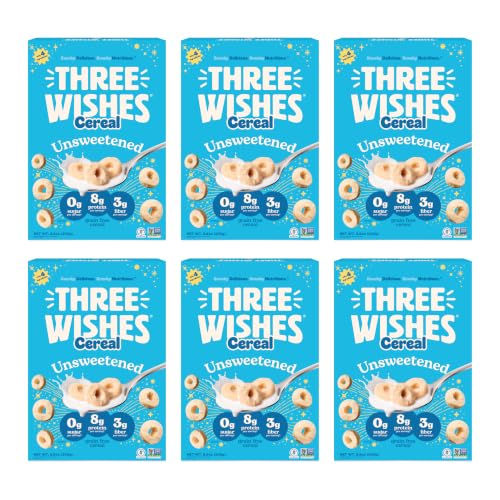
Unsweetened O’s that stay crunchy in milk and skip wheat, corn, rice, oats, peanuts, soy, and dairy.
The list of things this cereal does not contain is almost longer than what it does: no wheat, corn, rice, oats, peanuts, soy, or dairy — and no sweeteners, fillers, or artificial ingredients either. Each 35-gram serving delivers 8 grams of plant-based protein and 3 grams of fiber, made from just four ingredients — chickpea, tapioca, pea protein, and salt. It is gluten free, vegan, Kosher, and Non-GMO. The six-pack brings six 8.6-ounce boxes, and the uncoated O’s hold their crunch even after you pour the milk, which is the real functional payoff.
The taste story here is what keeps this cereal in baskets. It earns a strong reputation for crunch and for genuinely having no sugar, and the plain taste turns out to be a feature — it takes on whatever you add. Pile on fruit, nuts, seeds, and milk, and it becomes a real breakfast. One buyer’s routine stacks it with fruit, nuts, seeds, and sugar-free milk; another sprinkles it over an acai bowl for added protein and crunch. Because the taste is neutral, it works in savory trail mixes and yogurt parfaits too.
The honest caveat is the cost. Buyers tend to find it expensive for what lands in the bowl, and a recipe change upset some loyal customers who felt the bags got smaller and pricier. It also runs a much lighter protein and fiber count than the Julian Bakery clusters — 8g protein and 3g fiber against 11g and 11g — so it is the crunch-and-allergen play, not the macro-maximizer. Reach for it when a clean ingredient list and safe-for-everyone crunch matter more than maximizing protein per bite.
Where it wins
- 0g sugar and just four simple ingredients — chickpea, tapioca, pea protein, salt
- Free of the eight major allergens: wheat, corn, rice, oats, peanuts, soy, dairy, nuts
- Gluten free, vegan, Kosher, Non-GMO — one box for nearly every dietary plan
- Uncoated O’s stay crunchy after milk, and the neutral taste takes on any topping
Before you buy
- Higher cost per bowl than bran-based cereals — value reception across reviews is the soft spot
- Only 3g fiber and 8g protein per serving — lighter than the ProGranola clusters
- Recipe and bag-size changes have frustrated some long-time buyers
Ideal match: Allergy-conscious eaters who want a crunchy, unsweetened bowl without reading a long ingredient label.
Skip if: You are chasing max protein and fiber per bite — the ProGranola delivers a stronger macro punch.
Know the Specs
Fiber — soluble vs insoluble
Fiber is the headline number in any low-sugar cereal. Soluble fiber, found in oats, psyllium, and most beans, dissolves in water and forms a gel that slows digestion — that is the type linked to feeling full longer. Insoluble fiber, the kind in wheat bran, adds bulk and keeps things moving. All-Bran Buds blends wheat bran and psyllium for both. Looking for 3 grams or more per serving is a reliable starting floor; 8 to 11 grams per serving is a heavy hitter.
Sugar and net carbs
Added sugar is the difference between a cereal that supports your goals and one that undermines them. Unsweetened cereals list 0g added sugar and rely on the grain itself for any sweetness. “Net carbs” is total carbohydrates minus fiber — the number keto eaters track. A cereal with 2 net carbs per serving is doing serious work; one with 20 is a standard breakfast cereal. Read the label per serving, not per box.
Protein source and quality
Protein per serving separates a light breakfast from a filling one. Plant-based protein, from chickpea or pea, works for vegan and dairy-free diets. Whey protein, from milk, is a complete protein and denser per gram. Either way, check the number on the nutrition panel — three grams does almost nothing, fifteen grams genuinely changes how long you stay satisfied.
Grain content and allergens
Grain-free cereals swap wheat, oats, and rice for chickpea, tapioca, or nut flours. That matters if you are avoiding gluten, corn, or grains for dietary or medical reasons. It also usually means a higher cost and a lighter crunch than traditional flakes. If allergens are a real concern, look for cereals that explicitly list the top eight allergens as absent, and confirm the “gluten free” or “vegan” claim on the label rather than the front-of-box copy.
Common Questions
How much fiber should a high fiber cereal have per serving?
Is a zero sugar cereal better than one with a little sugar?
Will high fiber cereal keep me full until lunch?
Are grain-free cereals keto friendly?
Does high fiber cereal help with digestive regularity?
Which high fiber low sugar cereal is best for gluten free diets?
Is unsweetened cereal supposed to taste bland?
How long does a box of high fiber cereal last once opened?
Should I compare fiber and protein per cup or per actual serving?
Does the cereal stay crunchy after adding milk?
The Bottom Line
For most people searching for the best high fiber low sugar cereal, the strongest choice is NuTrail Protein Nut Granola because it lands 15–17g of whey protein and zero added sugar in a genuinely crunchy, buttery granola that works over yogurt or by the handful. If your single goal is maximum fiber per bite, grab the All-Bran Buds twin pack — 35.4 ounces of wheat bran and psyllium is the heaviest daily-fiber option on this list. For allergen-free crunch, the Three Wishes Unsweetened six-pack is the box to reach for, and keto eaters should look at the Julian Bakery ProGranola for 2 net carbs per serving. Whichever you pick, check the added sugar and fiber lines on the nutrition panel before you trust the front of the box.
How we choose
We do not accept paid placement. Every pick is matched to a real buyer and a real use-case; we do not hands-on test units.
Sources
Specifications: manufacturer listings and product documentation. Review insights: verified customer reviews, as of October 2026. Pricing: not shown on this page (it changes often); check the current price via the retailer link.
As an Amazon Associate, Aappliancez earns from qualifying purchases. This does not affect which products we feature.