Disclosure: Some links in this post are affiliate links. As an Amazon Associate I earn from qualifying purchases, at no extra cost to you. Learn more
Specs are compiled from manufacturer listings and verified buyer reviews and can change over time — please confirm the key details on the product page before buying.
A high-end sound bar delivers theater-style Atmos without running speaker wire through your walls. The catch is that most bars in this tier look similar on a shelf while behaving very differently in your living room. Some throw sound above and behind you from one box; others only come alive once you add a subwoofer and rear speakers. This guide separates bars that fill a large room from ones that only look the part on a shelf.
This guide is built by comparing the manufacturers’ published specifications and the patterns across verified customer reviews, so you get each pick’s real strengths and trade-offs instead of marketing spin.
You will see channel counts, driver sizes, and room-tuning features explained in plain terms, plus the honest limits of each pick. The crowd favorite here sits at 4.5+ stars across 740+ owners, but the right match depends on room size and seating distance. These are the picks worth your attention when you’re shopping for the best high-end sound bars.
Top Picks


How To Choose The Best High-End Sound Bars
Spending serious money on a sound bar only pays off when the bar matches your room size, your TV’s HDMI eARC port, and how loud you actually listen. A 54-inch chassis that shakes a dedicated theater will overwhelm a small apartment. A compact bar that sounds tidy in a bedroom can vanish in an open-plan living room. Match the bar’s width and subwoofer to the space first, then audit the features.
Channel count tells you where sound comes from
The three numbers in a spec like 11.1.4 describe how many speakers fire forward and sideways, how many subwoofer channels you get, and how many fire upward for overhead effects. More height channels generally mean a more convincing sense of rain, aircraft, and ceiling-rattling explosions. A 3.1.2 bar puts sound around you but keeps the overhead effect modest. An 11.1.4 system with rear speakers wraps the sound behind your head too.
Subwoofer size and count matter more than watts
Deep bass comes from moving air, and moving air needs a big cone — a 12-inch sub moves far more than a 4-inch in-bar driver. A 12-inch wireless subwoofer will pressurize a room in a way a pair of 4-inch drivers inside the bar cannot. Dual 10-inch subs go further still, adding output and smoothing out the low end. If you live in an apartment with shared walls, a smaller sub or a bar with a night mode is the wiser choice.
Room calibration is not a gimmick — it adjusts timing and tone to your furniture and walls.
Features like Sonos Trueplay, Bose Adaptiq, and Sony Sound Field Optimization measure your room with a microphone and adjust the sound to your furniture and walls. Hard floors, curtains, and low ceilings all change what reaches your ears. Calibration evens out those quirks so dialogue stays anchored to the screen instead of smearing across the room.
Check your TV’s HDMI port before anything else
Most premium bars rely on an HDMI eARC port to pass Dolby Atmos from your TV in one cable. If your TV only has an older ARC port or an optical output, some features simply will not switch on. Confirm your TV model supports eARC and Atmos passthrough before you commit to any bar in this tier.
Side-by-Side Comparison
| Model | Best For | Channels | Subwoofer | Key Streaming | Amazon |
|---|---|---|---|---|---|
| Sonos Arc Ultra★ Best Overall | All-in-one Atmos in a clean room | 9.1.4 | Built-in bass, Sub sold separately | WiFi, Bluetooth, AirPlay 2, Spotify Connect | Amazon |
| Klipsch Reference Home Theater PackFull Cinema Kit | Full separate-speaker cinema | 5.2 with height channels | 2x 12″ powered subwoofers | WiFi via receiver | Amazon |
| Samsung HW-Q600FSamsung TV Partner | Samsung TV owners on a budget | 3.1.2 | Wireless subwoofer | Bluetooth | Amazon |
| Klipsch Flexus CORE 200 | Bass without a separate box | 3.1.2 | Dual 4″ built-in | Bluetooth | Amazon |
| Bose Smart Dolby Atmos Soundbar | Small rooms and quiet listening | Dolby Atmos with TrueSpace | None built-in | Bluetooth, AirPlay 2, Spotify Connect, Chromecast | Amazon |
| Bose Smart Ultra Soundbar | Dialogue-first movie nights | Dolby Atmos, six transducers | None built-in, bass module optional | Bluetooth, Wi-Fi | Amazon |
| Samsung Q990F | Rear-speaker surround with a Samsung TV | 11.1.4 | Included subwoofer | Alexa, Google Cast, AirPlay 2 | Amazon |
| JBL Bar 1300X | Detachable surrounds, no wall wiring | 11.1.4 | 12″ wireless subwoofer | WiFi, AirPlay, Chromecast | Amazon |
| Sony BRAVIA Theater Bar 9 | PS5 and BRAVIA TV owners | 13 speaker units | Optional SW3/SA-SW5 | Spotify Connect, AirPlay 2, Bluetooth | Amazon |
| Nakamichi Shockwafe 11.2.6 | Theater-scale rooms | 11.2.6 | Dual 10″ wireless subwoofers | AirPlay 2, Bluetooth | Amazon |
| KEF XIO | Music-first listening in one bar | 5.1.2 | None built-in, sub output included | Wi-Fi 6, Bluetooth 5.3, AirPlay, Google Cast | Amazon |
Detailed Reviews
1. Sonos Arc Ultra Soundbar with Dolby Atmos
Our pick — 4.5+★ from 700+ verified ratings; the strongest balance of quality and price.
One slim bar that puts effects above your head and keeps every whispered line readable.
The number that carries this pick is 9.1.4 — nine front and surround channels, one bass channel, and four that fire upward for overhead effects. That is a huge leap past the 3.1.2 Samsung below, a 2.9x gap in raw channel count. In practice it means a single slim bar can suggest helicopters, rain, and ceiling noise without a second box on your floor. The Sound Motion acoustic architecture and Dolby Atmos support do the heavy lifting, and the metal enclosure keeps the look tidy under a large TV.
What wins people over most is dialogue. Speech Enhancement uses AI to detect the human voice and lift it clear of the score, so mumbled television drama stops being a rewind exercise. Setup is genuinely one cable — a single HDMI eARC run to your TV — and the Sonos app walks you through the rest. Trueplay then tunes the sound to your room using your phone’s microphone, which owners say is worth running more than once.
The honest catch is bass depth and cable quality. Owners describe full, rich bass for a bar this size, but a separate Sub and Era 300 rears are the route to true surround. Some also hit audio dropouts from the bundled HDMI cable and fixed it with a certified high-speed replacement. Expect no traditional remote either — you steer it with your TV remote, the app, or your voice.
Where the Arc Ultra earns its keep
- 9.1.4 channels put real height effects in one bar, no ceiling speakers needed
- Speech Enhancement pulls dialogue forward so quiet scenes stay followable
- Single HDMI eARC cable and app-guided setup keep the install simple
- Trueplay room tuning adapts the sound to your furniture and walls
What to plan around
- Deeper bass and true rear effects need the Sub and Era 300 speakers, sold separately
- A handful of setups reported dropouts until the included HDMI cable was swapped
- No dedicated remote — control runs through your TV remote, app, or voice
Reach for this if: you want one clean bar under a big TV that handles Atmos and clear dialogue without a floor full of speakers.
Look elsewhere if: you want chest-thumping bass straight from the start — budget for the Sub or consider the Nakamichi instead.
2. Klipsch Reference Home Theater Pack R-625FA R-52C R-41M
Not a sound bar at all — a boxed wall of floorstanders, dual subs, and a receiver that shakes the room.
If your heart is set on a single bar, this Klipsch pack will not scratch the itch. It bundles two R-625FA floorstanding towers, two R-12SW 12-inch powered subwoofers, an R-52C center channel, an R-41M bookshelf pair, and an Onkyo TX-NR7100 9.2-channel receiver. The main channels handle 100W continuous and 400W peak, with 75W/150W for the height channels. Those upward-firing towers carry the Dolby Atmos height channels, so the soundstage genuinely comes from above and in front of you.
The signature Klipsch sound is what people keep coming back to. Aluminum LTS tweeters sit in Tractrix horns for detailed highs, and spun-copper IMG woofers keep the mids warm. The two 12-inch subs add more low end than the room really needs — which is exactly how most owners want it. The system is 8-ohm compatible, so receiver swapping later is painless, and a five-year Klipsch warranty backs the speakers.
The trade-off is effort. As buyers report, “setup takes time but a big upgrade from 18-year-old 5.1 system” — expect an afternoon of wiring, and plan on 14-gauge cable. The receiver interface feels dated for some settings, and volume varies between older movies and Atmos streams. This is the pick for someone who wants a permanent, component-based theater and is happy to tune it.
Built for the long haul: Floorstanding towers, a real receiver, and two powered 12-inch subs make this the most upgrade-friendly system here — every piece is standard, swappable gear.
The honest sum: Cinematic scale at a component price, but you trade plug-and-play simplicity for wiring, receiver menus, and tuning time.
Your best move if: you have the floor space and patience for a true 5.2 speaker array and want tower-sized sound.
Skip this one if: you want one cable, one app, and movie audio running in ten minutes.
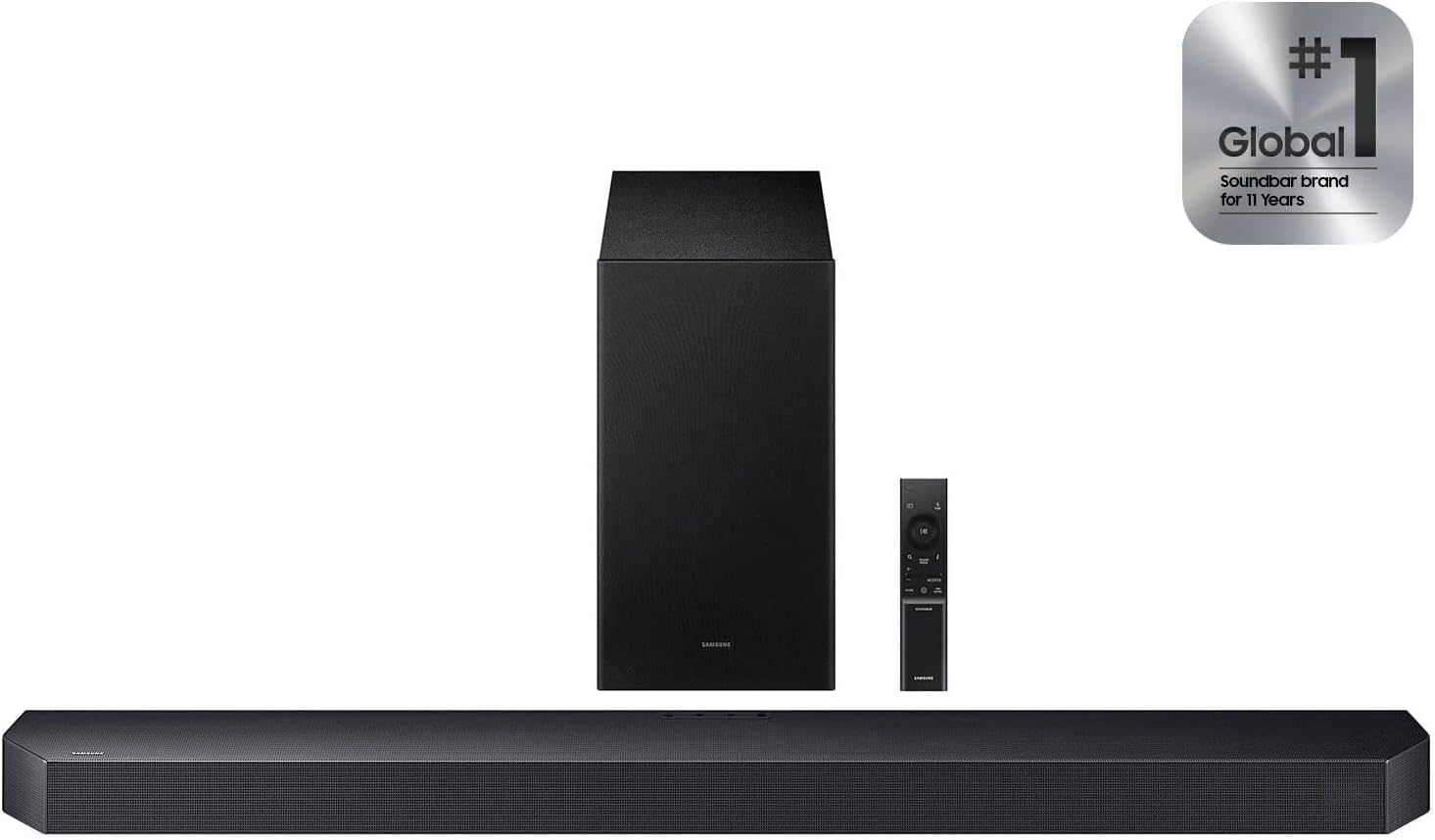
3. Samsung Q-Series HW-Q600F 3.1.2 Channel Soundbar
The quiet value move for anyone already sitting in front of a Samsung TV.
A 3.1.2 layout is the entry point to Atmos — three front channels, one subwoofer channel, and two up-firing drivers for a hint of height. The dedicated center channel keeps dialogue locked to the screen, and the wireless subwoofer adds low end without another cable to hide. Dolby Atmos and DTS:X formats are both supported, so a modern movie disc or streaming Atmos track renders properly.
Q-Symphony is the reason to look here with a Samsung TV. It synchronizes the TV’s own speakers with the bar so both play together and widen the soundstage. Setup is quick — Bluetooth, HDMI, and a bundled remote cover the basics.
This is the least expensive bar on the list, and it shows in scale rather than in features. If your room is large or your movie nights lean loud, the Samsung Q990F further down adds real rear speakers and a far higher channel count. For a smaller space with a Samsung screen, this is a sensible upgrade over TV speakers alone.
Suits you when: a Samsung TV is already mounted and you want Atmos and a wireless sub without a big spend.
Think twice if: your room is oversized — this 3.1.2 layout fills modest spaces, not theaters.
4. Klipsch Flexus CORE 200 3.1.2 Channel Sound Bar
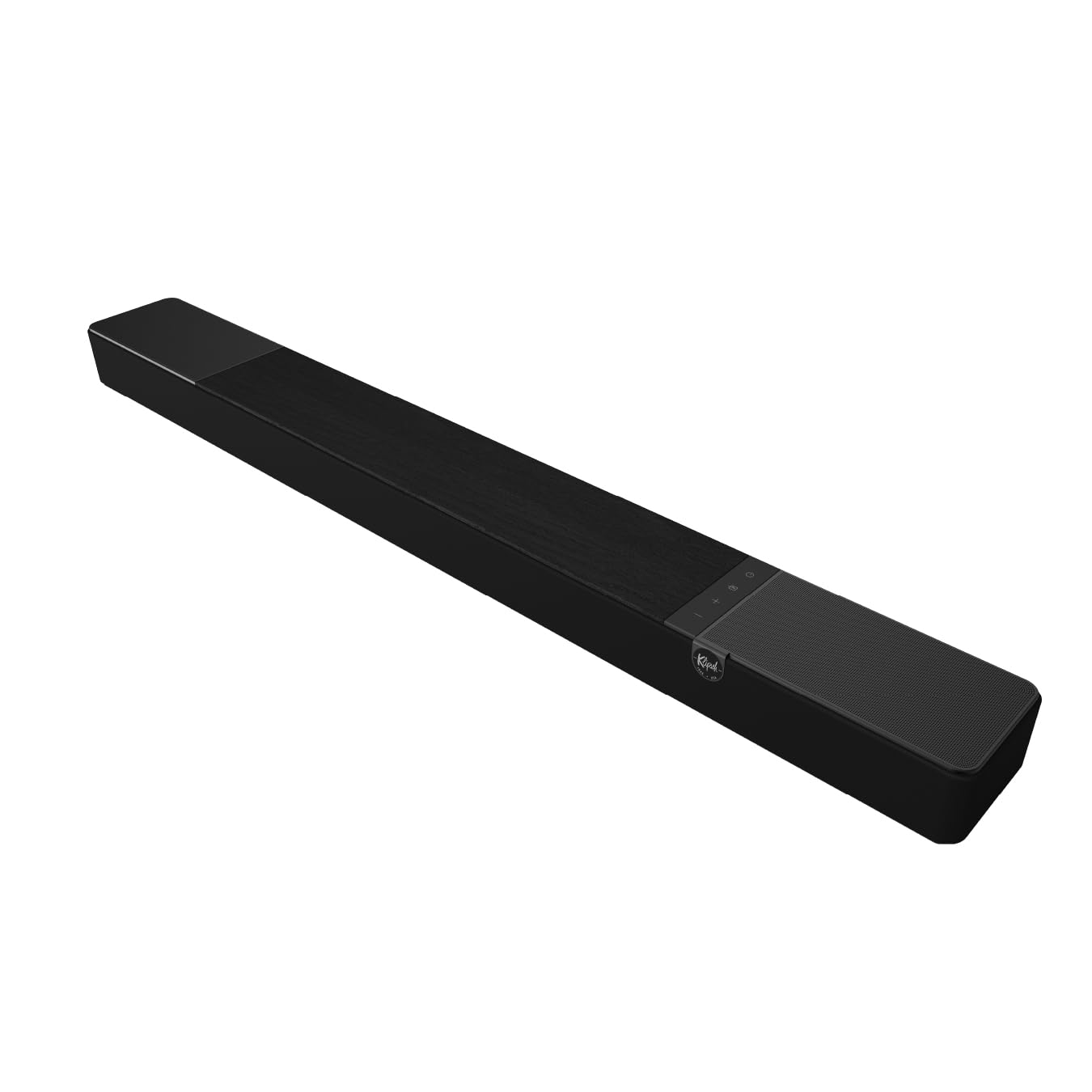
A 44-inch bar that tucks its own subwoofers inside and still keeps dialogue razor sharp.
Most bars at this height make you buy a separate bass box. The Flexus CORE 200 builds two 4-inch subwoofers right into the chassis, alongside four 2.25-inch ceramic drivers and two upward-firing elevation speakers for Atmos. A dedicated horn-loaded tweeter handles vocal clarity as the center channel, so tense dialogue scenes stay intelligible. Onkyo tuning sits behind the acoustics, which is why the low end reaches lower than the driver size suggests.
What owners rave about is exactly that clarity — and the volume of positive sound-quality feedback dwarfs every other talking point in the reviews. The dialog adjustment control earns real praise too, since you can nudge voices up without wrecking the mix. Setup runs through HDMI eARC, optical, or USB, and the hidden front display keeps the look clean.
The mixed signal is wireless. Bluetooth connects easily to phones, yet some buyers hit frequent disconnections, and there are scattered reports of crackling at high volume or a wired input failing over months. Plan to lean on HDMI rather than Bluetooth for the main TV feed. Bass is impressive for an all-in-one, but a large room will still want the bigger Klipsch pack above.
Clarity that carries dialogue: The horn-loaded center tweeter and dialog adjustment mean whisper-quiet scenes stay readable, which is the everyday win most people notice first.
One thing to watch: Wireless is the weak link — treat HDMI as the primary connection and use Bluetooth as a backup for music.
Built for: rooms where a separate subwoofer just is not happening, and where dialogue matters as much as explosions.
Not your pick if: you want rock-solid Bluetooth streaming as the main source — hardwire it instead.
5. Bose Smart Dolby Atmos Soundbar

Five transducers in a small frame that make ordinary stereo sound wider than it has any right to.
The clever bit here is TrueSpace. It analyzes anything that isn’t Dolby Atmos — plain stereo, 5.1 tracks — and upmixes it into a multi-channel sound. That means older shows and YouTube clips get some of the spatial treatment too, not just Atmos movies. Five transducers fit inside the compact frame, two of them firing upward. A.I. Dialogue Mode then balances voices against the surround mix so you can follow the plot.
You can stream however you like: Bluetooth, Apple AirPlay 2 (Apple’s wireless streaming), Spotify Connect, and Chromecast built-in (Google’s casting system). Alexa is built in, and Bose Voice4Video lets you control your TV and cable box by voice too. The included remote and a 30-foot Bluetooth range keep things simple. For a bedroom or mid-size living room, owners describe it as a detailed listen that plays loud without falling apart.
The catch is bass and reliability. Without a subwoofer the low end starts to fade in the region of 80-100Hz, so action films lack that chest punch. A portion of owners also report connection quirks and app friction, and some say it works only part of the time. Test it thoroughly in your first week and keep the TV handshake simple with eARC.
Worth it for: smaller rooms where a compact bar with wide, upmixed sound and easy streaming beats a giant black slab.
Consider the step up if: deep bass matters — the Smart Ultra below adds drivers, or you pair this with a separate sub.
6. Bose Smart Ultra Dolby Atmos Soundbar

The step-up Bose with six transducers and two upward-firing dipoles for a wider overhead wash.
Where the standard Bose bar carries five transducers, the Smart Ultra packs six, including two custom-engineered upward-firing dipole speakers for more convincing overhead placement. Dolby Atmos and TrueSpace upmixing both work here, so non-Atmos content still gets spatial treatment. The included Adaptiq headset measures your room and auto-calibrates the sound — a genuine improvement in odd-shaped spaces with sloped ceilings.
Sound quality is the star of the show, and dialogue clarity follows close behind with the A.I. Dialogue Mode. Owners describe crisp, balanced audio that reproduces whispers and explosions alike, and the compact build blends nicely with decor. Setup is a single HDMI eARC cable and a fast app walkthrough, with Alexa and Google voice control available. Bose SimpleSync lets you group the bar with select Bose headphones or speakers for private listening.
Two caveats. First, bass is polite without the separate bass module — many buyers add one to fill out the low end. Second, the app is essential and some owners find the setup picky about Wi-Fi and the account registration steps. Expect a learning curve on day one, then a smooth daily ride.
Why this Bose wins the dialogue battle
- Six transducers with two upward dipoles widen the overhead effects
- Adaptiq calibration tunes the bar to your room shapes and slopes
- A.I. Dialogue Mode keeps voices clear against the surround mix
- Wi-Fi and Bluetooth cover streaming from phones, tablets, and the cloud
Where it asks for patience
- No built-in bass module — low end tightens only with the add-on
- App-based setup and Wi-Fi pairing frustrate some buyers on day one
Pick this one if: you watch a lot of dialogue-heavy television and want a compact bar that gets voices right.
Take a pass if: big action bass is the priority — that requires the separate bass module.
7. Samsung Q990F 11.1.4ch Q Series Soundbar

Eleven front and surround channels plus a sub and rear speakers, all wireless — theater in a box.
The Q990F does what few bars attempt: 11 front and surround channels, one subwoofer channel, and four up-firing channels, with rear speakers in the box. Dolby Atmos pours overhead sound around and above without messy cables, and Q-Symphony lets a compatible Samsung TV’s built-in speakers play along for a fuller soundstage. The soundbar’s embedded sensors auto-calibrate the audio to your room, even tuning the bass.
What sells this system is discovery. Owners describe hearing new background details within the first movie — clapping, conversations behind the action, little ambient touches the old setup buried. The compact sub rattles walls while dialogue stays clear and adjustable, and it holds up at low volume as well as high. It handles both movies and music well, and the setup is plug-and-play through Samsung’s SmartThings app.
The recurring gripe is the app, not the sound. Recent version changes triggered disconnection and restart issues for some owners, though the audio hardware remains strong. The rear speakers are also fixed to the wall or shelf behind you, so positioning is less flexible than detachable surrounds. Plan on the app rather than the small-display remote for most adjustments.
Surround that surrounds you: The dedicated rear speakers and 11.1.4 layout create effects behind your head, not just in front — a clear step past single-bar systems.
Where the friction sits: The companion app has had stability complaints, so budget time for a firmware update before your first movie night.
Best for: Samsung TV owners who want true rear-channel surround with minimal wiring.
Look elsewhere if: you need rear speakers you can position freely, or you’d rather avoid app-based control.
8. JBL Bar 1300X 11.1.4-Channel Soundbar

Surround speakers that lift off the bar and run on battery — no cable run across your rug.
This is the pick for anyone who wants real rear effects but refuses to snake wires through a living room. Two detachable battery-powered speakers sit on the bar’s ends and lift off to place behind you. Four up-firing drivers in the main bar plus two more in those detachable speakers handle Dolby Atmos and DTS:X with MultiBeam wrapping the surround. A 12-inch wireless subwoofer supplies the low end, and 1170W of total system power drives the whole arrangement.
For everyday use, it syncs power on and off with the TV and fills an apartment without maxing the volume. Owners describe it as cinematic on 4K and Blu-ray, with the 12-inch sub moving more air than a 10-inch box. Built-in Wi-Fi with AirPlay, Chromecast, and Alexa Multi-Room Music adds high-definition streaming alongside the discs.
The honest limits are the app and the occasional defect. Some owners mention the DTS:X tracks get upmixed to Neural:X without an off switch, and a few report the app’s EQ or virtual remote intermittently vanishing. A rare detachable surround arrived with a clicking fault. Check your rears in the first week — once they are good, they tend to stay good.
This one is calling your name if: you want true rear-channel surround with no cable run and a big 12-inch sub for movie punch.
Give it a pass if: you need a fully wired, set-and-forget install with no battery-powered surrounds to charge.
9. Sony BRAVIA Theater Bar 9 Soundbar

Thirteen drivers and 360 Spatial Sound Mapping turn one bar into a wall of pinpointed audio.
Sony packs 13 speaker units into the Theater Bar 9, and 360 Spatial Sound Mapping uses them to place effects around you. Sound Field Optimization calibrates automatically to your room, so the balance widens beyond a single chair. Dolby Atmos, DTS:X, and IMAX Enhanced are all supported, and it plays nice with 4K HDR, 8K HDR, 4K120, VRR, and ALLM when connected to a modern TV and console. For PS5 owners, Auto HDR Tone Mapping and Auto Genre Picture Mode kick in with a BRAVIA TV.
With a compatible BRAVIA TV, Acoustic Center Sync turns the TV screen into the center speaker, so dialogue comes straight from the picture. Music streaming covers Spotify Connect, Apple AirPlay 2, and Bluetooth. On its own, the bar delivers a wide 3D soundstage and clear dialogue, and owners describe hearing a distinctly three-dimensional presentation from one box.
Two things to plan around. First, bass is light without the optional SW3 or SA-SW5 subwoofer, and rear effects need the RS3R or RS5 speakers to feel truly behind you. Second, the BRAVIA Connect app has caused setup and connection frustration for some buyers. If you already own a Sony TV, the ecosystem rewards you; if not, the value is less obvious.
The Sony advantage: 13 drivers and 360 Spatial Sound Mapping make this the most convincing single-bar presentation for a Sony household, especially with Acoustic Center Sync.
The bill of extras: A subwoofer and rear speakers are add-ons, so the full surround experience costs more than the bar alone suggests.
Your match if: a BRAVIA TV or PS5 already sits in your room and you want tight ecosystem integration.
Not the one if: your TV is another brand, or you need full bass and rear effects straight from the box.
10. Nakamichi Shockwafe 11.2.6 Dolby Atmos Surround Soundbar
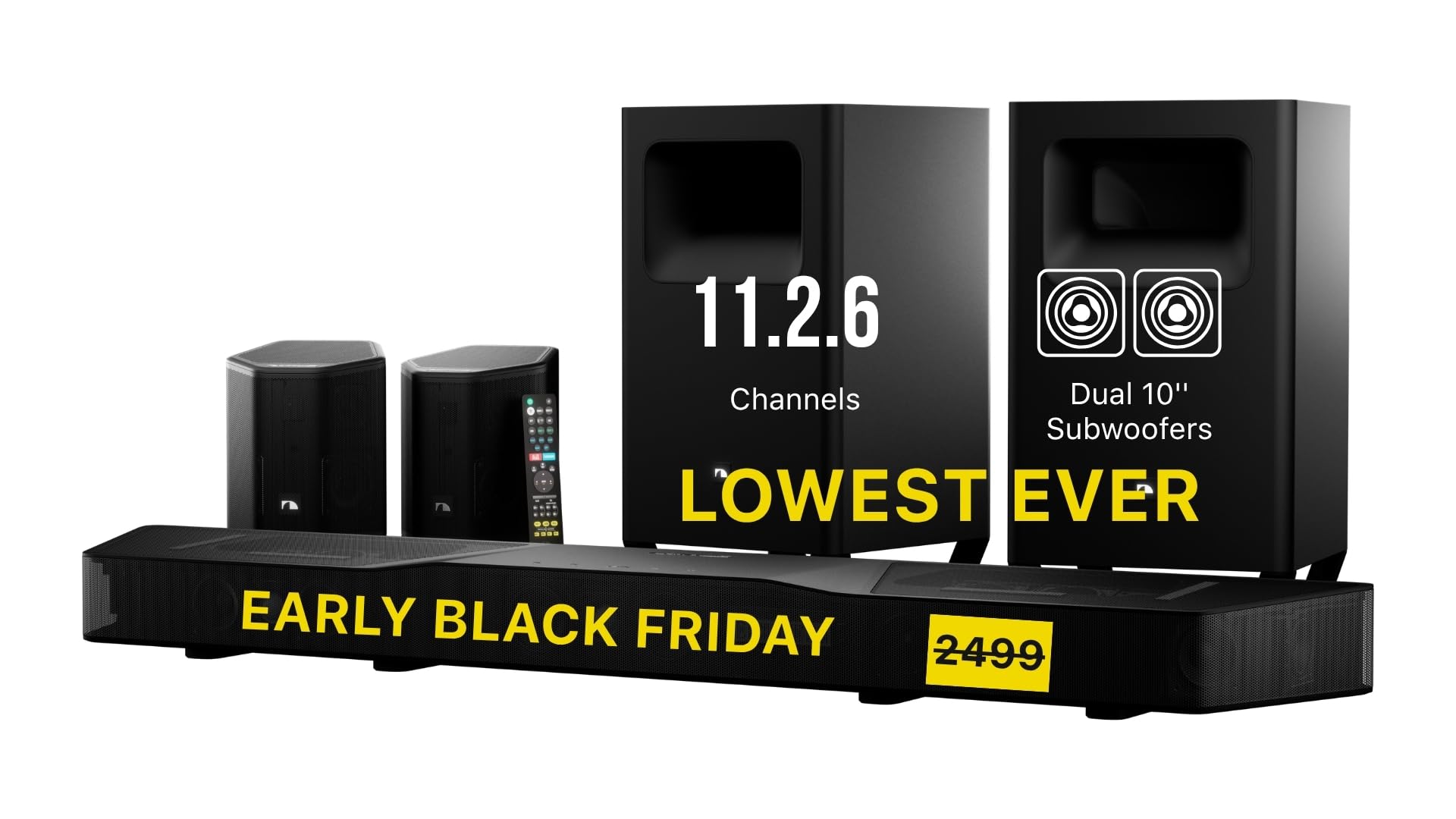
A 54-inch-wide chassis, two 10-inch subs, and six discrete height channels — this is full-scale theater gear.
Do not buy this expecting a compact soundbar. The Shockwafe’s bar alone measures 54 inches wide and 32.5 pounds, and each subwoofer stands 22.5 inches tall. It ships in three boxes. What that bulk buys is real air movement: an 11.2.6 architecture with six discrete height channels, a pair of 10-inch wireless subs, and bipolar surround speakers that fire from both sides and above. The AHD Ultra engine projects sound so the six surrounds feel like more speakers than they are.
The payoff is scale. Owners describe deep, feelable bass and detail they have never heard in familiar tracks, and cinema sound that comes closer to a full cinema than most one-box systems. HDMI eARC plus two HDMI 2.1 inputs pass 4K 120Hz, Dolby Vision, and HDR10+, and AirPlay or Bluetooth handle streaming. A backlit remote and app make tuning manageable, and the front display shows the incoming format.
The catch is physical commitment and tuning. The rear surrounds are hardwired from the bar, so plan your cable route. The DSP presets need some patience — owners say it rewards a factory reset and roughly ten minutes of setup — and the wireless components occasionally need a reconnect. If you have the floor space, this is the most cinematic package here.
Scale you can feel
- Dual 10″ subs and six height channels create true theater-scale pressure
- Bipolar surrounds and the AHD Ultra engine widen the surround bubble
- Two HDMI 2.1 inputs pass 4K 120Hz, Dolby Vision, and HDR10+
- Front display and backlit remote keep the source and format visible
The commitment required
- A 54-inch bar and twin 22.5-inch subs demand real floor and wall space
- Rear surrounds run on wired connections from the bar
- DSP presets need tuning, and wireless links sometimes need a reset
For the dedicated room: You have the space, the tolerance for wiring, and a hunger for genuine cinema pressure.
Not for the minimalist: A 54-inch bar and two floor subwoofers dominate any normal living room.
11. KEF XIO Soundbar, Dolby Atmos 5.1.2
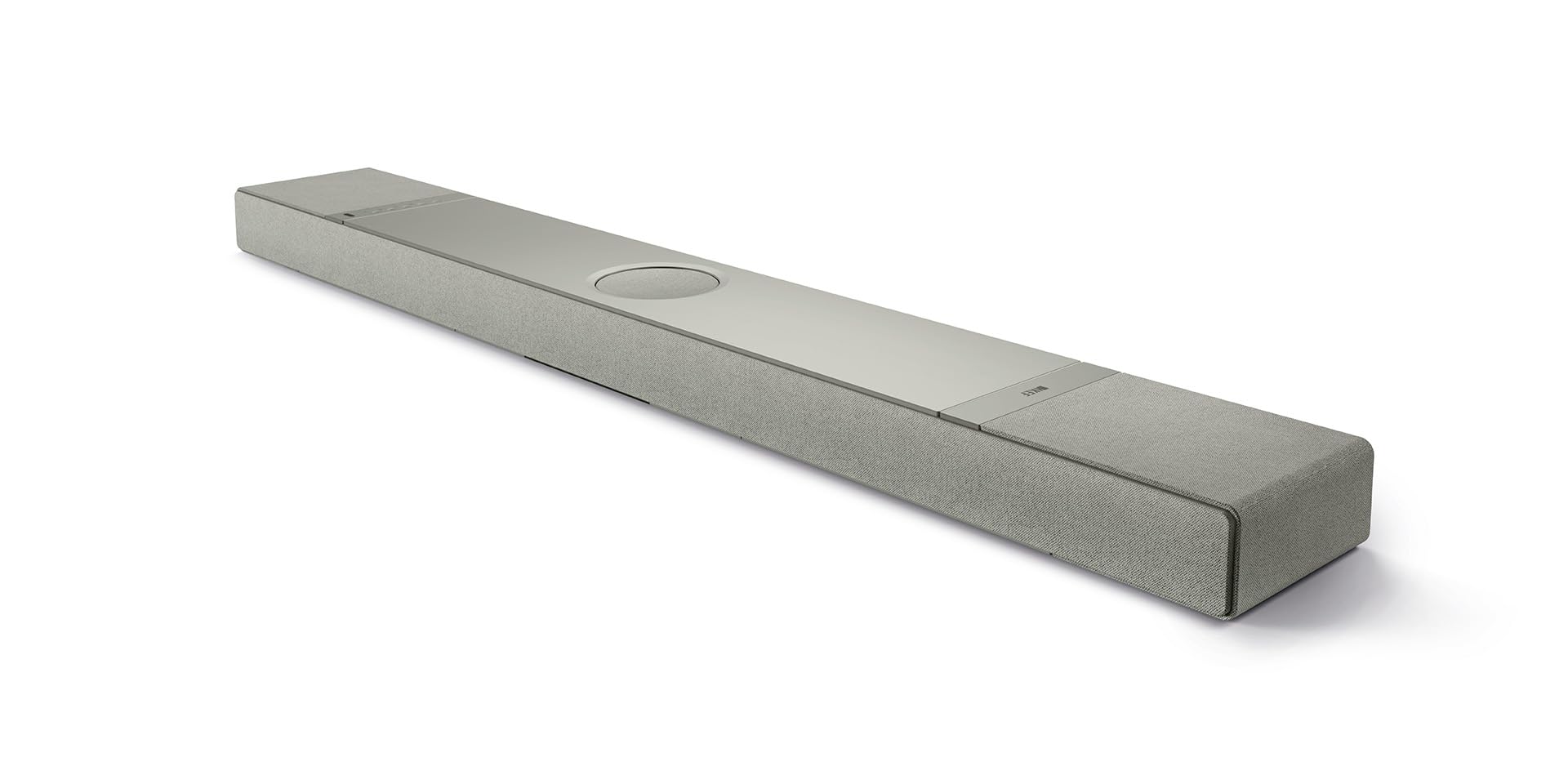
Twelve drivers and 820 watts in a single bar, tuned for music first and movies second.
The XIO is built like a hi-fi speaker that happens to sit under your TV. Twelve drivers powered by 820W of Class D amplification include six UNI-Q MX coaxial point-source drivers and four P185 force-balanced bass drivers with VECO sensor control. That combination reaches down to 34Hz without an external subwoofer, and two up-firing height channels cover Dolby Atmos and DTS:X in a 5.1.2 layout. One HDMI eARC cable to the TV does the video handshake.
Streaming is comprehensive: Wi-Fi 6, Bluetooth 5.3, AirPlay, Google Cast, Spotify Connect, and Tidal Connect all work in high resolution. Intelligent Placement Technology adapts the sound automatically for wall or shelf mounting, and Dialogue and Night modes handle the quiet-hours problems. The sculpted aluminum enclosure looks the part, and the subwoofer output lets you add bottom end later. Owners describe a precise, balanced, musical presentation that holds its own against stereo speakers for music.
The honest limit is bass and scale. Without an external sub the low end is impressive for a bar but cannot match a dedicated subwoofer for LFE, and the app connection has caused frustration for some buyers. At this price, the buyer looking for maximum movie slam should weigh the Nakamichi and Samsung options. The buyer who plays a lot of music will feel the extra spend land every time.
The audio-first read: UNI-Q point-source drivers and 820W of Class D power make this the most musical bar here, with 34Hz bass from the bar itself.
Where the money goes: You pay hi-fi prices for hi-fi sound — expect to add a subwoofer for true low-frequency effects and to tolerate app hiccups.
Choose the XIO if: music streaming is as important as movie night and you want genuine hi-fi tuning from one bar.
Leave it for the movie room if: maximum slam and deep LFE are the goal — that calls for a subwoofer system.
Know the Specs
Channel counts like 9.1.4 and 11.2.6
The numbers split into front and surround, subwoofer, and height channels. A 9.1.4 bar fires nine channels forward and sideways, has one bass channel, and four up-firing drivers for overhead sound. Changing that to 11.2.6 adds more rear and height channels, which gives movies a fuller bubble around the listener. When you read a spec, the final digit is the height channel count — the key to Atmos effects climbing the walls.
Dolby Atmos and DTS:X formats
Both formats send audio above your head by encoding height cues into the soundtrack. The bar or TV must decode them, and the source — a disc, an app, or a console — must send Atmos or DTS:X rather than plain stereo. If your TV or streaming device does not pass the format through, the bar falls back to a simpler mix. Check the source and the HDMI path, not just the bar’s badge.
Room calibration microphones
Calibration systems measure your room with a microphone — usually your phone’s — and adjust timing and tone to your furniture and walls. Sonos Trueplay and Bose Adaptiq both do this automatically. Rooms with low ceilings or hard floors change the sound a lot, so calibration keeps dialogue anchored to the screen instead of smearing. Run it more than once if the first pass sounds thin.
Wireless subwoofers and bass authority
Wireless subs connect by radio link instead of cable, so you place them anywhere near a power outlet. A bigger driver moves more air and delivers deeper notes than a small in-bar woofer, though placement near a wall reinforces the bass. Two subs add output and smooth out peaks across the room. In an apartment, use night mode or a smaller sub to stay on good terms with neighbours.
Common Questions
Will a high-end sound bar work with my older TV that only has an optical output?
Do I really need a separate subwoofer with a premium sound bar?
What is the difference between 3.1.2 and 11.1.4 channels?
Can a sound bar replace a full home theater speaker system?
How much space does the Nakamichi Shockwafe 11.2.6 actually need?
Will a sound bar fit in front of my TV without blocking the screen?
Does the Samsung Q-Symphony feature work with non-Samsung TVs?
How do detachable surround speakers on the JBL Bar 1300X stay powered?
Will a sound bar decode DTS:X as well as Dolby Atmos?
Can I add rear surround speakers later to a single-bar system?
Do high-end sound bars need a stable Wi-Fi network?
The Bottom Line
For most rooms, the winner among these high-end sound bars is the Sonos Arc Ultra. Its 9.1.4 channels put real overhead effects in one slim bar, Speech Enhancement keeps dialogue readable, and the single HDMI eARC cable and app-guided setup make it the easiest premium install here. If rear-channel immersion is the goal and you own a Samsung TV, the Samsung Q990F ships with rear speakers and a sub for true surround. And if cinematic scale matters more than a compact footprint, the Nakamichi Shockwafe 11.2.6 delivers theater-grade pressure with dual 10-inch subs and six height channels.
One honest nudge: the Arc Ultra’s 4.5+ stars across hundreds of owners makes it the safest premium bet, but the Q990F and Nakamichi offer more channel count for the same tier of spend if your room can take the extra speakers. Match the system to your room, run room calibration, and the sound will reward the choice for years.
How we choose
We do not accept paid placement. Every pick is matched to a real buyer and a real use-case; we do not hands-on test units.
Sources
Specifications: manufacturer listings and product documentation. Review insights: verified customer reviews, as of October 2026. Pricing: not shown on this page (it changes often); check the current price via the retailer link.
As an Amazon Associate, Aappliancez earns from qualifying purchases. This does not affect which products we feature.