Disclosure: Some links in this post are affiliate links. As an Amazon Associate I earn from qualifying purchases, at no extra cost to you. Learn more
Specs are compiled from manufacturer listings and verified buyer reviews and can change over time — please confirm the key details on the product page before buying.
You want coffee that tastes like the good café down the street, without the queue or the paper cup, and the machine that delivers it needs to earn its counter space every single morning. Below you get the machines that actually pump hot water at the right temperature, the ones that grind fresh, and the ones that simply hold heat better than the rest. Some premium names fall short on reliability, and the mid-range BUNN 55200’s 70 oz hot tank beats machines costing several times more.
This guide is built by comparing the manufacturers’ published specifications and the patterns across verified customer reviews, so you get each pick’s real strengths and trade-offs instead of marketing spin.
Taste starts with brew temperature, not the badge on the front, so every pick here was judged on its stated brew range first. Here is how these high end coffee makers stack up on what you actually taste in the cup.
Top Picks


How To Choose The Best High End Coffee Makers
Most buyers assume the expensive machine makes the better cup, but brew temperature decides it. In practice, the single biggest factor is whether the water hits the right temperature and stays there through the whole brew, and a modest brewer with a preheated tank can beat a fancy one that runs cool. Carafe type, grinder and milk system affect daily convenience and heat retention, not extraction temperature.
Brew temperature beats brand prestige
Coffee extracts best somewhere in the mid-190s to just over 200°F. The Bonavita Enthusiast lists 194˚–205˚F, and the OXO Brew states 197.6–204.8°F. Those ranges are the ones to look for on a spec sheet. A machine that cannot hold temperature will taste thin no matter how much you spent on it.
How many cups do you really pour?
A “cup” on a coffee maker is often about 5 oz, not the 8 oz measuring cup in your kitchen. That means a 10-cup brewer realistically fills around five big mugs. Check the fluid-ounce figure on the spec sheet — the Moccamaster’s 40 fluid ounces and the Aarke’s 42 fluid ounces are the honest numbers behind their cup labels. If two people drink two mugs each morning, a 40 oz pot is about right.
Thermal carafe or warming plate
A thermal carafe — a double-walled insulated pot — keeps coffee hot without a hot plate cooking it. The BUNN 55200 uses a vacuum-insulated double-walled carafe for that reason. Warming plates keep a glass pot hot, which is what the SYBO and Ninja carafe machines do. Thermal holds flavor longer. Glass plus a plate holds more volume and lets you see the level. Pick by which trade-off you will notice.
Where the money actually goes on espresso machines
On super-automatic espresso machines, your spend buys the grinder, the milk system, and the interface. A ceramic grinder (Philips lists one on the 3200 Series) grinds quietly and consistently. A milk system with no hidden tubes cleans in seconds. A touchscreen means fewer buttons to learn. None of that improves the bean — it improves how often you actually use the machine.
Side-by-Side Comparison
| Model | Best For | Capacity | Brew Style | Carafe | Amazon |
|---|---|---|---|---|---|
| BUNN 55200 Speed Brew Platinum★ Best Overall | Fast diner-style drip all morning | 10 cups | Drip, tank-heated | Vacuum thermal | Amazon |
| Braun MultiServe PlusBest for Cold Brew | Cold brew and single-serve flexibility | 10 cups | Drip, pod-free | Glass | Amazon |
| OXO Brew 9-CupBest Temperature Control | Precise temperature on a budget | 45 fl oz | Drip, programmable | Insulated | Amazon |
| Bonavita Enthusiast 8 Cup | SCA pour-over taste, no clock | 8 cups (40 oz) | Pour over | Stainless thermal | Amazon |
| Ninja Espresso & Coffee Maker CFN601 | Espresso pods plus a 12-cup pot | 12 cups | Espresso + drip | Glass | Amazon |
| Cuisinart Grind & Brew Plus | Fresh-ground pot and K-Cup in one | 12-cup carafe | Grind & brew + single serve | Glass | Amazon |
| SYBO SF-CB-2GA | Offices and big households | 15 liters | Commercial drip, dual warmer | Two glass carafes | Amazon |
| Technivorm Moccamaster KBGV Select | SCA gold-standard drip | 40 fl oz | Drip, one switch | Glass | Amazon |
| GE Profile Smart Grind & Brew | App and voice control brewing | 10-cup thermal | Grind & brew + podless single | Thermal | Amazon |
| aarke Drip Coffee Maker | Countertop design statement | 42 fl oz | Drip, SCA certified | Glass | Amazon |
| Philips 3200 Series EP3241/54 | Bean-to-cup espresso with milk | 3.8 lb bean hopper | Fully automatic espresso | — | Amazon |
| xBloom Studio | Automated pour-over with a scale | 32 fl oz | Pour over, app control | — | Amazon |
| Ninja Luxe Café Pro | Espresso, drip and cold brew | 68 fl oz | 4-in-1 espresso + drip | — | Amazon |
| Philips 5500 Series EP5544/94 | 20 drink presets with one-touch | 1.8 liters | Fully automatic espresso | — | Amazon |
| Bosch 800 Series TQU60307 | Remote brewing with Home Connect | 5.1 lb bean hopper | Fully automatic espresso | — | Amazon |
Detailed Reviews
1. BUNN 55200 CSB3T Speed Brew Platinum Thermal Coffee Maker
Our pick — 4.0+★ from 7,500+ verified ratings; the strongest balance of quality and price.
The brewer that keeps its own water hot so the first cup is already waiting.
Here is the mechanism that changes your morning: inside the BUNN Speed Brew sits a commercial-grade stainless steel hot water tank holding 70 ounces of water at brew temperature at all times. You pour water in, flip the lid, and coffee starts moving. A travel mug fills in 2 minutes; the full 50-ounce carafe finishes in 4. Nothing else in this lineup brews from a standing start like that, because most machines need several minutes just to heat the water first.
That speed is the whole pitch, and it is backed by an optional preheat routine owners work out within a week: run the brewer once to warm the vacuum-insulated double-walled carafe, then brew. The carafe keeps the pot at drinking temperature for a couple of hours thanks to the double wall, no hot plate involved. A commercial multi-stream sprayhead showers the grounds from several points instead of one, which is the small engineering choice behind the diner-style flavor people describe — even water contact across the whole bed of coffee.
The honest catch is footprint and upkeep. The tank is why the body is bigger than a standard drip machine, so measure your counter before committing. The manual also assumes regular descaling and, in hard-water areas, filtered water. Owners of the previous generation of these machines do report occasional heating-element failures, which is the trade for a tank that runs hot constantly. Keep it descaled and you are firmly on the good side of that.
What earns the tank its keep
- 70 oz stainless tank stays hot, so a travel mug of coffee is ready in 2 minutes
- Full 50 oz carafe brews in 4 minutes once the tank is up to temperature
- Vacuum-insulated double-wall carafe holds serving temperature for 2+ hours without a hot plate
- Multi-stream sprayhead spreads water evenly over the grounds for consistent extraction
What you live with
- Larger footprint on the counter than a conventional drip brewer
- Regular descaling is not optional in hard-water areas
- You cannot prefill the tank the night before — water goes in when you brew
Made for: households where coffee gets poured in a hurry and one pot has to survive till noon.
Think twice: if your counter is tight or your water is very hard and you will not descale on schedule.
2. Braun MultiServe Plus 10-Cup Drip Coffee Maker
Cold brew in under thirteen minutes, and seven pour sizes from one dial.
If the reason you have not made cold brew at home is the twelve-hour steep, the MultiServe Plus changes the maths. Its Cold Brew setting puts a fresh carafe of smooth-tasting cold brew in under 13 minutes, which is roughly the time it takes to shower and get dressed. The Over Ice, Gold and Bold settings sit alongside it, and there is a hot water function for tea.
The MultiServe dial is the second thing worth knowing about. It gives you 7 brewing sizes, from a pod-free single cup straight into a travel mug up to a full carafe, so you are not brewing a pot for one person. Grounds only — no capsules — which keeps the ongoing cost down and the waste out.
The FastBrew heating technology turns out a full pot in under 8 minutes. Now the trade-off, and it is a real one: owners of this generation report the automatic brew feature giving out after a month of use in some units. Braun’s appearance and versatility get consistent praise, but if programmable auto-start is the single feature you cannot live without, budget for a warranty conversation. Brew it manually and it is a genuinely flexible machine.
Where it wins you over: that 13-minute cold brew is a feature you will actually use in summer, and the 7-size dial means one machine handles a single mug and a dinner party pot without compromise.
The one to weigh: glass carafe, not thermal — it wants a warming base and you lose the double-wall heat retention the BUNN brings.
Reach for this one: if cold brew and single-serve flexibility are higher on your list than programmable brewing.
Look elsewhere: if you want to set the timer the night before and trust it every morning.
3. OXO Brew 9-Cup Drip Coffee Maker
Precision brewing temperatures held through the whole cycle, set with one dial.
Temperature is where the OXO Brew makes its case. BetterBrew controls the water between 197.6 and 204.8°F for the entire brew, and that is the range where coffee extracts properly. A Rainmaker shower head spreads water evenly across the grounds and an internal mixing tube keeps the last cup from tasting weaker than the first. It is SCA certified, which is the industry body that tests exactly these things.
On paper the machine is 9 cups, but the spec sheet’s 45 fluid ounces tells you the real story. Owners say the 2-cup minimum brews a single mug, which is a useful thing to know if you live alone. A single dial handles cup count, clock and the auto wake-up timer, and there is no hot plate — the insulated carafe does the holding instead.
Weight is worth flagging: at 10.5 pounds it is 13% heavier than the Bonavita Enthusiast’s 9.3 pounds, and it is a tall unit, so plan the cabinet clearance. The other recurring note is the plastic function knob, which feels a little loose and is the part most likely to go first. It also holds heat for around an hour, not the full day the marketing suggests. Great cup, modest holding time.
The engineering that shows up in the cup
- Holds water at 197.6–204.8°F through the whole brew cycle
- Rainmaker shower head plus internal mixing tube for even extraction
- SCA certified, one-dial programming, no hot plate to burn the pot
- 2-cup minimum means a single mug is a supported setting
Where it asks patience
- Tall body, so check it fits under your upper cabinets
- Insulated carafe holds heat for roughly an hour, not all day
- Plastic function knob is the soft spot in an otherwise solid build
Your match if: you want certified temperature control and honest programmable brewing together.
Pass it over: if you need a pot that is still hot three hours after brewing.
4. Bonavita Enthusiast 8 Cup Drip Coffee Brewer
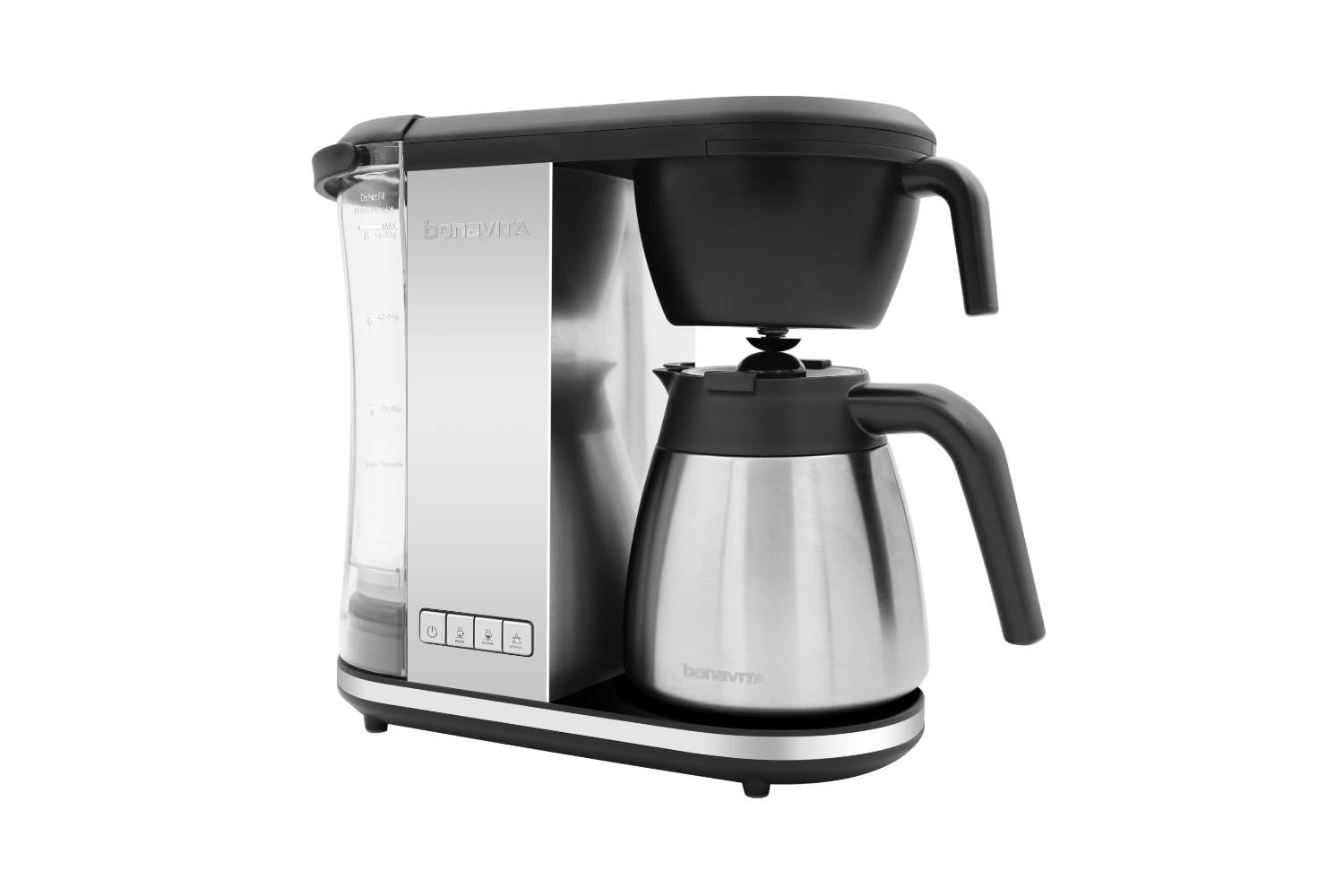
Certified pour-over quality from three buttons and a detachable tank.
The Enthusiast stores its facts on the label: SCA Certified, brewing at 194˚–205˚F, full 40-ounce pot in under 7 minutes. The brew method is pour over rather than a saturated drip bed, and there is an optional pre-infusion (bloom) mode that wets the grounds first so the coffee releases trapped gas before the main pour. That is the step that turns a flat cup into a fuller one.
Compared with the Braun MultiServe Plus, this is the smaller pot — 8 cups against 10, and its 40 ounces against the Braun’s larger reservoir. The trade is form factor: the Bonavita measures 6 inches wide, so it slides into a narrow gap between the toaster and the wall where the 13-inch-wide Braun simply will not go. It is also the lighter of the two by a clear margin at 9.3 pounds.
What it does not have is a clock, a timer, or any kind of scheduling. Three buttons and that is your lot. The stainless thermal carafe holds drinkable heat for an hour or so rather than hours, so brew what you will drink. There is no auto-shutoff on some units, so get into the habit of switching it off. The reward is a cup that punches well above this machine’s standing in the lineup.
What the cup delivers: a certified pour-over at the right temperature, with a bloom cycle that genuinely changes the flavor, from a machine you can learn in five minutes.
What it asks in return: you give up scheduling entirely — no clock and no timer — and the carafe holds heat for about an hour.
Pick it if: great coffee matters more to you than a programmable start.
Skip past it: if you want to wake up to a pot that brewed itself.
5. Ninja Espresso & Coffee Maker CFN601

One machine that pulls a Nespresso-compatible shot and brews a twelve-cup pot.
The CFN601 is built around a 19-bar pressure system, which is the spec that decides whether you get real espresso crema or a thin approximation of it. It brews Nespresso Original capsules in three styles — Espresso at 1.35 oz, Lungo at 3.75 oz, and Over Ice at 1 oz — and it also brews ground coffee in Classic, Rich or Over Ice at any of 9 sizes, right up to a full 12-cup carafe.
The built-in fold-away frother is what turns those shots into cappuccinos, lattes and flat whites without a separate appliance, and the used capsule storage bin holds up to 20 spent pods.
Durability is the variable. The machine is 13.6 pounds of mostly plastic with a stainless accent, and the espresso side’s reliability draws mixed reports — some owners get years of daily use without a leak, others get a unit that loses pressure. Coffee quality, when it works, gets enthusiastic reviews, with ex-baristas comparing the pod output to machines that cost a good deal more. If you want the espresso-and-pot combo in one footprint, it earns the space; buy with the return window in mind.
Best suited to: a household where one person wants a latte and the other wants a big pot of drip from the same machine.
Know before you buy: the espresso side is the part most likely to need a warranty claim, so keep the packaging for the first month.
6. Cuisinart Coffee Maker Grind & Brew Plus

Beans ground seconds before they hit the water, in a twelve-cup pot or a single pod.
Freshness is the whole argument for grinding at the machine, and the Grind & Brew Plus does it in the brew path: whole beans go in, they are ground right before brewing, and there is a grind-off mode for when you want to use pre-ground. The single-serve side brews 8, 10 or 12 ounces and takes any brand of single cup pod including K-Cup. The carafe side holds 12 cups in a glass pot with a drip-free spout and a knuckle guard.
Two reservoirs serve the two sides — a full-pot reservoir for the carafe and a 40-ounce removable reservoir for pods, with a minimum of 8 ounces on the single-serve side. Having both means you do not refill between a morning pot and an afternoon pod.
The grinder is loud. Owners consistently describe the grinding chamber as very noisy, and you have to clean it after each use, roughly 30 seconds of work. The bigger questions are durability and cleaning: both reservoirs are non-removable, so wiping them out is fiddly, and the grinder is the part that gives out on some units. The 12-pound body on a 10.75-inch-deep footprint is manageable for a dual-purpose machine.
Why it earns a spot: fresh-ground flavor plus K-Cup convenience plus a 12-cup carafe is a genuinely rare combination, and the 40-ounce pod reservoir means you are not refilling constantly.
Honest running cost: the grinder demands a 30-second clean after every use, and both water reservoirs are fixed in place, so routine cleaning takes more effort than the brew does.
Choose it when: you want fresh-ground coffee and pod convenience from one machine and can live with a noisy grinder.
Not the one: if you value quiet mornings and easy access to the water tank.
7. SYBO 12-Cup Commercial Pour Over Coffee Maker SF-CB-2GA

A café-grade workhorse with two warmers so a second pot is always ready.
Two warming plates is the detail that makes the SYBO different from every other drip brewer here. You brew a fresh pot while the previous one stays warm, so service never stops. For a busy kitchen, an office, or a house full of overnight guests, that is the feature that matters most.
It brews up to 12 cups in under 10 minutes, with a multi-stream shower head and a flat-bottom filter basket for even saturation. The drip-free carafes use a proprietary lid and spout design that arcs the pour and wicks dribbles back into the pot, so the counter stays clean. The stainless steel finish and 16.4-pound build read as commercial, and the machine is fully ETL, CE, ROHS and Intertek certified for commercial electrical safety.
Brew speed draws mixed notes — some find it fast, others slower than they expect for a commercial unit. There are also reports of the filter holder hole restricting flow and, in a small number of units, the machine tripping a GFCI outlet. Buy it for the dual-warmers and the certified build, get it on a dedicated outlet, and keep the 30-day return window in mind. For volume brewing at home or in a small office, nothing else here offers two simultaneous pots.
The case for the second warmer: you can keep a full pot of regular and a pot of decaf hot at the same time, which is exactly what a room full of guests needs.
The catch worth knowing: the return window is 30 days, so test it thoroughly on arrival and put it on its own outlet.
Built for: offices, event kitchens, and homes that regularly pour for eight or more.
Too much machine: if two people drink two mugs each and nothing else.
8. Technivorm Moccamaster KBGV Select 10-Cup Coffee Maker

The plain-looking machine that set the standard other drip brewers get measured against.
The Moccamaster skips a pump entirely. Water heats to the correct extraction temperature, then the machine relies on that heat to move water through the grounds — a deliberately simple approach that removes a common failure point. A full 40-ounce pot takes 4 to 6 minutes on one switch, and a volume selector lets you brew a half carafe without wasting beans.
It shuts itself off automatically after 100 minutes, which is about the right length of time for a pot to stay drinkable on a warming plate. The warranty runs 5 years, the longest in this lineup, and the brew is quiet enough to start while the house is still asleep. Performance and coffee quality are the two things owners talk about more than anything else — expect a clean, non-bitter cup without any fiddling.
Where it asks you to accept less: the glass carafe and its handle draw mixed build feedback, and the machine has no clock, no timer, no program. It is also the lightest brewer here at 6.3 pounds, which tells you how much of the construction is straightforward rather than armored. A few units stop working early. The 5-year warranty is the answer to that worry — it is the safety net that justifies the leap.
Why it keeps winning comparisons
- Pump-free design heats water to the correct brewing temperature with fewer moving parts
- Full 40 oz pot in 4–6 minutes with a half-carafe selector switch
- Auto-off after 100 minutes and a 5-year warranty
- Quiet operation and a clean, non-bitter cup owners describe as consistent
What it does not pretend to be
- Glass carafe and handle feel light, and the handle draws the most build criticism
- No clock, no programmable timer, no auto-start
- A small number of units stop working early, which is why the warranty matters
Fit for: the person who wants one switch, one pot, and the same great cup every single day.
Not your machine: if you want the pot already brewed when the alarm goes off.
9. GE Profile Smart Grind & Brew Coffee Maker

Start the brew from your phone before you leave the bedroom.
The GE Profile’s headline is the 90-ounce removable water tank, which is enough for up to 2 full carafes before you refill. Pair that with WiFi and the SmartHQ app and you can wake the machine from anywhere, adjust bloom time and grind time remotely, and start a pot by voice through Amazon or Google. For anyone who has ever wanted coffee waiting at the top of the stairs, that is the feature list.
The grinder is an adjustable burr unit with 6 settings, and the single-serve side is podless — a real cup brewed from fresh-ground beans directly into your mug, no capsule. The 10-cup thermal carafe is insulated rather than heated, and the machine is SCA certified, so the brew temperature side of the equation is covered by an outside body’s testing rather than GE’s own claims.
This is a new model with a modest review base, and early feedback runs mixed on reliability. Owners who like it love the looks and the connected brewing. Buy this if remote start and a podless single serve are the features you want, and treat it as a first-generation product — keep the manual and the return window handy.
The draw: phone or voice control plus a podless single serve plus an SCA-certified brew, all from a 90 oz tank that is only filled about once a week.
Watch this: the review base is small and reliability feedback is not settled, so the first month of ownership is the one that tells you everything.
Right for: smart-home owners who want the pot already going when they walk into the kitchen.
Hold off: if you want a long track record of reliability behind your purchase.
10. aarke Drip Coffee Maker with 42oz Glass Carafe

A Swedish countertop sculpture that happens to brew a certified cup.
Read the cup rating carefully before you buy this one, because Aarke measures differently. Its “10 cups” uses a 4.2 oz cup — smaller than the roughly 6 oz most US brands use and well under a standard 8 oz measuring cup. The full carafe holds about 42 ounces of brewed coffee, so plan on around five generous mugs per pot.
What you get in the cup is genuinely good. The 360° filter basket and precision shower head mimic a manual pour-over, and the optional Blooming Mode pre-soaks the grounds for 30 seconds to release trapped gases and round out the flavor. The machine is SCA-certified, built with high-grade stainless steel and BPA-free food-safe components by a Swedish design firm, and it looks like nothing else in this lineup.
Here is the part you need to weigh. The heat plate has failed after first use in some units, and a number of machines stop working within months. The body also mixes plastic with the stainless steel, which buyers who expected all-metal have objected to. That is a hard thing to accept at this position in the market. If the look is worth the risk to you, it brews well; go in with the warranty in mind.
For you if: the countertop look matters as much as the certified brew, and you want a 30-second bloom built in.
The real risk: the heat plate and the mixed plastic build are the two things that will decide whether you keep it.
11. Philips 3200 Series Espresso Machine EP3241/54
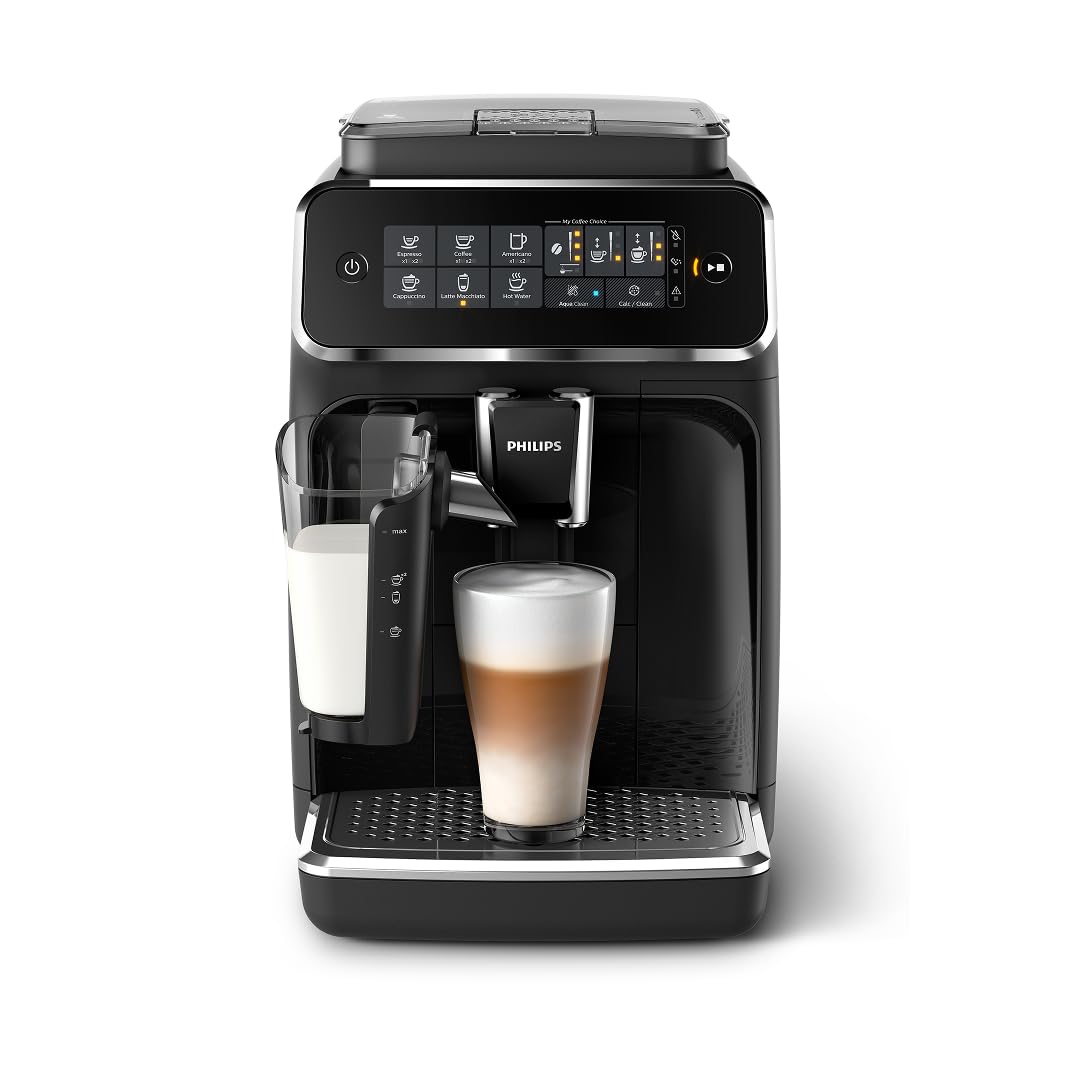
Five café drinks from whole beans, and a milk system that rinses clean in seconds.
Five drinks is the menu — espresso, coffee, americano, cappuccino and latte macchiato — selected from a touch display. Behind it sits a 100% ceramic grinder that runs quieter and more consistently than a steel blade, plus the Aroma Extract system that balances brewing temperature against extraction so the cup does not come out either sour or burnt.
The LatteGo milk system is the part worth understanding before you buy. It has just 2 parts and no tubes or hidden compartments, which is why Philips can claim a clean in as little as 15 seconds under the tap or in the dishwasher. Anyone who has owned a super-automatic with tubes knows how quickly milk residue turns into a chore. The AquaClean filter is the other long-haul perk: change it when prompted and you do not need to descale for up to 5,000 cups.
Now the durability picture, which is the honest concern with this machine. Long daily service from a happy majority, but a meaningful number of units fail — grinder and water pump sensor issues show up repeatedly in reports. It is also loud, the water reservoir fills faster than the spec implies, and the pre-ground chute can be fussy. Maintain it on schedule, clean the brew group monthly, and the odds swing in your favor. skip it if maintenance is not in your routine.
The everyday wins
- Five drinks from whole beans with a 100% ceramic grinder
- LatteGo milk system cleans in as little as 15 seconds, dishwasher safe
- AquaClean filter keeps descaling off the schedule for up to 5,000 cups
- Touch display and one-touch brewing with no barista skills required
The upkeep contract
- Reliability is the variable — pump sensor and grinder faults do appear
- Grinder is noisy first thing in the morning
- Water reservoir needs refilling more often than the spec suggests
- Monthly brew-group cleaning is not optional
The one to pick: if you want café drinks at home and will actually do the weekly and monthly cleaning.
Not for you: if you want to set it and never think about maintenance again.
12. xBloom Studio Coffee Machine
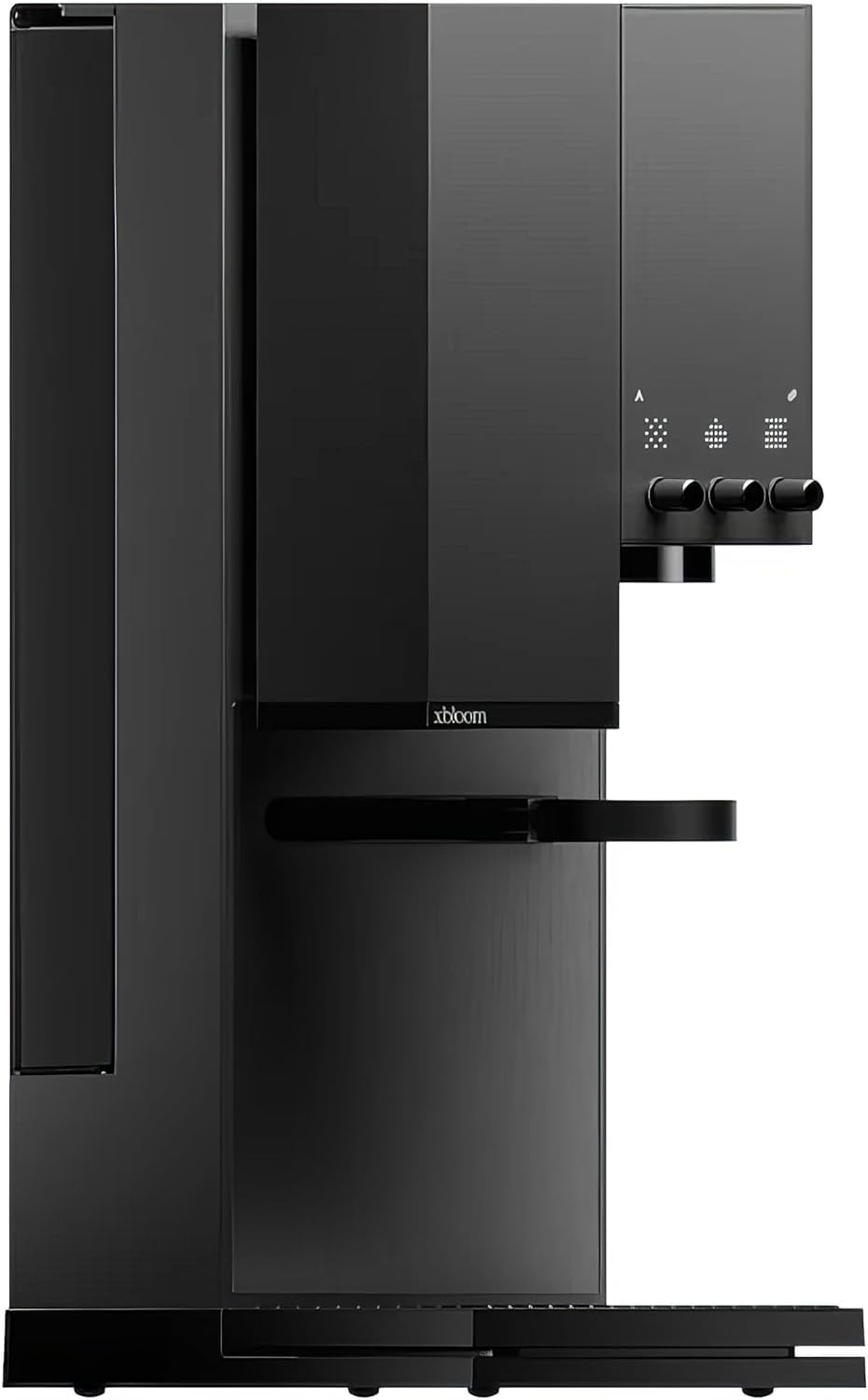
An automated pour-over rig with a grinder and a scale standing right beside it.
Pour-over is fussy by nature: grind size, water temperature, pour rate, and timing all matter, and the xBloom Studio automates the whole sequence in one machine. It carries a built-in grinder and a built-in scale, plus a 32-ounce capacity, and the LED Matrix display shows you grind size, water temperature and flow rate in real time. Physical knobs rather than a touchscreen menu — a deliberate choice that suits anyone who wants to adjust the bean without reading a manual.
Three modes cover the skill range. Autopilot does the entire brew for you, Copilot walks you through stepby step, and Free Solo hands you full manual control. The xBloom app lets you create, adjust, save and share recipes, and every parameter syncs to the machine instantly so a cup you liked is repeatable. The xPod system adds convenience: each pod holds selected whole beans and a built-in filter, so you pour the beans into the grinder, dock the pod, and press start — no capsules, no extra paper filters.
In the box you get the Studio, the Omni Dripper 2 with Hyperflow Bottom, 10 paper filters, an xPod Dock, a magnetic dosing cup, a recipe card and a cleaning brush, backed by a 2-Year xbloom brand warranty. The 11.3-pound body measures 8 inches deep and 6.7 inches wide, so it tucks into a narrow strip of counter. What it costs is the small pot — at 32 fluid ounces it is the tightest capacity here outside the espresso machines, so a two-pot household will be brewing twice. Worth knowing before you fall for the automation.
What the automation buys you: grinder, scale and pour-over sequence in one machine, with three modes that let a beginner and a tinkerer use the same brewer.
The honest limit: 32 ounces is one generous pot — larger households will be running it twice.
Built for: the pour-over drinker who wants repeatability without standing over a gooseneck kettle.
Overkill if: you are happy with a drip machine and never think about flow rate.
13. Ninja Luxe Café Pro 4-in-1 Espresso Machine

Espresso, drip, cold brew and hot water from one grinder-fed machine.
Four jobs in one body is the headline. Espresso, drip coffee, cold brew and a separate hot water system for tea or americanos — all fed by a built-in conical burr grinder with 25 settings, so each drink gets the grind and dose it needs. The 68-ounce capacity gives you room to brew a pot for a group or a single shot for yourself.
The Dual Froth Pro system is the feature that makes lattes painless: a magnetic spinning whisk works with an automatic steamer to produce microfoam, and the XL milk jug holds enough for two drinks at once. Barista Assist then handles the guesswork — weight-based dosing, an integrated tamper that tamps at the pull of a lever, and real-time temperature and pressure adjustments based on what you selected. For someone stepping up from a pod machine, that guidance is the difference between trying once and giving up.
The cold-pressed espresso function brews at a lower temperature, pressure and pace for a smoother iced drink, and cold brew runs without the overnight wait. Onboard accessory storage keeps the portafilter, baskets and jug out of the drawer. At 27.1 pounds it is a substantial piece of kit on the counter, so measure the space first. It is the most complete single machine here, but it asks for real counter real estate in return.
Made for: the household that wants espresso drinks and a drip pot without buying two machines.
Measure first: 27.1 pounds and a full accessory kit mean this one claims serious counter space.
14. PHILIPS 5500 Series Espresso Machine EP5544/94
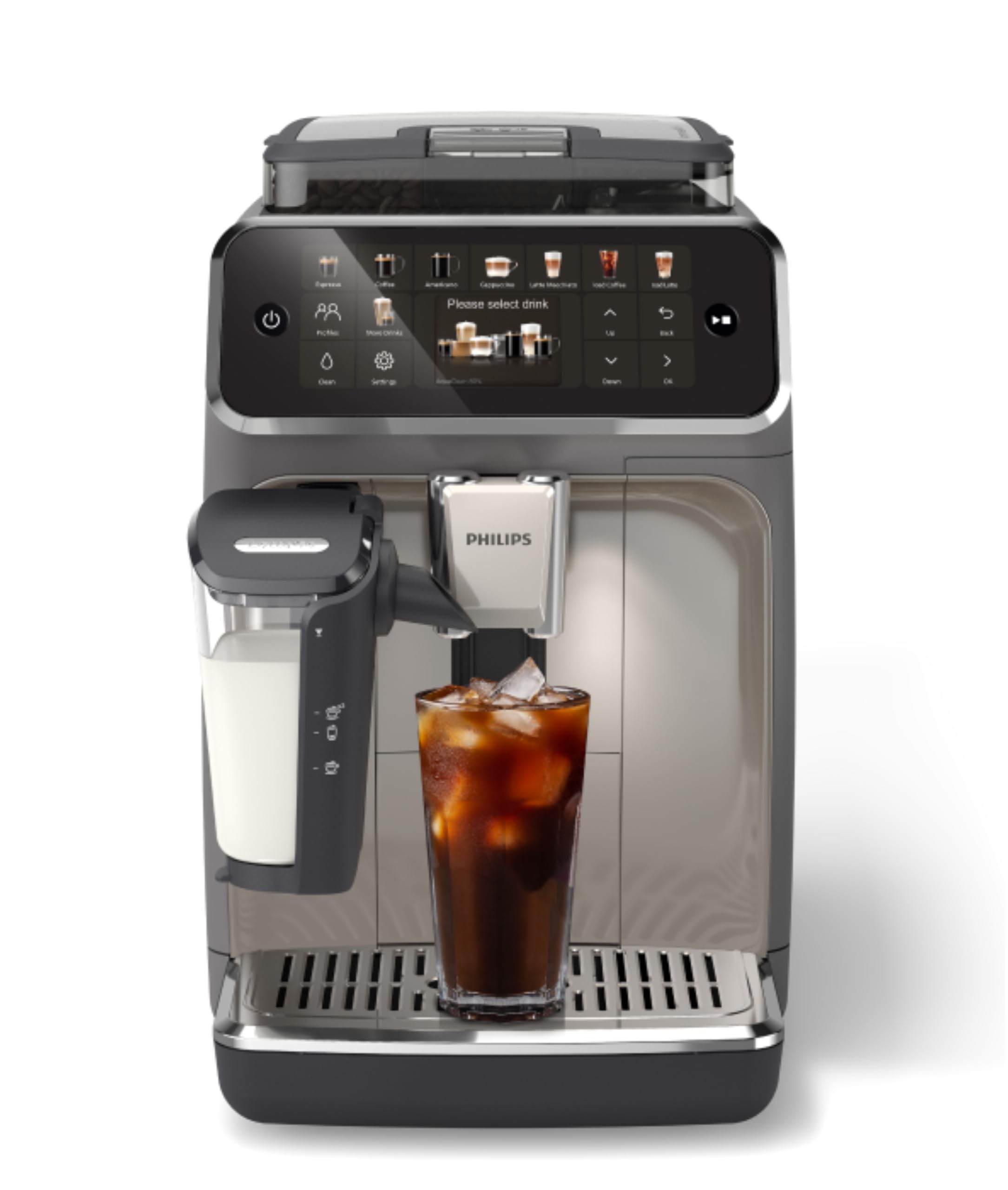
Twenty presets is the number to hold onto: espresso, coffee, lattes, cappuccinos, iced coffee and plain hot water, all one touch away on the color display. That is a big jump from the 3200 Series’ five drinks — if nobody in your house agrees on what coffee is, this machine settles the argument.
The 5500 grinds, tamps and brews at the push of a button, and you can save up to 4 profiles so each person’s strength, volume and milk preference comes back every time. The LatteGo milk system carries over from the 3200: 3 parts, no internal tubes or hidden compartments, dishwasher safe or rinsable in 10 seconds. QuickStart has it ready to brew in 3 seconds, and the SilentBrew sound shielding is certified by Quiet Mark — a meaningful difference if the machine sits near a bedroom.
The 1.8-liter water tank is the largest reservoir in this espresso group, which means fewer refills between pots. Where it asks for care: the first several cups need tuning before the drinks land where you want them, and there is a report of water leaking from under the base straight from the start on a defective unit. Set expectations for a short dial-in period and you will be rewarded with drinks that beat pod coffee by a wide margin.
The case for the preset menu: 20 drinks and 4 saved profiles mean a house full of different tastes all get their own button.
The setup reality: the first cups are a tuning exercise, not a finished product — budget a week of adjusting before you judge it.
Right for: a household with clashing coffee orders and a low tolerance for milk-system cleaning.
Think twice: if you want perfect drinks on day one without dialing anything in.
15. Bosch 800 Series Fully Automatic Coffee and Espresso Machine
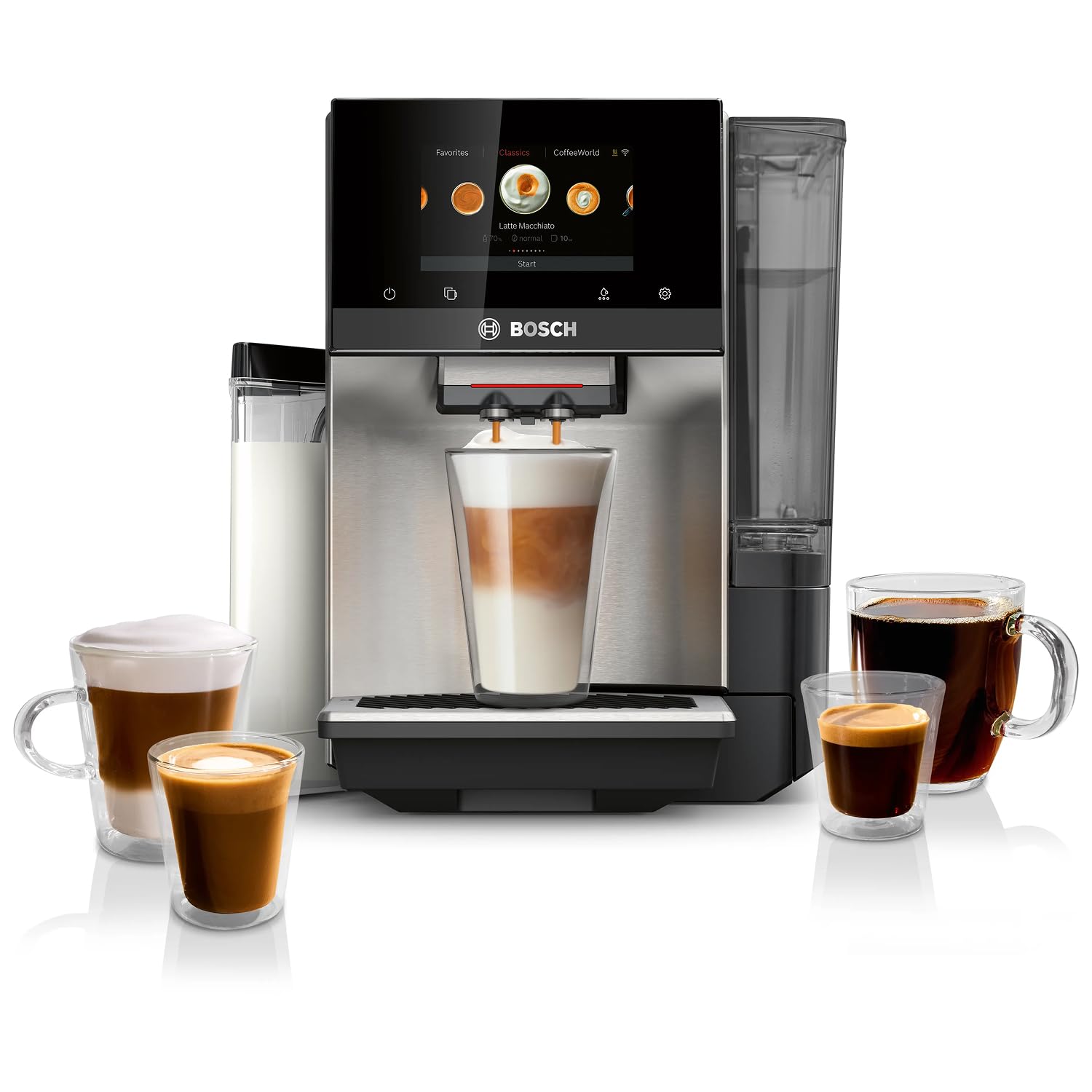
A large touchscreen, thirty-five plus drinks, and remote brewing from the couch.
The Bosch 800 is a different weight class of machine, and its build says so: stainless steel throughout, a 22-pound body, and a large touchscreen that walks you through drink selection and personalization. Strength, size, milk ratio and even aroma are adjustable, and the Home Connect app lets you start a brew remotely and explore 35+ beverages. Calc’n Clean combines descaling and cleaning into one guided program so maintenance is one routine rather than two.
The milk system is integrated into the machine’s body and the reviews single out its cleaning routine as one of the easier ones to live with. That step-by-step on-screen maintenance guide is the sort of thing you appreciate at month six, not week one. There is a cup warmer, a Mavea water filter in the box, and a well-insulated brew path that keeps noise down and temperature steady.
Two things to go in with your eyes open. The bean hopper lid’s plastic grill lets beans bounce onto the counter if you pour fast, and the pucks drop into the drip tray mixing with water, so it takes a different cleaning rhythm than a poke-and-tap machine. And at this price, the touch buttons on some units need repeated taps. The people who love this machine tend to be coffee veterans coming off competing super-automatics, and they describe the cappuccino and the milk foam as the reason they switched.
Where the money shows: the touchscreen, the stainless body, the 35+ drink library and a combined cleaning and descaling routine make this the least fussy machine in this group.
Where it asks more: pourover care with the hopper, a different cleanup rhythm for the pucks, and touch buttons that occasionally need a second press.
The buy if: you want a luxury super-automatic that looks the part next to the rest of the kitchen and makes remote brewing a habit.
Look elsewhere if: you want maximum drink value per dollar rather than maximum build and interface.
Know the Specs
Brew Temperature Range
This is the number that decides whether your cup tastes bright or flat. Coffee extracts best in a band roughly between the mid-190s and low 200s Fahrenheit. The Bonavita Enthusiast lists 194˚–205˚F, and the OXO Brew states 197.6–204.8°F — both are in the right zone. When you shop, look for a stated range rather than a promise of “optimal temperature,” because a printed number means the maker tested it.
SCA Certification
The Specialty Coffee Association (SCA) puts brewers through a fixed test of temperature and extraction. A machine that says “SCA Certified” has met the outside test, not just the maker’s own claims. The Bonavita Enthusiast, the OXO Brew, the aarke and the GE Profile all carry it. It is the clearest single signal that a drip brewer will hit the right numbers.
Thermal Carafe vs. Warming Plate
A thermal carafe is a double-walled insulated pot: brew into it and the coffee stays hot without a hot plate under it. The BUNN 55200 uses a vacuum-insulated double-wall design rated for 2+ hours. A warming plate, which the SYBO and the Ninja carafe machines use, keeps a glass pot hot but slowly cooks the flavor. Thermal wins on taste; glass wins on volume and letting you see how much is left.
Bar Pressure on Espresso Machines
Bar pressure is a measure of how hard the pump pushes water through the coffee. The Ninja CFN601 uses a 19-bar system to build crema and rich espresso. By contrast, the Moccamaster is pump-free and relies on heat to move water. For espresso you want pressure; for drip brewing you want steady temperature, and some machines deliberately avoid a pump to remove a failure point.
Burr Grinder Settings
A burr grinder crushes beans between two abrasive surfaces instead of chopping them with a blade, which gives a consistent particle size — important because uneven grounds extract unevenly. The GE Profile offers 6 grind settings, and the Ninja Luxe Café Pro offers 25. More settings mean finer control over each style of drink. The Cuisinart Grind & Brew Plus grinds whole beans before each brew but relies on a blade design, which is audible and needs cleaning after every pot.
Cup Ratings vs. Fluid Ounces
Cup counts on coffee makers are inconsistent, which is why the fluid-ounce figure matters more. A “cup” is often about 5 oz. The aarke rates its cup count on a 4.2 oz cup, so its “10 cups” is roughly 42 fluid ounces total, less than a mug-and-a-half per person for two people. Read the fluid-ounce figure and you can plan the pot size honestly.
Common Questions
Does a thermal carafe really keep coffee hot, or should I just buy one with a hot plate?
What does SCA certification actually verify on a coffee maker?
How many cups does a “10-cup” coffee maker actually make?
Is a pump-free brewer like the Moccamaster worse than one with a pump?
How often do I need to descale a high end coffee maker?
What is a bloom mode and does it change the coffee?
Do I need a bean-to-cup espresso machine or is a drip brewer enough?
How long should a high end coffee maker last?
Are glass carafes better than thermal for daily use?
Can I use pre-ground coffee in a bean-to-cup machine?
The Bottom Line
The best of these high end coffee makers for most people is the BUNN 55200 Speed Brew Platinum, because the 70-ounce stainless tank that stays hot means a mug in 2 minutes and a full carafe in 4 — the kind of speed you feel every single morning. If certified pour-over flavor matters more than scheduling, the Bonavita Enthusiast gives you bloom control and a 40-ounce thermal carafe at a lighter 9.3 pounds. And for café drinks without the café run, the Philips 3200 Series grinds fresh beans and cleans its milk system in as little as 15 seconds.
Whichever you pick, the machine that wins is the one you will actually descale and refill on schedule. A scale-clogged SCA-certified brewer makes worse coffee than a basic drip machine kept clean.
How we choose
We do not accept paid placement. Every pick is matched to a real buyer and a real use-case; we do not hands-on test units.
Sources
Specifications: manufacturer listings and product documentation. Review insights: verified customer reviews, as of October 2026. Pricing: not shown on this page (it changes often); check the current price via the retailer link.
As an Amazon Associate, Aappliancez earns from qualifying purchases. This does not affect which products we feature.