Disclosure: Some links in this post are affiliate links. As an Amazon Associate I earn from qualifying purchases, at no extra cost to you. Learn more
Specs are compiled from manufacturer listings and verified buyer reviews and can change over time — please confirm the key details on the product page before buying.
If your amplifier, turntable and streamer are stacked on a wobbly cabinet, that shelf is part of your system whether you like it or not. A good high-end audio rack does two jobs: it holds hundreds of pounds of gear without sagging, and it damps the vibration that reaches your turntable. Below you’ll find the four racks worth shortlisting, each graded on real load capacity, shelf dimensions and how the frame behaves under a heavy power amp.
This guide is built by comparing the manufacturers’ published specifications and the patterns across verified customer reviews, so you get each pick’s real strengths and trade-offs instead of marketing spin.
You’ll learn which load rating actually matters, why acoustic-inert shelves beat glass, and how much assembly work each design demands. The list starts with the rack that balances capacity, footprint and finish better than anything else in this high-end audio rack roundup.
Top Picks

How To Choose The Best High-End Audio Rack
The single most common mistake is buying a rack whose total rating looks fine but whose per-shelf rating sags under your heaviest power amp. Split the spec in two when you shop: what each shelf can take, and what the frame can take overall. A rack rated for 352 lbs total with 88 lbs per shelf handles a big amplifier and a turntable in the same tower. A rack rated 350 lbs total with 75 lbs per shelf is fine for a stack of mid-weight separates but will flex under a genuinely heavy power amp on any single tier.
Measure your deepest component before anything else
A high-end audio rack lives or dies on shelf depth, because a deep amplifier whose rear feet overhang the shelf loses the stability you paid for. Amplifiers and receivers with big transformer blocks run deep, and if the rear feet hang off the shelf you have lost the stability you paid for. Check the stated depth against the deepest box in your stack, and remember that rear-panel connectors and stiff cables need clearance behind the shelf too. An open-back frame with no rear panel gives you that clearance; a boxed cabinet does not.
Shelf material decides how much vibration reaches your turntable
Dense MDF shelves wrapped in a laminated finish absorb energy far better than glass, which rings. That is why the racks below lean on thick MDF and, in one case, on shelves described by the maker as acoustically inert. If you run a turntable, shelf damping is the spec to care about most. If you only run digital sources and a solid-state amp, shelf thickness and frame rigidity matter more than damping.
Count the shelves you will actually fill
A five-shelf tower looks generous until you realize two tiers are too short for a tall amp plus the clearance a cooling fan needs. Look for at least one tier with taller spacing, or a frame you can raise with longer posts. Modular designs let you add a shelf later instead of buying a second rack. Fixed towers are sturdier per shelf but lock you into the height you bought.
Side-by-Side Comparison
| Model | Best For | Per-Shelf Capacity | Shelves | Frame Material | Amazon |
|---|---|---|---|---|---|
| Pangea Audio Vulcan Five Shelf★ Best Overall | Full stacks of separates | 75 lbs | 5 | Dense MDF, laminated vinyl wrap | Amazon |
| Monolith Heavy Duty Double-Wide XL 3-Tier | Heavy amps and big receivers | 300 lbs | 3 | MDF shelves on tubular steel pillars | Amazon |
| RAJYQODIS Heavy Duty 4-Tier AV Media Stand | Tight rooms, tall gear | 88 lbs | 4 | MDF with wood laminate finish | Amazon |
| Salamander Designs A5/B Archetype | Incremental height adjustment | 250 lbs total | 5 | MDF shelves, steel support posts | Amazon |
Detailed Reviews
1. Pangea Audio Vulcan Five Shelf Audio Rack
Our pick — 4.5+★ from 800+ verified ratings; the strongest balance of quality and price.
Five shelves of dense MDF that swallow a whole separates stack without a wobble
The number that sells this rack is 39.75 inches of usable tower, because that is height you can divide into five tiers instead of cramming components into three. Each shelf is 23.75 inches wide, 18 inches deep and 0.625 inches thick — the MDF is the part that matters, since dense board deadens the sort of vibration a turntable picks up. A laminated vinyl wrap over that board shrugs off scratches, scuffs and most spills, so a dust cloth is all the upkeep it asks for.
Load ratings split cleanly: 75 lbs per shelf, or 350 lbs for the whole rack. That covers a receiver on one tier and a turntable on another with room to spare. Where this rack separates itself from the Salamander below is stability per shelf — the Salamander carries a 250 lbs total rating, while the Vulcan spreads its 350 lbs across five tiers. The trade-off is that a single very heavy power amp should sit low in the tower, not up top.
Assembly is the part that surprises people. Threaded rods, a stack of shelves and hardware, finished in about ten minutes with no tools — genuinely simpler than the threaded-rod Archetype, which is known to soak up an hour or more. The catch: the rods must stay loose during assembly, an undocumented step that trips people up when a shelf goes on crooked. Once squared, the frame sits rigid. Feet are carpet spikes, not rubber, so hard flooring needs aftermarket cups to avoid scratching.
What earns it the top slot
- Five tiers give you somewhere to put every separate without stacking two on one shelf.
- 0.625-inch MDF is dense enough that a turntable on top reads clean.
- Ten-minute, tool-free assembly is the fastest in this group.
- Shelf and post add-ons let you grow the tower instead of replacing it.
Where it asks for patience
- Carpet spikes only — hard floors need your own cups.
- Threaded rods must stay loose while you build, and nothing in the box tells you that.
- A 75 lbs amp belongs on the bottom tier, not the top.
The honest read: this is furniture-grade shelving for a serious separates stack, not a vault for one monster amp. Tapping the turntable shelf is audible through the frame, so treat it as solid rather than audiophile-isolated. For most buyers running a receiver, a streamer, a DAC and a turntable, it is the most sensible thing on this page.
Reach for this if: you have four or five separate components and want the tallest, most adaptable tower for the money.
Look elsewhere if: your amp is a single heavyweight box over 75 lbs — the Monolith is built for exactly that.
2. Monolith Heavy Duty Double-Wide XL 3-Tier AV Stand

A 300-lbs-per-shelf frame for the amplifier stack that bends everything else
Three tiers sounds like a compromise until you read the shelf rating. Each tier takes 300 lbs, and the frame below it is tubular steel pillars finished in scratch-resistant powder coat. Compare that to the Vulcan’s 75 lbs per shelf and the gap is the whole reason this rack exists — it is built for monoblock amps, big AVRs and anything with a transformer the size of a coffee tin. The published weight of 7.2 pounds is a shipping-data quirk on a stand that owners describe as a 105-lb built unit; judge this one by the steel and the rated capacity, not the listing number.
Sturdiness is what wins people over here, and by a margin — it is the most-praised trait of this rack across buyer feedback. The shelves are thick MDF and the maker describes each one as acoustically inert, doing the damping work so vibration from a heavy amp does not travel up into the tuner above. Open-air shelving on every side keeps a hot Class A amp breathing, and there is no rear panel to fight when you reach for the speaker terminals. One set of steel support tubes runs longer so a single tier can clear a tall chassis.
The recurring gripe is packaging, not the frame itself — shelves have arrived with minor edge dents and chips, so open the boxes and check before the return window closes. Weight capacity draws divided opinion in the reviews, which makes sense for a stand this wide. Assembly runs about twenty minutes solo with the included Allen wrenches, though the picture-only instructions reward reading them fully first. Width is its own consideration: this is a 60-inch-wide double-wide, so measure the wall before you commit.
What the frame delivers: rigid tubular steel, powder-coated for scratch resistance, and MDF shelves the maker calls acoustically inert — a combination that keeps a heavy amp from singing along with the music.
The flexible part: feet can mount directly without the 5-inch legs to drop the overall height, and the front center post can be left out to fit a center-channel speaker. The modular design lets you buy a base and add tiers as your stack grows.
Built for: anyone whose amplifier is heavy enough that per-shelf capacity, not shelf count, is the deciding number.
Check first: the 60-inch width and the packaging — inspect those MDF edges on arrival.
3. RAJYQODIS Heavy Duty 4-Tier AV Media Stand
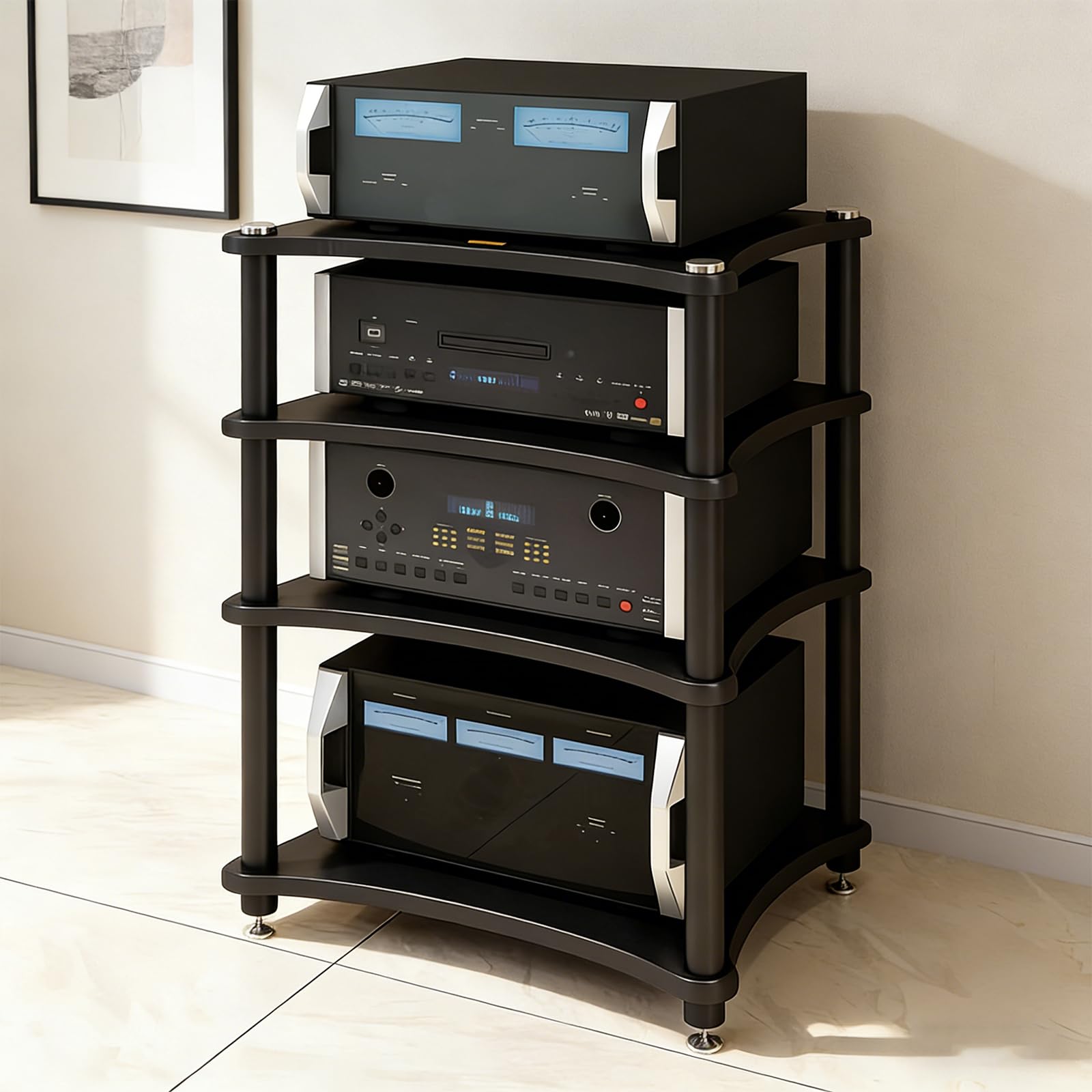
Four tiers, 0.7-inch shelves and spike feet in a footprint that fits a small room
Start with the shelf build, because it is where this rack punches above its tier. Shelves are 0.7 inches thick on 1.96-inch-wide support columns — thicker boards than the Vulcan’s 0.625 inches, and the spec that puts it ahead of that rack on shelf stiffness. Total capacity is 352 lbs split as 88 lbs per shelf. An 80-lb amp sits comfortably on any single tier, which is the scenario this rack is really designed around.
Adjustable spike feet under each column reduce the floor vibration that reaches your components, and the open frame lets heat climb straight out of the stack. What stands out in owner feedback is the look — the wood laminate finish and clean lines draw the most comment of anything on this rack, and the appearance and sturdiness are neck and neck as its praised traits. Size is the quieter advantage: at 18.8 inches deep and 33.4 inches tall it is 6.35 inches shorter than the Pangea, so it tucks under a low shelf or beside a short wall.
The gap versus the premium Salamander is cable management. There is no rear panel and no built-in routing here, so power cords and speaker runs hang in open air unless you build your own back cover — foam board is the common solution for a surround setup. Assembly is straightforward and the unit arrives well packed. If a tidy rear view matters as much as load capacity, budget for that DIY step.
Stiffest shelves in the group: 0.7 inches of MDF on wide support columns, carrying 88 lbs per shelf and 352 lbs overall.
Plan for the cables: a genuinely open-back frame with no routing channels — great for rear-panel access, invisible wire management is on you.
Suits: a compact listening room where a tall five-tier tower would dominate the wall.
Think twice if: you run a full surround system and want the back of the rack to look as finished as the front.
4. Salamander Designs A5/B Archetype Audio/Video Shelf
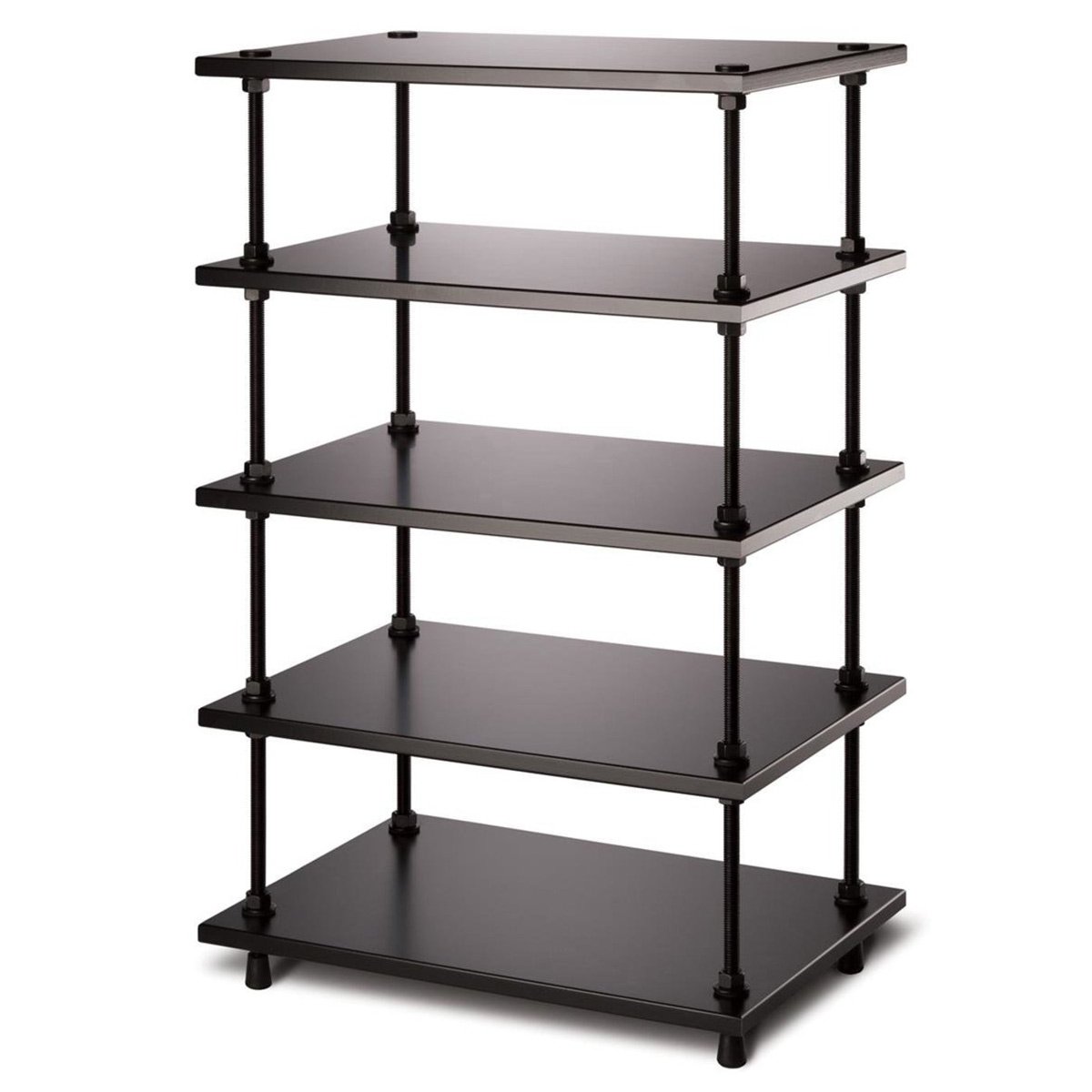
Five shelves that slide to any height you like along threaded steel posts
The defining feature here is not a load number, it is infinite vertical adjustment. Shelves ride threaded steel posts and lock wherever you set them, so a side-venting amp gets its clearance and a top-venting receiver gets its own. That flexibility is the top-rated trait of this piece by a wide margin, and it is why the four-sides-open design works in a room where a boxed home theater cabinet would suffocate the gear. Five shelves sit 16 inches deep and 23 inches wide in the A5 frame.
Capacity is 250 lbs for the rack, spread over those five shelves — less per tier than the Monolith, and a fair trade for a frame this compact and this adaptable. The MDF build in Soft-Glass Black gives you furniture rather than utility shelving; the glossy finish and clean lines look intentional in a living room. This is the piece owners keep for a decade or more, and it is designed as the foundation for a wider Archetype system when you add on.
Set aside an evening for the build. Eight nuts per shelf thread along the posts, which is where the hour-plus assembly time comes from — noticeably longer than the Vulcan’s ten minutes. Casters are not included. There are no rear cable holes, so zip ties along the back are the usual fix. Some owners find the MDF shelves on the thin side for a heavy turntable or tube amps, so if your stack is genuinely heavy, load the Monolith instead and keep this for lighter separates.
Adjustment is the whole point: infinite shelf spacing on threaded posts means any component gets exactly the clearance it needs.
The build is the tax: eight nuts per shelf and a spare evening — the price of that flexibility.
Pick this one if: your gear is a mix of tall and short chassis and you want every tier set to fit it perfectly.
Pass if: you are loading a very heavy turntable or tube monoblocks — the thinner shelves and 250 lbs total are the limiting factors.
Know the Specs
Per-shelf load vs total load
Two numbers describe how much a rack holds: what one shelf takes and what the frame takes together. A rack rated 352 lbs total with 88 lbs per shelf spreads that total evenly and tells you the weak point — one tier. Always check the per-shelf figure against your heaviest single component. A turntable plus a streamer on one shelf can sit well under the limit while a big power amp on its own sits right at it.
Shelf thickness in inches
Thicker MDF boards resist bowing under weight and deaden vibration better than thin ones. The Monolith’s shelves are described by the maker as acoustically inert; the RAJYQODIS runs 0.7 inches; the Pangea runs 0.625 inches. For a turntable, shelf thickness and damping matter more than anything else on the spec sheet. For digital separates and a solid-state amp, frame rigidity does most of the work.
Open-air vs enclosed cabinets
An open frame with no back panel and no side panels lets heat rise straight off your amplifiers and receivers. It also gives you a clear path to the rear connectors when you swap cables. The cost is that wires are visible, so plan on cable ties or a homemade back cover. Enclosed cabinets hide the cables but trap heat, which is the wrong trade for a Class A amplifier.
Spike feet vs rubber feet
Adjustable spikes couple the rack to the floor and help level it, and they reduce the floor-borne vibration that reaches your components. On carpet they sink in and stay put. On hardwood they can mark the floor, which is why some racks come with rubber feet and others leave you sourcing your own protective cups. Check what ships in the box before you build.
Common Questions
How much weight can a high-end audio rack actually hold?
Is an open-frame rack better than a closed AV cabinet?
Do I need a rack with adjustable shelf heights?
Will MDF shelves support a heavy turntable and tube amplifiers?
How long does assembly take on these racks?
Can I add shelves to a rack later?
Do spike feet damage hardwood floors?
Will a rack actually reduce vibration in my turntable?
How much clearance do I need behind the rack for cables?
The Bottom Line
For most buyers, the high-end audio rack winner is the Pangea Audio Vulcan Five Shelf because five tiers of dense MDF, 75 lbs per shelf and a ten-minute tool-free build cover a full separates stack with room to grow. If you want the heaviest load rating, grab the Monolith Heavy Duty Double-Wide XL and its 300 lbs per shelf. And for a compact room where you want every shelf set to its own height, the Salamander Designs A5/B Archetype is the one to reach for.
How we choose
We do not accept paid placement. Every pick is matched to a real buyer and a real use-case; we do not hands-on test units.
Sources
Specifications: manufacturer listings and product documentation. Review insights: verified customer reviews, as of October 2026. Pricing: not shown on this page (it changes often); check the current price via the retailer link.
As an Amazon Associate, Aappliancez earns from qualifying purchases. This does not affect which products we feature.