Disclosure: Some links in this post are affiliate links. As an Amazon Associate I earn from qualifying purchases, at no extra cost to you. Learn more
Specs are compiled from manufacturer listings and verified buyer reviews and can change over time — please confirm the key details on the product page before buying.
The best high build primer is the one that hides the damage underneath, not the one with the loudest label. High build primer is a thick, filler-heavy coating you spray or roll on to fill scratches, sanding marks, and small pits before color goes down. Get it right and your topcoat looks flat and factory-clean. Get it wrong and every sanding pigtail shows through as a ghost in the paint. This guide walks you through the five primers worth your money, from an acid etch aerosol for bare metal to a wallpaper bonding primer for torn drywall.
This guide is built by comparing the manufacturers’ published specifications and the patterns across verified customer reviews, so you get each pick’s real strengths and trade-offs instead of marketing spin.
Below you’ll find the real differences that matter most, from dry time in hours to coverage in square feet, so you can pick the right high build primer the first time.
Top Picks


How To Choose The Best High Build Primer
To pick a high build primer, check three things on the label: what surface it sticks to, how thick it builds, and how soon you can sand or topcoat it. Ignore brand stories and can colors. First match the primer to your surface, then use dry time and coverage to decide between close options.
Match the primer to the surface, not the brand
An acid etch primer is built for bare metal — think galvanized steel and aluminum, where smooth shiny surfaces fight paint adhesion. A water-based bonding primer is built for porous surfaces like torn drywall, joint compound, and skim coats. A spray-can epoxy primer is built for steel, aluminum, and galvanized metal on cars and motorcycles. Pick the wrong chemistry for your surface and no amount of skill saves the job — the coating simply does not bite.
Build matters more than color
High build means the primer carries solids that physically fill a scratch or pit instead of just tinting it. The tell is the finish type and whether the maker tells you to sand. A matte, sandable primer lets you knock the surface flat without gumming up your paper, while a gloss finish usually signals a sealer rather than a filler. If you can see your scratch texture through the dried coat, you needed more build or another pass.
Count the dry time in hours before you buy
Dry time is the number that decides your day. A fast-drying aerosol that is sandable within the hour keeps a shop moving. A slower epoxy system with a long pot life buys you working time but parks your project overnight. Full cure time matters just as much if you are stacking coats or painting over the primer. Read both numbers, not just the headline dry time.
Side-by-Side Comparison
| Model | Best For | Form & Volume | Dry Time | Finish | Amazon |
|---|---|---|---|---|---|
| Raptor Acid Etch Primer 1K Aerosol, 13.2 OZ★ Best Overall | Bare metal panels and rub-throughs | Aerosol, 450 ml | 1 hour | Matte | Amazon |
| Roman PRO-999 Rx-35 Wallpaper Primer and SealerBest for Walls | Drywall, joint compound and textured walls | Liquid, 1 Gallon | 3 hours | Matte | Amazon |
| SEM 42013 Grey High Build Acrylic Primer – 16 oz. | Spot repairs and high-build filling | Liquid, 16 oz | — | Matte | Amazon |
| SprayMax 2K Epoxy Primer Black | Restoration metalwork and topcoat prep | Aerosol, 341 ml | 12 hours | Gloss | Amazon |
| Paint Roller Kit with Extension Pole, 27 Piece Set | Applying primer and paint on walls and trim | Tool kit, 27 pieces | — | — | Amazon |
Detailed Reviews
1. Raptor Acid Etch Primer 1K Aerosol, 13.2 OZ
Our pick — 4.5+★ from 800+ verified ratings; the strongest balance of quality and price.
The one-can metal primer that etches, primes, and skips the sanding step entirely.
If you are priming bare metal — galvanized steel, aluminum, or a spot where you sanded through the factory finish — this is the pick that earns its place at the top. Raptor uses a phosphoric acid ester formula (a mild acid blend that bites into slick metal) to give paint something to grab. It etches and primes in one step, so you skip a whole stage of the job. No sanding is required, and you can topcoat directly with most paint systems.
The speed story is where it separates from the pack. Dry time is 1 hour — 1 hour — and it comes in a 450 ml aerosol can, which is 32% more volume than the 341 ml SprayMax can in this list. As one buyer reports: “Two light coats give great coverage and boost durability. Scratch-resistant color matches Stingray well. Raptor dries fast, ready to install next day.”
The real-world reputation here is a coating that stays put. Buyers report repainting running boards without stripping the factory paint first, and it did not bubble the existing finish underneath. That is the acid etch bonding to the existing paint instead of lifting it. The formula includes rust and corrosion protection, so treated steel holds up indoors and out. One caveat worth knowing: this is a matte finish, so it is a foundation coat, never a final look.
Why It Takes The Top Spot
- Etches and primes bare metal in a single step
- Dries in 1 hour and needs no sanding before topcoat
- 450 ml can holds 32% more than the 341 ml SprayMax primer
- Bonds over existing paint without bubbling it
Where It Stops Short
- Matte finish means you still need a color coat on top
- Built for metal, not for drywall or porous wall surfaces
- Small aerosol can runs out fast on full panels
Your match if: you are prepping bare metal, galvanized steel, or rubbed-through panels and want one product to etch, prime, and protect.
Walk past if: your surface is drywall, joint compound, or bare wood — the acid chemistry is aimed at metal.
2. Roman PRO-999 Rx-35 Wallpaper Primer and Sealer
The clear bonding primer that turns a torn-up wall into a surface wallpaper can actually grip.
Interior walls are a different problem than metal panels, and Roman PRO-999 solves it with a water-based bonding primer that dries clear and slightly tacky. That residual tack is the whole trick — tackiness increases the adhesion of wallpaper and other surface materials. It covers roughly 400 to 450 square feet per gallon, so one pail handles a full room. VOC content is under 25 grams per liter, which keeps the smell manageable indoors.
You can hang real wallpaper over peel-and-stick, but many people worry it will fail. One reviewer noted: “It was forgiving to move the paper around, held well once dried and we are a few months in with no bubbles and no issues.” That forgiving slip lets you slide a full drop into place, and the tack keeps the seam tight once it dries.
Dry time here is 3 hours with an optimum of 12 — and that 3-hour figure beats the SprayMax epoxy primer’s 12-hour full cure, so a wall project moves faster than a metal restoration. Coverage is the other strong suit: a single gallon of this runs a whole room, versus a 341 ml spray can that covers a hood and two fenders. It also works over joint compound, spackling, skim coats, popcorn ceilings, and textured surfaces. The catch is surface range — it is not waterproof, so keep it indoors, away from wet areas.
The adhesion story: what wins people over is that tacky dried surface that grabs paper and holds seams shut. It is excellent over torn or bare drywall, and the clear matte finish disappears under wallcoverings.
One thing to plan around: it is an indoor product, so bathrooms and exteriors are out. Hang after the 3-hour dry, not immediately.
Reach for this if: you are hanging wallpaper or wallcoverings and want the wall sealed and gripped in one coat.
Look elsewhere if: you need moisture resistance — this one is indoor-only and marked not waterproof.
3. SEM 42013 Grey High Build Acrylic Primer – 16 oz.

A grey acrylic that builds thick enough to bury imperfections, then sands back smooth.
This is the primer you reach for when the panel is not bare metal and not a wall — it is a body panel with small pits and sanding marks you want gone. SEM 42013 is a 16 oz high build acrylic primer in a matte grey (#808080) that covers imperfections and suits spot repairs. It is an indoor liquid you spray, and it holds its build — it stays together even after sanding with 60 grit, so you can knock it flat without cutting through.
What wins people over is the sanding behavior, and quality is the most-praised trait here by a wide margin. The most-discussed secondary note is drying time — it flashes off fast enough to keep a repair moving. Easy sanding comes up again and again, because a primer that powders instead of gumming is what lets you feather a repair into the surrounding panel. Spray performance and coverage get honest mixed notes, so dial in your gun and do not expect unlimited passes from 16 oz.
Compared with the SprayMax epoxy primer below, SEM is the friendlier sanding partner — acrylic build powders cleanly instead of curing to a hard gloss film. It is indoor-only and not waterproof, so it is a shop primer, not a topcoat. Set your air and tip before you commit, because spray quality is the one thing buyers flag as inconsistent.
what separates it
- High build acrylic fills pits and covers imperfections
- Sandable without falling apart — survives 60 grit
- Fast drying keeps spot repairs moving
- Matte grey is easy to sight down and block flat
What To Sort First
- Spray performance and quality get mixed notes — set your gun up
- Indoor-only and not waterproof
- 16 oz can runs short on big multi-panel jobs
Pick it when: a panel needs filling, feathering, and re-priming and you want a sandable build coat.
Pass if: you are priming bare galvanized metal or hanging wallpaper — this acrylic is for painted and repaired surfaces.
4. SprayMax 2K Epoxy Primer Black
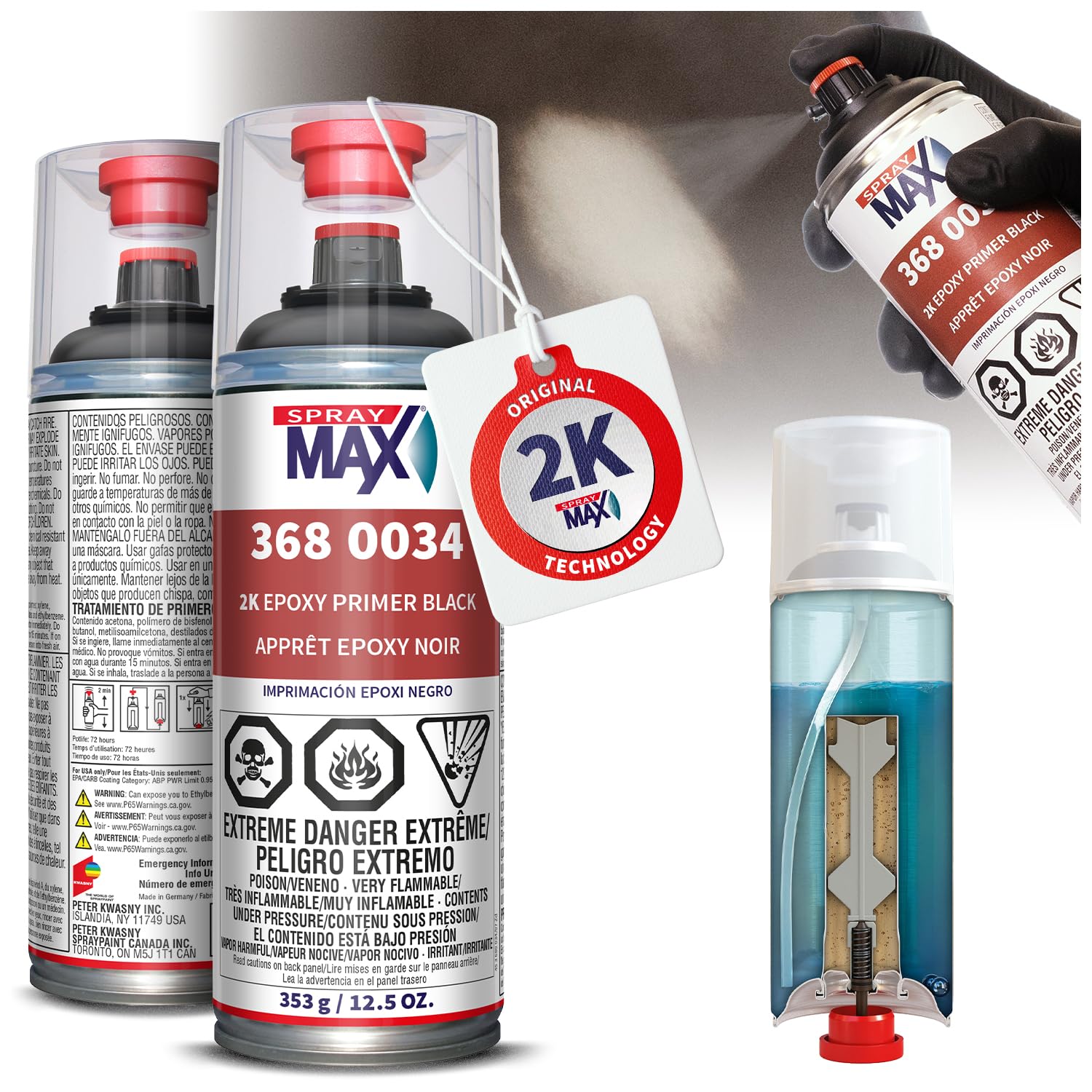
Pro-grade 2K epoxy in a can — activated epoxy bonding without a spray gun setup.
Two-component epoxy is the pro standard for corrosion protection, and SprayMax puts it in an aerosol you activate, shake, and spray. The 2K epoxy formula bonds to steel, aluminum, and galvanized metal with strong adhesion and rust protection, and it seals the surface smooth for the topcoat. No compressor is needed — the can does the mixing.
The working numbers tell you the tradeoff. Dust-dry in 15 minutes, but full cure takes 12 hours, which is 12 times the 1-hour figure of the Raptor acid etch. That long pot life is a feature for someone with a large panel to work — it is a cost for someone trying to finish by dinner. What owners mention: “It laid down perfectly. It was easy to sand flat with 600 grit. One can covered both halves of a motorcycle fairing with a small amount left in the can.” That is genuinely surprising coverage from a 341 ml aerosol.
Here is the honest part: epoxy quality and spray performance are both mixed notes on this one, and that tracks with the price tag. Some units spray a clean fan with no runs; some fight the nozzle. Adjust the variable fan and volume, activate fully, and keep the can warm for best results. When it works, the finish is a hard, uniform black that resists corrosion under automotive paint. When it does not, you waste a can. Buy enough cans: whole-car jobs run long.
The pro-grade angle: Activated 2K epoxy in an aerosol delivers the corrosion protection and sandability of a mixed system without the gun, compressor, and cleanup.
The nozzle reality: spray performance splits feedback. Prime the can, test the fan on scrap, and expect to fight inconsistency at the end of a full can.
Built for: restorers and car enthusiasts who want epoxy corrosion protection without spraying equipment.
Not the first pick if: you want a fast, simple to use coat — the 12-hour cure and mixed nozzle reports mean you need patience and technique.
5. Paint Roller Kit with Extension Pole, 27 Piece Set

The 27-piece roller kit that turns a primer bucket into a finished wall.
You need tools to apply primer, and this kit gives you almost everything. RHIBAK packs 27 pieces into one box: six 4-inch roller covers, six 9-inch roller covers, both roller frames, a handle extension roller, three 9-inch trays plus a liner, and brushes — 1-inch, 2-inch, and three angled brushes at 2.5, 2, and 1.5 inches — plus a scraper and a can opener. The extension pole is aluminum alloy and stretches from 23 inches to 47 inches, so you can reach high walls without a ladder.
The rollers are microfiber and the brushes are 100% synthetic bristles, and the tray cleans up without a fight. Nine-inch rollers get you a smooth finish on open walls while the 4-inch minis handle tight spaces and trim. The whole kit weighs 4.38 pounds, which is light enough to carry room to room without a strap. It works with latex and oil paints, glosses, stains, emulsions, and varnishes.
Two honest notes. First, roller performance splits feedback — some say they roll walls beautifully, others find they drag and do not roll smoothly; change out the cover if yours fights you. Second, the recurring gripe is the aluminum extension pole: it creaks with every roll when paired with the included rollers. Wear earbuds or upgrade the pole for long ceilings. Treat the kit as a working set — useful enough that cleaning and reusing beats throwing it out. The 47-inch reach is the spec that sells it.
What you get: one box that covers walls, trim, tight corners, and high ceilings with 27 pieces and a pole that extends from 23 to 47 inches.
The honest catch: the pole creaks and the roller feedback is mixed. If you paint ceilings all day, budget for a sturdier pole.
Buy it if: you are priming or painting a room yourself and want every tool in one box instead of shopping each piece separately.
Skip the pole upgrade only if: you paint flat walls at floor level — otherwise plan for the creak or swap the extension piece.
Know the Specs
Dry Time vs Full Cure Time
Dry time is when the surface stops being wet — the point you can sand or topcoat. Full cure is when the coating finishes hardening all the way through. A fast dry time like 1 hour gets you moving the same day; a 12-hour full cure parks the project overnight but rewards you with a hard, sandable film. Read both numbers on the can, because a product can dry in minutes and still need hours to cure.
Coverage and Volume
Coverage tells you how far one container goes. Liquid primers measure it in square feet per gallon — a wallpaper bonding primer covers roughly 400 to 450 square feet per gallon, enough for a full room. Aerosols measure it in milliliters of product, so a 450 ml can outlast a 341 ml can by a clear margin. Match the container to the job: aerosols for panels and touch-ups, gallons for walls.
Finish Type and Build
Finish type signals the primer’s job. A matte finish is a sandable build coat — it fills and feathers. A gloss finish usually points to a sealing or bonding layer rather than a filler. High build means the primer carries enough solids to physically fill scratches and pits instead of just tinting them. If you can still feel the damage after it dries, you needed more build or one more pass.
Adhesion Chemistry
Different surfaces need different bite. An acid etch primer uses a phosphoric acid ester (a mild acid that roughens slick metal at a microscopic level) to grip galvanized steel and aluminum. A water-based bonding primer dries tacky so wallpaper and wallcoverings stick. An epoxy primer uses a two-part reaction to protect steel from corrosion. Pick the chemistry that matches your surface, or the primer cannot do its job.
Common Questions
Does high build primer really fill scratches and pits?
Can I spray high build primer without a compressor?
How long should I wait before sanding or topcoating primer?
Do I need to sand before applying an acid etch primer?
Can I use a high build primer on drywall or bare wood?
How many cans of spray primer does a full panel take?
Is a 2K epoxy primer better than a 1K aerosol primer?
Do I need to primer a wall before hanging wallpaper?
What size roller and pole do I need to prime a wall?
Should I sand high build primer before painting over it?
The Bottom Line
For most metal jobs, the high build primer winner is the Raptor Acid Etch Primer 1K Aerosol because it etches and primes bare metal in one step with no sanding and a 1-hour dry time. If you are hanging wallpaper or sealing torn drywall, grab the Roman PRO-999 Rx-35 with its clear tacky bonding finish and 450 square feet of coverage. For spot repairs that need filling and feathering, the SEM 42013 Grey High Build Acrylic Primer is the sandable build coat to reach for — it survives 60-grit sanding without falling apart. And if you want pro-grade epoxy corrosion protection from a can, the SprayMax 2K Epoxy Primer delivers it, provided you prime the nozzle and give the full 12-hour cure. Whichever you choose, buy enough product to finish the job — running short mid-panel mid-coat is the one mistake no primer can fix.
How we choose
We do not accept paid placement. Every pick is matched to a real buyer and a real use-case; we do not hands-on test units.
Sources
Specifications: manufacturer listings and product documentation. Review insights: verified customer reviews, as of October 2026. Pricing: not shown on this page (it changes often); check the current price via the retailer link.
As an Amazon Associate, Aappliancez earns from qualifying purchases. This does not affect which products we feature.